Categories
books Thin Places in Hard Concrete

2: Wolf in Exile – Thin Places in Hard Concrete, story by story

The second story in my new collection, Thin Places in Hard Concrete, is called ‘Wolf in Exile’ and is about the son of a deposed dictator trying to live a quiet life but (literally) haunted by his past.

I wrote the first draft of this story in a single day in a fairly gloomy apartment in Bucharest, Romania, which perhaps gives you a clue to the specific inspiration.

My partner and I were in the middle of one of those ‘trips of a lifetime’ built around a three-month career break I was lucky enough to be allowed to take.

She’s a natural traveller, someone afflicted with Wanderlust. I’m not. About three and a half weeks into the trip I was exhausted, homesick, and badly wanted to spend a day sitting at my desk, alone, typing. When my partner decided she wanted to go to the thermal baths, also not my thing, I had my chance.

The urge to type was a result of inspiration having struck at an earlier stop on the journey, Timișoara, the city where the 1989 revolution which led to the end of the communist regime began.

The Museum of the Revolution in Timișoara is small but does its one job very well: it tells the story of how the Romanian people rose up, step by step, against Nicolae Ceaușescu and his family.

In one room there was a wall covered with official portraits of Ceaușescu, like a grim version of a Warhol print. In another, there were wobbly mannequins wearing the moth-eaten uniforms of various soldiers, police officers and riot squad men. I stared at those for quite a time.

Another stop on the tour was Sibiu, a beautiful city in Transylvania, which was the home of Ceaușescu’s alcoholic son and heir, Nicu. Something about the idea of this loser, destined for power, fascinated me. After his parents were executed, Nicu was arrested and imprisoned for two years. He was released in 1992 and lived the rest of his life in Vienna where he died at the age of 45.

In Bucharest, I found myself thinking about Nicu living the life of a playboy prince in a country where the population was oppressed and often starving, and then getting to spend his final years in relative comfort.

So, when I got to sit down at my keyboard in that very city, out came most of ‘Wolf in Exile’ in an uninterrupted stream.

Other seasonings

The story is not about Nicu Ceaușescu and Nicu Ceaușescu was not the only influence on the story.

Another, for example, was this specific DVD cover image from about 20 years ago which lodged in my brain.

A DVD cover with an image of a leather clad motorcyclist in a helmet holding a cleaver.
A Koch Media DVD of the 1974 film ‘What Have They Done to Your Daughters?’ from 2004.

I wrote (and rewrote, and rewrote) an entire crime novel which had this image as its seed, about the murder of a senior civil servant by a right wing lone wolf disguised as a motorcycle police officer. It’s the facelessness, I think, and the stance.

Here’s the poster I created for this story with my own sketched illustration.

A poster with a sketch of a riot cop with a shield, a blank blank visor, and a club in his hand.

The setting of ‘Wolf in Exile’ also reflects the many holidays I’ve taken in Germany over the past three decades, with places in Munich, Cologne, Nuremberg and elsewhere muddling in my subconscious to create a non-specific nightmare version of a rather complacent, well-to-do city.

There’s also a minor story by H.P. Lovecraft from 1926 called ‘He’ which I’ve always rather liked. It’s about a man who has moved to New York City and hates it but finds some comfort in finding and wandering the oldest streets in the city late at night:

The man came upon me at about two one cloudy August morning, as I was threading a series of detached courtyards; now accessible only through the unlighted hallways of intervening buildings, but once forming parts of a continuous network of picturesque alleys. I had heard of them by vague rumor, and realized that they could not be upon any map of today; but the fact that they were forgotten only endeared them to me, so that I had sought them with twice my usual eagerness. Now that I had found them, my eagerness was again redoubled; for something in their arrangement dimly hinted that they might be only a few of many such, with dark, dumb counterparts wedged obscurely betwixt high blank walls and deserted rear tenements, or lurking lamplessly behind archways unbetrayed by hordes of the foreign-speaking or guarded by furtive and uncommunicative artists whose practises do not invite publicity or the light of day.

It’s the idea of impossible geography, of streets that don’t make sense, that obliquely inspired certain aspects of ‘Wolf in Exile’.

Finally, I must mention the stories of my friend Jamie Evans. He and I are members of an small, informal writers’ group and I’ve been lucky enough to listen to him explain the concept of ‘cosmic justice’ as a narrative driver. Basically, it’s fun to read about a shithead getting what he deserves through supernatural means. This is more Jamie’s turf than mine but ‘Wolf in Exile’ definitely fits into this category.

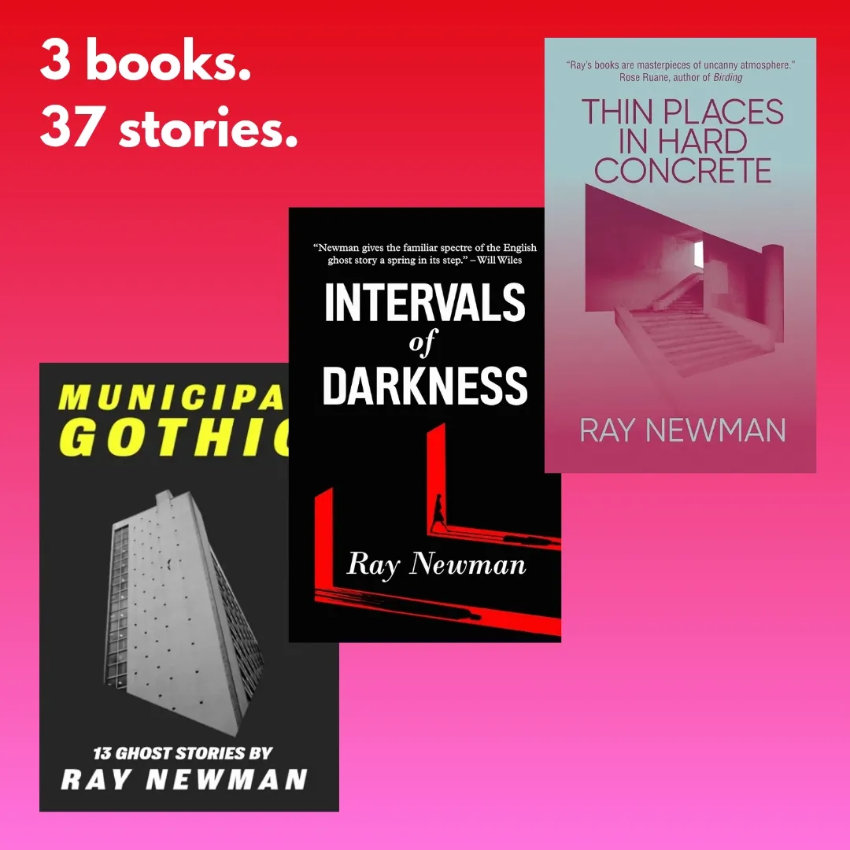
You can pre-order the eBook of Thin Places in Hard Concrete now and the paperback will be available to order from 23 April.

The cover of Thin Places in Hard Concrete with a floating brutalist staircase.

“Ray Newman is an M.R. James for the 21st century. His haunting stories unfold in familiar, even banal settings – a rented flat, a holiday let, an inexplicable motorway interchange, the corner of a room. Things happen, or seem to happen, just out of sight, and beyond comprehension. Admirers of the cult TV series Inside No. 9 will love this collection.”

David Collard

Categories
Thin Places in Hard Concrete

1: The Interchange – Thin Places in Hard Concrete, story by story

The first story in my new collection, Thin Places in Hard Concrete, is called ‘The Interchange’ and is about a road that should not be there.

This story is already out there in audio form thanks to a collaboration with Giles Booth, creator of the podcast Listen With Other. It’s read by me and Giles has mixed it with my own field recordings and synthesiser drones.

‘The Interchange’ was on my to-write list for years and its origins can be traced back to a single image shared on Twitter (RIP) by the brilliant LCC Municipal account which has since migrated to BlueSky.

Here’s the image which Ian, creator of LCC Municipal, kindly shared with me in a higher resolution scan back in July 2020:

A 1960s photo of a mini driving along an empty road towards multi-layered motorway flyovers. The sky behind is very blue.
SOURCE: LCC Municipal

I mean, look at it. Just look at it. It tells a story without me needing to write one, really. The lone vehicle, so small and lost; the confusing geometry of the roads; the uncannily blue sky.

I was so fascinated by it I acquired a set of original architectural plans for the Almdonsbury interchange from eBay, which I incorporated into the poster below. Don’t they look strangely organic to you? Almost Gigeresque.

A poster for 'The Interchange' with a backdrop of technical drawings of interconnecting, arterial, plant-like forms.

I’m generally pretty fascinated with motorways, though, and have written about them before, including this piece about the M32 originally published in The Modernist, and a story in my first collection, Municipal Gothic, called ‘Rainbow Pit’.

I blame this obsession on growing up on the Sydenham estate in Bridgwater. It’s a place where, even when it’s completely silent, it isn’t, because you can always hear the white noise of the M5.

My 2019 photo-zine project Bristol Without Cars also ties in, now I think of it. Depending on your point of view that was built around a series of images of empty roads that are either utopian or apocalyptic, depending on your point of view, and which are certainly somewhat eerie either way.

Empty roads in Birmingham
Empty roads in central Birmingham in early July 2019.

In recent years, I’ve also read quite a bit of J.G. Ballard who wrote in 1971:

If I were asked to condense the whole of the present century into one mental picture I would pick a familiar everyday sight: a man in a motor car, driving along a concrete highway to some unknown destination.

As it happens, that line is referenced by filmmaker and writer Chris Petit in the latest edition of the BFI magazine Sight & Sound which reminds me that I also saw his weird 1979 British road movie Radio On for the first time in 2022.

Radio On is full of images of roads, motorways, roundabouts and off-ramps – including rare footage of the ‘temporary’ flyover at Bristol Temple Meads which was actually in place for 30 years.

I can’t say I exactly enjoyed Crash, from 1973, but it certainly lodged in my brain. Concrete Island from 1974 did rather chime with me, though, feeling closer to weird fiction. It’s about a commuter whose car crashes through a barrier stranding him on a patch of wasteland between flyovers in West London. However he tries, he cannot escape – or is it that he doesn’t really want to? If we’re talking influential images, look at this cover design by Paul Bacon for the US first edition.

An illustrated book cover with interlocking and overlapping motorway flyovers above a trough of green from which a man is trying to climb.

I must also mention Broken Veil, a faux-documentary fiction podcast by Joel Morris and Will Maclean that I very much admired. Among its many uncanny ideas there is a “roundabout to nowhere” in the Essex countryside which confuses the protagonist-hosts attempts to find the location where the strange events of the story take place.

Finally, I must mention The Appointment, a 1981/82 film that has slowly emerged from obscurity thanks to a recent BFI Blu-ray release. It opens with a voiceover reading an official report which helps sell the reality of the strange events that follow…

“Extract from police report number 727a, strictly confidential, unpublished and unavailable. Subject: Sandy Freemont. The last positive sighting was on her way home from a school orchestra rehearsal. This was on Tuesday May 14th at approximately 6:30 in the evening. At about this time her friend Janey Carr places her positively as entering the footpath through the area known as Cromley Woods, a then popular shortcut for several of the children living in Millard Heights…”

Hopefully this, and the similar posts to follow for each story in the collection, will answer that recurring question “Where do you get your ideas?” The short answer is: by reading, looking, walking, and by giving my subconscious time (years) to digest the resulting soup.

Thin Places in Hard Concrete is out on 30 April 2026. You can pre-order the eBook now and the paperback will be available to order from 23 April. I’ll also have paperback copies to sell directly – details to follow.

The cover of Thin Places in Hard Concrete with a floating brutalist staircase.

Categories
books Film & TV ReadingThinkingDoing

Reading, watching, thinking March 2026: Witches, ghosts, cheesemakers

In the first quarter of 2026 I’ve been reading about witchcraft and folk horror, watching a lot of J-Horror, and trying to make more music, faster.

First, a quick reminder of the point of these posts: I very nearly set up a newsletter, then decided against it, because the world doesn’t need more Substacks. (And, in fact, my partner and I have now shuttered the Substack we used as the newsletter for our long-running beer blog.)

So, if you want to keep up to date with what I’m reading, watching, thinking and doing, your options are:

  • subscribe to this blog with the little widget down at the bottom right
  • add this blog to your RSS feed reader (I’m using Feedly)
  • follow me on BlueSky

I think blogs are fundamentally a good thing and I will keep blogging until they shut down the internet for good. I think more people should blog and those with blogs should (time and circumstances permitting) blog more often, even if nobody reads a word of it.

The covers of Witchfinders by Malcolm Gaskill, Black Magic by Marjorie Bowen and Jeeves in the Offing by P.G. Wodehouse.

What I’ve been reading

I’ve been struggling with reading in the past couple of months. I got promoted at work and am also on a tricky project which takes up a lot of bandwidth in my brain including, unfortunately, at 2 am when I should be sleeping. Still, having that soft annual target of 50 books has pushed me to pick up the odd paperback even when I felt weary.

If there’s been a theme it’s witchcraft. I read and enjoyed Malcolm Gaskill’s Witchfinders from 2005, appreciating his skill at turning hard research into a compelling narrative. I especially enjoyed collecting the names given by various people when forced to confess to keeping ‘imps’:

  • Littleman 
  • Prettyman
  • Dainty
  • Rug
  • Jack
  • Prickears
  • Frog
  • Touch 
  • Pluck 
  • Take 
  • Jacob 
  • Hangman 
  • Meribell
  • Kit
  • Beelzebub (a log)
  • Trullibub (a stick)

At a certain point, though, I did start to find the accounts of specific witchcraft panics repetitive and wondered whether he wasn’t being a little too generous to the archive material that, fair play, he’d spent years finding and burrowing through.

The most important lesson I learned from the book was that the belief in witches was generally sincere, rather than cynical, and that England in the 17th century was full of tensions and anxiety about what God might want and whether he might be mad at us. The execution of witches almost feels like a form of human sacrifice in that context.

Without planning it, I bounced straight from that into another book about witchcraft, Marjorie Bowen’s 1909 novel Black Magic, recently republished as part of the Vintage Classics ‘Weird Girls’ series. Being Edwardian, it’s no surprise that it is occasionally long-winded and a little too leisurely, with the same passionate conversations repeating themselves every few chapters. What feels way ahead of its time, however, is that complex portrayal of gender and sexuality, and the sheer raging blasphemousness of the story. Our hero, Dirk, is a practising black magician who falls in love with another would-be witch, Theirry, as they form a sort of coven. That feels quite daring and I can’t tell if it increases the frisson, or provides a moral get out clause, that it is blindingly obvious to modern readers that Dirk is actually a woman in disguise. The other surprise, for me at least, is that religious magic is real in this world, leading to a positively apocalyptic ending in a Rome lashed by God’s fury.

After that, I needed something light and turned to the stack of Penguin editions of P.G. Wodehouse novels I picked up in a charity shop in Ealing the other week. I hadn’t read Jeeves in the Offing before and was excited at the prospect of a new-to-me Bertie Wooster book. Being from 1960, however, it is an example of a lesser later Wodehouse. The prose in peak Wodehouse makes me laugh out loud every two or three lines. Here it was more like every three pages. The sparkle simply wasn’t there. It was nonetheless pleasant to spend time in a world where, apparently, the war never happened, nothing really matters, and people are constantly falling into ponds.

I’ve also been reading ‘zines’ in that 21st century sense of remarkably professional indie publications. The second edition of Ritual from the people at Weird Walk was themed around hauntological TV and featured, for example, a good piece on The Mind Beyond by Adam Scovell.

And I’m really savouring the first issue of Crossroads, a new publication about American folk horror edited by Candice Bailey AKA ‘Rowan Lee’ and Gavin Lees. At its core are three essays about Deliverance, The Texas Chain Saw Massacre and Race With the Devil introduced by Bailey’s own essay arguing that these could be said to constitute the ‘holy trinity’ of American folk horror. It’s available in the UK as a print on demand book or a bargain-priced eBook.

Finally, I’ve been enjoying rediscovering Longreads as a source of substantial articles, via my RSS reader. I’ve also subscribed to Wired for the first time in ages, specifically prompted by their publication of an article by Jane Ruffino about undersea cables.

What I’ve been watching

My aim for this year is to watch only films from countries other than the USA. I’ve been doing pretty well on that except that my partner loved Andy Weir’s novel Project Hail Mary and made a very rare request to watch the film adaptation at the cinema. I enjoyed it quite a bit, and I certainly enjoyed how much she enjoyed it, given that she’s someone who can generally take or leave movies.

Last year I acquired the Arrow Films Blu-ray box set J-Horror Rising and working through the lesser-known films in that collection prompted me to revisit the classics. In the first months of this year I rewatched Ring, Dark Water and Ju-On: The Grudge, along with several others I never got to first time round. This led to a blog post about how J-Horror revived the traditional ghost story for the 21st century.

I know it’s weird that I’m always giving myself these little jobs to do but once I’d decided to write that post it helped me prioritise watching movies over, say, watching TV, or binging YouTube.

My mission to watch more non-American films has also been aided by the excellent BFI Player streaming service which is a bargain at about £7 a month. It’s got a smaller selection of films than some other services but what’s there is so interesting, and so well chosen, that I never struggle to find something that piques my interest. Holy Cow (Louise Courvoisier, 2024) is something I’d never have ordered on disc but which I found fascinating, funny and moving. It’s about a teenage tearaway in France’s Jura region who suddenly decides he needs to become an expert cheese maker when his father dies. (That sounds like a spoof of a French film from The Simpsons, I know.)

I’ve also been buying discs from Radiance Films, a relatively new UK Blu-ray label which specialises in world cinema from the junction of genre and art film. From Japanese ghost stories to French crime thrillers, their catalogue is full of utter obscurities, each of which makes you think, “Wait, why isn’t this film better known?” Particular highlights have been the German heist movie The Cat (Dominik Graf, 1988) and Alain Corneau’s Série noire from 1979, about a weaselly little fantasist who mistakenly believes he can commit the perfect murder.

The cover design for Thin Places in Hard Concrete as of March 2026. There might be further tweaks.

What I’ve been doing

My main focus has been getting my next collection of short stories, Thin Places in Hard Concrete, to the finish line. The stories were all written months ago but they’ve needed rewriting, editing, polishing and proofreading – none of which are as much fun as writing. I’ve also had to do a bunch of admin around the self-publishing process, such as setting up the text for paperback and formatting the eBook.

I sometimes have my doubts about self-publishing – the thought lingers that it’s what you do when, actually, you cannot write, and cannot get published ‘properly’. Then I look at some books that have been traditionally published, with their knocked-up-in-Canva covers and complete lack of marketing, and feel reassured I’m doing the right thing. It helps that the feedback so far from those who’ve read it has been extremely positive. For example, here’s the blurb that David Collard has very kindly supplied:

Ray Newman is an M.R. James for the 21st century. His haunting stories unfold in familiar, even banal settings – a rented flat, a holiday let, an inexplicable motorway interchange, the corner of a room. Things happen, or seem to happen, just out of sight, and beyond comprehension. Admirers of the cult TV series Inside No. 9 will love this collection.

As a spin-off from that, I also collaborated with Giles Booth on an adaptation of ‘The Interchange’, one of the stories from Thin Places in Hard Concrete, for his podcast Listen With Other. This was great fun to do, even if I did end up recording the audio about 16 times.

This also motivated me to make some music for Giles to use in the production which I did with a mix of field recordings, hardware synthesisers, a dodgy old tape recorder, and Reason, my preferred digital music tool. It was such fun that I then recorded a bunch more ambient, droney background music which I’ve told Giles he is free to use however he likes in other episodes of Listen With Other.

MrRayNewman · Dream Interference

I used Reason for this second batch, though, realising that it really is much easier and faster than using hardware, even if it’s less tactile and ‘pure’. I also found myself questioning the ease with which a piece of music can be created using tools like Reason’s chord player, and its various arpeggiators. Is this so different to just generating a piece of music with AI? Well, yes, but it still feels very close to cheating.

With my lesser-worn graphic design and illustration hat on, I designed a cover for my friend Rory ffoulkes’s collection of weird stories, The Seen and the Unseen, which you can buy now.

The cover of The Seen and the Unseen with a mysterious glowing transparent figure hugging a tree in a dark forest.

Final thought: zoom in

In the next quarter, I’m going to be inspired by this excellent article by Adam Page about Christopher Lee’s performance in The Wicker Man which reminded me of the power of picking one detail or aspect of an artefact and really focusing on it. Not everything needs to be longread or an all-encompassing deep dive.

Categories
Film & TV

How J-Horror brought ghost stories back from the dead

A run of Japanese films released around the millennium, and bracketed together as ‘J-Horror’, gave new life to the ghost story. In 2026, they’re still exciting.

They’re particularly effective because they bring the ghost story up to date with post-war urban settings and a focus on modern technology.

They also play with our expectations of the ghost story, often seeming to present us with a cliche or familiar pattern only to yank away the guardrails in the final act.

In this blog post, I’ll be sharing some of my observations about what makes J-Horror tick based on a recent binge watch of most of the key films, plus some marginal candidates that helped me triangulate.

A working definition of J-Horror

For the purposes of this blog post, I want to talk specifically about Japanese supernatural horror films from between around 1997 and 2005.

Some people use the term to refer to Japanese horror cinema in general, stretching back to the 1960s. Others even apply it to nineteenth century literature, modern novels, and comics.

Others include films from the same period I’m covering but which do not have a supernatural element. When I asked on the social media platform BlueSky which films might be said to form the core of J-Horror, or its ‘holy trinity’, many people suggested Takashi Miike’s Audition from 1999 – a psychological horror with graphic scenes of torture. But I struggle to seat that alongside Ring (Hideo Nakata, 1998) and Ju-On: The Grudge (Takashi Shimizu, 2002) both of which are very much about ghosts, curses and haunted houses.

That conversation was helpful in finding the epicentre of J-Horror, even if its boundaries remain vague. Almost everyone named Ring and Ju-On: The Grudge as centrally important. The next most commonly suggested supernatural horror films were Dark Water (Hideo Nakata, 2002), Pulse, AKA Kairo (Kiyoshi Kurosawa, 2001), One Missed Call (Takashi Miike, 2003) and Noroi: the Curse (Koji Shiraishi, 2005).

These are the films I’ll be focusing on, with mentions of several others.

You are, of course, welcome to disagree with my definition of J-Horror, with the films I’ve chosen to consider part of it and, indeed, the very concept of the label. If so, I’d suggest writing your own blog post which anyone can do and everyone should be doing, because blogging is great.

I’ll also acknowledge that there are plenty of people who know Japanese cinema better than me and who have made a special study of J-Horror. If you want a definitive history of J-Horror, or a broader survey of media that might belong within the category, do check out their work, some of which I’ll flag throughout this post and in a reading list at the end.

A family photo, mum, dad, daughter, with the eyes blanked out by strips of black.
Noroi: the Curse.

Urban legends and viral storytelling

The viral nature of stories, and of the curses they convey, is a key theme of J-Horror films.

There’s a strong culture of urban legends in Japan. For example, in the July 2025 edition of Fortean Times Laura Mauro wrote about one particular strand of Japanese legend: the toilet ghost. Mauro recounts that the legend of Toire no Hanako-san (Hanako of the Toilet), who pulls people through the toilet bowl and down to hell, can be traced to a specific elementary school in Tokyo as far back as 1948. Spooky school stories are, she suggests, an entire literary sub-genre, with tales spread from child to child, school to school, and documented by writers like Toru Tsunemetsu.

This tendency also reached the small screen as explained by Nicholas Rucka in his excellent 2005 essay ‘The Death of J-Horror’:

A young office worker named Norio Tsuruta, employee at a video production company in Tokyo, had noticed that television shows about supposedly true ghost sightings and hauntings were extremely popular… Tsuruta’s highly popular 1991 Scary True Stories (Honto ni Atta Kowai Hanashi) provided through low budget production on video, the look, mood, and style of what we now know as J-Horror… They begin with candid snap-shots of normal Japanese folks who have had their eyes black-barred for anonymity. We start with the full photo on screen and then we cut into a close up of the ghost or spirit that has been caught in the background of the picture. These are regular folks who are being haunted.

In J-Horror films, schools, schoolchildren, and schoolgirls in particular are antennae for urban legends and ghost lore. In Ring we see schoolgirls being interviewed, speaking directly to camera. In narrative terms this acts as both a convincer and a distancing mechanism. They’re either expert witnesses who perceive and believe things that adults miss, or just silly, gullible kids.

In One Missed Call the first clear articulation of the mechanics of the curse comes from a group of kids in blazers and knee socks overheard by the protagonist Yumi (Ko Shibasaki) in the street. Where have they learned this? Oh, you know, just around.

Noroi: the Curse connects the urban legend aspect of J-Horror with another contemporary trend: found footage horror. Its protagonist is a producer of straight-to-video supernatural investigation documentaries. Following rumours and local myths he stumbles into a grim case that crosses over into folk horror. Like the urban legend framing, watching the action through handheld camera footage and clips from convincingly typical Japanese television shows helps to sell the reality of a fantastical situation.

No happy endings

Almost every J-Horror film in the core group sets up an expectation, or a hope, that the problem can be solved as it might be in a formal Victorian tale of the supernatural. That is, if you can solve the mystery, or find the buried corpse, you will lay the ghost or lift the curse.

Empathy and the quest for justice is, however, rarely rewarded.

J-Horror’s unhappy endings are the necessary pay off for the overwhelming sense of dread that they conjure up through eerie soundscapes, slow-building situations, and uncanny imagery.

As we near the end of Ring everything seems on track to wrap up neatly, with virtue, kindness and determination rewarded. But, no, the vengeful spirit doesn’t want to be found, understood or loved – it wants more victims, and it wants to make more monsters.

Ju-On: The Grudge gives us a taste of the logical conclusion of that idea in its brief but utterly chilling final shot of a city covered with posters seeking missing people, and seemingly abandoned.

But it is Pulse that really goes there, giving over its final act to an apocalyptic vision of a world invaded by ghosts. The vehicle for their crossing over is particularly interesting in the context of another recurring theme in J-Horror.

Yumi Nakamura (Kô Shibasaki) with what I think is a Panasonic clamshell phone in One Missed Call.

Technology as the vehicle of the curse

At the time of their release J-Horror films, as I recall it, were sometimes ridiculed for shoehorning contemporary technology into their plots. What next, a haunted MiniDisc? A cursed Nintendo DS?

Ring is where the important J-Horror motif of the cursed technological artefact seems to begin. Its lethal chain-message videotape was remarkably effective, too. VHS brought grit, noise and artefacting – again, distancing and concealing – so that what we did see felt all the more unsettling. The choice to show us the eerie, unsettling tape in its entirety, like a short art film, was also brilliant. As others have pointed out, most people saw Ring on VHS and so, for one very weird minute, found themselves exactly replicating the actions of the doomed protagonists.

Subsequent J-Horror films continued along this road and gave us cursed voicemail messages, spooky clamshell mobile phone ringtones, mysterious eCards, haunted video games, and so on. In this world, ghosts often manifest on glitching TV broadcasts, CCTV screens and webcam footage.

In Pulse it was the nascent internet itself that became a portal through which hostile ghosts were able to cross over from the other side.

This reliance on technology often gave these films a sharp contemporary edge at the time of their release but ensured that by, say, 2009, they felt almost hilariously dated.

Now, more than a quarter of a century on, they’ve begun to feel like the next generation of hauntological artefacts, taking over from Victorian dolls and music boxes, and from the 8mm film and reel-to-reel tape of the 1970s. And they bring their own digital dirt, and built-in sense of melancholy nostalgia.

A bland car park behind a bland apartment block with several white, grey and beige cars.
A blandscape from Ring.
A street between apartment blocks with bland grey structures, white and grey cars, and a general sense of mundane reality.
Suburbia in One Missed Call.

Blandscapes and backrooms

Another recurring feature of J-Horror films is the grey and beige mundanity of their settings. They are very decidedly anti-Gothic.

The action often takes place in and around post-war apartment blocks, in car parks, in playgrounds, or on suburban back streets.

There are brightly lit, quietly buzzing welfare offices with queues and waiting rooms, and blandly bureaucratic schools and hospitals.

The haunted houses are small, lived in and modern – more IKEA than Borley Rectory.

This tells us we’re in the real world, where real people really live and really work, so that when things start to drift towards the uncanny it feels all the more disquieting.

There’s also a foretaste of ‘The Backrooms’ trend of the 2010s in the between places the protagonists of J-Horror films find themselves exploring. In Dark Water it’s the functional rooftop infrastructure of an apartment block’s water system – rusty, damp, perfectly ordinary, except when it isn’t.

In Dark Water, Ju-On: The Grudge and One Missed Call the uncanny potential of lifts (elevators) is explored. They’re traps where vengeful spirits have their prey cornered, or from which the enclosed protagonists get brief glimpses of the creatures that stalk them.

A grainy video image of a girl with long hair and a white nightdress.
Sadako (Rie Inō) in Ring.

What if a girl had long hair?

Finally, I have to acknowledge a recurring visual trope in J-Horror: the vengeful female spirit with long dark hair. 

For starters, there’s Sadako, the antagonist of Ring, whose long dark hair is also (shudder) wet.

In Dark Water, by the same director, Mitsuko is another dreadfully damp monster whose hair even makes its way into the water system of the building, through the taps, and out into glasses of already murky-looking drinking water.

In Tomie (Ataru Oikawa, 1998) the face of the non-human entity at the heart of the film is concealed from us by long hair which she compels her bewitched male servant to brush for her.

Kayako, the furiously angry ghost of Ju-On: The Grudge and its sequels, hides behind her long, untidy hair, and even uses it as a weapon.

It’s easy to think of this as a superficial effect, or a cheap way of triggering feelings of unease. (See also: masks or crazily fixed smiles.) But academic Colette Balmain wrote about the meaning of unruly hair in Japanese horror films in a 2008 paper:

Theories of hair and its  relationship to socio-political structures in South East Asia suggest that long hair is symbolic of freedom, while short or bound hair is subject to social control… [and] unbound hair connotates sexuality…

By contrast, the young women who are so often the protagonists of J-Horror films generally have short, glossy, beautifully styled hair. Their characters are star students, social workers, television reporters, or devoted mothers, and the actresses who play them are usually some combination of pop star and model.

But who remembers the names of those characters? It was never them who inspired endless sequels and spinoffs.

J-Horror is worth revisiting in 2026

I’ve thoroughly enjoyed both revisiting J-Horror films that I watched first time round and discovering films I skipped at the time.

It’s often easier to make sense of trends and sub-genres after some time has passed, and when there’s less noise from marketing people repackaging any old tat to cash-in.

What got me started was the excellent Arrow Films Blu-ray box set J-Horror Rising which contains six relatively obscure films including Noroi: the Curse. They don’t all match my personal definition of J-Horror but where they deviate, and how they differ, helped me understand its fuzzy edges.

This also sent me back to rewatch Ring, Ju-On: The Grudge, and others. Suggestions from BlueSky led me to Cure (Kiyoshi Kurosawa, 1997) which, while it lacks the supernatural aspect I crave, was certainly a welcome discovery.

Most of all what I got from this was a sense of immersion in another culture along with a barrage of new ideas for how to think about ghost stories.

While I won’t be introducing any lank-haired well-dwelling revenants to my own fiction just yet, I’ll certainly be aiming to capture some of the bone-deep sense of wrongness that J-Horror conveys so well, in such clever ways.

Further reading

Categories
Film & TV weird fiction

What is ‘What is folk horror?’

When we ask ‘What is folk horror?’ we’re grappling with a problem of categorisation. We want there to be simple rules and neat boxes. But in the murky world of genre, those do not exist.

There are many well-argued attempts to define folk horror, running in length from a single sentence to hundreds of pages of dense academic prose.

What’s fascinating to me is that whichever definition you place in front of people, their immediate reaction will be to try to break it:

“Oh, so by this definition To The Manor Born is folk horror?”

My instinct is to find this infuriating: that thing is obviously not folk horror, and you don’t want it to be folk horror. You’d be disappointed if I sold you a box set of folk horror films that turned out to contain Dawn of the Dead and The Texas Chain Saw Massacre, right? Even if it wouldn’t be that difficult to construct a clever argument for their inclusion.

I guess I expect the thought process to be:

  1. This thing feels to me as if it might be folk horror.
  2. What tests can I apply to see if/how it might fit?
  3. I was right/wrong! That’s interesting.

Rather than:

  1. These tests exist.
  2. What’s the oddest shaped item that I can put through these tests that will pass?
  3. I get a medal for being cleverer than the person who devised the test.

Talking about this on BlueSky the other day another thing that occurred to me is that people are sometimes eager to broaden the definition, or to squeeze in a particular favourite film or book, because they think the folk horror label is a mark of quality, rather than simply a way to file media. (On a shelf, or in your brain.)

Perhaps we’ve been trained to think this way by other definitional debates: punk is better than not punk; indie is better than not indie; craft beer is better than not craft beer. (None of these are true either.)

I think it’s fine for the definition of folk horror to be quite narrow. I think it’s fine for things to fall outside of it, especially when there are alternative, more accurate, often overlapping labels that might fit better.

For example, I am baffled by the repeated suggestion that The Stone Tape is an example of folk horror, but I’m quite comfortable with it being described as ‘hauntological’ or an example of ‘English eerie’. Or just as a ghost story, for that matter.

For a few years, though, the folk horror label has carried value as a sales tool. Publishers were looking for folk horror to publish; producers wanted to produce films that could be marketed as folk horror.

In that context, maybe it’s understandable that people would want to fight to get their thing inside the tent.

A test I’ve often applied in conversations about genre or category (I’ve done it above, re: Dawn of the Dead) is this:

Would someone be confused if they liked a quintessential example of folk horror (say, The Wicker Man), asked for a recommendation, and I pointed them to [media product X].

There’s a lot of debate about whether Witchfinder General really fits into the folk horror genre, for example, and I can imagine people who didn’t know the backstory being baffled by it as a ‘Now watch…’ recommendation. While others might say, OK, I get it, I see the connections.

But partial matches and fuzzy edges are OK, too.

Genre categorisation helps us triangulate and facilitates discussion. Items can sit in multiple categories, or move categories, or sit on different shelves in different people’s mental models.

Categories
bristol history

Please use other path – a pilgrimage

When Henry VII visited Bristol in 1486 was he obliged to DISMOUNT or USE OTHER PATH on his pilgrimage to the holy well of St Anne?

He rode into town from Gloucester and was greeted by crowds at the High Cross. He then went onto the Abbey of St Augustine, now the cathedral, where he spent the night. Then, after breakfast, his entourage rode east “to Saint Anne’s in the Wodde”.

In the 15th century his route would have been across marshes and meadows. If he tried that today he’d find himself trapped in a chaos of construction work, road closures and diversions, as this part of Bristol reinvents itself once again.

Five hundred years ago St Philips and the land beyond was a pestilent rural bog. Later, it was industrialised with a canal, known as the Feeder, and endless acres of railway yards, miles of railway lines, and factories surrounded by terraced houses.

In the post war period, the terraces and factories came down to be replaced by tower blocks and industrial estates.

Now, in its latest phase, brownfield is being replaced by glass-fronted offices, or by blocks of flats for students and twenty-somethings who need somewhere to spend their hours of stasis.

A badly formatted sign that seems to read 'A place a building that for puts people first people'.

One development, surrounded by temporary walls that have stolen an entire pavement and half the road, describes itself, thanks to some badly formatted text, as “A place a building that for puts people first people.”

Another development on Gas Lane (a street name that absolutely does not play into aspirational corporate branding and sounds like an address from an episode of Hancock’s Half Hour) closed an entire road for more than a year. Pedestrians can still pass, if they don’t mind squeezing along a gap between hoardings – a dark, narrow pathway that might have been designed by the management committee of the Muggers Union.

Temporary signs that read "Road ahead closed" and "Diversion".

This block was surrounded by hoardings depicting the building that was supposed to emerge from the wreckage. A beautiful girl stared into the middle distance, enjoying the tranquillity of a student common room. A bearded young man laughed near a vegan cookbook. Imagined street scenes included computer generated characters, Blade Runner replicants, or perhaps Sims, clutching textbooks or locking up bikes. A dreamed-of Netherlands.

In reality, when you walk past these student blocks, the common areas look uncanny and sparse. There might be a couple of students. They tend to look rather as if they’ve accidentally been locked in a branch of Costa Coffee overnight. The students you see outside are usually dressed in pyjamas and Crocs, vaping as they wait for Deliveroo riders to arrive.

The mouths of two students pictured on a hoarding advertising a new block of student flats.
Aspirational hoarding, Gas Lane.

For now, though, if you want to stick to something like Henry VII’s route, you have to push past rows of signs and columns cones, squeeze between temporary fences, evade robotic security sentinels that shout at you if you linger too long, and leap muddy puddles in a road surface turned into no-man’s-land by the constant passing of concrete mixers.

There is a nail house to enjoy, of course – a post-war garage that has refused to be knocked down and from which, after dark, coloured lights and muffled music project into the street. Sometimes, an espresso machine also gurgles. There might be the smell of apple-scented tobacco.

At the end of Gas Lane is Silverthorne Lane, its near right-angled kink watched over by the Viollet-le-Duc Victorian Disneyland dream that is St Vincent’s Works – a folly, a blast of turreted camp. Which way to St Anne’s Wodde from here? Well, choose your own adventure.

Follow Silverthorne Lane straight ahead and you’ll see what remains of a row of Victorian factory buildings whose grand gates recall London’s East India Docks. The factories themselves have been demolished, or are being demolished, with only their most picturesque (listed) features being preserved for incorporation as part of the “Silverthorne Lane masterplan”.

At present, the street is cluttered with more temporary signs, more fencing, and articulated lorries wedged where they shouldn’t be, bossed around by dejected banksmen.

A small city is already emerging from the wasteland. First, there were grey concrete lift towers shooting upwards, floor numbers marked in massive sans-serif. Now there are mostly complete buildings with sheets of plastic flapping around their windows.

A pile of illegally dumped waste. On top is a mouldy framed portrait of a couple, perhaps on their wedding day, in about 1970.

For a year or so, this was the preferred dump site of a particularly audacious flytipper – the Arsène Lupin of illegal waste disposal. Fresh piles of crap appeared every night until they all but covered the road. The culprit was caught and prosecuted, eventually.

Others continue his work, though, and there are usually piles of waste to be found somewhere nearby: fridges, mattresses, building rubble, bags for life full of empty cider cans, stacks of DVDs, mouldering family portraits, sofas, cans of used cooking oil…

You might, at this point, want to slip up the alleyway beside the tower blocks, Silverthorne Passage, now it’s finally reopened after a year or so of temporary fences, forbidding signs, and torn up paving. It leads to a footbridge over the Feeder Canal.

A sign that reads 'Footpath closed' with a plastic barrier behind.

Or you can push on, into the tunnel beneath the railway line that runs to Temple Meads. There’s a ledge covered in bricks, bottles and cans and, sometimes, a bivouac tent. The road surface is thick with mud, hosed away from the building site towards drains that can’t handle it. Somebody keeps removing stones from the walls and using the damp black holes to stash contraband.

At the other end of the tunnel is the entrance to Network Rail’s Queen Anne Depot (“Warning: Do Not Trespass on the Railway”) from which minibuses loaded with hi-vis maintenance commandos come and go throughout the day and night.

A massive motorway flyover with concrete pillars.

There’s also St Philip’s Causeway, a concrete flyover constructed in the 1970s, which reminds me that when Henry VII entered Bristol in 1486 it was by a “causey way” somewhere in the suburbs. This causeway is high in the air and cars and trucks passing overhead create percussion which is picked up by the reverb in the vast space beneath: ba da dum, beat, ba da dum, beat, dum, dum, dum.

There’s one more bridge, a backup railway line mostly used by freight trains, and known by those in the know “the Rhubarb Loop”. It’s called that because it passes above The Rhubarb Tavern, which was itself named for nearby rhubarb fields.

The Rhubarb is tinned up at present while its owner, a property developer based in London, grapples with tenacious locals who want a pub, not more flats. While the battle goes on, a local collector of junk and caravans has moved into the dead space at the side of the pub. More caravans are parked nearby, beneath the Rhubarb Loop. At night their windows are illuminated by flickering candles.

Follow Queen Ann Road (derelict Victorian school) through Barton Hill (Corbusian tower blocks) along Avonvale Road (construction hoardings, ugly gaps where Victorian buildings used to be) and onto Marsh Lane. Now you’re back on the right track, with Netham Park (polluted land reclaimed from a former chemical works) on your left and an unnamed common on your right. Old maps show a mysterious ‘Stone’ here but I’ve kicked around in the grass for hours and can’t find it. Then cross the Feeder and…

(Let’s turn back to the page we marked, at the end of Gas Lane, and try a different route.)

Go right at St Vincent’s Works and follow Silverthorne Lane for another way to reach the Feeder. Of course it is half-blocked by building works. Temporary lights torture drivers until, by the time they get halfway home, or halfway to work, they’re behaving as if they’re in a Mad Max movie, jumping lights and mounting pavements, aiming for high-scoring pedestrians.

Temporary signs warn that the footway ahead is closed. There are plastic barriers and roadworks signs.
Two temporary signs point at each other, directing pedestrians to a standstill in between.

Motion, the legendary student nightclub which occupied old industrial buildings, is now dead and shuttered. Nearby, new student towers in red brick have replaced mechanics’ yards and factories, which in turn replaced abattoirs, cattle pens and quarantine hospitals many years ago.

A temporary sign outside a car dealership directs pedestrians around road works. A big blue car is in the background.

Car dealerships line the Feeder. Is there a type of building with less soul than these big, blank temporary boxes? One by one they’re emptying, too, their sites awaiting redevelopment. One occupies the former site of a Victorian church, long demolished, and is now in the process of collapsing itself, its metallic flanks embraced by thick-stemmed weeds.

Between the dealerships are junkyards, cafes, workshops and a rehearsal space from which the sound of clattering drums comes at all hours of the day.

A comprehensively blocked road and pavement cluttered with signs, barriers, temporary lights and railings.

Eventually, at Netham Lock, the Feeder reaches the River Avon. Here, you might see a heron. You might see rowers from the university. You might see a tree blown down in a storm making its leisurely way into town.

A metal bridge covered in pigeons disappearing into mist.
Where Henry VII crossed the Avon to St Anne’s in 1486.

How did Henry VII cross the Avon? By a ferry that ran for centuries where Blackswarth Road meets the river. To replicate his route, walk along the river path and cross the footbridge that leads from the ruins of a concrete works to the site of the old mill, now a shopping precinct car park. On summer evenings, local car enthusiasts gather here to admire each other’s hatchbacks and rev their engines.

Let’s stick to the road, though, and use the concrete suspension bridge that looks as if it belongs in Berlin, perfect for the exchange of spies.

A concrete bridge with two big arches suspending it. There is graffiti on the concrete. Mopeds are speeding along the road, blurred.
Feeder Road enters St Anne’s.

On the other side is St Anne’s where the world between industrial units begins to turn green. Depending on the time of year, you’ll find fallen apples, scattered cherries, or brown leaves beneath your feet. Or you might tread through the daffodils that fill the pointed corner where four roads meet.

Follow St Anne’s Road, with parcel depots on one side and a rising green bank on the other, and you’ll eventually reach St Anne’s House, a post-war office block now used by various community groups. Wander to one side, up Chapel Way, and on the side of St Anne’s House, by the bins, above a community defibrillator, you’ll find a plaque:

Near this memorial is the site of St. Anne’s chapel, a 14th century shrine, founded by one of the lords de la Warr, and attached to the abbey of Keynsham. Before its dissolution in 1538 it was a place of pilgrimage visited by many distinguished persons including King Henry VII in 1486, and his queen, Elizabeth of York 1502.

A patch of woodland on a slope next to a former council office and a shipping container being used as a shed.
The site of St Anne’s Chapel, round by the bins.

An often-quoted description by William Worcester, from his 1480 survey of Bristol, tells us what was lost:

The Chapel of St. Anne contained in length 19 yards… The breadth contained 5 yards… And there are 19 buttresses about the Chapel… Also, there are two four-sided wax lights: one, the gift of the Weavers’ Guild, which contained in height from the ground to the arch of the roof 80 feet. And the through measurement of one four-sided wax light from the Guild of Cordwainers contains in width 10 inches, and in breadth 8 inches. And the four-sided wax light given by the Guild of Weavers contains in height to the roof of the Chapel 80 feet, width 8 inches, breadth 7 inches… And there are in the said Chapel 32 ships and boats, and five of the ships are of silver… And before the image of St. Anne are 13 four-sided wax lights.

Everybody seems to doubt the likelihood of these 80 foot tall candles. But who knows.

Continue along St Anne’s Road and, by the roundabout near Co-Op, you’ll reach a gate which leads to a muddy path into The Wodde. Follow the path up, past garages, sheds, and overgrown flytips that have become part of the landscape, then steeply down to a trickling stream.

The best time to visit the Wodde is in spring when an absurd abundance of wild garlic covers the ground and scents the air. It can seem idyllic, cut off from the world, birdsong louder than traffic sounds for once. Or you might find a burned out moped blocking your way.

The stream will lead you to the holy well, ringed with black railings. There are scraps of tattered, mouldy fabric hanging from the branches above, including face masks from the pandemic.

I don’t know whether Henry VII drank from the well or washed in the water. You can’t do either now, and probably wouldn’t want to.

Categories
Fiction

FICTION: The Stray Dog

The members of the Society of Particular Peculiarities meet every month, but the December meeting is the most important and best attended of the year, because that is when I tell my ghost story.

There was a good mist up as we gathered last week in the venerable old county town. The clubhouse is off the market square, old but not ancient, being a former Unitarian chapel of 1712, with a clamshell hood above the door, and a galleried interior. It is generally colder inside the clubhouse than outside but on the evening of our meeting Gough, the caretaker, had provided a paraffin heater and a supply of blankets.

Very nearly the entire membership of the Society was in attendance, including Mrs Neville, the celebrated lepidopterist, and the silent Sampson twins who had travelled all day on foot from their remote farmhouse. They were collectors and chroniclers of shipwrecks despite not having been within sight of the sea their whole lives, as far as I am aware.

When all were gathered in the pews, with hunting cups of Scotch whisky or tin mugs of sweet tea, Mr Smyth-Glover read the minutes of the last meeting. There was a brief discussion of membership fees and several members spoke for the record of their own recent work – Mr Salani’s dinosaurs, Miss Kitchen’s fairy dens, and so on. Then, these business matters being concluded, I was prompted to mount the dais. Looking out on a hall barely illuminated by a few oil lamps and candles I saw the upturned faces of my audience as pale, shimmering ellipses.

‘This ghost I found at a village in Devonshire,’ I began, ‘the tale whispered to me in exchange for the price of a double-handled mug of cider.’

* * *

Mr Edward Palmer was one of Mrs Duddridge’s ‘stray dogs’, as her husband called them. She met him during a talk about Africa at one of the university settlements in London.

‘I simply had to invite him,’ she said. ‘Otherwise the poor man would spend Christmas quite alone in some awful bedsitting room. He has no parents, no siblings, and no other friends as far as I can tell.’

‘He’s good company, then?’ asked Mr Duddridge.

‘Don’t be facetious, Henry. He will, I’m certain, blossom in the nurturing warmth of a family home.’

As Christmas drew near, however, Mrs Duddridge realised that there would not, in fact, be enough room at the Lodge for the numerous friends, relatives and lonely strangers she had invited. And, despite her desire to be tolerant of the foibles of others, even she had to admit that Palmer had a somewhat testing personality.

‘He has an ability to terminate conversation,’ she explained to her sister. ‘The silences are awful. What else can I do?’

When Palmer arrived at Bittlecombe on the Exeter train a few days before Christmas Mrs Duddridge greeted him on the platform and, in a cloud of polite chatter, diverted him towards the Station Hotel.

‘You will, I’m sure, be much more comfortable at the hotel and Bittlecombe is a small place. You will be able to walk to the Lodge to join us for as many meals as you like and return to your own room here when the children and the crowds and the noise become too much for you.’

Palmer, hunched and dreary, muttered something about not minding children or crowds or noise, but allowed himself to be ushered through the door of the inn.

‘You are our guest, of course, and Mr Duddridge has taken and paid for several rooms for–’ She rang the bell on the counter and tried to think of the correct turn of phrase. ‘For those among our wider circle of dear friends.’

As the hotelier carried Palmer’s single shabby bag up the stairs, with Palmer following rather too close on his heels, Mrs Duddridge called after him: ‘Dinner will be at seven o’clock if you wish to join us.’

Palmer nodded and moved his lips, indicating gratitude, but no sound emerged.

The Station Hotel was singularly gloomy and Palmer’s room, number seven on the first floor, had too many dark corners or, rather, too few lamps. Every surface Palmer touched felt wet until the slight warmth of his sallow hand chased away the fine dew. The fireplace was empty and the heavy old radiators, rusting inside and out, gave out little warmth, though making much noise in the process.

Once he had unpacked, and dressed for dinner, Palmer found himself at a loose end. He tried reading, first a newspaper, then a novel, but continually found his attention wandering. It wandered, specifically, to the door that connected his room with the next along the corridor. The door was locked and bolted. The gap at the bottom was quite dark and Palmer fancied he could feel a draught, almost a breeze, seeping through the black gap.

As if sleepwalking Palmer put down his book, rose from the threadbare armchair, and approached the connecting door. The incoming air had a faint but unusual scent, not entirely wholesome, as if something had been left out of the pantry and was beginning to turn. He placed his fingers against the thickly painted wood and fancied he felt some slight vibration. Then he pressed his ear to one of the door panels. Was there a voice? Was somebody speaking?

Palmer rarely smiled, or frowned, or allowed his face to take on any expression at all, but his brow wrinkled slightly at that faint sound. He seemed, somehow, to know the music of that voice – to recognise its faint rumble. Of whom it reminded him he could not yet say.

Anxious not to be late, Palmer set off too early, was caught in a cloudburst, and arrived at the Lodge drenched well before his expected time. Mr Duddridge was obliged to entertain him for an uncomfortably long hour. What’s more, Palmer had dressed for dinner, which the men of the Lodge rarely did, and never for these informal family meals. He sat stiff and upright with a glass of sherry pinched between his thin fingers while Duddridge lounged comfortably in a saggy brown suit.

At dinner, Palmer let the soup spoon rattle against his prominent teeth, like a gaoler’s key being fumbled in the lock, and nearly choked to death on a fish bone. Conscious of his duty as a guest, he attempted to tell an anecdote, but did so in such a low whisper that much of the detail was missed by those gathered around the table and, lacking a punchline, the tale drifted to an uncertain ending. Nobody was sad to see Palmer lurch out into the night at a little after ten o’clock.

Palmer lay between his cold, faintly moist sheets, and tried to sleep. Every time he began to drift, however, some sound or other would cause his eyes to spring open and scour the darkness of the room. The partial darkness, that is, because the drooping curtains did not quite block the moonlight, which sketched the edges of the heavy old furniture that cluttered the room. Some of the disturbing noises were easy enough to explain: footsteps on wet cobbles in the street outside; the screech of a fox; the boom of the old boiler in the basement sounding through the pipes; wood cooling and cracking. One sound, however, seemed to sit beneath these others, not exactly like a long bowed note on a double bass, but insinuating itself in that same way. It came, he was certain, from room number eight. Palmer strained to listen and even held his breath, but could not make out anything concrete. Perhaps the sound was his own blood rushing in his ears, or the beating of his own feeble heart.

There was still no light beneath the door and, indeed, the darkness there seemed deeper than anywhere else in the room. His eyes fixed on it just as his ears had fixed on the elusive sound, perceiving forms and movement which he knew were mere interpolations made by his mind in response to that pool of impossible, deep, textureless black.

He must have gone to sleep because he certainly awoke, finding the room filled with soft grey morning light, and the sound of heavy rain upon the rattling window pane. In daylight, the door looked quite ordinary and remarkable, if at all, only for its seediness.

Unable to remember if he had been invited for breakfast, lunch, or neither, he decided to present himself at the Lodge anyway. The thought of its warm fires and atmosphere of familial joy were irresistible compared to the moth-eaten gloom of the hotel.

There was, indeed, a gathering at the Lodge, and Palmer was made to feel quite welcome, eventually falling into conversation with a young man he fancied to be a nephew or cousin of Mrs Duddridge. He was a handsome fellow of about twenty five who introduced himself as Warren and, though hardly bright, shared Palmer’s interest in bicycles, their maintenance, and recent improvements in the manufacture of British machines. At lunch, Palmer avoided embarrassment by eating and drinking almost nothing. He joined a party for a walk in the afternoon and played billiards as night fell.

He was politely turned away after tea, that evening being reserved for ‘a dinner for close family’, which seemed to include everyone except Palmer. He did not notice or mind, having quite exhausted himself anxiously choosing every word and worrying about the arrangement of his long limbs for many hours on end.

He bathed and, shivering slightly, read the better part of an atrocious novel by Le Queux. By ten o’clock he was in bed and by quarter past, sleeping deeply.

What woke him some time after midnight he could not say, the only clue being that he heard himself shout into the darkness ‘No, don’t come in!’ and scrambling to cover himself. Had someone knocked? He pulled on his dressing gown and stepped into the corridor. It was empty and the only sound was the whine of wind through a cracked pane at the end of the hall.

Returning to bed, he rolled to face away from the connecting door and pulled the thin blanket high over his head. He began to recite something from Tennyson, a long verse he’d been forced to learn at school. In the pause between each line he fancied he heard an echo of his own voice, the faintest sibilance, something less than a breath.

It was now Christmas Eve and Palmer understood that he was expected to spend all day at the Lodge for carol singing, games, and other sociable activities at which he hardly excelled. He dawdled terribly, only setting out of his room at a little before eleven o’clock. He found the hotelier sweeping the lobby and cleared his throat hoping to catch the man’s attention.

‘Good morning, sir.’

‘Um,’ said Palmer.

‘Yes, sir?’

‘Is there…’ He coughed. ‘Is there a guest in room eight? The room next to mine?’

The hotelier blinked and shook his head.

‘It’s only you at the moment, sir. Another guest of Mrs D is due today, I believe, but I’d thought I’d put him in number ten.’

Palmer rotated his hat in his hands.

‘Not number eight, then?’

The hotelier looked peeved for an instant then corrected himself.

‘Well, sir, no, because truth be told, that room is in need of some repair. Pigeons got in last winter and made a rotten mess.’

‘Ah, yes, pigeons. Noisy creatures.’

He was able to ascribe all the disturbances of the preceding nights to this colony of pigeons, even though he’d heard nothing resembling cooing or the flapping of wings. It was enough to know that there might, indeed, be a living presence of any kind in room eight.

The improvement in his mood carried over to the Lodge where over lunch he managed to successfully respond to questions from a young lady called Miss Day with questions of his own, maintaining quite a successful rally. He told a joke he’d heard in the office which, for once, was both funny and inoffensive. Someone slapped his back and called him a ‘good fellow’  which he found to be an entirely novel experience.

Mr Warren sought him out after lunch and invited him to inspect his bicycle, a brand new Rudge-Whitworth.

‘You must try her out,’ said Warren. ‘Pneumatic tyres are the only thing for the countryside.’

Palmer accepted this invitation and cycled up the drive, out into the lane, and around the village square, returning with ruddy cheeks and an appetite some twenty minutes later.

Mrs Duddridge observed Warren and Palmer with an indulgent smile, as if to introduce them had been her plan all along.

As evening came, sherry and port were consumed, and Mr Palmer also drank two bottles of double stout supplied by one of the servants. This gave his carol singing a certain confidence if not contributing to its precision.

Towards midnight, Mr Warren gave Mr Palmer a piggyback ride, and Mr Palmer returned the favour. Mrs Duddridge was not quite sure whether to be amused by these boyish escapades. Eventually, catching Mr Warren’s eye, she pursed her lips and gave a small shake of her magnificent head.

Mr Duddridge decided that a late supper was required and went to the kitchen himself, returning with a loaf of bread, a wedge of cheese, and something on a stand covered with a fine lace doily. He placed these items on the table and, with a proud flourish, whipped away the covering to reveal a quivering cake of brawn. The aspic had been tinted pink and slivers and chunks of meat were suspended in it like jewels.

‘What do you think of that?’ said Mr Duddridge, prodding the brawn with a finger.

Mr Palmer blanched, staggered, and was promptly sick behind the piano.

The party broke up and Palmer found himself once again ejected into the darkened lane, with a foul taste in his mouth and the beginning of a sore head.

He was in his room just as the church bells began to ring midnight, announcing Christmas Day. The rusting radiator had been on all evening and was practically steaming with heat. Feeling nauseous and overdressed, Palmer disrobed in a disorderly, rather frantic fashion, casting his waistcoat one way and his threadbare silk scarf another. It was only when he’d stripped down to his wooly combinations that he noticed, first, a cold draught and, secondly, a sharp line of moonlight.

The connecting door was open. It seemed to be inviting him in. The stench of rotten meat both repelled and enticed him.

An Edwardian style illustration: a man stands on guard next to an open door beyond which is darkness.

He stepped closer, his bare feet turned inward.

‘I say,’ he whispered, unable to stimulate his vocal cords into meaningful movement. He coughed and tried again. ‘I say, is there somebody there?’

There was no answer but the silence had weight, like those occasions when his mother had refused to speak to him for days on end.

He pressed his flat fingertips against the door and pushed it, gently, until he could see into room eight.

The room was dark, except for the moonlight through the filthy windows, but that was enough to etch in silver the form of a person lying upon the unmade bed. No, several people. No, two people locked together. No, one very large person with many limbs. No, the carcass of an animal, or a mass of whale blubber, studded with wet, swivelling eyes, and weeping pearlescent liquid.

He lurched away and slammed the door shut, but it did not catch. As it bounced away from the frame, opening itself wide for a second time, it revealed a young man, naked, sitting on the edge of the bed. He pressed a hand to his own bare chest and then held it out to Palmer. Moonlight caught the dark, wet surface of the palm.

‘Waterloo,’ said Palmer.

The young man in room eight did not reply.

* * *

Glancing across the faces of my audience in the old chapel, I shrugged.

‘The story as it was told to me was pieced together from gossip in the village. Palmer’s own account was the primary source, delivered to the police and circulated through friends and relatives of the village constable. They found him in room eight, undressed and cold, having written the better part of his confession on seven sheets of hotel notepaper.’

Miss Kitchen’s hand went up.

‘Confession?’

‘That business in the Cut last summer. The clerk, the sailor, the public house barman. Palmer admitted to all three.’

‘Was there no trial?’

‘Palmer died in his cell at Exeter. Mr Duddridge kept the story out of the newspapers not wanting the Lodge and its Christmas parties to be tainted by association. How he died, in a locked cell, with knife wounds to the chest but without the slightest sign of a weapon, is a puzzle in its own right. One for Doctor Dutoit and his study of black magic, perhaps.’

Dutoit nodded from the back of the hall.

‘It has to do with doors,’ he said, his low voice echoing from the bare boards and plain white walls. ‘They cannot be relied upon. They are unstable.’

With that perplexing thought, the meeting concluded, and we took our leave of each other, wandering out into what had become a settled fog, heavy with the scent of woodsmoke.


Main image: my own photo overlaid with a design borrowed from an Edwardian book, and text in a font scanned from an old type specimen manual, manipulated with textures from texturelabs.org. In-story illustration adapted by me from one created by Sidney Paget for the Sherlock Holmes story ‘The Adventure of the Beryl Coronet’. I did not use any artificial intelligence tools to create these images, or any of the text.

Categories
books Film & TV

Favourite new-to-me books and films in 2025

Novels about juvenile delinquents, short films about consumerism, and a weird classic I got round to far too late are among my cultural highlights from the past year.

I like these little bits of end-of-year housekeeping – looking back, sorting and filing, debating with past Ray the stupid ratings he gave months ago.

I often find that a book or film I wasn’t sure I’d liked has stayed with me and become a reference point, or an inspiration. Liking isn’t everything, it turns out.

Still, those ratings are useful because they help me remember how I felt in the moment, and make it possible to pull out highlights for a post like this.

I’d like to read more. My annual target of 50 books is do-able, just about, but slightly stresses me out. I certainly couldn’t read much more without it turning reading into another task at which I feel I’m failing.

My approach is to write a little capsule review of each book after I’ve finished and mark any book that I had a strong positive feeling about with an asterisk. A ‘strong positive feeling’ might be that it left me feeling cleverer, or moved me, as well as that it was simply enjoyable.

As for films, I don’t have a target, but I do try to watch films rather than TV or (ugh) YouTube. Of course I do watch YouTube, because it’s irresistible, but often feel dirty afterwards. In the hour I spent watching some bloke build a castle out of lolly sticks I could have got through most of a 1940s horror movie.

Films I review and rate on Letterboxd. That gives me quite a granular sense of the real standouts, especially as I’m quite stingy with any rating of four stars or more.

Lois the Witch by Elizabeth Gaskell.

The best new-to-me books of 2025

The Furnished Room by Laura Del-Rivo, published in 1961, is a stone cold classic and anyone who likes both crime fiction and angry young man novels ought to read it. My copy, tatty and yellowing, came from the 50p bin in a charity shop, and its state of near disintegration seemed quite fitting. It’s about a young man who might be a psychopath, who has paedophilic and Nazi fantasies, and who thinks he’s better than everyone else despite being, essentially, a bum. It reminded me of Absolute Beginners (it’s a great West London novel), The Talented Mr Ripley, and Saturday Night and Sunday Morning. Perhaps there’s even a little of Billy Liar there, if Billy was a killer.

Big Man by Ed McBain (Evan Hunter) from 1959 is in a similar vein, but set in New York City rather than London. I was astonished by its brilliance and vigour and think it might be the best thing McBain wrote in a long, prolific career. The protagonist is a street punk who drifts into a life in organised crime because the mob identify him as someone who can be groomed, and trained to be an emotionless killer. It has several genuinely shocking twists and an utterly bleak ending.

I wrote more about both of the books above in a blog post about juvenile psychopaths earlier in the year, which also includes notes on The Dead Beat by Robert Bloch.

1992’s A Fire Upon the Deep by Vernor Vinge is a big, high concept sci-fi novel which is bewildering at first but then, when you get used to it, has the pure thrills of a Lucasfilm adventure. My favourite characters were the Skroderiders, sentient plants who have symbiotic relationships with small carts on which they whizz around. There are also packs of intelligent dogs, each of which shares a consciousness and personality, and plenty of big spaceships.

I Have Some Questions For You by Rebecca Makkai, from 2023, is a murder mystery set in an American private school that plays with, and criticises, the tropes of true crime and podcasting. It’s also about the Me Too movement, male privilege, and institutional wagon circling – conscious or otherwise. I found it both entertaining (“I couldn’t put it down” &c.) and thought provoking, which is always a pleasing combination.

The Forever War by Joe Haldeman, 1974, is a rather brilliant study of intergalactic war, spanning centuries, from the point of view of a single soldier. It’s Band of Brothers in space. The constant references to the increasing homosexual population reads as homophobic but I buy the argument that this is supposed to depict the alienation of veterans from the societies for which they fight. (Hey, guess what? It’s about Vietnam.)

Jordan Tannahill’s The Listeners, 2021, is a short, punchy novel that at times reads like weird fiction, and at others like a modern melodrama. A woman hears a mysterious hum. Her family can’t hear it and think she’s losing it. Then she finds that one of her students can hear it, too, and they form a bond that destroys her career and marriage. Slowly, she drifts into what might be a cult, depending on your point of view.

Hangsaman by Shirley Jackson, 1951, is brilliant, compelling, and maddeningly oblique. I think the plot (if plot is the word) is that student Natalie is raped; disassociates; goes through a period of psychedelically intense psychosis; then emerges with new clarity, and new strength. But I spent most of the book feeling anxious and bewildered, in the best possible sense.

Time Shelter by Georgi Gospodinov, 2020, isn’t quite a novel. The plot unravels, the characters are cyphers. Part autobiography, part philosophical ramble, part political tract, it has interesting things to say about Bulgaria, nostalgia, conservatism, and the end of human history. The premise is the hook, though: in a world gone mad, a therapist creates domestic spaces where people can go back in time and ignore the present. But these comforting fantasies prove irresistible and, soon, begin to spread across wider society.

Fleischerei by Saoirse Ní Chiaragáin, 2025, was quite a challenge for me, Britain’s Most Uptight Man™, concerning as it does an intense cannibalistic affair between two outsiders in Berlin. It’s beautifully written, though, and there’s something thrilling about reading what feels like a forbidden text.

Lois the Witch by Elizabeth Gaskell, 1859, was a real highlight of the year, republished as part of the Penguin Archive series as a small, plain paperback. It’s about a young woman in 17th century England who is despatched to America and finds herself a victim of witch madness in Salem. It is tragic and atmospheric, with some brilliant depictions of haunted landscapes:

Sights, inexplicable and mysterious, were dimly seen – Satan, in some shape, seeking whom he might devour. And at the beginning of the long winter season, such whispered tales, such old temptations and hauntings, and devilish terrors, were supposed to be peculiarly rife. Salem was, as it were, snowed up, and left to prey upon itself. The long, dark evenings, the dimly-lighted rooms, the creaking passages, where heterogeneous articles were piled away out of reach of the keen-piercing frost, and where occasionally, in the dead of night, a sound was heard, as of some heavy falling body, when, next morning, everything appeared to be in its right place – so accustomed are we to measure noises by comparison with themselves, and not with the absolute stillness of the night-season – the white mist, coming nearer and nearer to the windows every evening in strange shapes, like phantoms, – all these, and many other circumstances, such as the distant fall of mighty trees in the mysterious forests girdling them round, the faint whoop and cry of some Indian seeking his camp, and unwittingly nearer to the white men’s settlement than either he or they would have liked could they have chosen, the hungry yells of the wild beasts approaching the cattle-pens, – these were the things which made that winter life in Salem, in the memorable time of 1691-2, seem strange, and haunted, and terrific…

I was so impressed by the first two books in Evelyn Waugh’s Sword of Honour trilogy that I’d been saving Unconditional Surrender, from 1961. It’s incredibly readable and often very funny, almost ‘Bertie Wooster goes to war’. At the same time, it has profound things to say about the coming of the modern world, and the banal inhumanity of modern conflict, which is all paperwork and silent death.

Uncertain Sons by Thomas Ha, 2025, is the book I’ve been naming when asked for recommendations. It’s a collection of thematically linked stories about the apocalypse, mutation, denial, and family relationships. They’re all at very least good, and some are truly great. My favourite story was ‘Where the Old Neighbors Go’ which is about urban gentrification, flavoured with fairy folklore and Ghibliesque talking animals.

1958’s Spotted Hemlock by Gladys Mitchell, my favourite of the golden age mystery writers, was a treat towards the end of the year. A girl goes missing from an agricultural college for women, which is twinned with a similar school for men several miles away across country. The characters, the gothic atmosphere, and the observational humour carry a slightly less than brilliant plot. The sheer raging horniness of the girls in particular is very funny.

I came across The Diving Pool by Yoko Ogawa in the new Vintage Classics ‘Weird Girls’ series. It was originally published in English in 2008 and comprises three long short stories, or short novellas. They’re all rather sick. A girl who tortures a child, while lusting after a fellow inmate at her orphanage. A woman who casually, unconsciously poisons her pregnant sister. And, in the the third and best story, ‘Dormitory’, a sinisterly empty student accommodation block with only one resident and a predatory caretaker.

Finally, BUtterfield 8 by John O’Hara, 1935, is a brilliant evocation of the speakeasy era in New York City. It tells the story of the tragic downfall of glamorous Gloria Wandrous, a wild child with many lovers, who has never not been preyed upon by men.

A scene from Picnic at Hanging Rock with three girls in Edwardian dresses.

The best new-to-me films of 2025

I’ve been strict here and limited myself to flagging films that I rated 4.5 stars or higher – plus a couple of entries that, on reflection, I should have rated more highly at the time.

Writer G.F. Newman’s Law & Order, broadcast in four feature-length parts in 1978, is an astonishing achievement. It explains how police corruption works in practice, and why it’s a problem, as we watch the ‘fitting up’ and imprisonment of a low-level criminal from multiple angles. Detective Fred Pyall is the bland, teddy-bearish villain of the piece, abusing his power and knowledge of the system to extract bribes and choose who does and not go to prison. Pyall is played by Derek Martin and his victim is played by Peter Dean, both better known for playing characters in Eastenders. Almost every other face is familiar from British TV soaps or comedies, or British films like Lock, Stock and Two Smoking Barrels. Alan Ford is here, for example, and Ken Campbell gives a surprisingly restrained performance as a corrupt solicitor.

Picnic at Hanging Rock, directed by Peter Weir and released in 1975, took a long time to get to the top of my watchlist. Somewhere along the line, I’d got the idea that it might be an endurance test, perhaps because people keep describing it as ‘dreamlike’ and ‘ambiguous’, which can often mean vague and tedious. But, no, it’s utterly brilliant. From the opening scene, I was mesmerised by the mix of beautiful, hazy visuals and hypnotic, exotic music. Years before The Blair Witch Project or Fargo pulled the same trick, it sells itself as being based on a true story, which is enough to blur the audience’s sense of what is real and what is not. As in reality, as in true stories of crime and disappearance, things don’t make sense in neat and tidy ways. This film is the essence of ‘weird fiction’: ambiguous; unsettling; not only about haunting but actually somehow haunted itself.

The Lonely Shore, Ken Russell, 1962, is an astonishing short film unearthed and shared on the excellent BBC Archive YouTube channel. It feels like one of the apocalyptic short stories written by Michael Moorcock or J.G. Ballard for New Worlds – surreal, weird, disturbing, and deadpan funny. It is packed with breathtaking images conjured up from the contents of a junk shop arranged on a desolate beach. The radiophonic ambient horror score is the icing on the cake.

The Children of Dynmouth, Peter Hammond, 1987, is a TV movie made for the BBC’s Screen One strand. It’s a strange, perverse take on Billy Liar, based on a novel by William Trevor. Timothy Gedge (Simon Fox) is a disturbed teenager with a voyeurism habit. He sticks his nose into the business of the respectable people of Dynmouth and casually blackmails many of them, either to get their help with his talent show act, or just for the sake of entertainment. Sometimes, his accusations are accurate; on other occasions, they’re pure self-dramatising fantasy – but no less dangerous for that. This was Fox’s only acting credit and his drama coach gets a special credit at the end. His non-professional performance only adds to the weirdness, as if an actual oddball has wandered onto the set and is bothering everyone. The character is supposed to have a poor understanding of boundaries, and to be intensely irritating, but I’m not sure the viewer is supposed to find him almost unwatchably annoying, too. I’m glad I persevered, though, because the final act of the film has overtones of Patricia Highsmith, the oblique school of weird fiction, and perhaps even Royston Vasey. This film startled and mesmerised me. It tapped into a bunch of my obsessions – small towns, West Country life, the darkness beneath the surface of suburbia. And, because it’s so obscure, it felt delightfully fresh.

Dinner in America, Adam Rehmeier, 2020, is a delightfully uplifting film from an alien world of Christian family dinners, bullying jocks, and raging punk arsonists. All the performances are excellent but it would be nothing without Emily Skeggs as Patty, a girl who is not secretly a genius, and doesn’t suddenly become a raging beauty when she removes her glasses and shakes out her hair. No, that only happens when a smile or a giggle breaks over her face as she feels real happiness for the first time, and it’s as if a searchlight has been flipped to full beam. The pivotal moment in the film, for me, is when she gets the opportunity to sing a song with Simon (Kyle Gallner), AKA her favourite punk musician John Q. As the intro plays out and she readies herself to sing there’s suspense in the moment. If she can’t sing, and her lyrics are bad, then she’s just the subject of yet another cruel joke. Spoiler: there’s a good reason her song causes a tear to roll down Simon’s bruised cheek.

The Family Way, Roy Boulting, 1966, has a reputation as a bit of a flop. I’m not sure why. For me, it’s the perfect midpoint between the angry young man Northern kitchen sink drama and the swinging sixties sex movie. It’s best known these days as an artefact of Beatles history: the soundtrack is (sort of) by Paul McCartney and hints at the bandstand brass to come on Sgt. Pepper, and some shots of terraced houses and gasworks look like Eleanor Rigby sounds. In itself, however, it’s a sweet little film about a young couple, played by the equally adorable Hayley Mills (Jenny) and Hywel Bennett (Arthur), learning how to be married under the prying noses of family and neighbours. The most surprising theme, however, is queerness. Ezra (John MIlls), Arthur’s gruff working class dad, begins to fear his son is gay. After all, he listens to classical music, reads books and, crucially, hasn’t yet consummated his marriage. When challenged by his wife, however, he becomes gentle: of course he wouldn’t shame his son for it, if it were true; of course he’d be there for him. But there’s more: she points out that Ezra brought his best and closest friend Billy on their honeymoon; that he and Billy were inseparable; that they started each day of the honeymoon with a walk on the beach together, leaving her in the hotel. He becomes dewy eyed when he talks about Billy and misses arm wrestling with him. And Arthur is, it turns out, probably Billy’s son – and reminds Ezra so much of his lost friend that it makes him weep. I mean, blimey.

Strange Days, Kathryn Bigelow, 1995, is a film I could have seen at the cinema when it came out, or on VHS, or on DVD. I finally got round to it 30 years after it came out, and more than a quarter of a century after it is set, on New Year’s Eve 1999. This vision of the then near future is all about organic virtual reality and not, as actually transpired, Netscape Navigator and the Nokia 3210. The details might be wrong but the point holds true: the retreat into nostalgia, the dependence on technology, and the place pornography always has at the cutting edge. It’s beautifully realised with hardly a clunky detail, and shot like a film from ten years later. The lack of obvious CGI must help in this regard. The scenes of violence towards women are hard to stomach, and are supposed to be – here, put this on, don’t look away, you need to watch to understand.

As for new films, I watched and enjoyed both The Brutalist and Nosferatu, but I’m not sure anyone needs more words on either of those right now.

I also want to mention an extremely bad film that is among the maddest things I saw this year. Cipayos, Jorge Coscia, 1989, is a dystopian film from Argentina which has Buenos Aires occupied by British troops – and the tango has been banned! But the underground resistance keeps the dance alive, in back alleys and speakeasies, as they get ready to see off the arrogant invaders once and for all. Key scenes involve British dignitaries at a garden party getting the shits and the Irish soldiers joining in a musical number in which they gaily sing ‘Brits out!’ before switching sides. I want to find more of this kind of thing in 2026.

Categories
Film & TV

Another collection of vintage ghost stories for Christmas

If you’ve seen all of the BBC Ghost Stories for Christmas, and want more of the same, I’ve got good news for you.

Last year I put together a list of films, short films and TV episodes that seemed to me to capture something of the vibe of the Lawrence Gordon Clark era of BBC ghost stories for Christmas.

Since then, I’ve come across quite a few more examples.

I found them through:

  • my own nosing about on YouTube
  • social media posts and chats with people like Jamie Evans and Jon Dear
  • on blogs like A Year in the Country
  • mentioned in old film and TV guides actually printed in ink on yellowing paper
  • in the extra features on Blu-ray discs

Some of the qualities I’m drawn to are, in brief:

  • the textures of vintage media – film grain, video wobble
  • conciseness – under and hour is best
  • bleak, melancholy nostalgia
  • a vaguely literary sensibility

You can hear me talk more about this on the latest episode of Joe Tindall’s Cinéclub podcast, if you’re a podcast person.

Now, onto the list.

Shades of Darkness: Afterward, 1983

A misty, melancholy adaptation of an Edith Wharton story. The premise is fascinating – you won’t realise you’ve seen the ghost until long afterward, goes the legend – but unfortunately sets up a disappointing ending. Still, it is fascinating to watch a period ghost story with a female protagonist, from a story by a female author.

The Mind Beyond: Stones, 1976

The Mind Beyond was a series of TV plays on supernatural themes produced by Irene Shubik for BBC 2’s Playhouse strand. They’re all interesting but this particular episode has stone circles, cursed tomes, and possessed children, putting it squarely in folk horror and hauntology territory. It has the usual pondering and bickering for the first 40 minutes or so and then accelerates towards a rather powerful ending.

A young man and a young man in turquoise Volkswagen are looking shocked at something.
The Lake

The Lake, 1978

The short film Lindsey C. Vickers made before The Appointment. It’s about a young couple who go out to the countryside to see a famous ‘murder house’ and then find themselves being stalked, or haunted, by a mysterious presence. It’s available on the first of the BFI’s Short Sharp Shocks collections (recommended) and also as an extra on their disc of The Appointment.

Andrina, 1981

This one’s a bit special: it’s a ‘lost’ Bill Forsyth film, made between Gregory’s Girl and Local Hero. It’s more melancholy and bittersweet than the BBC ghost stories but shares their stillness and reliance on rural landscapes to create a sense of lonely unease. It’s about a lonely old man in Orkney who is blessed to meet a young woman who takes charge of his life and cares for him. I’d never heard of it until ‘Afterglow’ posted about it turning up, surprisingly, on YouTube.

Night Terrors: The Hospice, 1987

A 50-minute TV film that quite adequately interprets one of Robert Aickman’s best ‘strange stories’. It has to stretch the material a little, amping it up somewhat in the process, and the ending feels slightly less ambiguous than in the original text. But many of the key moments and images are there, and every bit as disturbing. Where the film benefits is in the performances by Jack Shepherd as Maybury, Alan Dobie as the sinister manager, and Jonathan Cecil as Maybury’s unsettling roommate Bannard. Cecil in particular seems to have been given the instruction I imagine actors love to hear: take it as far as you like, love; go as far over the top as you like. His chinless, rubbery British face, through a fish eye, looming too close to Maybury, and too close to us, is truly disturbing.

A young man with shattered spectacles lies on the ground while an old woman's hand reaches out for his face.
Loving Memory

Loving Memory, 1970

Tony Scott’s directorial debut. Country folk keep to themselves and follow their own laws. When Ambrose and his nameless sister kill a young cyclist they don’t only hit and run – they take the corpse with them and make it part of the family. All three performances are excellent although it’s David Pugh as a blankly staring cadaver, surrounded by buzzing flies, who perhaps has the greatest challenge. It’s available on a BFI disc along with his brother Ridley Scott’s first short film. You can also rent it online via the BFI.

Haunted: The Ferryman, 1974

A one-hour TV film based on a story by Kingsley Amis and starring Jeremy Brett. A writer (an avatar of Amis himself) achieves great success with a novel about a haunted pub. Then, resenting the attention that comes with success, he runs away for a weekend in the country with his wife. They’re not quite happy, perhaps because his ego takes up too much space in the relationship, and there’s tension around their lack of children. They end up in a pub that has almost the same name as the one in his book. The manager has almost the same name as his pub manager. The barman has almost the same name as his barman. Has he been here before, or is there a crack in reality? It’s got that pleasing mix of stillness and shock that marks so many supernatural British TV productions of this era and Brett is magnetic, if unsubtle, in the lead role.

A man hangs from a gibbet on a moor.
The Pledge

The Pledge, 1981

A macabre short by Digby Rumsey which marries shots of desolate moorland with close ups of maggots wriggling in the mouth of a corpse dangling from a gibbet. It’s not about the living dead but the dead dead – and what happens after death. It’s given an enormous lift by a propulsive theme tune by Michael Nyman. It’s an extra on the BFI disc of Schalcken the Painter and is also available on BFI Player.

I don’t know if I’ll have enough for another list next year but do feel free to make suggestions. I know about The Stone Tape and Schalcken the Painter, though.

Categories
books Film & TV ReadingThinkingDoing

Reading, thinking, doing December 2025

I’ve been reading about New York during prohibition, thinking about Stanley Kubrick, and writing in the Edwardian mode.

This blog is what I do instead of starting yet another Substack newsletter.

You can subscribe to this blog (enter an email address, get updates when I post) using the widget at the bottom of the screen.

Or, if you use an RSS reader like Feedly or Readwise Reader, you can add this blog there.

This particular post is the third in an ongoing series inspired by someone saying: “I don’t really want to read writing advice from authors… I just want to know what they are reading and thinking and doing.”

If you follow me on Bluesky, you already have a pretty good idea of what I’m reading, thinking and doing at all times. These are some edited highlights.

The cover illustration from a book showing a pretty young woman in a big fur coat on  a New York street.
Adrian Bailey’s cover illustration for the Penguin edition of BUtterfield 8.

Reading John O’Hara’s BUtterfield 8

The entire premise of this post is a fib, by the way, because what I’ve really been thinking is “Ugh, I’m so ill”, and what I’ve been doing is sleeping, coughing, and generally feeling run down.

But I couldn’t lead with that because other people’s illnesses are utterly tedious.

When the flu was at its height, I couldn’t even read. I spent two days mostly lying in bed with my eyes closed, only half listening to podcasts and audio dramas. In a low key way, this made me somewhat anxious, because I knew I had a yearly reading target to achieve.

That target is a very manageable 50 books. It’s just challenging enough to make me take a book from the shelf and read it rather than looking at my phone, but not so tough that it becomes a chore. As the end of November came around, I’d read 47 books, and needed to stay on track.

When the flu began to lift, I grabbed almost the first thing I saw with an interesting cover, and that was John O’Hara’s 1935 novel BUtterfield 8.

It’s a startlingly frank, sexy novel, with an undercurrent of sexual sickness. Gloria Wandrous is a flapper (although that term had gone out of fashion by the time the book is set, in around 1931) with many boyfriends, and dark memories of being abused by a family friend when she was eleven.

Her latest boyfriend, Weston Liggett, is a married man unhappy with his wife and overcome with lust for the 18-year-old Gloria. When he unwisely takes her to the family apartment after a day of drinking, she steals his wife’s mink coat, which careless act brings everything crashing down around them.

I didn’t realise until after I’d finished it that it was based loosely on a true story, that of a woman with the equally unlikely name Starr Faithfull, born Marian Wyman in 1906. The truth is even more grim and sad than O’Hara’s reinvention.

What O’Hara does brilliantly is to capture the whirl of conflicting feelings and emotions in the mind of a young person who has not been well cared for. She’s sexually uninhibited, she’s socially conservative; she wants a platonic friendship, she is offended that her one platonic friend doesn’t want to have sex with her; she feels dirty, she knows she is the most beautiful woman in New York City. The most important thing is never to stand still, or be alone, or think even for a moment.

For the beer blog I’ve been writing with my partner since 2007 I wrote a post highlighting O’Hara’s depiction of the New York speakeasy – an incidental but not unimportant aspect of the book.

Stanley Kubrick

One of my favourite podcasts, Pure Cinema, recently ran a pair of epic episodes considering the complete films of Stanley Kubrick.

It’s just a podcast, not a documentary or an academic text, but within those bounds it was a great primer on the films I haven’t seen, and a reminder of what’s interesting about those I have.

It made me think I need to prioritise seeing Lolita, which I’ve put off until now because, well, I’m basically a prude, and even the basic premise of the book/film made me feel uneasy.

It also made me want to watch Eyes Wide Shut again, having not seen it since it was released in cinemas in 1999. Back then, I was bewildered and bored by it. Now, with a bit more life behind me and more patience, I suspect I’d get more out of it.

I should say that Karina Longworth’s You Must Remember This seeded this idea. That’s less of a podcast and more like a documentary and in a series from a couple of years ago, Erotic Nineties, Longworth made a strong case for Eyes Wide Shut over the course of two long episodes.

As you might know, one of my particular obsessions is the way cities are recreated on studio backlots, like London in Los Angeles. One of the features accompanying the new Criterion Collection release of Eyes Wide Shut is a documentary about how Kubrick went about recreating New York in London, commissioning Lisa Leone, a friend of his daughter’s, to photograph the real New York in intense detail to inform the design of the set.

This feels like a fascinating creative project in its own right and there’s something fascinating about seeing photos of rubbish bins (sorry, trash cans) and shop fascias presented like evidence in a trial, or as if intended to communicate the concept of America to an alien from another world.

It’s also given me an idea for a project of my own. Watch this space.

Writing like an Edwardian

One of the principles behind my next collection of weird stories is to try to avoid nostalgia and retro pastiche. At the same time, I’ve written quite a bit of that over the years, and might put out a separate collection of only Victorian-Edwardian-style stories at some point.

As I have done for a few years in a row, now, I want to share a ghost story for Christmas on this blog. This time, I weakened, and decided to write something vaguely in the style of M.R. James or one of his contemporaries. It’s a long way from Municipal Gothic but what the hell, it’ll be free. The important thing, really, is that I enjoy writing it.

With that in mind, I’ve spent three evenings after work to get to a finished draft of about 2,800 words. What’s particularly enjoyable about writing in this mode is learning little historical details on the way. For example, you know those all-in-one underwear suits with a little flap on the bum? Those were known as ‘union suits’ in the US and as ‘combinations’, ‘woolly combinations’ or ‘woolly comms’ in the UK.

The story needs an edit and will be out in time for Christmas. Hopefully it’ll offer at least a little of the thrill of the real thing.

Broadcasts

I’m recording a podcast tonight, another episode of CinéClub with Joe Tindall, talking about the BBC ghost stories for Christmas and similar. That’ll be out before Christmas too, I hope.

A few weeks ago, with my professional hat on, I was the guest on another podcast talking about content design in healthcare. You can listen to that now.

Here on the blog, I wrote about AI art and how it stinks up anything it’s part of, even if it’s only used incidentally or for minor aspects of a larger work. It seemed to resonate with people.