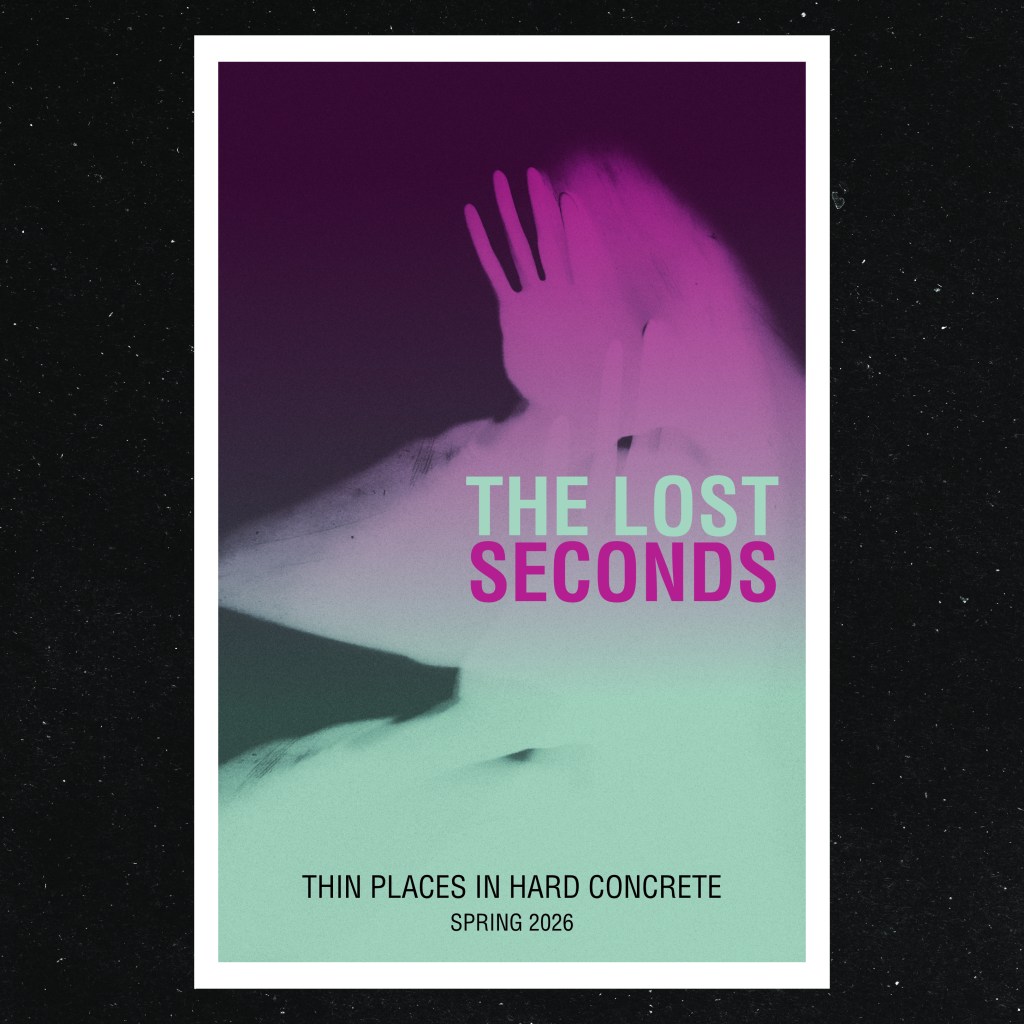
The tenth and final story in my new collection Thin Places in Hard Concrete is about what might happen if time froze around you for just a few seconds, leaving you out of sync with the world.
Here’s a bit from the opening which takes place in the gents toilets beneath London’s Paddington Station:
The cleaner’s mop ceased to splash and slap. Cisterns and taps no longer dripped – the background percussion I hadn’t even noticed was there disappeared. I’m now aware of the constant, multi-layered hum of electricity, fans and mechanical devices but at that moment, for the first time, I really knew what silence was… You know how when you pause a film, it looks different? Even if the shot is of nothing – a blank wall, paint drying, still life – when the video is playing at twenty-four or thirty or sixty frames a second, it feels alive. But paused, it loses definition. The grain or pixels become fixed in place, revealing the surface texture and two-dimensionality of the image. During the freeze, when time stopped for me, the real world looked something like that. Dust hung in the air, no longer swirling but like a previously unnoticed field of stars, and fruit flies, fixed in space, became solid black punctuation marks.
I suppose what I’ve written is more speculative fiction than weird fiction – but what could be weirder than time freezing for no apparent reason? And what I really wanted to explore wasn’t the mechanics or science of a disruption in time but how it might feel.
Like quite a few of the stories in Thin Places in Hard Concrete it’s really about someone whose sense of how the world works has been yanked out from beneath them, leaving them alienated and disconnected from society.
As I type that I think, huh, that’s weird, because I sometimes feel alienated and disconnected from society. There’s a good description of this phenomenon in a recent post by Eoghan Walsh:
For readers among you who have never experienced this feeling, it may seem paradoxical to both feel lonely and simultaneously fail to grasp with the fervour of a thirsty man in the desert any and all opportunities the world presents to engage with it. I am sure there are people reading this now, furrowing their brows at the memory of their own efforts to arrange drinks that went nowhere, contact scorned, or the prolonged periods where it appears I just disappear for weeks on end.
It’s interesting that we sometimes refer to breaking off contact like this as ‘ghosting’, isn’t it? Some other behaviours Eoghan describes – being physically present but refusing to engage, holding yourself at arms’ length, making yourself invisible – are also arguably those of a living ghost.
In an interview with Bob Fischer in Fortean Times recently film director Mark Jenkin said:
I realised at some point during the making of this film that all time travel films are effectively about ghosts, and all ghost stories are effectively about time travel.
In ‘The Lost Seconds’ the protagonist becomes a sort of ghost from 8 seconds in the future – or perhaps he’s haunted by the world from 8 seconds ago?
The ability to freeze time is a common fantasy. I think what it often expresses is a desire to stop all the noise and action, reduce the cognitive load of a world in motion, and take control. When it all begins to feel too much, the ability to hit pause might help.
London stories
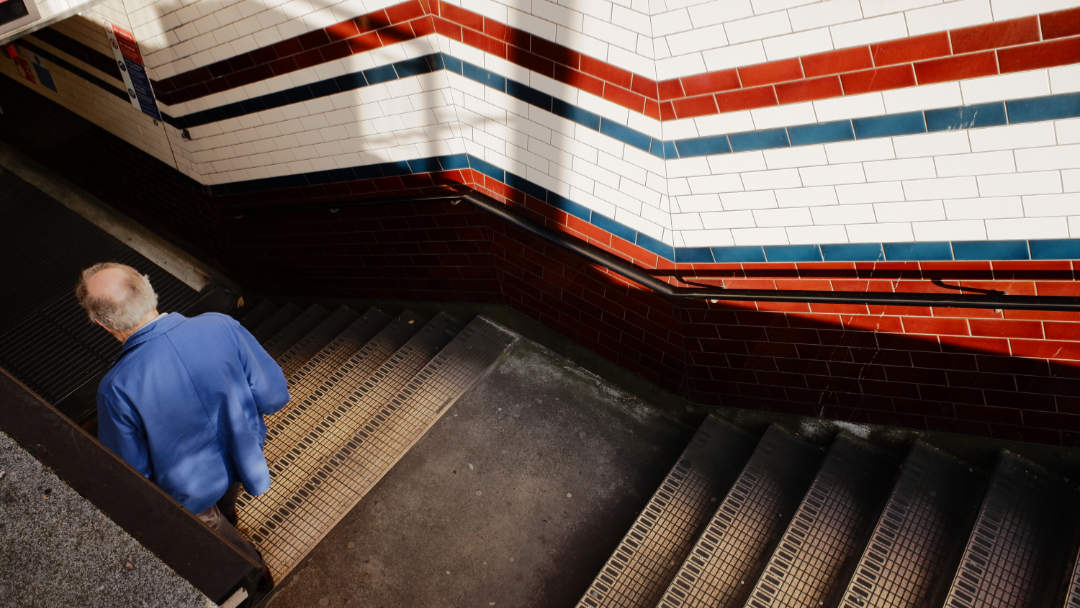
I lived in London for a decade after university; my partner is from London; and we visit often. Being an obsessive walker and casual photographer I’ve probably explored more of London’s streets than many people born and bred there, sometimes with Nairn’s London or some other guidebook in hand.
So, I feel confident in depicting London and entitled to set the odd story there, if it feels right. But when does it feel right? All I can say in this case is that the moment from which the entire story sprang, the opening quoted above, popped into my head while I was in London, using the very facility described.
For a moment, I was the only person there and thought, “If the whole world disappeared above ground, I’d have no idea.” Somehow, that led to the follow-up question: “What if nobody ever walks down those steps because they’re all frozen in place somewhere else?”
The final story-by-story post
I’ve enjoyed writing these, forcing myself to recall where stories came from, and interrogating myself about their influences.
I want them to work like trailers for people who have not read Thin Places in Hard Concrete (“You had me at ‘gents toilets beneath Paddington’!”) and as a bonus feature for people who have read the book and want to know more.
Maybe it’s not a good idea to reveal so much about how my stories come into being. If the essence of weird fiction is leaving things unexplained, the zero ending, deliberate obscurity, then this over-explaining must be the antithesis.
You can buy Thin Places in Hard Concrete as an eBook or paperback from Amazon wherever you are. For starters, here’s where you’ll find it if you’re in the UK or US:
I’ve chosen not to apply digital rights management (DRM) to the eBook file so you can download it as an ePub file or PDF to read on whichever device you like, such as a Kobo.


