Categories
Fiction Film & TV

FICTION: We Have Always Battled Monsters in This Castle

Lightning drew a blue outline around the spires and towers of the castle on the mountaintop. Captain Rauch, high on his charger, pointed with his cavalry sword.

‘There, Doctor Kleist,’ he rumbled. ‘Do you see?’

Kleist lifted his skeletal features and peered from beneath his brimmed hat. His blue eyes gleamed. He waited a split second and then, as thunder cracked, said with perfect diction: ‘Castle. Grafenstein.’

Both men steadied their horses.

‘Grafenstein,’ repeated Rauch uncertainly, a fine line appearing between his dark eyebrows. ‘Yes, Grafenstein.’

Kleist pressed delicate fingertips to the ornate golden crucifix around his neck and snapped the reins to drive the horse along the strangely flat path into the forest that surrounded the mountain.

Only a few moments later, it seemed, they arrived at the castle gate. Once again Rauch’s natural haughtiness was tempered by confusion.

‘I don’t remember… How…’

He looked back to where the woods should be and saw a nothingness.

Kleist seemed untroubled. He dismounted and tied his horse to a railing. He straightened his heavy woollen frock coat, adjusted the fox fur collar, and clapped his gloved hands.

‘At last, his reign of terror will come to an end and the people of Kronstadt will be free from the malign master of Castle–’

He stopped and stared at the carved coat of arms above the gate. Text in German blackletter read ‘Schloss Krolek’.

‘Castle Krolek.’

Rauch drew alongside, towering above Kleist, and glowered.

‘Count Krolek of Castle Krolek, of course.’

‘Of course.’

As they passed through the gate, Rauch reached out to touch its grey stone and felt it crumble beneath his fingers, scattering white flakes.

They crossed the moat and approached the great door which opened before them like a giant mouth awaiting food. Kleist held up his crucifix and waved a gloved hand at Rauch, urging him to do the same.

As they crossed the threshold, Kleist shuddered and clapped a hand to Rauch’s chest.

‘Did you feel that?’

Rauch nodded.

There had been some strange shift, like a cut in time, though neither man could put the feeling into words.

The entrance hall of the castle was brightly lit and luxuriously decorated. Flames roared in an enormous stone fireplace.

Rauch looked back. Beyond the door where the courtyard and moat had been a moment before, the nothingness had further encroached.

‘Kleist, look!’

Kleist ignored him. He had already begun to stalk the great hall, inspecting its stonework and tapestries with his long fingers. He paused when he reached the fireplace and looked up at the portrait that hung above it. He stepped back and gasped. It was Rauch, crudely painted, in a black cloak and the ceremonial uniform of a Wallachian boyar.

‘You admire the portrait of my ancestor,’ said Rauch from the staircase.

Kleist felt a fluttering in his mind and his eyes misted for a moment. He heard himself say, involuntarily, ‘Count Krolek!’

‘I bid you welcome to my home,’ said Krolek, who was no longer… who had he been? Kleist had already forgotten not only Rauch’s name but also his very existence. Krolek wore a red lined cape and a velvet jacket the colour of dried blood. His voice was low and resonant and there was a combination of hatred and arrogance at odds with the words he spoke.

Kleist reached for the cross at his neck and for the pistol at his side.

‘Do not move, Krolek. This is loaded with silver bullets blessed by the priest at Kronstadt… I mean, at Carslbad – and dressed with Holy Water!’

Krolek’s eyes burned red.

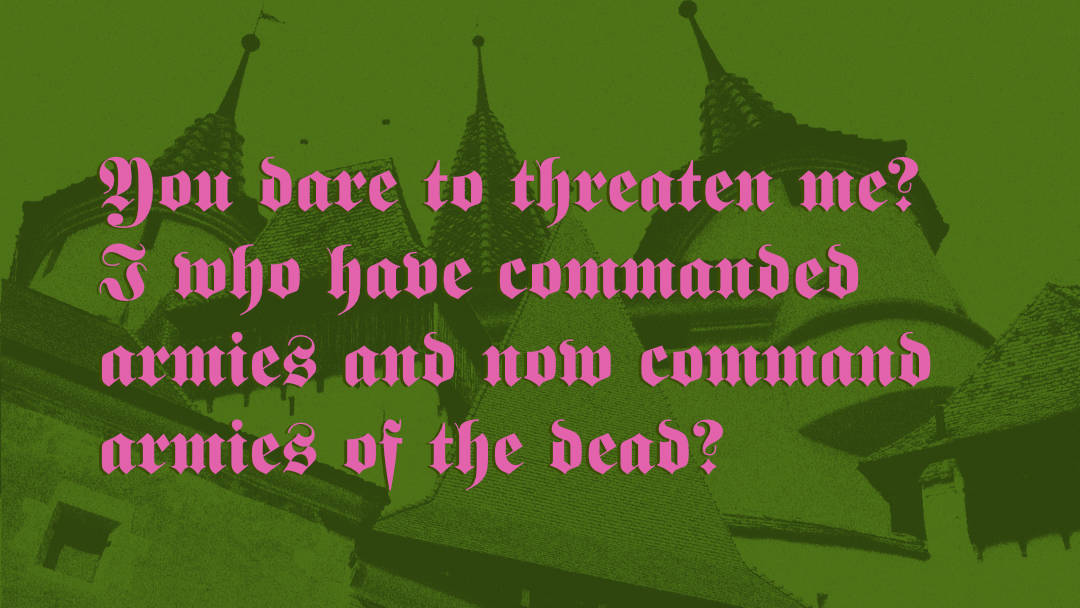
‘You dare to threaten me? I who have commanded armies and now command armies of the dead? I who have in my veins the blood of… of…’

Krolek’s powerful voice faltered. He looked up and became mesmerised by something.

Kleist followed his gaze. There was no ceiling above, only that same blacker-than-night nothingness. Turning slowly Kleist realised that there was also darkness behind him where a castle wall ought to be.

Then, to his left, another wall began to move.

‘What black magic of yours is this, Krolek?’

Another wall slid between Kleist and Krolek, locking with the first, blocking Krolek from sight. Objects shifted around Kleist, whirling and drifting into place, until he was surrounded.

The pistol in his hand had become a scalpel, his coat a surgical apron. His eyebrow arched as he turned the blade to catch the beam of a vivid pink light. He forgot the nothingness for a moment, and forgot he had ever been Kleist. His work with the human brain was too important to be distracted.

Beyond the wall, Rauch-Krolek was lost. When the walls moved, the nothingness surrounded him for a moment and he found himself adrift on the staircase in blank space. He tried ascending the stairs and found himself on a landing with a large stone eagle. On its plinth were carved the words ‘The House of Zarkhov’. The nothingness advanced behind him like a rising tide. He swore in Russian-accented English and bounded up another flight of steps. The eagle confronted him again but this time with the name ‘Pengellis’ carved into its base. Why was he running? Oh, yes, for revenge on Baron Pengellis for what he had done to the girls of the village, including his own sister, while he, Captain Trelawny, was away at sea. Black water, or something like water, lapped at his boots, forcing him up another storey. Again he found the eagle, the very same eagle, with the worst name of all: Frankenstein.

Kleist-Frankenstein leapt at him with a scalpel causing him to drop the feathered policeman’s helmet from the crook of his arm. He clapped a hand to his arm which was now bleeding freely, his blood too vivid and viscous to make sense.

‘You can’t stop me now, Inspector Becker, you must know that.’

He swiped again and caught Rauch-Krolek-Becker’s face. A line of blood appeared at one, as if a child had marked him with school poster paint.

‘My experiments with transplanting multiple human consciousnesses into a single brain are almost complete. No meddling policeman–’

‘Look!’ said Becker.

Frankenstein smiled and kept his eyes fixed on both the tip of his blade and the stiff-backed Saxon police officer.

For a moment, the nothingness swallowed Frankenstein’s lower leg. The smile left his face. When the shadow withdrew like a lapping wave he was weak and confused.

‘We’d better go up another floor,’ said Becker softly.

For the first time, there was complete silence. The music they were used to hearing, that called their names in brass, had ceased.

‘You first,’ said Frankenstein, gesturing with his scalpel, still trying to dominate the situation.

Somewhere on the flight of steps, as his neat elastic-sided boots pressed into deep red carpet, the scalpel became a British Army pistol and Inspector Becker grew a goatee beard.

This time, the Eagle bore the name ‘Corbeau’. Becker was no longer Becker but his old friend Colonel Gautier, scourge of the satanists. When Gautier addressed him by a new name, he was not surprised.

‘Hold fast, Henniker,’ he said, raising a finger to his ear. ‘Hark – the ritual has begun!’

There was a sound, a deep hum, that might have been chanting, Henniker supposed. It seemed to come from a double door before them. The door was white with gilded trim. On either side were statues of Anubis on white plaster columns.

Gautier turned to Henniker and planted his hands on the smaller man’s shoulders.

‘In our many adventures together, we have never come across a villain as dastardly as Corbeau. Are you with me? I should not judge you if you walked back down–’

He stopped. The steps had gone. There was now only a floor with black and white tiles leading to an entrance hall.

‘I mean…’ Gautier shook his head, touched his brow, and found the line. ‘I should not judge you if you walked out of the door and left me to do psychic battle with this rogue alone.’

Henniker shook his head and raised his service pistol.

‘I’m with you, old man, just as I was at the Devil’s Wood in sixteen.’

As they advanced on the door, jaws fixed, they didn’t notice the walls behind them sliding out of place, or the floor falling away as if into space.

Gautier flung open the door and they burst onto a plain, empty, flagstoned terrace. Lichen grew on the slabs. There were cigarette ends scattered about.

There was no ritual, no Corbeau.

Gautier whirled around. The door behind them was an ordinary door set into an ordinary English country house of no particular distinction.

Kleist-Frankenstein-Henniker dropped his scalpel-gun-sword which landed with a tinkle-clunk-clatter and approached the balcony.

Below was a park where a man in a yellow anorak was walking a dog. The red roof of a number sixteen bus passed above the trees.

Wind whipped at Rauch-Krolek-Gautier’s wig which, in broad daylight, looked absurd.

Henniker shivered. He was, after all, a frail old man.

With brotherly care, Gautier guided him back through the door, into the house, where the eagle, the nothingness, and a thousand monsters awaited them.


This story originally appeared in issue 3 of the General Witchfinders Zine in September 2025.
Categories
therapy

Radio Lento and the augmented reality blues

The soundscapes of Radio Lento can turn even the most overwhelming urban landscape into a rural retreat. But is it good for me?

A couple of weeks ago, feeling stressed at work, I took myself around the block for a mid-afternoon walk. It didn’t help because all I could hear was the sound of traffic, which always feels louder and more intense when I’m anxious.

Even in the park the thundering of lorries, whining of boy-racer hatchbacks and throb of the nearby flyover seemed unbearable.

Then I had a bright idea: why not plug in my noise cancelling headphones and choose a better soundtrack? On Tidal I found a 4-minute track called something like ‘English countryside sounds’ and hit play.

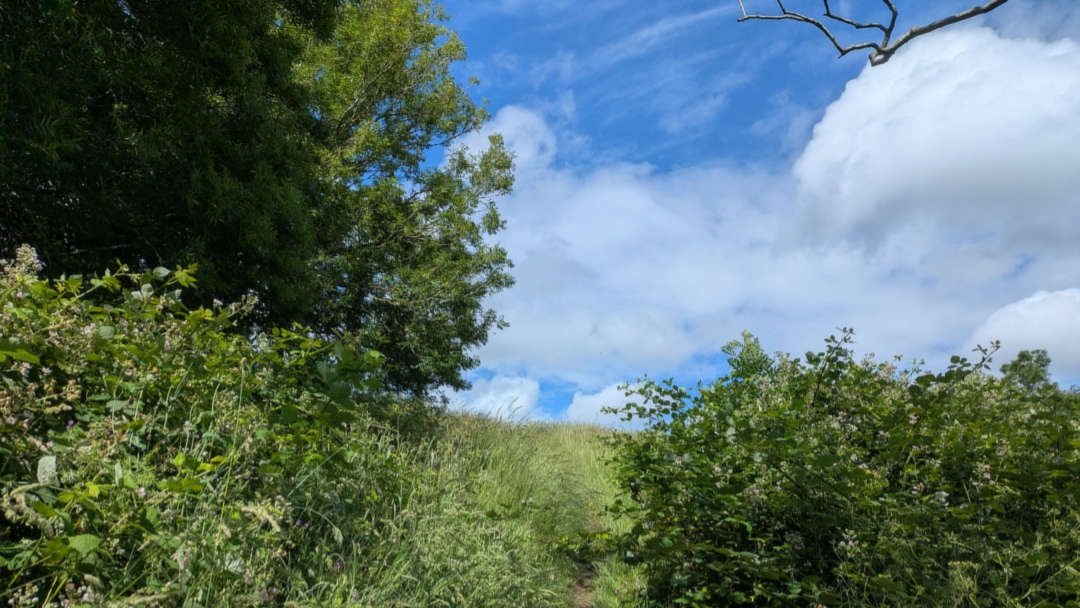
The improvement was instant. The sounds I was hearing matched what I saw in front of me – tall yellow grass waving in the wind, mature trees, weeds at full stretch – and as the recorded birds sang, I felt myself uncoil. By the time the track ended, I felt completely reset.

A few days later, after a difficult day, I set out to replicate this effect. This time, instead of random spammy ambient recordings on Tidal, I turned to Radio Lento.

A ‘slow radio’ podcast, it was launched by Hugh Huddy and Madeleine Sugden in 2020 during the pandemic, and now has a catalogue of almost 300 recordings of natural soundscapes.

On this particular after-work walk through the industrial and post-industrial landscape of East Bristol I chose the most recent episode, ‘Sonorous rural woodland before an approaching storm’.

In the park it worked predictably well, fitting this small green world far better than the background racket of jammed commuter traffic just beyond the trees. Again, my shoulders untensed, my breathing slowed, and I felt something like (I think I remember the sensation) happiness.

To my surprise, though, it continued to be effective even when I left the park and found myself on suburban side streets. The chirruping of birds and occasional flypast by a bee (recorded hundreds of miles away, weeks ago) turned a busy inner city neighbourhood into an impossibly tranquil one.

I tried again a few days after that, this time with ‘Dawn in Shelve Wood Shropshire with cuckoo’. In a different park, surrounded by houses and busy roads, I sat on a bench and let myself believe I was somewhere with no traffic at all.

Except that I didn’t quite believe it. It felt something like a lucid dream, or a hallucination, or an out-of-body experience.

Something about how much I liked it also made me uneasy. I was allowing myself to wallow in a fantasy, cutting myself off from reality. That I found it difficult to stop listening and remove my headphones also troubled me. Could this aural perfection be addictive?

It occurred to me that I was indulging in a version of an idea often found in science fiction: the Better Than Life simulation in which it is all too easy to get lost.

In The Matrix it’s all leather coats and high speed chases. It’s visual and visceral. This way of using the very gentle, genteel Radio Lento feels different – but is it?

I found myself thinking particularly of Stanisław Lem’s 1971 novel The Futurological Congress. It depicts a world in which everyone is permanently under the effect of hallucinogenic drugs which make them believe they are living in a functional, futuristic society. But they’re actually living in the dystopian ruins of human civilisation, eating slop in concrete bunkers and imagining it to be fine food in luxurious surroundings. When the protagonist of the novel discovers this reality, he feels bereft. He misses the illusion.

Of course I’m going to keep listening to Radio Lento, and letting the sound of invisible cuckoos drown out the intolerable racket of combustion engines. The immediate, obvious therapeutic benefits are worth a little philosophical fretting after the fact.

The question is, if I had the option of glasses that could make the world even greener and more beautiful, would I also choose to wear those? Maybe, because the thing about being blissfully unaware is, I suppose, is all that lovely bliss.

Categories
Thin Places in Hard Concrete

How to buy Thin Places in Hard Concrete direct from me

If you want to buy the paperback of Thin Places in Hard Concrete directly from me now’s your chance because I’ve got a limited number of copies and I’m all geared up to do the admin.

One copy costs £13 including what for some reason we always refer to as “postage and packing” (P&P).

If you’re interested message me to let me know:

  1. Where you want me to post the book.
  2. If you want it signed.
  3. If you want it dedicated to you or someone else.

And I’ll let you know how to pay me for it.

I also have copies of my earlier collections, Municipal Gothic and Intervals of Darkness. They’re also £13 each including postage and packing.

I’ll apply a discount if you buy two or more books:

  • 1 book = £13 inc. UK postage
  • 2 books = £25 inc. P&P
  • 3 books = £36 inc. P&P

Other ways to buy and read my books

I really, really don’t mind if you buy from Amazon. Unless you need them signed, it’s probably easier for you, and definitely easier for me.

If you’ve got Kindle Unlimited, you can read the eBook for free – or, at least, as part of your subscription. I get paid according to the number of pages you read. This is all totally cool as far as I’m concerned.

Various online booksellers like Hatchard’s also carry the paperback. I get a smaller cut this way but, again, I really don’t mind that at all.

If you really want to read one of my books but you’re too skint to buy a copy, message me and we’ll sort something out.

Or you could ask your local library to get them in, which would also be great for me.

Categories
weird fiction

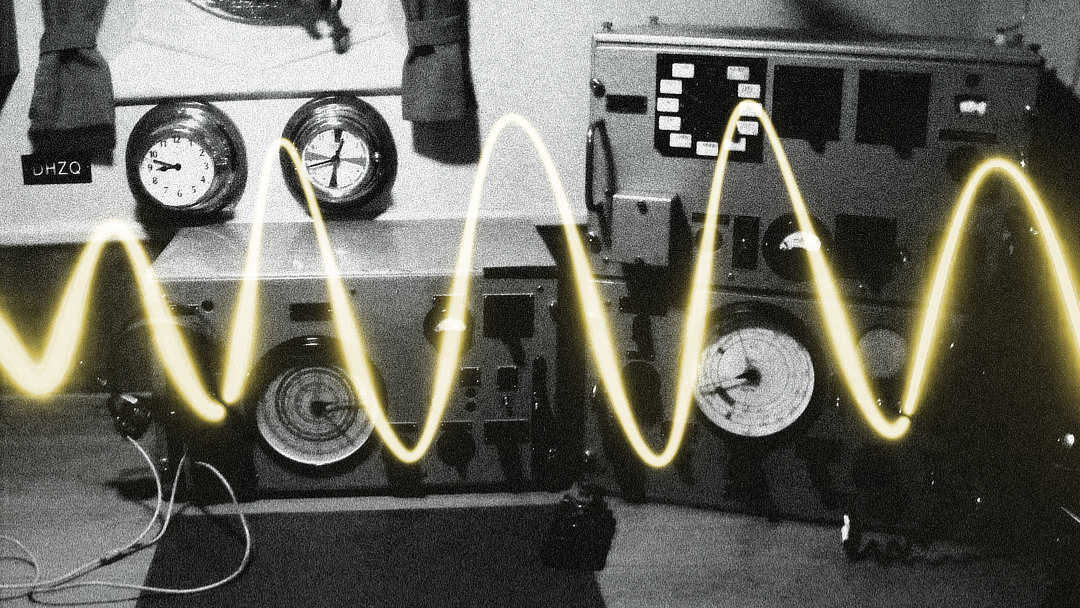
Broken Veil Series 2 – secrets and lies in haunted Essex

Series 2 of the found footage horror podcast Broken Veil builds and improves on the first season with a focus on the audio uncanny.

Arguably my positive reaction to Broken Veil, verging now on fanboyish, is because this is media made for people exactly like me, by people rather like me.

Creators Joel Morris and Will Maclean are children of the so-called ‘haunted generation’ who seem to have spent their adult lives chasing the thrill of reading The Unexplained magazine, of hearing local legends in the school playground, and catching glimpses of grainy ghost stories on late night TV.

The problem with real life creepy stories is that eventually you run out of good ones. Just look at the hit podcast and TV show Uncanny which, after a dazzling start, has been scraping the barrel for a couple of years now.

Enter Morris and Maclean with a valiant effort to make up some brand new faux genuine eerie mythology. Their efforts are so deft that, at times, I had to pause the podcast and ask myself: wait, is this real? The trick is that they interlace their fabrications with snippets of real and familiar supernatural lore.

They mention the well-known Max Headroom broadcast intrusion. That’s the convincer. Then they introduce their own invented ‘Marconi Intrusion’ which is not. But even knowing this is cleverly camouflaged drama, it took me a while to realise we’d crossed the line from fact into fiction.

In fact, there really was a Marconi intrusion, in 1903, when the magician Nevil Maskelyne interrupted an early radio broadcast. So when the Broken Veil team uses that phrase, something in the recesses of the brain says, “Oh, yes, I’ve heard of that.” Cunning.

One reassuring giveaway that we are listening to drama is that, in many instances, their concoctions are too perfect and perhaps too weird. The description of the Marconi Intrusion from the Broken Veil timeline (outcome) is dense with fantastic, Lovecraftian imagery a million miles from some dickhead in a rubber mask wobbling about in front of a tin shed.

When the real story of the rediscovery of the audio for the legendary Hexham Heads footage is borrowed and applied to an invented local news report from 1979 it performs one of two functions. Either it makes you feel clever for spotting the reference, bringing you in on the joke. Or it triggers that feeling that you’re re-hearing something familiar but half forgotten, and therefore true.

I wonder how many listeners, even those well schooled in British folklore and the paranormal, would correctly identify every truth and every falsehood. Eric Gill did indeed carve 14 stations of the cross for Westminster Cathedral. But is there a memorial to him studded with black stone and inscribed ‘Lapidarius’ beneath station 14? I really haven’t been able to confirm that there is, even though it sounds entirely plausible, and even though Joel Morris stridently declares “This is not bullshit” at that point in the episode.

The emphasis on the early days of radio, electronic voice phenomena (EVPs), lost tapes and broadcasting gives this series a sharper focus than the first. It also, obviously, leans into the podcast medium. Morris’s immersive sound design adds layers of dirt, noise and obfuscation so that the ‘evidence’ in the case is always heard obliquely, through a sort of fog. The two investigators are placed in echoing, noisy spaces – cars, trains, cafes – constantly reinforcing the mundane reality of their adventures.

Broken Veil is also a great example of how nimble independent audio productions can be. Though a year in the making it nonetheless includes what feel like references to the current fascination with liminal horror triggered by the release of the film Backrooms and to a weird news story that went viral back in February.

If I had reservations about the excellent first season they were around the ending which felt hurried and somehow unsatisfying. This time, they really stick the landing, finishing on a suspended note of uncertainty that’s been building throughout the series.

If you think of it as like buying an album, or a Big Finish Doctor Who audio adventure, the price of entry via Patreon is pretty minimal. I’ve certainly got more value from it than I would from a couple of takeaway coffees.

I also find myself wondering about spinoffs. A Haunted Essex Corridor short story anthology, perhaps, inviting various authors into the game. Or a TV adaptation starring Laurence Miller and Chris McNally – ideally with monster of the week episodes to prolong the enjoyment.

The second series of Broken Veil is available via Patreon. The first series is available free wherever you forage for podcasts.

Categories
Fiction Film & TV weird fiction

12 thoughts about liminal horror

The new film Backrooms directed by Kane Parsons has everyone talking about ‘liminal horror’. As someone who writes stories which might fit into this bracket, I’m excited to have a new sub-genre to ponder.

Here are some initial thoughts – reactions, almost – to a phrase I had not heard until about three days ago.

1. In liminal horror the space itself is the source of the unease, not the ghosts or monsters that lurk within it. A still image of an empty room can evoke the appropriate sense of unease, partly because it is empty.

An empty, abandoned shop with bare shelves, dark shadows, and security monitor on the ceiling glowing purple.

2. “It’s bigger on the inside…” Perhaps liminal horror is about spaces that should not be and that make no sense. A long corridor is creepy; a corridor that seems infinitely long is deeply unsettling. H.P. Lovecraft wrote about spaces with non-Euclidean geometry just as he referred to impossible colours. You might also think of the deliberately disconcerting geometry of Hill House in Shirley Jackson’s The Haunting of Hill House. Or even the land that somehow sits beyond the back of the wardrobe in the works of C.S. Lewis.

3. Do we hate these eerie spaces, or yearn for them? It’s a love-hate relationship. We call it liminal horror but there’s also a romantic allure about places that are silent, empty, blank… Where we might lose ourselves, slip between walls, and be left alone for two fucking minutes. In Genki Kawamura’s Exit 8, the other liminal horror film currently doing the rounds, the protagonist finds himself on a subway station corridor that he soon learns is an impossible space and a trap. But at the beginning, for a moment, he is free from the noise and aggression of the city – and from his responsibilities. Did he perhaps want this?

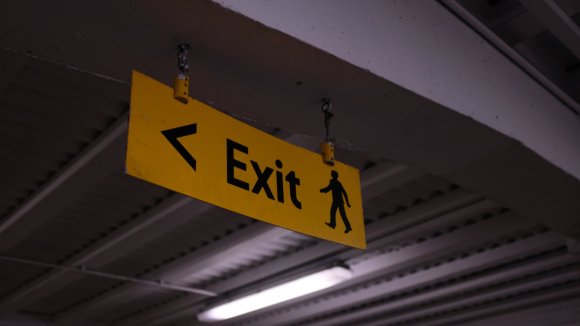
A dangling yellow exit sign in a brutalist car park with poor lighting.

4. Did Lucio Fulci get there first? I know, I know, I’m always on about Fulci’s 1981 film The Beyond, which I don’t even think is a good film, and certainly isn’t one I’d recommend to everyone. But the ending has the protagonists run down a staircase in a hospital and find themselves in the labyrinthine basement of a hotel from which they had earlier fled. They continue their flight until the basement opens up into an infinite, foggy plain strewn with shrouded corpses. That feels like liminal horror to me.

Four seats against a concrete wall in a dark corner of an institutional building.

5. These are some other things that are coming to mind, but I don’t know if they’re liminal horror:

  • the mausoleum in Phantasm
  • the wasteland and abandoned industrial buildings of Stalker
  • the near-abandoned apartment block in Dark Water
  • the shopping mall in Dawn of the Dead
  • Dave Bowman’s tacky hotel room in space in 2001: A Space Odyssey
  • Judgement City in Albert Brooks’s comedy Defending Your Life
  • Being John Malkovich and the floor between 7 and 8
  • that perfectly white room where Willie Wonka shrinks Mike Teavee

6. “Alright, cunt, what happens?” – Reece Shearsmith. Liminal horror as internet meme doesn’t need a plot, or characters. It can just be, “Whoah, look at this weird door I found,” or, “Check out this hallway!” But books, stories and films generally do require things to happen to people. But does this spoil the fun? Perhaps liminal horror is a rare sub-genre that might work best in virtual reality.

A door in a dingy basement through which can be seen a group of creepy white mannequins gathered around a wardrobe.

7. Oh, actually, never mind Fulci – perhaps Elizabeth Jane Howard got there first. At the end of her story ‘Three Miles Up’ from 1951 concludes with a canal boat exiting a channel not on the map into “a sheet, an infinity, of water stretched ahead; oily, silent, and still, as far as the eye could see, with no country edging it, nothing but water to the low grey sky above it.” Infinite, edgelesss and endless feel like the qualities we’re looking for here.

8. Are the spaces where liminal horror stories take place related to ideas of heaven, purgatory or hell? I mentioned Defending Your Life above which isn’t a horror film but, like the sitcom The Good Place which I’m sure it inspired, suggests that death might feel like being in a waiting room. “I’m in the waiting room now,” is something my mum actually says when pondering her mortality. Waiting rooms, like corridors, are spaces between spaces, checkpoints or chokepoints on a journey rather than the final destination.

A bench on the London Underground with dirty smudges on the wall showing where people have been sitting.
Ghosts of the Elizabeth Line, London.

9. Fog creates instant liminality. It erases the edges, swallows the horizon, silences the world, and leaves you floating in space. It turns any house into The House on the Borderland.

10. So, every single haunted house story is liminal horror? So, John Carpenter’s The Fog is liminal horror? So, any story where they find tunnels hidden beneath a building is liminal horror? Well, yes, maybe, I don’t know, that’s what I’m trying to work out. But perhaps the missing component in my thinking above is that the weird spaces in which liminal horror occurs need to be modern, or at least not antique. In liminal horror, the lights are probably on; they’re probably fluorescent; and they’re probably humming. They’re probably not domestic settings, either, but institutional: hotels, schools, transport hubs, office blocks. They’re bland, beige and functional. Is there some element of the Kafkaesque here – the fear of being lost in the system?

An old beige institutional telephone on a white wall.

11. Liminal horror is in the eye of the beholder. When I wrote about the creepiness of hotels, someone on BlueSky got mad at me because they just didn’t understand what I was talking about. Hotels are nice! Stop saying things are uncanny when they’re not! It’s just a hallway. It’s just an empty space. It’s only a storeroom.

A doorway at the end of a concrete hallway.

12. Sorry I keep using the word ‘liminal’. It’s one that many people avoid using these days. I usually avoid it myself. How else might we describe this sub-genre or trend? I’ve heard ‘analogue horror’ thrown around, referring to the use of filters to evoke VHS recordings and other vintage media. That’s not about spaces but it can help sell their reality and their feeling of being outside time. Today, I saw ‘ordinary horror’ for the first time, via Zachary Gillan, but Andrea Capra, the author of the book of that title, means something very specific: “the horror that haunts our world, and that we may encounter firsthand”. I feel some connections between liminal horror, analogue horror, and various forms of lo-fi ambient music – analogue hiss and crackle, ASMR-adjacent field recordings, a hypnotic waiting room quality. So, perhaps ambient horror would work, too.


My latest collection of stories Thin Places in Hard Concrete has a story about a motorway interchange and a recreation of a medieval palace in an underground bunker, among other contenders for the liminal horror tag. It’s available as an eBook or paperback from Amazon wherever you are. For starters, here’s where you’ll find it if you’re in the UK or US:

I’ve chosen not to apply digital rights management (DRM) to the eBook file so you can download it as an ePub file or PDF to read on whichever device you like, such as a Kobo.

Categories
books Film & TV

Lists, curation and the power of brevity

Lists and guides can be a great way to find new books to read, films to watch and music to listen to. They’re also difficult to put together and seem to make people furious.

As I write, the most recent list to have riled people was The Guardian’s top 100 novels of all time. The criticisms of the list are along these lines:

  • “My favourite book isn’t on it.”
  • “A book I hated is on it.”
  • “Nobody really likes these boring books, they’re just being pretentious.”
  • “The very idea of a list offends me, why must everything be counted and categorised?”

Because this particular list is interactive and helps readers tot up how many of the books they’ve read, there’s also some anxiety around not having read enough of them or having read fewer of them than other people. And anyone who has read quite a few of them is, of course, lording it and showing off.

Honestly, I think the list is fine. As critic and writer Andy Miller has pointed out, however you cut it, these are 100 worthy, interesting, notable books. I didn’t personally get much out of Ulysses but I don’t dispute its right to be on the list because I am not the most special boy and the world does not revolve around my tastes.

The controversial Sight & Sound top 100 films list from a couple of years ago prompted similar debate – which is, of course, exactly why publications go to the immense trouble of running polls and compiling lists. Not cynically, as ‘clickbait’, but because they know that, whatever they might claim to the contrary, people are, in fact, extremely interested in lists and are likely to engage with them as a result.

What I saw on BlueSky yesterday, dismissed as ‘discourse’ by the weary eye-rolling classes, was lots of people having passionate, involved discussions about books. And reacting against the list is just another totally valid way of engaging with it.

For me, that conversation spilled over into a very enjoyable discussion with my partner in the pub, and a flurry of interesting messages with a couple of writer pals.

What does ‘best’ mean anyway?

One problem with lists and guides is that there are a hundred different ways to approach the question of what is ‘best’.

If you’re choosing a hundred novels to represent the best of human intellectual endeavour, and the full breadth of global culture over centuries, your list will look one way. If it’s about which novels you’d take to a desert island, it might be quite different.

You might also think about novels that have meant the most to you over the course of your life, or novels that are socially important, or novels that will have the widest popular appeal, or novels you’d recommend to friends, or…

These are all interesting questions with which to grapple and, remember, lists aren’t rationed. We can have as many as we like, and anyone can write one for the group to get mad about, as long as they’ve got a blog or social media account on which to share it.

Short lists beat long ones

A hundred novels sounds like a lot but it’s not. Of course good and important books are going to get left out.

Even so, if I asked a friend for recommendations and they gave me a list of a hundred books, films or albums, I’d think it was too much, and not particularly helpful.

A list of ten items is more useful. When I create Letterboxd lists they often include only ten or twelve films. That seems digestible and achievable to me. It’s enough to make an argument and to avoid marginal cases and fuzzy edges.

A list of three recommendations might be better again, though, and perfect for social media. To paraphrase, “If I had more time, I’d have made a shorter list.” If someone asks, for example, “I liked The Big Combo, what should I watch next?” you can suggest:

  • something safe and similar (The Big Heat)
  • something a little more obscure (Kansas City Confidential)
  • something tangentially connected (Leave Her To Heaven)

Interesting doesn’t always mean good

One of my favourite podcasts, Pure Cinema, has recently been focused on two important books by Michael J. Weldon, The Psychotronic Encyclopedia of Film from 1983 and The Psychotronic Video Guide from 1996.

These are great breeze blocks of books and intimidatingly comprehensive. But, of course, you’re not really supposed to read them from cover to cover so much as dip into them for reference, or at random.

I also watched a short documentary about the BBC’s Moviedrome strand that popped up on BFIPlayer the other day. Moviedrome ran from 1988 to 2000, originally with filmmaker Alex Cox as the host, and later critic and documentarian Mark Cousins.

The format was simple: before a showing of one of the many films in the BBC’s library of licensed titles, Cox/Cousins would speak for two or three minutes, setting the context and giving the viewer some ideas to bear in mind.

It was hugely influential in establishing a British angle on the canon of cult films. I often ended up watching it and taping the films for my personal collection. Ask any British film enthusiast of a certain age when they first saw a particular cult film and there’s a good chance it will have been via a Moviedrome screening.

What both Weldon and Cox do well is to explain with energy and enthusiasm why a film is noteworthy and valuable, even if it might not make it onto that rather highbrow Sight & Sound list anytime soon – even if, frankly, it stinks, and they don’t personally like the movie at all.

I’m drowning, help

What properly curated guides and lists do is reduce the cognitive load of navigating an overwhelming media landscape.

They make the millions of books, films and records we’ll never get to feel a little more manageable.

They help us decide how to spend our time, energy and money. And they give us permission to focus on certain things while ignoring others.

The only problem is knowing which guides or lists to look at. We probably need a top 100, as voted for by experts.

My list of 10 great novels

In case you’re interested, here’s the list I’d have submitted if, for some reason, The Guardian had asked my opinion:

  • The Long Goodbye by Raymond Chandler
  • Great Expectations by Charles Dickens
  • War & Peace by Leo Tolstoy
  • The Code of the Woosters by P.G. Wodehouse
  • The Rising of the Moon by Gladys Mitchell
  • The Yellow Dog by Georges Simenon 
  • The Inheritors by William Golding
  • Buddenbrooks by Thomas Mann
  • The Haunting of Hill House by Shirley Jackson
  • Ripley’s Game by Patricia Highsmith
Categories
books Thin Places in Hard Concrete

10: The Lost Seconds – Thin Places in Hard Concrete, story by story

The tenth and final story in my new collection Thin Places in Hard Concrete is about what might happen if time froze around you for just a few seconds, leaving you out of sync with the world.

Here’s a bit from the opening which takes place in the gents toilets beneath London’s Paddington Station:

The cleaner’s mop ceased to splash and slap. Cisterns and taps no longer dripped – the background percussion I hadn’t even noticed was there disappeared. I’m now aware of the constant, multi-layered hum of electricity, fans and mechanical devices but at that moment, for the first time, I really knew what silence was… You know how when you pause a film, it looks different? Even if the shot is of nothing – a blank wall, paint drying, still life – when the video is playing at twenty-four or thirty or sixty frames a second, it feels alive. But paused, it loses definition. The grain or pixels become fixed in place, revealing the surface texture and two-dimensionality of the image. During the freeze, when time stopped for me, the real world looked something like that. Dust hung in the air, no longer swirling but like a previously unnoticed field of stars, and fruit flies, fixed in space, became solid black punctuation marks.

I suppose what I’ve written is more speculative fiction than weird fiction – but what could be weirder than time freezing for no apparent reason? And what I really wanted to explore wasn’t the mechanics or science of a disruption in time but how it might feel.

Like quite a few of the stories in Thin Places in Hard Concrete it’s really about someone whose sense of how the world works has been yanked out from beneath them, leaving them alienated and disconnected from society.

As I type that I think, huh, that’s weird, because I sometimes feel alienated and disconnected from society. There’s a good description of this phenomenon in a recent post by Eoghan Walsh:

For readers among you who have never experienced this feeling, it may seem paradoxical to both feel lonely and simultaneously fail to grasp with the fervour of a thirsty man in the desert any and all opportunities the world presents to engage with it. I am sure there are people reading this now, furrowing their brows at the memory of their own efforts to arrange drinks that went nowhere, contact scorned, or the prolonged periods where it appears I just disappear for weeks on end.

It’s interesting that we sometimes refer to breaking off contact like this as ‘ghosting’, isn’t it? Some other behaviours Eoghan describes – being physically present but refusing to engage, holding yourself at arms’ length, making yourself invisible – are also arguably those of a living ghost.

In an interview with Bob Fischer in Fortean Times recently film director Mark Jenkin said:

I realised at some point during the making of this film that all time travel films are effectively about ghosts, and all ghost stories are effectively about time travel.

In ‘The Lost Seconds’ the protagonist becomes a sort of ghost from 8 seconds in the future – or perhaps he’s haunted by the world from 8 seconds ago?

The ability to freeze time is a common fantasy. I think what it often expresses is a desire to stop all the noise and action, reduce the cognitive load of a world in motion, and take control. When it all begins to feel too much, the ability to hit pause might help.

A poster for the story with an abstract image of someone with their hands raised, blurred, ghostly.

London stories

I lived in London for a decade after university; my partner is from London; and we visit often. Being an obsessive walker and casual photographer I’ve probably explored more of London’s streets than many people born and bred there, sometimes with Nairn’s London or some other guidebook in hand.

So, I feel confident in depicting London and entitled to set the odd story there, if it feels right. But when does it feel right? All I can say in this case is that the moment from which the entire story sprang, the opening quoted above, popped into my head while I was in London, using the very facility described.

For a moment, I was the only person there and thought, “If the whole world disappeared above ground, I’d have no idea.” Somehow, that led to the follow-up question: “What if nobody ever walks down those steps because they’re all frozen in place somewhere else?”

The final story-by-story post

I’ve enjoyed writing these, forcing myself to recall where stories came from, and interrogating myself about their influences.

I want them to work like trailers for people who have not read Thin Places in Hard Concrete (“You had me at ‘gents toilets beneath Paddington’!”) and as a bonus feature for people who have read the book and want to know more.

Maybe it’s not a good idea to reveal so much about how my stories come into being. If the essence of weird fiction is leaving things unexplained, the zero ending, deliberate obscurity, then this over-explaining must be the antithesis.


You can buy Thin Places in Hard Concrete as an eBook or paperback from Amazon wherever you are. For starters, here’s where you’ll find it if you’re in the UK or US:

I’ve chosen not to apply digital rights management (DRM) to the eBook file so you can download it as an ePub file or PDF to read on whichever device you like, such as a Kobo.

Categories
books Thin Places in Hard Concrete

9: Damnatio Memoriae – Thin Places in Hard Concrete, story by story

The ninth story in my new collection Thin Places in Hard Concrete is about what happens when you read aloud the names on old headstones in your local cemetery.

If you follow me on BlueSky, and previously followed me on Twitter, you might know that I collect names from headstones and sometimes share them with the hashtag #CemeteryNames.

I do this because I find them beautiful and fascinating, especially when the name is one I’ve never come across before.

When I was the guest at one of David Collard’s online literary meetups the other day someone mentioned the fact that many surnames died out during World War I and perhaps this brings an added layer of melancholy and bittersweetness.

Here are some recent examples from cemeteries in Bristol and South Gloucestershire:

  • Bundey
  • Dascombe
  • Dolling
  • Duffin
  • Filor
  • Greasley
  • Gubbins
  • Hordo
  • Krywen
  • Lasper
  • Loney
  • Rodbard
  • Skyrme
  • Tossell
  • Weetch

The best, though – my absolute favourite – is Frederick T. Mittens, which would be a great name for a cat.

These names sometimes end up in my stories, too, bringing their own strange flavour. Another place I look for character names is on war memorials. (And on the shelf right above my desk, where I keep books about London, the West Country, and folk traditions.)

I have wondered if my spotting, writing down or saying aloud these names triggers some kind of notification to their bearers in the afterlife: “Ping! Emma Weetch you have… One… new mention.”

As you’ll know if you’ve already read it (thank you) this thought was the origin of the story ‘Damnatio Memoriae’.

Avonview Cemetery in Bristol really is my nearest cemetery and, like the unnamed protagonist of ‘Damnatio Memoriae’, I often walk there. My family on both sides has tended to prefer cremation so there are very few places I can go to pay my respects. Visiting the graves of other people’s relatives is a good substitute, though, prompting me to think about my dad, my grandparents, my uncle Norman, and various other people I’ve lost over the years.

It also helps put my everyday worries in perspective. Sure, I might be a bit stressed at work, but at least I’m alive beneath a big blue sky, hearing the wind shaking the trees, rather than buried under a stone which records the charabanc accident that killed me.

A poster for the story Damnatio Memoriae with a sculpture of a hooded figure and a bunch of plastic flowers.

The mechanics of the afterlife

‘Damnatio Memoriae’ is also a contribution to one of my favourite sub-genres: stories about how the afterlife works, and especially its processes and bureaucracy.

I’ve got a Letterboxd watchlist of films that fit, including Albert Brooks’s Defending Your Life and After Life directed by Hirokazu Kore-eda.

The former depicts a blandly pleasant reception resort for the recently dead where they’re given the chance to explain why they deserve to move onto heaven.

The latter depicts the grey-suited civil servants who process the departed, helping them understand the meaning of their lives before they’re allowed to progress.

A similar example from TV would be The Good Place.

In each case, there’s an attempt to grapple with the practicalities of how the afterlife might work, and an assumption that it will resemble the systems of waiting rooms, appointments, petty rules and paperwork we know from our lives on earth.

My story doesn’t quite go there but it does assume that there’s a line of communication between earth and the afterlife, and that the system has its own rules, faults and quirks.

Cemeteries lend themselves to stories like this because they resemble human filing cabinets; they’re places where death is visibly present in our communities; and where we go to transact with our own mortality.

A note on the title

The title for this story came from one of the many museums I visited in the Balkans last year. They’re stuffed with Roman artefacts and one exhibit explained that when a prominent Roman was deposed, and fell out of favour, their name and face would be scrubbed from the record – their memory would be condemned or damned.


You can buy Thin Places in Hard Concrete as an eBook or paperback from Amazon wherever you are. For starters, here’s where you’ll find it if you’re in the UK or US:

I’ve chosen not to apply digital rights management (DRM) to the eBook file so you can download it as an ePub file or PDF to read on whichever device you like, such as a Kobo.

Categories
books Thin Places in Hard Concrete

8: The Dead Spot – Thin Places in Hard Concrete, story by story

The eighth story in my new collection, Thin Places in Hard Concrete, is just as long as it needs to be. Which is another way of saying it’s very short – just shy of a thousand words.

I’ve mentioned before how inspiring I found ‘24 Rules for Writing Short Stories’ by Owen Booth. There’s plenty of good advice doused in snark, such as this:

9. All short stories should be 3,000 words long.

When I read that it flipped a switch in my brain and I suddenly understood that if I wanted to write a 10,000 word story, that was fine, and if I wanted to write 350 words, that was also OK. Sure, it’s useful to have guidelines, but they shouldn’t interfere with the simple act of storytelling.

‘The Dead Spot’, it turned out, wanted to be about a thousand words long. Sure, I could have stretched it, but I like to keep my prose lean, and I hate reading stories that I can tell have been padded, or pulled too thin.

With ghost stories especially the plot often comes after the central image, incident or premise. The writer wants to tell an anecdote, or evoke a feeling, but is obliged to shape it into a more substantial narrative.

I love Algernon Blackwood – his stories genuinely creep me out – but they often seem to me to be about a third too long, with an excess of preamble and rounds of repetition. I suspect he was often writing to meet the word count requirements of magazine publishers.

When I’m putting together one of my own collections, I’m not bound by any such restrictions. And, in fact, I like to vary the stories by theme, intensity and length. I won’t go so far as to suggest that a collection of stories has a rhythm but a succession of 3,000 word stories probably does register with the reader as repetitive on some subconscious level.

A poster for The Dead Spot with a bullet hole in glass and a smoking cigarette.

English Civil War

‘The Dead Spot’ is set in the aftermath of some sort of conflict – I’ve kept it fairly oblique – as life is getting back to a new post-war normal. Everyone wants to move on and forget, but that’s easier said than done with ruins and memorials all around.

It was inspired by a visit to Mostar in Bosnia where we stayed in a clean, modern apartment-hotel that it turned out was previously a ruin on the frontline between Bosniak and Croat forces during the Bosnian War of the early 1990s.

Discovering this freaked me out. The flat was so ordinary – spatulas in the drawer, wi-fi router behind the telly, pot pourri on the coffee table – and yet 30 years ago it might well have been a sniper’s nest.

A couple of days ago I wrote about my story ‘One Star Review’ which touches on some of the same feelings which are, really, the fundamental energy source for ghost stories. What happened in this place and might it have left residue? It doesn’t matter if it’s a Gothic castle or a holiday flat, the feeling is the same.

There’s also something in the day-after-tomorrow faintly dystopian setting of ‘The Dead Spot’ that comes from the experience of living in 2026. Things feel unstable. Never-agains feel as if they might, in fact, be about to happen again. We’re already feeling the effects of climate change and the battle for resources has begun.

About 20 years ago, I started work on a novel provisionally titled English Civil War. I wrote about 20,000 words before, first, deciding that it was too ambitious for me to handle and, secondly, that reality was moving faster than my imagination.

A later completed but unpublished novel, Long Knives, borrowed some of the mood of that earlier piece, being set in the slow run up to civil war as the facade of British democracy begins to crumble.

‘The Dead Spot’ might be set in this same world.


You can buy Thin Places in Hard Concrete as an eBook or paperback from Amazon wherever you are. For starters, here’s where you’ll find it if you’re in the UK or US:

I’ve chosen not to apply digital rights management (DRM) to the eBook file so you can download it as an ePub file or PDF to read on whichever device you like, such as a Kobo.

Categories
music

Mozart in mirrorshades, Bach to the future

What was going on in the 1970s and 80s that Bach and Mozart became tangled up with technology and science fiction? I’ve got a theory.

A key text in all of this is the 1985 cyberpunk story ‘Mozart in Mirrorshades’ by Bruce Sterling and Lewis Shiner, available in the genre-defining anthology Mirrorshades from 1986. Originally published in Omni magazine, it depicts a world in which time travel is used to mine resources from the past, while at the same time polluting the culture of the past. So, of course, a teenage Wolfgang Amadeus Mozart has become a rock star in an alternate Salzburg of 1775.

In his introduction to the story Sterling writes:

The figure of Wolfgang Amadeus Mozart seems to have a special resonance for this decade, appearing in films, Broadway plays, and rock videos, as well as in SF. It’s an interesting case of cultural synchronicity. Something is loose in the 1980s. And we are all in it together.

When he mentions rock videos Sterling must have been thinking of another product of 1985, ‘Rock me Amadeus’ by the Austrian musician Falco.

It features Falco as a punked up Mozart in a biker bar, garish video graphics, and various synthesisers and drum machines. It is, in itself, a cyberpunk artefact.

Falco was inspired in turn by the 1984 film Amadeus, directed by Miloš Forman from a screenplay by Peter Shaffer from the Broadway play mentioned by Sterling in his list of 1980s Mozartiana. It isn’t a science fiction story but it achieves its effect by asking: what if Mozart behaved like an American guy from 1984?

In 1983 a version of Mozart the child genius appeared in an advertisement making music on the Commodore 64 home computer.

And by 1986, you could program your Commodore 128 to compose “minuets in the style of Mozart himself”:

This Commodore 128 program is a translation of a game by Wolfgang Amadeus Mozart. It composes a complete, original minuet at random. Mozart delighted in games of chance, so it was only natural that he should combine his two interests and produce an activity known as Musikalisches Wuerfelspiel, or musical craps. The idea was not original with Mozart, but his effort was the most successful.

The cover of a magazine featuring an illustration of Mozart making music on a computer.
Compute magazine, October 1986

As far back as 1968 Philip K. Dick’s ur-cyberpunk novel Do Androids Dream of Electric Sheep? contained this reference to Mozart:

[Rick Deckard] wondered if Mozart had had any intuition that the future did not exist, that he had already used up his little time. Maybe I have, too, Rick thought as he watched the rehearsal move along. This rehearsal will end, the performance will end, the singers will die, eventually the last score of the music will be destroyed in one way or another; finally the name ‘Mozart’ will vanish, the dust will have won.

Switched on Bach

J.S. Bach seems to have had a similar status, even if he lacked the punk-before-his-time cool of the imagined Mozart of the 1980s. His music, baroque rather than classical, more precise and algorithmic again, was repeatedly repurposed in futuristic contexts.

First, from the same year there’s Wendy Carlos’s 1968 album Switched on Bach which featured several pieces by Bach performed on the then brand new Moog synthesiser. The cover image sets the tone for the two decades to follow: an actor dressed in silk frock coat and powdered wig stands in front of an enormous Moog modular synth holding a set of headphones. He’s been brought up to date! Or yoinked out of his grave, dragged forward through time, to marvel at and approve of the technological future.

Wait, though – was it first? Or should we credit Procul Harum’s ‘A Whiter Shade of Pale’ from the preceding year? It lacked the obviously futuristic sound of the synthesizer but was certainly Bach dug up, electrified and revived.

Out of the spotlight, in academia, as early as 1971, Hugh Longuet-Williams and Mark Steedman were using Bach as a training ground for early experiments in artificial intelligence. Their paper ‘On interpreting Bach’ (PDF) explained how they’d created algorithms that could determine the meter and melodies of fugues passages from pieces in The Well-Tempered Clavier.

And music by Bach – not played on synthesizers – was sent into space in the form of the Voyager Golden Record dispatched with Voyager 1 and 2 in 1977.

The cover of an LP called 'Sound Fantasy: Bach for Computer' by Carlos Futura.
An obscure 1979 LP featuring Bach played on ‘computer’.

The not-very-cyberpunk prog rock band Sky had a chart hit in 1980 with Toccata, featuring Francis Monkman on synthesisers that dominate the track.

In 1984 we find this remarkable example of computer-baroque in the film Electric Dreams. Edgar, a super home computer voiced by Bud Cort, attempts to seduce the cellist upstairs (Virginia Madsen) by duetting with her on a piece of music inspired by a minuet once attributed to Bach but now known to be by Christian Petzold.

Fiddling while chrome burns

I’m not sure how to classify projects like Gian Piero Reverberi’s Rondo Veneziano whose biggest hit, ‘La Serenissima’, evokes Vivaldi despite being an original composition in baroque style. But is there any clearer statement of the perceived connection between the music of the 18th century and the cyberpunk 1980s than this video?

My theory is that Mozart and Bach represent a supposed peak of human artistic achievement – civilised, orderly, precise – which both contrasted with the pre-apocalyptic chaos of the 20th century and found an echo in its technological achievements.

The steady, speedy, almost mechanical flow of baroque and early classical music reflected how people tended to imagine the internal operations of computers; and fingers on a harpsichord or organ didn’t seem so different to fingers on computer keyboards.

It’s also a typical manifestation of post-modernism – the same jumbling of styles, movements and eras that gave us a 1950s revival every few years from the 1970s onward, and which saw Beethoven’s fifth arranged as a disco tune.