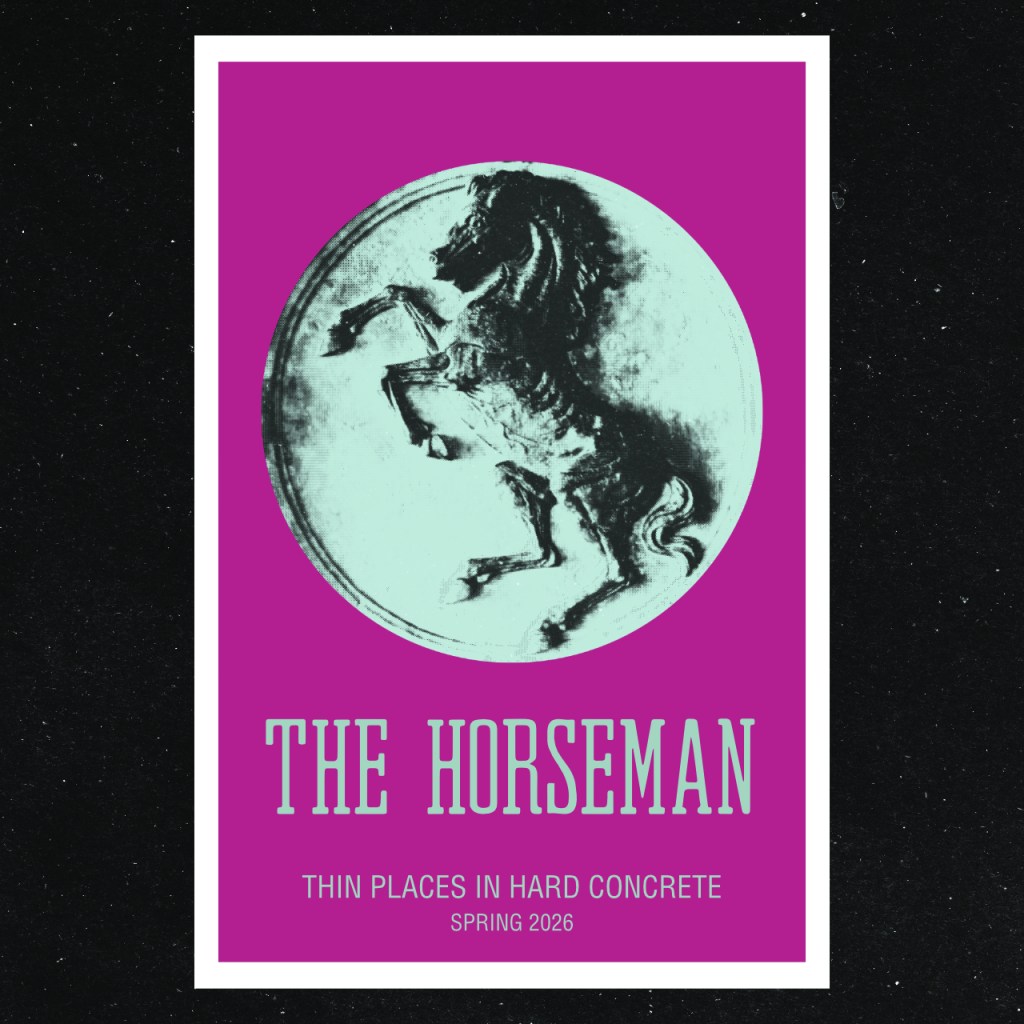
The fifth story in my new collection Thin Places in Hard Concrete is about a woman who doesn’t understand why on the site of St John the Baptist on the high street there now stands a temple to the cult of a horseman.
Not only is the temple there but it seems to have been there for more than a hundred years, and everyone around her seems to take this strange cult for granted.
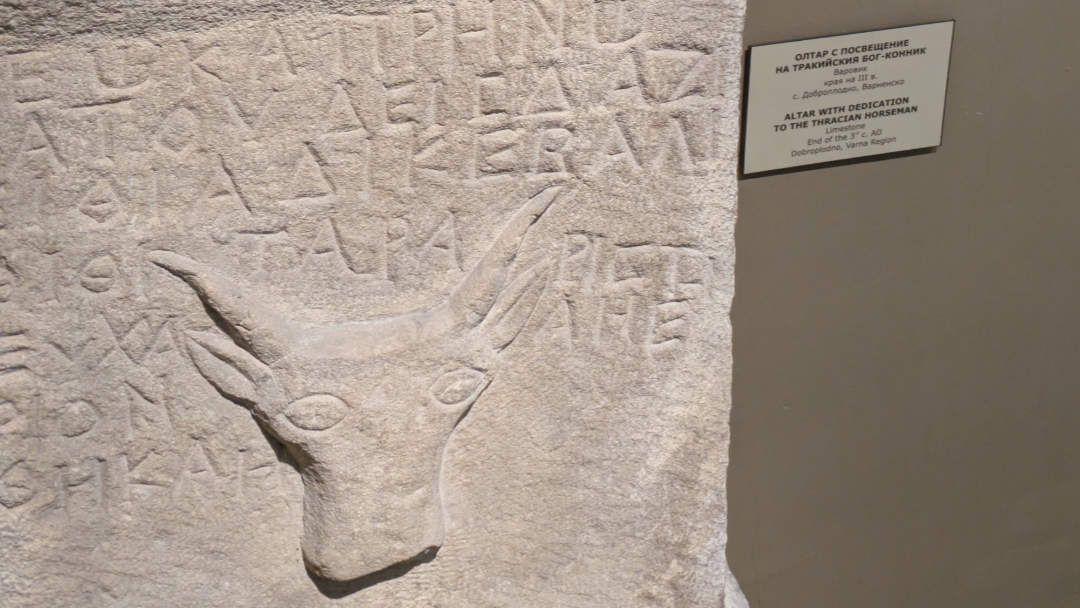
It’s an alternate reality story was inspired by my visits to museums in Romania, Bulgaria and Serbia where various artefacts from the ancient world depicted images of the Thracian horseman. There was a cult of the Thracian horseman in the Balkans for about 500 years from the third century BC. Then, in the Christian era, the imagery of the rider was applied to depictions of St George and St Demetrius.
I was already fascinated by this, and pondering on whether there might be some folk horror potential in it, when something I saw in a museum in Bosnia gave me the final inspiration I needed.
Up to this point, the Balkan countries I’d visited tended to talk about the Ottoman period as a dark time when very little of cultural importance happened. They were on hold, waiting to be liberated. But in Bosnia, that narrative was flipped, and the Ottoman Empire brought light where there had been ignorance. In that context, a display of medieval Christian artefacts came with interpretation that said something like:
“Christianity was one of many cults that emerged in the Roman Empire.”
Now, I’m not religious, but I did grow up in a country and a culture shaped by Christianity, so this description momentarily startled me. Even though, of course, this is exactly the point that is also made in Monty Python’s Life of Brian.
What if a different cult had risen to the top? And what if that cult was totally unlike Christianity? Would there still be harvest festivals and church coffee mornings and dancercise meetings in the hall on Wednesday mornings?
My friend Alex kindly reviewed Thin Places in Hard Concrete on Goodreads before anyone else could get in first. He says:
I think my favourite might be The Horseman, in which a woman is surprised to see the local church has been replaced with a temple to a strange new faith… except it’s not new, it’s clearly an old building, which everyone else remembers having always been there. So far, so Arkham City, but what elevates it is that rather than playing out like a grand cosmic horror narrative, the replacement faith operates with the same faint crapness as modern British Christianity, all Henry hoovers in the holy places, awkward attendance at occasional ceremonies to placate older relatives, and an air of cringe around anyone too thoroughly into it.
And, yes, that’s exactly what I wanted to achieve.
Re: that Henry hoover, by the way…

One thing I noticed when compiling the collection is that its protagonists are, on the whole, slightly less working class than in Municipal Gothic and Intervals of Darkness.
In this case, I found myself thinking of the slightly more well-to-do people from my home town who, while not posh, and still with Somerset accents, drove newer cars, played golf, and took holidays to Turkey or Spain every year.
They had management jobs at the cellophane factory, became councillors, wore blazers on special occasions and, of course, had a church that they sometimes went to.
Their vague commitment to Christianity was part of what made them respectable.
You can buy Thin Places in Hard Concrete as an eBook or paperback from Amazon wherever you are. For starters, here’s where you’ll find it if you’re in the UK or US:
I’ve chosen not to apply digital rights management (DRM) to the eBook file so you can download it as an ePub file or PDF to read on whichever device you like, such as a Kobo.


