Categories
Fiction

FICTION: Passenger X

Do not alight

On 4 September this year, as a result of a door malfunction, Passenger X was able to disembark at a disused ThamesLink platform when the 20:51 from St Pancras to Bedford was briefly held at a signal on the approach to Farringdon. They did so despite the presence of a substantial amount of do-not-alight (DNA) signage. This was observed by the driver and by the control room via CCTV. Passenger X then left via a platform exit that was supposed to be caged off and locked. Subsequent inspection showed that the cage and padlock were both in place. Passenger X did not exit the station at ground level and a thorough search by London Underground staff and British Transport Police has found no trace. A limited description of Passenger X has been circulated along with images extracted from CCTV.

The electric chair

The photograph, taken on an iPhone by a Dutch tourist, on the Victoria Line between Oxford Circus and Green Park, shows a distinct human figure on the other side of the carriage window, in the darkness of the tunnel. The person in the photograph appears to be staring into the carriage, mouth open, hands up and splayed on either side of their pale, rather elongated face. It has been compared to the 1983 Karen Collett photograph which apparently shows somebody being executed in an electric chair in a darkened Bakerloo line tunnel. In both cases, an advertising poster is suspected to be the root of the phenomenon.

Crush zone

On the night of 3 March 1943, 174 people were crushed to death sheltering from an air raid at Bethnal Green tube station. I know this because I read about it, and obsessed over it, as a nervous child. The fluorescent light there is impure, green-tinted, making every passing commuter look like a corpse. We avoid each other’s eyes, coming and going, most of us, so I notice the man who looks directly at me. I see his open mouth and the palms of his hands, which seem to be flattened, as if pressed against an invisible sheet of glass. There is something he wants to say. I want to ask him a question, I’m not sure what question, or why, but I’m pulled along in the crowd and out into the daylight. Someone is smoking weed. A car passes with loud music playing. My phone rings.

Lost and found

Found in an alcove in a southbound Northern Line tunnel between Euston and Warren Street: one rucksack, red; one A5 hardback notebook, partially filled, used as a diary; one fountain pen, cartridge expired; one hand-drawn map comprising 40 sheets of A4 paper taped together, showing the locations of tube stations, main tunnels and service tunnels; one diagram, possibly of an electrical circuit, unlabelled, laminated. British Transport Police and security services aware.

Van Kappelle’s unused tiles

British-based Dutch artist Piet Van Kappelle was commissioned to design tiles for one of the stations in the planned southward extension of the Victoria Line. The designs he submitted to the London Underground design office in March 1973 were rejected and caused Van Kappelle to be removed from the list of approved craftsmen and designers for LU projects. Asked about this several years later, he said he had only followed the brief received in the post. For their part, the LU design team denied having sent Van Kappelle such a brief. The documents he shared to corroborate his story – eight foolscap sheets in a manila envelope sealed with a string toggle of the type then used for LU internal mail – spoke about energy fields, the repelling force of magnets with matching poles, circuits and loops, and so on.

Death Line AKA Raw Meat

I swear to god I’ve never seen that film. I don’t know what you’re talking about. All I know is, I was waiting on the Northern Line – southbound, yeah, right – and I saw someone coming out of the tunnel and onto the platform. Crawling. Kind of… oozing? No, not dirty. Very clean. Totally bald, completely white head. Dressed in a suit, I think, and maybe a black coat. No, they didn’t say anything. Nothing I could hear. I don’t know what happened next. I got out of there. I got a bus. Two hours, the bus took. Two hours!

The banshee scream

Mechanical friction noise has long been a problem on the Jubilee Line as a result of rail corrugation and friction over curves. A long-running joke among London Underground personnel is that it resembles a person screaming, or a chorus of screams. A review of CCTV footage from the weeks preceding the disappearance of Passenger X found numerous instances of the same individual aboard noisy stretches of the Jubilee Line apparently screaming in unison with the train. The CCTV is without audio but the footage was cross-referenced against staff reports and customer complaints, two of which referred to Passenger X as “singing” or “harmonising” with the screech of the rails.

An American Werewolf in London

Yes, I’ve seen it, who hasn’t? It was nothing like that, apart from the escalator. It wasn’t… He wasn’t chasing me. He wanted help. He was lost. But I was going up and he was down at the bottom, lying on the ground, crawling towards the escalator with his hands out. His fingers were long, too long, like those cheap candles you use during a powercut. I told someone up top and they said they’d check it out. Did they check it out? Is he OK?

Inspector Sands

At 20:58 on 11 September maintenance workers accessing the storage area in the tunnel extension south of Brixton reported an electrical blackout followed by an unrecorded, unauthorised and non-standard Inspector Sands announcement. One of them recorded a brief snippet using their phone. The recording backs their collective assertion that the announcement was in the same voice as the usual Inspector Sands fire warning, with a similar audio quality, but the words spoken were something like “Inspector Sands cannot find the exit” or “Inspector Sands cannot reach the exit”. Monitoring has been established but no repetition of the incident has occurred.

Extract from the diary of Passenger X

The escalator is not working which means I have to walk up it, struggling with the deeper than usual steps. I know it isn’t working, I know that when I step off it will just be like reaching the top of a normal staircase. But, still, I feel a lurch, a jolt, and stumble as I transition from one surface to another. In some small way, it feels like a near-death experience. The tube is full of moving parts, and non-moving parts, and tunnels, and closed tunnels, and spaces between the two. They say “mind the gap” but what if that gap is where I need to be?

Flashover

I saw the man again at King’s Cross, on the Piccadilly Line escalator. I’ve always been nervous there, since I was a kid, since the fire, since the evening of 18 November 1987 when 31 people died. I was going down, on my way home; he was coming up. The advertising screens behind him blacked out one by one as he passed and he looked straight at me. I knew the question I wanted to ask this time: Where will it happen, and how do I stop it? But I couldn’t ask it, not with all those people around. He mouthed something I couldn’t understand by lip reading, and I couldn’t hear him, not from behind his wall of glass.

Note from the diary of Passenger X

Stray current… imperfect insulation of running rails… asymmetric distribution of traction current and poor rail-to-ground conditions of traction power supply system… closed metro tunnels… new conductive pathways… accumulation of carbon dust… traction reflux leaking from rail into ground, creating stray current… running rails as current return path… increases leakage current… (Makeyaw et al, Energies)

The ghosts of the Elizabeth Line

Within weeks of its opening, clean and gleaming, ghosts began to appear on Elizabeth Line platforms – smudges of dirt on the white walls behind benches, human shaped, shadows from the grease and dirt of thousands of bodies and thousands of heads. Cleaning was intensified. It didn’t work. Eventually, large decorative vinyl stickers were applied to the walls to conceal the ghosts, and prevent further staining. Mercy Owoyomi, a late night cleaner, swears she has seen one of the ghosts stand up and drift towards the platform edge. She says she’s seen it pass through the glass and be rushed away like smoke in the wind. Mercy only tells this story to her closest friends, in the break room, in a language the supervisor cannot understand. Mercy doesn’t want to be thought mad.

Categories
Fiction Film & TV

FICTION: We Have Always Battled Monsters in This Castle

Lightning drew a blue outline around the spires and towers of the castle on the mountaintop. Captain Rauch, high on his charger, pointed with his cavalry sword.

‘There, Doctor Kleist,’ he rumbled. ‘Do you see?’

Kleist lifted his skeletal features and peered from beneath his brimmed hat. His blue eyes gleamed. He waited a split second and then, as thunder cracked, said with perfect diction: ‘Castle. Grafenstein.’

Both men steadied their horses.

‘Grafenstein,’ repeated Rauch uncertainly, a fine line appearing between his dark eyebrows. ‘Yes, Grafenstein.’

Kleist pressed delicate fingertips to the ornate golden crucifix around his neck and snapped the reins to drive the horse along the strangely flat path into the forest that surrounded the mountain.

Only a few moments later, it seemed, they arrived at the castle gate. Once again Rauch’s natural haughtiness was tempered by confusion.

‘I don’t remember… How…’

He looked back to where the woods should be and saw a nothingness.

Kleist seemed untroubled. He dismounted and tied his horse to a railing. He straightened his heavy woollen frock coat, adjusted the fox fur collar, and clapped his gloved hands.

‘At last, his reign of terror will come to an end and the people of Kronstadt will be free from the malign master of Castle–’

He stopped and stared at the carved coat of arms above the gate. Text in German blackletter read ‘Schloss Krolek’.

‘Castle Krolek.’

Rauch drew alongside, towering above Kleist, and glowered.

‘Count Krolek of Castle Krolek, of course.’

‘Of course.’

As they passed through the gate, Rauch reached out to touch its grey stone and felt it crumble beneath his fingers, scattering white flakes.

They crossed the moat and approached the great door which opened before them like a giant mouth awaiting food. Kleist held up his crucifix and waved a gloved hand at Rauch, urging him to do the same.

As they crossed the threshold, Kleist shuddered and clapped a hand to Rauch’s chest.

‘Did you feel that?’

Rauch nodded.

There had been some strange shift, like a cut in time, though neither man could put the feeling into words.

The entrance hall of the castle was brightly lit and luxuriously decorated. Flames roared in an enormous stone fireplace.

Rauch looked back. Beyond the door where the courtyard and moat had been a moment before, the nothingness had further encroached.

‘Kleist, look!’

Kleist ignored him. He had already begun to stalk the great hall, inspecting its stonework and tapestries with his long fingers. He paused when he reached the fireplace and looked up at the portrait that hung above it. He stepped back and gasped. It was Rauch, crudely painted, in a black cloak and the ceremonial uniform of a Wallachian boyar.

‘You admire the portrait of my ancestor,’ said Rauch from the staircase.

Kleist felt a fluttering in his mind and his eyes misted for a moment. He heard himself say, involuntarily, ‘Count Krolek!’

‘I bid you welcome to my home,’ said Krolek, who was no longer… who had he been? Kleist had already forgotten not only Rauch’s name but also his very existence. Krolek wore a red lined cape and a velvet jacket the colour of dried blood. His voice was low and resonant and there was a combination of hatred and arrogance at odds with the words he spoke.

Kleist reached for the cross at his neck and for the pistol at his side.

‘Do not move, Krolek. This is loaded with silver bullets blessed by the priest at Kronstadt… I mean, at Carslbad – and dressed with Holy Water!’

Krolek’s eyes burned red.

‘You dare to threaten me? I who have commanded armies and now command armies of the dead? I who have in my veins the blood of… of…’

Krolek’s powerful voice faltered. He looked up and became mesmerised by something.

Kleist followed his gaze. There was no ceiling above, only that same blacker-than-night nothingness. Turning slowly Kleist realised that there was also darkness behind him where a castle wall ought to be.

Then, to his left, another wall began to move.

‘What black magic of yours is this, Krolek?’

Another wall slid between Kleist and Krolek, locking with the first, blocking Krolek from sight. Objects shifted around Kleist, whirling and drifting into place, until he was surrounded.

The pistol in his hand had become a scalpel, his coat a surgical apron. His eyebrow arched as he turned the blade to catch the beam of a vivid pink light. He forgot the nothingness for a moment, and forgot he had ever been Kleist. His work with the human brain was too important to be distracted.

Beyond the wall, Rauch-Krolek was lost. When the walls moved, the nothingness surrounded him for a moment and he found himself adrift on the staircase in blank space. He tried ascending the stairs and found himself on a landing with a large stone eagle. On its plinth were carved the words ‘The House of Zarkhov’. The nothingness advanced behind him like a rising tide. He swore in Russian-accented English and bounded up another flight of steps. The eagle confronted him again but this time with the name ‘Pengellis’ carved into its base. Why was he running? Oh, yes, for revenge on Baron Pengellis for what he had done to the girls of the village, including his own sister, while he, Captain Trelawny, was away at sea. Black water, or something like water, lapped at his boots, forcing him up another storey. Again he found the eagle, the very same eagle, with the worst name of all: Frankenstein.

Kleist-Frankenstein leapt at him with a scalpel causing him to drop the feathered policeman’s helmet from the crook of his arm. He clapped a hand to his arm which was now bleeding freely, his blood too vivid and viscous to make sense.

‘You can’t stop me now, Inspector Becker, you must know that.’

He swiped again and caught Rauch-Krolek-Becker’s face. A line of blood appeared at one, as if a child had marked him with school poster paint.

‘My experiments with transplanting multiple human consciousnesses into a single brain are almost complete. No meddling policeman–’

‘Look!’ said Becker.

Frankenstein smiled and kept his eyes fixed on both the tip of his blade and the stiff-backed Saxon police officer.

For a moment, the nothingness swallowed Frankenstein’s lower leg. The smile left his face. When the shadow withdrew like a lapping wave he was weak and confused.

‘We’d better go up another floor,’ said Becker softly.

For the first time, there was complete silence. The music they were used to hearing, that called their names in brass, had ceased.

‘You first,’ said Frankenstein, gesturing with his scalpel, still trying to dominate the situation.

Somewhere on the flight of steps, as his neat elastic-sided boots pressed into deep red carpet, the scalpel became a British Army pistol and Inspector Becker grew a goatee beard.

This time, the Eagle bore the name ‘Corbeau’. Becker was no longer Becker but his old friend Colonel Gautier, scourge of the satanists. When Gautier addressed him by a new name, he was not surprised.

‘Hold fast, Henniker,’ he said, raising a finger to his ear. ‘Hark – the ritual has begun!’

There was a sound, a deep hum, that might have been chanting, Henniker supposed. It seemed to come from a double door before them. The door was white with gilded trim. On either side were statues of Anubis on white plaster columns.

Gautier turned to Henniker and planted his hands on the smaller man’s shoulders.

‘In our many adventures together, we have never come across a villain as dastardly as Corbeau. Are you with me? I should not judge you if you walked back down–’

He stopped. The steps had gone. There was now only a floor with black and white tiles leading to an entrance hall.

‘I mean…’ Gautier shook his head, touched his brow, and found the line. ‘I should not judge you if you walked out of the door and left me to do psychic battle with this rogue alone.’

Henniker shook his head and raised his service pistol.

‘I’m with you, old man, just as I was at the Devil’s Wood in sixteen.’

As they advanced on the door, jaws fixed, they didn’t notice the walls behind them sliding out of place, or the floor falling away as if into space.

Gautier flung open the door and they burst onto a plain, empty, flagstoned terrace. Lichen grew on the slabs. There were cigarette ends scattered about.

There was no ritual, no Corbeau.

Gautier whirled around. The door behind them was an ordinary door set into an ordinary English country house of no particular distinction.

Kleist-Frankenstein-Henniker dropped his scalpel-gun-sword which landed with a tinkle-clunk-clatter and approached the balcony.

Below was a park where a man in a yellow anorak was walking a dog. The red roof of a number sixteen bus passed above the trees.

Wind whipped at Rauch-Krolek-Gautier’s wig which, in broad daylight, looked absurd.

Henniker shivered. He was, after all, a frail old man.

With brotherly care, Gautier guided him back through the door, into the house, where the eagle, the nothingness, and a thousand monsters awaited them.


This story originally appeared in issue 3 of the General Witchfinders Zine in September 2025.

Categories
Fiction Film & TV weird fiction

12 thoughts about liminal horror

The new film Backrooms directed by Kane Parsons has everyone talking about ‘liminal horror’. As someone who writes stories which might fit into this bracket, I’m excited to have a new sub-genre to ponder.

Here are some initial thoughts – reactions, almost – to a phrase I had not heard until about three days ago.

1. In liminal horror the space itself is the source of the unease, not the ghosts or monsters that lurk within it. A still image of an empty room can evoke the appropriate sense of unease, partly because it is empty.

An empty, abandoned shop with bare shelves, dark shadows, and security monitor on the ceiling glowing purple.

2. “It’s bigger on the inside…” Perhaps liminal horror is about spaces that should not be and that make no sense. A long corridor is creepy; a corridor that seems infinitely long is deeply unsettling. H.P. Lovecraft wrote about spaces with non-Euclidean geometry just as he referred to impossible colours. You might also think of the deliberately disconcerting geometry of Hill House in Shirley Jackson’s The Haunting of Hill House. Or even the land that somehow sits beyond the back of the wardrobe in the works of C.S. Lewis.

3. Do we hate these eerie spaces, or yearn for them? It’s a love-hate relationship. We call it liminal horror but there’s also a romantic allure about places that are silent, empty, blank… Where we might lose ourselves, slip between walls, and be left alone for two fucking minutes. In Genki Kawamura’s Exit 8, the other liminal horror film currently doing the rounds, the protagonist finds himself on a subway station corridor that he soon learns is an impossible space and a trap. But at the beginning, for a moment, he is free from the noise and aggression of the city – and from his responsibilities. Did he perhaps want this?

A dangling yellow exit sign in a brutalist car park with poor lighting.

4. Did Lucio Fulci get there first? I know, I know, I’m always on about Fulci’s 1981 film The Beyond, which I don’t even think is a good film, and certainly isn’t one I’d recommend to everyone. But the ending has the protagonists run down a staircase in a hospital and find themselves in the labyrinthine basement of a hotel from which they had earlier fled. They continue their flight until the basement opens up into an infinite, foggy plain strewn with shrouded corpses. That feels like liminal horror to me.

Four seats against a concrete wall in a dark corner of an institutional building.

5. These are some other things that are coming to mind, but I don’t know if they’re liminal horror:

  • the mausoleum in Phantasm
  • the wasteland and abandoned industrial buildings of Stalker
  • the near-abandoned apartment block in Dark Water
  • the shopping mall in Dawn of the Dead
  • Dave Bowman’s tacky hotel room in space in 2001: A Space Odyssey
  • Judgement City in Albert Brooks’s comedy Defending Your Life
  • Being John Malkovich and the floor between 7 and 8
  • that perfectly white room where Willie Wonka shrinks Mike Teavee

6. “Alright, cunt, what happens?” – Reece Shearsmith. Liminal horror as internet meme doesn’t need a plot, or characters. It can just be, “Whoah, look at this weird door I found,” or, “Check out this hallway!” But books, stories and films generally do require things to happen to people. But does this spoil the fun? Perhaps liminal horror is a rare sub-genre that might work best in virtual reality.

A door in a dingy basement through which can be seen a group of creepy white mannequins gathered around a wardrobe.

7. Oh, actually, never mind Fulci – perhaps Elizabeth Jane Howard got there first. At the end of her story ‘Three Miles Up’ from 1951 concludes with a canal boat exiting a channel not on the map into “a sheet, an infinity, of water stretched ahead; oily, silent, and still, as far as the eye could see, with no country edging it, nothing but water to the low grey sky above it.” Infinite, edgelesss and endless feel like the qualities we’re looking for here.

8. Are the spaces where liminal horror stories take place related to ideas of heaven, purgatory or hell? I mentioned Defending Your Life above which isn’t a horror film but, like the sitcom The Good Place which I’m sure it inspired, suggests that death might feel like being in a waiting room. “I’m in the waiting room now,” is something my mum actually says when pondering her mortality. Waiting rooms, like corridors, are spaces between spaces, checkpoints or chokepoints on a journey rather than the final destination.

A bench on the London Underground with dirty smudges on the wall showing where people have been sitting.
Ghosts of the Elizabeth Line, London.

9. Fog creates instant liminality. It erases the edges, swallows the horizon, silences the world, and leaves you floating in space. It turns any house into The House on the Borderland.

10. So, every single haunted house story is liminal horror? So, John Carpenter’s The Fog is liminal horror? So, any story where they find tunnels hidden beneath a building is liminal horror? Well, yes, maybe, I don’t know, that’s what I’m trying to work out. But perhaps the missing component in my thinking above is that the weird spaces in which liminal horror occurs need to be modern, or at least not antique. In liminal horror, the lights are probably on; they’re probably fluorescent; and they’re probably humming. They’re probably not domestic settings, either, but institutional: hotels, schools, transport hubs, office blocks. They’re bland, beige and functional. Is there some element of the Kafkaesque here – the fear of being lost in the system?

An old beige institutional telephone on a white wall.

11. Liminal horror is in the eye of the beholder. When I wrote about the creepiness of hotels, someone on BlueSky got mad at me because they just didn’t understand what I was talking about. Hotels are nice! Stop saying things are uncanny when they’re not! It’s just a hallway. It’s just an empty space. It’s only a storeroom.

A doorway at the end of a concrete hallway.

12. Sorry I keep using the word ‘liminal’. It’s one that many people avoid using these days. I usually avoid it myself. How else might we describe this sub-genre or trend? I’ve heard ‘analogue horror’ thrown around, referring to the use of filters to evoke VHS recordings and other vintage media. That’s not about spaces but it can help sell their reality and their feeling of being outside time. Today, I saw ‘ordinary horror’ for the first time, via Zachary Gillan, but Andrea Capra, the author of the book of that title, means something very specific: “the horror that haunts our world, and that we may encounter firsthand”. I feel some connections between liminal horror, analogue horror, and various forms of lo-fi ambient music – analogue hiss and crackle, ASMR-adjacent field recordings, a hypnotic waiting room quality. So, perhaps ambient horror would work, too.


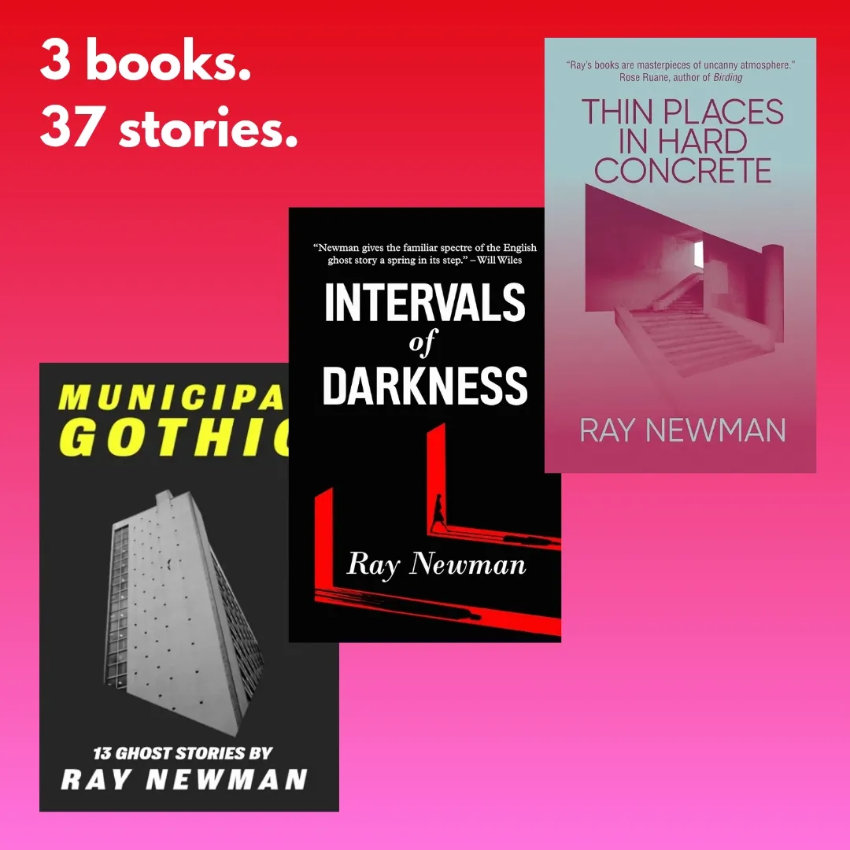
My latest collection of stories Thin Places in Hard Concrete has a story about a motorway interchange and a recreation of a medieval palace in an underground bunker, among other contenders for the liminal horror tag. It’s available as an eBook or paperback from Amazon wherever you are. For starters, here’s where you’ll find it if you’re in the UK or US:

I’ve chosen not to apply digital rights management (DRM) to the eBook file so you can download it as an ePub file or PDF to read on whichever device you like, such as a Kobo.

Categories
Fiction

FICTION: The Stray Dog

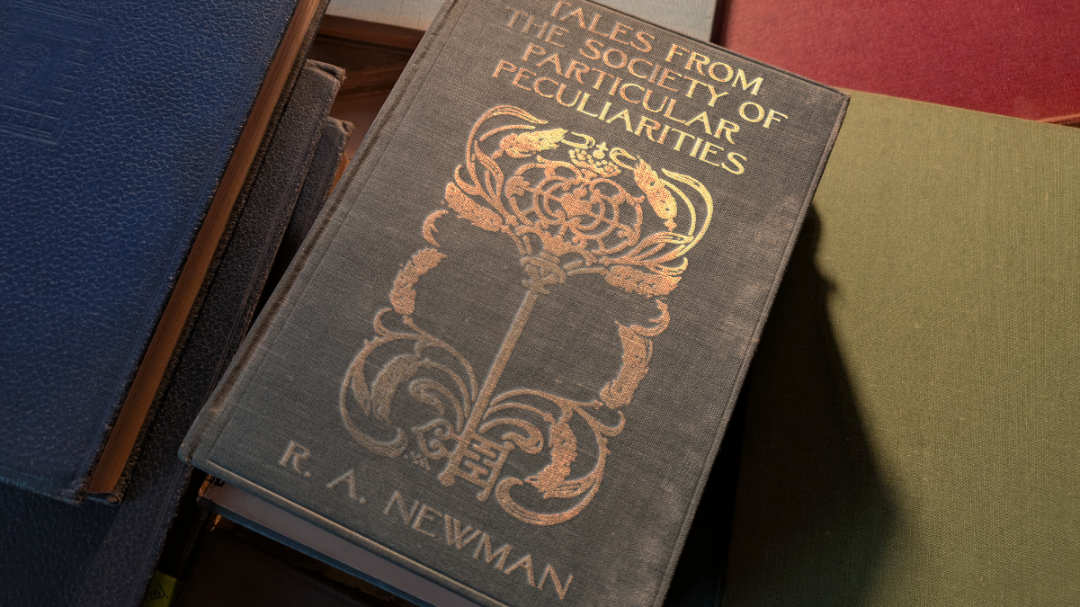
The members of the Society of Particular Peculiarities meet every month, but the December meeting is the most important and best attended of the year, because that is when I tell my ghost story.

There was a good mist up as we gathered last week in the venerable old county town. The clubhouse is off the market square, old but not ancient, being a former Unitarian chapel of 1712, with a clamshell hood above the door, and a galleried interior. It is generally colder inside the clubhouse than outside but on the evening of our meeting Gough, the caretaker, had provided a paraffin heater and a supply of blankets.

Very nearly the entire membership of the Society was in attendance, including Mrs Neville, the celebrated lepidopterist, and the silent Sampson twins who had travelled all day on foot from their remote farmhouse. They were collectors and chroniclers of shipwrecks despite not having been within sight of the sea their whole lives, as far as I am aware.

When all were gathered in the pews, with hunting cups of Scotch whisky or tin mugs of sweet tea, Mr Smyth-Glover read the minutes of the last meeting. There was a brief discussion of membership fees and several members spoke for the record of their own recent work – Mr Salani’s dinosaurs, Miss Kitchen’s fairy dens, and so on. Then, these business matters being concluded, I was prompted to mount the dais. Looking out on a hall barely illuminated by a few oil lamps and candles I saw the upturned faces of my audience as pale, shimmering ellipses.

‘This ghost I found at a village in Devonshire,’ I began, ‘the tale whispered to me in exchange for the price of a double-handled mug of cider.’

* * *

Mr Edward Palmer was one of Mrs Duddridge’s ‘stray dogs’, as her husband called them. She met him during a talk about Africa at one of the university settlements in London.

‘I simply had to invite him,’ she said. ‘Otherwise the poor man would spend Christmas quite alone in some awful bedsitting room. He has no parents, no siblings, and no other friends as far as I can tell.’

‘He’s good company, then?’ asked Mr Duddridge.

‘Don’t be facetious, Henry. He will, I’m certain, blossom in the nurturing warmth of a family home.’

As Christmas drew near, however, Mrs Duddridge realised that there would not, in fact, be enough room at the Lodge for the numerous friends, relatives and lonely strangers she had invited. And, despite her desire to be tolerant of the foibles of others, even she had to admit that Palmer had a somewhat testing personality.

‘He has an ability to terminate conversation,’ she explained to her sister. ‘The silences are awful. What else can I do?’

When Palmer arrived at Bittlecombe on the Exeter train a few days before Christmas Mrs Duddridge greeted him on the platform and, in a cloud of polite chatter, diverted him towards the Station Hotel.

‘You will, I’m sure, be much more comfortable at the hotel and Bittlecombe is a small place. You will be able to walk to the Lodge to join us for as many meals as you like and return to your own room here when the children and the crowds and the noise become too much for you.’

Palmer, hunched and dreary, muttered something about not minding children or crowds or noise, but allowed himself to be ushered through the door of the inn.

‘You are our guest, of course, and Mr Duddridge has taken and paid for several rooms for–’ She rang the bell on the counter and tried to think of the correct turn of phrase. ‘For those among our wider circle of dear friends.’

As the hotelier carried Palmer’s single shabby bag up the stairs, with Palmer following rather too close on his heels, Mrs Duddridge called after him: ‘Dinner will be at seven o’clock if you wish to join us.’

Palmer nodded and moved his lips, indicating gratitude, but no sound emerged.

The Station Hotel was singularly gloomy and Palmer’s room, number seven on the first floor, had too many dark corners or, rather, too few lamps. Every surface Palmer touched felt wet until the slight warmth of his sallow hand chased away the fine dew. The fireplace was empty and the heavy old radiators, rusting inside and out, gave out little warmth, though making much noise in the process.

Once he had unpacked, and dressed for dinner, Palmer found himself at a loose end. He tried reading, first a newspaper, then a novel, but continually found his attention wandering. It wandered, specifically, to the door that connected his room with the next along the corridor. The door was locked and bolted. The gap at the bottom was quite dark and Palmer fancied he could feel a draught, almost a breeze, seeping through the black gap.

As if sleepwalking Palmer put down his book, rose from the threadbare armchair, and approached the connecting door. The incoming air had a faint but unusual scent, not entirely wholesome, as if something had been left out of the pantry and was beginning to turn. He placed his fingers against the thickly painted wood and fancied he felt some slight vibration. Then he pressed his ear to one of the door panels. Was there a voice? Was somebody speaking?

Palmer rarely smiled, or frowned, or allowed his face to take on any expression at all, but his brow wrinkled slightly at that faint sound. He seemed, somehow, to know the music of that voice – to recognise its faint rumble. Of whom it reminded him he could not yet say.

Anxious not to be late, Palmer set off too early, was caught in a cloudburst, and arrived at the Lodge drenched, well before his expected time. Mr Duddridge was obliged to entertain him for an uncomfortably long hour. What’s more, Palmer had dressed for dinner, which the men of the Lodge rarely did, and never for these informal family meals. He sat stiff and upright with a glass of sherry pinched between his thin fingers while Duddridge lounged comfortably in a saggy brown suit.

At dinner, Palmer let the soup spoon rattle against his prominent teeth, like a gaoler’s key being fumbled in the lock, and nearly choked to death on a fish bone. Conscious of his duty as a guest, he attempted to tell an anecdote, but did so in such a low whisper that much of the detail was missed by those gathered around the table and, lacking a punchline, the tale drifted to an uncertain ending. Nobody was sad to see Palmer lurch out into the night at a little after ten o’clock.

Palmer lay between his cold, faintly moist sheets, and tried to sleep. Every time he began to drift, however, some sound or other would cause his eyes to spring open and scour the darkness of the room. The partial darkness, that is, because the drooping curtains did not quite block the moonlight, which sketched the edges of the heavy old furniture that cluttered the room. Some of the disturbing noises were easy enough to explain: footsteps on wet cobbles in the street outside; the screech of a fox; the boom of the old boiler in the basement sounding through the pipes; wood cooling and cracking. One sound, however, seemed to sit beneath these others, not exactly like a long bowed note on a double bass, but insinuating itself in that same way. It came, he was certain, from room number eight. Palmer strained to listen and even held his breath, but could not make out anything concrete. Perhaps the sound was his own blood rushing in his ears, or the beating of his own feeble heart.

There was still no light beneath the door and, indeed, the darkness there seemed deeper than anywhere else in the room. His eyes fixed on it just as his ears had fixed on the elusive sound, perceiving forms and movement which he knew were mere interpolations made by his mind in response to that pool of impossible, deep, textureless black.

He must have gone to sleep because he certainly awoke, finding the room filled with soft grey morning light, and the sound of heavy rain upon the rattling window pane. In daylight, the door looked quite ordinary and remarkable, if at all, only for its seediness.

Unable to remember if he had been invited for breakfast, lunch, or neither, he decided to present himself at the Lodge anyway. The thought of its warm fires and atmosphere of familial joy were irresistible compared to the moth-eaten gloom of the hotel.

There was, indeed, a gathering at the Lodge, and Palmer was made to feel quite welcome, eventually falling into conversation with a young man he fancied to be a nephew or cousin of Mrs Duddridge. He was a handsome fellow of about twenty five who introduced himself as Warren and, though hardly bright, shared Palmer’s interest in bicycles, their maintenance, and recent improvements in the manufacture of British machines. At lunch, Palmer avoided embarrassment by eating and drinking almost nothing. He joined a party for a walk in the afternoon and played billiards as night fell.

He was politely turned away after tea, that evening being reserved for ‘a dinner for close family’, which seemed to include everyone except Palmer. He did not notice or mind, having quite exhausted himself anxiously choosing every word and worrying about the arrangement of his long limbs for many hours on end.

He bathed and, shivering slightly, read the better part of an atrocious novel by Le Queux. By ten o’clock he was in bed and by quarter past, sleeping deeply.

What woke him some time after midnight he could not say, the only clue being that he heard himself shout into the darkness ‘No, don’t come in!’ and scrambling to cover himself. Had someone knocked? He pulled on his dressing gown and stepped into the corridor. It was empty and the only sound was the whine of wind through a cracked pane at the end of the hall.

Returning to bed, he rolled to face away from the connecting door and pulled the thin blanket high over his head. He began to recite something from Tennyson, a long verse he’d been forced to learn at school. In the pause between each line he fancied he heard an echo of his own voice, the faintest sibilance, something less than a breath.

It was now Christmas Eve and Palmer understood that he was expected to spend all day at the Lodge for carol singing, games, and other sociable activities at which he hardly excelled. He dawdled terribly, only setting out of his room at a little before eleven o’clock. He found the hotelier sweeping the lobby and cleared his throat hoping to catch the man’s attention.

‘Good morning, sir.’

‘Um,’ said Palmer.

‘Yes, sir?’

‘Is there…’ He coughed. ‘Is there a guest in room eight? The room next to mine?’

The hotelier blinked and shook his head.

‘It’s only you at the moment, sir. Another guest of Mrs D is due today, I believe, but I’d thought I’d put him in number ten.’

Palmer rotated his hat in his hands.

‘Not number eight, then?’

The hotelier looked peeved for an instant then corrected himself.

‘Well, sir, no, because truth be told, that room is in need of some repair. Pigeons got in last winter and made a rotten mess.’

‘Ah, yes, pigeons. Noisy creatures.’

He was able to ascribe all the disturbances of the preceding nights to this colony of pigeons, even though he’d heard nothing resembling cooing or the flapping of wings. It was enough to know that there might, indeed, be a living presence of any kind in room eight.

The improvement in his mood carried over to the Lodge where over lunch he managed to successfully respond to questions from a young lady called Miss Day with questions of his own, maintaining quite a successful rally. He told a joke he’d heard in the office which, for once, was both funny and inoffensive. Someone slapped his back and called him a ‘good fellow’  which he found to be an entirely novel experience.

Mr Warren sought him out after lunch and invited him to inspect his bicycle, a brand new Rudge-Whitworth.

‘You must try her out,’ said Warren. ‘Pneumatic tyres are the only thing for the countryside.’

Palmer accepted this invitation and cycled up the drive, out into the lane, and around the village square, returning with ruddy cheeks and an appetite some twenty minutes later.

Mrs Duddridge observed Warren and Palmer with an indulgent smile, as if to introduce them had been her plan all along.

As evening came, sherry and port were consumed, and Mr Palmer also drank two bottles of double stout supplied by one of the servants. This gave his carol singing a certain confidence if not contributing to its precision.

Towards midnight, Mr Warren gave Mr Palmer a piggyback ride, and Mr Palmer returned the favour. Mrs Duddridge was not quite sure whether to be amused by these boyish escapades. Eventually, catching Mr Warren’s eye, she pursed her lips and gave a small shake of her magnificent head.

Mr Duddridge decided that a late supper was required and went to the kitchen himself, returning with a loaf of bread, a wedge of cheese, and something on a stand covered with a fine lace doily. He placed these items on the table and, with a proud flourish, whipped away the covering to reveal a quivering cake of brawn. The aspic had been tinted pink and slivers and chunks of meat were suspended in it like jewels.

‘What do you think of that?’ said Mr Duddridge, prodding the brawn with a finger.

Mr Palmer blanched, staggered, and was promptly sick behind the piano.

The party broke up and Palmer found himself once again ejected into the darkened lane, with a foul taste in his mouth and the beginning of a sore head.

He was in his room just as the church bells began to ring midnight, announcing Christmas Day. The rusting radiator had been on all evening and was practically steaming with heat. Feeling nauseous and overdressed, Palmer disrobed in a disorderly, rather frantic fashion, casting his waistcoat one way and his threadbare silk scarf another. It was only when he’d stripped down to his wooly combinations that he noticed, first, a cold draught and, secondly, a sharp line of moonlight.

The connecting door was open. It seemed to be inviting him in. The stench of rotten meat both repelled and enticed him.

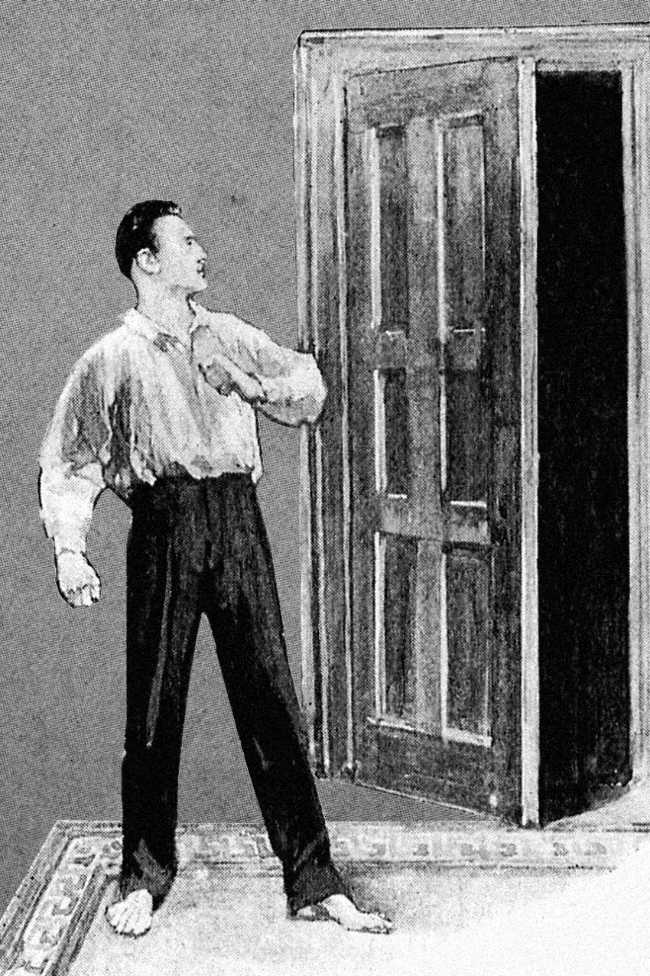
An Edwardian style illustration: a man stands on guard next to an open door beyond which is darkness.

He stepped closer, his bare feet turned inward.

‘I say,’ he whispered, unable to stimulate his vocal cords into meaningful movement. He coughed and tried again. ‘I say, is there somebody there?’

There was no answer but the silence had weight, like those occasions when his mother had refused to speak to him for days on end.

He pressed his flat fingertips against the door and pushed it, gently, until he could see into room eight.

The room was dark, except for the moonlight through the filthy windows, but that was enough to etch in silver the form of a person lying upon the unmade bed. No, several people. No, two people locked together. No, one very large person with many limbs. No, the carcass of an animal, or a mass of whale blubber, studded with wet, swivelling eyes, and weeping pearlescent liquid.

He lurched away and slammed the door shut, but it did not catch. As it bounced away from the frame, opening itself wide for a second time, it revealed a young man, naked, sitting on the edge of the bed. He pressed a hand to his own bare chest and then held it out to Palmer. Moonlight caught the dark, wet surface of the palm.

‘Waterloo,’ said Palmer.

The young man in room eight did not reply.

* * *

Glancing across the faces of my audience in the old chapel, I shrugged.

‘The story as it was told to me was pieced together from gossip in the village. Palmer’s own account was the primary source, delivered to the police and circulated through friends and relatives of the village constable. They found him in room eight, undressed and cold, having written the better part of his confession on seven sheets of hotel notepaper.’

Miss Kitchen’s hand went up.

‘Confession?’

‘That business in the Cut last summer. The clerk, the sailor, the public house barman. Palmer admitted to all three.’

‘Was there no trial?’

‘Palmer died in his cell at Exeter. Mr Duddridge kept the story out of the newspapers not wanting the Lodge and its Christmas parties to be tainted by association. How he died, in a locked cell, with knife wounds to the chest but without the slightest sign of a weapon, is a puzzle in its own right. One for Doctor Dutoit and his study of black magic, perhaps.’

Dutoit nodded from the back of the hall.

‘It has to do with doors,’ he said, his low voice echoing from the bare boards and plain white walls. ‘They cannot be relied upon. They are unstable.’

With that perplexing thought, the meeting concluded, and we took our leave of each other, wandering out into what had become a settled fog, heavy with the scent of woodsmoke.


Main image: my own photo overlaid with a design borrowed from an Edwardian book, and text in a font scanned from an old type specimen manual, manipulated with textures from texturelabs.org. In-story illustration adapted by me from one created by Sidney Paget for the Sherlock Holmes story ‘The Adventure of the Beryl Coronet’. I did not use any artificial intelligence tools to create these images, or any of the text.

Categories
Fiction

FICTION: Local Legends

I’ve extracted the text from the booklet The Boiled Egg Lady and Other Local Legends of East Bristol which I found on an online auction site earlier this year. It doesn’t seem to have been reprinted; Bristol Libraries don’t have a copy; and I have not been able to track down the authors.

Introduction

This small monograph was compiled by members of the St Philips Folklore and History Society in order to record that which would otherwise be lost. As members of the community, these are stories we have heard ourselves in pubs, clubs, schools and butcher’s shop queues. You may choose to dismiss them as nonsense but, true or not, they carry a flavour of the place – and of the fears and anxieties of the people who live and work on and around the Marsh.

C.F. Rawlins, Editor, August 1993

A crude sketch of a man with a beard and dark hair looking vaguely malevolent.
The 598 Man as sketched by a supposed eyewitness in 1988, reproduced in The Boiled Egg Lady and Other Local Legends of East Bristol, 1993.

The 598 Man

Mass hysteria, or something more sinister? In the summer of 1988 multiple people in St George reported an encounter with a strange man driving a yellow Bedford van. Strange because he spoke as if through gritted teeth, had a heavy black beard, and an oddly immobile face.

Usually encountered at dawn, he would pull up alongside young men walking to work, or to school, and ask for help. Assuming he needed directions, they were surprised to be asked: “One piece of information, please – does the number five nine eight mean anything to you?” Of course they all said no, and after a moment, the 598 man drove away. What would have happened if someone did know the number?

On two occasions, he was said to have stopped a little further along the way, where a younger man appeared from a side street or alleyway and jumped into the passenger seat before the van sped off.

A black and white sketch of a sinister person concealed behind a fence with long thin fingers protruding through a gap.
Charlie Grabknuckle, artist unknown, reproduced in The Boiled Egg Lady and Other Local Legends of East Bristol.

Charlie Grabknuckle 

This is the name given to a mysterious bogeyman figure said to lurk beneath the many railway arches and tunnels that cover the industrial landscape of St Philips Marsh.

The great game for children between the wars was to find a gap in a fence or in brickwork and dare each other to insert a hand, inviting Charlie Grabknuckle to take it. Invariably, a child already secreted in that place would play the part of Charlie, seizing the proffered hand and refusing to let go.

After the war, the myth of Charlie metamorphosed and he became a more sinister character, supposedly able to pull any child through a gap, however small, by breaking their bones. Thus tenderised he would, of course, eat them.

It can be no coincidence that, over the decades, many unfortunates and outcasts have indeed been found living beneath those railway arches – or, worse, been found dead.

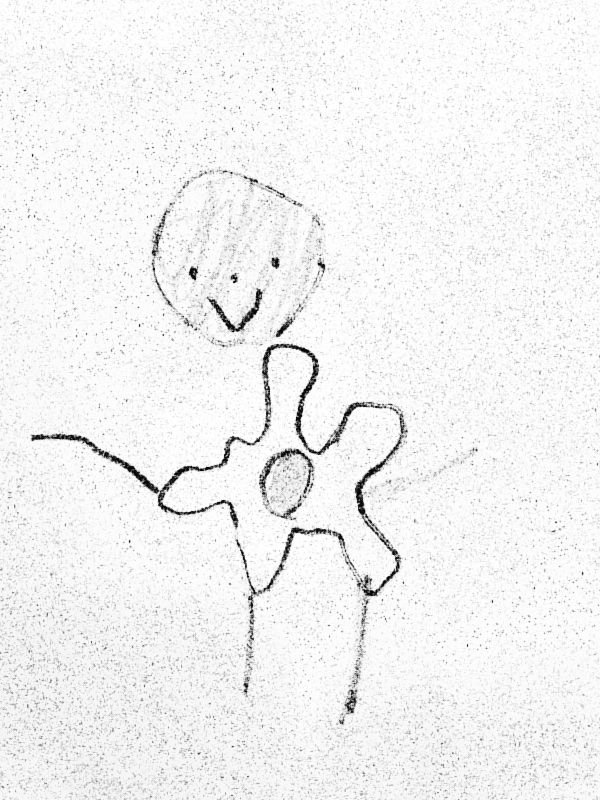
A child's drawing of a smiling woman with a fried egg for a body.
An unknown child’s drawing of the Boiled Egg Lady reproduced in The Boiled Egg Lady and Other Local Legends of East Bristol.

The Boiled Egg Lady

In November 1957 the Bristol Evening Post reported that children at a junior school in Brislington were playing truant because they were afraid of ‘the Boiled Egg Lady’.

The initiating rumour was that an old woman had offered hard boiled eggs to two boys on their way to school, inviting them into her house. Within days, several other children had reported encountering the same woman, and the story became embellished. Now, there was a shadowy figure waiting in the house – supposedly the woman’s son, an escaped murderer. Police actually spoke to an elderly woman who lived in one of the terraces off the Feeder Road, at a house identified by one of the two boys who started the rumour. A childless widow, she had been in the habit of speaking to children on their way to school, and was heartbroken when asked to stop doing so. 

That was that, until a decade or so later when stories about the Boiled Egg Lady once again began to circulate, only now the story had evolved, inspired more by that evocative phrase than by anything in fact. The landscape had also changed, with mass demolition of terraces, schools, churches and factories, creating something of an eerie wasteland.

By 1968, teenagers were daring each other to traverse this space where, in the dark, the Boiled Egg Lady would be waiting for them. In this version, she took the form of a seductive young woman in a red dress. Any young man who stopped to speak to her would be asked “Do you think I’m pretty?” Of course, she was, so they would answer “Yes.” She would then remove her long dark hair – a wig – and with fingertips prise open the top of her completely bald head to reveal… Who knows? Because of course her victims fled before they could see, or were found dead.

There is no concrete record of any such incident, although several children did die playing on wasteland and construction sites during the 1960s and 1970s. Even now, it can feel a melancholy place at night.

Scarecrow Hill

Perhaps it was a prank, or perhaps a project by an art student. Whatever lay behind it, the discovery of fifteen rather horrible scarecrows on a slope at Netham Park on the 3rd of September 1974 caused considerable upset. They were found at dawn and soon a crowd from the neighbourhood had gathered to see the sinister scene. They seemed authentic enough, crafted from wood and jointed with grubby string, and decked out in old clothes of considerable vintage. Weatherworn and decayed, they seemed to have been outdoors for many years, but certainly not in this spot. Council park keepers came and took them away the same day.

That wasn’t the end of the story, however, for when the scarecrows were examined by police, several items of their clothing were found to belong to people who had gone missing or been murdered in and around Bristol in the preceding decades.

Since that time, individual scarecrows have sometimes appeared on the slope. Some theorists have noted that their appearance often coincides with the first anniversary of the disappearance of some person or another. They are promptly taken away and rarely discussed, though their number, including the original fifteen, is now said to be close to thirty.

The Blitz Babies

This story goes back to the end of World War II when Bristol was still half in ruins and its people were psychologically scarred from the experience of German bombing. It has been connected with various former bomb sites in Barton Hill and Lawrence Hill. Many of those sites were left uncleared and undeveloped until the 1970s. Throughout the 1960s, people reported hearing babies crying on these sites and, assuming they’d been abandoned, would scramble over rubble and through weeds in search of these unfortunate children. Of course they found nothing. 

In one account, two children did find a baby, blackened by fire, screaming furiously. When they returned with police to examine the site, bones were found beneath the soil – far beneath the soil, long buried. There are, of course, those who point out that foxes can sound a lot like crying babies, and perhaps that’s all the blitz babies were.

In some of the council housing blocks built on these former bombsites, tenants have reported cold spots, eerie atmospheres and, yes, the sound of babies crying at night. If not foxes, then perhaps thin partition walls are to blame in this instance.

The Naked Swimmer

This is the newest of the local myths or legends in this collection, having emerged as recently as 1979. Where the Feeder Canal meets the River Avon at Netham Lock there have been frequent sightings of somebody swimming, naked, beneath the dirty water. Only beneath, however, for this curious swimmer never seems to need to surface.

Police investigated the first sighting as a potential case of indecent exposure and arrested a man found sunbathing on the manmade protuberance that marks the entrance to the canal. He insisted he had not been swimming and had worn swimming trunks at all times.

One rumour is that the so-called Naked Swimmer is actually some amphibious creature or reptile, rather than a human. An albino seal, perhaps, or a white-bellied crocodile, escaped from some private collection.

Another theory is that it was invented by some enterprising parent to deter children from paddling in the hazardous waters where stomach bugs are as big a risk as underwater obstacles.

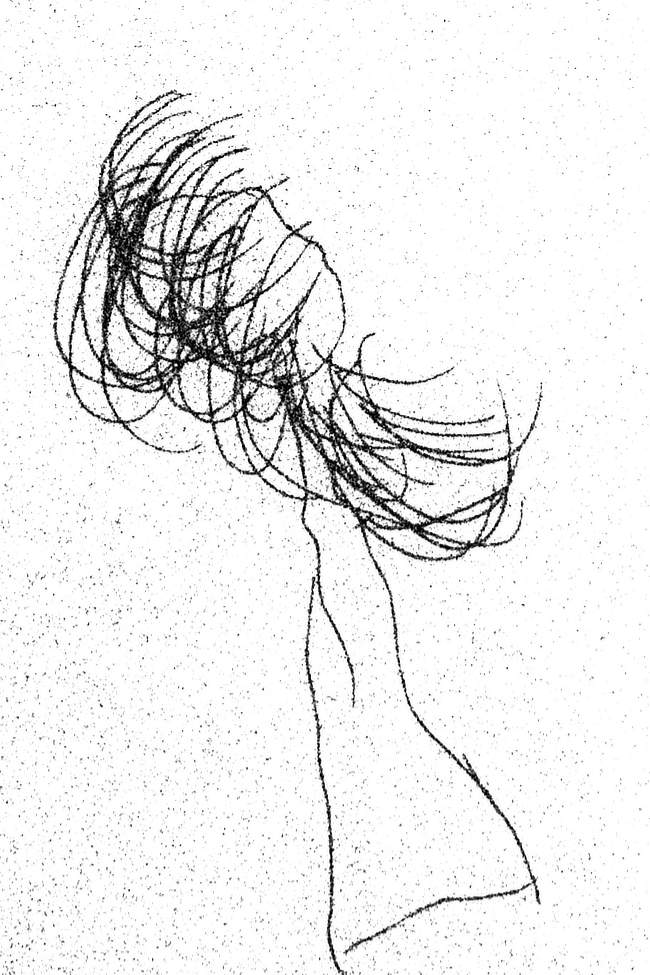
A child's drawing of a vaguely feminine shape with lots of mad dark hair and a sort of white dress.
Hairy Jane as drawn by Jessica, aged 6, at a history and folklore open day at Bristol Central Library, 1992, reproduced in The Boiled Egg Lady and Other Local Legends of East Bristol.

Hairy Jane of Combfactory Lane

Walk backwards up Combfactory Lane between midnight and four in the morning and you’ll be sure to bump into Hairy Jane – literally so. Nobody has seen her but many have felt her long hair tangle around their limbs and throat, until they tear themselves free and flee.

There are too many stories, none of them in agreement, about her nature or origin. In one version of the tale, she escaped from a travelling circus, where she was an exhibit in the sideshows, and survived on the streets by capturing and eating cats or rats. In another, she was employed at the comb factory that gave the narrow cut through its name until her hair began to grow and didn’t stop. A slight variation on that account has it that her impossibly long, unruly hair became caught in one of the comb cutting machines and she was dragged to her gory death.

Spiderman Bridge

The story goes that, on dark winter evenings, people passing through the short, unlit tunnel beneath the railway line at the bottom of Cole Road hear a voice: “Spare a little change?” But there’s nobody there. Until, that is, they look up and see a bearded man in ragged clothes splayed against the red brick above, clinging on with filthy fingers and toes.

The Unscheduled Stop

Bus drivers working out of Lawrence Hill depot have for many years told new recruits about the danger of making unscheduled stops, however much a passenger might insist. There are good operational reasons for this, of course, but stories have also circulated for years about what might happen to a poor driver when such a stop is made.

For example, one veteran – we’ll call him Ted – tells of being asked to stop his bus near Avonvale Cemetery. The passenger, a young woman, asked nicely, and as it was late, and there was freezing fog, he decided to be gallant. No sooner had she departed the now empty bus, however, than another passenger boarded – an old man with pale, drawn features and a shabby black suit. He paid for his ticket with a handful of dirty old coins and took a seat near the driver. Bill could see him quite clearly in his rear view mirror. As the bus neared the junction with Church Road, Bill glanced back again and was startled to note that the passenger had gone. Pulling over, he got out of his cab to check in case the old man had slumped or fallen. He found only a length of filthy white cloth of the type used to wrap corpses.

Ted also talks of a colleague, a friend of a friend, who stopped in much the same place thirty years before, when flagged down by a man carrying a heavy package. After a few stops, this passenger departed the bus by the back door. A few moments later, the conductor shouted for the driver to stop. The man had left his package on the bus – with blood oozing through the brown paper. When opened, it was found to contain no less than twelve human hands, of various sizes and colours, and in varying degrees of decay.

Others

Many other stories are known only in passing and are still being researched by the Society. We should be grateful to hear from anyone who can tell us about:

  • The Phantom Social Worker (St George, 1950s)
  • The Avonvale Ghoul (St George, c.1968)
  • The Underground Theatre (Lawrence Hill, 1920s)
  • The Fox Tail Man (Easton, 1920s)
  • The German Lodger (Lawrence Hill, 1940s)
  • The Men in Blue Suits (Pile Marsh, c.1956)
  • Bonfire Billy (Barton Hill, 1960s)

Look, I put Fiction’ right up there in the title of the post. I just think Bristol ought to have more decent ghosts and urban legends, so I made some up.

But perhaps some of them will take, if they make it into the rumour mill.

Or maybe someone will message me to say that, actually, they saw Bonfire Billy themselves – that poor young man who decided to sleep in the Barton Hill bonfire stack one cold November, not realising that it was due to be lit that very night…

Categories
Fiction

FICTION: The Newhamstead Goblin

You stop calling the police after a while, d’yer know worrimean? What’s the point? Either they don’t come at all, or by the time they turn up, the bloody thing’s gone to ground.

They think we’re daft enough up here as it is, up at Longwood. Normal for Longwood – NFL. That’s what the doctors write on your clipboard at the hospital. It means they think you’re either mental, or thick.

So, yeah, you don’t call the police. You just learn to live with it. Well, you have to, don’t you, know worrimean? Life’s too short, intit?

In practice, that means, one, trying to get home before dark. If you can’t, get a cab to the door, and get in quick.

Two, keep your doors and windows shut and locked after dark – which is easier said than done with these summers we have nowadays, don’t get me started! And before you say it, yes, we’ve tried nets over the windows, which is how we lost two dogs and a toddler back in 2015. ‘Mystery disappearance’ my arse. We all knew what did it. We told them. But they don’t believe you, do they?

Oh, and three, you keep your curtains drawn, because it’ll look in, if it can, and that’s no good. Best case, it puts you right off your tea, with them bloody eyes. Literally, I mean. Bloody. The eyes. Worst case scenario, you end up sort of mesmerised. That’s what they say happened to old Graham Dodd. Saw it, he did, and stared at it, and then climbed out the window. From the second floor of Thorncombe House, mind, so, well, you don’t need me to describe it.

Right, four: don’t answer your door after dark, even if it’s someone you know. God knows how but it’s got a way of speaking to you. I heard it once and I’d have sworn blind our Darren was outside. Your first thought is, oh, shit, I’d better let him in before that bloody thing gets him. Then you think, hang on, Darren’s in Corfu this week. Then it stops knocking and starts scratching like it’s going to burrow right through the wood.

In the daytime it’s alright. You don’t see it, not a sign. Maybe the odd footprint. Maybe a big pile of shit. Maybe an upturned car. You ignore it, though. Well, you have to, don’t you? You just get on with your life.

They asked me once, the lads from the Railwayman’s Club, did I want to go on a hunt for it. I said, no thank you, bugger that for a game of soldiers. Well, they did it anyway, out with their air rifles and cricket bats until dawn. Nothing. Sod all. Except when Kev Parsonage got home, it had been all through his house and ripped the place to shreds.

Have I seen it? Many times. Oh yes. Many times. First time, I’d have been about fourteen, not long after we moved here from up country. Nobody warns you, because they know you won’t believe them. They just wait for you to catch on yourself. I was out kicking a ball around the green, wondering why all the other lads hadn’t come out again after tea. Then I looked straight down Longwood Avenue, and I couldn’t make any sense of it at all. There was too much of it, in one way, but not enough at the same time. Too many arms and legs, that’s what I thought, but I couldn’t quite count them. The way it moved… Now, hold on, how do I put this? It was as if it wasn’t taking steps so much as shifting between them. Like… Like… Like dirty water pouring from one container into another. Does that sound daft? And the eyes. They were like old bike lamps, which was fine, until the bastard blinked.

Last time I saw it was about a week ago. Forgot to put the bins out, decided to risk nipping down the path to the gate after dark. Got most of the way there when, boom, there it is, eating something from the gutter, down into the drain, with that… What would you call it, oh, my bloody memory, that, um, that sort of trunk it has.

I should have taken a picture, I suppose. Then you’d understand. Maybe you wouldn’t. I’ve seen other people’s photos and it just looks like… Well, it don’t look like nothing. There’s literally nothing to see. A load of old dead leaves in the gutter, a tarp caught on the brambles, streetlights in a puddle. Nothing. It’s as if it knows how to make sure you can’t see it.

Trust me, though, that’s what it was – that’s what’s done this to you. I probably scared it off before it had finished, driving through with my lights on full beam. I’d like to help you, I really would, but I should never have stopped. And, like I say, you stop calling the police after a while, because they don’t come. They don’t believe you.

I’d best be on my way, mate. Let it finish what it started.

It’s for the best all round.


A quote from Verity Holloway: "Impressively eerie and packed with shocks... moments of powerful poignancy and startling strangeness. You'll want to linger over these stories." Next to it is the cover of Intervals of Darkness with a black background and red details. The illustration is of a person casting a long shadow. Nearby is another shadow suggesting a lurking but hidden figure.

If you enjoyed ‘The Newhamstead Goblin’ check out Intervals of Darkness, my most recent collection of weird stories, which is available as an eBook and paperback.

Categories
Fiction weird fiction

FICTION: Mothership

Penny does not expect to hear the roar of an invisible dragon on the path on the edge of a potato field. It takes a moment for her to think to look up.

The hot air balloon passing above her head is too low and too large. Its white sphere stands out sharply against dense black clouds.

Should it even be in the air on a day like this, with a gale blowing up and rain beginning to spot the cracked soil? Penny misjudged the weather for her walk but is dressed for it in waterproof trousers and hooded jacket. Perhaps the pilot of the balloon also misread or ignored the weather forecast. Or has a deathwish.

The wicker basket beneath the balloon is only a few metres above her head. She stops and waits for it to go by, and to progress beyond the line of red-studded bramble bushes ahead. She knows very little about balloons but understands that they have little control over their direction, being at the mercy of layers of wind at different altitudes. She hopes this one, this colossal pearlescent object, will avoid the fourteenth century tower of St. Leonard’s Church which lies a mile or so ahead.

As the balloon moves ahead she expects to see its pilot come into view above the edge of the basket. This does not happen, though someone must be there to trigger the burner, which turns the pearl orange for a second. The balloon does not rise.

In fact, even as the wind whips at the synthetic fabric of her waterproofs and pulls strands of her dark hair across her face, the balloon seems to slow. Then it stops altogether, fixing itself in the air, as if a pause button has been pressed. The hawthornes to Penny’s left are shaken by the growing gale and lurch forward. A torn cement sack tumbles across the field to her right, a tangle of white, brown and blue. But the balloon does not move, at least not forward, because, yes, like an elevator, it is descending gently.

The basket rolls slightly on contact with the pale brown earth, rights itself, settles flat. The structure of the balloon sits solidly, neither sagging nor swaying.

Penny takes a few steps and calls out in her high, nasal voice: ‘Hello? Is everything okay? Do you need help?’ She can barely hear herself and knows that her words have been lost.

The balloon waits.

Rain comes harder, tearing across her rucksack and back. She moves instinctively towards the balloon hoping it might offer shelter, skipping awkwardly over ruts in the ground, stumbling in her sturdy boots.

Close by, the balloon has the bulk of an office block. Its perfect white shell throws out a soft internal light, as if the sun itself has fallen, weakened, from the sky.

The burner exhales flame and it sounds like a weary sigh, or an exhortation. Penny is overcome with a sense that to ignore it would be rude, or hostile. The rain lashes her forward as she hurries to the basket, throws her rucksack over the worn leather of the rim, and climbs in after it.

The basket is empty. There is no pilot, no flask of hot tea, no warm blanket. Here, though, the wind is diminished, and the rain cannot reach. She feels like a child in the arms of a great mother.

Flames rise above her head. Mother sighs. The balloon begins to rise.

Categories
Fiction weird fiction

FICTION: Do Not Eat

Do you get the urge or is it just me? You’re walking along and you see a half-eaten sandwich lying on the ground, covered with bits of grit and crawling with ants, and you think: I want to eat that.

You don’t, obviously. But you think it.

Like how you consider throwing your wallet into the river every time you cross the bridge in town. Or feel your hand edging towards the emergency brake on the train during your commute, specifically because there’s a sign telling you not to. That’s exactly what it’s like when you see a plastic glass half full of cola sitting on a wall and you think, I want to drink that, and eat the chunks that are floating in it, whatever they are. Do you really never get that? Really? I do. All the time.

You don’t do it, as I say, obviously you don’t do it, but it’s touch and go sometimes. When nobody’s looking, when you’ve had a really bad day and everything’s turned to absolute shit, you think, if I eat something I’ll feel better. And if you’re going to eat something, why not that scoop of ice cream that’s been dropped on the pavement and is still mostly solid, even though it’s sent out sticky brown runners towards the gutter? Imagine just scooping it up in your fingers and sticking it in your mouth in one neat move. If you get it right you could leave behind the bit that’s been in contact with the pavement and just get the good stuff that’s probably hardly even been licked. You get so you don’t mind a bit of lick, anyway. People snog strangers all the time – how is a bit of lick on an ice cream any different?

It started when I was a washer-up in a chain restaurant as a teenager. The stuff that used to come back uneaten! Chicken nuggets from the kids’ meals, they’re the ones that tempt you the most, and cakes. Imagine throwing away good food like that and then going home to an economy burger, oven chips, and frozen peas. So, yes, you do eat the odd bit here and there, when they look fairly clean and intact. Nobody notices and nobody cares. It’s like a little bonus, a little treat, and all for free.

One particularly bad shift, though, when the manager had been snippy with me, and I knew it wouldn’t be much better at home, I confess that I did once give myself an extra treat and eat some gristle left over from a steak. It had been chewed and spat out. I chewed it again myself, like gum, while I used the extendable hose to rinse gravy from a pile of plates. You chew and chew and eventually it softens up. That’s why people chew gum, because it’s calming and meditative.

Licking ketchup and melted cheese from the insider of a discarded burger wrapper, that’s another good one. It’s like you’ve eaten the burger without having eaten the burger. Sometimes, when the wrapper’s been out all night, blowing round the retail park car park, it’ll have picked up crunchy bits of glass or splinters of wood. You clear the paper with your tongue and it leaves you feeling clean, too, like you’ve groomed the dirt off your own body.

Nobody eats the salad from a kebab, have you noticed that? On Saturday and Sunday mornings you can pick up all sorts: trampled iceberg lettuce salad, pickled chilli peppers, pitta breads soaked with grease and garlic sauce where the bread has become like a sponge in the morning dew. Get your five a day.

A bit of mold doesn’t even do any harm. You eat blue cheese, don’t you? They say it’s good for you to put bacteria into your gut. There was a whole bag of shopping once, hanging on a railing. A pack of pittas gone blue all over, a cucumber rotten in its plastic sleeve. You can slurp that like an ice pop. You can’t just leave it hanging there. You can’t just walk past, letting good food go to waste, even if it does leave you feeling too full to move. Beats feeling empty inside, that’s what I say.

Or what about those full plastic bottles you find in the gutter? It might be apple juice or beer, it might not, but waste not want not. You’ve got to scratch the itch sometimes, you’ve got to give into the urge.

Some people take roadkill home and cook it. They have freezers full of the stuff. I say, why go to all that bother? The good stuff is like jerky, dried naturally in the sun, seasoned with engine oil and brake fluid. Does your mouth water when you smell petrol? Mine does. Chicken wings, too – it’s like eating chicken wings. Lots of little bones to chew the tough meat from. You really feel as if you’ve earned your meal.

When people feed good bread to the ducks, that breaks my heart. There’s kids starving and they’re throwing bread into the pond in the park – are you serious? It’s not even good for ducks to eat bread, is it? If you have a small net, it’s easy enough to fish the bread out out, or you can just use your hands. The texture is like nothing else. Municipal caviar, I call it.

Dregs from drinks cans, too. Lots of variety, a little dribble of lots of different things, cider or Fanta or whatever, and you can always spit out the cig ends and the insects.

I like a mystery, a blind taste test. You don’t always know what’s in a holdall you find dumped on a verge, do you? There’s no way to be sure if it’s been there a while. You just have to get stuck in and enjoy it for what it is, all of it, pounds and pounds of raw, sweating meat. Almost enough to fill the infinite empty space inside you – not quite, but almost. The only problem is that sometimes you worry you might have helped to dispose of evidence, when they start talking about that holdall on the news, but how are you to know?

I find there’s really no need to go home at all these days, or to go to work, not when you can eat three square meals a day out and about for free. You just need to have a good eye and a strong stomach. And your stomach gets stronger, too, the more you do it. What’s at home, anyway? Much better to be in the fresh air, enjoying all of nature’s bounty.

Oh, see there, under the brambles – a yoghurt pot that looks to be, yes it is, almost half full. Now, don’t you get the urge to eat that? Don’t you? Is it just me?


A quote from Verity Holloway: "Impressively eerie and packed with shocks... moments of powerful poignancy and startling strangeness. You'll want to linger over these stories." Next to it is the cover of Intervals of Darkness with a black background and red details. The illustration is of a person casting a long shadow. Nearby is another shadow suggesting a lurking but hidden figure.

If you enjoyed ‘Do Not Eat’ check out Intervals of Darkness, my most recent collection of weird stories, which is available as an eBook and paperback.

Categories
Fiction

FICTION: The Short Stay

All they want to do is get out of their wet clothes but the key doesn’t work. As Hannah struggles, Joe stands behind her sniffing the warm, musty air of the corridor.

‘Stinks of mice.’

Hannah tries pulling the key out a little as she turns it. She tries pulling up on the door handle. She tries pushing the key harder into the door.

‘Let me try,’ says Joe.

He pushes her aside, reaches for the key, and turns it without the slightest trouble.

‘Easy, see?’

The flat is smaller than it looked in the photographs on the booking website. The laminate flooring is scuffed and there is a vegetal smell.

Joe lugs his bag into the bedroom leaving Hannah to carry her own.

‘Fucking rail replacement fucking buses,’ says Joe, more to himself than to her. ‘“Let’s spend Christmas somewhere different,” she says. Oh, yeah, nice one. I don’t know why we ever bother going anywhere with the state of the trains in this country.’

‘Never mind,’ says Hannah. ‘We’ll have an early night tonight and explore the city properly tomorrow.’

Joe hangs his sodden black trenchcoat over the back of a chair and pulls his wet shirt away from his bony torso. Looking around he puffs out, despairing and disbelieving.

‘Merry Christmas to us, and happy anniversary.’

‘This is just a base, though, isn’t it?’ says Hannah, her voice beginning to crack.

‘You’d better change,’ he replies. ‘You look like a drowned cat.’

Hannah pushes a snake of dyed black hair behind her ear, her bangles rattling, and slides her glasses up her nose.

Joe won’t look at her. As he heads to the bathroom with their shared toiletry bag he slides past without making contact.

Alone, Hannah listens to the room for a moment. It has no sound at all. It’s too small and too full of furniture to reverberate. She wonders how many flats they managed to squeeze into the former warehouse when they converted it. Too many, anyway.

She hears the sounds of Joe using the toilet, the flush, the shower. Bathroom smells, shit and lime-scented gel, fill the small flat.

She removes her dripping dress and stands in her underwear, shivering and goose-bumped, while she unpacks her bag. She puts on pyjama bottoms and an oversized t-shirt and heads to the combined sitting room and dining area.

There are two windows looking out over an office block. Only a few lights are on – a meeting room on the first floor, an office on the sixth – so the wall of glass forms a blank, black mirror. She moves and spots her own reflection, sees herself doubled, distorted, reflected, shadowed. The flat’s windows open a few inches, not enough to jump from, but enough to let in frosty air and sounds from the street below: a whisper, a shrieking laugh, and the crunch of broken glass.

Joe emerges from the bathroom wrapped in a towel. His fine white hair is plastered to his head and his body looks thinner and paler than ever.

‘All yours,’ he says and disappears into the bedroom.

Hannah goes into the bathroom and locks the door. She can’t use the toilet because it’s not private enough for her to relax, but she sits on the seat for a while. There’s no window, only an extractor fan that hums at an irritating frequency. After a while she gives up and gets up to wash. Before she picks up the soap, she removes her wedding ring. It’s a struggle to get it over the knuckle, over the swell of flesh it pushes before it, but sheer force does the job. She places the ring carefully on the glass shelf above the sink. The metal clicks into place as if magnetised. Hannah washes her hands, neck and face, then dries herself with the only other towel in the flat. She flosses, cleans her teeth, and ties her hair up with an elasticated band.

When she reaches for the wedding ring, it is gone.

Her fingers crab and scrape around. She inspects the full length of the glass shelf. She drops to her knees and looks beneath the sink, finding only a tangle of cobwebs and hair. She looks under the bath and behind the toilet. She checks the plughole. No, it couldn’t have fallen down there, the strainer would have caught it. She pats the pockets of her pyjama bottoms. Finally, she looks into the toilet bowl where perhaps, she thinks, it might have rolled, which would be just her luck. Nothing.

‘What are you doing in there? Come to bed so I can turn the light off.’

Hannah feels a flutter in her heart.

She opens the door and, hesitating, steps across the hall to the bedroom.

He is already curled up beneath the duvet, his head almost buried.

‘I’ve lost my wedding ring,’ she says in a weak voice.

Joe emerges and peers at her, blinking and small-eyed.

‘What? When?’

‘Just now. Freshening up.’

He groans.

‘It can’t have gone far. We’ll find it in the morning. I’ll find it.’

She climbs into bed and reaches out for Joe.

‘Christ, you’re cold,’ he says, when her hand brushes his back.

He turns off the bedside lamp.

Exhausted but awake, Hannah lies and listens. Apart from Joe’s soft snoring, there is something else in the silence – the non-sound of someone holding their breath and holding still.

The morning is bright and Joe’s mood has improved a little. He even makes the coffee, bringing two cups into the bedroom.

‘Four sachets they’ve given us, and four little pots of fake milk. Stingy bastards.’

Hannah draws her knees up beneath the duvet and hugs them with one curled arm, the other lifting the steaming coffee cup to her mouth at intervals. Joe stares at his phone which, perhaps subconsciously, he angles so that Hannah can’t see the screen.

‘Can you have a look for my ring?’ she asks.

‘What? Oh, yeah, sure. In a minute.’

After a second or two he looks up from his screen and turns to her.

‘Why do you take your wedding ring off at all?’

‘It’s more hygienic,’ she says. ‘I don’t want it to get dirty under there.’

‘Yeah, but if you leave it on you’re putting it in hot soapy water. So it gets cleaned. It’s probably more hygienic that way, if anything.’

He turns back to his phone, chews his thumbnail to tidy the edges.

‘It’s supposed to symbolise eternity, isn’t it?’ he mutters. ‘Commitment. I never take mine off.’

‘What I don’t understand is how I lost it. It definitely didn’t roll and there’s nowhere for it to go.’

Joe puts his phone on the bedside table and limps into the bathroom groaning. She watches as he inspects the shelf, the sink, the floor, the plughole.

‘Probably got taken by the house elves,’ he says as he comes back to the bedroom. ‘Try asking for it back.’

‘How does that work?’

Stretching a t-shirt over his head and angular arms Joe says, muffled: ‘Hey, house elves – may I please have my wedding ring back? Like that.’

Hannah mutters the request under her breath. It doesn’t work, at least not immediately.

Joe spends another ten minutes investigating the bathroom before they go out and emerges with a shrug.

‘Sometimes there are gaps around the pipework but everything is sealed tight in there. I don’t know how you do it, I really don’t.’

Over an expensive breakfast at a cafe with oatmeal coloured walls and smashed avocado on sourdough toast Hannah says:

‘Let’s just forget about the ring and try to have a nice Christmas anyway. Just the two of us, somewhere new. We need to decorate the flat a bit. Brighten it up. And get some treats in.’

‘Beer. Wine. Gin.’

They spend the morning of the day before Christmas Eve shopping, buying a tiny tree with twinkling fibre-optic lights, a plastic wreath, and a candle that’s supposed to smell of fir trees. Joe lugs two heavy bags back from the supermarket and opens his first can of beer at exactly midday as he flips through channels on the TV.

As she lays out slices of ham, cheese and salami on a plate, and cuts a supermarket baguette into small rounds, Hannah looks at her hands. They look different without the ring, obviously, but do they look better?

‘We should go to the pub or something,’ says Joe after lunch, two cans of beer down. ‘While there’s still, like, an hour of daylight.’

They wrap up in coats, scarves, and hats and head out into the city. There are Christmas lights up in the centre and a busker is playing ‘Jingle Bells’ on an accordion. Hannah leads them to the cathedral which they circle, but Joe doesn’t want to go inside. The light begins to die and the grey sky turns flat, first, then begins to shade to blue. They drift back to the shopping precinct and its bright lights.

‘That place looks cosy,’ says Joe, spotting a half-timbered pub called Ye Olde Bear. He heads through the door and Hannah follows. It’s crowded and hot with half the customers in novelty Christmas jumpers. Joe pushes his way to the bar and raises a hand to get the attention of the barman. His wedding ring, a thick, plain band, glints amid the fairy lights. He orders Hannah’s usual half of lager and a pint of cider for himself.

Because it’s Christmas, when the usual rules don’t apply, they both drink too much. Hannah’s usual limit is three pints but she ends up drinking five. Dinner is two cheese rolls and a packet of crisps. Joe is on eight pints when he decides to switch to single malt whisky, because it’s Christmas, and Hannah agrees to have one, too, because it’s Christmas, and suddenly, it’s nearly midnight and the pub is closing around them.

They go from giggling arm-in-arm to arguing in no time at all. They both need the toilet but Joe insists on pissing behind a wheelie bin, prolonging her discomfort. He wants to find a kebab shop. She begins to cry, for no particular reason, just everything, and he raises his voice without meaning to.

‘Go back to the flat, then! Take the key! I’ll see you there when I’ve had my chicken doner.’

‘You want me to walk back on my own, in the dark, in a strange city?’

‘Fuck sake… Come with me, then!’

‘I really need a wee.’

He shoves the keyring into her hands.

‘I’ll see you there in, like, fifteen minutes.’

Hannah watches him stagger away and wonders what it is she feels, other than heartburn from the whisky and a pressing pain in her bladder.

The next morning, Christmas Eve, she wakes with a head that feels like concrete and a papery mouth. Joe is not with her. She croaks his name then checks her phone. There are several missed calls and messages from Joe, each more desperate than the last. She must have fallen asleep, or passed out, leaving him stuck in the street outside all night. The last message reads:

‘Will sleep in park. Fuck you.’

Dressing hurriedly, wanting to vomit, she rushes out and downstairs, trying to work out which park he might have meant. She calls him and listens to his phone ring as she walks over frosty cobbles. He doesn’t answer.

The nearest park is by the riverside. She makes a complete circuit, checking each bench and shelter, looking at the single-person tents concealed in the hedgerows and copses. She shouts his name, screams it, constantly redialling his number.

‘What if he comes back to the flat and I’m not there?’ she thinks after a while. She returns to wait for him.

Wide awake now, shaking with cold and adrenalin, she sits down in the kitchen. She closes her eyes, breathes out, breathes in, breathes out, breathes in, but calm never comes.

Her eyes pop open when something slams into the tabletop.

There in front of her something is spinning and shining. She is mesmerised. It slows to a teeter and then falls flat on its side. Her wedding ring. 

She sees the second ring fall, seeming to appear from somewhere just above her head, before it hits the table with force. It is thicker and heavier and begins to roll. To stop it reaching the table’s edge she reaches out and slaps it flat.

It feels hot.

She looks at her palm.

A perfect red circle has been burned into the skin.


Image based on a photograph by Luwadlin Bosman at unsplash.com

Categories
Fiction

FICTION: Dead in a ditch

Where is the worst place you could end up haunting? I reckon my spots a contender. It was bad from day one, standing knee deep in the green water of a ditch, looking down on my own smashed body in the half-submerged hatchback.

Then it took them three months to find me, even right there by the main road between town and the village, because the reeds were high. I watched my body bloat and fart bog gas and liquify. I watched rats and insects help themselves to my flesh. I saw my bones emerge like the wreckage of a ship on the shoreline with the tide sliding out.

I tried not to look. I took an interest in the clouds in the big sky above the levels, and in the trees as they began to yellow at the edges and drop their leaves. I watched sunrises, sunsets, and stared at the stars – I could see them so clearly out there in total darkness. I counted cars, too, as they flew by. You’re going too fast, I thought, and remembered that people kept saying that to me, too.

Then, when the trees were bare with black branches, a car passed slowly enough that a child in the back seat saw the low sun catch the roof of the wreck. The car stopped at a layby a little way along the road into town. I could hear the burr of its engine and the tick of its hazard lights above the breath of the westerly wind. The police car came a little later and the road was closed. Then an ambulance. Then, just after dark, a forensics team with floodlights and tents. Finally, a pickup truck from a garage in town arrived and, by dawn, the car was gone, and it was just me and the dirty water around my jeans.

Mum and Dad came, parking at the roadside. Cars kept passing at twenty above the limit, one or two honking their horns in irritation at the blockage in the road. My parents couldn’t see or hear me as I murmured to them: ‘It’s alright, don’t miss me, don’t feel pain for me…’ Before they departed they left a stuffed monkey, a bunch of flowers in a heavy stone pot, and a card I couldn’t read. In the weeks that followed I watched the card blow away in the wash from an articulated lorry, the monkey turn ragged and grow green mould, and the flowers rot to black stalks. I didn’t see Mum and Dad again. I suppose they drove the long way round to town after that, so as not to have to think about me.

After a long while I got tuned into the other dead around and about. There was a pale smudge in the field opposite that I thought must once have been a woman. She seemed young and was always stooped, always weeping. The sound sometimes carried on the wind. She might have been there since the Civil War, or long before. One night in June I watched a Douglas C-47 with black and white invasion stripes on its tail pass silently overhead and fade out of existence somewhere over the old airfield. I learned that the famous Headless Horseman was real, too, though less glamorous than in the stories they told around town. He passed by, once a month or so, and was a nasty old thing. He had a dirty tunic streaked with brown blood and his head was in his lap, crushed and misshapen, but still screaming. He was always in a hurry to be somewhere. On summer evenings, if there wasn’t too much traffic, and the wind was right, I could hear the sounds of the battle of 1685 being replayed on the field outside the village. The teachers from the village school used to take us there to camp out, and tell us ghost stories as we toasted bread over a fire.

Years must have passed before I saw Dani again. I’d dropped her off in town before making that last journey and I suppose she had no reason to come to the village after I’d gone. Then one day, there she was, in the driver’s seat of her own hatchback, framed in the open window. She was a little older but no less beautiful. After the car had passed I realised there was also someone in the passenger seat. An hour later, she drove back and I saw her for another two seconds, a face in shadow, her hands on the wheel. I also saw that the man sitting next to her had a broad chest and tidy beard.

I’d always wondered how eternity would work. Wouldn’t you get bored? In life, I could hardly sit still, and was always after a distraction or a thrill. That’s probably why I drove so fast all the time, to feel not-boredom for a few minutes. But boredom, it turns out, is only a problem for the living. It comes out of being anxious the whole time about your status and how much you’ve achieved. It does us all right in the survival game. It keeps us moving and exploring. In death, though, you let time wash over you in an endless stream. I wasn’t waiting. I didn’t expect anything, or hope for anything. I just was, and just am.

If there was anything I longed for, and longing’s too strong a word, it was to see Dani again. When I died, the wires that connected me to the world were cut, but the cut wasn’t clean. An intermittent contact made me feel something, or remember how it felt to feel something, or something like that.

She passed along the road many times after that. Alone in the car; with the man; following a removal van; dressed for work in her supermarket uniform; dressed for a Christmas party in a sparkling silver dress, with the man in a shimmering suit; and in a wedding dress in a vintage car with ribbons tied to its radiator. Their car got bigger, the backseat gained a baby seat, then a baby, then two babies. They drove too fast, of course, because everyone did. The car hugged the bend, lifted a little one one side, always ready to tip.

Through cycles of sun and moon, summer and winter, flood and drought, I stood there with water boatmen skidding around my knees, and rats circling. The creatures knew I was there, somehow, in some simple way, because they never touched me, or went through me, or whatever would have happened.

There was no way for me to make any difference in the world, I knew that for sure. Still, I always wanted Dani’s car to break down as it passed me, so I thought hard about it, and one day, it did. I felt as if I’d made it happen. The engine cut out and she began to drift. She guided it into the verge and put on the hazard lights. Then she got out and walked along the road directly in front of me.

Her fine blonde hair had just begun to turn grey and there were new folds and grooves around her eyes. Speaking into her phone she said:

‘About halfway, yes, just past Crockford Farm.’

It was the first time I’d heard her voice in all these years and I experienced something like a memory of how it felt to yearn for someone. I remembered, for a sliver of a moment, how a sweet harvest apple tasted and what it meant to smell the sea.

While she waited for the mechanics to come, she leaned on a gate and, resting her chin on her arms, looked out over a field of yellow rapeseed.

Did she remember this was where it had happened? Did she ever know?

The recovery vehicle came, its orange lights throwing twists of fire on the surface of the filthy ditchwater. Within a few minutes the engine of her car was turning over. She put the radio on and I heard two bars of a song I didn’t know before she waved to the mechanic and sped off.

Over the years, Dani kept passing, back and forth, like an irregular pendulum, village to town, town to village. The car changed, and she changed, but I didn’t.

Her children got their own cars, which they drove much too fast, and I wondered if she ever used my story as a warning.

One day, after I suppose decades must have gone by, Dani appeared dressed in black in the back of a limousine, following a hearse.

A few years after that, the hearse passed again, and this time Dani’s children were in the black car that followed.

That night, the Headless Horseman passed, screaming mad, as usual. I screamed back.


The cover of Intervals of Darkness with quotes from John Grindrod and Rowan Lee.

If you enjoyed this story you’ll probably also enjoy my collections Intervals of Darkness (2024) and Municipal Gothic (2022).