If you’ve seen all of the BBC Ghost Stories for Christmas, and want more of the same, I’ve got good news for you.
Last year I put together a list of films, short films and TV episodes that seemed to me to capture something of the vibe of the Lawrence Gordon Clark era of BBC ghost stories for Christmas.
Since then, I’ve come across quite a few more examples.
A misty, melancholy adaptation of an Edith Wharton story. The premise is fascinating – you won’t realise you’ve seen the ghost until long afterward, goes the legend – but unfortunately sets up a disappointing ending. Still, it is fascinating to watch a period ghost story with a female protagonist, from a story by a female author.
The Mind Beyond: Stones, 1976
The Mind Beyond was a series of TV plays on supernatural themes produced by Irene Shubik for BBC 2’s Playhouse strand. They’re all interesting but this particular episode has stone circles, cursed tomes, and possessed children, putting it squarely in folk horror and hauntology territory. It has the usual pondering and bickering for the first 40 minutes or so and then accelerates towards a rather powerful ending.
The Lake
The Lake, 1978
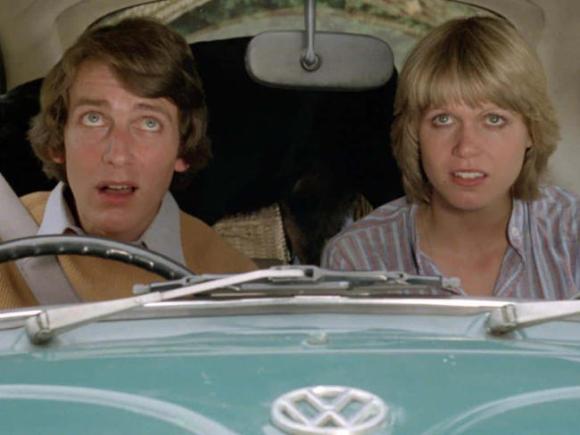
The short film Lindsey C. Vickers made before The Appointment. It’s about a young couple who go out to the countryside to see a famous ‘murder house’ and then find themselves being stalked, or haunted, by a mysterious presence. It’s available on the first of the BFI’s Short Sharp Shocks collections (recommended) and also as an extra on their disc of The Appointment.
Andrina, 1981
This one’s a bit special: it’s a ‘lost’ Bill Forsyth film, made between Gregory’s Girl and Local Hero. It’s more melancholy and bittersweet than the BBC ghost stories but shares their stillness and reliance on rural landscapes to create a sense of lonely unease. It’s about a lonely old man in Orkney who is blessed to meet a young woman who takes charge of his life and cares for him. I’d never heard of it until ‘Afterglow’ posted about it turning up, surprisingly, on YouTube.
Night Terrors: The Hospice, 1987
A 50-minute TV film that quite adequately interprets one of Robert Aickman’s best ‘strange stories’. It has to stretch the material a little, amping it up somewhat in the process, and the ending feels slightly less ambiguous than in the original text. But many of the key moments and images are there, and every bit as disturbing. Where the film benefits is in the performances by Jack Shepherd as Maybury, Alan Dobie as the sinister manager, and Jonathan Cecil as Maybury’s unsettling roommate Bannard. Cecil in particular seems to have been given the instruction I imagine actors love to hear: take it as far as you like, love; go as far over the top as you like. His chinless, rubbery British face, through a fish eye, looming too close to Maybury, and too close to us, is truly disturbing.
Loving Memory
Loving Memory, 1970
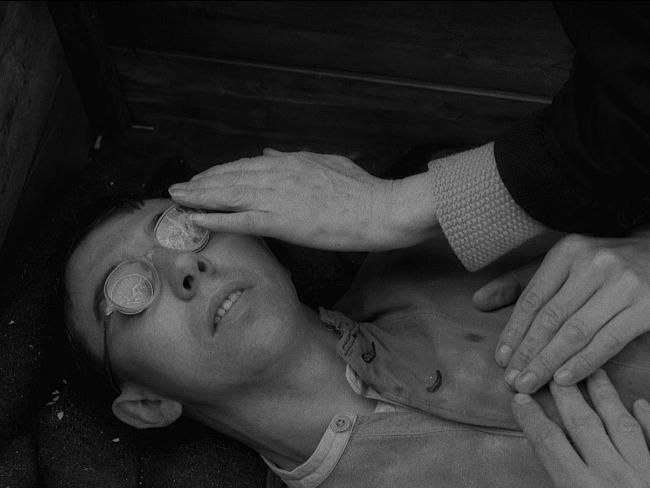
Tony Scott’s directorial debut. Country folk keep to themselves and follow their own laws. When Ambrose and his nameless sister kill a young cyclist they don’t only hit and run – they take the corpse with them and make it part of the family. All three performances are excellent although it’s David Pugh as a blankly staring cadaver, surrounded by buzzing flies, who perhaps has the greatest challenge. It’s available on a BFI disc along with his brother Ridley Scott’s first short film. You can also rent it online via the BFI.
Haunted: The Ferryman, 1974
A one-hour TV film based on a story by Kingsley Amis and starring Jeremy Brett. A writer (an avatar of Amis himself) achieves great success with a novel about a haunted pub. Then, resenting the attention that comes with success, he runs away for a weekend in the country with his wife. They’re not quite happy, perhaps because his ego takes up too much space in the relationship, and there’s tension around their lack of children. They end up in a pub that has almost the same name as the one in his book. The manager has almost the same name as his pub manager. The barman has almost the same name as his barman. Has he been here before, or is there a crack in reality? It’s got that pleasing mix of stillness and shock that marks so many supernatural British TV productions of this era and Brett is magnetic, if unsubtle, in the lead role.
The Pledge
The Pledge, 1981
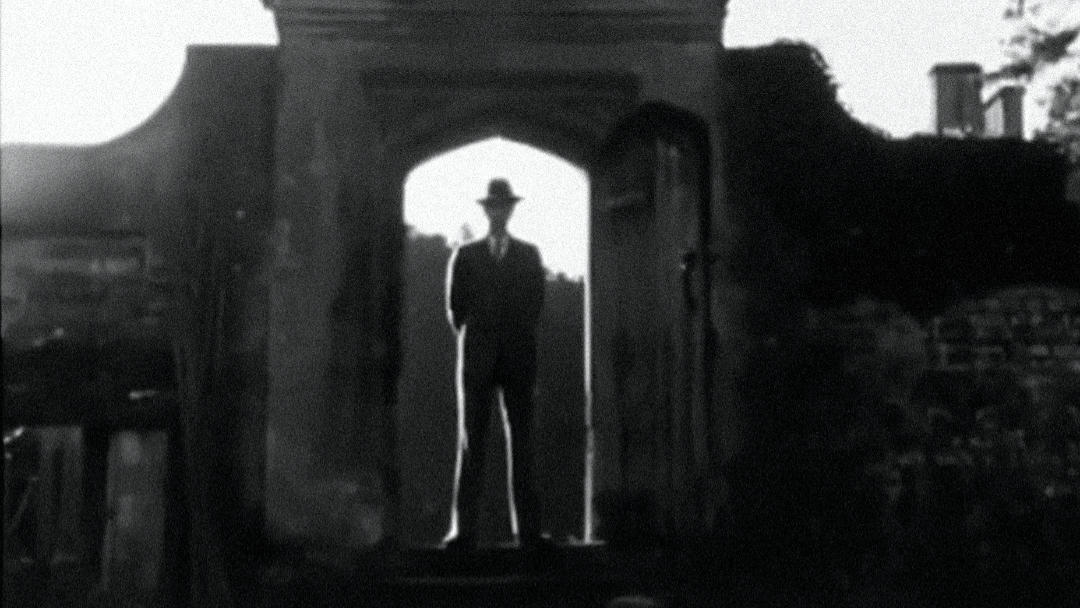
A macabre short by Digby Rumsey which marries shots of desolate moorland with close ups of maggots wriggling in the mouth of a corpse dangling from a gibbet. It’s not about the living dead but the dead dead – and what happens after death. It’s given an enormous lift by a propulsive theme tune by Michael Nyman. It’s an extra on the BFI disc of Schalcken the Painter and is also available on BFI Player.
I don’t know if I’ll have enough for another list next year but do feel free to make suggestions. I know about The Stone Tape and Schalcken the Painter, though.
I’ve been reading about New York during prohibition, thinking about Stanley Kubrick, and writing in the Edwardian mode.
This blog is what I do instead of starting yet another Substack newsletter.
You can subscribe to this blog (enter an email address, get updates when I post) using the widget at the bottom of the screen.
Or, if you use an RSS reader like Feedly or Readwise Reader, you can add this blog there.
This particular post is the third in an ongoing series inspired by someone saying: “I don’t really want to read writing advice from authors… I just want to know what they are reading and thinking and doing.”
If you follow me on Bluesky, you already have a pretty good idea of what I’m reading, thinking and doing at all times. These are some edited highlights.
Adrian Bailey’s cover illustration for the Penguin edition of BUtterfield 8.
Reading John O’Hara’s BUtterfield 8
The entire premise of this post is a fib, by the way, because what I’ve really been thinking is “Ugh, I’m so ill”, and what I’ve been doing is sleeping, coughing, and generally feeling run down.
But I couldn’t lead with that because other people’s illnesses are utterly tedious.
When the flu was at its height, I couldn’t even read. I spent two days mostly lying in bed with my eyes closed, only half listening to podcasts and audio dramas. In a low key way, this made me somewhat anxious, because I knew I had a yearly reading target to achieve.
That target is a very manageable 50 books. It’s just challenging enough to make me take a book from the shelf and read it rather than looking at my phone, but not so tough that it becomes a chore. As the end of November came around, I’d read 47 books, and needed to stay on track.
When the flu began to lift, I grabbed almost the first thing I saw with an interesting cover, and that was John O’Hara’s 1935 novel BUtterfield 8.
It’s a startlingly frank, sexy novel, with an undercurrent of sexual sickness. Gloria Wandrous is a flapper (although that term had gone out of fashion by the time the book is set, in around 1931) with many boyfriends, and dark memories of being abused by a family friend when she was eleven.
Her latest boyfriend, Weston Liggett, is a married man unhappy with his wife and overcome with lust for the 18-year-old Gloria. When he unwisely takes her to the family apartment after a day of drinking, she steals his wife’s mink coat, which careless act brings everything crashing down around them.
I didn’t realise until after I’d finished it that it was based loosely on a true story, that of a woman with the equally unlikely name Starr Faithfull, born Marian Wyman in 1906. The truth is even more grim and sad than O’Hara’s reinvention.
What O’Hara does brilliantly is to capture the whirl of conflicting feelings and emotions in the mind of a young person who has not been well cared for. She’s sexually uninhibited, she’s socially conservative; she wants a platonic friendship, she is offended that her one platonic friend doesn’t want to have sex with her; she feels dirty, she knows she is the most beautiful woman in New York City. The most important thing is never to stand still, or be alone, or think even for a moment.
For the beer blog I’ve been writing with my partner since 2007 I wrote a post highlighting O’Hara’s depiction of the New York speakeasy – an incidental but not unimportant aspect of the book.
It’s just a podcast, not a documentary or an academic text, but within those bounds it was a great primer on the films I haven’t seen, and a reminder of what’s interesting about those I have.
It made me think I need to prioritise seeing Lolita, which I’ve put off until now because, well, I’m basically a prude, and even the basic premise of the book/film made me feel uneasy.
It also made me want to watch Eyes Wide Shut again, having not seen it since it was released in cinemas in 1999. Back then, I was bewildered and bored by it. Now, with a bit more life behind me and more patience, I suspect I’d get more out of it.
I should say that Karina Longworth’s You Must Remember This seeded this idea. That’s less of a podcast and more like a documentary and in a series from a couple of years ago, Erotic Nineties, Longworth made a strong case for Eyes Wide Shut over the course of two long episodes.
As you might know, one of my particular obsessions is the way cities are recreated on studio backlots, like London in Los Angeles. One of the features accompanying the new Criterion Collection release of Eyes Wide Shut is a documentary about how Kubrick went about recreating New York in London, commissioning Lisa Leone, a friend of his daughter’s, to photograph the real New York in intense detail to inform the design of the set.
This feels like a fascinating creative project in its own right and there’s something fascinating about seeing photos of rubbish bins (sorry, trash cans) and shop fascias presented like evidence in a trial, or as if intended to communicate the concept of America to an alien from another world.
It’s also given me an idea for a project of my own. Watch this space.
Writing like an Edwardian
One of the principles behind my next collection of weird stories is to try to avoid nostalgia and retro pastiche. At the same time, I’ve written quite a bit of that over the years, and might put out a separate collection of only Victorian-Edwardian-style stories at some point.
As I have done for a few years in a row, now, I want to share a ghost story for Christmas on this blog. This time, I weakened, and decided to write something vaguely in the style of M.R. James or one of his contemporaries. It’s a long way from Municipal Gothic but what the hell, it’ll be free. The important thing, really, is that I enjoy writing it.
With that in mind, I’ve spent three evenings after work to get to a finished draft of about 2,800 words. What’s particularly enjoyable about writing in this mode is learning little historical details on the way. For example, you know those all-in-one underwear suits with a little flap on the bum? Those were known as ‘union suits’ in the US and as ‘combinations’, ‘woolly combinations’ or ‘woolly comms’ in the UK.
The story needs an edit and will be out in time for Christmas. Hopefully it’ll offer at least a little of the thrill of the real thing.
Broadcasts
I’m recording a podcast tonight, another episode of CinéClub with Joe Tindall, talking about the BBC ghost stories for Christmas and similar. That’ll be out before Christmas too, I hope.
A few weeks ago, with my professional hat on, I was the guest on another podcast talking about content design in healthcare. You can listen to that now.
Purely as a matter of aesthetics, on an emotional, instinctive level, I reject the use of generative AI in the creative arts.
When people were playing with Craiyon a few years ago, I found something interesting in the disturbing, woozy, weird images it generated. I experimented with taking its lo-res outputs, blowing them up, and blurring them to all hell to create what felt like snapshots taken with a camera I’d somehow smuggled into my own nightmares.
But as the images these tools could generate got ‘better’ – sharper, cleaner, more convincing – they slipped across a line into a kind of creepy I didn’t like. Oily. Rubbery. Like fairy treasure that turns to shit when you see it in broad daylight.
At what concentration do you start to discern the peculiar tang of AI in art you’re consuming? Setting aside ethical concerns, and arguments about solidarity between creatives, there’s an amount of AI I can just about deal with on an aesthetic level.
The Brutalist contained some background prop imagery, seen in passing, generated with AI, and used AI to massage some of Adrien Brody’s Hungarian dialogue. I wish they hadn’t done it, I don’t think it was necessary in either case, but it didn’t outweigh the vast bulk of human effort and brilliance evident throughout the film.
Late Night With The Devil, a trashier, sillier film, also used AI-generated imagery for a few onscreen graphics. Again, these were seen in passing, and made up about 0.05% of the film’s running time. They were bad, like someone dubbing a little fart noise onto the soundtrack three or four times during the film’s running time, but David Dastmalchian’s dominating performance was real enough that I could waft them away.
Watching the latest installment of British Cryptids yesterday, I was charmed by the typography, the music, the authentic 1970s patrician voiceover, and the invented folk mythology. It reminded me of Look Around You and The Day Today but with an added Fortean thrill.
Then a question occurred to me: how on earth had the creator managed to source or create all the incredible vintage images? The video was crammed with old photographs, engravings, paintings, and illustrations. Some appeared, to my eyes, to have been adapted from real archive images. Others, however, seemed to have the telltale signs of being generated with AI.
It was like biting into a delicious pie and, after taking several bites, finding a wriggling maggot.
I then began to worry every mouthful had maggots in it.
I doubted the voiceover, for example, which was too steady and repetitive in its rhythms. Where had they found a performer able to deliver this on a YouTube creator budget? I’m not 100 per cent sure, perhaps it is a voice actor, but I now think that was generated using a service like Speechify, whose ‘Russell’ voice is quite a close match to my ears.
When two brief video clips appeared I was certain they were AI-generated. They had the unstable, slippery quality of moving images generated with something like Sora.
I felt that lurch in my gut, that sense of having been pranked, and stopped watching.
When I talk about this emotional reaction to AI-generated text or visuals – when I say I don’t enjoy consuming things created with it – one counter argument is: “But what about CGI?”
To which I can smugly say, well, I’m not keen on computer-generated imagery or digital post-production either.
I tolerate it if it’s not intrusive and doesn’t outweigh the narrative and performances. But if I never see, say, another digital matte painting of the London skyline with too much detail and digital smoke, but which is also somehow completely unconvincing, that’s fine by me.
This is probably the reason I mostly watch older films and haven’t seen anything from Marvel since the first Avengers film. The finale of that film left me cold, with its digital characters being flung around a digital city, battling digital monsters, surrounded by digital smoke and digital flame.
But there’s no point in counter-arguments. This isn’t about logic, it’s about feelings.
I manage to read about 50 books a year and watch around 200 films. I want each of those to be an opportunity to connect with the creativity and craft of other human beings.
That has to go beyond having an idea and pressing a button to generate the end product.
Even if you press the button many times, and choose the best bits of whatever gunge is extruded to stitch together into a slightly less stinky, repellent object, you still haven’t made anything.
At best, I don’t care and won’t engage with it. At worst, I will hate it, and resent your attempt to feed it to me.
I’ve extracted the text from the booklet The Boiled Egg Lady and Other Local Legends of East Bristol which I found on an online auction site earlier this year. It doesn’t seem to have been reprinted; Bristol Libraries don’t have a copy; and I have not been able to track down the authors.
Introduction
This small monograph was compiled by members of the St Philips Folklore and History Society in order to record that which would otherwise be lost. As members of the community, these are stories we have heard ourselves in pubs, clubs, schools and butcher’s shop queues. You may choose to dismiss them as nonsense but, true or not, they carry a flavour of the place – and of the fears and anxieties of the people who live and work on and around the Marsh.
C.F. Rawlins, Editor, August 1993
The 598 Man as sketched by a supposed eyewitness in 1988, reproduced in The Boiled Egg Lady and Other Local Legends of East Bristol, 1993.
The 598 Man
Mass hysteria, or something more sinister? In the summer of 1988 multiple people in St George reported an encounter with a strange man driving a yellow Bedford van. Strange because he spoke as if through gritted teeth, had a heavy black beard, and an oddly immobile face.
Usually encountered at dawn, he would pull up alongside young men walking to work, or to school, and ask for help. Assuming he needed directions, they were surprised to be asked: “One piece of information, please – does the number five nine eight mean anything to you?” Of course they all said no, and after a moment, the 598 man drove away. What would have happened if someone did know the number?
On two occasions, he was said to have stopped a little further along the way, where a younger man appeared from a side street or alleyway and jumped into the passenger seat before the van sped off.
Charlie Grabknuckle, artist unknown, reproduced in The Boiled Egg Lady and Other Local Legends of East Bristol.
Charlie Grabknuckle
This is the name given to a mysterious bogeyman figure said to lurk beneath the many railway arches and tunnels that cover the industrial landscape of St Philips Marsh.
The great game for children between the wars was to find a gap in a fence or in brickwork and dare each other to insert a hand, inviting Charlie Grabknuckle to take it. Invariably, a child already secreted in that place would play the part of Charlie, seizing the proffered hand and refusing to let go.
After the war, the myth of Charlie metamorphosed and he became a more sinister character, supposedly able to pull any child through a gap, however small, by breaking their bones. Thus tenderised he would, of course, eat them.
It can be no coincidence that, over the decades, many unfortunates and outcasts have indeed been found living beneath those railway arches – or, worse, been found dead.
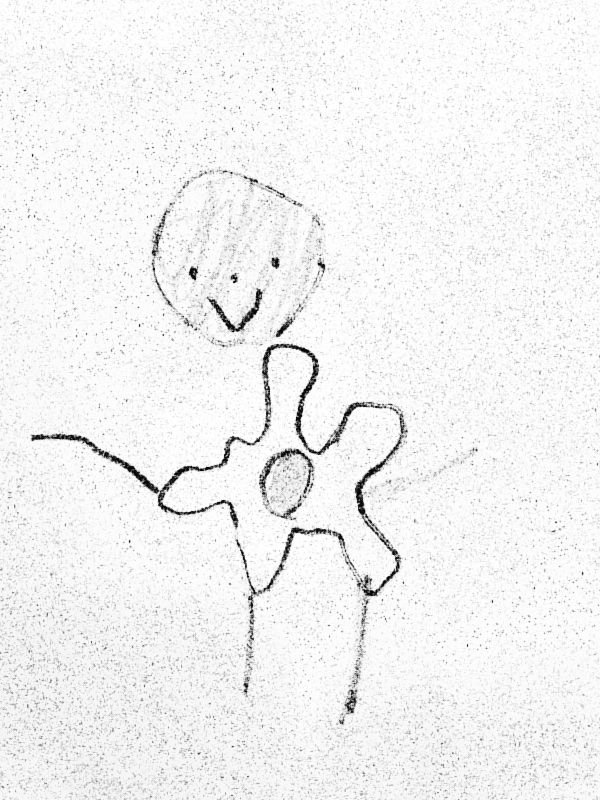
An unknown child’s drawing of the Boiled Egg Lady reproduced in The Boiled Egg Lady and Other Local Legends of East Bristol.
The Boiled Egg Lady
In November 1957 the Bristol Evening Post reported that children at a junior school in Brislington were playing truant because they were afraid of ‘the Boiled Egg Lady’.
The initiating rumour was that an old woman had offered hard boiled eggs to two boys on their way to school, inviting them into her house. Within days, several other children had reported encountering the same woman, and the story became embellished. Now, there was a shadowy figure waiting in the house – supposedly the woman’s son, an escaped murderer. Police actually spoke to an elderly woman who lived in one of the terraces off the Feeder Road, at a house identified by one of the two boys who started the rumour. A childless widow, she had been in the habit of speaking to children on their way to school, and was heartbroken when asked to stop doing so.
That was that, until a decade or so later when stories about the Boiled Egg Lady once again began to circulate, only now the story had evolved, inspired more by that evocative phrase than by anything in fact. The landscape had also changed, with mass demolition of terraces, schools, churches and factories, creating something of an eerie wasteland.
By 1968, teenagers were daring each other to traverse this space where, in the dark, the Boiled Egg Lady would be waiting for them. In this version, she took the form of a seductive young woman in a red dress. Any young man who stopped to speak to her would be asked “Do you think I’m pretty?” Of course, she was, so they would answer “Yes.” She would then remove her long dark hair – a wig – and with fingertips prise open the top of her completely bald head to reveal… Who knows? Because of course her victims fled before they could see, or were found dead.
There is no concrete record of any such incident, although several children did die playing on wasteland and construction sites during the 1960s and 1970s. Even now, it can feel a melancholy place at night.
Scarecrow Hill
Perhaps it was a prank, or perhaps a project by an art student. Whatever lay behind it, the discovery of fifteen rather horrible scarecrows on a slope at Netham Park on the 3rd of September 1974 caused considerable upset. They were found at dawn and soon a crowd from the neighbourhood had gathered to see the sinister scene. They seemed authentic enough, crafted from wood and jointed with grubby string, and decked out in old clothes of considerable vintage. Weatherworn and decayed, they seemed to have been outdoors for many years, but certainly not in this spot. Council park keepers came and took them away the same day.
That wasn’t the end of the story, however, for when the scarecrows were examined by police, several items of their clothing were found to belong to people who had gone missing or been murdered in and around Bristol in the preceding decades.
Since that time, individual scarecrows have sometimes appeared on the slope. Some theorists have noted that their appearance often coincides with the first anniversary of the disappearance of some person or another. They are promptly taken away and rarely discussed, though their number, including the original fifteen, is now said to be close to thirty.
The Blitz Babies
This story goes back to the end of World War II when Bristol was still half in ruins and its people were psychologically scarred from the experience of German bombing. It has been connected with various former bomb sites in Barton Hill and Lawrence Hill. Many of those sites were left uncleared and undeveloped until the 1970s. Throughout the 1960s, people reported hearing babies crying on these sites and, assuming they’d been abandoned, would scramble over rubble and through weeds in search of these unfortunate children. Of course they found nothing.
In one account, two children did find a baby, blackened by fire, screaming furiously. When they returned with police to examine the site, bones were found beneath the soil – far beneath the soil, long buried. There are, of course, those who point out that foxes can sound a lot like crying babies, and perhaps that’s all the blitz babies were.
In some of the council housing blocks built on these former bombsites, tenants have reported cold spots, eerie atmospheres and, yes, the sound of babies crying at night. If not foxes, then perhaps thin partition walls are to blame in this instance.
The Naked Swimmer
This is the newest of the local myths or legends in this collection, having emerged as recently as 1979. Where the Feeder Canal meets the River Avon at Netham Lock there have been frequent sightings of somebody swimming, naked, beneath the dirty water. Only beneath, however, for this curious swimmer never seems to need to surface.
Police investigated the first sighting as a potential case of indecent exposure and arrested a man found sunbathing on the manmade protuberance that marks the entrance to the canal. He insisted he had not been swimming and had worn swimming trunks at all times.
One rumour is that the so-called Naked Swimmer is actually some amphibious creature or reptile, rather than a human. An albino seal, perhaps, or a white-bellied crocodile, escaped from some private collection.
Another theory is that it was invented by some enterprising parent to deter children from paddling in the hazardous waters where stomach bugs are as big a risk as underwater obstacles.
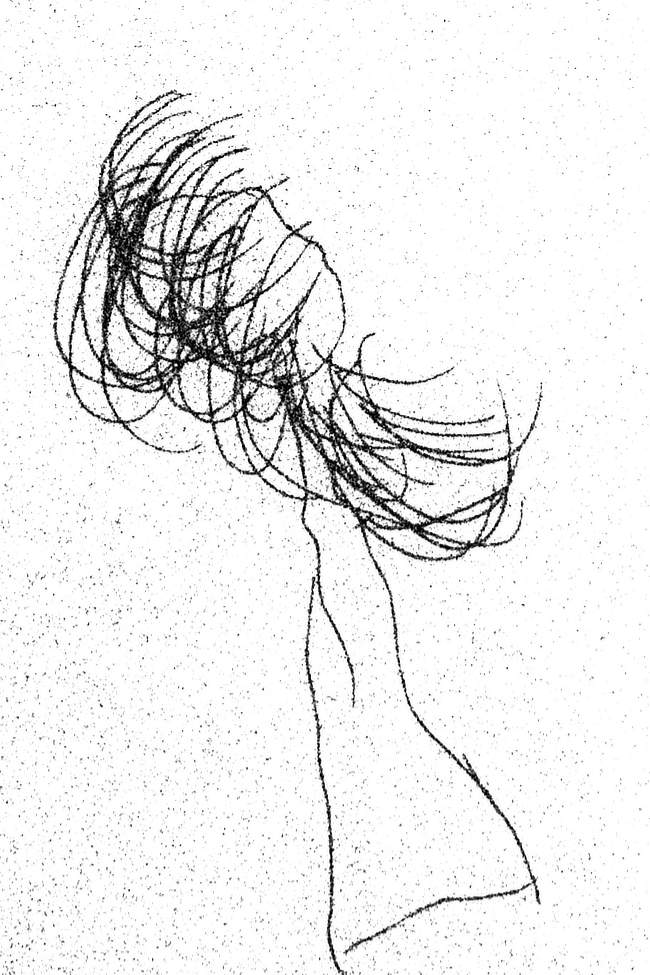
Hairy Jane as drawn by Jessica, aged 6, at a history and folklore open day at Bristol Central Library, 1992, reproduced in The Boiled Egg Lady and Other Local Legends of East Bristol.
Hairy Jane of Combfactory Lane
Walk backwards up Combfactory Lane between midnight and four in the morning and you’ll be sure to bump into Hairy Jane – literally so. Nobody has seen her but many have felt her long hair tangle around their limbs and throat, until they tear themselves free and flee.
There are too many stories, none of them in agreement, about her nature or origin. In one version of the tale, she escaped from a travelling circus, where she was an exhibit in the sideshows, and survived on the streets by capturing and eating cats or rats. In another, she was employed at the comb factory that gave the narrow cut through its name until her hair began to grow and didn’t stop. A slight variation on that account has it that her impossibly long, unruly hair became caught in one of the comb cutting machines and she was dragged to her gory death.
Spiderman Bridge
The story goes that, on dark winter evenings, people passing through the short, unlit tunnel beneath the railway line at the bottom of Cole Road hear a voice: “Spare a little change?” But there’s nobody there. Until, that is, they look up and see a bearded man in ragged clothes splayed against the red brick above, clinging on with filthy fingers and toes.
The Unscheduled Stop
Bus drivers working out of Lawrence Hill depot have for many years told new recruits about the danger of making unscheduled stops, however much a passenger might insist. There are good operational reasons for this, of course, but stories have also circulated for years about what might happen to a poor driver when such a stop is made.
For example, one veteran – we’ll call him Ted – tells of being asked to stop his bus near Avonvale Cemetery. The passenger, a young woman, asked nicely, and as it was late, and there was freezing fog, he decided to be gallant. No sooner had she departed the now empty bus, however, than another passenger boarded – an old man with pale, drawn features and a shabby black suit. He paid for his ticket with a handful of dirty old coins and took a seat near the driver. Bill could see him quite clearly in his rear view mirror. As the bus neared the junction with Church Road, Bill glanced back again and was startled to note that the passenger had gone. Pulling over, he got out of his cab to check in case the old man had slumped or fallen. He found only a length of filthy white cloth of the type used to wrap corpses.
Ted also talks of a colleague, a friend of a friend, who stopped in much the same place thirty years before, when flagged down by a man carrying a heavy package. After a few stops, this passenger departed the bus by the back door. A few moments later, the conductor shouted for the driver to stop. The man had left his package on the bus – with blood oozing through the brown paper. When opened, it was found to contain no less than twelve human hands, of various sizes and colours, and in varying degrees of decay.
Others
Many other stories are known only in passing and are still being researched by the Society. We should be grateful to hear from anyone who can tell us about:
The Phantom Social Worker (St George, 1950s)
The Avonvale Ghoul (St George, c.1968)
The Underground Theatre (Lawrence Hill, 1920s)
The Fox Tail Man (Easton, 1920s)
The German Lodger (Lawrence Hill, 1940s)
The Men in Blue Suits (Pile Marsh, c.1956)
Bonfire Billy (Barton Hill, 1960s)
Look, I put ‘Fiction’ right up there in the title of the post. I just think Bristol ought to have more decent ghosts and urban legends, so I made some up.
But perhaps some of them will take, if they make it into the rumour mill.
Or maybe someone will message me to say that, actually, they saw Bonfire Billy themselves – that poor young man who decided to sleep in the Barton Hill bonfire stack one cold November, not realising that it was due to be lit that very night…
It’s cowardice, isn’t it? That instinct that draws horror fans to old movies; camp, arch, silly films; and contemporary films set in the comforting warmth of the hand-knitted past.
The word ‘cosy’ has become an irritating background note in conversations around horror fiction.
It’s usually spoken about as a specific subset of work in the genre that offers “that happy ending, or low stakes”, as explained by Agatha Andrews on the podcast Books in the Freezer on 30 May 2023. It’s perhaps about friendship and love more than it is about cruelty.
But beyond that explicit cosiness, there’s an implicit cosiness baked into much of the genre.
Few consumers or fans of horror like to think of themselves as craving cosiness. Horror is edgy, grim, and dark. It’s for kids who don’t fit it and, like, see the world differently, man.
Horror critics speak approvingly of horror films as ‘disturbing’, ‘harrowing’ and ‘unflinching’ – ordeals through which we put ourselves, tests of our mettle, proof of our resilience in the face of fucked up shit.
In practice, however, we don’t want to be disturbed or harrowed. We want to be able to flinch. So, we protect ourselves with a range of distancing factors:
1. Time. Stories set or written in the past are less threatening than those which are strictly contemporary.
2. Geography. If the setting is physically distant from us – Texas, Italy, deep space – we feel safer.
3. Realism, or its absence. Freddy Krueger might be mean, and the Nightmare on Elm Street films might be gory, but they’re also close to being fairy tales.
4. Personal experience. We all know what will feel like salt in our own psychological wounds and can choose to avoid it.
5. Topicality. Difficult topics become less difficult when they’re no longer live; nuclear war was less scary in 2003 than in 1984.
Don’t look away
The 2020 film His House (dir. Remi Weekes) is about as far from cosy as I can imagine. It’s about a couple, refugees from South Sudan, who are dumped in a council house on an estate in England. The house turns out to be haunted by those they left behind on the gruelling journey.
It is set now. It is set in the UK, in a landscape I recognise. Remove the ghosts and it is an example of brutal social realism.
With its narrative about war, the danger of small boat crossings on the English Channel, and the vicious heartlessness of the UK asylum system, it could not feel more topical.
And, though I had it easy compared to these characters, the setting and sense of poverty reminded me uncomfortably of my own childhood – of scraping by with bugger all, constantly on edge.
I admired it, and am glad to have seen it, but cannot say I enjoyed watching it. At various points I actually felt the beginnings of a true panic response.
That’s what horror writers often believe they want to achieve, or to evoke. In reality, however, for the consumer of horror, the effect desired is more often a shiver, a pleasant thrill, or perhaps even a giggle.
I have a colleague (a woman, very politically aware) who talks about 1980s slasher movies as ‘comfort viewing’.
These are films in which one person after another is brutally murdered, often in graphic, gory detail; these people are often young, often female; and the feel of the films is often distinctly grimy.
But they are generally so over the top, so ridiculous, and so clearly set in another time (the 1980s) and place (Everytown USA) that, for British viewers, they’re a reassuring arm’s-length away from real fear. They make us jump and gasp but they rarely stay with us, or haunt our dreams.
That distance only increases when modern filmmakers or writers recycle slasher tropes and evoke the idealised Spielburbian settings of our collective childhoods. In Stranger Things or Fear Street Part One: 1994, both on Netflix, there’s an added layer of retro kitsch, or ironic detachment.
‘Trauma dumping’
A lot of contemporary horror fiction, or weird fiction, is inspired by the authors’ personal, physical or mental trauma.
Modern short stories are often ‘about’ some raw, real personal issue, such as child abuse, depression, racism, chronic illness, or gender transition. Or big, pressing existential problems like climate change.
They force us to confront complex, difficult subjects to the extent that reading for pleasure can feel like watching the news through a fictionalising filter, or listening to a deep, painful confession.
By turning them into fantastic stories, the authors are giving us a comfort blanket – a tiny degree of cosiness. But is it enough? For many readers, the answer is, no. It still feels too much like homework.
Or, to put that another way, they are often more enjoyable for the writer to write than for the reader to read.
(And I say this as someone who cannot stop writing stories attempting to process my own experiences of childhood poverty, often without intending to do so at all.)
Tweed, jerkins and knitwear
When I think of ‘cosy horror’ my mind leaps to M.R. James. His stories often have historic settings – they are set decades before they were written – and their revenants are older still. Now, in addition, we have more than a century of additional distancing. The tweediness of Edwardian prose tells us that we’re perfectly safe.
You might argue that James’s stories present eternal, subconscious fears: loneliness, unresolved sexuality, child murder… This is true. ‘Lost Hearts’, for example, certainly gave me shivers, as did its 1970s BBC TV adaptation.
At the same time, the way these stories are framed as fireside yarns in the original texts, or as ‘ghost stories for Christmas’ on TV, offers us a protective shield.
Similarly, I prompted some disagreement on Bluesky when I argued that folk horror is an essentially cosy sub-genre. As the filmmaker Paul Duane observed in response, folk horror often deals with “harsh” themes.
Equally, however, most of the best known examples are now viewed through a fog of 1970s film grain with half the cast in literally cosy vintage knitwear (dark Hygge) or 17th century jerkins and buckled boots (heritage horror).
Because that patina is part of the texture of folk horror, modern takes on this sub-genre are often also set in the past, as is the case with Starve Acre or Robert Eggers’s The Witch.
We get people in wigs discussing old news, with perhaps the odd talking goat or immortal rabbit to remind us that, by the way, none of this is real.
Even better, or more cosy, are Hammer films, and those from similar British studios such as Amicus. Does anybody watch these expecting to feel scared?
We might feel a little unnerved, perhaps, by the occasional striking image, or be made uneasy by the sexual politics. But more often, our reaction is to laugh at the big performances, at the Home Counties playing dress-up as Transylvania, and at blood as red as primary school poster paint.
The zombie apocalypse is another strong example of a cosying mechanism. These are really visions of our world post-plague, post-apocalypse, which give us a safe space in which to ask: could I shoot my neighbour in the head if they came for my resources, or threatened my tribe?
Anyway, enough of all that. I’m off to escape the horrors of the modern world in the warm embrace of a silly, colourful film in which a pair of binoculars fire spikes into someone’s eyes.
You know, in a cosy way.
This piece first appeared in issue two of the General Witchfinders zine. Issue three is out shortly and features a new short story by me called ‘We Have Always Battled Monsters in this Castle’.
I’ve been reading about the end of the world, walking from Kings Cross to Wapping, and making zines.
This blog is what I do instead of starting yet another Substack newsletter.
You can subscribe to this blog (enter an email address, get updates when I post) using the widget at the bottom of the screen.
Or, if you use an RSS reader like Feedly, you can add this blog there.
This particular post is the second in what might be an ongoing series inspired by a post in which someone said: “I don’t really want to read writing advice from authors… I just want to know what they are reading and thinking and doing.”
If you follow me on Bluesky, you already have a pretty good idea of what I’m reading, thinking and doing at all times.
These are, I suppose, some edited highlights.
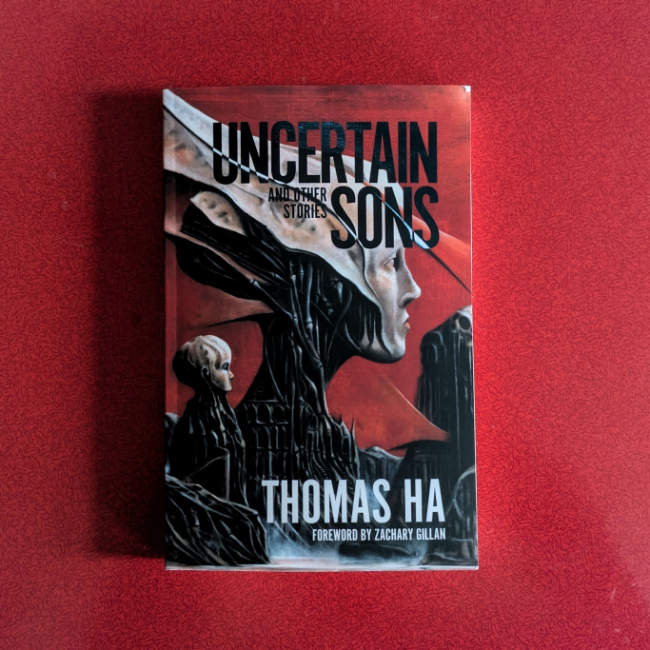
Uncertain Sons by Thomas Ha
Reading Thomas Ha’s Uncertain Sons
I’ve been struggling with reading again, if I’m completely honest. I started a new project at work and the process of onboarding is using most of my energy and brainpower. So, at bedtime, I’m only managing a few pages before conking out.
Having said that, on a week’s holiday in Belgium, I ripped through Thomas Ha’s new collection Uncertain Sons.
It presents a series of thematically linked stories, some of which also share mythologies and are perhaps hints of novels to come.
Those themes include the apocalypse, denial, family relationships, artificial intelligence (obliquely), alien forms, and mutation. They’re all defiantly weird, disorienting us and forcing us to learn on the fly new rules about how the world works.
Sentient zombie hot air balloons that only come at night. A mutant that lives in the roots of a tree and kills its sibling over and over again. A new disease that causes narcolepsy, and the sinister perverts who prey on those sleeping in public.
It’s bleak and bewildering, the latter balancing the former, and keeping our eyes locked on a world falling apart.
The standout for me was ‘Where the Old Neighbors Go’ which offers very slight respite from the climate change, pandemic, End Times vibes of the rest of the book. It’s about urban gentrification but overlaid with fairy folklore and enchanted animal imagery straight out of the darker end of Studio Ghibli.
You can read various of Ha’s stories online if you want a taster, or order the book from Undertow Publications. I actually ended up breaking my Amazon streak for this one, though, as I couldn’t find an easy way to buy it in the UK otherwise.
Thinking about creepy hotels, Krimi, delinquency and content design
I’ve written quite a few blog posts since I last produced one of these updates.
Here at Precast Reinforced Heart – that’s the blog’s rarely used official name, by the way – I wrote about how…
“Hotels are fundamentally weird places and the sense of unease they prompt is powerful fuel for weird stories.” – Horror Hotels
“I’ve found the Blu-ray box set Shadows in the Fog to be a great introduction to the West German Krimi genre despite, on paper, being a collection of also-rans.” – The German-accented phantoms of old London town
“What happens when angry young men are more than angry? These three roughly contemporary books give us portraits of youths struggling with their own murderous instincts.” – Three pulp paperbacks about juvenile psychopaths
With my work hat on, I’ve been writing about design and content design on LinkedIn, of all places:
A couple of my LinkedIn posts (not articles) also went, by my standards, gently viral, including this item about cognitive load.
I also wrote some press release material to support a new exhibition about Bristol’s brutalist architecture which prompted me to think pretty hard about brutalist car parks in particular. I now want to write something more substantial just about the giant Trenchard Street car park which was built in the 1930s, replaced and rebuilt in the 1960s, and which, Overlook Hotel style, has a somewhat dark history.
Walking, zines, photos
Last weekend, I went up to London to meet a couple of old university friends for our annual walk. This year, it came late, and wasn’t very adventurous. Logistics got the better of us.
Still, I arrived in London early and got to walk on my own in glorious sunshine from Paddington to the rendezvous point at Kings Cross.
I find London very soothing. Being surrounded by people (against loneliness) who don’t want to talk to me (introversion) is perfect – and there’s just so much to look at.
When I’m walking, I sometimes activate what I call Path Less Taken Mode (PLTM). It’s really easy to follow the route Google Maps suggests, or to lock into habits and routines. With PLTM, the idea is, at every decision point, to take the less familiar turn.
In London, PLTM took me past the Tyburn Convent and the former Oranjehaven where Dutch airmen hung out during World War II. It also led me to some remarkably tranquil streets one or two blocks behind Tottenham Court Road where, from the right angle, it might have been 1892.
Back home, I’ve been making zines somewhat compulsively. There’s generally no particular purpose to this although I might end up slipping them in with orders of my books.
Which reminds me: you can order copies of Municipal Gothic and Intervals of Darknessdirectly from me. They’re £13 each, including delivery, or it’s £25 for both.
Anyway, back to zines… What I’m particularly enjoying is trying to make a complete zine from (a) one sheet of A4 paper and (b) a single copy of a magazine, or several copies of the same magazine. This creates a pleasing consistency in style and typography and also challenges me to dig a little deeper.
A detail from a zine called The Nerk made my cutting up a copy of The New Yorker.
I’ve been taking photos too, of course, although the fading autumn light makes that harder.
I take most of my pictures on walks before or after work, and when it’s grey and/or dimpsy, it feels harder to find subjects.
There’s been the odd image I’ve been quite happy with, though.
Rose Green Road, Bristol, September 2025
A prize for making it this far
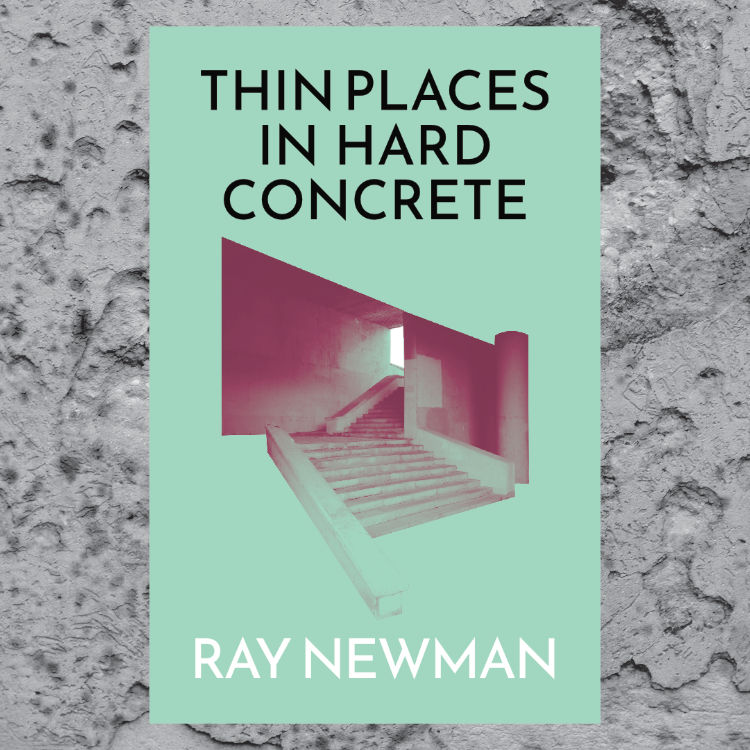
This is the first time I’m saying this publicly: my next collection is likely to be called Thin Places in Hard Concrete and this is a first sketch of the cover.
Hotels are fundamentally weird places and the sense of unease they prompt is powerful fuel for weird stories.
Even before we consider aspects of the uncanny, and the hotel in weird fiction, the very concept of the hotel is troubling.
You’re telling me I’m going to a strange town to sleep in a strange room, in a strange house, where someone I don’t know has a master key to my room?
It’s no wonder I barely get a wink of sleep whenever I’m away from home.
I have stayed in some objectively odd hotels over the years. The converted U-Boat factory in Gdańsk, for example, which aimed for industrial minimalism but whose concrete walls throbbed with memories of Nazism.
In Lithuania, one hotel had a display of KGB bugging and recording equipment that had been removed from the walls during its renovation.
Back home in the UK, my mind turns to a genteel bed and breakfast in Gloucestershire that hadn’t been decorated in about forty years. There were faded paintings of Spitfires, Hurricanes and the Queen on every flat vertical surface. In the corner of my room was a small door which I opened to find a cupboard filled with box after box of children’s drawings and schoolbooks from, I’d guess, the nineteen-seventies.
In the Scottish Highlands, there was a would-be boutique hotel whose lobby came with a chaise longue strewn with sinister porcelain dolls, and whose owner had a way of making tourist tips sound like threats: “I’m only trying to help you…”
Chain hotels are no better. In one, my partner and I only discovered there was a connecting door to the next room when its occupant burst in looking for the bathroom. He was almost as terrified as us.
In another we were kept awake all night by local youths roaming the corridors banging on doors and smoking pungent weed.
Bad things do happen in hotel rooms, too – those private spaces for hire where, even if you can no longer sign in as ‘Mr and Mrs Smith’, you are at least free from surveillance or supervision.
I was prompted to think about the hotel in connection with weird fiction by reading Daisy Johnson’s The Hotel. It’s a collection of stories originally written for BBC Radio Four all of which are set in and around the same fenland hotel.
It feels to me as if Johnson was trying to exorcise every single anxiety she’s ever felt while visiting hotels, whether caused directly by the strangeness of the buildings themselves (what’s behind that door?) or the social situations that bring us to them. There’s a particularly effective pair of stories about a hen party in which an actual monster is less scary than the cruelty of old friends.
Critics have rightly noted a connection between Johnson’s creation and The Overlook Hotel from Stephen King’s The Shining, via Stanley Kubrick’s 1980 film adaptation of that novel.
The Overlook is a brilliant creation, and of the best haunted houses in fiction, alongside Shirley Jackson’s Hill House. Here’s my favourite line from the book:
It was empty and silent, the only sound that curious subaural echo that seems to linger in all large rooms, from the largest cathedral to the smallest home-town bingo parlour.
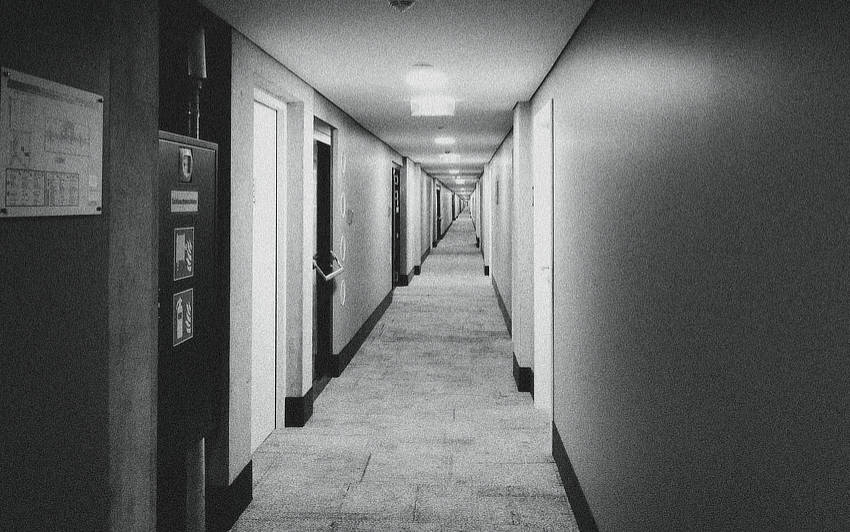
Hotels are bigger than our houses, and often as big as palaces. There might be hundreds of other guests, or none. We can easily find ourselves alone on seemingly endless corridors, lined with endless doors. King, and Kubrick, mine these in-between spaces for all they’re worth.
A handcrafted photo manipulation duplicating a hotel corridor into infinity.
Neither the Overlook nor Daisy Johnson’s hotel are especially old buildings but both have managed to accumulate many ghosts in their short lives. A private house might have, say, twenty occupants in a hundred years, whereas even a small hotel could have that many people pass through in a single weekend. Many lives are overlaid there.
In Joanna Hogg’s film 2022 film The Eternal Daughter Tilda Swinton plays a woman staying at a country hotel out of season, surrounded by dense fog. She is accompanied by her elderly mother, also played by Swinton. It’s an unsettling, confusing film, which plays with ideas of time and memory – and what are ghosts if they’re not memories? We might visit the same hotel every year, or years apart, and feel that we’re picking up where we left off, stepping into another life, or other timestream.
Another feature of The Overlook as presented in the film of The Shining is that, like Hill House, it does not make sense as a coherent space. There are many analyses of the layout of The Overlook online, some treating these problems as ‘goofs’ or continuity errors, others acknowledging that they might contribute to our unease.
This gives us a link to the traditional English ghost story which was often quite capable of high weirdness.
In his tale ‘Number 13’ M.R. James gives us a hotel room that shrinks and expands as an impossible room next door appears and disappears during the night:
He started to go down to breakfast. Rather late, but Number 13 was later: here were his boots still outside his door—a gentleman’s boots. So then Number 13 was a man, not a woman. Just then he caught sight of the number on the door. It was 14. He thought he must have passed Number 13 without noticing it. Three stupid mistakes in twelve hours were too much for a methodical, accurate-minded man, so he turned back to make sure. The next number to 14 was number 12, his own room. There was no Number 13 at all.
A welcome you’ll never forget
We’re supposed to feel welcome in hotels; the industry is called ‘hospitality’. But in horror or weird fiction, they can be either cold, or positively hostile.
The Bates Motel from Robert Bloch’s Psycho, filmed by Alfred Hitchcock in 1960, is a famous example of a hotel that lures in guests, then devours them. There are peep holes, so no privacy, and the doors do not keep predators out of the rooms. The chambers of the Bates Motel are very unsafe spaces.
Robert Aickman’s 1975 story ‘The Hospice’ is about a travelling salesman who gets lost on country roads and checks into a country hotel. The events that occur during the course of his stay follow nightmare logic – and are, in fact, very much like some of my own recurring nightmares. He wants to leave, but can’t, with various obstacles placed in his way.
Are the guests there against their wills? Are some of them ghosts? Has there been a murder?
Aickman’s technique here, as usual, is to leave us asking questions, and to withhold answers.
His story also makes me wonder about the overlap between hotels and other bed-and-board institutions – hospitals, care homes, mental health care facilities, halfway houses, and prisons.
In 2025, of course, they also perform the role of refugee asylum facilities. They weren’t designed for this, and their guests are not on holiday. But that doesn’t stop mobs assailing them from outside, turning the hotel into a trap.
Hotels in my stories
I could easily write a hundred stories about hotels. As set out above, I often find discomfiting – even the most benign examples.
Why do Premier Inns have those weird purple-tinted Lovecraftian landscape prints on their walls? Who left that handwritten love letter in the drawer? What do the Gideons know that I don’t?
In practice, I restrain myself, and it’s only ‘Alice Li is Snowed Under’ in my collection Municipal Gothic that really explores this setting. It was inspired by the many years I spent doing too much travelling for work.
As I was, Alice is an earnest twentysomething trying to make a career in the Civil Service and, like me, she is an introvert who welcomes the loneliness of hotels – up to a point.
When the hotel becomes snowed in, she is forced to stop working, and to be alone with her own thoughts, and with a visitation that makes her confront an unresolved question. The blank, bland offers nowhere to hide.
There is also, however, a strange old country hotel in my retro folk horror story ‘The Night of the Fox’ and a truly horrible one-star dosshouse in ‘The Horns in the Earth’. Both are in my other collection Intervals of Darkness.
There’s also another story I’m working on inspired by a stay at a chain hotel in central London the night before an early train. There, I was kept awake by the sound of drilling during the night, which the manager insisted was not happening.
When all you want is to sleep, a malevolent hotel that insists on preventing that from happening is pretty close to the ultimate horror.
I’ve found the Blu-ray box set Shadows in the Fog to be a great introduction to the West German Krimi genre despite, on paper, being a collection of also-rans.
‘Krimi’ is a description applied to a run of films made in Germany between the 1950s and the 1970s, based on or inspired by the works of British crime writer Edgar Wallace.
The six films in this set were made by CCC Filmkunst as an attempt to cash in on the better-known Rialto Film series.
Rialto’s films were adapted directly from the novels of Edgar Wallace but CCC cannily enlisted Wallace’s son, Bryan Edgar Wallace, as the mascot for their knockoff series.
CCC’s films were all supposed to be based at least on ideas by Wallace the younger, although really the important thing was to get his name on the posters and in the opening credits.
Much has been made of the influence of Krimi on the Italian giallo genre. Often, the suggestion is that the giallo realises fully what the Krimi only half grasped. It’s true that gialli are generally bolder, more erotic, and more colourful.
Being British, it’s easy to scoff at the version of England presented in these films, recreated on Berlin studio backlots, on suburban streets, or in the grounds of historic buildings.
If you’re even remotely sensitive to architecture and design, you’ll notice the absence of London brick and the jarring presence of baroque stonework. And wven with the careful placement of extras in British police helmets and strategically parked Jaguars, you can’t turn smart Berlin apartment blocks on a neat grid into Soho or Whitechapel.
It’s only fair, though, isn’t it? At the same time the UK’s Hammer Films expected us to buy a country park as the wild mountain forests of Mitteleuropa, and its own backlot dollhouses as ‘Carlsbrück’ or ‘Karlsbad’.
The Mad Executioners, AKA Der Henker von London.
It doesn’t really matter that the London of the Krimi film is unconvincing because in this context it is merely a mythic playground for archetypes. (See also the landscape of the western, as various critics have observed.)
It has more in common with the foggy Universal backlot London of the Basil Rathbone Sherlock Holmes films of the 1940s than with the real thing.
In fact, Sherlock Holmes is clearly an unspoken reference point for the Krimi.
For example, the plot of The Phantom of Soho (Franz Josef Gottlieb, 1964) concerns a group of wealthy conspirators being hunted down one by one as revenge for a crime committed overseas – a plot structure Conan Doyle used multiple times.
As in the Holmes stories, we often get lords and wards and family secrets, with stately homes as key locations.
The films perhaps have more in common with the money-grubbing post-war Holmes pastiches of Adrian Conan Doyle, or with August Derleth’s Solar Pons stories, both of which tend to the macabre and the melodramatic.
One of the films in this set, The Curse of the Yellow Snake (Franz Josef Gottlieb, 1963) suggests a contemporary of Holmes, Sax Rohmer’s Fu Manchu, with all the racism that entails. It also feels like a precursor to Indiana Jones and the Temple of Doom and, going full circle, Young Sherlock Holmes.
Unlike Sherlock Holmes stories, Krimi credits the dogged men of Scotland Yard with a certain amount of genius.
The chief protagonist is usually a police inspector, like Jeff Mitchell (Harry Riebauer) in The Strangler of Blackmoor Castle (Harald Reinl, 1963) or John Hillier (Hansjörg Felmy) in The Mad Executioners (Edwin Zbonek, 1963).
They’re often the sharpest men on screen, both in terms of brainpower and fashion sense.
There’s never anything supernatural afoot but the films often hint that there might be. The killer in The Phantom of Soho wears a skeleton mask while in The Mad Executioners a gang of vigilantes rides about the Home Counties in a horsedrawn Gothic hearse straight out of Dracula.
The more Krimi I watch, the more I want to watch.
They’re reassuringly formulaic but also constantly surprising. The music is groovy, jazzy, and often surprisingly electronic. The faces are fascinating – household names in Germany but mostly unknown elsewhere, unless they cropped up in war films playing Nazi officers.
And this fantasyland of nightclubs, secret tunnels, laboratories, ruins, wild moors, and foggy Spreeside-Thameside streets is such a wonderful place to escape the here and now.
What happens when angry young men are more than angry? These three roughly contemporary books give us portraits of youths struggling with their own murderous instincts.
I came to The Furnished Room, Big Man and The Dead Beat one at a time after finding tatty old paperbacks in charity shops or roadside book swap boxes.
All three were written during a period of anxiety about juvenile delinquency and a simultaneous growth in popular discussion of psychopathy.
The term ‘psychopath’ was popularised in the 1940s and a slew of novels and movies from that point on portrayed a particularly chilling type of killer. Being outwardly in control, and even charming, they were able to walk and live among us.
Joseph Cotten’s Uncle Charlie in Alfred Hitchcock’s brilliant 1943 film Shadow of a Doubt is one example. Patricia Highsmith’s The Talented Mr Ripley introduced us to the chameleonic Tom Ripley in 1955.
At the same time, young people were beginning to seem dangerously out of control, with motorbikes, switchblades, and a lack of respect for authority.
That’s the context in which the following three pulp paperbacks emerged.
Little boys to broken men
Big Man is the earliest, published in 1959. Its author was prolific novelist Evan Hunter, born Salvatore Lombino, and best known for a series of police procedural novels written under the name Ed McBain. He wrote this book as Richard Marsten and it reflects something of that sense of fractured personae.
It’s written from the point of view of Frankie, a young man living in poverty with an alcoholic mother, and drawn into petty crime by sheer boredom. Petty crime leads to organised crime where, after resisting, he embraces his true murderous self.
The 87th Precinct novels are set in an anonymised fantasy of New York where Manhattan is Isola, Queens is Bethtown, the river is the Harb, and so on. Big Man is set in New York proper, where Hunter grew up and which he knew at street level.
This authenticity shines through in his portrayal of the everyday lives of idle young men with no coin in their pockets and every reason to feel detached from the world. That Frankie’s best friend Jobbo has appalling body odour sets the tone: this is a world where sweat stinks.
These early chapters are similar in mood to The Incident, a 1967 film based on a 1963 TV play, about two young men who terrorise a New York City subway car. In both cases, the thesis is that the road to murder begins at robbery, and robbery comes as much from a need for something to do as from the urge to acquire.
For Frankie, the lure of organised crime isn’t so much money but also a sense of family, respect, and affection. The mob boss is a father figure – someone who tells Frankie he is a good boy and has value.
Even through Frankie’s unreliable narration we see, of course, that he is being preyed upon and manipulated. Through favours owed, debts incurred, steps taken from which there is no walking back, he is drawn away from society and becomes ever more tangled in a shadow world with its own values.
What really sets the book apart is Frankie’s relationship with his two lovers. Frankie is torn between two women – a sexually insatiable gangster’s moll who has been with the whole crew, and the nice neighbourhood girl who wants to start a family.
It is shocking when he shoots the former on the indirect order of his boss. It is absolutely devastating when he puts a bullet in the head of the second because she has become a hindrance to his career.
Hunter plays with our prejudices: promiscuous girls who get involved with criminals put themselves in the firing line, but nice girls who just want their boys to go straight? They deserve a happy ending.
By the end of the novel, Frankie has become a killing machine, like a soldier trained for combat. He follows orders and shoots when he’s told to shoot.
He is also cursed with the knowledge that if he can bring death to the others so swiftly and easily, then death can come to him the same way.
Robert Bloch’s The Dead Beat was published in 1960 and tells the story of another blank, murderous young man.
Larry Fox is a dead beat jazz pianist who finds a way to break out of the world of crime, prostitution and drugs and into the nice suburban home of a nice suburban family.
His great skill is being able to present as a good boy when it suits him – or maybe these are actually glimpses of the real Larry, or another Larry, battling Bad Larry for supremacy?
As Good Larry, he’s bashful, well-spoken and polite. He’s musically talented and has hopes to study composition at university. This is catnip for the middle class saviours who take him in and nurse him when they find him unconscious in the back of their car. Especially the women.
But Bad Larry plans to get revenge on his former accomplices in a robbery and will fuck, rob, drug and manipulate anyone who gets in his way, or can help him achieve his goal.
Bloch doesn’t expect the reader to read between the lines. He has his characters debate matters of juvenile delinquency and ‘the beatnik problem’ which gives him an excuse to insert chunks of his thesis into the text:
It all began with World War One, I suppose. Up until then, the traditional role of the young man in this country was that of an apprentice. In rural communities he started as a hired hand or helped his father on the farm. In the cities he entered business as a clerk or a messenger or an office boy. Youth accepted a subordinate position unquestioningly, even when the industrial era developed… War is the great glorifier of youth… Our economic leaders, through the media of advertising, assure us that it is the duty of everyone to appear young; to buy products which enhance the illusion of immaturity. Our books, magazines, motion pictures and television programs inform us, not too subtly, that romance and adventure are the exclusive property of young people between the ages of seventeen and twenty-five. Nobody over that age ever falls in love or experiences anything of lasting significance, except for a few oddball characters thrown in for comedy relief.
Bloch was primarily a writer of horror stories and the scary idea in this story is that adults cannot tell good boys from bad ones. That nice young man your daughter is dating might be a hophead, a junkie, a pervert or a killer – better not let him in. Especially not if he reminds your wife of when she was young.
The kitchen sink killer
Crossing the Atlantic, Laura Del-Rivo’s The Furnished Room was published in 1961 and filmed as West 11 in 1963.
In many ways it sits alongside British social realist novels like Saturday Night and Sunday Morning or, closer in tone and setting, Absolute Beginners. The difference is that Del-Rivo introduces a gun into the mix turning it into something like a crime novel, or one of Georges Simenon’s romans durs.
Joe Beckett is another semi-intellectual, but a reader rather than a musician. Like Larry Fox, he is capable of making himself presentable, as long as nobody gets close enough to notice the grubbiness of his shirt or smell his unwashed socks. To some people he reads as clever, almost an intellectual, although his drug-fuelled lectures don’t stand up to the scrutiny of really intelligent people.
As with the protagonists of many other British novels of the period, he is too full of fury to be constrained by the drudgery of a nine to five job, or by love and marriage. Unlike Arthur Seaton, however, he decides that committing a murder might fix the emptiness inside him.
Haunting the cafes and bedsits of West London, Joe meets a classic British type: the faux-military conman with a range of regimental ties to suit whichever story he is telling on any given day. Keen to inherit from an aged aunt, he draws Joe into a scheme apparently inspired by Strangers on a Train.
That standard crime plot isn’t where the excitement lies in this story, though. That’s in Joe’s battle with his own worst instincts. He has constant intrusive psychopathic, paedophilic and fascistic fantasies. Reading about Nazi concentration camps thrills him:
Beckett’s immediate reaction had been a burst of sadistic joy. He knew that if, at that precise moment, he had seen a woman prisoner with her arms yearning for a lost child, he would have kicked her in the face. The shooting of the new detachment had pleased his sense of order. They were damn nuisances, screaming and panicking like that. Shooting them was the only orderly thing to do. He loathed the prisoners for their ugliness, their suffering, and their lack of pride. The photographs of these degraded sufferers, squatting behind their barbed wire, had revolted him so much that he had thought it a pity that the whole lot hadn’t been gassed. He had preferred the photographs of the Nazi guards, who had at least looked clean and self-respecting.
This book in particular feels like a commentary on present day alt-right, manosphere and incel cultures.
All three books force us to inhabit the minds of boys who don’t know how to love, even if they sometimes get close.
Those are the moments when we want them to break through the barriers, to untangle the complex feelings that threaten to break through their anger, resentment and hatred.
But they can’t do it. So they reach for guns and point them at innocent people.
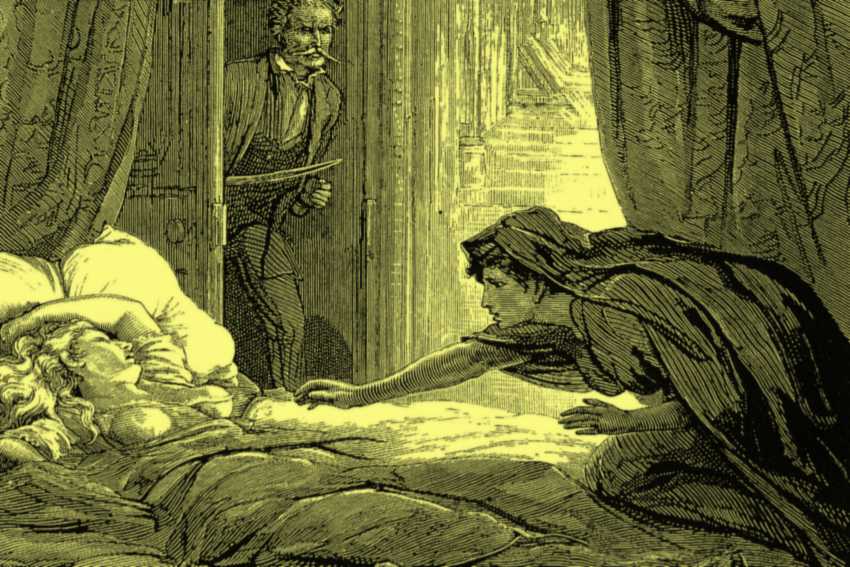
Sheridan Le Fanu’s Carmilla is a fascinating story. If nothing else it was published in 1872, long before Dracula, and was clearly a huge influence on Bram Stoker.
When the team at the Vampire Videos podcast invited me to join them as their guest on an episode my first challenge was to think of a vampire movie they hadn’t already covered.
Fortunately, I’ve developed a taste for the kinds of films you can only find in the depths of YouTube, which is where I found a 1989 episode of the US anthology series Nightmare Classics based on Carmilla.
It stars Jennifer Tilly as Carmilla and relocates the action from Styria in Eastern Europe to the American Deep South.
Here, though, I wanted to say a few words about Le Fanu’s original story which I suspect many readers of vampire fiction have overlooked for various reasons.
I first read Carmilla as a teenager during the vampire craze of the early 1990s, when kids at my comprehensive school in Somerset – even those who wouldn’t normally be seen dead with a book – were carrying around film tie-in editions of Dracula and Interview With a Vampire.
I read both, and saw both films, and wanted more, so when I was given the chance to choose a book for a school prize, I selected The Penguin Book of Vampire Stories edited by Alan Ryan.
What a treasure trove that book was, and is. I still have the same copy, its pages yellowing, wrapped in ‘protective film’ that is slowly eating it, with a slip on the flyleaf which tells me I won the Phillips Award for Academic Achievement in 1994.
As well as John Polidori’s ‘The Vampyre’ and Stoker’s own ‘Dracula’s Guest’ it contains the complete text of Carmilla, a novella at 70 or so pages.
I sometimes describe myself as Britain’s Most Uptight Man and I was even worse as a teenager. Carmilla, at that time more than 120 years’ old, still had the power to thrill and shock (me, at least). I was astonished by how modern it seemed with an intense sexuality and, specifically, what seemed to me in 1994 to be a clear and unambiguous portrayal of a lesbian relationship:
In silence, slowly we walked down to the drawbridge, where the beautiful landscape opened before us.
“And so you were thinking of the night I came here?” she almost whispered.
“Are you glad I came?”
“Delighted, dear Carmilla,” I answered.
“And you asked for the picture you think like me, to hang in your room,” she murmured with a sigh, as she drew her arm closer about my waist, and let her pretty head sink upon my shoulder. “How romantic you are, Carmilla,” I said. “Whenever you tell me your story, it will be made up chiefly of some one great romance.”
She kissed me silently.
“I am sure, Carmilla, you have been in love; that there is, at this moment, an affair of the heart going on.”
“I have been in love with no one, and never shall,” she whispered, “unless it should be with you.”
I’d like to pretend I had a sensitive, sophisticated response to this at the age of 16 but what I probably thought was “I’m confused, help!” and/or “Cor, girls kissing!”
Carmilla, I later learned, was the source for all of Hammer’s “Cor! Girls with their tops off!” vampire movies of the 1970s, their use of the name ‘Karnstein’ being the most obvious giveaway.
The Vampire Lovers from 1972, with Ingrid Pitt as Carmilla, is a fairly close adaptation of Le Fanu’s novella with all the flaws and compromises you might expect for a film of the time.
I don’t want to spoil the podcast but it’s fair to say the 1989 adaptation, though less exploitative, also has its flaws.
It would be great to see an adaptation of this story as lavish and careful as Francis Ford Coppola’s Bram Stoker’s Dracula or Robert Eggers’s recent version of Nosferatu.
There are themes in Carmilla that still resonate in 2025, not least the negative power of loneliness.
Laura is utterly isolation in a castle in the middle of nowhere, surrounded by stuffy old men and servants.
It is her desperation for a friend, for any kind of companionship, that makes her so vulnerable to Carmilla’s serial predation. Or, to put it another way, that makes her so ready to be liberated. Which is it?
I see in this uncomfortable tension some interesting echoes of online exploitation and catfishing.
That such contemporary parallels can be drawn is perhaps a sign that Carmilla has depth and value beyond it’s part in the genesis of Dracula, and beyond its undoubted erotic charge.
You can listen to the podcast at vampirevideos.co.uk or wherever you usually get podcasts. The full text of Carmilla is available online at Project Gutenberg and in The Penguin Book of Vampire Stories which you can buy used for buttons.