I’ve got a limited supply of paperback copies of both Municipal Gothic and Intervals of Darkness ready to ship to anyone in the UK who wants to buy one.
They’re £13 each including delivery in the UK, or you can get both for £25.
They’ve each got a selection of weird stories and ghost stories, with Intervals of Darkness being the more recent of the two collections.
“Impressively eerie and packed with shocks, Intervals of Darkness ushers the reader through 1970s grime and Gothic opulence, with moments of powerful poignancy and startling strangeness. You’ll want to linger over these stories.” – Verity Holloway
“Housing estates, factories, tower blocks and caravans, nowhere is safe from Ray Newman’s dark imagination. Existing somewhere between Robert Aickman and JG Ballard, these blackly funny tales are sure to chill you, no matter how high you turn the central heating. It’s every bit the equal of Municipal Gothic, and if anything it’s darker and stranger.” – John Grindrod
Contact me to sort out payment and delivery, and to let me know if you want the books signed or dedicated.
If we’re already connected, you probably know how to reach me, but otherwise…
A key feature of popular music is the use of artificial echo and reverberation to make small ensembles sound big, to complexify simple arrangements, and to turn poky studio spaces into wide open landscapes.
Listen to ‘Isi’, the opening track of Neu! 75, by German band Neu, for example. It begins with a simple sequence played on a piano. But a reverberation (reverb) effect sends each of the three basic chords out into a big blue sky – one that exists only in a studio box of tricks.
Echo and reverb are such a part of the background to recorded music that most of us don’t notice they’re there. We would notice, however, if they weren’t.
The same piano chord ‘dry’ and then with reverb and echo.
When a piece of music is described as ‘epic’ it’s probably reverb, often paired with echo, that is creating that impression.
Echo, or ‘delay’, is a subtly different effect. It’s about the repetition of distinct sounds rather than their washing away into space.
Play a single note, add repetitions with delay, and play that into reverb and, in an instant, you have music. A sound that can make you feel things.
Please subscribe to get notified when I post something new here. It’s what I’m doing instead of setting up yet another Substack newsletter.
Psychedelic music was largely built on the use of reverb and echo. Think of Sgt. Pepper’s Lonely Hearts Club Band by The Beatles and its associated single, ‘Strawberry Fields Forever’, and how often John Lennon’s voice in particular is adrift in a swirl of its own tails, haunting itself.
To psychedelic and progressive musicians, reverb and echo perhaps seemed to mimic the opening up of their own minds through the use of psychedelic drugs, or their discovery of esoteric spirituality, or both.
These effects turn the performer into a god, their voice calling out across all the lands – or, alternatively, allow them to become as one with the universe. At any rate, they allow them to cease to be themselves:
“With ‘Tomorrow Never Knows’ I’d imagined in my head that in the background you would hear thousands of monks chanting.”
John Lennon quoted in The Beatles by Hunter Davies, 1968
What we rarely acknowledge is how strange it is to be able to create these auditory virtual realities from loops of magnetic tape, wobbly springs, sheets of metal suspended in boxes, electronic circuits or, most recently, lines of code.
Before reverb and echo devices, these effects were created by playing in real spaces such as halls, churches or water tanks. Then studio technicians worked out that they could pipe sound into those spaces, record the echo remotely, and blend it with the mix. But, still, you needed big, empty rooms to play with.
Spring reverb was an early breakthrough. It achieved the impression of space by channeling sound through a box full of springs and recording their vibrations. This is very much the sound of surf music. But where is the surf guitar player as we hear them twanging on recordings? In the hall created by the curl of a giant wave? In Monument Valley? In deep space?
Early echo/delay effects were created through similarly analogue means, using loops of tape to record a sound and play it back almost immediately, layered over the original. By adjusting settings engineers can create the impression of sounds bouncing into infinity, or slapping back as if from a nearby cliff face.
The EMT 140 plate reverb, first manufactured in 1957, was a significant breakthrough. That’s it travelling in space in the main image above. It was used extensively on recordings by The Beatles and Pink Floyd, among others, and is one of the defining sounds of psychedelia.
It conjures vastness from a bland looking wooden box of the type you might find collecting dust at the back of a school assembly hall.
Inside that box is a large plate of sheet metal suspended from springs. Your raw sound – John Lennon singing, for example – is played into the plate through (in non technical terms) a small speaker. That causes the plate to reverberate and that sound, in turn, is picked up and sent back out of the box to be mixed with the original sound.
Since the 1970s, it’s been possible to create reverb and echo using, first, analogue electronic circuits, and then digital signal processing. This has allowed those mindbendingly enormous spaces to be housed in ever-smaller packages – the voice of God in a matchbox.
In recent years, convolution reverb has emerged. It uses ‘impulse responses’ (IRs) to capture the qualities of real spaces. Or to steal their souls at gunpoint, you might say. Because that’s often how IRs are created – by firing a starter pistol into, say, a cave, or concert hall, and recording the violent boom.
Another modern trend is shimmer reverb which, rather than recreating real spaces in perfect fidelity, creates impossible ones, where sound behaves in illogical but magical ways. It uses digital processing to repeat each sound at a different pitch, as part of a wash of sound, creating twinkling harmonies. It’s a key feature of modern ambient music.
Ambient music. Musical ambience. Ambience as music. Listeners want to be taken away, enveloped, lifted ten feet off the ground.
Having narrowly avoided setting up a newsletter on Substack (well, a second newsletter) I’m going to use this blog for a similar purpose.
Not least because the other day I read this…
Hot take: I don’t really want to read writing advice from authors I like and to who’s newsletters I subscribe to. I just want to know what they are reading and thinking and doing.
I’ve also been inspired by Paul Watson in a couple of ways. First, by his monthly round-up of interesting reading, much of which really is interesting for once. And, secondly, by his habit of maintaining a proper RSS feed reader, which is how he manages to stay on top of other people’s blogs.
As a result, I’ve fired up Feedly and given it a spring clean.
That is, I’ve deleted all the blogs and websites I followed about a decade ago – because most of them are now either defunct or degraded beyond belief – and added a bunch of new and active blogs.
Many of those I cribbed from Paul’s blogroll but I also had success asking people on BlueSky to let me know about their own blogs, or suggest others they liked.
I’m especially interested in:
hauntology
folk horror
architecture
cities
books, films, music
graphic design
content design
Do let me know if you have a blog in that territory, or know of a good one by someone else.
In lieu of a newsletter, I’m also nudging people to subscribe to this blog, so they’ll be notified when I update it. So, uh…
A new favourite blog is Stephen Prince’s A Year in the Country which examines various hauntological and folk-horror-related texts in serious detail, drawing unexpected connections between them.
In fact, I’ve been enjoying it so much, I bought the latest print-on-demand anthology of recent writing which I’ve also been reading before bed.
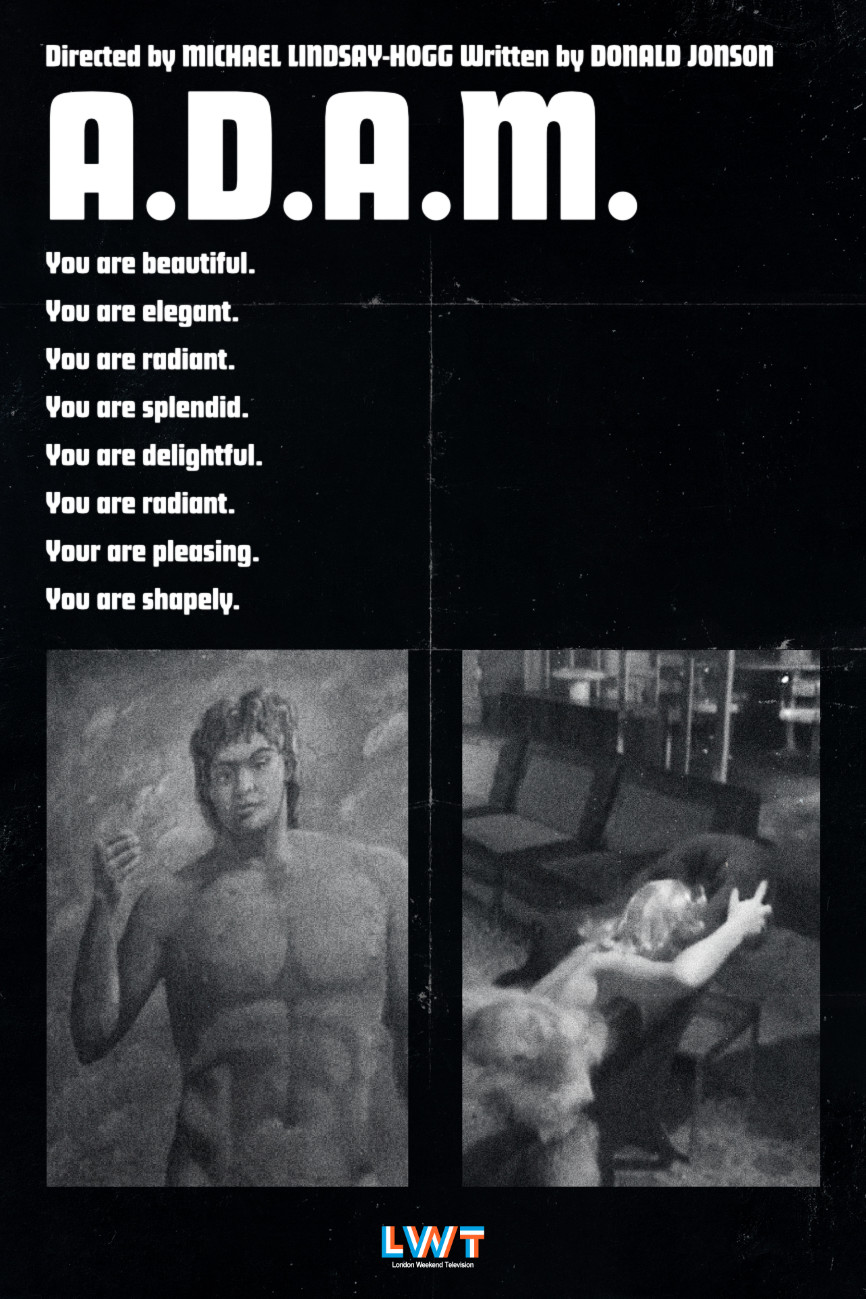
That, in turn, led me to A.D.A.M., a one-off play broadcast on ITV in 1973 as part of its Sunday Night Theatre strand.
It’s about a disabled woman (Georgina Hale) whose scientist husband builds her an electronically controlled house with a voice-activated AI helper. Predictably, perhaps, stuck at home together all day while hubby does Serious Government Work, A.D.A.M. and Jean form an intense and unhealthy relationship.
I found it fascinating and rather enjoyed its paciness, at 53 minutes. Of course it has gained new relevance in the age of Alexa and ChatGPT. In particular, with recent stories of people becoming infatuated with avatars in AI dating apps, there was particular resonance in a scene where Jean writhes naked on a chaise longue while A.D.A.M. robotically recites compliments she’s taught him.
“[In] a TV play that comes in under an hour, a two and half-minute sequence that is essentially two people walking through a doorway comes across as some fairly extreme padding. As this is only the second scene, it doesn’t bode well.”
Oddly, and pleasingly, A.D.A.M. is available for anyone in the UK to watch for free via the excellent BFI Player, so you can make up your own mind at little cost. If nothing else, the opening five minutes are a wonderfully moody piece of grey 1970s British grot.
I was also moved to design a new poster for the film, very quickly, because the default one on Letterboxd was so crappy. Fan made posters are discouraged at The Movie Database but I’ve contributed a few where there really wasn’t otherwise a good alternative.
I love it when reading one thing leads me to read another which leads me to watch something else which prompts me to make something – however trivial. That’s what it’s all about.
Integrating music making into my life
I’ve also been trying to work out how to make more music, just for fun, in a way that fits around my day job, my relationships, and my other hobbies.
The latest effort is to actually spend time playing my guitar and learning to play particular songs, in part or in whole.
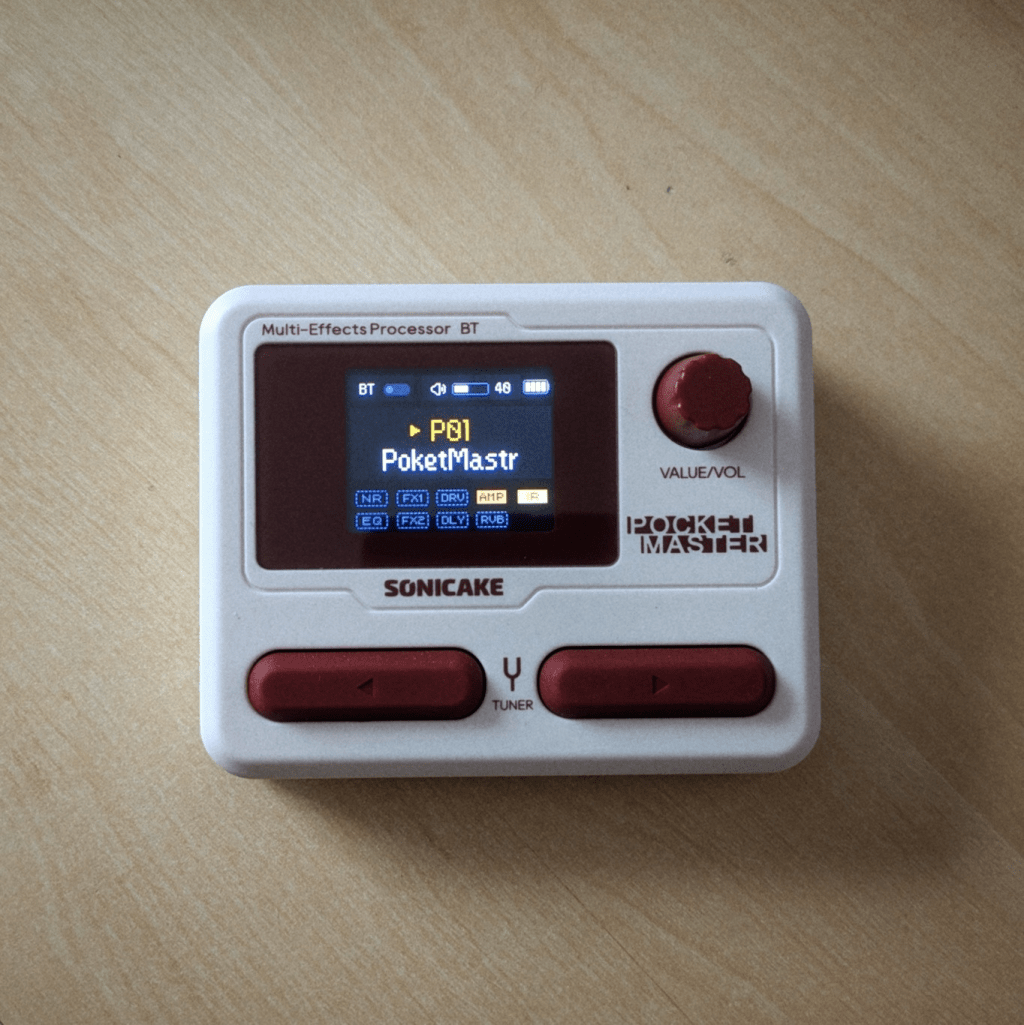
I’m being helped with this by a new gadget, the Sonicake Pocket Master, which cost about £50, has a headphone jack, and among other features can convincingly (to my ears) recreate the sound of playing through various amplifiers.
Last night, I spent about an hour and twenty minutes learning to play ‘September Gurls’ by Big Star for no particular reason other than that for about an hour and twenty minutes I didn’t think about anything but ‘September Gurls’ by Big Star.
It helps, I think, that thanks to the headphones other people can’t hear my playing badly, so I’m able to stick at it until it actually sounds good.
Writing weird stories
I’m continuing to work on my next collection of short stories in the background and seeking input, through blogs, books and films, as set out above, is helping enormously.
I’ve actually got drafts of a full set of stories but I really want to have more than enough so I can (a) pick the very best and (b) try to pull out a theme.
One of my theories for why Municipal Gothic continues to outsell Intervals of Darkness is that the former has a stronger proposition which is further underlined by the brutalist tower block on the cover.
I’ve also been considering turning those free stories, and some other bits I’ve written for zines, or never published at all, into a sort of bargain B-sides and offcuts compilation.
I always loved those as a teenage music collector because they were both cheaper than ‘proper’ albums and tended to have weirder stuff on them.
What do you reckon?
Lois the Witch
Finally, I’m going to recommend the novella Lois the Witch by Elizabeth Gaskell, from 1859. It’s been rereleased as a cute little minimalist Penguin paperback which I picked up on a whim at Bookhaus in Bristol.
It tells the story of a girl who is sent to New England to live with relatives when her parents die and finds herself at the heart of the Salem witch trials.
In the middle of a heatwave this description of the spookiness of 17th century Salem in winter hit all my buttons:
Sights, inexplicable and mysterious, were dimly seen – Satan, in some shape, seeking whom he might devour. And at the beginning of the long winter season, such whispered tales, such old temptations and hauntings, and devilish terrors, were supposed to be peculiarly rife. Salem was, as it were, snowed up, and left to prey upon itself. The long, dark evenings, the dimly-lighted rooms, the creaking passages, where heterogeneous articles were piled away out of reach of the keen-piercing frost, and where occasionally, in the dead of night, a sound was heard, as of some heavy falling body, when, next morning, everything appeared to be in its right place – so accustomed are we to measure noises by comparison with themselves, and not with the absolute stillness of the night-season – the white mist, coming nearer and nearer to the windows every evening in strange shapes, like phantoms, – all these, and many other circumstances, such as the distant fall of mighty trees in the mysterious forests girdling them round, the faint whoop and cry of some Indian seeking his camp, and unwittingly nearer to the white men’s settlement than either he or they would have liked could they have chosen, the hungry yells of the wild beasts approaching the cattle-pens, – these were the things which made that winter life in Salem, in the memorable time of 1691-2, seem strange, and haunted, and terrific…
Photography
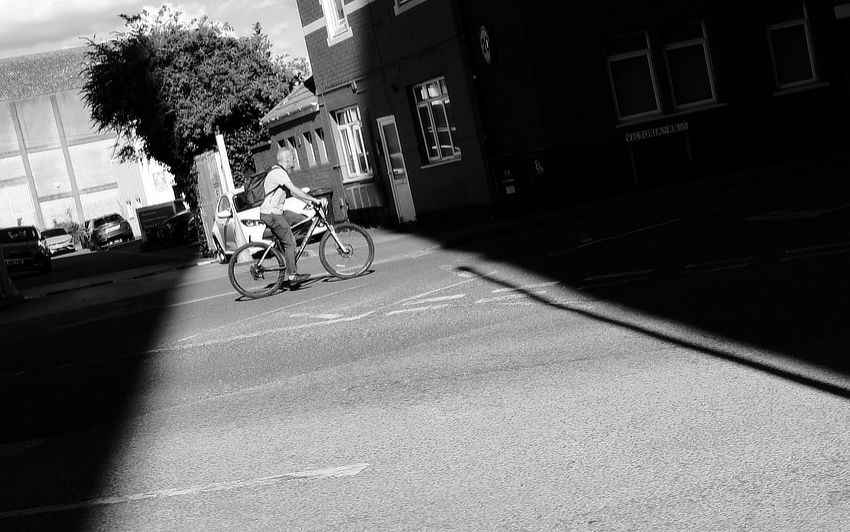
Finally, I’m still taking photos, and currently enjoying trying to imitate Daidō Moriyama. See the main image above for an example.
Moriyama’s style is high contrast black and white, shot from the hip, often askew or otherwise technically ‘bad’, and yet full of vigour and interest.
The murkiness of his photos is half the fun, forcing you to stare a little harder to understand what you’re looking at. Which may well just be a bin bag blowing down an empty street.
If horror film makers have nothing else they can always rely on a cheap mask to bring a sense of the uncanny, playing upon our deepest instinctive fear of The Other.
Watching the 1974 Spanish horror thriller Night of the Skull, directed by Jess Franco, I was struck by how it instantly seemed to step up a notch when a character in a mask appeared on screen.
The mask in question isn’t a lovingly crafted custom design. It’s not carved or sculpted. No, it’s a typically floppy, tacky rubber Halloween mask, as you can see in the picture above. But that doesn’t matter.
What matters is that, suddenly, there’s a human on screen whose true features we cannot see or read – who is utterly blank.
A few years later the same trick was used to even greater effect in Halloween, from 1978. John Carpenter’s film, which really kickstarted the ‘slasher’ craze, gave its enigmatic killer Michael Myers a mask which, as everyone knows, was adapted from a novelty product supposed to depict William Shatner as Captain Kirk.
In that case, the mask is more detailed and comes with the added oddness of feeling vaguely familiar. Should we recognise this face?
Demonstrating just how broadly we might define a mask in this context, the monster at the heart of the Friday the 13th series, Jason Voorhees, at first wore a simple sack over his head. Then, from the third film in the series, he gained his trademark hockey mask – a white ellipse with a few dark holes punched in it.
Alice, Sweet Alice.
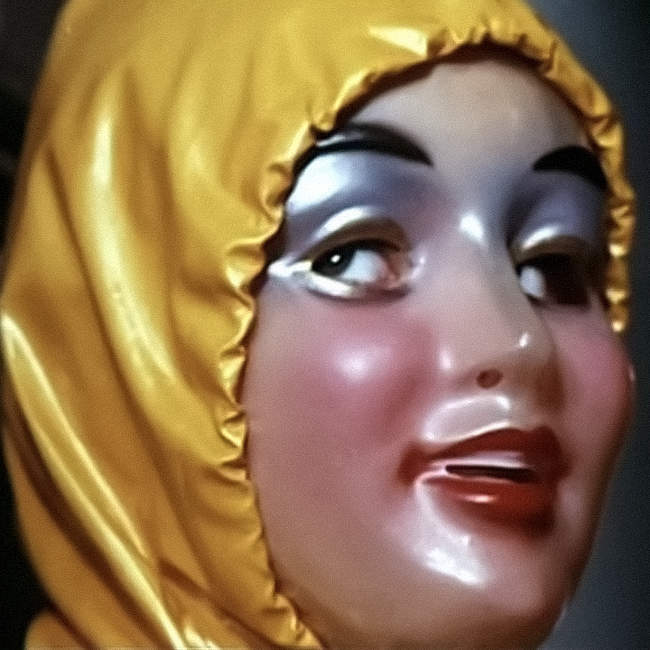
In proto-slasher Alice, Sweet Alice (Alfred Sole, 1976) the mask is the cheapest, simplest plastic mask you can imagine – the kind I might have bought with my pocket money at the seaside, held on with a string of thin elastic. And it still works. The killer’s face becomes fixed, glossy and rigid, frozen in a smile that our animal brains read as uncanny.
There are examples of real life murderers wearing masks. The perpetrator of the 1946 Texarkana Moonlight Murders, for example, wore a white cloth mask.
And the Zodiac Killer who terrorised San Francisco and the surrounding area in the late 1960s wore a hood that concealed his face, turning him into a folkloric bogeyman.
For people like this, the mask is a way to become more than their pathetic selves, and to assert their dominance.
If you can’t see my face, but I can see you, then I’m in control.
Ed Gein, the inspiration for Norman Bates, The Texas Chain Saw Massacre, and many other fictional serial killers, made a mask from the peeled skin of his victims. His motive seems to have been to possess them from within – to steal their identities in a sense that predates online fraud.
Kansas City Confidential.
Accessories to crime
The mask gives anonymity to criminals of all kinds, from lads riding eBikes too fast round the local park to hardened blaggers.
Criminals pull a pair of tights over their heads, or a balaclava, and in an instant their features are concealed or distorted.
In the heist movie, as much as the horror movie, masks create an instant visual hook. Think of the gang in Kansas City Confidential (Phil Karlson, 1952) with their unsettling felt masks, or the crew in Point Break (Kathryn Bigelow, 1991) who wear comical rubber masks representing various presidents of the USA.
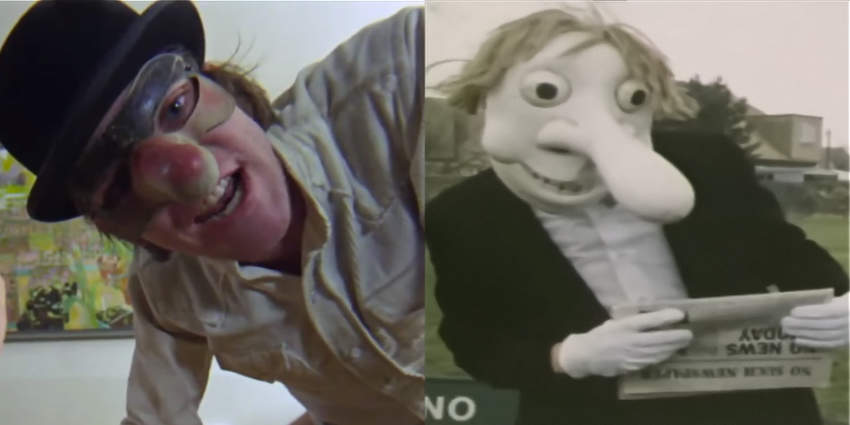
In A Clockwork Orange (Stanley Kubrick, 1971) the juvenile delinquent Alex wears a particularly grotesque, phallic mask during an instance of home invasion and rape.
Alex, left, and Noseybonk, right.
And when hauntologically minded British people over fifty talk about being ‘terrified’ of the 1970s children’s television character Noseybonk, consider the similarities between Alex’s mask and Noseybonk’s.
Much as they are empowering masks can also be dangerous.
The best section of a book I did not otherwise care for, Grady Hendrix’s 2023 novel How to Sell a Haunted House, is a side narrative which depicts the danger of masks. It tells the story of a troupe of avant garde puppeteers who fashion and don masks in the likeness of Pupkin, a sinister haunted puppet, and lose control of themselves:
It’s hard to describe what it feels like to wear a mask. You’re aware of what’s going on around you but it all feels far away. The longer you wear the mask, the more distant the world becomes through your eyeholes. Bits and pieces of time go black because the mask is active and you slip into a semi-somnolent state, but it feels good because you’re not in control. Nothing is your fault. You’re a puppet. Like Clark said, ‘A puppet is a possession that possesses the possessor.’ And a mask turns a person into a puppet.
In Kaneto Shindō’s 1964 film Onibaba, set in medieval Japan, the particularly sinister mask below equates to a curse. Yes, it confers power, but it also extracts a fee, binding itself to the wearer’s face, with removal only coming at too high a cost.
Onibaba.
Creating horror from nothing
Masks are scary, among other reasons, because they deny us the cues we rely on to assess threats.
They turn our fellow humans into creatures that are humanlike but different enough to trigger deeply programmed fight-or-flight subroutines.
Art doesn’t necessarily need to include people, and art that omits them isn’t necessarily inhumane – but we need to resist the allure of the soothing blank.
When I read the line “For its right wing adherents, the absence of humans is a feature, not a bug, of AI art” it felt like a contribution to a conversation I’ve been having in my head for years.
It depicts two schoolboys walking along a street in an idealised small town in 1950s America. It’s kitsch, essentially – the stuff of ‘Who remembers…?’ accounts on Facebook.
Part of the supposed appeal of the image is the promise of space, peace and homogenous white culture. It presents the small town as the antidote to the Lovecraftian nightmare of the big city, with its crowded streets, small skies and complex mix of peoples.
My Darling Clementine, dir. John Ford, 1946.
In America, ‘manifest destiny’ was about heading west to open space, and to freedom. On film in particular, westerns continued to mythologise this expansion throughout the 20th century. That’s especially true of the films of John Ford who fetishises vast desert landscapes, and the brave men who exist in them, in contented isolation.
From manifest destiny it’s only a couple of steps to the idea of ‘Lebensraum’ (living space) which was a key concept justifying the Nazis’ annexation of European nations, and the push into the east.
In a 2023 article, nature writer Richard Smyth argued that the appeal of rewilding programmes sometimes reflects an urge to purge natural spaces of humans, and evidence of human activity:
A strong anti-people streak is evident not only in old-school get-orf-my-land types, but also among the carefully curated hills and vales of the rewilders – a queasy tension, in the latter case, between ‘look at these splendid landscapes!’ and ‘stay the hell away from these splendid landscapes!’
When right wingers complain that “Britain is full!” or overcrowded it only compounds the sense that the left-liberal position must be to embrace and revel in the presence of people, and to resist the allure of spaces without them.
Cropping people from the frame
As someone who is a habitual Camera Haver and Photograph Taker, I’ve been grappling for more than a decade with the question of whether photos should or should not include people.
Photos of the world around us, I mean. Street photography, in other words.
There’s an argument that photographs without people don’t qualify as street photography. Those are just photos of streets. No, street photography at its best captures human beings in motion, living their lives, in all their infinite variety, behaving in fascinating ways.
To capture real life, however, street photographers must be, to some extent, intrusive, voyeuristic, and sly. They snatch images of strangers who either don’t know they’re being photographed, or don’t get chance to object.
Some street photographers push this to the limit. Bruce Gilden is famous for his aggressive technique, thrusting his camera into the faces of strangers and snapping them with full flash. It gives his pictures enormous energy but can also feel like a form of abuse.
All of this is why there’s now a view that the only truly ethical way to take photographs of strangers in the street is to ask permission, ideally before you point your camera at them; and to share publicly only images that come with explicit permission from the subject in the form of signed consent documents.
In that context, photos of spaces without people begin to feel like the less problematic (less fascistic) choice.
East Bristol, June 2025.Central Bristol, June 2025.
A convenient excuse for misanthropy
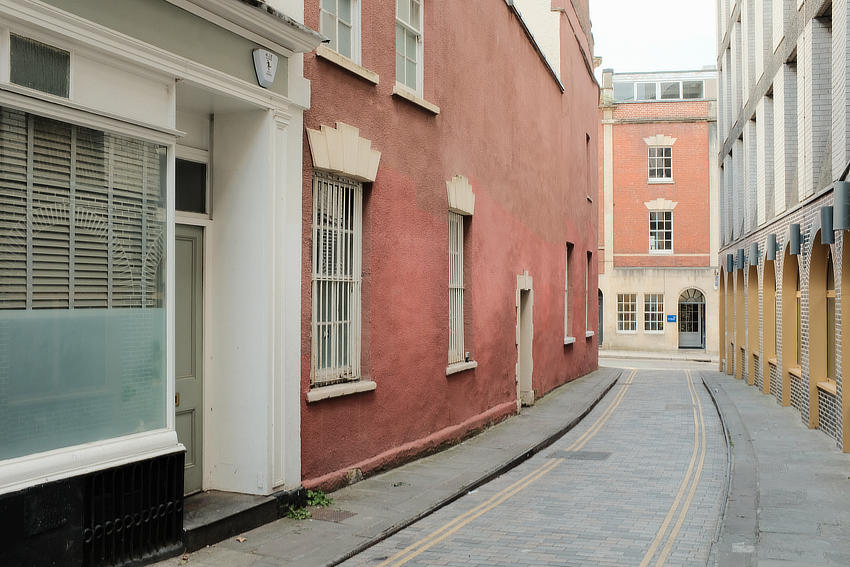
My own photographs tend to be of humanless spaces and blanks in the urban landscape. I often spend ages waiting for people to clear the frame, or grab my shot in split second gaps as people pass back and forth through the scene.
One of my more successful photo projects, Bristol Without Cars, relied on this approach for its effect.
I might tell myself this is an ethical choice but it’s also a personal preference.
With or without a camera, I spend hours every week walking through industrial estates near my house rather enjoying their dusty, desert-like emptiness.
Recently, I found myself alone in a Norman church in an apparently deserted village, listening to birdsong and the wind. And I was surprised to hear myself emit a long, contented sigh.
When I think about nerdy billionaires and their post-apocalyptic bunkers, I sometimes wonder if being the last men on earth is their true desire – peace at last! And, uncomfortably, I recognise that urge in myself.
During my Bristol Without Cars project, I thought I was creating rather peaceful, almost utopian images. But others found them unsettling and even post-apocalyptic.
In this world, people are viewed as clutter, or as a mess to be cleared away. Is it also, perhaps, part of what Tracy Durnell has called “the business borg aesthetic”, in which “Humans are perceived as sources of inefficiency”?
Remember me
I worry about the long-term value of the thousands of largely people-free photographs I take every year. When I choose to photograph bins (as my partner mockingly puts it) rather than humans, I’m not only magically erasing them from the landscape but also from (small H) history.
As time passes, the work of great street photographers gains additional value as documentation of history, and specifically aspects of social history that would otherwise be overlooked.
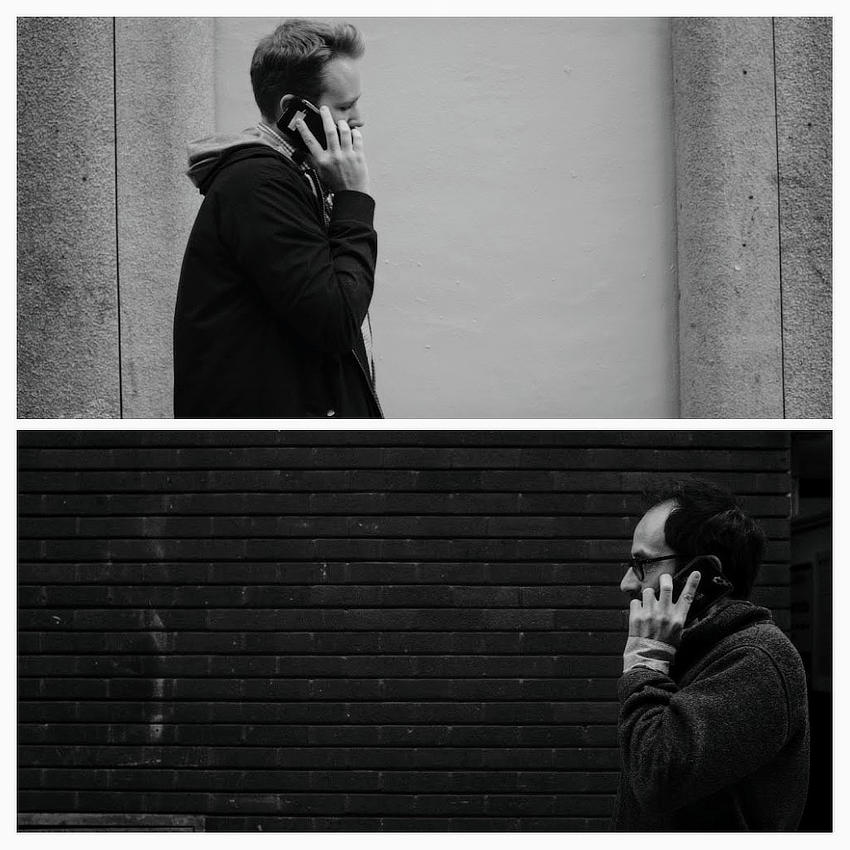
Men on phones, 2018.
Tish Murtha’s work captures the bodies, the faces and the living spaces of working class English people in ways that now feel profound and vital. This is also true of, say, Chris Killip, or the many citizen photographers whose work is unearthed and published by Cafe Royal books.
This is why I have a guilty secret: I do, in fact, take photographs of strangers in their place in the urban landscape. It’s just that I don’t often share those images in public, or on social media.
No, those are for (small P) posterity. There for me to look at in 30 or 40 years time and remember that I was, in fact, surrounded by humanity in all its wonderful variety.
I’ve never been to Los Angeles and probably never will. But it’s a city that exists as a high fidelity virtual model in our collective imagination as a result of more than a century of dominance over mass media.
What percentage of American films and TV shows are set in LA? A disproportionate number, I’m certain. And that’s before you take into account those that are filmed there even though they’re set in New York City, Las Vegas, Dallas, or wherever.
As a result, we all know aspects of Los Angeles’s landscape that would otherwise be insignificant to outsiders.
For example, there’s the concrete trough in which its river runs. Built to guard against flash flooding between the 1930s and 1950s it has since become a favourite location for filmmakers looking to shoot car chases and action sequences.
Griffith Observatory is another landmark that turns up in movie after movie, from Rebel Without a Cause to Bowfinger.
Watching Michael Mann’s 1995 film Heat for the first time this week I was struck by the deliberate choice of less frequently filmed locations, often quite anonymous. But even these spaces, beneath flyovers and in the car parks of malls, seemed familiar. If we haven’t seen these exact spots, we’ve seen similar ones in, say, episodes of T.J. Hooker, or Bosch.
Perhaps it’s because filmmakers so often live in Los Angeles that they so often make films about the city, or in which, as the cliché goes, “the city is a character in its own right”.
Films like To Live And Die in L.A. (William Friedkin, 1985) and Once Upon a Time in Hollywood (Quentin Tarantino, 2019) present particular versions of the city. The former shows us a dusty Wild West city of backrooms, guard dogs, and industrial zones. The latter takes us back in time and attempts to magic back into existence the Los Angeles of the director’s childhood.
Model Shop (Jacques Demy, 1969), Cisco Pike (Bill Norton, 1972) and L.A. Confidential (Curtis Hanson, 1997) are all set in ostensibly the same city but each present it from a different perspective, in different light. There are a thousand others.
Together, they allow the outsider to begin to triangulate – to understand how the city fits together, and how it has changed over time.
L.A. Confidential is based on a novel by James Ellroy whose literary version of Los Angeles is both vivid and idiosyncratic. It’s similar to the city presented by Raymond Chandler in his Philip Marlowe novels, or by Chandler’s disciples in their LA private eye stories, only meaner and more brutal. Chandler’s LA is at least romantic, in a cheap, rather superficial way.
Chandler was an outsider, born in America but raised and educated in England, and looked at Los Angeles as if it were an alien planet. This is from The Little Sister published in 1949:
Real cities have something else, some individual bony structure under the muck. Los Angeles has Hollywood – and hates it. It ought to consider itself damn lucky. Without Hollywood it would be a mail order city. Everything in the catalogue you could get better somewhere else.
Another British writer who observed Los Angeles from a similar distance was critic Reyner Banham whose 1971 book Los Angeles: The Architecture of Four Ecologies feels like a manual for understanding the city. Read a chapter or two and you’ll start to feel like an insider – as if you’ve seen LA’s top secret schematics.
Beyond literature and highbrow criticism, there are a million other ways that Los Angeles infiltrates the brains of people who live in, say, Luton, or Lübeck. If you listen to podcasts the chances are that you’ve heard the hosts fill the first ten minutes comparing notes on their drives to the studio, the weather, where’s good to eat, and how they’ve been effected by whichever natural disasters or episode of social unrest has most most recently occurred.
It’s an interesting aspect of the parasocial relationships we form with these strangers who murmur unscripted nothings in our ears every week for years on end.
Every month the excellent movie podcast Pure Cinema has an episode running down what’s showing at The New Beverly Cinema in Los Angeles. It’s interesting not only as a list of recommended viewing but also because of the ambient notes on life in the city, including casual asides about which actors have been spotted where, doing what.
Before podcasts there was radio and vast chunks of old radio shows from Los Angeles are now readily available on YouTube. As with podcasts, the pleasure here is in the snippets of chat between songs, and the evocative advertisements.
The songs, though, shouldn’t be ignored. Listening to The Beach Boys, The Byrds and The Monkees, as well as all those Nuggets fodder one-hit wonders, also transports you to Los Angeles.
British music fans talk casually about the Capitol Building and the crack session musicians later christened the Wrecking Crew. The most obsessed listen to hour after hour of bootleg recordings, absorbing the good vibrations of Gold Star Studios in the near silence between takes.
Surely with all of this data – all those episodes of Columbo and Adam-12 – at some point we’ll be able to conjure up a four-dimensional immersive model of a sunny Los Angeles we can wander about in, or even escape into for good.
There have been a few attempts already. The 2011 game L.A. Noire was an attempt to make the world of James Ellroy explorable and playable. To achieve that its creators, Team Bondi, recreated a vast swathe of Los Angeles approximately as it looked and felt in 1947.
It wasn’t perfect but in a rather moving article games journalist Chris Donlan wrote about playing the game with his father who grew up in LA in the 1940s. He found it pretty convincing:
The accuracy with which the city structures and roadways are recreated is really astounding, and the details were almost perfect… To be able to experience it again with my son who was born 20 years after I first left the city was, I think, wonderful for us both…
Then there are the several not-quite Los Angeles cities of the Grand Theft Auto games. The 2004 game GTA: San Andreas gives us Los Santos, an almost parodic version of LA circa 1992. The GTA V from 2013 develops Los Santos further, in higher fidelity, to the point where players were able to shoot their own films in its ultra-realistic environments.
If, like me, you’re not very good at games, there’s also Google Street View – a wonder of the age that so many of us take for granted. It’s easy to lose hours wandering jerkily from one street or roadscape to another, feeling both close to the city and impossibly far away.
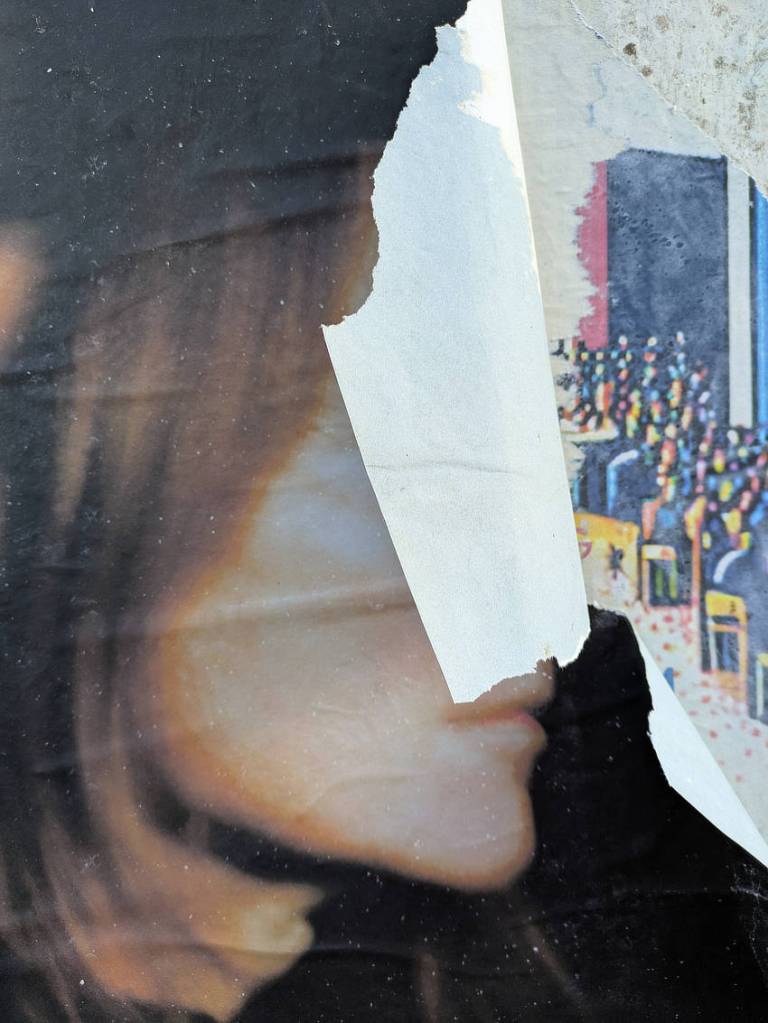
“As with shadows and reflections, so with portraits; they are often believed to contain the soul of the person portrayed. People who hold this belief are naturally loth to have their likenesses taken; for if the portrait is the soul, or at least a vital part of the person portrayed, whoever possesses the portrait will be able to exercise a fatal influence over the original of it.”
James Frazer, The Golden Bough
“One evening I was walking along a path, the city was on one side and the fjord below. I felt tired and ill. I stopped and looked out over the fjord – the sun was setting, and the clouds turning blood red. I sensed a scream passing through nature; it seemed to me that I heard the scream.”
Edvard Munch, diary entry
“The eye is the lamp of the body. If your eye is clear, your whole body will be full of light.”
Matthew 6:22
“The eyes are the first thing you have to destroy because they have seen too many bad things.”
Lucio Fulci
These photos were taken between 2019 and 2025, mostly in Bristol, but also in London, Istanbul, and elsewhere.
Do you get the urge or is it just me? You’re walking along and you see a half-eaten sandwich lying on the ground, covered with bits of grit and crawling with ants, and you think: I want to eat that.
You don’t, obviously. But you think it.
Like how you consider throwing your wallet into the river every time you cross the bridge in town. Or feel your hand edging towards the emergency brake on the train during your commute, specifically because there’s a sign telling you not to. That’s exactly what it’s like when you see a plastic glass half full of cola sitting on a wall and you think, I want to drink that, and eat the chunks that are floating in it, whatever they are. Do you really never get that? Really? I do. All the time.
You don’t do it, as I say, obviously you don’t do it, but it’s touch and go sometimes. When nobody’s looking, when you’ve had a really bad day and everything’s turned to absolute shit, you think, if I eat something I’ll feel better. And if you’re going to eat something, why not that scoop of ice cream that’s been dropped on the pavement and is still mostly solid, even though it’s sent out sticky brown runners towards the gutter? Imagine just scooping it up in your fingers and sticking it in your mouth in one neat move. If you get it right you could leave behind the bit that’s been in contact with the pavement and just get the good stuff that’s probably hardly even been licked. You get so you don’t mind a bit of lick, anyway. People snog strangers all the time – how is a bit of lick on an ice cream any different?
It started when I was a washer-up in a chain restaurant as a teenager. The stuff that used to come back uneaten! Chicken nuggets from the kids’ meals, they’re the ones that tempt you the most, and cakes. Imagine throwing away good food like that and then going home to an economy burger, oven chips, and frozen peas. So, yes, you do eat the odd bit here and there, when they look fairly clean and intact. Nobody notices and nobody cares. It’s like a little bonus, a little treat, and all for free.
One particularly bad shift, though, when the manager had been snippy with me, and I knew it wouldn’t be much better at home, I confess that I did once give myself an extra treat and eat some gristle left over from a steak. It had been chewed and spat out. I chewed it again myself, like gum, while I used the extendable hose to rinse gravy from a pile of plates. You chew and chew and eventually it softens up. That’s why people chew gum, because it’s calming and meditative.
Licking ketchup and melted cheese from the insider of a discarded burger wrapper, that’s another good one. It’s like you’ve eaten the burger without having eaten the burger. Sometimes, when the wrapper’s been out all night, blowing round the retail park car park, it’ll have picked up crunchy bits of glass or splinters of wood. You clear the paper with your tongue and it leaves you feeling clean, too, like you’ve groomed the dirt off your own body.
Nobody eats the salad from a kebab, have you noticed that? On Saturday and Sunday mornings you can pick up all sorts: trampled iceberg lettuce salad, pickled chilli peppers, pitta breads soaked with grease and garlic sauce where the bread has become like a sponge in the morning dew. Get your five a day.
A bit of mold doesn’t even do any harm. You eat blue cheese, don’t you? They say it’s good for you to put bacteria into your gut. There was a whole bag of shopping once, hanging on a railing. A pack of pittas gone blue all over, a cucumber rotten in its plastic sleeve. You can slurp that like an ice pop. You can’t just leave it hanging there. You can’t just walk past, letting good food go to waste, even if it does leave you feeling too full to move. Beats feeling empty inside, that’s what I say.
Or what about those full plastic bottles you find in the gutter? It might be apple juice or beer, it might not, but waste not want not. You’ve got to scratch the itch sometimes, you’ve got to give into the urge.
Some people take roadkill home and cook it. They have freezers full of the stuff. I say, why go to all that bother? The good stuff is like jerky, dried naturally in the sun, seasoned with engine oil and brake fluid. Does your mouth water when you smell petrol? Mine does. Chicken wings, too – it’s like eating chicken wings. Lots of little bones to chew the tough meat from. You really feel as if you’ve earned your meal.
When people feed good bread to the ducks, that breaks my heart. There’s kids starving and they’re throwing bread into the pond in the park – are you serious? It’s not even good for ducks to eat bread, is it? If you have a small net, it’s easy enough to fish the bread out out, or you can just use your hands. The texture is like nothing else. Municipal caviar, I call it.
Dregs from drinks cans, too. Lots of variety, a little dribble of lots of different things, cider or Fanta or whatever, and you can always spit out the cig ends and the insects.
I like a mystery, a blind taste test. You don’t always know what’s in a holdall you find dumped on a verge, do you? There’s no way to be sure if it’s been there a while. You just have to get stuck in and enjoy it for what it is, all of it, pounds and pounds of raw, sweating meat. Almost enough to fill the infinite empty space inside you – not quite, but almost. The only problem is that sometimes you worry you might have helped to dispose of evidence, when they start talking about that holdall on the news, but how are you to know?
I find there’s really no need to go home at all these days, or to go to work, not when you can eat three square meals a day out and about for free. You just need to have a good eye and a strong stomach. And your stomach gets stronger, too, the more you do it. What’s at home, anyway? Much better to be in the fresh air, enjoying all of nature’s bounty.
Oh, see there, under the brambles – a yoghurt pot that looks to be, yes it is, almost half full. Now, don’t you get the urge to eat that? Don’t you? Is it just me?
If you enjoyed ‘Do Not Eat’ check out Intervals of Darkness, my most recent collection of weird stories, which is available as an eBook and paperback.
The six-part podcast series Broken Veil, created and presented by Joel Morris and Will Maclean, exploits the inherent ‘truthiness’ of the podcast format to chill its audience.
When the first episode landed a few weeks ago I wasn’t sure if it was an attempt to jump on the Uncanny bandwagon by telling a supposedly true ghost story, or a clever fiction.
I suspected the latter thanks to the involvement of Maclean, best known for his 2020 novel The Apparition Phase. It didn’t take long to spot tells which confirmed that, yes, this was a drama – albeit one that felt, at times, uncomfortably real.
Those tells? Acting as if you’re not acting is difficult, for one thing. Broken Veil is cleverly directed to minimise this problem with actors apparently briefed on the story they need to tell and encouraged to improvise around a loose script.
Conversations recorded on noisy microphones, in noisy cafes, in open spaces, or in moving vehicles, also dragged it a touch closer to verisimilitude.
I’ve listened to a lot of audio drama that feels like stage school kids in sound-proofed studios, over-egging their performances, and slurping their tea too aggressively, too near the microphone. Broken Veil felt light years ahead of that. But still not completely, seamlessly, perfectly convincing, even if it got very near.
Despite deciding that it was fiction, there continued to be moments when I doubted myself. Perhaps it was more complex than I’d realised. Perhaps some of the incidents described were real, and only some were fictional, or fictionalised.
The spooky, moody, Scandi-noir score was another tick in the ‘feels real’ column. This is how true crime and supernatural podcasts tend to sound.
Another was the way episodes were edited to finish on revelations and cliffhangers. Co-creator Morris is an expert in understanding and documenting the patterns and structures behind stories, and comedy, and he applies that expertise here to apply the unwritten rules of of non-fiction podcasting.
Just as real non-fiction podcasts tend to do, it also went off on tangents, and gave over whole episodes to what felt like ‘side quests’. Each made the story feel more complex and more confusing, in pleasing ways. When the real actress Gabrielle Glaister (Bob from Blackadder) turned up playing herself it worked both as a standalone story and as a ‘convincer’.
Horror, or weird fiction, often thrives in that space between truth and fantasy. To paraphrase Fox Mulder from The X-Files (a reference point for Broken Veil) “We want to believe.”
Like Morris and Maclean, I’m of the generation that saw Ghostwatch air live on the BBC in 1992. It was clearly labelled as a drama, with an on-screen writing credit for Stephen Volk. But it employed non-actors like Sarah Greene and Michael Parkinson, and the look and feel of live TV, to play with the audience’s perceptions of reality.
Other touchpoints in a similar vein are Alternative 3, a 1977 mockumentary which was originally scheduled for 1 April but actually aired much later in the year, and so fooled many viewers; and The Blair Witch Project, which triggered the found footage movie boom of the early 21st century.
Throughout Broken Veil’s short arc the hosts frequently invoke cultural references like these, along with myths and legends of the paranormal that a certain type of British child has latched onto and absorbed for decades.
The Philadelphia Experiment gets a mention, for example, as does Matthew Hopkins, the Witchfinder General, and the ‘backrooms’ internet meme.
All of these are shortcuts to the mood the creators want to create: paranoid, hauntological, psychogeographical – layers of muddled meaning on worn-out, overdubbed tape.
As with many weird stories, the opening is the strongest section. It’s when the sense of reality is strongest and the story being told feels most plausible. A challenge for creators of weird fiction is that setting up a mystery is fun, and it’s what people enjoy. They think they want a solution but no explanation you can provide will be as pleasurable as drifting, bewildered, in the unknown.
If there’s a problem with Broken Veil, it’s the pacing. Though it’s been a success, at least in terms of podcast charts and critical commentary, it was a side project for two busy creatives, and that shows in its brief run, and hurried denouement.
The final episode in particular felt like several weeks’ worth of content crammed together into too small a space. And of course the opaque solution half provided wasn’t wholly satisfactory – how could it be?
I would have been quite happy to listen to a longer, slower version of this podcast that revealed small nuggets of information over months. And I wouldn’t have minded had it never resolved.
Just being in this world, with two softly-spoken, slightly geeky hosts murmuring strange stories to each other, was pleasure enough.
London, like New York, is often too busy, and too much in flux, to play itself on film. So, time after time, filmmakers rebuild it on backlots – with varying degrees of accuracy.
Each of these other Londons represents a particular vision of the city, and conveys the creators’ preconceptions, prejudices and perspectives.
Even the best of them never quite look real. On high definition video, more than ever, we can see that ‘bricks’ are lines etched into plaster, and that their streets merge with painted ‘flats’ or matte paintings.
They’re fantasies. But are they any worse than, say, Dublin, or Riga, or Budapest, with every stone and brick the wrong colour, putting on their best cockney accents?
I’ll take the artistry and illusion of a backlot set over Prague scattered with red buses and phone boxes any day. (Even if that backlot is, itself, in Prague.)
Stand-in Londons in Hollywood
Old Hollywood loved to build Londons.
Cedric Gibbons created one at MGM for David Copperfield, directed by George Cukor in 1935. On screen, the backlot construction was supplemented with matte paintings.
Parts of that set, later known as ‘Copperfield Court’ or ‘Copperfield Courtyard’, were used in other productions, including on TV, for years to come.
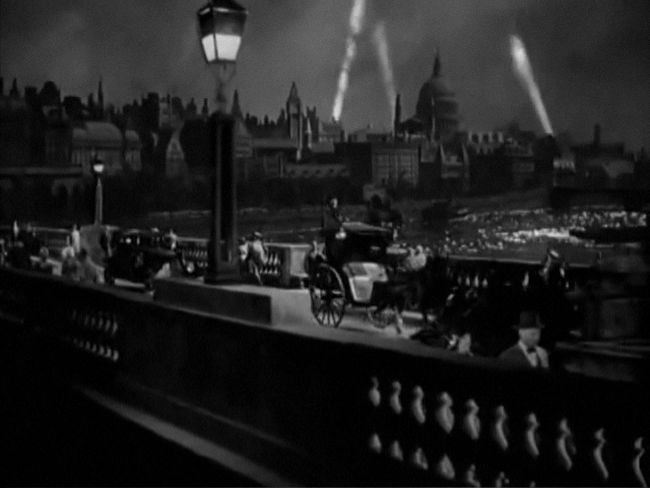
At Universal, before Frankenstein, James Whale directed a version of Waterloo Bridge, released in 1931. For that production, a misty wartime London was created by Charles Hall, including a replica of the bridge itself that used forced perspective to suggest scale.
A scene from Waterloo Bridge, 1931.
Hall and Whale were both British and perhaps this added to the relative realism of the production.
In his 1976 book Caligari’s Cabinet and Other Grand Illusions production designer Léon Barsacq shares a promotional image from the 1933 production of Noël Coward’s Cavalcade by Frank Lloyd for Fox. Barsacq also quotes the text that came with the photograph:
“Why! This is a section of the Strand!” exclaimed Miriam Jordan, whose home is in London, when taken to the London ‘set’ for ‘Cavalcade’ on the Fox Films lot. In the background is a typical London building and at the left is an exact replica of a small London park. Natives of the British Empire and world travelers are amazed at the fidelity with which William Darling, art director of Fox Films studios, reproduced London street scenes. Even the lamp posts are authentic.
Even after the war, when many Americans had seen Britain for themselves, Hollywood continued to film London under the Californian sun.
A scene from Kiss the Blood off My Hands, 1948, showing a recreation of Wapping in Hollywood.
Burt Lancaster starred in and produced the British-set Kiss the Blood off My Hands – one of the all-time great film noir titles – in 1948. It was shot at Universal on an extensive recreation of the East End of London, and Wapping in particular, that supposedly represented 30 blocks of houses, warehouses and wharves.
At the other end of the scale, there was the brightly coloured, sugar-icing version of London seen in Mary Poppins, shot at the Disney studios in Burbank. Along with many matte paintings there was also a large physical set for Cherry Tree Lane, with more forced perspective, including on the cherry trees.
Backup Londons near London
Why recreate London when you’re on the outskirts of the real thing? Why not film on the actual streets? For convenience. Because London changes too fast for historical drama. And, perhaps, because an air of fantasy might be desirable.
In 1961, Cliff Richard, ‘the British Elvis’, was a huge star. The Young Ones was to be his first serious star vehicle, directed by Sidney J. Furie, and the budget justified the construction of a “quite extensive backlot town” of “relatively anonymous West London streets”, as described by Jonathan Bignell.
A scene from The Young Ones, 1961.
Bignell’s particular interest is that this set lingered on and was used and reused, dressed and redressed, to represent not only London but also locations around the world in British TV shows such as The Saint, The Champions and Randall and Hopkirk (Deceased).
The Counterfeit Constable, 1964.
A little later, at Shepperton, a 1964 French production, The Counterfeit Constable, called for the construction of another London in miniature.
These streets also hung about and, with tweaks, represented everything from the 18th century city in Moll Flanders to post-apocalyptic future London in one of the Doctor Who films.
The never-never London of Sherlock Holmes
The backup London at Shepperton described above was also used, with adjustments, in the 1965 Hammer film A Study in Terror, starring John Neville as Sherlock Holmes.
Over the years, however, Holmes has prompted the construction of several elaborate Londons in his own right.
The set for The Private Life of Sherlock Holmes under construction. SOURCE: Library of Congress.
In 1969, Alexander Trauner built a long stretch of Baker Street at Pinewood for Billy Wilder’s The Private Life of Sherlock Holmes. (He’d previously constructed a very convincing Paris for Wilder’s Irma la Douce in Los Angeles.)
This set would also linger on, decaying, and appear in distinctly less prestigious British productions such as Carry on at Your Convenience.
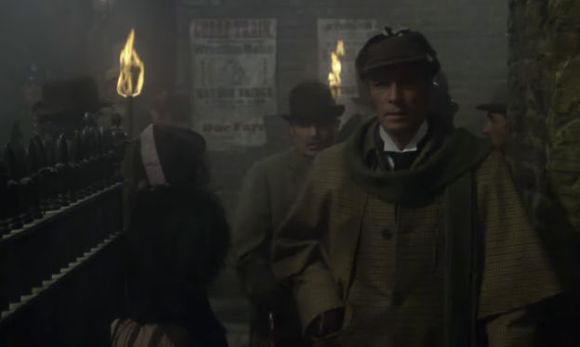
A decade or so later, Granada in Manchester set about bringing Sherlock Holmes to TV with Jeremy Brett in the lead role. For this expensive production it constructed its own Baker Street – just around the corner from its recreation of a red-brick Manchester terrace for the long-running soap opera Coronation Street.
This set is particularly interesting because it’s one many British children visited over the years as part of the Granada Studios Tour. I went myself, as a dorky teenage Holmesian, and felt as if I’d gone to heaven. (Years later, I worked on the real Baker Street for about six months, and there was no romance about that at all.)
When Guy Ritchie filmed his Sherlock Holmes with Robert Downey Jr., released in 2009, he also had a large scale Baker Street set to play with – albeit one built for a Harry Potter film and refitted. Rather than forced perspective, as employed by Trauner 40 years earlier, this set was extended with green screen and CGI. It was not an improvement, in artistic terms.
Recreating the East End
London’s East End is another common target for cinematic recreators – not least because the real East End was so extensively changed by, first, the Blitz, and then post-war remodelling.
Murder by Decree, 1979.
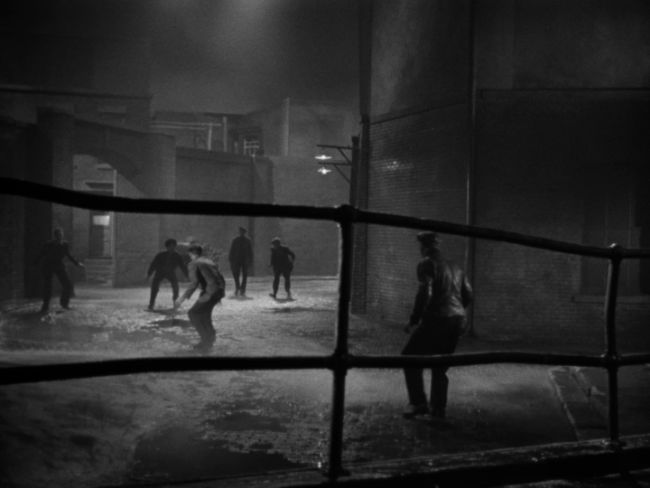
In Murder by Decree, a 1979 Sherlock Holmes film directed by Bob Clark and starring Christopher Plummer, Baker Street is played by Barton Street, a well-preserved thoroughfare in Westminster. But the East End, where Jack the Ripper stalks, was constructed at Elstree (Whitechapel streets) and Shepperton (docks and wharves). It’s very convincing, even sharing the screen with real locations in Bermondsey.
Twenty or so years later a film with a very similar plot, From Hell, directed by the Hughes Brothers, was shot on a set outside Prague designed by Martin Childs. Released in 2001, it fell between the cracks as the internet came into being, and the set is unfortunately not well documented. In ‘production notes’ of uncertain provenance at cinema.com Childs is quoted as saying:
“We couldn’t find anyplace here that resembled Whitechapel from all angles, so we ended up building it in the middle of a field. It became the unexpected highlight of this entire enterprise… We were very lucky that Prague was undergoing a major restoration and digging up many of its streets… because we were able to borrow cobblestones from the city…”
This set included versions of The Ten Bells pub and Nicholas Hawksmoor’s Christ Church, Spitalfields. The film might not be a masterpiece but the set might have been.
Another perhaps surprisingly careful reconstruction of the East End appears in Till Death Us Do Part, the 1969 feature film adaptation of the TV sitcom starring Warren Mitchell as Alf Garnett.
From the trailer for Till Death Us Do Part.
Several streets and corners are recreated in loving detail, with the brick convincingly soot blackened, and a railway arch to terminate the street. This neat capsule set allows director Norman Cohen to take us from the 1930s to the 1960s by changing details such as the brewery branding on the very realistic pub.
What it’s very like, in fact, is the Coronation Street set mentioned above or, jumping forward to the mid-1980s, the set constructed at BBC Elstree for another long-running soap, Eastenders.
Albert Square, which has been on TV every week since 1985, was supposedly based largely on Fassett Square in Dalston, and offers a snapshot of pre-gentrification East London. The set was carefully weathered and distressed to resemble real East London streets and I suspect fooled many people into thinking it was filmed on location.
Over the years, the set expanded, gaining new offshoot streets and details. In recent years, rebuilt and refined for the high-definition age, it’s even, finally, gained some modern flats and new-build townhouses.
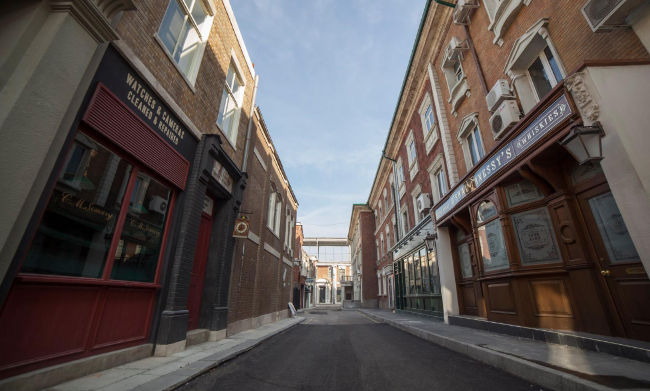
Its standing London street set was built, I believe, for the 2016 action thriller London Has Fallen, and includes a version of the forecourt and entrance to St Paul’s Cathedral. More importantly, it also has several streets that reflect what too much of London really feels like today.
There are bland modern flats, like those which have filled in every available gap in East London. There are bland modern shop fronts painted in shades of grey. There are rows of bland Mayfair houses, too neat and too tidy, where it’s clear nobody actually lives. There’s a bland Irish theme pub that looks like no fun at all. There’s even a Patisserie Valerie.
This set crops up in cheap Christmas movies and cheap action movies – the type that go straight to streaming, and maybe feature an older actor just long enough to feature his face prominently on the poster.
I’m pretty sure I see it in adverts, too, providing a shiny, simple version of London without any of the grime or graffiti.
I could go on…
There are so many other Londons.
The streets of Poplar constructed for Call the Midwifein the grounds of stately home in Surrey, for example; the fantastical Fleet Street built at Pinewood for Tim Burton’s Sweeney Todd; the Soho built for Julien Temple’s Absolute Beginners; the other Soho constructed on an airfield for Amazon’s Good Omens; or the 1930s suburban street slowly bombed to bits in John Boorman’s blitz memoir Hope & Glory; or…
Well, like I say, I could go on.
Together, these many peculiar, partial Londons add up to a complete imaginary city that helps us see and appreciate the real one in all its infinite depth.






















 Precast Reinforced Concrete Heart