Categories
weird fiction

Broken Veil Series 2 – secrets and lies in haunted Essex

Series 2 of the found footage horror podcast Broken Veil builds and improves on the first season with a focus on the audio uncanny.

Arguably my positive reaction to Broken Veil, verging now on fanboyish, is because this is media made for people exactly like me, by people rather like me.

Creators Joel Morris and Will Maclean are children of the so-called ‘haunted generation’ who seem to have spent their adult lives chasing the thrill of reading The Unexplained magazine, of hearing local legends in the school playground, and catching glimpses of grainy ghost stories on late night TV.

The problem with real life creepy stories is that eventually you run out of good ones. Just look at the hit podcast and TV show Uncanny which, after a dazzling start, has been scraping the barrel for a couple of years now.

Enter Morris and Maclean with a valiant effort to make up some brand new faux genuine eerie mythology. Their efforts are so deft that, at times, I had to pause the podcast and ask myself: wait, is this real? The trick is that they interlace their fabrications with snippets of real and familiar supernatural lore.

They mention the well-known Max Headroom broadcast intrusion. That’s the convincer. Then they introduce their own invented ‘Marconi Intrusion’ which is not. But even knowing this is cleverly camouflaged drama, it took me a while to realise we’d crossed the line from fact into fiction.

In fact, there really was a Marconi intrusion, in 1903, when the magician Nevil Maskelyne interrupted an early radio broadcast. So when the Broken Veil team uses that phrase, something in the recesses of the brain says, “Oh, yes, I’ve heard of that.” Cunning.

One reassuring giveaway that we are listening to drama is that, in many instances, their concoctions are too perfect and perhaps too weird. The description of the Marconi Intrusion from the Broken Veil timeline (outcome) is dense with fantastic, Lovecraftian imagery a million miles from some dickhead in a rubber mask wobbling about in front of a tin shed.

When the real story of the rediscovery of the audio for the legendary Hexham Heads footage is borrowed and applied to an invented local news report from 1979 it performs one of two functions. Either it makes you feel clever for spotting the reference, bringing you in on the joke. Or it triggers that feeling that you’re re-hearing something familiar but half forgotten, and therefore true.

I wonder how many listeners, even those well schooled in British folklore and the paranormal, would correctly identify every truth and every falsehood. Eric Gill did indeed carve 14 stations of the cross for Westminster Cathedral. But is there a memorial to him studded with black stone and inscribed ‘Lapidarius’ beneath station 14? I really haven’t been able to confirm that there is, even though it sounds entirely plausible, and even though Joel Morris stridently declares “This is not bullshit” at that point in the episode.

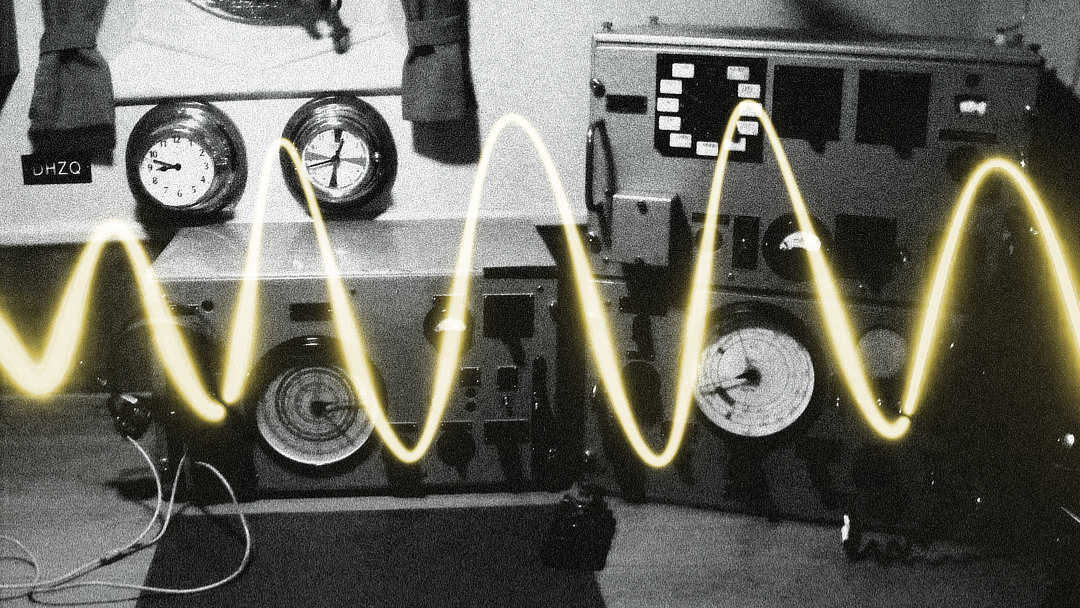
The emphasis on the early days of radio, electronic voice phenomena (EVPs), lost tapes and broadcasting gives this series a sharper focus than the first. It also, obviously, leans into the podcast medium. Morris’s immersive sound design adds layers of dirt, noise and obfuscation so that the ‘evidence’ in the case is always heard obliquely, through a sort of fog. The two investigators are placed in echoing, noisy spaces – cars, trains, cafes – constantly reinforcing the mundane reality of their adventures.

Broken Veil is also a great example of how nimble independent audio productions can be. Though a year in the making it nonetheless includes what feel like references to the current fascination with liminal horror triggered by the release of the film Backrooms and to a weird news story that went viral back in February.

If I had reservations about the excellent first season they were around the ending which felt hurried and somehow unsatisfying. This time, they really stick the landing, finishing on a suspended note of uncertainty that’s been building throughout the series.

If you think of it as like buying an album, or a Big Finish Doctor Who audio adventure, the price of entry via Patreon is pretty minimal. I’ve certainly got more value from it than I would from a couple of takeaway coffees.

I also find myself wondering about spinoffs. A Haunted Essex Corridor short story anthology, perhaps, inviting various authors into the game. Or a TV adaptation starring Laurence Miller and Chris McNally – ideally with monster of the week episodes to prolong the enjoyment.

The second series of Broken Veil is available via Patreon. The first series is available free wherever you forage for podcasts.

Categories
weird fiction

Broken Veil: indescribable horrors gently whispered in your ear

The six-part podcast series Broken Veil, created and presented by Joel Morris and Will Maclean, exploits the inherent ‘truthiness’ of the podcast format to chill its audience.

When the first episode landed a few weeks ago I wasn’t sure if it was an attempt to jump on the Uncanny bandwagon by telling a supposedly true ghost story, or a clever fiction.

    I suspected the latter thanks to the involvement of Maclean, best known for his 2020 novel The Apparition Phase. It didn’t take long to spot tells which confirmed that, yes, this was a drama – albeit one that felt, at times, uncomfortably real.

    Those tells? Acting as if you’re not acting is difficult, for one thing. Broken Veil is cleverly directed to minimise this problem with actors apparently briefed on the story they need to tell and encouraged to improvise around a loose script.

    Conversations recorded on noisy microphones, in noisy cafes, in open spaces, or in moving vehicles, also dragged it a touch closer to verisimilitude.

    I’ve listened to a lot of audio drama that feels like stage school kids in sound-proofed studios, over-egging their performances, and slurping their tea too aggressively, too near the microphone. Broken Veil felt light years ahead of that. But still not completely, seamlessly, perfectly convincing, even if it got very near.

    Despite deciding that it was fiction, there continued to be moments when I doubted myself. Perhaps it was more complex than I’d realised. Perhaps some of the incidents described were real, and only some were fictional, or fictionalised.

    The spooky, moody, Scandi-noir score was another tick in the ‘feels real’ column. This is how true crime and supernatural podcasts tend to sound.

    Another was the way episodes were edited to finish on revelations and cliffhangers. Co-creator Morris is an expert in understanding and documenting the patterns and structures behind stories, and comedy, and he applies that expertise here to apply the unwritten rules of of non-fiction podcasting.

    Just as real non-fiction podcasts tend to do, it also went off on tangents, and gave over whole episodes to what felt like ‘side quests’. Each made the story feel more complex and more confusing, in pleasing ways. When the real actress Gabrielle Glaister (Bob from Blackadder) turned up playing herself it worked both as a standalone story and as a ‘convincer’.

    Horror, or weird fiction, often thrives in that space between truth and fantasy. To paraphrase Fox Mulder from The X-Files (a reference point for Broken Veil) “We want to believe.”

    Like Morris and Maclean, I’m of the generation that saw Ghostwatch air live on the BBC in 1992. It was clearly labelled as a drama, with an on-screen writing credit for Stephen Volk. But it employed non-actors like Sarah Greene and Michael Parkinson, and the look and feel of live TV, to play with the audience’s perceptions of reality.

    Other touchpoints in a similar vein are Alternative 3, a 1977 mockumentary which was originally scheduled for 1 April but actually aired much later in the year, and so fooled many viewers; and The Blair Witch Project, which triggered the found footage movie boom of the early 21st century.

    Throughout Broken Veil’s short arc the hosts frequently invoke cultural references like these, along with myths and legends of the paranormal that a certain type of British child has latched onto and absorbed for decades.

    The Philadelphia Experiment gets a mention, for example, as does Matthew Hopkins, the Witchfinder General, and the ‘backrooms’ internet meme.

    All of these are shortcuts to the mood the creators want to create: paranoid, hauntological, psychogeographical – layers of muddled meaning on worn-out, overdubbed tape.

    As with many weird stories, the opening is the strongest section. It’s when the sense of reality is strongest and the story being told feels most plausible. A challenge for creators of weird fiction is that setting up a mystery is fun, and it’s what people enjoy. They think they want a solution but no explanation you can provide will be as pleasurable as drifting, bewildered, in the unknown.

    If there’s a problem with Broken Veil, it’s the pacing. Though it’s been a success, at least in terms of podcast charts and critical commentary, it was a side project for two busy creatives, and that shows in its brief run, and hurried denouement.

    The final episode in particular felt like several weeks’ worth of content crammed together into too small a space. And of course the opaque solution half provided wasn’t wholly satisfactory – how could it be?

    I would have been quite happy to listen to a longer, slower version of this podcast that revealed small nuggets of information over months. And I wouldn’t have minded had it never resolved.

    Just being in this world, with two softly-spoken, slightly geeky hosts murmuring strange stories to each other, was pleasure enough.

    Broken Veil is available through all the usual podcast services.