Categories
history Somerset

The Ghost Factory

Growing up in the shadow of the British Cellophane factory in Bridgwater, Somerset, I often heard stories of its ghosts.

The factory opened in 1937 as a joint project between the French firm that owned the rights to the process for mass-manufacturing cellulose film and British textile company Courtaulds.

It was built on fields next to Sydenham House, a 16th century mansion with its own stock of strange tales as recounted in Berta Lawrence’s 1973 book Somerset Legends. The Duke of Monmouth, she suggests, haunts a bedroom where he is said to have stayed (‘said’ always being a danger sign in such stories) before the Battle of Sedgemoor in July 1685. The room overlooked an oak tree, and some years later a member of the Perceval family was lifted by “some invisible spirit out of the chamber beyond his window-bars and, by levitation, set in the oak’s branches”. The house was also the scene of violence during the peasants’ revolt of 1381.

In the 20th century, the house was used by Courtaulds for corporate hospitality and, beyond the security boundary, hidden behind foliage, attained semi-legendary status among local children. I was taken to the garden once as a child, on a hot but darkly overcast day, and found it unsettling – the perfect setting for a timeslip.

I spent most of my childhood living within five minutes’ walk of the factory and its famous stink – it was often called ‘Smellophane’ – and my father worked there in the 1970s and 1980s, as did the parents of many of my peers. Every Thursday morning, as I was walking to school, they’d test the emergency sirens, adding to the collective sense of Cold War dread.

The first person to tell me a ghost story about the factory was my childhood best friend whose father worked in the section of Courtaulds dedicated to the production of non-woven synthetic fabrics. I asked my friend if he remembered what he’d told me all those years ago and his reply (edited for clarity) was as follows:

Late one night Dad saw someone in a checked shirt at the end of the production line. There wouldn’t have been many people about at that time so he went to investigate but the person had gone and the only door nearby was locked. The bloke couldn’t have gone anywhere else. It turned out someone from the other shift had died in just that spot (drowned, I think, in a cooling tank, or dragged under the rollers) and had been wearing the same clothes as the figure Dad saw.

As an 8-year-old I’d simply enjoyed shuddering at this story but I find myself wondering today if his father – quite a joker – might have been teasing him. My friend thinks not: “Mum said he was absolutely convinced at the time and quite shaken.”

I also remember a variant of this ‘drowned in a vat’ tale told by another school contemporary: a figure spotted on a high gantry, then apparently falling from the edge into a tank; emergency services called, the vessel drained, but no body found.

Adapted from ‘British Cellophane’ by Noel Jenkins, via Geograph, under CC BY-SA 2.0.

I asked my own father if he’d ever found working on the site unnerving. He talked at length about the general twitchiness of factory life, especially working nights, practically alone in vast, echoing spaces, and the long stretches of boredom between bouts of strenuous labour. But as to specifics, he said:

The only experience I had was of something that passed through a corridor. It might have been that somebody opened a door and it was a cold chill or something… It was weird. It wasn’t something I saw, just felt.

My younger brother suggested I get in touch with a friend of his who worked on the site in its final years, who wrote:

[One] of the machines there, called C2, killed a guy back the 1970s and it was definitely creepy in that area. [He] was pulled into a huge heated steamrolling press. [There was no] reverse mechanism and the firemen had to sledgehammer the machine apart to peel him out.

With prompting, Dad recalled a similar story from British Cellophane – strangely similar, you might say – about an operator who got cocky while threading a length of film through the moving parts of a machine. He was pulled into the workings and then when the machine reached full speed it “tore his limb right from his shoulder, voom! He Dropped dead.”

My suspicion is that these were scare stories, garbled and embellished as they spread, perhaps intended to reinforce the importance of safety procedures, or merely to wind up new recruits. The arm-ripping incident my father recounted of course happened ‘a few years’ before he joined the firm, like all good urban myths.

It’s hard to prove that something didn’t happen but I can say that I have not been able to find any record of any events like these in newspapers, even though relatively less gruesome accidents at the factory were reported. A painter died during construction of the plant; a laboratory apprentice fell from a landing stage with no barrier and later died; a foreman dropped dead while walking along a gantry; and Raymond Culverwell set a legal precedent when a truck crushed his leg: being late back from his tea break, the Court of Appeal ruled, he was not entitled to compensation. Gruesome limb-tearing and crushing incidents at other industrial sites were frequently covered so the press were clearly interested.

After a version of this story first appeared in Fortean Times in 2018, however, I heard from Gavin Hogg whose grandfather, George Rogers, worked at Cellophane in the 1950s and 60s, and died there in 1963. He asked his mother for more detail:

He was killed in an accident during the night-shift (22:00 – 06:00) and she writes that he was on his own at the time (I don’t know if she means just in the immediate area, or the whole factory). The official inquest verdict was death by misadventure.

There was no compensation or any financial help for my grandmother and her two daughters – my Mum would have been 21 at the time and her younger sister would have been around 16-17.

Mum says that the factory destroyed all the evidence after the accident and changed the machinery.

A little digging turned up an account of the inquest from June 1963, which set out the details: at about 5am, Mr Rogers was alone, his colleague having stepped outside for a few moments, and accidentally put an amount of vinylidine chloride into a hot vessel rather than a cool one, whereupon it instantly vaporised and gassed him to death.

Again, no falls into vats, or torn limbs, but this does echo my own father’s explanation for the uneasy atmosphere in the factory, which is simultaneously more down-to-earth and scarier than any ghost. The premises was, he says, often dense with chemical fumes, and he would frequently find himself wading in pools of toluene, a liquid solvent known to cause hallucinations. It’s easy to see how that sort of thing might combine with the disorientation of shift work, and those grim shock tales, to generate paranoia, confusion and even strange visions.

Though none of that, of course, explains how Perceval got into the oak tree.

Categories
1959 books crime

Reading 1959: The Galton Case

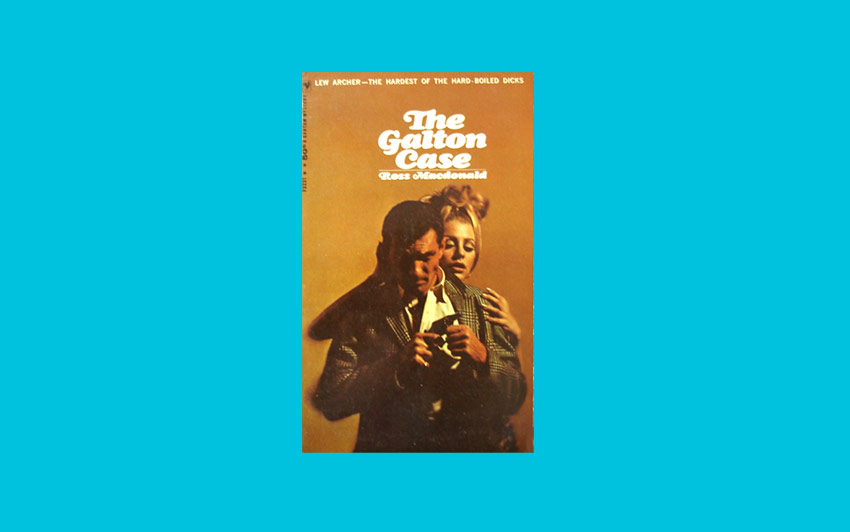
The Galton Case

Ross Macdonald’s hardboiled crime novel is closer to Raymond Chandler in tone and style than any other book I’ve encountered.

The prose isn’t quite there – Chandler dropped fragments from half-visible poems on to every page – but the hard California sunlight, the squalor and snobbery, and the neither-tarnished-nor-afraid protagonist are.

Well, hold on, I’ll go a bit further: there are moments where Macdonald’s prose made me wince, as in his description of a pretty girl as ‘doe-eyed’. Minimalism conceals a lot; this small choice reveals it.

The story, though, is reminiscent of Chandler’s The Little Sister, but perhaps better engineered. Though the action (involving multiple aeroplanes, car and $3 motel after another) runs from California to Canada via the American Midwest, everything connects neatly, and all the apparent coincidences are proved to be nothing of the sort.

Is John Galton Jr a Tom Ripley to be feared, or a poor orphan to be pitied? Prince Charming, or Norman Bates? That tension is a powerful engine to build a mystery around.

Lew Archer shares about 80 per cent of his DNA with Philip Marlowe but would be more fun to share an office with. He doesn’t drink as much, seems a more functional human being, and isn’t as prone to pointless self-sacrifice.

I might go so far as to recommend Macdonald over Chandler to those interested in reading their first hardboiled detective novel. Being a little less showy in his writing, less weirdly obsessed with chivalry, and markedly less sour, he is probably less likely to alienate than Chandler, while still being stylish and sharp.

Categories
1959 books

Reading 1959: A Travelling Woman

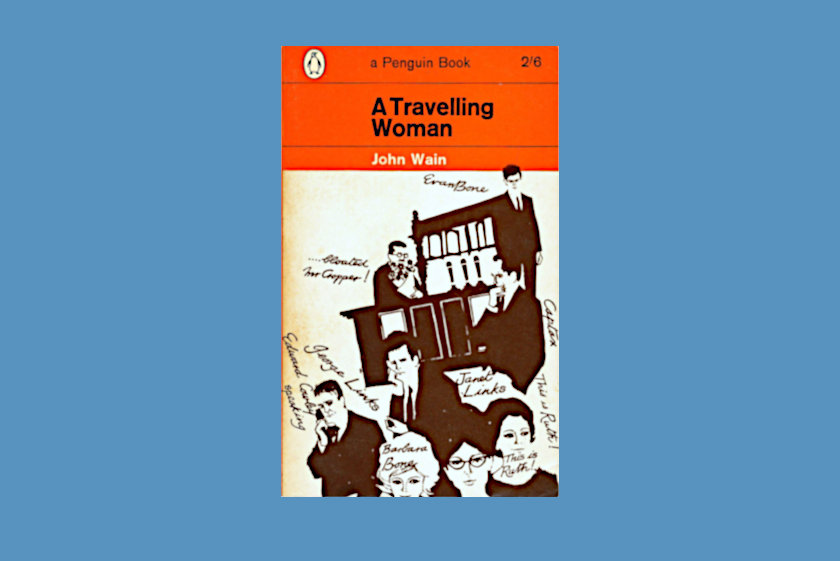
I picked up John Wain’s A Travelling Woman purely because I liked the cover of the Penguin paperback edition from 1963, with an illustration by Adrian Bailey, and because it was first published in 1959.

It tells the story of George Links, a selfish commuter-town manchild who is unhappy in his marriage and job, and obsessed with the service of his own pleasure.

When his wife, Janet, pushes him to see a therapist in London, his drinking companion, Captax, points out that this provides the perfect opportunity to spend some time away from home indulging the pursuit of other women.

Captax directs him towards the Cowleys who have an attic room they let to lodgers, and so Links meets Ruth, a sad woman whose husband, Edward, is a philosopher lost in grappling with the question of religious faith. Links falls in love with Ruth and has a brief affair with her which not only revives his mood but also his marriage. Until, inevitably, it all falls apart.

For the first hundred pages or so, I frankly disliked this book. It seemed glib and seedy – a portrayal of a world in which men take women, and where women are either prizes or puzzles, but not quite people. It’s true that Wain goes out of his way to make George Links unlikable – he is pedantic about grammar, short-tempered, and thick-headed; and Ruth tells him to his face that she doesn’t like him, more than once. Nonetheless, we spend most of the book in his head, while Captax and others reassure him in his betrayal of his wife. Like playing a first-person rotten bastard simulator on the PS4.

But the synopsis on the back of the Penguin paperback has it right when it says “what began as light-hearted Restoration comedy in modern dress becomes a grim tragedy of emotional maturity”. One by one, the opportunities for happy endings are cut off: Links loses his wife, then Ruth, and ends up living in a seedy hotel; Captax find his heart, but then has it broken within a fortnight; Evan and Barbara Bone, another unhappy couple on the periphery of the plot, break up, too.

Only the Cowleys seem to emerge intact, perhaps because they have a son, Teddy, and maybe because they’ve already given up on the idea of romance when the book begins.

The book surges in strength when the focus shifts from George Links to Janet Links – when we see how his behaviour breaks her. The fact that he shows her renewed affection and gives her the impression that the marriage is revived only makes its sudden collapse all the more humiliating.

Janet Links has her romantic idealism shattered and becomes a harder, meaner person, but perhaps more resilient. Captax experiences love and realises the true price of meddling in other people’s marriages.

The lesson George Links learns is that he is not, after all, the centre of the universe – that other people have inner lives, desires and feelings, too. Which makes me wonder if this is, in a sense, a portrait of the psychopathic tendencies of many half-formed young men. One odd interlude, with that in mind, which is thrown away in a paragraph or two, is the suggestion that George is attracted to Ruth and Edward Cowley’s young son, Teddy, because he is in love with the child’s mother and admires his father. What a dark twist that would have been for 1959.

Categories
1959 books reading1959

Reading 1959: Memento Mori

Confession: this is the first Muriel Spark I’ve ever read, and I don’t know anything about her except what I gleaned from the brief bio in the back of the book, and a vague sense that she’s Important.

Memento Mori tells the story of an interconnected group of Londoners, most in their seventies and eighties – novelists, poets, theatrical types, academics, and their resentful servants and children.

The twin engines of the plot are, first, a series of anonymous phone calls in which, one after another, the characters are told, “Remember you must die”; and, secondly, a dark tale of wills, infidelity and blackmail.

At times, there are echoes of Agatha Christie, but without the familiar structure, and of Patricia Highsmith and Shirley Jackson, both specialists in drawing suspense from fibs, foibles and fading sanity.

My favourite characters are Godfrey, a selfish octogenarian whose failure in life is masked by upper class entitlement, and Mrs Pettigrew, the sinister 73-year-old housekeeper who exploits him. Within hours of arriving to takeover the running of the home Godfrey shares with his senile wife, Charmian, Mrs Pettigrew is showing her stocking-tops to Godfrey in exchange for pound notes. Soon after, creeping around the house making copies of keys, she has ferreted out his every secret and is pressuring him to change his will in her favour.

As someone who spent 30+ years immersed in crime fiction and thrillers, I’ll admit to feeling a prickle of irritation that the loose-end of the phone calls isn’t wrapped up. But once I’d accepted the most likely answer – the voice on the line, which sounds different to each recipient, might be the Grim Reaper himself – I started to file this alongside Robert Aickman, and felt happier.

Does it say much about 1959? I don’t think so. Class structures aside, the reflections on growing old and the weird mutations of very long relationships, seem utterly timeless.

But, still, it’s a funny, emotionally truthful, acidic little book that I’m delighted to have been pushed towards by this project of mine.

Categories
1959 books reading1959 Uncategorized

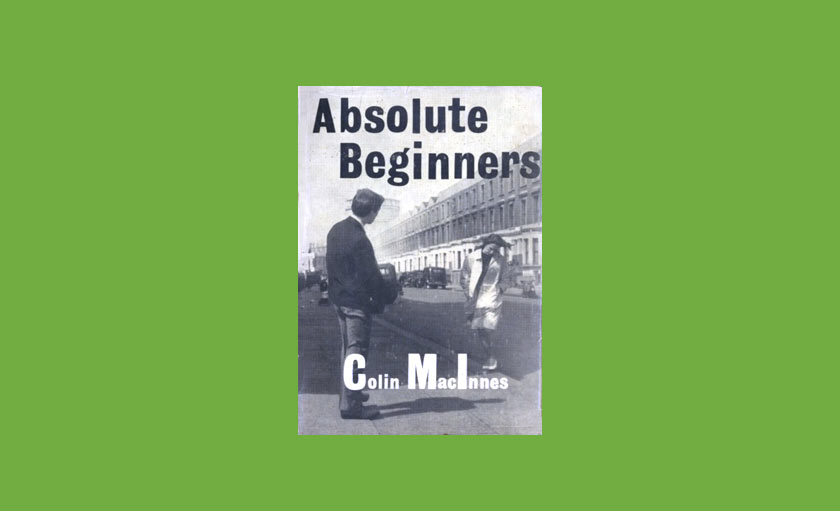
Reading 1959: Absolute Beginners

Colin MacInnes’s Absolute Beginners is an invigorating virtual reality experience – a hot London summer spent swimming in the primordial soup of a teenager’s head.

If No Love for Johnnie was about a generation struggling to break free from Victorian tradition, the misery of slum-life and the trauma war, then Absolute Beginners presents what is left when the cocoon is finally shed.

The nameless 18-year-old protagonist didn’t fight in the war, though he is a ‘Blitz baby’, and doesn’t care for the ‘sad, gloomy and un-contemporary’.

He successfully presents himself as cynical for the first half of the book, professing to care about nothing, not even the ever-present threat of atomic war. He seems to despise his pathetic cuckold of a father, his promiscuous mother, and his hopeless half brother. At one point, just when the reader might be warming to him, he exploits a girl’s heroin problem for his own ends.

But a steady tap, tap, tap of optimism and enthusiasm begins to shine through: he loves his on-off girlfriend, Crepe Suzette, wholeheartedly.

He loves jazz, too. Really loves it, not for show, but in his bones: it ‘sends him’.

He takes pornographic photos to pay the rent but all the time he is slowly turning into a real photographer – into an unashamed artist.

When he is really tested, when he is asked to prove his humanity as race riots turn West London into a warzone, he cannot pretend to be other than an idealist. He sides with the underdogs, against the racists, and risks his neck to do the right thing in a pocket civil war.

Ultimately he can’t even conceal the love he feels for his parents. “Don’t be a c–t,” says his his mother at one point, but we, and he, know what she really means.

Almost everyone in this book behaves surprisingly, from the proto-hippy pimp who turns out to be a bright-eyed fascist, to the retired Admiral who refuses to be homophobic for the TV cameras. These characters are hard to grasp and all the more real for it.

But Absolute Beginners was written in the late 1950s, and so perhaps Crepe Suzette is lacking a dimension or two – a manic pixie dream girl with the sex dial turned up. On the whole, the female characters aren’t as convincing or as interesting as the male characters, even Big Jill the lesbian pimp.

After a stretch where it seems black characters might be treated merely as a background mass, individuals emerge, though still primarily as non-player-characters for the white protagonist to react against or move towards. Some of his best friends are black, and all that.

(But, come on, let’s be fair: compare this with the grimmer, greyer angry young man novels where there are hardly any non-white characters, and in which women are generally either fantasy figures or ambition-crushing marriage traps.)

Quibbles aside, spat out of the far end of Absolute Beginners, my heart was beating fast. I could still see the colours, hear the beat, and the roar of the Vespa. I felt 20 again. I wanted to go out on to the streets and do something to make things better. (And, very badly, to see my Dad for a pint.)

Categories
books reading1959

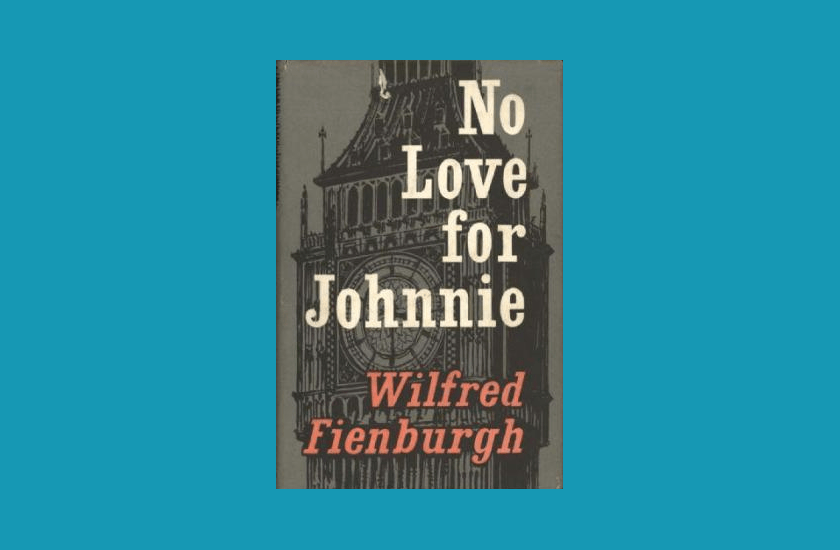
Reading 1959: No Love for Johnnie

This felt like a good week to be reading a drama about the underlying loneliness and emotional frailty of a Westminster big shot, written by a serving MP.

No Love for Johnnie is really a 1958 novel but its publication was delayed due the death of the author, Wilfred Fienburgh, in a car crash at Mill Hill in north London in February that year.

Is the depiction of the handsome, sexually inexperienced, unhappy, arrogant, insecure, vain Johnnie Byrne MP actually Fienburgh laying himself bare?

Byrne was brought up in the fictional Yorkshire town of Bradley, Fienburgh in Bradford. Byrne served in World War II, reaching the rank of captain from the ranks, while Fienburgh was demobbed as a major. Byrne became an MP in 1950, Fienburgh in 1951.

Perhaps we can conclude that Fienburgh was getting something off his chest in depicting the collapse of Johnnie Byrne’s left wing idealism, and the mid-life crisis brought on by his passionless marriage. Or maybe he was just wargaming the worst-case scenario — picturing at 37 where he might be in five years time.

As someone who didn’t grow up embroiled in Labour party politics, this was a fascinating crash course for me: the battle between the left and right of the party, the philosophical debates over whether it is acceptable to compromise on left wing values for the sake of gaining and retaining power, and the need to switch between modes in Westminster on Wednesday and the constituency clinic on Friday morning.

One glimpse into the moment when this book was written is that Byrne owes his career in large part to his good looks and a strong performance on television in the run up to the general election. This really was something Labour was focused on at the end of the 1950s, even sending selected MPs on training courses to learn how to work the camera. (I’m delighted to find that the newspapers and books from 1959 I’m reading echo each other so clearly.)

Byrne lives on edge, constantly judging whether to flatten his vowels and speak plainly, or slip into an affected officers’ mess drawl, or use the neutral high register he has cultivated for conspiring with fellow MPs. Ignore the political plot and this is yet another story about a man cast adrift by social mobility, confused about his place in the world, able to fit in anywhere but really belonging nowhere. (See also Hoggart’s Uses of Literacy, 1957.)

Two novels into #Reading1959 certain themes are beginning to emerge. First, everyone is miserable because they can’t have sex until they’re married, so they end up marrying the first person they even slightly fancy, blind to their incompatibilities. In the case of Johnnie Byrne, it’s a Bradley lass, Alice, who is busy with her own political career as a leading light in the Communist Party of Great Britain. Not only is she emotionally cold but, Johnnie later discovers, her politics are the cause of the stalling of his career — the Prime Minister can’t give him a Cabinet role while she is in the picture, with her connections to Moscow.

Secondly, there’s the war, of course. Naive young men forced to grow up observing atrocities, reeducated in the brothels of Belgium, and turned into gentlemen by accident as pips appear on their tunics. For Byrne, the war isn’t about trauma, it’s about guilt. He wasn’t an effective leader of men, he was a coward, and he knows it, even if the world believes otherwise. A flashback to the taking of a French farmhouse sometime after D-Day reads like a Commando comic (“Bren gun…. Pass a Bren.”) until the moment when Byrne’s entire platoon is cut down by machine gun fire while he hides, vomiting, in a hayloft.

There are stretches where this book reads like pure pulp — titillation, cheap drama, obvious words and stock phrases dumped on the page — but where it works is in the honesty with which it depicts the unravelling of the male brain. When Byrne fails to get a Cabinet job, his wife leaves him, and he immediately becomes obsessed with getting a young girlfriend to make up for the lost years. His fling with Pauline, a self-assured 20-year-old he meets at a party, is passionate but brief, and then becomes merely sad: he stalks her to her family’s home in Yorkshire after she tries to get away from him, where he ends up dressed in one of her Dad’s too-small spare suits, while she refuses to play the part in his fantasy he demands.

At the end of the book, he still has nobody to love, and nobody to love him back, but he knows who he is: a grasping, arrogant, ambitious coward who would rather accept the job of Deputy Postmaster General, and the rather remote prospect of a Cabinet job when he’s proved his worth, than change.

Categories
1959 buildings history

Reading My Way Through 1959

I’m planning to spend 2019 reading only novels from 1959, with some extra homework on the side.

Why? Because in 2017, I set myself a similar reading challenge – only books by women – and it helped me focus. I read more, and more widely, and more books that were new to me. I discovered some new favourite writers (such as Edna O’Brien) and the habit stuck: I continued to read more books by women in 2018, and feel better for it.

But in 2018, with no specific challenge, I read less overall, and caught myself lazily returning to old favourites out of which I have already chewed all the flavour.

So, for this year, I needed a challenge, and focusing on a specific time period seemed like a good idea. The mid-20th century happens to be where my head is at a lot of the time anyway. It also happens to be when the Big Novel I’m working on is mostly set, so this also doubles as research.

I landed on 1959 specifically by asking my handful of discerning Twitter followers to choose between 80 years ago, 70, 60, and 50. (It was close – 1969 nearly won.)

As of this morning, I’ve started reading Free Fall by William Golding, which I found on Wikipedia’s list of British novels published in 1959, and then happened to stumble across in a secondhand bookshop in Osterley on Sunday. “Perhaps you found this book on a stall fifty years hence which is another now”, he writes eight pages in, bending my mind somewhat, despite being ten years out. It’s not quite my usual thing – very self-consciously literary, prose verging on Joycean – but it seems to have hooks in me already.

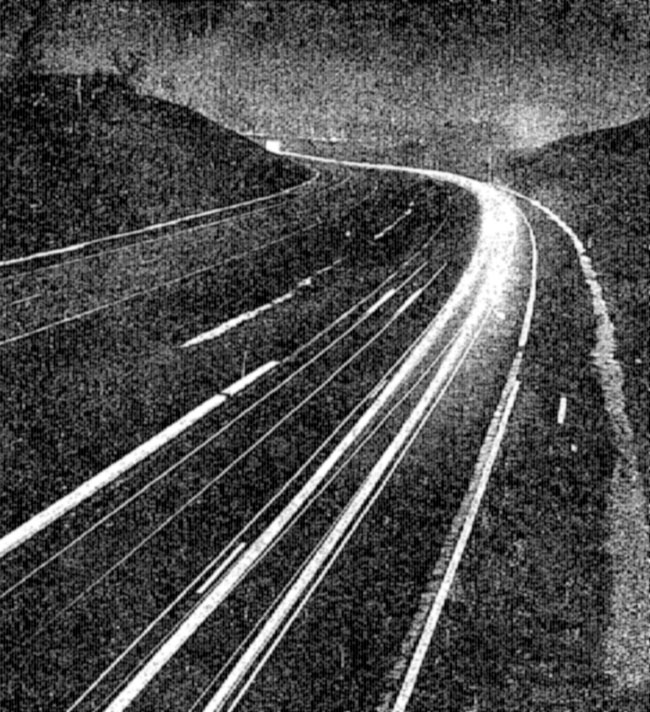
A low resolution image of streaks of light on a curving road.
From the front page of the Manchester Guardian for 1 January 1959: ‘The lights of south-bound vehicles on the Preston Motorway’.

On the side, though, I’m also going to try to do something I’ve been thinking about for years: reading a daily newspaper for each day of 1959.

This has never been easier than today with local libraries offering access to The Times and the Guardian, and the incredible British Newspaper Archive providing scans of all kinds of local and national titles.

On 1 January 1959 the Manchester Guardian was declaring A PROSPEROUS NEW YEAR with “Industrial shares index at highest level ever”. It reported that actor Alec Guinness had been awarded a knighthood, and that the West had rejected Nikita Khruschev’s suggestion that Berlin be made a “free city”. Meanwhile, in Cyprus, EOKA issued a defiant new year message for the British government: “We will emerge from our present peaceful attitude as FULLY armed avengers to return the blows.”

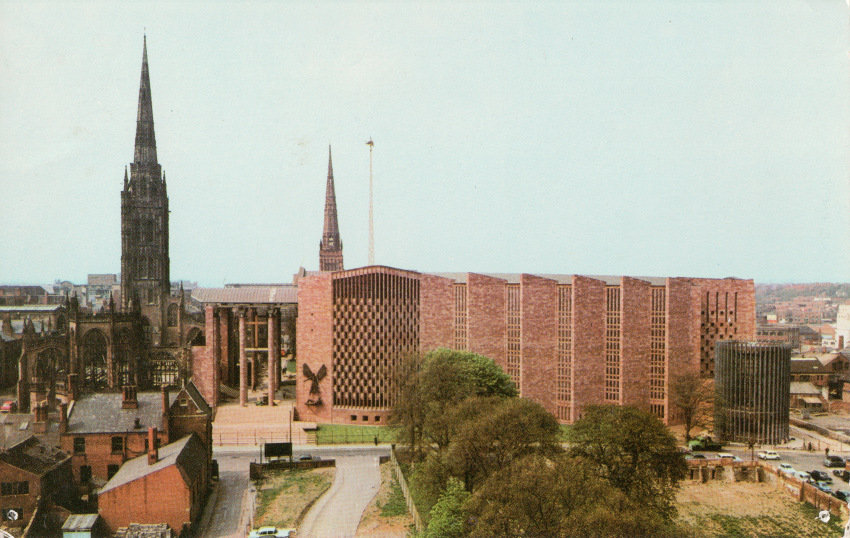
Postcard of Coventry Cathedral.

Given my interest in post-war architecture, I was also interested to read this:

To-day, for the first time, hymns and prayers have sounded in Coventry’s new cathedral. They came not from the choice and chapter but from the unaccustomed voices of the masons and labourers, tilers and glaziers and plumbers, whose hands are raising the walls of what to-oday we heard called “This great fortress of God in Coventry.”

Unfortunately, an opinion piece on racial tension, and a surge in white nationalist tendencies, suggests that there’s little shelter from the problems of 2019 to be found in desk-bound time travel.

I’ll also be making a point of listening to music from 1959, and watching films and TV from the same year, without being exclusive about it. I’m looking forward to rewatching Room at the Top for starters, which I last saw as a teenager in Steven Bennison’s media studies class at Bridgwater College.

If anyone feels like joining in, or borrowing this idea but wallowing in a different year, go for it – I always enjoy company on these expeditions.

Categories
council therapy

Send me to sleep

A bedroom.
Bedroom in a prefab at St Fagan’s Museum, Wales.

These days, I have reached a fragile accord with sleep, but for a long time it, or rather its absence, dominated my life.

In my twenties I struggled with sleep. I never had any trouble getting off but staying under seemed impossible, and I had often given up by 4:30 or 5 am and was up and dressed, just me and the mice.

Then I realised: I’d become one of those tiresomely tired people who responds to the polite question “How are you?” with “Ugh, exhausted.” This could not go on; steps had to be taken.

I started taking naps in the office canteen at lunchtime, until my boss made it clear he didn’t approve.

I tried giving up caffeine (no difference), I tried exercise (good in other ways, but didn’t help my sleep).

I drank more (really didn’t help), less (a great improvement, but only for one night) and different: whisky gave me mad dreams and indigestion, cocoa did nothing, fruit tea did nothing, steamed milk did nothing…

Nytol worked brilliantly – absolutely knocked me out, so that I woke feeling completely renewed – but, again, only for one night.

Hot baths, soothing music, fancy lamps and alarms, writing a pre-sleep diary, eating lighter meals, ditching carbs, sleeping on the floor, nice pyjamas, new pillows, a new bed, everything, anything. No joy.

Eventually I accepted the facts of the matter: it was my brain.

A sleeping statue.

That led me to the doctor, which led me to counselling at a terraced house in Chingford where I travelled after work on a bus every Friday for two months.

My only mission was to sort out my sleep. Other than insomnia, I thought, my life was pretty good, and I was sure I was fundamentally happy.

Talking out loud, though, I realised there was some weird stuff going on:

“I usually wake up first at about 1 am. I feel very alert and sit up to check the back garden.”

“What do you mean, check the back garden?”

“Just, you know, stare out into the dark until my eyes adjust, to make sure there’s nobody out there.”

“Like who?”

“Burglars.”

“Interesting. Have you been burgled?”

“Well, not recently, but…”

This took me back to the council estate and the people who used to raid our shed every other night, who stole our bikes, and rattled the back door from time to time. That’s when, between the ages of about 10 and 17, I got into the habit of staying up late watching the garden; of waking up throughout the night to look outside, hoping to catch them; and getting up early to see what damage they’d done.

Remembering that took me to university where staying up late was normal, and getting up early felt like an evolutionary advantage. I’d usually read a book or two by breakfast, and spent an hour or two in the library before most of my peers had stirred in search of lunch. So not sleeping became an embedded habit, and I powered through it on adolescent adrenaline.

But reflecting on university also took me into what turned out to be a foul well of pent up resentment, sadness and minor humiliations, the weight of which had slowly built up on my shoulders so that I hadn’t noticed myself being pushed down.

It all became clear: I wasn’t exhausted because I wasn’t sleeping – I was exhausted because I was burned out by going from estate to school to work to university to work to work to work… No gap year, barely a pause for breath, and no second chance if I failed.

A streetlight at night.

Counselling, I’m pleased to say, dealt with all that – I’m lucky enough to have been easy to fix with a bit of talking, which I know isn’t how it goes for everyone – and by the final session I felt a million times better, but…

I still couldn’t sleep. The counsellor, I sense, was a bit exasperated by this.

“Would people know you’ve slept badly and feel tired if you didn’t tell them?” he asked eventually. “Does your work suffer? Are you less effective? Does it stop you socialising?”

“Well, no, I don’t think so.”

“So don’t tell people. It can be your secret. Why not just let yourself be.”

With that finger-snap, everything seemed to change. I stopped talking about sleep (or at least, stopped constantly talking about sleep) and learned to accept it.

And you know the punchline: because I stopped worrying about it, I did begin to sleep a little better. Not well – I still don’t sleep well – but a touch deeper, a few minutes longer throughout the night. Waking up in the dark no longer felt like a personal failure, just a fact of life. I almost learned to like it.

At some point, I’m not quite sure when, I even stopped checking the garden for burglars.

The days after especially restless nights can still feel difficult but I’ve grown philosophical: like the man said, nobody knows, and bad sleep last night increases the chances of good sleep tonight, or tomorrow, or maybe the night after, but soon.

In the meantime, think of all those extra hours for reading, writing, for just being.

I was prompted to write this by a bad night’s sleep, an article in the New Yorker, and this excellent Tweet.

Categories
west country

Westward Ho!

A vintage car behind an ice cream parlour in Penzance.

Endings are good, so let’s have one: a year since I left Cornwall for Bristol, and half a year since this project began, it feels done.

What have I learned? That there’s a lot more to learn, for starters.

One of the aims of this project was to jolt me from a rut, to make me look at towns and villages that didn’t previously have a place in my consciousness, and in that respect, it worked. I’ve read books, looked at maps, and even (money and time permitting) got on buses and trains.

Places I thought I knew turned out to be deeper than I had considered, with further depths to explore yet. The Torquay bread riots, for example, would bear further study, as would the mysterious Prince Tchajkowsky of Midsomer Norton.

The fun, silly stuff — the trivia — turned up in surprising places, and hardly ever when I was actually looking for it. I have no doubt there’s plenty more to stumble upon, and I hope to keep stumbling. Only the other night I learned that Paul the psychic World Cup octopus was hatched in Weymouth.

I have also reached some conclusions about the West Country. Despite having lived there for six years, and knowing that it was distinct and different, I never really doubted that Cornwall was part of the West Country. Having got to know Gloucestershire a little, at the other end of the scale, it seems absurd to consider those two places part of a single entity.

At the same time, lots of the photos I Tweeted — of folk traditions, or tower blocks, or mysterious moorlands — look, I have to admit, as if they could be anywhere in the country.

The West Country is more real to me than ever, but perhaps the idea of the West Country has slipped away.

I’ll be keeping the Twitter feed up, and this blog, but anything else I write about the West Country will be on my other, more personal blog, or on my other, less specific Twitter account. I’d love it if you joined me there.

If not, thanks for following and for reading, and I’ll see ‘ee round, my luvvers.

Categories
Devon

Impressions of Torquay: Riviera Blues

The Grand Hotel.

Take the wrong path through Torquay, in the wrong weather, and it can seem a decaying place.

Despite the very point of the English Riviera being the gentleness of the climate the buildings look weather-beaten. Their paint peels and they are streaked by gulls and pigeons. “You have to keep on top of it,” one local stopped to tell me as I stared up at one particularly forlorn building. “Lick of paint, keep it in good repair, or round here nature sort of comes and starts to take it back.”

Hotels and bed-and-breakfast establishments with grand names have ageing Perspex signs that are missing letters, or sagging under the weight of crowns of nails intended to keep incontinent birds away. It’s as if they’re one good season away from the full refurbishment they need, but always one full refurbishment away from that good season.

There are too many junctions that make no allowance for pedestrians, or rather treat them as a nuisance to be managed, prodded out of the way of traffic by fences and obstacles. Boy racers fly through town using the gravitational pull of roundabouts to boost acceleration, although sometimes what looks at first glance like a Hot Hatch is actually just a Hatch being driven by a hunched pensioner hammering the pedal for fear that the car won’t make it up a steep hill.

Torquay Town Centre.

An entire row of shops in what ought to be a prime location is derelict, near collapse, while a huge post-modernist mall with galleries and walkways dominates the centre. The old market hall, built in the 1850s and with a plaque from the local historical society, has been gutted and partitioned so that the interior, like a reverse Tardis, barely has the grandeur of a Portakabin.

Riviera Centre.

A leisure centre lurks beyond the promenade – a last dry breath of brutalism from the 1980s, the grey Atlantic Wall intimidation exercise of its exterior undercut by a curl of fibreglass waterslide that pops out and back in again like some parasite. At ground level it is all warning signs, cameras and black grilles, some of which blast sickly-warm chlorinated air across the weed-covered car park.

The landmark Pavilion Theatre on the seafront is a beautiful Edwardian building that, scaled up, would look at home in Monte Carlo, except it is derelict and boarded up – too precious to demolish, but too much trouble to use, and so being left to rust and rot.

Mini golf. Bowling.

And yet come at Torquay from another angle, in the sun, in a better mood, and the Riviera fantasy of GWR posters and The Persuaders lives on. The marina is full of yachts, some of them sleek and substantial, and the streets nearby accordingly full of yacht people – tanned, posh and loud. Motorboats motor across the bay as middle-aged couples in designer clothes (men sockless, women perfumed) stroll arm-in-arm, summoning the spirit of Nice.

Torquay looking like the South of France.

Even the bland modern blocks on the hillsides add their own glamour, evoking the aggressive development of the coastlines of the Mediterranean.

My favourite parts of town, though, are those reserved for purposes other than tourism or shopping: the remarkable Central Church with its concrete launch gantry; the boldly Art Deco council offices, and more modest library of the same vintage; the Edwardian town hall; and St Andrews with its rows of dignified white war graves.

Torquay, I think, is a deeper town than all the seaside superficiality might suggest, with plenty more to discover yet.