A run of Japanese films released around the millennium, and bracketed together as ‘J-Horror’, gave new life to the ghost story. In 2026, they’re still exciting.
They’re particularly effective because they bring the ghost story up to date with post-war urban settings and a focus on modern technology.
They also play with our expectations of the ghost story, often seeming to present us with a cliche or familiar pattern only to yank away the guardrails in the final act.
In this blog post, I’ll be sharing some of my observations about what makes J-Horror tick based on a recent binge watch of most of the key films, plus some marginal candidates that helped me triangulate.
A working definition of J-Horror
For the purposes of this blog post, I want to talk specifically about Japanese supernatural horror films from between around 1997 and 2005.
Some people use the term to refer to Japanese horror cinema in general, stretching back to the 1960s. Others even apply it to nineteenth century literature, modern novels, and comics.
Others include films from the same period I’m covering but which do not have a supernatural element. When I asked on the social media platform BlueSky which films might be said to form the core of J-Horror, or its ‘holy trinity’, many people suggested Takashi Miike’s Audition from 1999 – a psychological horror with graphic scenes of torture. But I struggle to seat that alongside Ring (Hideo Nakata, 1998) and Ju-On: The Grudge (Takashi Shimizu, 2002) both of which are very much about ghosts, curses and haunted houses.
That conversation was helpful in finding the epicentre of J-Horror, even if its boundaries remain vague. Almost everyone named Ring and Ju-On: The Grudge as centrally important. The next most commonly suggested supernatural horror films were Dark Water (Hideo Nakata, 2002), Pulse, AKA Kairo (Kiyoshi Kurosawa, 2001), One Missed Call (Takashi Miike, 2003) and Noroi: the Curse (Koji Shiraishi, 2005).
These are the films I’ll be focusing on, with mentions of several others.
You are, of course, welcome to disagree with my definition of J-Horror, with the films I’ve chosen to consider part of it and, indeed, the very concept of the label. If so, I’d suggest writing your own blog post which anyone can do and everyone should be doing, because blogging is great.
I’ll also acknowledge that there are plenty of people who know Japanese cinema better than me and who have made a special study of J-Horror. If you want a definitive history of J-Horror, or a broader survey of media that might belong within the category, do check out their work, some of which I’ll flag throughout this post and in a reading list at the end.
Urban legends and viral storytelling
The viral nature of stories, and of the curses they convey, is a key theme of J-Horror films.
There’s a strong culture of urban legends in Japan. For example, in the July 2025 edition of Fortean Times Laura Mauro wrote about one particular strand of Japanese legend: the toilet ghost. Mauro recounts that the legend of Toire no Hanako-san (Hanako of the Toilet), who pulls people through the toilet bowl and down to hell, can be traced to a specific elementary school in Tokyo as far back as 1948. Spooky school stories are, she suggests, an entire literary sub-genre, with tales spread from child to child, school to school, and documented by writers like Toru Tsunemetsu.
This tendency also reached the small screen as explained by Nicholas Rucka in his excellent 2005 essay ‘The Death of J-Horror’:
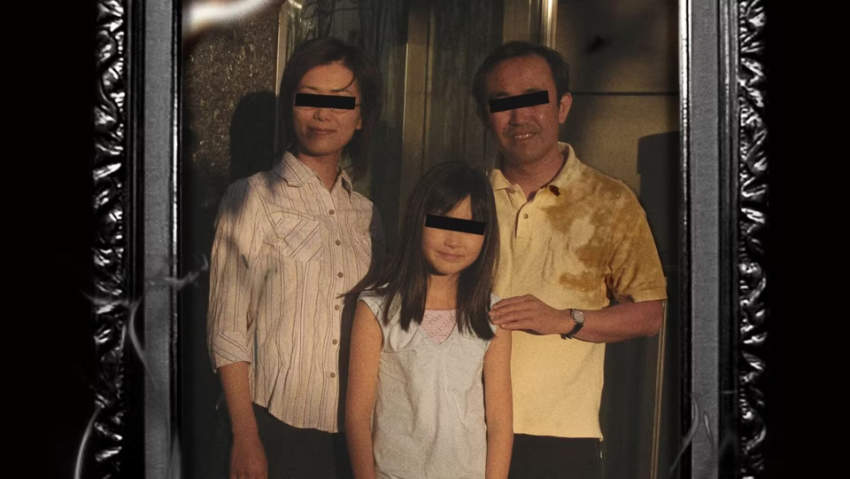
A young office worker named Norio Tsuruta, employee at a video production company in Tokyo, had noticed that television shows about supposedly true ghost sightings and hauntings were extremely popular… Tsuruta’s highly popular 1991 Scary True Stories (Honto ni Atta Kowai Hanashi) provided through low budget production on video, the look, mood, and style of what we now know as J-Horror… They begin with candid snap-shots of normal Japanese folks who have had their eyes black-barred for anonymity. We start with the full photo on screen and then we cut into a close up of the ghost or spirit that has been caught in the background of the picture. These are regular folks who are being haunted.
In J-Horror films, schools, schoolchildren, and schoolgirls in particular are antennae for urban legends and ghost lore. In Ring we see schoolgirls being interviewed, speaking directly to camera. In narrative terms this acts as both a convincer and a distancing mechanism. They’re either expert witnesses who perceive and believe things that adults miss, or just silly, gullible kids.
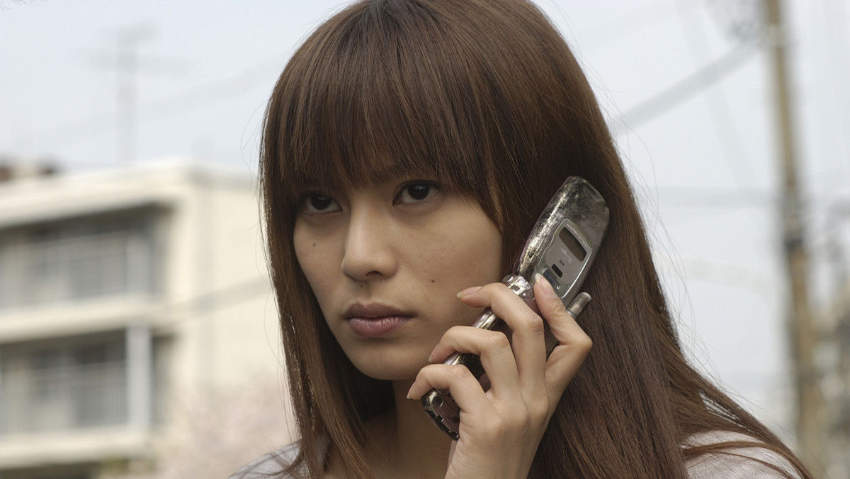
In One Missed Call the first clear articulation of the mechanics of the curse comes from a group of kids in blazers and knee socks overheard by the protagonist Yumi (Ko Shibasaki) in the street. Where have they learned this? Oh, you know, just around.
Noroi: the Curse connects the urban legend aspect of J-Horror with another contemporary trend: found footage horror. Its protagonist is a producer of straight-to-video supernatural investigation documentaries. Following rumours and local myths he stumbles into a grim case that crosses over into folk horror. Like the urban legend framing, watching the action through handheld camera footage and clips from convincingly typical Japanese television shows helps to sell the reality of a fantastical situation.
No happy endings
Almost every J-Horror film in the core group sets up an expectation, or a hope, that the problem can be solved as it might be in a formal Victorian tale of the supernatural. That is, if you can solve the mystery, or find the buried corpse, you will lay the ghost or lift the curse.
Empathy and the quest for justice is, however, rarely rewarded.
J-Horror’s unhappy endings are the necessary pay off for the overwhelming sense of dread that they conjure up through eerie soundscapes, slow-building situations, and uncanny imagery.
As we near the end of Ring everything seems on track to wrap up neatly, with virtue, kindness and determination rewarded. But, no, the vengeful spirit doesn’t want to be found, understood or loved – it wants more victims, and it wants to make more monsters.
Ju-On: The Grudge gives us a taste of the logical conclusion of that idea in its brief but utterly chilling final shot of a city covered with posters seeking missing people, and seemingly abandoned.
But it is Pulse that really goes there, giving over its final act to an apocalyptic vision of a world invaded by ghosts. The vehicle for their crossing over is particularly interesting in the context of another recurring theme in J-Horror.
Technology as the vehicle of the curse
At the time of their release J-Horror films, as I recall it, were sometimes ridiculed for shoehorning contemporary technology into their plots. What next, a haunted MiniDisc? A cursed Nintendo DS?
Ring is where the important J-Horror motif of the cursed technological artefact seems to begin. Its lethal chain-message videotape was remarkably effective, too. VHS brought grit, noise and artefacting – again, distancing and concealing – so that what we did see felt all the more unsettling. The choice to show us the eerie, unsettling tape in its entirety, like a short art film, was also brilliant. As others have pointed out, most people saw Ring on VHS and so, for one very weird minute, found themselves exactly replicating the actions of the doomed protagonists.
Subsequent J-Horror films continued along this road and gave us cursed voicemail messages, spooky clamshell mobile phone ringtones, mysterious eCards, haunted video games, and so on. In this world, ghosts often manifest on glitching TV broadcasts, CCTV screens and webcam footage.
In Pulse it was the nascent internet itself that became a portal through which hostile ghosts were able to cross over from the other side.
This reliance on technology often gave these films a sharp contemporary edge at the time of their release but ensured that by, say, 2009, they felt almost hilariously dated.
Now, more than a quarter of a century on, they’ve begun to feel like the next generation of hauntological artefacts, taking over from Victorian dolls and music boxes, and from the 8mm film and reel-to-reel tape of the 1970s. And they bring their own digital dirt, and built-in sense of melancholy nostalgia.
Blandscapes and backrooms
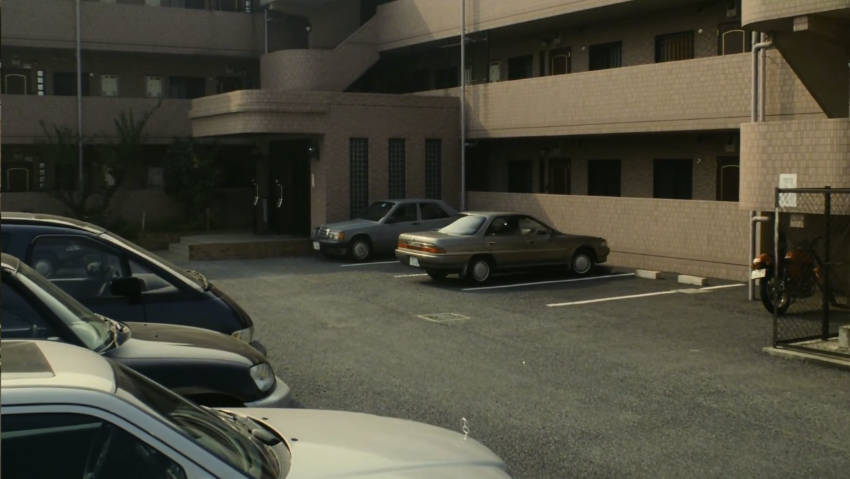
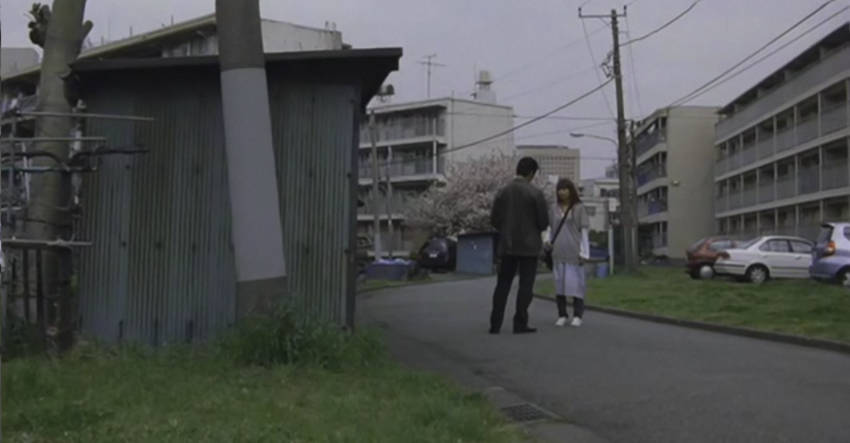
Another recurring feature of J-Horror films is the grey and beige mundanity of their settings. They are very decidedly anti-Gothic.
The action often takes place in and around post-war apartment blocks, in car parks, in playgrounds, or on suburban back streets.
There are brightly lit, quietly buzzing welfare offices with queues and waiting rooms, and blandly bureaucratic schools and hospitals.
The haunted houses are small, lived in and modern – more IKEA than Borley Rectory.
This tells us we’re in the real world, where real people really live and really work, so that when things start to drift towards the uncanny it feels all the more disquieting.
There’s also a foretaste of ‘The Backrooms’ trend of the 2010s in the between places the protagonists of J-Horror films find themselves exploring. In Dark Water it’s the functional rooftop infrastructure of an apartment block’s water system – rusty, damp, perfectly ordinary, except when it isn’t.
In Dark Water, Ju-On: The Grudge and One Missed Call the uncanny potential of lifts (elevators) is explored. They’re traps where vengeful spirits have their prey cornered, or from which the enclosed protagonists get brief glimpses of the creatures that stalk them.
What if a girl had long hair?
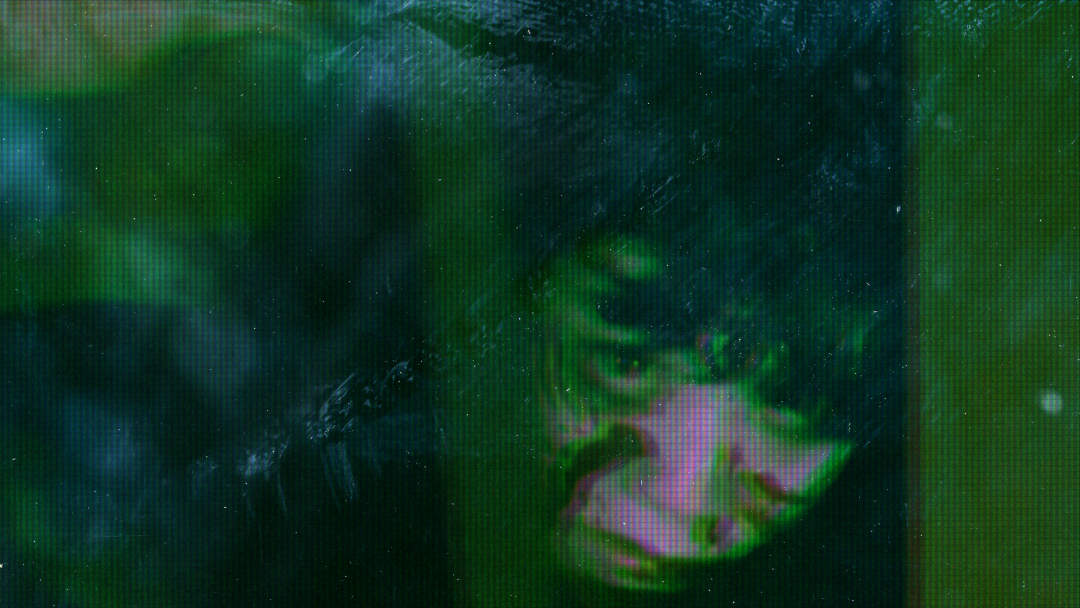
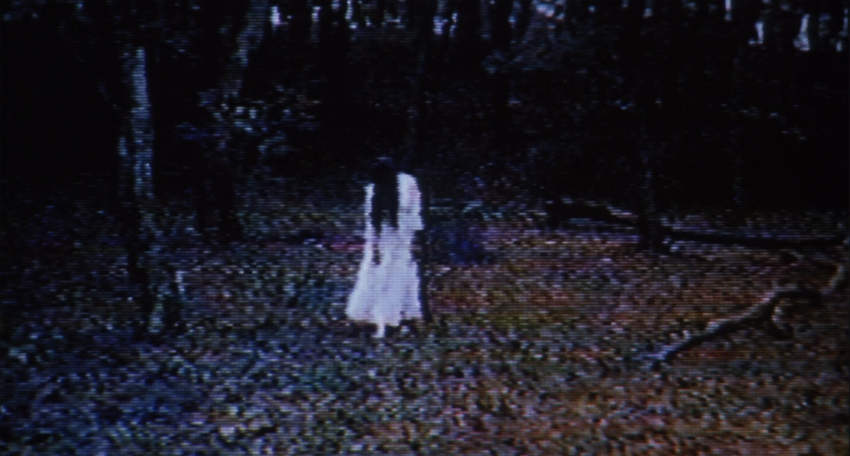
Finally, I have to acknowledge a recurring visual trope in J-Horror: the vengeful female spirit with long dark hair.
For starters, there’s Sadako, the antagonist of Ring, whose long dark hair is also (shudder) wet.
In Dark Water, by the same director, Mitsuko is another dreadfully damp monster whose hair even makes its way into the water system of the building, through the taps, and out into glasses of already murky-looking drinking water.
In Tomie (Ataru Oikawa, 1998) the face of the non-human entity at the heart of the film is concealed from us by long hair which she compels her bewitched male servant to brush for her.
Kayako, the furiously angry ghost of Ju-On: The Grudge and its sequels, hides behind her long, untidy hair, and even uses it as a weapon.
It’s easy to think of this as a superficial effect, or a cheap way of triggering feelings of unease. (See also: masks or crazily fixed smiles.) But academic Colette Balmain wrote about the meaning of unruly hair in Japanese horror films in a 2008 paper:
Theories of hair and its relationship to socio-political structures in South East Asia suggest that long hair is symbolic of freedom, while short or bound hair is subject to social control… [and] unbound hair connotates sexuality…
By contrast, the young women who are so often the protagonists of J-Horror films generally have short, glossy, beautifully styled hair. Their characters are star students, social workers, television reporters, or devoted mothers, and the actresses who play them are usually some combination of pop star and model.
But who remembers the names of those characters? It was never them who inspired endless sequels and spinoffs.
J-Horror is worth revisiting in 2026
I’ve thoroughly enjoyed both revisiting J-Horror films that I watched first time round and discovering films I skipped at the time.
It’s often easier to make sense of trends and sub-genres after some time has passed, and when there’s less noise from marketing people repackaging any old tat to cash-in.
What got me started was the excellent Arrow Films Blu-ray box set J-Horror Rising which contains six relatively obscure films including Noroi: the Curse. They don’t all match my personal definition of J-Horror but where they deviate, and how they differ, helped me understand its fuzzy edges.
This also sent me back to rewatch Ring, Ju-On: The Grudge, and others. Suggestions from BlueSky led me to Cure (Kiyoshi Kurosawa, 1997) which, while it lacks the supernatural aspect I crave, was certainly a welcome discovery.
Most of all what I got from this was a sense of immersion in another culture along with a barrage of new ideas for how to think about ghost stories.
While I won’t be introducing any lank-haired well-dwelling revenants to my own fiction just yet, I’ll certainly be aiming to capture some of the bone-deep sense of wrongness that J-Horror conveys so well, in such clever ways.
Further reading
- ‘The Death of J-Horror?’, Nicholas Rucka, Midnight Eye, 2005
- ‘The Ring phenomenon’, Mark Hodgson, 2008
- ‘Naming the nightmare: the urban legends of the J-Horror label’, Julian Singleton, NightTide Magazine, 2025









 Precast Reinforced Concrete Heart