Categories
Film & TV

We need our flinches: on the cosiness of horror

It’s cowardice, isn’t it? That instinct that draws horror fans to old movies; camp, arch, silly films; and contemporary films set in the comforting warmth of the hand-knitted past.

The word ‘cosy’ has become an irritating background note in conversations around horror fiction.

It’s usually spoken about as a specific subset of work in the genre that offers “that happy ending, or low stakes”, as explained by Agatha Andrews on the podcast Books in the Freezer on 30 May 2023. It’s perhaps about friendship and love more than it is about cruelty.

But beyond that explicit cosiness, there’s an implicit cosiness baked into much of the genre.

Few consumers or fans of horror like to think of themselves as craving cosiness. Horror is edgy, grim, and dark. It’s for kids who don’t fit it and, like, see the world differently, man.

Horror critics speak approvingly of horror films as ‘disturbing’, ‘harrowing’ and ‘unflinching’ – ordeals through which we put ourselves, tests of our mettle, proof of our resilience in the face of fucked up shit.

In practice, however, we don’t want to be disturbed or harrowed. We want to be able to flinch. So, we protect ourselves with a range of distancing factors:

1. Time. Stories set or written in the past are less threatening than those which are strictly contemporary.

2. Geography. If the setting is physically distant from us – Texas, Italy, deep space – we feel safer.

3. Realism, or its absence. Freddy Krueger might be mean, and the Nightmare on Elm Street films might be gory, but they’re also close to being fairy tales.

4. Personal experience. We all know what will feel like salt in our own psychological wounds and can choose to avoid it.

5. Topicality. Difficult topics become less difficult when they’re no longer live; nuclear war was less scary in 2003 than in 1984.

Don’t look away

The 2020 film His House (dir. Remi Weekes) is about as far from cosy as I can imagine. It’s about a couple, refugees from South Sudan, who are dumped in a council house on an estate in England. The house turns out to be haunted by those they left behind on the gruelling journey.

It is set now. It is set in the UK, in a landscape I recognise. Remove the ghosts and it is an example of brutal social realism.

With its narrative about war, the danger of small boat crossings on the English Channel, and the vicious heartlessness of the UK asylum system, it could not feel more topical.

And, though I had it easy compared to these characters, the setting and sense of poverty reminded me uncomfortably of my own childhood – of scraping by with bugger all, constantly on edge.

I admired it, and am glad to have seen it, but cannot say I enjoyed watching it. At various points I actually felt the beginnings of a true panic response.

That’s what horror writers often believe they want to achieve, or to evoke. In reality, however, for the consumer of horror, the effect desired is more often a shiver, a pleasant thrill, or perhaps even a giggle.

I have a colleague (a woman, very politically aware) who talks about 1980s slasher movies as ‘comfort viewing’.

These are films in which one person after another is brutally murdered, often in graphic, gory detail; these people are often young, often female; and the feel of the films is often distinctly grimy.

But they are generally so over the top, so ridiculous, and so clearly set in another time (the 1980s) and place (Everytown USA) that, for British viewers, they’re a reassuring arm’s-length away from real fear. They make us jump and gasp but they rarely stay with us, or haunt our dreams.

That distance only increases when modern filmmakers or writers recycle slasher tropes and evoke the idealised Spielburbian settings of our collective childhoods. In Stranger Things or Fear Street Part One: 1994, both on Netflix, there’s an added layer of retro kitsch, or ironic detachment.

‘Trauma dumping’

A lot of contemporary horror fiction, or weird fiction, is inspired by the authors’ personal, physical or mental trauma.

Modern short stories are often ‘about’ some raw, real personal issue, such as child abuse, depression, racism, chronic illness, or gender transition. Or big, pressing existential problems like climate change.

They force us to confront complex, difficult subjects to the extent that reading for pleasure can feel like watching the news through a fictionalising filter, or listening to a deep, painful confession.

By turning them into fantastic stories, the authors are giving us a comfort blanket – a tiny degree of cosiness. But is it enough? For many readers, the answer is, no. It still feels too much like homework.

Or, to put that another way, they are often more enjoyable for the writer to write than for the reader to read.

(And I say this as someone who cannot stop writing stories attempting to process my own experiences of childhood poverty, often without intending to do so at all.)

Tweed, jerkins and knitwear

When I think of ‘cosy horror’ my mind leaps to M.R. James. His stories often have historic settings – they are set decades before they were written – and their revenants are older still. Now, in addition, we have more than a century of additional distancing. The tweediness of Edwardian prose tells us that we’re perfectly safe.

You might argue that James’s stories present eternal, subconscious fears: loneliness, unresolved sexuality, child murder… This is true. ‘Lost Hearts’, for example, certainly gave me shivers, as did its 1970s BBC TV adaptation.

At the same time, the way these stories are framed as fireside yarns in the original texts, or as ‘ghost stories for Christmas’ on TV, offers us a protective shield.

Similarly, I prompted some disagreement on Bluesky when I argued that folk horror is an essentially cosy sub-genre. As the filmmaker Paul Duane observed in response, folk horror often deals with “harsh” themes.

Equally, however, most of the best known examples are now viewed through a fog of 1970s film grain with half the cast in literally cosy vintage knitwear (dark Hygge) or 17th century jerkins and buckled boots (heritage horror).

Because that patina is part of the texture of folk horror, modern takes on this sub-genre are often also set in the past, as is the case with Starve Acre or Robert Eggers’s The Witch.

We get people in wigs discussing old news, with perhaps the odd talking goat or immortal rabbit to remind us that, by the way, none of this is real.

Even better, or more cosy, are Hammer films, and those from similar British studios such as Amicus. Does anybody watch these expecting to feel scared?

We might feel a little unnerved, perhaps, by the occasional striking image, or be made uneasy by the sexual politics. But more often, our reaction is to laugh at the big performances, at the Home Counties playing dress-up as Transylvania, and at blood as red as primary school poster paint.

The zombie apocalypse is another strong example of a cosying mechanism. These are really visions of our world post-plague, post-apocalypse, which give us a safe space in which to ask: could I shoot my neighbour in the head if they came for my resources, or threatened my tribe?

Anyway, enough of all that. I’m off to escape the horrors of the modern world in the warm embrace of a silly, colourful film in which a pair of binoculars fire spikes into someone’s eyes.

You know, in a cosy way.

This piece first appeared in issue two of the General Witchfinders zine. Issue three is out shortly and features a new short story by me called ‘We Have Always Battled Monsters in this Castle’.

Categories
Film & TV

The German-accented phantoms of old London town

I’ve found the Blu-ray box set Shadows in the Fog to be a great introduction to the West German Krimi genre despite, on paper, being a collection of also-rans.

‘Krimi’ is a description applied to a run of films made in Germany between the 1950s and the 1970s, based on or inspired by the works of British crime writer Edgar Wallace.

The six films in this set were made by CCC Filmkunst as an attempt to cash in on the better-known Rialto Film series.

Rialto’s films were adapted directly from the novels of Edgar Wallace but CCC cannily enlisted Wallace’s son, Bryan Edgar Wallace, as the mascot for their knockoff series.

CCC’s films were all supposed to be based at least on ideas by Wallace the younger, although really the important thing was to get his name on the posters and in the opening credits.

Much has been made of the influence of Krimi on the Italian giallo genre. Often, the suggestion is that the giallo realises fully what the Krimi only half grasped. It’s true that gialli are generally bolder, more erotic, and more colourful.

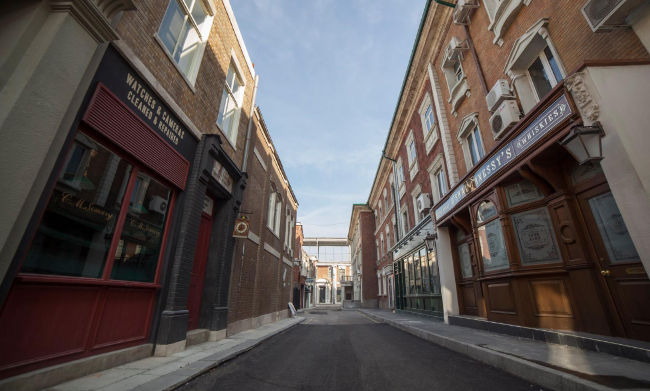
Being British, it’s easy to scoff at the version of England presented in these films, recreated on Berlin studio backlots, on suburban streets, or in the grounds of historic buildings. 

If you’re even remotely sensitive to architecture and design, you’ll notice the absence of London brick and the jarring presence of baroque stonework. And wven with the careful placement of extras in British police helmets and strategically parked Jaguars, you can’t turn smart Berlin apartment blocks on a neat grid into Soho or Whitechapel.

It’s only fair, though, isn’t it? At the same time the UK’s Hammer Films expected us to buy a country park as the wild mountain forests of Mitteleuropa, and its own backlot dollhouses as ‘Carlsbrück’ or ‘Karlsbad’.

A terrified man stands framed by a noose while hooded figures look on.
The Mad Executioners, AKA Der Henker von London.

It doesn’t really matter that the London of the Krimi film is unconvincing because in this context it is merely a mythic playground for archetypes. (See also the landscape of the western, as various critics have observed.)

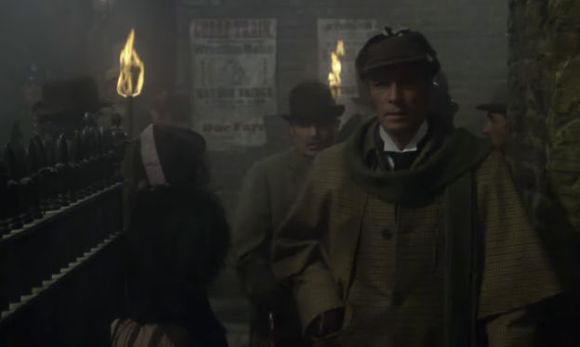
It has more in common with the foggy Universal backlot London of the Basil Rathbone Sherlock Holmes films of the 1940s than with the real thing.

In fact, Sherlock Holmes is clearly an unspoken reference point for the Krimi.

For example, the plot of The Phantom of Soho (Franz Josef Gottlieb, 1964) concerns a group of wealthy conspirators being hunted down one by one as revenge for a crime committed overseas – a plot structure Conan Doyle used multiple times.

As in the Holmes stories, we often get lords and wards and family secrets, with stately homes as key locations.

The films perhaps have more in common with the money-grubbing post-war Holmes pastiches of Adrian Conan Doyle, or with August Derleth’s Solar Pons stories, both of which tend to the macabre and the melodramatic.

One of the films in this set, The Curse of the Yellow Snake (Franz Josef Gottlieb, 1963) suggests a contemporary of Holmes, Sax Rohmer’s Fu Manchu, with all the racism that entails. It also feels like a precursor to Indiana Jones and the Temple of Doom and, going full circle, Young Sherlock Holmes.

Unlike Sherlock Holmes stories, Krimi credits the dogged men of Scotland Yard with a certain amount of genius.

The chief protagonist is usually a police inspector, like Jeff Mitchell (Harry Riebauer) in The Strangler of Blackmoor Castle (Harald Reinl, 1963) or John Hillier (Hansjörg Felmy) in The Mad Executioners (Edwin Zbonek, 1963).

They’re often the sharpest men on screen, both in terms of brainpower and fashion sense.

There’s never anything supernatural afoot but the films often hint that there might be. The killer in The Phantom of Soho wears a skeleton mask while in The Mad Executioners a gang of vigilantes rides about the Home Counties in a horsedrawn Gothic hearse straight out of Dracula.

The more Krimi I watch, the more I want to watch.

They’re reassuringly formulaic but also constantly surprising. The music is groovy, jazzy, and often surprisingly electronic. The faces are fascinating – household names in Germany but mostly unknown elsewhere, unless they cropped up in war films playing Nazi officers.

And this fantasyland of nightclubs, secret tunnels, laboratories, ruins, wild moors, and foggy Spreeside-Thameside streets is such a wonderful place to escape the here and now.

Shadows in the Fog is available from Eureka as part of its Master of Cinema series.

Categories
Film & TV

Beavers, battlefields and the suspension of disbelief

Watching the film Hundreds of Beavers and a product of Shakespeare’s Henry V in the same week was something of a crash course in the suspension of disbelief.

Hundreds of Beavers (Mike Cheslik, 2022) is a slapstick comedy about a fur trapper (Ryland Tews) using ever more elaborate methods to catch beavers.

Except the beavers are people in cheap beaver costumes and much of the action was conjured up using deliberately unconvincing digital effects.

Even if we allow the excuse that it’s supposed to resemble a cartoon, the quality of the animation is often so janky that it jars. More South Park than Snow White.

Two people in cheap, fake beaver costumes. Sorry, I mean, two beavers.
A still from Hundreds of Beavers. SOURCE: hundredsofbeavers.com

Does this in-your-face fakeness matter? Clearly, in this case, it’s intended to be a selling point, with phrases like “lo-fi” being used to describe what, in other contexts, might be referred to as “shit”. But whether it’s a plus point or not, it certainly doesn’t get in the way of enjoying the story.

If there’s one thing human brains are good at, it’s working with the limited information they’ve been given to create sense from chaos.

In this case, once you’ve been told a person in a beaver costume represents a beaver, and that a paper cutout style animation represents a man climbing a tree.

After all, what do you need to know to follow the story? That the man is climbing the tree to catch and kill the beaver. They could almost be represented by boardgame counters or, indeed, plain text.

If you want to be notified when I post something new, usually once every week or two, do subscribe. 👇

Insane Root’s production of Henry V employs similar tricks to evoke crowded, chaotic 15th century battlefields with a cast of seven, minimal sets, and a handful of props.

What’s interesting about Henry V in particular is that Shakespeare addresses the question of suspension of disbelief head on, in the text. He has the Chorus (the MC, or narrator) address the audience at the beginning of the play, urging them to get on board:

…pardon, gentles all,
The flat unraised spirits that hath dar’d
On this unworthy scaffold to bring forth
So great an object. Can this cockpit hold
The vasty fields of France? Or may we cram
Within this wooden O the very casques
That did affright the air at Agincourt?
O, pardon! since a crooked figure may
Attest in little place a million;
And let us, ciphers to this great accompt,
On your imaginary forces work.
Suppose within the girdle of these walls
Are now confin’d two mighty monarchies,
Whose high upreared and abutting fronts
The perilous narrow ocean parts asunder.
Piece out our imperfections with your thoughts:
Into a thousand parts divide one man,
And make imaginary puissance;
Think, when we talk of horses, that you see them
Printing their proud hoofs i’ th’ receiving earth;
For ’tis your thoughts that now must deck our kings,
Carry them here and there, jumping o’er times,
Turning th’ accomplishment of many years
Into an hour-glass; for the which supply,
Admit me Chorus to this history;
Who prologue-like, your humble patience pray
Gently to hear, kindly to judge, our play.

In both the 1944 and 1989 film versions of the play this preamble works brilliantly, highlighting the artificiality of the filmmaking process while also gaining a note of ironic self deprecation.

Because, of course, film can have a broader canvas than theatre, and better special effects, and hosts of extras in period costume.

But watching the Insane Root company shrouded in smoke, swinging swords in balletic slow motion, mimicking the hunched posture of mounted soldiers, I can’t say that I missed any of that.

I played along.

I accepted that (hiking boots and sunglasses aside) we were in 15th century France on a field strewn, horrifyingly, with butchered corpses – even if those corpses were nothing more than scattered red tennis balls.

A third strand in my accidental study of suspension of disbelief this week emerged from reading German Expressionist Cinema by Ian Roberts, published in 2009. It’s a slim volume designed as primer on the subject and includes observations like this:

The Austrian novelist and playwright Hugo von Hofmannsthal [claimed] that “all the working people are looking for in the movie theater is a substitute for dreams”… Yet with hindsight we can acknowledge that this oneiric quality, the ability of film to transport the viewer to a world of dreams, is precisely why cinema went on to confound its critics, and why the films of the Weimar period contribute to our understanding of the process whereby cinema was transformed from a vaudeville sideshow for the masses to a global entertainment industry and a major art form in its own right.

The Cabinet of Dr. Caligari, directed by Robert Wiene in 1920, is perhaps the most famous example of expressionism on film. Its obviously, unashamedly painted sets aren’t intended to feel real. They use contrasting paint to create light and shadow, and forced perspective to imply depth. They are intended to read as beyond real, as dreamscapes, or as projections from a troubled mind.

The lack of realism isn’t a bug, it’s a feature. It’s style. It supports the themes and mood of the film. And it’s one of the main reasons people are still talking about Caligari more than a hundred years after it was made.

If audiences are willing to suspend their disbelief and play along, filmmakers should feel more confident in doing things the cheap and dirty way.

Not everything needs to look cinematic or hyperreal, especially if that aspiration becomes a barrier to making anything at all.

Being aggressively handmade and imperfect might also a way to push back against the rise of computer generated imagery (CGI) and images generated with artificial intelligence.

Categories
Film & TV

The mask as the cheapest unit of the uncanny

If horror film makers have nothing else they can always rely on a cheap mask to bring a sense of the uncanny, playing upon our deepest instinctive fear of The Other.

Watching the 1974 Spanish horror thriller Night of the Skull, directed by Jess Franco, I was struck by how it instantly seemed to step up a notch when a character in a mask appeared on screen.

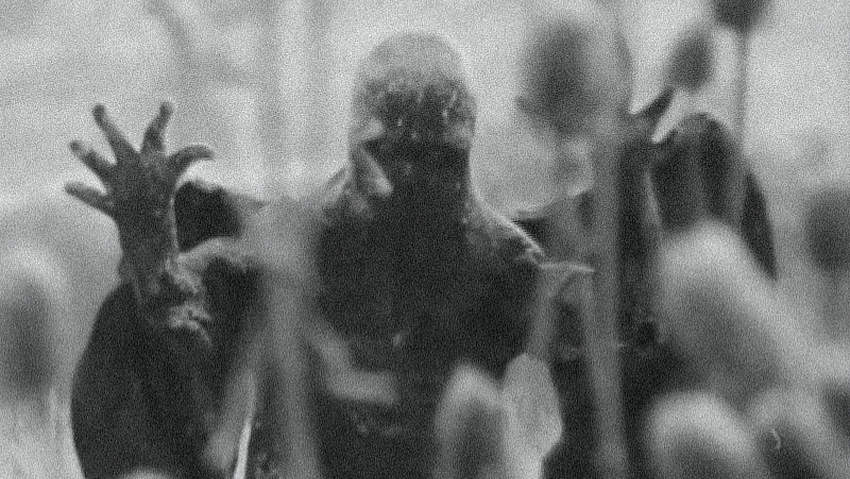
The mask in question isn’t a lovingly crafted custom design. It’s not carved or sculpted. No, it’s a typically floppy, tacky rubber Halloween mask, as you can see in the picture above. But that doesn’t matter.

What matters is that, suddenly, there’s a human on screen whose true features we cannot see or read – who is utterly blank.

A few years later the same trick was used to even greater effect in Halloween, from 1978. John Carpenter’s film, which really kickstarted the ‘slasher’ craze, gave its enigmatic killer Michael Myers a mask which, as everyone knows, was adapted from a novelty product supposed to depict William Shatner as Captain Kirk.

In that case, the mask is more detailed and comes with the added oddness of feeling vaguely familiar. Should we recognise this face?

Demonstrating just how broadly we might define a mask in this context, the monster at the heart of the Friday the 13th series, Jason Voorhees, at first wore a simple sack over his head. Then, from the third film in the series, he gained his trademark hockey mask – a white ellipse with a few dark holes punched in it.

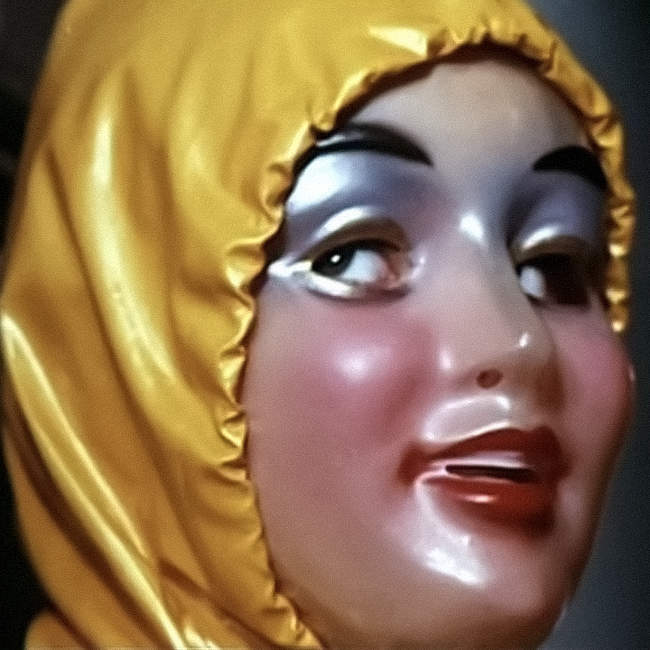
A person in a yellow anorak with a cheap plastic mask covering their face. It has shiny red cheeks and smiling red lips. The whole thing looks waxy and alien.
Alice, Sweet Alice.

In proto-slasher Alice, Sweet Alice (Alfred Sole, 1976) the mask is the cheapest, simplest plastic mask you can imagine – the kind I might have bought with my pocket money at the seaside, held on with a string of thin elastic. And it still works. The killer’s face becomes fixed, glossy and rigid, frozen in a smile that our animal brains read as uncanny.

There are examples of real life murderers wearing masks. The perpetrator of the 1946 Texarkana Moonlight Murders, for example, wore a white cloth mask.

And the Zodiac Killer who terrorised San Francisco and the surrounding area in the late 1960s wore a hood that concealed his face, turning him into a folkloric bogeyman.

For people like this, the mask is a way to become more than their pathetic selves, and to assert their dominance.

If you can’t see my face, but I can see you, then I’m in control.

Ed Gein, the inspiration for Norman Bates, The Texas Chain Saw Massacre, and many other fictional serial killers, made a mask from the peeled skin of his victims. His motive seems to have been to possess them from within – to steal their identities in a sense that predates online fraud.

A shot from a black and white film of two robbers wearing loose, leathery masks that make them look like monsters.
Kansas City Confidential.

Accessories to crime

The mask gives anonymity to criminals of all kinds, from lads riding eBikes too fast round the local park to hardened blaggers.

Criminals pull a pair of tights over their heads, or a balaclava, and in an instant their features are concealed or distorted.

In the heist movie, as much as the horror movie, masks create an instant visual hook. Think of the gang in Kansas City Confidential (Phil Karlson, 1952) with their unsettling felt masks, or the crew in Point Break (Kathryn Bigelow, 1991) who wear comical rubber masks representing various presidents of the USA.

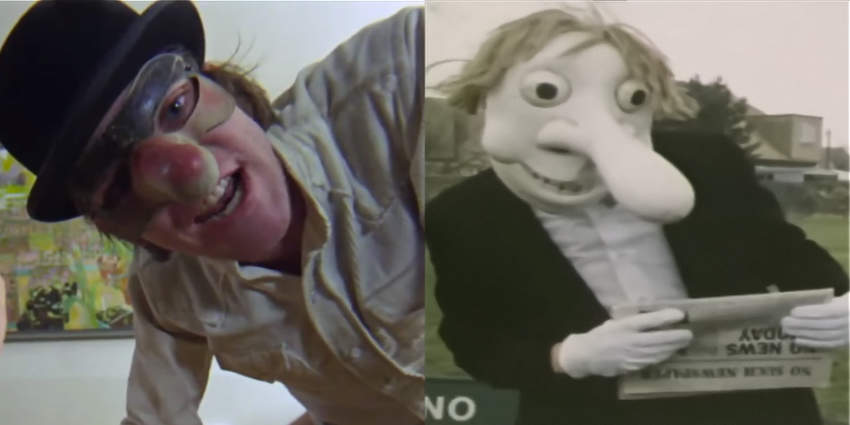
In A Clockwork Orange (Stanley Kubrick, 1971) the juvenile delinquent Alex wears a particularly grotesque, phallic mask during an instance of home invasion and rape.

A comparison of Alex the Droog with his phallic nose and Mr Noseybonk with his perfectly innocent, but very similar, long proboscis.
Alex, left, and Noseybonk, right.

And when hauntologically minded British people over fifty talk about being ‘terrified’ of the 1970s children’s television character Noseybonk, consider the similarities between Alex’s mask and Noseybonk’s.

Much as they are empowering masks can also be dangerous.

The best section of a book I did not otherwise care for, Grady Hendrix’s 2023 novel How to Sell a Haunted House, is a side narrative which depicts the danger of masks. It tells the story of a troupe of avant garde puppeteers who fashion and don masks in the likeness of Pupkin, a sinister haunted puppet, and lose control of themselves:

It’s hard to describe what it feels like to wear a mask. You’re aware of what’s going on around you but it all feels far away. The longer you wear the mask, the more distant the world becomes through your eyeholes. Bits and pieces of time go black because the mask is active and you slip into a semi-somnolent state, but it feels good because you’re not in control. Nothing is your fault. You’re a puppet. Like Clark said, ‘A puppet is a possession that possesses the possessor.’ And a mask turns a person into a puppet.

In Kaneto Shindō’s 1964 film Onibaba, set in medieval Japan, the particularly sinister mask below equates to a curse. Yes, it confers power, but it also extracts a fee, binding itself to the wearer’s face, with removal only coming at too high a cost.

A Japanese mask fixed in a horrifying grimace.
Onibaba.

Creating horror from nothing

Masks are scary, among other reasons, because they deny us the cues we rely on to assess threats.

They turn our fellow humans into creatures that are humanlike but different enough to trigger deeply programmed fight-or-flight subroutines.

If you can afford to buy or make a mask, as simple and cheap as you like, you can generate horror.

And you will do so in the most efficient, powerful way possible – by short circuiting our rational minds.

Night of the Skull is available on Blu-Ray from Vinegar Syndrome, along with two other rare gialli, in the box set Spanish Blood Bath.

Categories
Film & TV

The virtual Los Angeles media has built in our brains

I’ve never been to Los Angeles and probably never will. But it’s a city that exists as a high fidelity virtual model in our collective imagination as a result of more than a century of dominance over mass media.

What percentage of American films and TV shows are set in LA? A disproportionate number, I’m certain. And that’s before you take into account those that are filmed there even though they’re set in New York City, Las Vegas, Dallas, or wherever.

As a result, we all know aspects of Los Angeles’s landscape that would otherwise be insignificant to outsiders.

For example, there’s the concrete trough in which its river runs. Built to guard against flash flooding between the 1930s and 1950s it has since become a favourite location for filmmakers looking to shoot car chases and action sequences.

Griffith Observatory is another landmark that turns up in movie after movie, from Rebel Without a Cause to Bowfinger.

Watching Michael Mann’s 1995 film Heat for the first time this week I was struck by the deliberate choice of less frequently filmed locations, often quite anonymous. But even these spaces, beneath flyovers and in the car parks of malls, seemed familiar. If we haven’t seen these exact spots, we’ve seen similar ones in, say, episodes of T.J. Hooker, or Bosch.

Perhaps it’s because filmmakers so often live in Los Angeles that they so often make films about the city, or in which, as the cliché goes, “the city is a character in its own right”.

Films like To Live And Die in L.A. (William Friedkin, 1985) and Once Upon a Time in Hollywood (Quentin Tarantino, 2019) present particular versions of the city. The former shows us a dusty Wild West city of backrooms, guard dogs, and industrial zones. The latter takes us back in time and attempts to magic back into existence the Los Angeles of the director’s childhood.

Model Shop (Jacques Demy, 1969), Cisco Pike (Bill Norton, 1972) and L.A. Confidential (Curtis Hanson, 1997) are all set in ostensibly the same city but each present it from a different perspective, in different light. There are a thousand others.

Together, they allow the outsider to begin to triangulate – to understand how the city fits together, and how it has changed over time.

L.A. Confidential is based on a novel by James Ellroy whose literary version of Los Angeles is both vivid and idiosyncratic. It’s similar to the city presented by Raymond Chandler in his Philip Marlowe novels, or by Chandler’s disciples in their LA private eye stories, only meaner and more brutal. Chandler’s LA is at least romantic, in a cheap, rather superficial way.

The cover of Reyner Banham's book Los Angeles: The Architecture of Four Ecologies.

Chandler was an outsider, born in America but raised and educated in England, and looked at Los Angeles as if it were an alien planet. This is from The Little Sister published in 1949:

Real cities have something else, some individual bony structure under the muck. Los Angeles has Hollywood – and hates it. It ought to consider itself damn lucky. Without Hollywood it would be a mail order city. Everything in the catalogue you could get better somewhere else.

Another British writer who observed Los Angeles from a similar distance was critic Reyner Banham whose 1971 book Los Angeles: The Architecture of Four Ecologies feels like a manual for understanding the city. Read a chapter or two and you’ll start to feel like an insider – as if you’ve seen LA’s top secret schematics.

Beyond literature and highbrow criticism, there are a million other ways that Los Angeles infiltrates the brains of people who live in, say, Luton, or Lübeck. If you listen to podcasts the chances are that you’ve heard the hosts fill the first ten minutes comparing notes on their drives to the studio, the weather, where’s good to eat, and how they’ve been effected by whichever natural disasters or episode of social unrest has most most recently occurred.

It’s an interesting aspect of the parasocial relationships we form with these strangers who murmur unscripted nothings in our ears every week for years on end.

Every month the excellent movie podcast Pure Cinema has an episode running down what’s showing at The New Beverly Cinema in Los Angeles. It’s interesting not only as a list of recommended viewing but also because of the ambient notes on life in the city, including casual asides about which actors have been spotted where, doing what.

Before podcasts there was radio and vast chunks of old radio shows from Los Angeles are now readily available on YouTube. As with podcasts, the pleasure here is in the snippets of chat between songs, and the evocative advertisements.

The songs, though, shouldn’t be ignored. Listening to The Beach Boys, The Byrds and The Monkees, as well as all those Nuggets fodder one-hit wonders, also transports you to Los Angeles.

British music fans talk casually about the Capitol Building and the crack session musicians later christened the Wrecking Crew. The most obsessed listen to hour after hour of bootleg recordings, absorbing the good vibrations of Gold Star Studios in the near silence between takes.

Surely with all of this data – all those episodes of Columbo and Adam-12 – at some point we’ll be able to conjure up a four-dimensional immersive model of a sunny Los Angeles we can wander about in, or even escape into for good.

There have been a few attempts already. The 2011 game L.A. Noire was an attempt to make the world of James Ellroy explorable and playable. To achieve that its creators, Team Bondi, recreated a vast swathe of Los Angeles approximately as it looked and felt in 1947.

It wasn’t perfect but in a rather moving article games journalist Chris Donlan wrote about playing the game with his father who grew up in LA in the 1940s. He found it pretty convincing:

The accuracy with which the city structures and roadways are recreated is really astounding, and the details were almost perfect… To be able to experience it again with my son who was born 20 years after I first left the city was, I think, wonderful for us both…

Then there are the several not-quite Los Angeles cities of the Grand Theft Auto games. The 2004 game GTA: San Andreas gives us Los Santos, an almost parodic version of LA circa 1992. The GTA V from 2013 develops Los Santos further, in higher fidelity, to the point where players were able to shoot their own films in its ultra-realistic environments.

If, like me, you’re not very good at games, there’s also Google Street View – a wonder of the age that so many of us take for granted. It’s easy to lose hours wandering jerkily from one street or roadscape to another, feeling both close to the city and impossibly far away.

Main image: a detail from a Los Angeles street scene by Lee Russell, 1942, by via the Library of Congress website.

Categories
Film & TV

These other Londons: the imagined city of the backlots

London, like New York, is often too busy, and too much in flux, to play itself on film. So, time after time, filmmakers rebuild it on backlots – with varying degrees of accuracy.

Each of these other Londons represents a particular vision of the city, and conveys the creators’ preconceptions, prejudices and perspectives.

Even the best of them never quite look real. On high definition video, more than ever, we can see that ‘bricks’ are lines etched into plaster, and that their streets merge with painted ‘flats’ or matte paintings.

They’re fantasies. But are they any worse than, say, Dublin, or Riga, or Budapest, with every stone and brick the wrong colour, putting on their best cockney accents?

I’ll take the artistry and illusion of a backlot set over Prague scattered with red buses and phone boxes any day. (Even if that backlot is, itself, in Prague.)

Stand-in Londons in Hollywood

Old Hollywood loved to build Londons.

Cedric Gibbons created one at MGM for David Copperfield, directed by George Cukor in 1935. On screen, the backlot construction was supplemented with matte paintings.

Parts of that set, later known as ‘Copperfield Court’ or ‘Copperfield Courtyard’, were used in other productions, including on TV, for years to come.

What looks like a Victorian or Georgian terrace with an ornate bow-fronted shop.
Copperfield Courtyard at MGM in 1949. SOURCE: The Phantom of the Backlots.

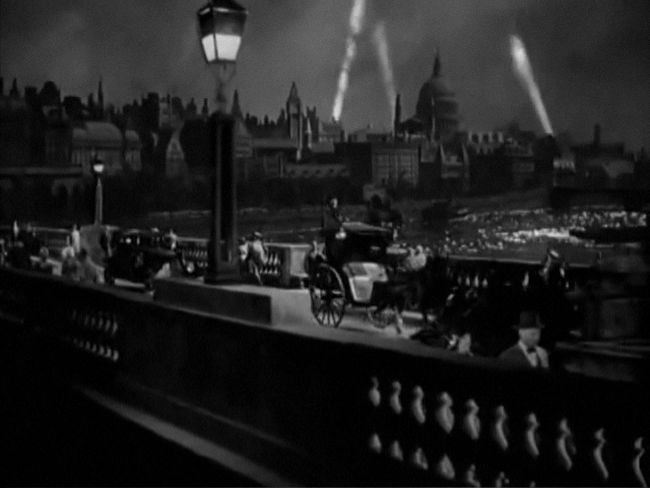
At Universal, before Frankenstein, James Whale directed a version of Waterloo Bridge, released in 1931. For that production, a misty wartime London was created by Charles Hall, including a replica of the bridge itself that used forced perspective to suggest scale.

A vista of London with Waterloo Bridge in the foreground, bustling with people.
A scene from Waterloo Bridge, 1931.

Hall and Whale were both British and perhaps this added to the relative realism of the production.

In his 1976 book Caligari’s Cabinet and Other Grand Illusions production designer Léon Barsacq shares a promotional image from the 1933 production of Noël Coward’s Cavalcade by Frank Lloyd for Fox. Barsacq also quotes the text that came with the photograph:

“Why! This is a section of the Strand!” exclaimed Miriam Jordan, whose home is in London, when taken to the London ‘set’ for ‘Cavalcade’ on the Fox Films lot. In the background is a typical London building and at the left is an exact replica of a small London park. Natives of the British Empire and world travelers are amazed at the fidelity with which William Darling, art director of Fox Films studios, reproduced London street scenes. Even the lamp posts are authentic.

Even after the war, when many Americans had seen Britain for themselves, Hollywood continued to film London under the Californian sun.

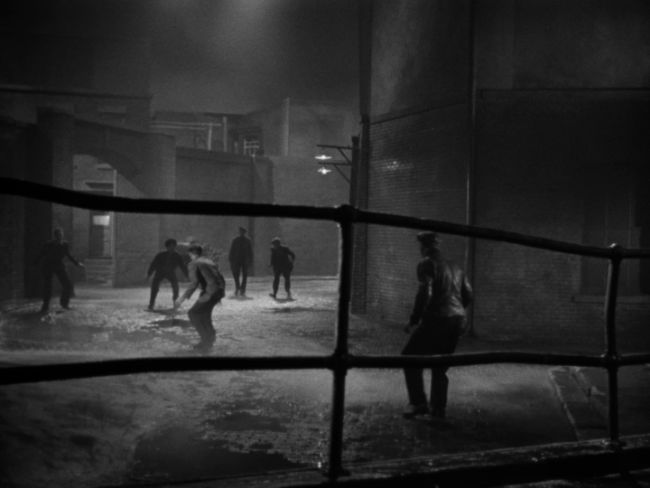
Dock walls and cobbled streets at night while various men prepare to rumble.
A scene from Kiss the Blood off My Hands, 1948, showing a recreation of Wapping in Hollywood.

Burt Lancaster starred in and produced the British-set Kiss the Blood off My Hands – one of the all-time great film noir titles – in 1948. It was shot at Universal on an extensive recreation of the East End of London, and Wapping in particular, that supposedly represented 30 blocks of houses, warehouses and wharves.

At the other end of the scale, there was the brightly coloured, sugar-icing version of London seen in Mary Poppins, shot at the Disney studios in Burbank. Along with many matte paintings there was also a large physical set for Cherry Tree Lane, with more forced perspective, including on the cherry trees.

Backup Londons near London

Why recreate London when you’re on the outskirts of the real thing? Why not film on the actual streets? For convenience. Because London changes too fast for historical drama. And, perhaps, because an air of fantasy might be desirable.

In 1961, Cliff Richard, ‘the British Elvis’, was a huge star. The Young Ones was to be his first serious star vehicle, directed by Sidney J. Furie, and the budget justified the construction of a “quite extensive backlot town” of “relatively anonymous West London streets”,  as described by Jonathan Bignell.

Cliff Richard and Carole Gray dancing on a fake London street with shop fronts, red phone boxes, and a bench.
A scene from The Young Ones, 1961.

Bignell’s particular interest is that this set lingered on and was used and reused, dressed and redressed, to represent not only London but also locations around the world in British TV shows such as The Saint, The Champions and Randall and Hopkirk (Deceased).

A police officer guards a hole in the road on a fake London street.
The Counterfeit Constable, 1964.

A little later, at Shepperton, a 1964 French production, The Counterfeit Constable, called for the construction of another London in miniature.

These streets also hung about and, with tweaks, represented everything from the 18th century city in Moll Flanders to post-apocalyptic future London in one of the Doctor Who films.

The never-never London of Sherlock Holmes

The backup London at Shepperton described above was also used, with adjustments, in the 1965 Hammer film A Study in Terror, starring John Neville as Sherlock Holmes.

Over the years, however, Holmes has prompted the construction of several elaborate Londons in his own right.

A London street set under construction with scaffolding holding up flimsy facades.
The set for The Private Life of Sherlock Holmes under construction. SOURCE: Library of Congress.

In 1969, Alexander Trauner built a long stretch of Baker Street at Pinewood for Billy Wilder’s The Private Life of Sherlock Holmes. (He’d previously constructed a very convincing Paris for Wilder’s Irma la Douce in Los Angeles.)

This set would also linger on, decaying, and appear in distinctly less prestigious British productions such as Carry on at Your Convenience.

A version of Baker Street with terraced houses opening their doors straight onto the pavement.
Baker Street at Granada. SOURCE: Horslip5 on Flickr.

A decade or so later, Granada in Manchester set about bringing Sherlock Holmes to TV with Jeremy Brett in the lead role. For this expensive production it constructed its own Baker Street – just around the corner from its recreation of a red-brick Manchester terrace for the long-running soap opera Coronation Street.

This set is particularly interesting because it’s one many British children visited over the years as part of the Granada Studios Tour. I went myself, as a dorky teenage Holmesian, and felt as if I’d gone to heaven. (Years later, I worked on the real Baker Street for about six months, and there was no romance about that at all.)

When Guy Ritchie filmed his Sherlock Holmes with Robert Downey Jr., released in 2009, he also had a large scale Baker Street set to play with – albeit one built for a Harry Potter film and refitted. Rather than forced perspective, as employed by Trauner 40 years earlier, this set was extended with green screen and CGI. It was not an improvement, in artistic terms.

Recreating the East End

London’s East End is another common target for cinematic recreators – not least because the real East End was so extensively changed by, first, the Blitz, and then post-war remodelling.

Sherlock Holmes and Dr Watson walk through the East End after Jack the Ripper has committed another murder.
Murder by Decree, 1979.

In Murder by Decree, a 1979 Sherlock Holmes film directed by Bob Clark and starring Christopher Plummer, Baker Street is played by Barton Street, a well-preserved thoroughfare in Westminster. But the East End, where Jack the Ripper stalks, was constructed at Elstree (Whitechapel streets) and Shepperton (docks and wharves). It’s very convincing, even sharing the screen with real locations in Bermondsey.

Twenty or so years later a film with a very similar plot, From Hell, directed by the Hughes Brothers, was shot on a set outside Prague designed by Martin Childs. Released in 2001, it fell between the cracks as the internet came into being, and the set is unfortunately not well documented. In ‘production notes’ of uncertain provenance at cinema.com Childs is quoted as saying:

“We couldn’t find anyplace here that resembled Whitechapel from all angles, so we ended up building it in the middle of a field. It became the unexpected highlight of this entire enterprise… We were very lucky that Prague was undergoing a major restoration and digging up many of its streets… because we were able to borrow cobblestones from the city…”

This set included versions of The Ten Bells pub and Nicholas Hawksmoor’s Christ Church, Spitalfields. The film might not be a masterpiece but the set might have been.

Another perhaps surprisingly careful reconstruction of the East End appears in Till Death Us Do Part, the 1969 feature film adaptation of the TV sitcom starring Warren Mitchell as Alf Garnett.

A view of an East End street with railway line, pub, and terraced houses.
From the trailer for Till Death Us Do Part.

Several streets and corners are recreated in loving detail, with the brick convincingly soot blackened, and a railway arch to terminate the street. This neat capsule set allows director Norman Cohen to take us from the 1930s to the 1960s by changing details such as the brewery branding on the very realistic pub.

What it’s very like, in fact, is the Coronation Street set mentioned above or, jumping forward to the mid-1980s, the set constructed at BBC Elstree for another long-running soap, Eastenders

Albert Square, which has been on TV every week since 1985, was supposedly based largely on Fassett Square in Dalston, and offers a snapshot of pre-gentrification East London. The set was carefully weathered and distressed to resemble real East London streets and I suspect fooled many people into thinking it was filmed on location.

Over the years, the set expanded, gaining new offshoot streets and details. In recent years, rebuilt and refined for the high-definition age, it’s even, finally, gained some modern flats and new-build townhouses.

The bland Bulgarian London

One of my favourite recreations of London – as in, one with which I am grimly fascinated – is at Nu Boyana Studios outside Sofia, Bulgaria.

Its standing London street set was built, I believe, for the 2016 action thriller London Has Fallen, and includes a version of the forecourt and entrance to St Paul’s Cathedral. More importantly, it also has several streets that reflect what too much of London really feels like today.

A bland London street with an Irish pub and a shop or two.
SOURCE: Nu Boyana on Facebook.

There are bland modern flats, like those which have filled in every available gap in East London. There are bland modern shop fronts painted in shades of grey. There are rows of bland Mayfair houses, too neat and too tidy, where it’s clear nobody actually lives. There’s a bland Irish theme pub that looks like no fun at all. There’s even a Patisserie Valerie.

This set crops up in cheap Christmas movies and cheap action movies – the type that go straight to streaming, and maybe feature an older actor just long enough to feature his face prominently on the poster.

I’m pretty sure I see it in adverts, too, providing a shiny, simple version of London without any of the grime or graffiti.

I could go on…

There are so many other Londons.

The streets of Poplar constructed for Call the Midwife in the grounds of stately home in Surrey, for example; the fantastical Fleet Street built at Pinewood for Tim Burton’s Sweeney Todd; the Soho built for Julien Temple’s Absolute Beginners; the other Soho constructed on an airfield for Amazon’s Good Omens; or the 1930s suburban street slowly bombed to bits in John Boorman’s blitz memoir Hope & Glory; or…

Well, like I say, I could go on.

Together, these many peculiar, partial Londons add up to a complete imaginary city that helps us see and appreciate the real one in all its infinite depth.

Categories
Film & TV

The infinite supply of BBC ghost stories for Christmas

There are only eight episodes of the BBC Ghost Story for Christmas, produced between 1971 and 1978. That’s not enough. Here are some suggestions for where to go next.

First, let’s address a technicality: the 1968 adaptation of M.R. James’s ‘Oh, Whistle, and I’ll Come to You, My Lad’ directed by Jonathan Miller was a standalone film in the Omnibus strand.

It inspired A Ghost Story for Christmas and is often spoken about as part of that strand. In the unlikely event you haven’t seen it – start there!

Seven of the eight core episodes were directed by Lawrence Gordon Clark. He wrote the first two before handing over that duty to people like John Bowen and David Rudkin.

The final episode of that original run, ‘The Ice House’, from 1978, was written by Bowen and directed by Derek Lister.

The short films and television episodes listed below aren’t all ghost stories. And they weren’t all produced by the BBC.

Some are lighter, some are darker. Some are quite cinematic, others distinctly low-budget studio productions.

I’ve chosen them because they trigger in me something of the same feeling I get from, say, ‘Lost Hearts’, an M.R. James adaptation with a period setting, or from ‘Stigma’, which has an original story and a contemporary setting.

If I’ve omitted a film you like, it might be because I don’t know about it – do leave suggestions in the comments. But it’s probably more likely at this point that I do know about it but decided it didn’t fit.

‘The Beast’ from the 1982 West Country Tales series, for example, doesn’t feel to me like the same thing at all, enjoyable as it is.

1. Dead of Night: The Exorcism, 1972

Written and directed by Don Taylor this episode of the anthology series Dead of Night works as both (a) a terrifying ghost story and (b) a commentary on class. It has a group of well-to-do friends gathering for Christmas in an old working man’s cottage which one couple has bought and renovated. The title hints at a twist.

BFI DVD (out of print) | YouTube

2. Dead of Night: A Woman Sobbing, 1972

Another story from the same anthology series which combines social commentary with effective, shiver-inducing horror. John Bowen’s script is about unhappy marriages, the sidelining of middle-aged women, and menopausal depression. Anna Massey is a brilliant actress and there’s less scenery chewing than in some TV plays of the period. And the sobbing woman, symbolic as she may be, is as creepy as hell.

BFI DVD (out of print) | YouTube

3. Wessex Tales: The Withered Arm

Adapted from a Thomas Hardy story this has the perfect mix of bleak landscapes, horrifying moments, and stillness. It’s got a distinct folk horror feel, too.

BBC iPlayer

4. Beasts: Baby, 1976

The whole of this series written by Nigel Kneale is interesting, and very much worth watching. But this is the episode which feels, to me, closest in tone to the work of Lawrence Gordon Clark and his collaborators. It’s about a haunted house, essentially, with Jane Wymark as a pregnant woman and Simon MacCorkindale as her VERY SHOUTY husband. They find a mummified animal in the walls of their cottage and (probably) supernatural occurrences ensue.

Network DVD (out of print, eBay) | YouTube

5. Mr. Humphreys and his Inheritance, 1976

A 1970s M.R. James adaptation ought to hit all the right notes but this very short adaptation of a lesser-known James story is flawed and slight. It was made by Yorkshire Television as an educational piece to demonstrate the power of music in film which means it has intrusive music throughout. The pay-off is worth 15 minutes of anyone’s time, though – one of those psychedelic, nightmare images that works so well on grainy 16mm film.

YouTube

6. A Child’s Voice, 1978

This is often described online as a BBC production, presumably as a bit of search engine optimisation clickbaitery. Not only is it not a BBC production – it is not even British. It was produced by the Irish company B.A.C. Films and filmed, I believe, in Dublin, with an Irish director, Kieran Hickey, and Irish crew. The script is by a Brit, though – film critic David Thomson. It stars T.P. McKenna as a writer who has a cult following reading his own ghost stories on the radio late at night. Then a character from one of those stories begins to call him on the telephone…

YouTube

7. Tarry-Dan Tarry-Dan Scarey Old Spooky Man, 1978

A recent discovery for me, this BBC production was written by Peter McDougall and directed by John Reardon. It’s set and was shot in Cornwall and tells the story of a troubled young man who becomes obsessed with a local tramp, and has nightmares about the stained glass in a local church. It’s Penda’s Fen adjacent but with a grittier, tougher feel, as Kim Newman has written about on his blog

YouTube

8. Casting the Runes, 1979

This is a big one being an M.R. James adaptation directed by Lawrence Gordon Clark, but for ITV (Yorkshire Television) rather than the BBC. It updates the story to 1970s Leeds and makes great use of bleak, snowy locations. It also makes the protagonist a woman (Jan Francis) and has her working in TV journalism, instead of academia. It’s atmospheric and unsettling but, like the original story, also has an element of suspense and adventure.

Network DVD (out of print, eBay) | YouTube

9. Ghost in the Water, 1982

This was made for children and it shows, being more Grange Hill than Lawrence Gordon Clark. It’s about working class children investigating a haunting in the industrial landscape of the English Midlands – all canals, comprehensive schools and council estates. The lead actors are amateurs and their performances sit somewhere between monotonous and annoying. But, still, that arguably adds to the unusual feel of the piece. It was directed by Renny Rye and based on a story by Edward Chitham.

BBC DVD (Google it) | YouTube

10. Classic Ghost Stories: Wailing Well, 1986

This series of five 15-minute Jackanory-style readings of M.R. James stories by Robert Powell is more effective than you might expect. They’re all good but I’ve singled out this one as a story that hasn’t, as far as I know, been adapted elsewhere. They were offered as extras on my BFI DVD set of the BBC Christmas ghost stories and are also available as a standalone disc.

BFI DVD | YouTube

11. The Woman in Black, 1989

I hesitate to mention this as it’s so well known, and feature length. But the mood and feel is so close to the work of Lawrence Gordon Clark that I can’t exclude it from the list. It was also hard to see for a long time, until the defunct label Network released a Blu-ray in 2020. It was adapted for ITV by Nigel Kneale from Susan Hill’s 1983 novel and was filmed partly on location at Osea in Essex. It’s fantastically moody and also has one legendary jump scare that still works even when you know it’s coming.

Network Blu-ray (Google it) | Amazon Prime streaming

12. Ghosts: Three Miles Up, 1995

An adaptation of Elizabeth Jane Howard’s classic of weird fiction made for a short-lived BBC anthology series. It takes some liberties with the original story but catches some of the mood – and also borrows from Lawrence Gordon Clark that love of desolate but beautiful English landscapes. It’s about two brothers who try to fix their relationship by going on a canal boat holiday together. It’s already going badly when they pick up a strange girl and things get really strange.

YouTube

Categories
crime Film & TV

The Todd Killings, Smooth Talk, and the allure of the creep

Everything about the American serial killer Charles Schmid sounds pathetic – so how was he able to command the loyalty of his teenage followers?

That’s a question grappled with by two films based on Schmid’s story, 1971’s The Todd Killings, directed by Barry Shear, and 1985’s Smooth Talk, directed by Joyce Chopra.

Both films ultimately share the same original source: a 1966 Life magazine article by Don Moser called ‘The Pied Piper of Tucson’.

That article is a masterpiece of true crime writing, available online, and also collected in a 2008 Library of America anthology. Moser painted a picture of a loser and weirdo who, in his early 20s, was still hanging around with school kids in Tucson, Arizona:

At the time of his arrest last November, Charles Schmid was 23 years old. He wore face make-up and dyed his hair. He habitually stuffed three or four inches of old rags and tin cans into the bottoms of his high-topped boots to make himself taller than his five-foot-three and stumbled about so awkwardly while walking that some people thought he had wooden feet. He pursed his lips and let his eyelids droop in order to emulate his idol, Elvis Presley. He bragged to girls that he knew 100 ways to make love, that he ran dope, that he was a Hell’s Angel.

But Schmid was somehow appealing to teenagers who saw not a creep but a local own-brand version of Elvis Presley:

He had a nice car. He had plenty of money from his parents, who ran a nursing home, and he was always glad to spend it on anyone who’d listen to him. He had a pad of his own where he threw parties and he had impeccable manners… He knew where the action was, and if he wore make-up—well, at least he was different… [To] the youngsters – to the bored and the lonely, to the dropout and the delinquent, to the young girls with beehive hairdos and tight pants they didn’t quite fill out, and to the boys with acne and no jobs – to these people, Smitty was a kind of folk hero. Nutty maybe, but at least more dramatic, more theatrical, more interesting than anyone else in their lives: a semi-ludicrous, sexy-eyed pied piper who, stumbling along in his rag-stuffed boots, led them up and down Speedway.

Schmid was more than “nutty”. He tortured at least one cat, for starters. Then, in May 1964 he convinced two young friends to accompany him as he kidnapped, raped and murdered 16-year-old Aileen Rowe. They helped him bury the body in the desert – and kept his secret.

A little later, in the summer of 1964, he met 16-year-old Gretchen Fritz at a swimming pool. He seduced her and they had a rocky year-long relationship. It culminated in the death of both Gretchen and her younger sister, Wendy, in August 1965. When he showed a friend called Richard Bruns where the bodies were buried in the desert, Bruns turned Schmid into the law.

Schmid was convicted of murder in August 1966 and sentenced to death. By June 1967 a film based on the story was in production.

A screengrab from The Todd Killings showing Skipper Todd with bushy long hair, shades, and a wide collared shirt.
Robert F. Lyons as Skipper Todd in The Todd Killings.

The Todd Killings: torn from today’s headlines!

The Todd Killings had a range of working titles like ‘Pied Piper of Tucson’, ‘The Pied Piper’ and ‘What Are We Going to Do Without Skipper?’

It was eventually released in 1971 with the action relocated from Tucson to the fictional town of Darlington, California.

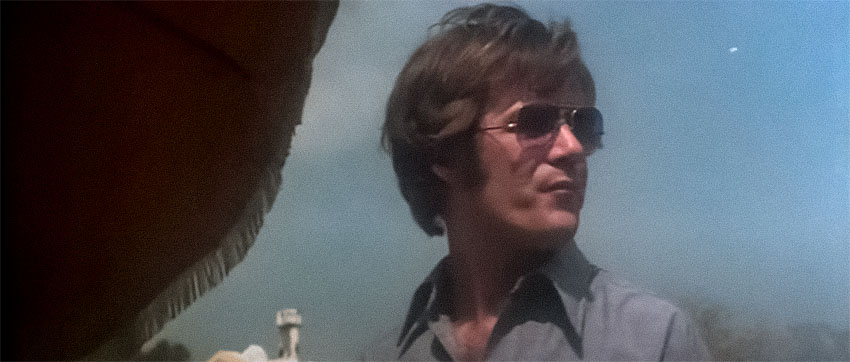
Schmid became ‘Skipper Todd’ played by Robert F. Lyons, with his look and lingo brought up to date. Skipper has shaggy Mick Jagger hair, tight bell bottoms, and a green dune buggy. He also plays folk rock songs on an acoustic guitar, almost like a spare member of The Monkees, or Charles Manson.

Lyons really is good looking, though, and brings to the part a commanding arrogance. The children follow him because he has the qualities of a leader. In odd, intercut scenes he is shown lying to a US Army recruiter to wriggle out of fighting in Vietnam where, actually, he might have thrived as another William Calley.

Updates and poetic licence aside, the film is an otherwise relatively faithful recounting of the facts of the case.

It has a particularly strong opening: Skipper is burying a body in the desert, helped by a devoted young girlfriend and a panicky boy.

This is not a whodunnit, or a did-he-do-it, like Psycho. That this young man is bad is established from shot number one.

From the off, we also empathise with the bored kids who are groomed by Skipper Todd, even as we want to shake them by the shoulders and urge them to break free.

We even begin to understand why they would reward his madness and violence with devotion. They are weak, and their parents are weak, too. He is good at spotting weakness and filling the gaps in people’s live. He has everyone, both boys and girls, under an erotic spell.

Did Charles Schmid ever see The Todd Killings? He died in prison in 1975 so it’s just about possible. If so, he would probably have found it flattering.

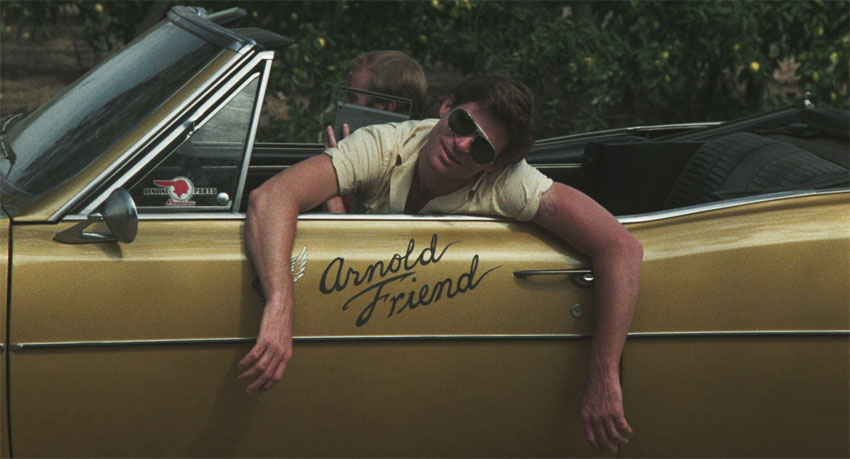
A man with muscular arms and sunglasses leans over the door of a gold convertible. His head is tipped to one side. The name Arnold Friend is painted in script letters on the side of the car.
Treat Williams as Arnold Friend in Smooth Talk.

Smooth Talk: back to the future

More than a decade later a second film tackled the story more obliquely, and more artfully. Joyce Chopra’s Smooth Talk from 1985 was not based on Moser’s article but on a short story by Joyce Carol Oates, ‘Where Are You Going, Where Have You Been?’ first published in 1966.

In Oates’s version of the Schmid affair, which was distilled from Moser, the monstrous fake teenager is called Arnold Friend. He stalks, seduces and seizes a teenager called Connie while her well-to-do parents are out at a barbecue. It crams a lot into a few thousand words and presents small town America as a menacing, sickly place.

Smooth Talk expands on the short story significantly, using Oates’s original material to form only the final act of the film.

It also does something really clever with the period. Connie (Laura Dern) is a quintessential 1980s teenager straight out of a John Hughes movie, while Arnold Friend (Treat Williams) is a relic of the 1950s. He is a cheap knockoff of James Dean (Connie has posters of Dean on her bedroom wall) and therefore closer to the real Charles Schmid than Skipper Todd.

In this, there’s an echo of another film: Terence Malick’s Badlands from 1973, in which Martin Sheen based his performance as spree-killer Kit Carruthers on James Dean. Kit wasn’t based on Charles Schmid, however, but his near namesake, Charles Starkweather – another rural weirdo with a taste for teenage girls.

In some ways, Arnold Friend is a less complex character than Skipper Todd, or the real Charles Schmid. He’s a sinister stranger, not a ‘pied piper’ who everyone knows and admires. He’s clearly a much older man (Williams was 34 when he played the part), dressed anachronistically, and almost supernaturally sinister in his manner, like an avatar of the Devil after Connie’s living soul.

In this version of the story Arnold Friend doesn’t kill anybody – as far as we know. He stalks Connie and, eventually, convinces her to go for a ride. This is roughly where Oates’s story ends and in that version we’re left to speculate on her fate. But if you know it’s inspired by Schmid your speculation is likely to favour murder.

In the film, Connie returns. She is changed – an adult, now, and no longer innocent. But she is, at least, not dead and buried in the desert.

In almost every way Smooth Talk is the better film. Not least because it makes Friend/Schmid an exterior menace and puts in the turbulent mind of one of his victims.

The Schmids, they’re multiplying

There is something particularly dark and rich about this story which must be why filmmakers keep coming back to it.

There’s Dead Beat from 1994, which seems almost impossible to see; Lost from 2005, adapted from a novel by horror writer Jack Ketchum; and Dawn from 2014, which focuses on the sister of one of Schmid’s victims.

Schmid is not the only killer to have inspired multiple movies, though. In fact, it’s unusual for a notable serial killer not to have inspired multiple movies.

Leopold and Loeb are practically a sub-genre (Rope, Compulsion, Swoon). So is Ed Gein – the original model for six decades of psycho-slashers, from Norman Bates to Leatherface. And Badlands is by no means the only take on the Charles Starkweather and Caril Ann Fugate story.

As a writer of fiction I find it almost maddening that real life generates stories that are so much more out there than anything I could invent. If I’d created Charles Schmid as a character it wouldn’t have occurred to me to give him white foundation make-up, a fake mole, and shoes full of crushed tin cans. Real criminals are often both dumber and more interesting than their fictional counterparts.

More importantly, I don’t know if I’d have been able to look at Schmid through the eyes of a teenager and have them think, “That guy is cool, I love him, I’ll do whatever he says.”

Main image: A digital sketch based on several different photos of Charles Schmid composited, traced, and treated with textures and filters.

Categories
Fiction Film & TV

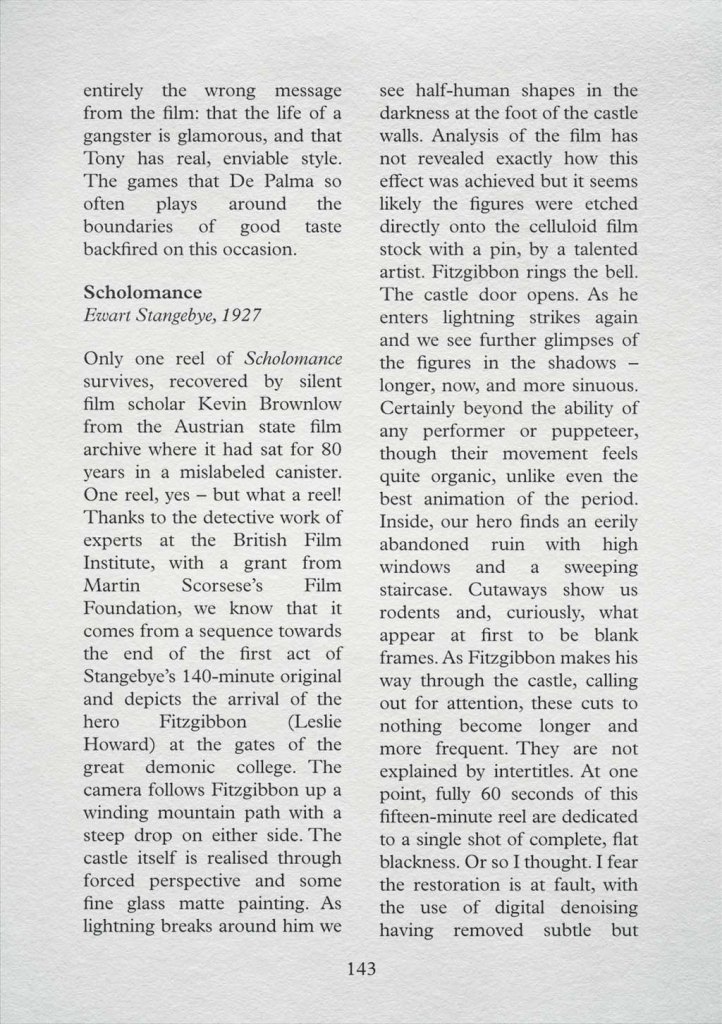
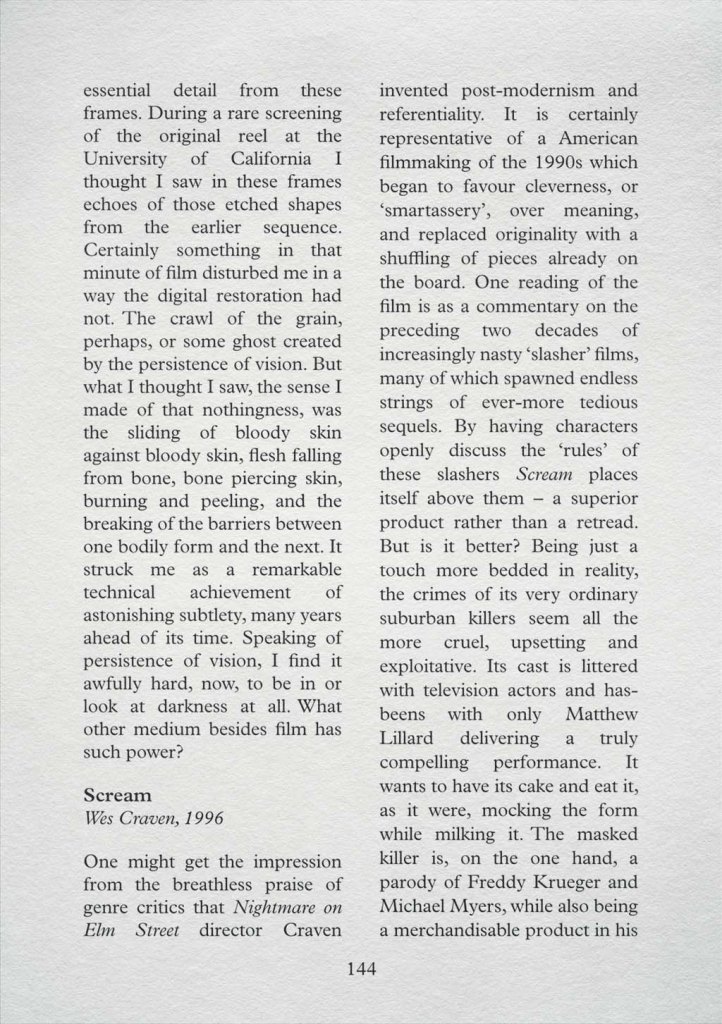
FICTION: Scholomance, dir. Ewart Stangebye, 1927

A page from a film guide that opens with the tail-end of a review: "...entirely the wrong message from the film: that the life of a gangster is glamorous, and that Tony has real, enviable style. The games that De Palma so often plays around the boundaries of good taste backfired on this occasion. Scholomance, Ewart Stangebye, 1927. Only one reel of Scholomance survives, recovered by silent film scholar Kevin Brownlow from the Austrian state film archive where it had sat for 80 years in a mislabeled canister. One reel, yes – but what a reel! Thanks to the detective work of experts at the British Film Institute, with a grant from Martin Scorsese’s Film Foundation, we know that it comes from a sequence towards the end of the first act of Stangebye’s 140-minute original and depicts the arrival of the hero Fitzgibbon (Leslie Howard) at the gates of the great demonic college. The camera follows Fitzgibbon up a winding mountain path with a steep drop on either side. The castle itself is realised through  forced perspective and some fine glass matte painting. As lightning breaks around him we see half-human shapes in the darkness at the foot of the castle walls. Analysis of the film has not revealed exactly how this effect was achieved but it seems likely the figures were etched directly onto the celluloid film stock with a pin, by a talented artist. Fitzgibbon rings the bell. The castle door opens. As he enters lightning strikes again and we see further glimpses of the figures in the shadows – longer, now, and more sinuous. Certainly beyond the ability of any performer or puppeteer, though their movement feels quite organic, unlike even the best animation of the period. Inside, our hero finds an eerily abandoned ruin with high windows and a sweeping staircase. Cutaways show us rodents and, curiously, what appear at first to be blank frames. As Fitzgibbon makes his way through the castle, calling out for attention, these cuts to nothing become longer and more frequent. They are not explained by intertitles. At one point, fully 60 seconds of this fifteen-minute reel are dedicated to a single shot of complete, flat blackness. Or so I thought. I fear the restoration is at fault, with the use of digital denoising having removed subtle but..." It continues on the next page.
The following page from the same film guide: "...essential detail from these frames. During a rare screening of the original reel at the University of California I thought I saw in these frames echoes of those etched shapes from the earlier sequence. Certainly something in that minute of film disturbed me in a way the digital restoration had not. The crawl of the grain, perhaps, or some ghost created by the persistence of vision. But what I thought I saw, the sense I made of that nothingness, was the sliding of bloody skin against bloody skin, flesh falling from bone, bone piercing skin, burning and peeling, and the breaking of the barriers between one bodily form and the next. It struck me as a remarkable technical achievement of astonishing subtlety, many years ahead of its time. Speaking of persistence of vision, I find it awfully hard, now, to be in or look at darkness at all. What other medium besides film has such power? Scream, Wes Craven, 1996: One might get the impression from the breathless praise of genre..."
Categories
Film & TV

Lure of the wasteland: love and death in the rubblescape

When they’ve built flats or superstores on the last of our wastelands, where will stories happen? Where will we go to play dangerous games?

Think of a 1970s British crime drama and you might well picture Jags and Ford Granadas chasing each other round nowhere spaces strewn with rubbish and ruins.

And any number of films stage their denouements on wasteland – because that’s where you end up when you’ve nowhere else to run.

It is a blank space, an urban version of the wild west, where confrontations between goodies and baddies can play out without civilians getting in the way.

Where did the wasteland come from?

It’s perhaps no surprise that the popularity of the word began to soar from the 1920s onward. 

Until then, the life of cities took place in their centres – factories, offices, housing, ports and public transport.

But in the 20th century, that began to change.

Wasteland is primarily a product of the decline of industry. In his 1969 book Derelict Britain John Barr explained the extent of the problem of wasteland in post-war Britain:

First of all, industrial wastelands are a visual affront. They offend the eye, they offend what is one of the world’s most civilised landscapes… To tolerate dereliction spattering that landscape, to expect people to live amidst dereliction, is not civilised… Derelict land, and the industrial junk left behind when industry has made its profit and fled, is dangerous to life.

There was also the clearance of ‘slums’ and the movement of the population out to suburbs and new towns.

And, of course, there was World War II. The Blitz created spectacular wastelands in the hearts of cities such as London and Bristol.

What wastelands mean

T.S. Eliot’s 1922 poem The Waste Land (significant ‘the’, wasteland as two words) addresses the collapse of western civilization brought about by the industrial revolution and the technological age.

For the 1979 album Setting Sons Paul Weller of The Jam wrote a song called ‘Wasteland’ which equates industrial dereliction with childhood freedom. It is only there “amongst the smouldering embers of yesterday” that the song’s working class narrator feels free to express feelings of love.

In the atomic age, wasteland also offered a taste of what might be – a vision of what our homes and streets could become with one well-placed missile.

On film, as well as being logistically convenient for location shooting, wasteland represented similar ideas.

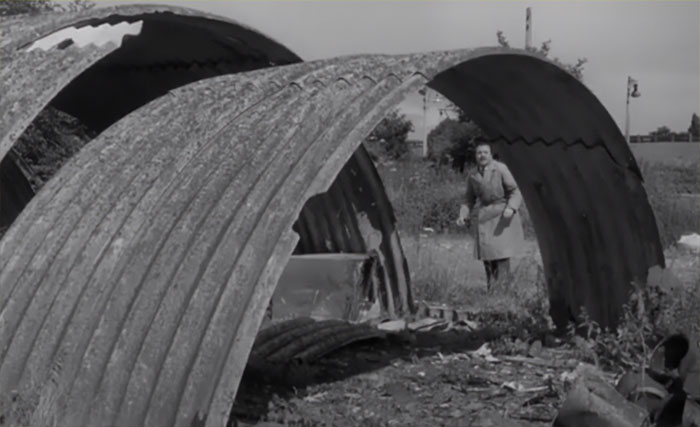
A man stares through the remains of Nissen huts surrounded by rubbish and weeds.
Richard Attenborough in Seance on a Wet Afternoon.

Wastelands on screen

In Seance on a Wet Afternoon (Bryan Forbes, 1964) wasteland is vital to the unhinged kidnap plot enacted by Billy and Myra (Richard Attenborough and Kim Stanley) as a promotional stunt for her work as a psychic.

Among tall grass, rusting Nissen huts and the remains of a half-demolished greyhound racing track, Billy prepares for the kidnap by dying his hair and hiding his motorbike.

Then, when he has the child in his custody, he returns to the same place to dump the stolen car and ditch his disguise.

The wasteland is a place between worlds, and between lives.

By passing through this wild space, he is able to leave civilization behind and transform himself from a timid suburban husband into a criminal capable of anything.

In The Small World of Sammy Lee (Ken Hughes, 1963) Anthony Newley plays a Soho nightclub compere who gets in debt with the wrong people.

His desperate attempts to raise money, against the clock, take him from one part of London to another.

Eventually, though, he runs out of road and winds up on a stretch of Thameside wasteland after dark.

There is nobody there to see or care as he is beaten half to death by his bookie’s enforcer.

In Bronco Bullfrog (Barney Platts-Mills, 1969) a young working class man called Del (Del Walker) tries to find somewhere to be alone with his girlfriend Irene (Anne Gooding).

They are frustrated at every turn, with interfering parents denying them privacy in both modernist flats and Victorian terraced houses.

Though it is far from ideal, like the protagonists of Paul Weller’s song, they resort to an inbetween space: a ruined building on wasteland in Stratford, East London. It is dirty, damp, overgrown and covered with graffiti, and this doesn’t work out either.

The Bashers is a remarkable documentary from 1963. Filmed by the BBC in Bristol it depicts the lives of youths in Barton Hill whose neighbourhood has great stretches of wasteland, awaiting the construction of new blocks of flats.

They don’t have much but they do have this remarkable resource and so entertain themselves by building giant bonfires, and battling gangs from rival neighbourhoods.

The authorities didn’t like this kind of thing, of course, and another place we see wasteland is in one of the most famous public information films. Lonely Water from 1973 shows children playing on the edge of a flooded quarry, among rusting cars and other fly-tipped rubbish.

Villains and tough cops

It’s in the gritty crime film that wasteland really comes into its own. Police corruption scandals and tabloid coverage of the Kray twins triggered a cycle of these in Britain from the late 1960s and through the 1970s.

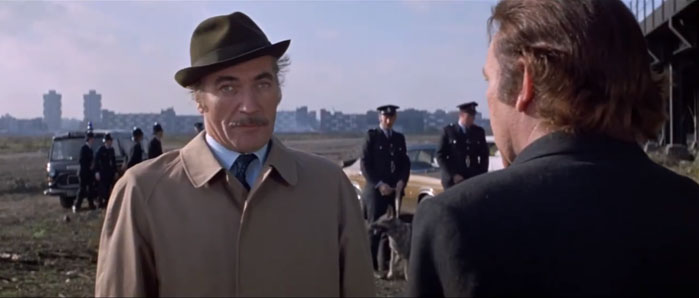
The final act of Villain (Michael Tuchner, 1971) sees Ronnie Kray-alike Vic Dakin (Richard Burton) on the run in the aftermath of a robbery.

He ends up on a vast area of wasteland at Nine Elms in Battersea, being chased through the ruins of a gas works and a British Rail goods depot.

Richard Burton confronts a Scotland Yard detective on wasteland with tower blocks in the distance.
Villain.

In Sitting Target (Douglas Hickox, 1972) the final scenes take place in a distinct type of wasteland location: a dusty, cluttered transport depot full of workmen’s sheds, parked buses and freight cars.

Here, Harry Lomart (Oliver Reed) is able to pursue his nemesis, using a red jeep to crash into their car time and again, spinning them around a space that already feels half like a graveyard.

Again, the idea seems to be that this is the end of the line. It’s where you end up when there’s nowhere else to go and where, if you’re lucky, you might just about be able to lose yourself.

This isn’t uniquely British. We see similar settings in American crime films from the same period, and in Italy especially. Italian films about tough cops, known as poliziotteschi, invariably include a car chase or shootout on wasteland on the outskirts of Rome, Milan, Turin, or some other città violenta.

When the villain and the tough cop made it to British TV, the wasteland went with them.

The very first shot of the very first regular episode of The Sweeney, broadcast in January 1975, is of a stretch of cracked concrete, where a van races towards a bright yellow Ford Capri. They’re tooling up for a blag, you see, and where else can you do that except on wasteland?

The same episode concludes with a brutal brawl on what looks like a bombsite. It’s like watching boys play cops and robbers and probably not the first time this particular bit of wasteland was used for that purpose.

Turning waste into money

In 1980, crime drama The Long Good Friday arguably signalled the end of the wasteland era. Harry Shand (Bob Hoskins) is an East End gangster looking to go straight by getting in early on the London docklands property development boom.

In the decades that followed, London would lose much of its wasteland as Canary Wharf rose from the rubble, and other cities have followed the same pattern.

That barren landscape beyond Tower Bridge would have one last starring role, though, with the remains of Beckton gas works doubling for Vietnam in Stanley Kubrick’s Full Metal Jacket.

Now they’re almost gone, some of us have started to feel nostalgic for those wastelands. They were dangerous, mysterious and wide open.

Those that remain, pending development, are invariably locked down tight, with heavy security and surveillance.

For our own protection, of course, so we don’t end up like the victim of a 1970s public information film, drowned or crushed.

And to make sure squatters can’t get in and make use of these otherwise barren spaces to park vans or caravans.

But where are we supposed to have our showdowns now?

Or hold hands amongst the punctured footballs and rusting bicycles?