Categories
books Film & TV

Favourite new-to-me books and films in 2025

Novels about juvenile delinquents, short films about consumerism, and a weird classic I got round to far too late are among my cultural highlights from the past year.

I like these little bits of end-of-year housekeeping – looking back, sorting and filing, debating with past Ray the stupid ratings he gave months ago.

I often find that a book or film I wasn’t sure I’d liked has stayed with me and become a reference point, or an inspiration. Liking isn’t everything, it turns out.

Still, those ratings are useful because they help me remember how I felt in the moment, and make it possible to pull out highlights for a post like this.

I’d like to read more. My annual target of 50 books is do-able, just about, but slightly stresses me out. I certainly couldn’t read much more without it turning reading into another task at which I feel I’m failing.

My approach is to write a little capsule review of each book after I’ve finished and mark any book that I had a strong positive feeling about with an asterisk. A ‘strong positive feeling’ might be that it left me feeling cleverer, or moved me, as well as that it was simply enjoyable.

As for films, I don’t have a target, but I do try to watch films rather than TV or (ugh) YouTube. Of course I do watch YouTube, because it’s irresistible, but often feel dirty afterwards. In the hour I spent watching some bloke build a castle out of lolly sticks I could have got through most of a 1940s horror movie.

Films I review and rate on Letterboxd. That gives me quite a granular sense of the real standouts, especially as I’m quite stingy with any rating of four stars or more.
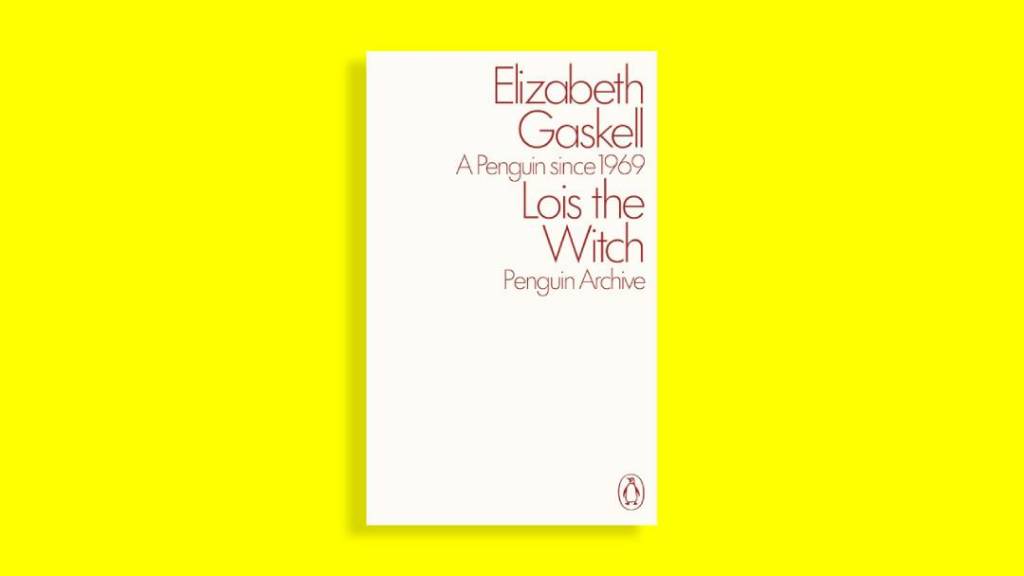
Lois the Witch by Elizabeth Gaskell.

The best new-to-me books of 2025

The Furnished Room by Laura Del-Rivo, published in 1961, is a stone cold classic and anyone who likes both crime fiction and angry young man novels ought to read it. My copy, tatty and yellowing, came from the 50p bin in a charity shop, and its state of near disintegration seemed quite fitting. It’s about a young man who might be a psychopath, who has paedophilic and Nazi fantasies, and who thinks he’s better than everyone else despite being, essentially, a bum. It reminded me of Absolute Beginners (it’s a great West London novel), The Talented Mr Ripley, and Saturday Night and Sunday Morning. Perhaps there’s even a little of Billy Liar there, if Billy was a killer.

Big Man by Ed McBain (Evan Hunter) from 1959 is in a similar vein, but set in New York City rather than London. I was astonished by its brilliance and vigour and think it might be the best thing McBain wrote in a long, prolific career. The protagonist is a street punk who drifts into a life in organised crime because the mob identify him as someone who can be groomed, and trained to be an emotionless killer. It has several genuinely shocking twists and an utterly bleak ending.

I wrote more about both of the books above in a blog post about juvenile psychopaths earlier in the year, which also includes notes on The Dead Beat by Robert Bloch.

1992’s A Fire Upon the Deep by Vernor Vinge is a big, high concept sci-fi novel which is bewildering at first but then, when you get used to it, has the pure thrills of a Lucasfilm adventure. My favourite characters were the Skroderiders, sentient plants who have symbiotic relationships with small carts on which they whizz around. There are also packs of intelligent dogs, each of which shares a consciousness and personality, and plenty of big spaceships.

I Have Some Questions For You by Rebecca Makkai, from 2023, is a murder mystery set in an American private school that plays with, and criticises, the tropes of true crime and podcasting. It’s also about the Me Too movement, male privilege, and institutional wagon circling – conscious or otherwise. I found it both entertaining (“I couldn’t put it down” &c.) and thought provoking, which is always a pleasing combination.

The Forever War by Joe Haldeman, 1974, is a rather brilliant study of intergalactic war, spanning centuries, from the point of view of a single soldier. It’s Band of Brothers in space. The constant references to the increasing homosexual population reads as homophobic but I buy the argument that this is supposed to depict the alienation of veterans from the societies for which they fight. (Hey, guess what? It’s about Vietnam.)

Jordan Tannahill’s The Listeners, 2021, is a short, punchy novel that at times reads like weird fiction, and at others like a modern melodrama. A woman hears a mysterious hum. Her family can’t hear it and think she’s losing it. Then she finds that one of her students can hear it, too, and they form a bond that destroys her career and marriage. Slowly, she drifts into what might be a cult, depending on your point of view.

Hangsaman by Shirley Jackson, 1951, is brilliant, compelling, and maddeningly oblique. I think the plot (if plot is the word) is that student Natalie is raped; disassociates; goes through a period of psychedelically intense psychosis; then emerges with new clarity, and new strength. But I spent most of the book feeling anxious and bewildered, in the best possible sense.

Time Shelter by Georgi Gospodinov, 2020, isn’t quite a novel. The plot unravels, the characters are cyphers. Part autobiography, part philosophical ramble, part political tract, it has interesting things to say about Bulgaria, nostalgia, conservatism, and the end of human history. The premise is the hook, though: in a world gone mad, a therapist creates domestic spaces where people can go back in time and ignore the present. But these comforting fantasies prove irresistible and, soon, begin to spread across wider society.

Fleischerei by Saoirse Ní Chiaragáin, 2025, was quite a challenge for me, Britain’s Most Uptight Man™, concerning as it does an intense cannibalistic affair between two outsiders in Berlin. It’s beautifully written, though, and there’s something thrilling about reading what feels like a forbidden text.

Lois the Witch by Elizabeth Gaskell, 1859, was a real highlight of the year, republished as part of the Penguin Archive series as a small, plain paperback. It’s about a young woman in 17th century England who is despatched to America and finds herself a victim of witch madness in Salem. It is tragic and atmospheric, with some brilliant depictions of haunted landscapes:

Sights, inexplicable and mysterious, were dimly seen – Satan, in some shape, seeking whom he might devour. And at the beginning of the long winter season, such whispered tales, such old temptations and hauntings, and devilish terrors, were supposed to be peculiarly rife. Salem was, as it were, snowed up, and left to prey upon itself. The long, dark evenings, the dimly-lighted rooms, the creaking passages, where heterogeneous articles were piled away out of reach of the keen-piercing frost, and where occasionally, in the dead of night, a sound was heard, as of some heavy falling body, when, next morning, everything appeared to be in its right place – so accustomed are we to measure noises by comparison with themselves, and not with the absolute stillness of the night-season – the white mist, coming nearer and nearer to the windows every evening in strange shapes, like phantoms, – all these, and many other circumstances, such as the distant fall of mighty trees in the mysterious forests girdling them round, the faint whoop and cry of some Indian seeking his camp, and unwittingly nearer to the white men’s settlement than either he or they would have liked could they have chosen, the hungry yells of the wild beasts approaching the cattle-pens, – these were the things which made that winter life in Salem, in the memorable time of 1691-2, seem strange, and haunted, and terrific…

I was so impressed by the first two books in Evelyn Waugh’s Sword of Honour trilogy that I’d been saving Unconditional Surrender, from 1961. It’s incredibly readable and often very funny, almost ‘Bertie Wooster goes to war’. At the same time, it has profound things to say about the coming of the modern world, and the banal inhumanity of modern conflict, which is all paperwork and silent death.

Uncertain Sons by Thomas Ha, 2025, is the book I’ve been naming when asked for recommendations. It’s a collection of thematically linked stories about the apocalypse, mutation, denial, and family relationships. They’re all at very least good, and some are truly great. My favourite story was ‘Where the Old Neighbors Go’ which is about urban gentrification, flavoured with fairy folklore and Ghibliesque talking animals.

1958’s Spotted Hemlock by Gladys Mitchell, my favourite of the golden age mystery writers, was a treat towards the end of the year. A girl goes missing from an agricultural college for women, which is twinned with a similar school for men several miles away across country. The characters, the gothic atmosphere, and the observational humour carry a slightly less than brilliant plot. The sheer raging horniness of the girls in particular is very funny.

I came across The Diving Pool by Yoko Ogawa in the new Vintage Classics ‘Weird Girls’ series. It was originally published in English in 2008 and comprises three long short stories, or short novellas. They’re all rather sick. A girl who tortures a child, while lusting after a fellow inmate at her orphanage. A woman who casually, unconsciously poisons her pregnant sister. And, in the the third and best story, ‘Dormitory’, a sinisterly empty student accommodation block with only one resident and a predatory caretaker.

Finally, BUtterfield 8 by John O’Hara, 1935, is a brilliant evocation of the speakeasy era in New York City. It tells the story of the tragic downfall of glamorous Gloria Wandrous, a wild child with many lovers, who has never not been preyed upon by men.

A scene from Picnic at Hanging Rock with three girls in Edwardian dresses.

The best new-to-me films of 2025

I’ve been strict here and limited myself to flagging films that I rated 4.5 stars or higher – plus a couple of entries that, on reflection, I should have rated more highly at the time.

Writer G.F. Newman’s Law & Order, broadcast in four feature-length parts in 1978, is an astonishing achievement. It explains how police corruption works in practice, and why it’s a problem, as we watch the ‘fitting up’ and imprisonment of a low-level criminal from multiple angles. Detective Fred Pyall is the bland, teddy-bearish villain of the piece, abusing his power and knowledge of the system to extract bribes and choose who does and not go to prison. Pyall is played by Derek Martin and his victim is played by Peter Dean, both better known for playing characters in Eastenders. Almost every other face is familiar from British TV soaps or comedies, or British films like Lock, Stock and Two Smoking Barrels. Alan Ford is here, for example, and Ken Campbell gives a surprisingly restrained performance as a corrupt solicitor.

Picnic at Hanging Rock, directed by Peter Weir and released in 1975, took a long time to get to the top of my watchlist. Somewhere along the line, I’d got the idea that it might be an endurance test, perhaps because people keep describing it as ‘dreamlike’ and ‘ambiguous’, which can often mean vague and tedious. But, no, it’s utterly brilliant. From the opening scene, I was mesmerised by the mix of beautiful, hazy visuals and hypnotic, exotic music. Years before The Blair Witch Project or Fargo pulled the same trick, it sells itself as being based on a true story, which is enough to blur the audience’s sense of what is real and what is not. As in reality, as in true stories of crime and disappearance, things don’t make sense in neat and tidy ways. This film is the essence of ‘weird fiction’: ambiguous; unsettling; not only about haunting but actually somehow haunted itself.

The Lonely Shore, Ken Russell, 1962, is an astonishing short film unearthed and shared on the excellent BBC Archive YouTube channel. It feels like one of the apocalyptic short stories written by Michael Moorcock or J.G. Ballard for New Worlds – surreal, weird, disturbing, and deadpan funny. It is packed with breathtaking images conjured up from the contents of a junk shop arranged on a desolate beach. The radiophonic ambient horror score is the icing on the cake.

The Children of Dynmouth, Peter Hammond, 1987, is a TV movie made for the BBC’s Screen One strand. It’s a strange, perverse take on Billy Liar, based on a novel by William Trevor. Timothy Gedge (Simon Fox) is a disturbed teenager with a voyeurism habit. He sticks his nose into the business of the respectable people of Dynmouth and casually blackmails many of them, either to get their help with his talent show act, or just for the sake of entertainment. Sometimes, his accusations are accurate; on other occasions, they’re pure self-dramatising fantasy – but no less dangerous for that. This was Fox’s only acting credit and his drama coach gets a special credit at the end. His non-professional performance only adds to the weirdness, as if an actual oddball has wandered onto the set and is bothering everyone. The character is supposed to have a poor understanding of boundaries, and to be intensely irritating, but I’m not sure the viewer is supposed to find him almost unwatchably annoying, too. I’m glad I persevered, though, because the final act of the film has overtones of Patricia Highsmith, the oblique school of weird fiction, and perhaps even Royston Vasey. This film startled and mesmerised me. It tapped into a bunch of my obsessions – small towns, West Country life, the darkness beneath the surface of suburbia. And, because it’s so obscure, it felt delightfully fresh.

Dinner in America, Adam Rehmeier, 2020, is a delightfully uplifting film from an alien world of Christian family dinners, bullying jocks, and raging punk arsonists. All the performances are excellent but it would be nothing without Emily Skeggs as Patty, a girl who is not secretly a genius, and doesn’t suddenly become a raging beauty when she removes her glasses and shakes out her hair. No, that only happens when a smile or a giggle breaks over her face as she feels real happiness for the first time, and it’s as if a searchlight has been flipped to full beam. The pivotal moment in the film, for me, is when she gets the opportunity to sing a song with Simon (Kyle Gallner), AKA her favourite punk musician John Q. As the intro plays out and she readies herself to sing there’s suspense in the moment. If she can’t sing, and her lyrics are bad, then she’s just the subject of yet another cruel joke. Spoiler: there’s a good reason her song causes a tear to roll down Simon’s bruised cheek.

The Family Way, Roy Boulting, 1966, has a reputation as a bit of a flop. I’m not sure why. For me, it’s the perfect midpoint between the angry young man Northern kitchen sink drama and the swinging sixties sex movie. It’s best known these days as an artefact of Beatles history: the soundtrack is (sort of) by Paul McCartney and hints at the bandstand brass to come on Sgt. Pepper, and some shots of terraced houses and gasworks look like Eleanor Rigby sounds. In itself, however, it’s a sweet little film about a young couple, played by the equally adorable Hayley Mills (Jenny) and Hywel Bennett (Arthur), learning how to be married under the prying noses of family and neighbours. The most surprising theme, however, is queerness. Ezra (John MIlls), Arthur’s gruff working class dad, begins to fear his son is gay. After all, he listens to classical music, reads books and, crucially, hasn’t yet consummated his marriage. When challenged by his wife, however, he becomes gentle: of course he wouldn’t shame his son for it, if it were true; of course he’d be there for him. But there’s more: she points out that Ezra brought his best and closest friend Billy on their honeymoon; that he and Billy were inseparable; that they started each day of the honeymoon with a walk on the beach together, leaving her in the hotel. He becomes dewy eyed when he talks about Billy and misses arm wrestling with him. And Arthur is, it turns out, probably Billy’s son – and reminds Ezra so much of his lost friend that it makes him weep. I mean, blimey.

Strange Days, Kathryn Bigelow, 1995, is a film I could have seen at the cinema when it came out, or on VHS, or on DVD. I finally got round to it 30 years after it came out, and more than a quarter of a century after it is set, on New Year’s Eve 1999. This vision of the then near future is all about organic virtual reality and not, as actually transpired, Netscape Navigator and the Nokia 3210. The details might be wrong but the point holds true: the retreat into nostalgia, the dependence on technology, and the place pornography always has at the cutting edge. It’s beautifully realised with hardly a clunky detail, and shot like a film from ten years later. The lack of obvious CGI must help in this regard. The scenes of violence towards women are hard to stomach, and are supposed to be – here, put this on, don’t look away, you need to watch to understand.

As for new films, I watched and enjoyed both The Brutalist and Nosferatu, but I’m not sure anyone needs more words on either of those right now.

I also want to mention an extremely bad film that is among the maddest things I saw this year. Cipayos, Jorge Coscia, 1989, is a dystopian film from Argentina which has Buenos Aires occupied by British troops – and the tango has been banned! But the underground resistance keeps the dance alive, in back alleys and speakeasies, as they get ready to see off the arrogant invaders once and for all. Key scenes involve British dignitaries at a garden party getting the shits and the Irish soldiers joining in a musical number in which they gaily sing ‘Brits out!’ before switching sides. I want to find more of this kind of thing in 2026.
Categories
books Film & TV ReadingThinkingDoing

Reading, thinking, doing December 2025

I’ve been reading about New York during prohibition, thinking about Stanley Kubrick, and writing in the Edwardian mode.

This blog is what I do instead of starting yet another Substack newsletter.

You can subscribe to this blog (enter an email address, get updates when I post) using the widget at the bottom of the screen.

Or, if you use an RSS reader like Feedly or Readwise Reader, you can add this blog there.

This particular post is the third in an ongoing series inspired by someone saying: “I don’t really want to read writing advice from authors… I just want to know what they are reading and thinking and doing.”

If you follow me on Bluesky, you already have a pretty good idea of what I’m reading, thinking and doing at all times. These are some edited highlights.

The cover illustration from a book showing a pretty young woman in a big fur coat on  a New York street.
Adrian Bailey’s cover illustration for the Penguin edition of BUtterfield 8.

Reading John O’Hara’s BUtterfield 8

The entire premise of this post is a fib, by the way, because what I’ve really been thinking is “Ugh, I’m so ill”, and what I’ve been doing is sleeping, coughing, and generally feeling run down.

But I couldn’t lead with that because other people’s illnesses are utterly tedious.

When the flu was at its height, I couldn’t even read. I spent two days mostly lying in bed with my eyes closed, only half listening to podcasts and audio dramas. In a low key way, this made me somewhat anxious, because I knew I had a yearly reading target to achieve.

That target is a very manageable 50 books. It’s just challenging enough to make me take a book from the shelf and read it rather than looking at my phone, but not so tough that it becomes a chore. As the end of November came around, I’d read 47 books, and needed to stay on track.

When the flu began to lift, I grabbed almost the first thing I saw with an interesting cover, and that was John O’Hara’s 1935 novel BUtterfield 8.

It’s a startlingly frank, sexy novel, with an undercurrent of sexual sickness. Gloria Wandrous is a flapper (although that term had gone out of fashion by the time the book is set, in around 1931) with many boyfriends, and dark memories of being abused by a family friend when she was eleven.

Her latest boyfriend, Weston Liggett, is a married man unhappy with his wife and overcome with lust for the 18-year-old Gloria. When he unwisely takes her to the family apartment after a day of drinking, she steals his wife’s mink coat, which careless act brings everything crashing down around them.

I didn’t realise until after I’d finished it that it was based loosely on a true story, that of a woman with the equally unlikely name Starr Faithfull, born Marian Wyman in 1906. The truth is even more grim and sad than O’Hara’s reinvention.

What O’Hara does brilliantly is to capture the whirl of conflicting feelings and emotions in the mind of a young person who has not been well cared for. She’s sexually uninhibited, she’s socially conservative; she wants a platonic friendship, she is offended that her one platonic friend doesn’t want to have sex with her; she feels dirty, she knows she is the most beautiful woman in New York City. The most important thing is never to stand still, or be alone, or think even for a moment.

For the beer blog I’ve been writing with my partner since 2007 I wrote a post highlighting O’Hara’s depiction of the New York speakeasy – an incidental but not unimportant aspect of the book.

Stanley Kubrick

One of my favourite podcasts, Pure Cinema, recently ran a pair of epic episodes considering the complete films of Stanley Kubrick.

It’s just a podcast, not a documentary or an academic text, but within those bounds it was a great primer on the films I haven’t seen, and a reminder of what’s interesting about those I have.

It made me think I need to prioritise seeing Lolita, which I’ve put off until now because, well, I’m basically a prude, and even the basic premise of the book/film made me feel uneasy.

It also made me want to watch Eyes Wide Shut again, having not seen it since it was released in cinemas in 1999. Back then, I was bewildered and bored by it. Now, with a bit more life behind me and more patience, I suspect I’d get more out of it.

I should say that Karina Longworth’s You Must Remember This seeded this idea. That’s less of a podcast and more like a documentary and in a series from a couple of years ago, Erotic Nineties, Longworth made a strong case for Eyes Wide Shut over the course of two long episodes.

As you might know, one of my particular obsessions is the way cities are recreated on studio backlots, like London in Los Angeles. One of the features accompanying the new Criterion Collection release of Eyes Wide Shut is a documentary about how Kubrick went about recreating New York in London, commissioning Lisa Leone, a friend of his daughter’s, to photograph the real New York in intense detail to inform the design of the set.

This feels like a fascinating creative project in its own right and there’s something fascinating about seeing photos of rubbish bins (sorry, trash cans) and shop fascias presented like evidence in a trial, or as if intended to communicate the concept of America to an alien from another world.

It’s also given me an idea for a project of my own. Watch this space.

Writing like an Edwardian

One of the principles behind my next collection of weird stories is to try to avoid nostalgia and retro pastiche. At the same time, I’ve written quite a bit of that over the years, and might put out a separate collection of only Victorian-Edwardian-style stories at some point.

As I have done for a few years in a row, now, I want to share a ghost story for Christmas on this blog. This time, I weakened, and decided to write something vaguely in the style of M.R. James or one of his contemporaries. It’s a long way from Municipal Gothic but what the hell, it’ll be free. The important thing, really, is that I enjoy writing it.

With that in mind, I’ve spent three evenings after work to get to a finished draft of about 2,800 words. What’s particularly enjoyable about writing in this mode is learning little historical details on the way. For example, you know those all-in-one underwear suits with a little flap on the bum? Those were known as ‘union suits’ in the US and as ‘combinations’, ‘woolly combinations’ or ‘woolly comms’ in the UK.

The story needs an edit and will be out in time for Christmas. Hopefully it’ll offer at least a little of the thrill of the real thing.

Broadcasts

I’m recording a podcast tonight, another episode of CinéClub with Joe Tindall, talking about the BBC ghost stories for Christmas and similar. That’ll be out before Christmas too, I hope.

A few weeks ago, with my professional hat on, I was the guest on another podcast talking about content design in healthcare. You can listen to that now.

Here on the blog, I wrote about AI art and how it stinks up anything it’s part of, even if it’s only used incidentally or for minor aspects of a larger work. It seemed to resonate with people.

Categories
books buildings weird fiction

Horror Hotels: you can check in but…

Hotels are fundamentally weird places and the sense of unease they prompt is powerful fuel for weird stories.

Even before we consider aspects of the uncanny, and the hotel in weird fiction, the very concept of the hotel is troubling. 

You’re telling me I’m going to a strange town to sleep in a strange room, in a strange house, where someone I don’t know has a master key to my room?

It’s no wonder I barely get a wink of sleep whenever I’m away from home.

I have stayed in some objectively odd hotels over the years. The converted U-Boat factory in Gdańsk, for example, which aimed for industrial minimalism but whose concrete walls throbbed with memories of Nazism.

In Lithuania, one hotel had a display of KGB bugging and recording equipment that had been removed from the walls during its renovation.

Back home in the UK, my mind turns to a genteel bed and breakfast in Gloucestershire that hadn’t been decorated in about forty years. There were faded paintings of Spitfires, Hurricanes and the Queen on every flat vertical surface. In the corner of my room was a small door which I opened to find a cupboard filled with box after box of children’s drawings and schoolbooks from, I’d guess, the nineteen-seventies.

In the Scottish Highlands, there was a would-be boutique hotel whose lobby came with a chaise longue strewn with sinister porcelain dolls, and whose owner had a way of making tourist tips sound like threats: “I’m only trying to help you…”

Chain hotels are no better. In one, my partner and I only discovered there was a connecting door to the next room when its occupant burst in looking for the bathroom. He was almost as terrified as us.

In another we were kept awake all night by local youths roaming the corridors banging on doors and smoking pungent weed.

Bad things do happen in hotel rooms, too – those private spaces for hire where, even if you can no longer sign in as ‘Mr and Mrs Smith’, you are at least free from surveillance or supervision.

For the Brutal Bristol zine I wrote about the history of a brutalist Premier Inn in Bristol, now demolished, which was used by a grooming gang. It was all too easy for people to believe in conspiracy theories around the Elm Guest House. Hoteliers spy on their guests. And sometimes, guests leave corpses behind.

The cover of a hardback book with a ghostly figure passing through a door.
The Hotel by Daisy Johnson

The hotel in weird fiction

I was prompted to think about the hotel in connection with weird fiction by reading Daisy Johnson’s The Hotel. It’s a collection of stories originally written for BBC Radio Four all of which are set in and around the same fenland hotel.

It feels to me as if Johnson was trying to exorcise every single anxiety she’s ever felt while visiting hotels, whether caused directly by the strangeness of the buildings themselves (what’s behind that door?) or the social situations that bring us to them. There’s a particularly effective pair of stories about a hen party in which an actual monster is less scary than the cruelty of old friends.

Critics have rightly noted a connection between Johnson’s creation and The Overlook Hotel from Stephen King’s The Shining, via Stanley Kubrick’s 1980 film adaptation of that novel.

The Overlook is a brilliant creation, and of the best haunted houses in fiction, alongside Shirley Jackson’s Hill House. Here’s my favourite line from the book:

It was empty and silent, the only sound that curious subaural echo that seems to linger in all large rooms, from the largest cathedral to the smallest home-town bingo parlour.

Hotels are bigger than our houses, and often as big as palaces. There might be hundreds of other guests, or none. We can easily find ourselves alone on seemingly endless corridors, lined with endless doors. King, and Kubrick, mine these in-between spaces for all they’re worth.

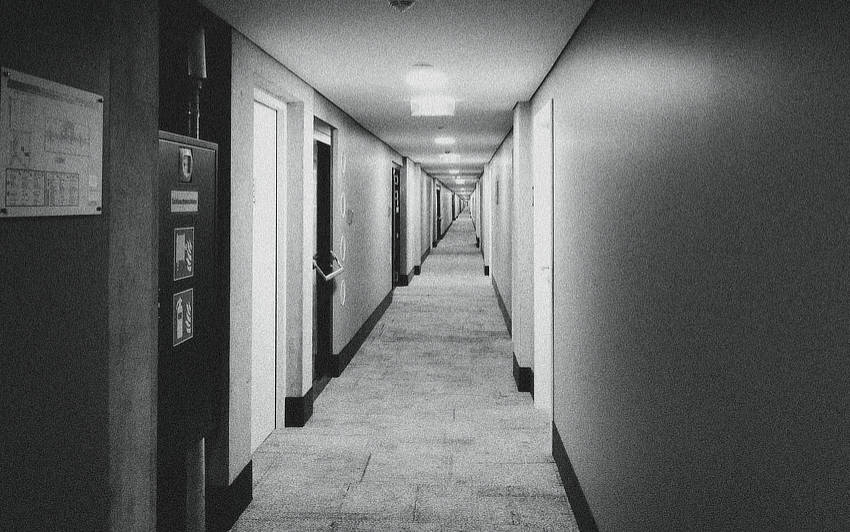
A handcrafted photo manipulation duplicating a hotel corridor into infinity.

Neither the Overlook nor Daisy Johnson’s hotel are especially old buildings but both have managed to accumulate many ghosts in their short lives. A private house might have, say, twenty occupants in a hundred years, whereas even a small hotel could have that many people pass through in a single weekend. Many lives are overlaid there.

In Joanna Hogg’s film 2022 film The Eternal Daughter Tilda Swinton plays a woman staying at a country hotel out of season, surrounded by dense fog. She is accompanied by her elderly mother, also played by Swinton. It’s an unsettling, confusing film, which plays with ideas of time and memory – and what are ghosts if they’re not memories? We might visit the same hotel every year, or years apart, and feel that we’re picking up where we left off, stepping into another life, or other timestream.

Another feature of The Overlook as presented in the film of The Shining is that, like Hill House, it does not make sense as a coherent space. There are many analyses of the layout of The Overlook online, some treating these problems as ‘goofs’ or continuity errors, others acknowledging that they might contribute to our unease.

This gives us a link to the traditional English ghost story which was often quite capable of high weirdness.

In his tale ‘Number 13’ M.R. James gives us a hotel room that shrinks and expands as an impossible room next door appears and disappears during the night:

He started to go down to breakfast. Rather late, but Number 13 was later: here were his boots still outside his door—a gentleman’s boots. So then Number 13 was a man, not a woman. Just then he caught sight of the number on the door. It was 14. He thought he must have passed Number 13 without noticing it. Three stupid mistakes in twelve hours were too much for a methodical, accurate-minded man, so he turned back to make sure. The next number to 14 was number 12, his own room. There was no Number 13 at all.

A welcome you’ll never forget

We’re supposed to feel welcome in hotels; the industry is called ‘hospitality’. But in horror or weird fiction, they can be either cold, or positively hostile.

The Bates Motel from Robert Bloch’s Psycho, filmed by Alfred Hitchcock in 1960, is a famous example of a hotel that lures in guests, then devours them. There are peep holes, so no privacy, and the doors do not keep predators out of the rooms. The chambers of the Bates Motel are very unsafe spaces.

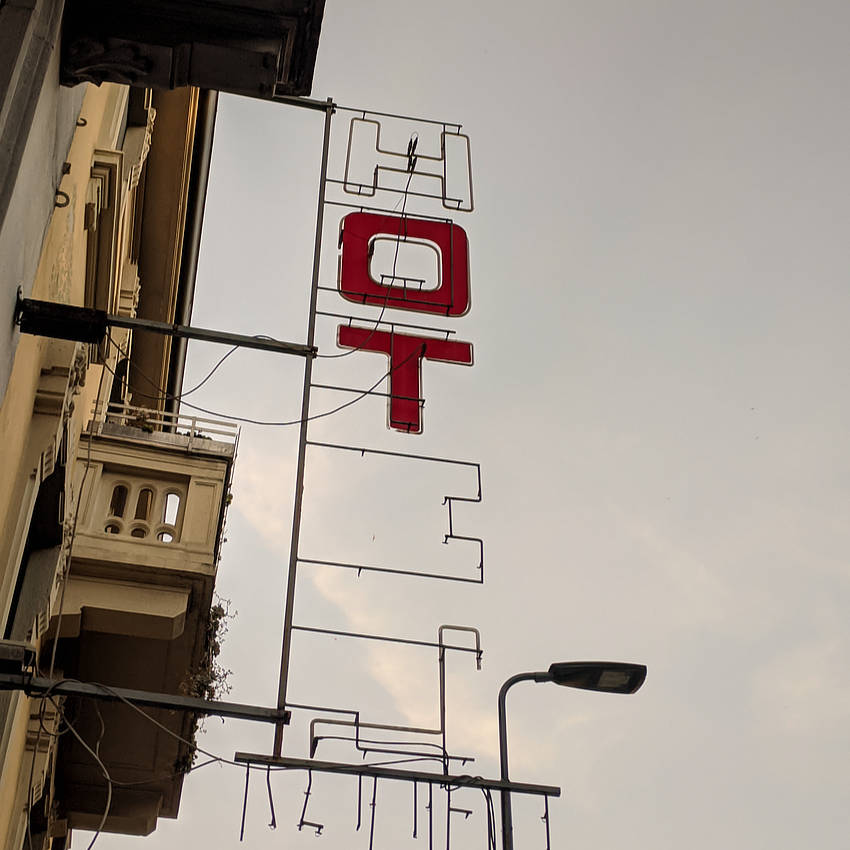
A broken neon sign that once read HOTEL but now has only two letters, O and T, remaining.

Robert Aickman’s 1975 story ‘The Hospice’ is about a travelling salesman who gets lost on country roads and checks into a country hotel. The events that occur during the course of his stay follow nightmare logic – and are, in fact, very much like some of my own recurring nightmares. He wants to leave, but can’t, with various obstacles placed in his way.

Are the guests there against their wills? Are some of them ghosts? Has there been a murder?

Aickman’s technique here, as usual, is to leave us asking questions, and to withhold answers.

His story also makes me wonder about the overlap between hotels and other bed-and-board institutions – hospitals, care homes, mental health care facilities, halfway houses, and prisons. 

In 2025, of course, they also perform the role of refugee asylum facilities. They weren’t designed for this, and their guests are not on holiday. But that doesn’t stop mobs assailing them from outside, turning the hotel into a trap.

Hotels in my stories

I could easily write a hundred stories about hotels. As set out above, I often find discomfiting – even the most benign examples.

Why do Premier Inns have those weird purple-tinted Lovecraftian landscape prints on their walls? Who left that handwritten love letter in the drawer? What do the Gideons know that I don’t?

In practice, I restrain myself, and it’s only ‘Alice Li is Snowed Under’ in my collection Municipal Gothic that really explores this setting. It was inspired by the many years I spent doing too much travelling for work.

As I was, Alice is an earnest twentysomething trying to make a career in the Civil Service and, like me, she is an introvert who welcomes the loneliness of hotels – up to a point.

When the hotel becomes snowed in, she is forced to stop working, and to be alone with her own thoughts, and with a visitation that makes her confront an unresolved question. The blank, bland offers nowhere to hide.

There is also, however, a strange old country hotel in my retro folk horror story ‘The Night of the Fox’ and a truly horrible one-star dosshouse in ‘The Horns in the Earth’. Both are in my other collection Intervals of Darkness.

There’s also another story I’m working on inspired by a stay at a chain hotel in central London the night before an early train. There, I was kept awake by the sound of drilling during the night, which the manager insisted was not happening.

When all you want is to sleep, a malevolent hotel that insists on preventing that from happening is pretty close to the ultimate horror.

A quote from Verity Holloway: "Impressively eerie and packed with shocks... moments of powerful poignancy and startling strangeness. You'll want to linger over these stories." Next to it is the cover of Intervals of Darkness with a black background and red details. The illustration is of a person casting a long shadow. Nearby is another shadow suggesting a lurking but hidden figure.
Categories
1959 books reading1959

Three pulp paperbacks about juvenile psychopaths

What happens when angry young men are more than angry? These three roughly contemporary books give us portraits of youths struggling with their own murderous instincts.

I came to The Furnished Room, Big Man and The Dead Beat one at a time after finding tatty old paperbacks in charity shops or roadside book swap boxes.

All three were written during a period of anxiety about juvenile delinquency and a simultaneous growth in popular discussion of psychopathy.

The term ‘psychopath’ was popularised in the 1940s and a slew of novels and movies from that point on portrayed a particularly chilling type of killer. Being outwardly in control, and even charming, they were able to walk and live among us.

Joseph Cotten’s Uncle Charlie in Alfred Hitchcock’s brilliant 1943 film Shadow of a Doubt is one example. Patricia Highsmith’s The Talented Mr Ripley introduced us to the chameleonic Tom Ripley in 1955.

At the same time, young people were beginning to seem dangerously out of control, with motorbikes, switchblades, and a lack of respect for authority.

That’s the context in which the following three pulp paperbacks emerged.

Little boys to broken men

Big Man is the earliest, published in 1959. Its author was prolific novelist Evan Hunter, born Salvatore Lombino, and best known for a series of police procedural novels written under the name Ed McBain. He wrote this book as Richard Marsten and it reflects something of that sense of fractured personae.

It’s written from the point of view of Frankie, a young man living in poverty with an alcoholic mother, and drawn into petty crime by sheer boredom. Petty crime leads to organised crime where, after resisting, he embraces his true murderous self.

The 87th Precinct novels are set in an anonymised fantasy of New York where Manhattan is Isola, Queens is Bethtown, the river is the Harb, and so on. Big Man is set in New York proper, where Hunter grew up and which he knew at street level. 

This authenticity shines through in his portrayal of the everyday lives of idle young men with no coin in their pockets and every reason to feel detached from the world. That Frankie’s best friend Jobbo has appalling body odour sets the tone: this is a world where sweat stinks.

These early chapters are similar in mood to The Incident, a 1967 film based on a 1963 TV play, about two young men who terrorise a New York City subway car. In both cases, the thesis is that the road to murder begins at robbery, and robbery comes as much from a need for something to do as from the urge to acquire.

For Frankie, the lure of organised crime isn’t so much money but also a sense of family, respect, and affection. The mob boss is a father figure – someone who tells Frankie he is a good boy and has value.

Even through Frankie’s unreliable narration we see, of course, that he is being preyed upon and manipulated. Through favours owed, debts incurred, steps taken from which there is no walking back, he is drawn away from society and becomes ever more tangled in a shadow world with its own values.

What really sets the book apart is Frankie’s relationship with his two lovers. Frankie is torn between two women – a sexually insatiable gangster’s moll who has been with the whole crew, and the nice neighbourhood girl who wants to start a family.

It is shocking when he shoots the former on the indirect order of his boss. It is absolutely devastating when he puts a bullet in the head of the second because she has become a hindrance to his career.

Hunter plays with our prejudices: promiscuous girls who get involved with criminals put themselves in the firing line, but nice girls who just want their boys to go straight? They deserve a happy ending.

By the end of the novel, Frankie has become a killing machine, like a soldier trained for combat. He follows orders and shoots when he’s told to shoot.

He is also cursed with the knowledge that if he can bring death to the others so swiftly and easily, then death can come to him the same way.

A suburban house in America.
SOURCE: Library of Congress.

The killer is in the house

Robert Bloch’s The Dead Beat was published in 1960 and tells the story of another blank, murderous young man.

Larry Fox is a dead beat jazz pianist who finds a way to break out of the world of crime, prostitution and drugs and into the nice suburban home of a nice suburban family.

His great skill is being able to present as a good boy when it suits him – or maybe these are actually glimpses of the real Larry, or another Larry, battling Bad Larry for supremacy?

As Good Larry, he’s bashful, well-spoken and polite. He’s musically talented and has hopes to study composition at university. This is catnip for the middle class saviours who take him in and nurse him when they find him unconscious in the back of their car. Especially the women.

But Bad Larry plans to get revenge on his former accomplices in a robbery and will fuck, rob, drug and manipulate anyone who gets in his way, or can help him achieve his goal.

Bloch doesn’t expect the reader to read between the lines. He has his characters debate matters of juvenile delinquency and ‘the beatnik problem’ which gives him an excuse to insert chunks of his thesis into the text:

It all began with World War One, I suppose. Up until then, the traditional role of the young man in this country was that of an apprentice. In rural communities he started as a hired hand or helped his father on the farm. In the cities he entered business as a clerk or a messenger or an office boy. Youth accepted a subordinate position unquestioningly, even when the industrial era developed… War is the great glorifier of youth… Our economic leaders, through the media of advertising, assure us that it is the duty of everyone to appear young; to buy products which enhance the illusion of immaturity. Our books, magazines, motion pictures and television programs inform us, not too subtly, that romance and adventure are the exclusive property of young people between the ages of seventeen and twenty-five. Nobody over that age ever falls in love or experiences anything of lasting significance, except for a few oddball characters thrown in for comedy relief.

Bloch was primarily a writer of horror stories and the scary idea in this story is that adults cannot tell good boys from bad ones. That nice young man your daughter is dating might be a hophead, a junkie, a pervert or a killer – better not let him in. Especially not if he reminds your wife of when she was young.

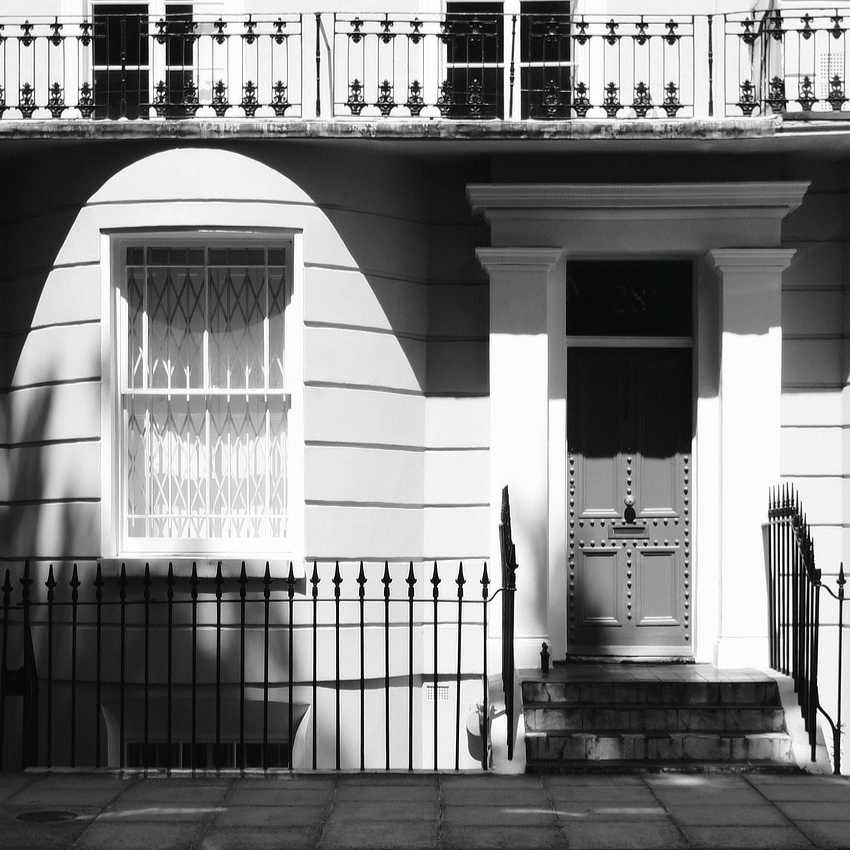
A Victorian terraced house in West London.

The kitchen sink killer

Crossing the Atlantic, Laura Del-Rivo’s The Furnished Room was published in 1961 and filmed as West 11 in 1963.

In many ways it sits alongside British social realist novels like Saturday Night and Sunday Morning or, closer in tone and setting, Absolute Beginners. The difference is that Del-Rivo introduces a gun into the mix turning it into something like a crime novel, or one of Georges Simenon’s romans durs.

Joe Beckett is another semi-intellectual, but a reader rather than a musician. Like Larry Fox, he is capable of making himself presentable, as long as nobody gets close enough to notice the grubbiness of his shirt or smell his unwashed socks. To some people he reads as clever, almost an intellectual, although his drug-fuelled lectures don’t stand up to the scrutiny of really intelligent people.

As with the protagonists of many other British novels of the period, he is too full of fury to be constrained by the drudgery of a nine to five job, or by love and marriage. Unlike Arthur Seaton, however, he decides that committing a murder might fix the emptiness inside him.

Haunting the cafes and bedsits of West London, Joe meets a classic British type: the faux-military conman with a range of regimental ties to suit whichever story he is telling on any given day. Keen to inherit from an aged aunt, he draws Joe into a scheme apparently inspired by Strangers on a Train.

That standard crime plot isn’t where the excitement lies in this story, though. That’s in Joe’s battle with his own worst instincts. He has constant intrusive psychopathic, paedophilic and fascistic fantasies. Reading about Nazi concentration camps thrills him:

Beckett’s immediate reaction had been a burst of sadistic joy. He knew that if, at that precise moment, he had seen a woman prisoner with her arms yearning for a lost child, he would have kicked her in the face. The shooting of the new detachment had pleased his sense of order. They were damn nuisances, screaming and panicking like that. Shooting them was the only orderly thing to do. He loathed the prisoners for their ugliness, their suffering, and their lack of pride. The photographs of these degraded sufferers, squatting behind their barbed wire, had revolted him so much that he had thought it a pity that the whole lot hadn’t been gassed. He had preferred the photographs of the Nazi guards, who had at least looked clean and self-respecting.

This book in particular feels like a commentary on present day alt-right, manosphere and incel cultures.

All three books force us to inhabit the minds of boys who don’t know how to love, even if they sometimes get close.

Those are the moments when we want them to break through the barriers, to untangle the complex feelings that threaten to break through their anger, resentment and hatred.

But they can’t do it. So they reach for guns and point them at innocent people.

Categories
books

Le Fanu’s Carmilla: how loneliness makes us vulnerable to vampires

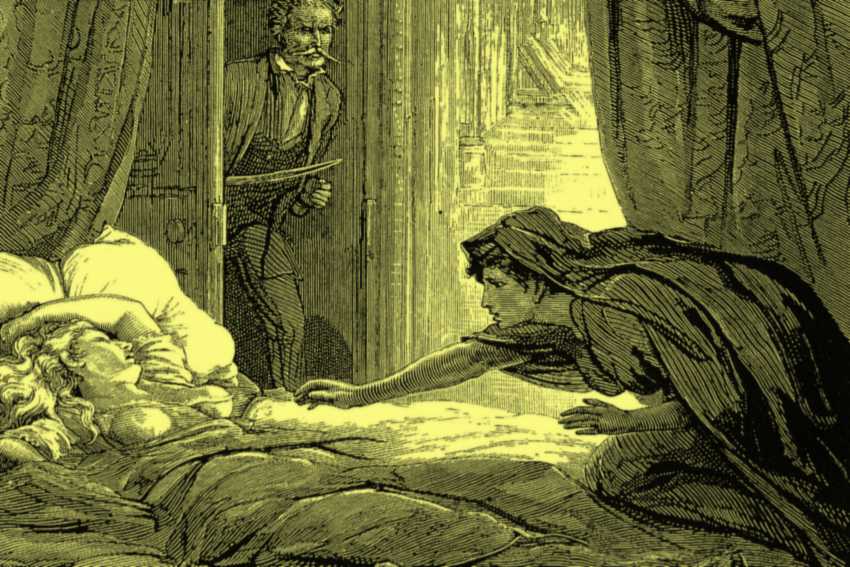
Sheridan Le Fanu’s Carmilla is a fascinating story. If nothing else it was published in 1872, long before Dracula, and was clearly a huge influence on Bram Stoker.

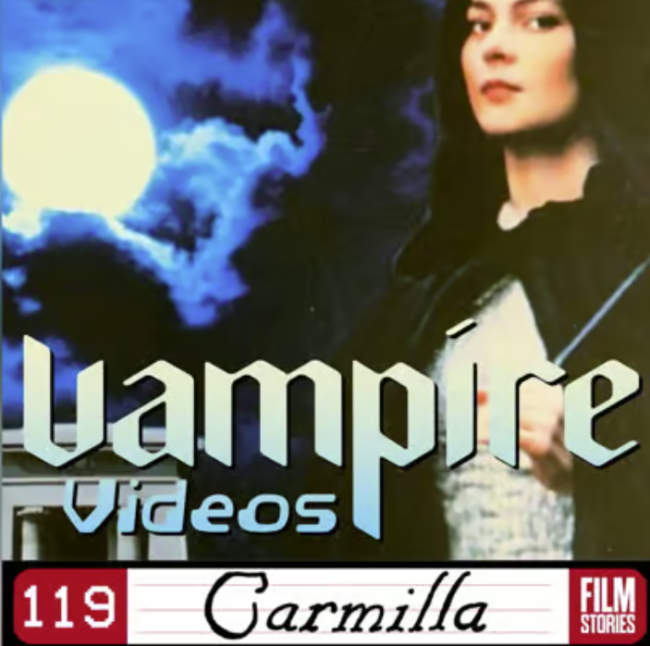
When the team at the Vampire Videos podcast invited me to join them as their guest on an episode my first challenge was to think of a vampire movie they hadn’t already covered.

Fortunately, I’ve developed a taste for the kinds of films you can only find in the depths of YouTube, which is where I found a 1989 episode of the US anthology series Nightmare Classics based on Carmilla.

It stars Jennifer Tilly as Carmilla and relocates the action from Styria in Eastern Europe to the American Deep South.

You can find out what I think of this adaptation by listening to the podcast.

The cover image for the podcast wit Jennifer Tilly as Carmilla.

Here, though, I wanted to say a few words about Le Fanu’s original story which I suspect many readers of vampire fiction have overlooked for various reasons.

I first read Carmilla as a teenager during the vampire craze of the early 1990s, when kids at my comprehensive school in Somerset – even those who wouldn’t normally be seen dead with a book – were carrying around film tie-in editions of Dracula and Interview With a Vampire.

I read both, and saw both films, and wanted more, so when I was given the chance to choose a book for a school prize, I selected The Penguin Book of Vampire Stories edited by Alan Ryan.

What a treasure trove that book was, and is. I still have the same copy, its pages yellowing, wrapped in ‘protective film’ that is slowly eating it, with a slip on the flyleaf which tells me I won the Phillips Award for Academic Achievement in 1994.

As well as John Polidori’s ‘The Vampyre’ and Stoker’s own ‘Dracula’s Guest’ it contains the complete text of Carmilla, a novella at 70 or so pages.

I sometimes describe myself as Britain’s Most Uptight Man and I was even worse as a teenager. Carmilla, at that time more than 120 years’ old, still had the power to thrill and shock (me, at least). I was astonished by how modern it seemed with an intense sexuality and, specifically, what seemed to me in 1994 to be a clear and unambiguous portrayal of a lesbian relationship:

In silence, slowly we walked down to the drawbridge, where the beautiful landscape opened before us.

“And so you were thinking of the night I came here?” she almost whispered.

“Are you glad I came?”

“Delighted, dear Carmilla,” I answered.

“And you asked for the picture you think like me, to hang in your room,” she murmured with a sigh, as she drew her arm closer about my waist, and let her pretty head sink upon my shoulder. “How romantic you are, Carmilla,” I said. “Whenever you tell me your story, it will be made up chiefly of some one great romance.”

She kissed me silently.

“I am sure, Carmilla, you have been in love; that there is, at this moment, an affair of the heart going on.”

“I have been in love with no one, and never shall,” she whispered, “unless it should be with you.”

I’d like to pretend I had a sensitive, sophisticated response to this at the age of 16 but what I probably thought was “I’m confused, help!” and/or “Cor, girls kissing!”

Carmilla, I later learned, was the source for all of Hammer’s “Cor! Girls with their tops off!” vampire movies of the 1970s, their use of the name ‘Karnstein’ being the most obvious giveaway.

The Vampire Lovers from 1972, with Ingrid Pitt as Carmilla, is a fairly close adaptation of Le Fanu’s novella with all the flaws and compromises you might expect for a film of the time.

I don’t want to spoil the podcast but it’s fair to say the 1989 adaptation, though less exploitative, also has its flaws.

It would be great to see an adaptation of this story as lavish and careful as Francis Ford Coppola’s Bram Stoker’s Dracula or Robert Eggers’s recent version of Nosferatu.

There are themes in Carmilla that still resonate in 2025, not least the negative power of loneliness.

Laura is utterly isolation in a castle in the middle of nowhere, surrounded by stuffy old men and servants.

It is her desperation for a friend, for any kind of companionship, that makes her so vulnerable to Carmilla’s serial predation. Or, to put it another way, that makes her so ready to be liberated. Which is it?

I see in this uncomfortable tension some interesting echoes of online exploitation and catfishing.

That such contemporary parallels can be drawn is perhaps a sign that Carmilla has depth and value beyond it’s part in the genesis of Dracula, and beyond its undoubted erotic charge.

You can listen to the podcast at vampirevideos.co.uk or wherever you usually get podcasts. The full text of Carmilla is available online at Project Gutenberg and in The Penguin Book of Vampire Stories which you can buy used for buttons.

Categories
books Intervals of Darkness municipal gothic

A rare chance to buy books direct from me

I’ve got a limited supply of paperback copies of both Municipal Gothic and Intervals of Darkness ready to ship to anyone in the UK who wants to buy one.

They’re £13 each including delivery in the UK, or you can get both for £25.

They’ve each got a selection of weird stories and ghost stories, with Intervals of Darkness being the more recent of the two collections.

“Impressively eerie and packed with shocks, Intervals of Darkness ushers the reader through 1970s grime and Gothic opulence, with moments of powerful poignancy and startling strangeness. You’ll want to linger over these stories.” – Verity Holloway

“Housing estates, factories, tower blocks and caravans, nowhere is safe from Ray Newman’s dark imagination. Existing somewhere between Robert Aickman and JG Ballard, these blackly funny tales are sure to chill you, no matter how high you turn the central heating. It’s every bit the equal of Municipal Gothic, and if anything it’s darker and stranger.” – John Grindrod

Contact me to sort out payment and delivery, and to let me know if you want the books signed or dedicated.

If we’re already connected, you probably know how to reach me, but otherwise…

If you’d rather buy from Amazon, that’s also fine. I get about the same cut and I don’t have to wrangle padded envelopes or schlep to the post box.

Categories
books Intervals of Darkness

Story-by-story: Second Homes

I lived in Penzance in Cornwall for six years, including several stormy, boarded-up off-seasons. This story is about how that felt – and about the distinctly haunted landscape.

I used to observe the coming and going of people throughout the year, and the rhythms of the tourist industry. Repainting and repointing in the run up to Easter. And the general air of exhaustion in early autumn.

I was especially struck by how silent Mousehole seemed in the gaps between holidays, when the second homes and rental properties were empty.

(See also: Bait, dir. Mark Jenkin, 2019.)

On Scilly, in Marazion, and in various other places, I’d pick up interesting details about how things worked – like the chip shop owners who shut for the winter and disappeared to Florida.

Another influence, though not directly referenced, was the Solomon Browne disaster of 1981. When the Penlee lifeboat went out in a storm to save crew and passengers aboard the MV Union Star. Sixteen people died including eight lifeboatmen from Mousehole.

This tragedy suffused the village and the area. The old lifeboat house was a permanent memorial on the coast path and The Ship Inn has a plaque and photographs of the lifeboat crew. Children and relatives of crew members still live in the area.

This sadness offers a strange contrast to the Instagram-friendly lifestyles of people from ‘up country’ who only come down when there’s a reasonable chance the sun will be out.

I can’t claim to have totally sussed Cornwall in six years. I doubt you could do that in four centuries. But I learned enough to tell this small story.

A note on ‘granfer’

A couple of stories in this collection use the West Country word ‘granfer’ – that is, grandfather.

I’ve heard it used naturally and without affectation in both Cornwall and Bristol, hundreds of miles apart.

I like it because it adds a bit of regional texture without doing the impenetrable Jarge Balsh thing.

In another story, however, I have ‘gramps’. One reason for that is that, as a kid in Somerset, I heard it used quite frequently – but never ‘granfer’.

The other quite weird reason for ‘gramps’ over ‘granfer’ I’ll reveal in a later post in this series.

A quote from Verity Holloway: "Impressively eerie and packed with shocks... moments of powerful poignancy and startling strangeness. You'll want to linger over these stories." Next to it is the cover of Intervals of Darkness with a black background and red details. The illustration is of a person casting a long shadow. Nearby is another shadow suggesting a lurking but hidden figure.

Intervals of Darkness will be published on 7 September. You can pre-order the eBook now.

Categories
books Intervals of Darkness

Story-by-story: British Chemicals

The third story in Intervals of Darkness draws on research I did for an article published in Fortean Times a few years ago about a haunted factory.

My dad worked at the factory in question and we often talked about what might have made it feel spooky.

Point: the land was ancient, with old ghosts.

Counterpoint: everyone was exhausted and off their tits on chemical fumes.

This story, which Rowan Lee has suggested recalls the work of Nigel Kneale, is an attempt to explore that line between rational explanation and genuine supernatural experiences.

I also had in mind Danny Robins’s radio and TV series Uncanny which, especially in more recent episodes, has included ‘cases’ which seem less than convincing.

I asked myself in what context an account of a haunting might seem truly beyond doubt.

Perhaps being shared in private, behind closed doors, by someone who definitely isn’t seeking attention – and who has a strong commercial incentive not to have seen a ghost – might be convincing.

Working on this story on and off for the past couple of years I quizzed Dad to harvest convincing details.

Those were added to the stories I’ve been hearing for years about life working at British Cellophane, and other factories.

I also drew on my own teenage experiences of factory work, including the time I accidentally got high on solvents while cleaning a protective suit and floated across the shop floor giggling, unable to feel my legs.

Hints of worldbuilding?

The story takes place in a post-war new town called Newhamstead. That name also crops up 

in another quite different story in Intervals of Darkness, ‘The Night of the Fox’.

I’ve always loved the way H.P. Lovecraft and his literary circle casually reused the names of places, characters, forbidden tomes, and monstrous entities.

That there’s no particular coherence in the way they are applied (despite later attempts by nerds to tidy things up) only adds to the sense of intrigue.

See also: those throwaway references in Star Wars to the Kessel Run and the Clone Wars.

So, I don’t know if the Newhamstead in these stories is the same place, exactly, or if this will one day add up to a ‘cycle’, but I couldn’t resist the deliberate internal reference.

A quote from Rowan Lee: "Newman returns to haunted Britain with fourteen more wonderful stories... Fans of folk horror and weird fiction find a lot to love..." Next to it is the cover of Intervals of Darkness with a black background an illustration, in red, of a person casting a long shadow as they emerge from a doorway. Another shadow is nearby, implying the presence of a second, unseen person.

Intervals of Darkness will be published on 7 September. You can pre-order the eBook now.

Categories
books Intervals of Darkness

Story-by-story: Men Who Live in Caravans

The second story in Intervals of Darkness is unusual in that it’s not overtly supernatural – but it could have been, with a couple of tweaks, and is certainly, I think, weird.

It’s also one of the most personal, close-to-the-bone things I’ve ever written. In the sense that I sort of hoped my family wouldn’t read it.

It’s about a man who lives in a caravan on farmland, scraping a living with shift work.

This could describe more than one of my own late relatives, and several people my parents have known over the years, and several people I’ve encountered in pubs up and down the West Country.

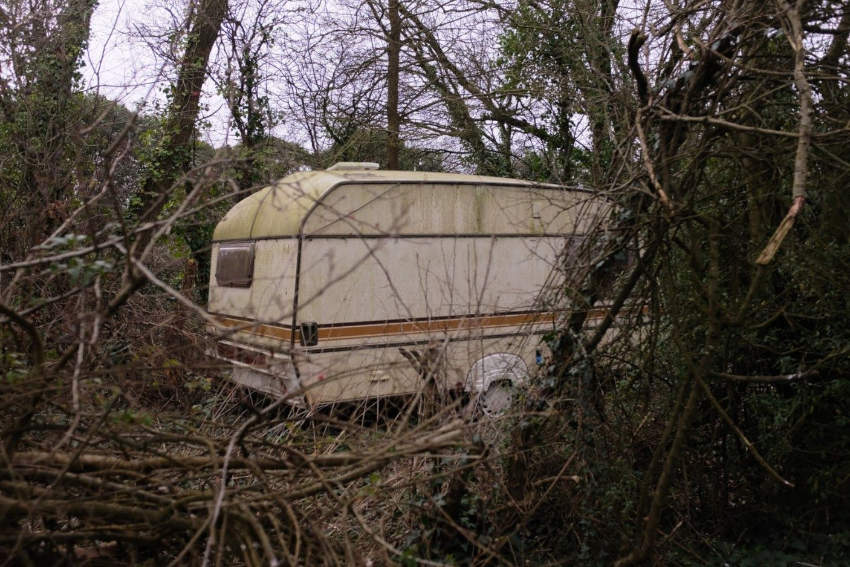
The specific trigger – the thing that put it on my to-write list – was a particular caravan in a particular field. It was overgrown, tangled among branches, and green with moss. And yet there were signs that someone was living in it.

(That’s it above.)

I stared at it for a long time, took a photograph or two. Then I thought about an uncle who died in a caravan in the corner of a field, and was discovered by my dad when he went round with his regular care package one weekend.

With a few wrong turns, that could have been Dad, too. Or me.

But, fretting about class, I tied myself in knots over this for a while.

Did I have the right to tell this story?

Was it inherently snobbish or sneering?

Eventually, I had a word with myself. Who else was going to write it if not me? And if I wrote it plainly, sincerely, honestly, I’d be using my small amount of privilege in a useful way.

Still, at first, I wanted to do what I usually do and hide behind the safety of a spooky story. An early draft ended, predictably, with more overtly supernatural events.

But, as with a story not in this collection, ‘The Architects’, I pulled back and let weirdness be a seasoning, rather than the sauce.

Writing it was an emotional experience. I had to stop several times, overcome with feeling, and even pushed to tears.

The feedback I’ve had since it was published at Minor Literatures suggests that people took the story as intended.

A drainage channel alongside a narrow country lane. There are reeds at its banks and algae on its surface. The landscape is flat.
The Mark Yeo at Rooksbridge in Somerset.

On ‘reens’

The word ‘reens’ crops up quite often in my stories. That’s because I grew up in Somerset which is sliced all across with reens, or rhynes.

They’re drainage ditches – a human intervention in the landscape.

One near my parents’ house, the Mark Yeo, was created in the 13th century.

I find them romantic and mysterious in a very specific, unromantic, un-mysterious way.

Sometimes, they look like shimmering, infinite mirrors running towards distant hills.

And at other times, they’re full of beer cans and algae.

A quote from John Grindrod: "Existing somewhere between Robert Aickman and J.G. Ballard, these blackly funny tales are sure to chill you, no matter how high you turn the central heating." Next to it is the cover of Intervals of Darkness with a black background and red details. The illustration is of a person casting a long shadow. Nearby is another shadow suggesting a lurking but hidden figure.

Intervals of Darkness will be published on 7 September. You can pre-order the eBook now.

Categories
books Intervals of Darkness

Story-by-story: Poor Ned’s Head

The story that opens Intervals of Darkness is an example of magically frictionless fiction.

I saw a call for submissions on the theme of ‘water’ and then, only a little while later, visited the wreck of the Mary Rose in Portsmouth.

Being me, I was drawn to the cabinets filled with skulls found aboard the wreck. What must it feel like to be killed in action, lie in the mud for several hundred years, and then be put on display?

The facial reconstructions added another layer of weirdness. In curatorial terms, this is good interpretation. It helps civilians like me understand the past more clearly, in human terms. But all those disclaimers, and the careful choice of language… Those reconstructions are just informed guesswork, really. And they always look a bit… wrong. Talk about the uncanny valley.

My other half says that she likes being with me when an idea for a story strikes me. She recalls it happening very obviously on this museum visit – “Must find notebook… Must write down… Haunted skull… Eye to eye with… Must find notebook…”

Then I did something at which I’m worryingly good: quickly absorbed a bunch of writing about ships, sailing, and archaeology, and synthesised it into some plausible bullshit. It wouldn’t fool anyone who knows a lot about those subjects (I suspect Steve Toase might fling the book into a fire) but it’s enough to sell the story to most readers, I think.

Having successfully begged for an extended submission deadline I hammered out a first draft of the story in a couple of hours. And not much changed in the rewrite.

Maybe that impassioned drafting gave it a boost. I don’t think it’s an exaggeration to say that Verity Holloway, editor of Cloister Fox magazine, snapped it up – and she’s told me again since what a great story she believes it to be.

This was also the story that signalled a slight change of direction from Municipal Gothic. Not every story I write has to be set in those working class environments where I feel most at home.

It’s also the first time I’ve written a story intended to evoke Nigel Kneale. I was thinking about his particular niche – that intersection of technology and the spirit world, as in The Stone Tape – and wondered if and how a computer-generated model might become possessed.

The first review, from Rowan Lee, mentioned Nigel Kneale, though not in connection with this story, so that thread obviously runs throughout the collection.

Blooper reel

  • In the original draft of the story I had my ship, Faerie, sailing from Falmouth to Portsmouth, but sinking in Mount’s Bay. Revising it for Intervals of Darkness I thought, hold on, that doesn’t make sense… So now, she was bound for Kinsale instead.
  • The first draft of the story had the eyes as being in the ‘stern’ of the skull but it got fixed in the edit. Look, I told you I was blagging this.
A quote from Verity Holloway: "Impressively eerie and packed with shocks... moments of powerful poignancy and startling strangeness. You'll want to linger over these stories." Next to it is the cover of Intervals of Darkness with a black background and red details. The illustration is of a person casting a long shadow. Nearby is another shadow suggesting a lurking but hidden figure.

Intervals of Darkness will be published on 7 September. You can pre-order the eBook now.