Confession: this is the first Muriel Spark I’ve ever read, and I don’t know anything about her except what I gleaned from the brief bio in the back of the book, and a vague sense that she’s Important.
Memento Mori tells the story of an interconnected group of Londoners, most in their seventies and eighties – novelists, poets, theatrical types, academics, and their resentful servants and children.
The twin engines of the plot are, first, a series of anonymous phone calls in which, one after another, the characters are told, “Remember you must die”; and, secondly, a dark tale of wills, infidelity and blackmail.
At times, there are echoes of Agatha Christie, but without the familiar structure, and of Patricia Highsmith and Shirley Jackson, both specialists in drawing suspense from fibs, foibles and fading sanity.
My favourite characters are Godfrey, a selfish octogenarian whose failure in life is masked by upper class entitlement, and Mrs Pettigrew, the sinister 73-year-old housekeeper who exploits him. Within hours of arriving to takeover the running of the home Godfrey shares with his senile wife, Charmian, Mrs Pettigrew is showing her stocking-tops to Godfrey in exchange for pound notes. Soon after, creeping around the house making copies of keys, she has ferreted out his every secret and is pressuring him to change his will in her favour.
As someone who spent 30+ years immersed in crime fiction and thrillers, I’ll admit to feeling a prickle of irritation that the loose-end of the phone calls isn’t wrapped up. But once I’d accepted the most likely answer – the voice on the line, which sounds different to each recipient, might be the Grim Reaper himself – I started to file this alongside Robert Aickman, and felt happier.
Does it say much about 1959? I don’t think so. Class structures aside, the reflections on growing old and the weird mutations of very long relationships, seem utterly timeless.
But, still, it’s a funny, emotionally truthful, acidic little book that I’m delighted to have been pushed towards by this project of mine.
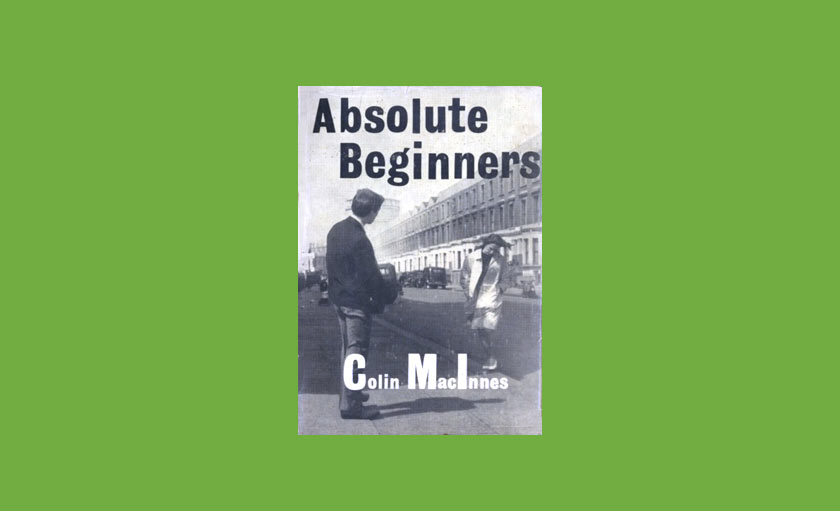
Colin MacInnes’s Absolute Beginners is an invigorating virtual reality experience – a hot London summer spent swimming in the primordial soup of a teenager’s head.
The nameless 18-year-old protagonist didn’t fight in the war, though he is a ‘Blitz baby’, and doesn’t care for the ‘sad, gloomy and un-contemporary’.
He successfully presents himself as cynical for the first half of the book, professing to care about nothing, not even the ever-present threat of atomic war. He seems to despise his pathetic cuckold of a father, his promiscuous mother, and his hopeless half brother. At one point, just when the reader might be warming to him, he exploits a girl’s heroin problem for his own ends.
But a steady tap, tap, tap of optimism and enthusiasm begins to shine through: he loves his on-off girlfriend, Crepe Suzette, wholeheartedly.
He loves jazz, too. Really loves it, not for show, but in his bones: it ‘sends him’.
He takes pornographic photos to pay the rent but all the time he is slowly turning into a real photographer – into an unashamed artist.
When he is really tested, when he is asked to prove his humanity as race riots turn West London into a warzone, he cannot pretend to be other than an idealist. He sides with the underdogs, against the racists, and risks his neck to do the right thing in a pocket civil war.
Ultimately he can’t even conceal the love he feels for his parents. “Don’t be a c–t,” says his his mother at one point, but we, and he, know what she really means.
Almost everyone in this book behaves surprisingly, from the proto-hippy pimp who turns out to be a bright-eyed fascist, to the retired Admiral who refuses to be homophobic for the TV cameras. These characters are hard to grasp and all the more real for it.
But Absolute Beginners was written in the late 1950s, and so perhaps Crepe Suzette is lacking a dimension or two – a manic pixie dream girl with the sex dial turned up. On the whole, the female characters aren’t as convincing or as interesting as the male characters, even Big Jill the lesbian pimp.
After a stretch where it seems black characters might be treated merely as a background mass, individuals emerge, though still primarily as non-player-characters for the white protagonist to react against or move towards. Some of his best friends are black, and all that.
(But, come on, let’s be fair: compare this with the grimmer, greyer angry young man novels where there are hardly any non-white characters, and in which women are generally either fantasy figures or ambition-crushing marriage traps.)
Quibbles aside, spat out of the far end of Absolute Beginners, my heart was beating fast. I could still see the colours, hear the beat, and the roar of the Vespa. I felt 20 again. I wanted to go out on to the streets and do something to make things better. (And, very badly, to see my Dad for a pint.)
This felt like a good week to be reading a drama about the underlying loneliness and emotional frailty of a Westminster big shot, written by a serving MP.
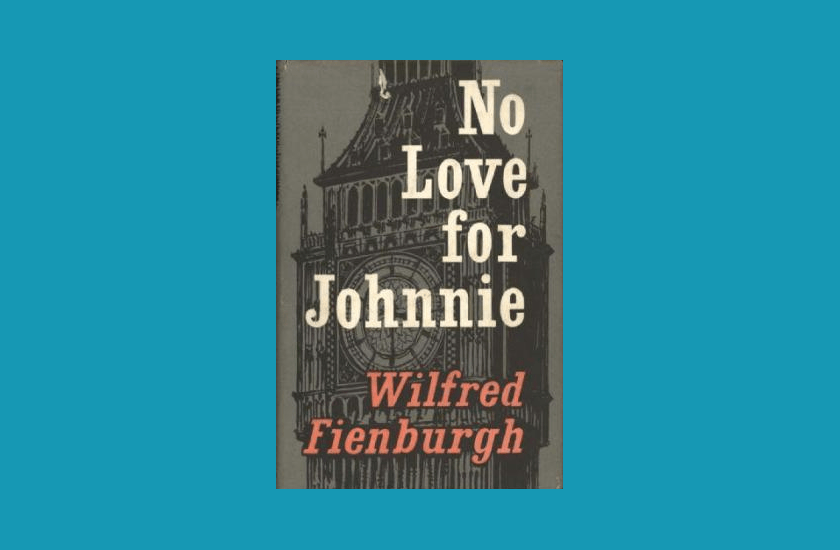
No Love for Johnnie is really a 1958 novel but its publication was delayed due the death of the author, Wilfred Fienburgh, in a car crash at Mill Hill in north London in February that year.
Is the depiction of the handsome, sexually inexperienced, unhappy, arrogant, insecure, vain Johnnie Byrne MP actually Fienburgh laying himself bare?
Byrne was brought up in the fictional Yorkshire town of Bradley, Fienburgh in Bradford. Byrne served in World War II, reaching the rank of captain from the ranks, while Fienburgh was demobbed as a major. Byrne became an MP in 1950, Fienburgh in 1951.
Perhaps we can conclude that Fienburgh was getting something off his chest in depicting the collapse of Johnnie Byrne’s left wing idealism, and the mid-life crisis brought on by his passionless marriage. Or maybe he was just wargaming the worst-case scenario — picturing at 37 where he might be in five years time.
As someone who didn’t grow up embroiled in Labour party politics, this was a fascinating crash course for me: the battle between the left and right of the party, the philosophical debates over whether it is acceptable to compromise on left wing values for the sake of gaining and retaining power, and the need to switch between modes in Westminster on Wednesday and the constituency clinic on Friday morning.
One glimpse into the moment when this book was written is that Byrne owes his career in large part to his good looks and a strong performance on television in the run up to the general election. This really was something Labour was focused on at the end of the 1950s, even sending selected MPs on training courses to learn how to work the camera. (I’m delighted to find that the newspapers and books from 1959 I’m reading echo each other so clearly.)
Byrne lives on edge, constantly judging whether to flatten his vowels and speak plainly, or slip into an affected officers’ mess drawl, or use the neutral high register he has cultivated for conspiring with fellow MPs. Ignore the political plot and this is yet another story about a man cast adrift by social mobility, confused about his place in the world, able to fit in anywhere but really belonging nowhere. (See also Hoggart’s Uses of Literacy, 1957.)
Two novels into #Reading1959 certain themes are beginning to emerge. First, everyone is miserable because they can’t have sex until they’re married, so they end up marrying the first person they even slightly fancy, blind to their incompatibilities. In the case of Johnnie Byrne, it’s a Bradley lass, Alice, who is busy with her own political career as a leading light in the Communist Party of Great Britain. Not only is she emotionally cold but, Johnnie later discovers, her politics are the cause of the stalling of his career — the Prime Minister can’t give him a Cabinet role while she is in the picture, with her connections to Moscow.
Secondly, there’s the war, of course. Naive young men forced to grow up observing atrocities, reeducated in the brothels of Belgium, and turned into gentlemen by accident as pips appear on their tunics. For Byrne, the war isn’t about trauma, it’s about guilt. He wasn’t an effective leader of men, he was a coward, and he knows it, even if the world believes otherwise. A flashback to the taking of a French farmhouse sometime after D-Day reads like a Commando comic (“Bren gun…. Pass a Bren.”) until the moment when Byrne’s entire platoon is cut down by machine gun fire while he hides, vomiting, in a hayloft.
There are stretches where this book reads like pure pulp — titillation, cheap drama, obvious words and stock phrases dumped on the page — but where it works is in the honesty with which it depicts the unravelling of the male brain. When Byrne fails to get a Cabinet job, his wife leaves him, and he immediately becomes obsessed with getting a young girlfriend to make up for the lost years. His fling with Pauline, a self-assured 20-year-old he meets at a party, is passionate but brief, and then becomes merely sad: he stalks her to her family’s home in Yorkshire after she tries to get away from him, where he ends up dressed in one of her Dad’s too-small spare suits, while she refuses to play the part in his fantasy he demands.
At the end of the book, he still has nobody to love, and nobody to love him back, but he knows who he is: a grasping, arrogant, ambitious coward who would rather accept the job of Deputy Postmaster General, and the rather remote prospect of a Cabinet job when he’s proved his worth, than change.
I’m planning to spend 2019 reading only novels from 1959, with some extra homework on the side.
Why? Because in 2017, I set myself a similar reading challenge – only books by women – and it helped me focus. I read more, and more widely, and more books that were new to me. I discovered some new favourite writers (such as Edna O’Brien) and the habit stuck: I continued to read more books by women in 2018, and feel better for it.
But in 2018, with no specific challenge, I read less overall, and caught myself lazily returning to old favourites out of which I have already chewed all the flavour.
So, for this year, I needed a challenge, and focusing on a specific time period seemed like a good idea. The mid-20th century happens to be where my head is at a lot of the time anyway. It also happens to be when the Big Novel I’m working on is mostly set, so this also doubles as research.
I landed on 1959 specifically by asking my handful of discerning Twitter followers to choose between 80 years ago, 70, 60, and 50. (It was close – 1969 nearly won.)
As of this morning, I’ve started reading Free Fall by William Golding, which I found on Wikipedia’s list of British novels published in 1959, and then happened to stumble across in a secondhand bookshop in Osterley on Sunday. “Perhaps you found this book on a stall fifty years hence which is another now”, he writes eight pages in, bending my mind somewhat, despite being ten years out. It’s not quite my usual thing – very self-consciously literary, prose verging on Joycean – but it seems to have hooks in me already.
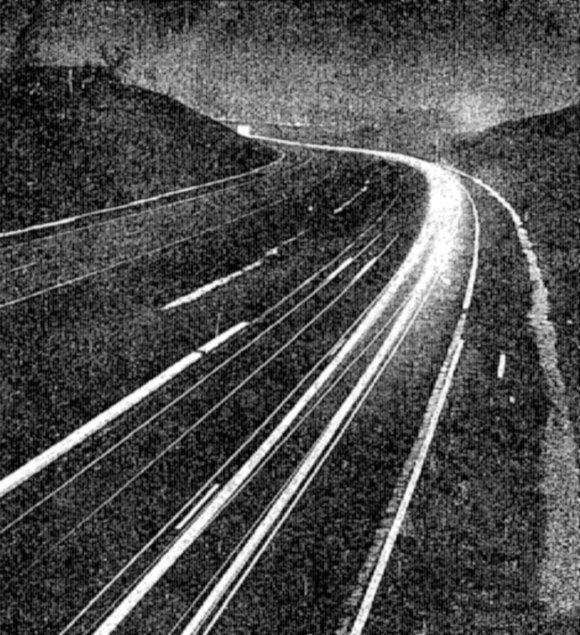
From the front page of the Manchester Guardian for 1 January 1959: ‘The lights of south-bound vehicles on the Preston Motorway’.
On the side, though, I’m also going to try to do something I’ve been thinking about for years: reading a daily newspaper for each day of 1959.
This has never been easier than today with local libraries offering access to The Times and the Guardian, and the incredible British Newspaper Archive providing scans of all kinds of local and national titles.
On 1 January 1959 the Manchester Guardian was declaring A PROSPEROUS NEW YEAR with “Industrial shares index at highest level ever”. It reported that actor Alec Guinness had been awarded a knighthood, and that the West had rejected Nikita Khruschev’s suggestion that Berlin be made a “free city”. Meanwhile, in Cyprus, EOKA issued a defiant new year message for the British government: “We will emerge from our present peaceful attitude as FULLY armed avengers to return the blows.”
Given my interest in post-war architecture, I was also interested to read this:
To-day, for the first time, hymns and prayers have sounded in Coventry’s new cathedral. They came not from the choice and chapter but from the unaccustomed voices of the masons and labourers, tilers and glaziers and plumbers, whose hands are raising the walls of what to-oday we heard called “This great fortress of God in Coventry.”
Unfortunately, an opinion piece on racial tension, and a surge in white nationalist tendencies, suggests that there’s little shelter from the problems of 2019 to be found in desk-bound time travel.
I’ll also be making a point of listening to music from 1959, and watching films and TV from the same year, without being exclusive about it. I’m looking forward to rewatching Room at the Top for starters, which I last saw as a teenager in Steven Bennison’s media studies class at Bridgwater College.
If anyone feels like joining in, or borrowing this idea but wallowing in a different year, go for it – I always enjoy company on these expeditions.
These days, I have reached a fragile accord with sleep, but for a long time it, or rather its absence, dominated my life.
In my twenties I struggled with sleep. I never had any trouble getting off but staying under seemed impossible, and I had often given up by 4:30 or 5 am and was up and dressed, just me and the mice.
Then I realised: I’d become one of those tiresomely tired people who responds to the polite question “How are you?” with “Ugh, exhausted.” This could not go on; steps had to be taken.
I started taking naps in the office canteen at lunchtime, until my boss made it clear he didn’t approve.
I tried giving up caffeine (no difference), I tried exercise (good in other ways, but didn’t help my sleep).
I drank more (really didn’t help), less (a great improvement, but only for one night) and different: whisky gave me mad dreams and indigestion, cocoa did nothing, fruit tea did nothing, steamed milk did nothing…
Nytol worked brilliantly – absolutely knocked me out, so that I woke feeling completely renewed – but, again, only for one night.
Hot baths, soothing music, fancy lamps and alarms, writing a pre-sleep diary, eating lighter meals, ditching carbs, sleeping on the floor, nice pyjamas, new pillows, a new bed, everything, anything. No joy.
Eventually I accepted the facts of the matter: it was my brain.
That led me to the doctor, which led me to counselling at a terraced house in Chingford where I travelled after work on a bus every Friday for two months.
My only mission was to sort out my sleep. Other than insomnia, I thought, my life was pretty good, and I was sure I was fundamentally happy.
Talking out loud, though, I realised there was some weird stuff going on:
“I usually wake up first at about 1 am. I feel very alert and sit up to check the back garden.”
“What do you mean, check the back garden?”
“Just, you know, stare out into the dark until my eyes adjust, to make sure there’s nobody out there.”
“Like who?”
“Burglars.”
“Interesting. Have you been burgled?”
“Well, not recently, but…”
This took me back to the council estate and the people who used to raid our shed every other night, who stole our bikes, and rattled the back door from time to time. That’s when, between the ages of about 10 and 17, I got into the habit of staying up late watching the garden; of waking up throughout the night to look outside, hoping to catch them; and getting up early to see what damage they’d done.
Remembering that took me to university where staying up late was normal, and getting up early felt like an evolutionary advantage. I’d usually read a book or two by breakfast, and spent an hour or two in the library before most of my peers had stirred in search of lunch. So not sleeping became an embedded habit, and I powered through it on adolescent adrenaline.
But reflecting on university also took me into what turned out to be a foul well of pent up resentment, sadness and minor humiliations, the weight of which had slowly built up on my shoulders so that I hadn’t noticed myself being pushed down.
It all became clear: I wasn’t exhausted because I wasn’t sleeping – I was exhausted because I was burned out by going from estate to school to work to university to work to work to work… No gap year, barely a pause for breath, and no second chance if I failed.
Counselling, I’m pleased to say, dealt with all that – I’m lucky enough to have been easy to fix with a bit of talking, which I know isn’t how it goes for everyone – and by the final session I felt a million times better, but…
I still couldn’t sleep. The counsellor, I sense, was a bit exasperated by this.
“Would people know you’ve slept badly and feel tired if you didn’t tell them?” he asked eventually. “Does your work suffer? Are you less effective? Does it stop you socialising?”
“Well, no, I don’t think so.”
“So don’t tell people. It can be your secret. Why not just let yourself be.”
With that finger-snap, everything seemed to change. I stopped talking about sleep (or at least, stopped constantly talking about sleep) and learned to accept it.
And you know the punchline: because I stopped worrying about it, I did begin to sleep a little better. Not well – I still don’t sleep well – but a touch deeper, a few minutes longer throughout the night. Waking up in the dark no longer felt like a personal failure, just a fact of life. I almost learned to like it.
At some point, I’m not quite sure when, I even stopped checking the garden for burglars.
The days after especially restless nights can still feel difficult but I’ve grown philosophical: like the man said, nobody knows, and bad sleep last night increases the chances of good sleep tonight, or tomorrow, or maybe the night after, but soon.
In the meantime, think of all those extra hours for reading, writing, for just being.
Endings are good, so let’s have one: a year since I left Cornwall for Bristol, and half a year since this project began, it feels done.
What have I learned? That there’s a lot more to learn, for starters.
One of the aims of this project was to jolt me from a rut, to make me look at towns and villages that didn’t previously have a place in my consciousness, and in that respect, it worked. I’ve read books, looked at maps, and even (money and time permitting) got on buses and trains.
Work in progress: a map of the fictional West Country, from Boskenna to Sandford. pic.twitter.com/zNPE1tBuXC
The fun, silly stuff — the trivia — turned up in surprising places, and hardly ever when I was actually looking for it. I have no doubt there’s plenty more to stumble upon, and I hope to keep stumbling. Only the other night I learned that Paul the psychic World Cup octopus was hatched in Weymouth.
I have also reached some conclusions about the West Country. Despite having lived there for six years, and knowing that it was distinct and different, I never really doubted that Cornwall was part of the West Country. Having got to know Gloucestershire a little, at the other end of the scale, it seems absurd to consider those two places part of a single entity.
The Ghost Exhibition at Frampton Feast, Gloucestershire, 1887.
At the same time, lots of the photos I Tweeted — of folk traditions, or tower blocks, or mysterious moorlands — look, I have to admit, as if they could be anywhere in the country.
The West Country is more real to me than ever, but perhaps the idea of the West Country has slipped away.
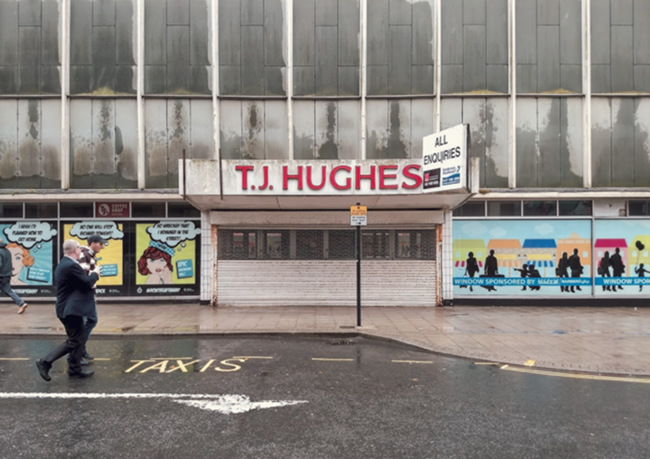
Take the wrong path through Torquay, in the wrong weather, and it can seem a decaying place.
Despite the very point of the English Riviera being the gentleness of the climate the buildings look weather-beaten. Their paint peels and they are streaked by gulls and pigeons. “You have to keep on top of it,” one local stopped to tell me as I stared up at one particularly forlorn building. “Lick of paint, keep it in good repair, or round here nature sort of comes and starts to take it back.”
Hotels and bed-and-breakfast establishments with grand names have ageing Perspex signs that are missing letters, or sagging under the weight of crowns of nails intended to keep incontinent birds away. It’s as if they’re one good season away from the full refurbishment they need, but always one full refurbishment away from that good season.
There are too many junctions that make no allowance for pedestrians, or rather treat them as a nuisance to be managed, prodded out of the way of traffic by fences and obstacles. Boy racers fly through town using the gravitational pull of roundabouts to boost acceleration, although sometimes what looks at first glance like a Hot Hatch is actually just a Hatch being driven by a hunched pensioner hammering the pedal for fear that the car won’t make it up a steep hill.
An entire row of shops in what ought to be a prime location is derelict, near collapse, while a huge post-modernist mall with galleries and walkways dominates the centre. The old market hall, built in the 1850s and with a plaque from the local historical society, has been gutted and partitioned so that the interior, like a reverse Tardis, barely has the grandeur of a Portakabin.
A leisure centre lurks beyond the promenade – a last dry breath of brutalism from the 1980s, the grey Atlantic Wall intimidation exercise of its exterior undercut by a curl of fibreglass waterslide that pops out and back in again like some parasite. At ground level it is all warning signs, cameras and black grilles, some of which blast sickly-warm chlorinated air across the weed-covered car park.
The landmark Pavilion Theatre on the seafront is a beautiful Edwardian building that, scaled up, would look at home in Monte Carlo, except it is derelict and boarded up – too precious to demolish, but too much trouble to use, and so being left to rust and rot.
And yet come at Torquay from another angle, in the sun, in a better mood, and the Riviera fantasy of GWR posters and The Persuaders lives on. The marina is full of yachts, some of them sleek and substantial, and the streets nearby accordingly full of yacht people – tanned, posh and loud. Motorboats motor across the bay as middle-aged couples in designer clothes (men sockless, women perfumed) stroll arm-in-arm, summoning the spirit of Nice.
Even the bland modern blocks on the hillsides add their own glamour, evoking the aggressive development of the coastlines of the Mediterranean.
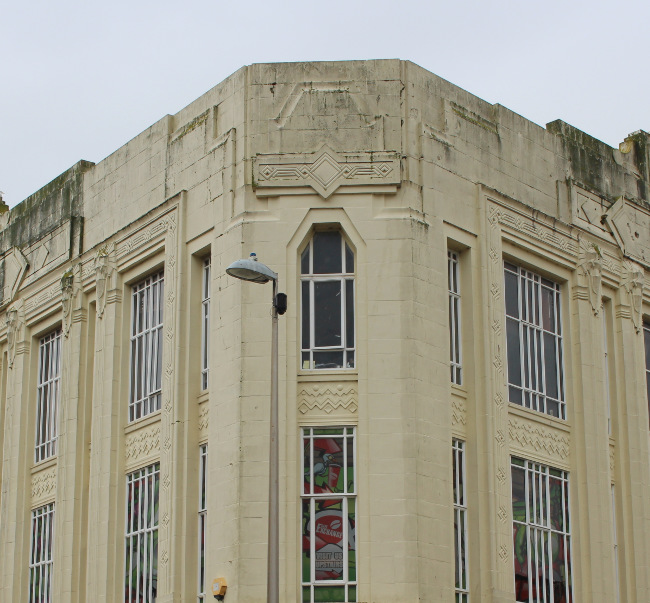
My favourite parts of town, though, are those reserved for purposes other than tourism or shopping: the remarkable Central Church with its concrete launch gantry; the boldly Art Deco council offices, and more modest library of the same vintage; the Edwardian town hall; and St Andrews with its rows of dignified white war graves.
Torquay, I think, is a deeper town than all the seaside superficiality might suggest, with plenty more to discover yet.
An outstretched hand brushing the stalks until, yes, this one, and then a soft snap. Tidy it up first, nipping it off with a thumbnail at the thick part above the knee; then stripping away the sheath to reveal the brighter green inside; and, finally, trimming straggling lower seed spikes to leave a neat arrowhead. It is ready.
When Jarge Balsh, the comic hero of William Jones’s once popular Somerset bumpkin stories, first appeared in 1925 it was with grass in his mouth:
One did not need to be a Sherlock Holmes to realise that he was connected with the agricultural industry. His boots and leggings were generously plastered with samples of the usual contents of the farm-yard, whilst to his slouch hat and old bottle-green morning coat there still adhered strands of hay…. Halting before me, and spreading his legs, he thrust his hands deeper into the cross pockets of his corduroy breeches, and changed the straw he was sucking to the other side of his mouth…. “Be you the young gent as is gwain ta bide wee widder Toop? ‘Cos if ye be, I be come vor ‘ee.”
The depiction of Balsh on the title page of the book cemented the image:
The prepared rapier of grass lightly bridges the lower teeth and lip, its feather-duster-head in the distance bouncing with each step, shaking its hair. Chewing the stalk destroys it quickly so instead it is held gently in place by the jaws and worked by the tongue like a rudder, pulling it in to make the seedhead swing out, and pushing it out to bring the brush swishing back to the centre. Relax the jaws and it droops; thrust the lower jaw out and the grass comes up to eye level. Up, down, left, right, swish, swirl – simple but absorbing.
Along with tractors, cider and smocks, the chewing of grass crops up over and over in lists of West Country stereotypes, often in the defensive form “There’s more to Devon/Somerset than…” There’s some embarrassment perhaps in the idea of being seen to ruminate dumbly, further evidence of the supposed animal stupidity of the bumpkin.
And yet it doesn’t take much to work out that chewing grass is a habit claimed, or disclaimed, by rural communities all over the country, and indeed around the world. Grass is not, after all, a scarce commodity, and the urge to nibble on it, I would say, is very nearly instinctive.
Eventually the bruised stalk begins to release its sap in the mouth – a bitter, raw taste that has a strange effect on the other senses. With a length of grass in the mouth birdsong seems louder, while traffic sounds diminish. The aroma of wildflowers intensifies. This is the easiest, cheapest, most innocent of psychedelic experiences.
I don’t believe chewing grass is something we, or anyone, should feel defensive over, or self-conscious about, whether alone on a quiet lane, or among the faux-rurality of the unkempt meadow-land in Hyde Park, sick for home.
There is no more sap, no more structure – the grass has become tasteless and is nearing collapse. Take it out, throw it away — it doesn’t matter, grass is free — then stretch out the hand, brush the stalks, until, yes….
My snapshot image of Weston from childhood is of great, clean whitewashed walls weaponised by the sun.
Blackpool was seedy – knickers for a nicker, pants for a pound, and drunks scrapping in the street – and Burnham-on-Sea was boring. But Weston… Weston was glamorous. Squint and you could be in Miami, or Nice. It was the posh seaside.
Revisiting it in 2018, especially on a rainy day, lifts the spell. There is more grey and more dereliction than I remember, and a sense that Weston’s problems – the same problems afflicting many towns – are breaking through its plaster façade.
Though it may seem less pristine than 30 years ago, however, I find in it greater depth and detail as an adult.
Alleyways and back streets reveal Victorian details, ghost signs, beerhouses and post-modern oddities.
There’s Art Deco.
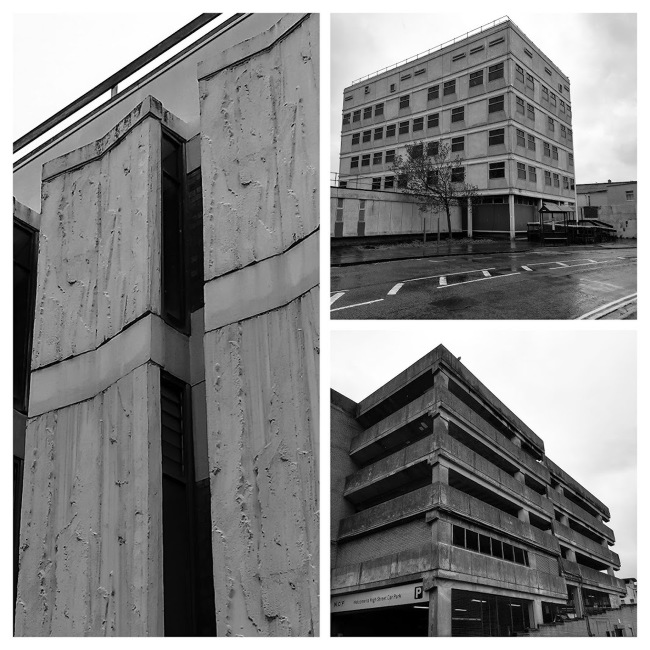
There’s plenty of post-war modernism.
And concrete brutalism.
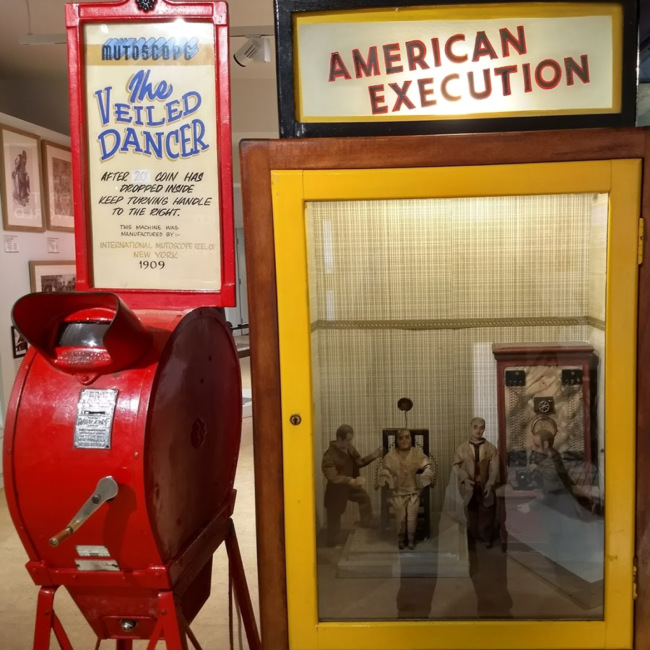
The museum, recently reopened, is small but dense: look down on an architectural model of a post-war Weston that never was; feed 20p to the What the Butler Saw machine and watch the imprisoned ghost of a long-dead dancer perform with a length of silk; and place a hand on a stretch of railing from the old pier where millions of fingers sticky with ice cream and rock have been before. The narrative also does a good job of bringing home the extent to which Weston was Blitzed – something that surprised me, and which helps explain some of the buildings above.
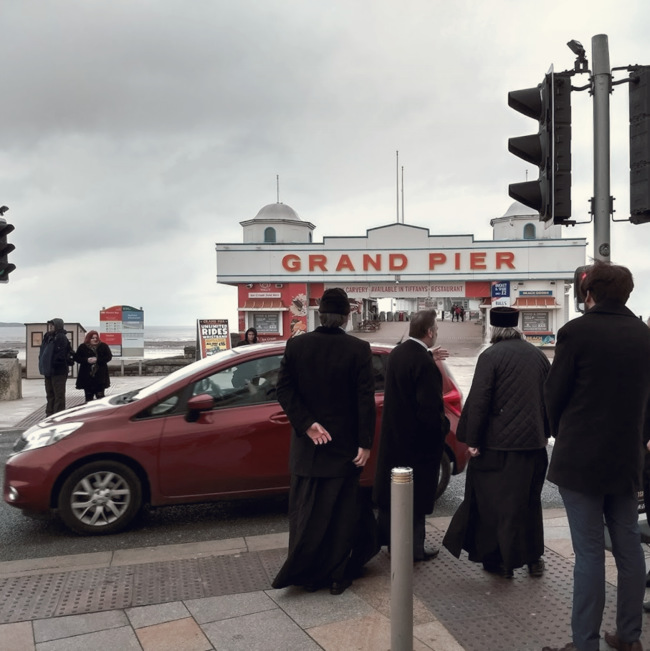
The pier is good, even in its post-2008-fire incarnation: worth walking up and down three or four times for the thrill of feeling truly at sea, and a little nearer mysterious Steep Holm.
And there are memories. Having thought it long gone I stumbled upon Revolver Records the very smell of which – tobacco, damp, worn-in leather jackets – transported me back to standing at my Dad’s side as he flipped through racks of vinyl looking for who knows what.
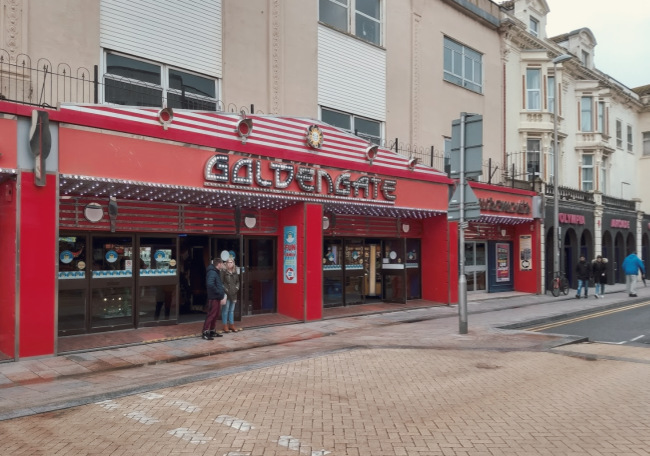
And I approached the Golden Gate amusement arcade from just the right angle to trigger a specific recollection: coming to Weston in about 1992 with the express purpose of experiencing virtual reality. At 14 I’d read William Gibson, was buying Wired most months, and fancied myself quite the cyberpunk in my Hi-Tec trainers and generic sweatshirt from Highbridge market. I went with two friends and we had to queue for about 20 minutes to pay £1.50 each for five minutes play time on a supposed combat flight simulator that actually consisted of a nausea inducing field of blue (sky) and green (ground) with occasional blocks of grey jerking across it.
I’m glad I now live near enough to Weston to visit whenever I like. I suspect there’s plenty more to find yet.
In Britain hauntings occur in ancient manor houses, old inns, and Gothic asylums – places whose very age makes them groan and creak, where shadows sit deep, and which are scarred by the lingering imprint of lives lived and lost. And yet arguably the most famous British ghost story of the 20th century took place somewhere quite different: in a humble council house, only half a century old, in Enfield, north London.
This turns out to be far from the only such instance, however, and was certainly not the first.
“The world of the ghost is riddled with class,” wrote Roger Clarke in his 2012 Natural History of Ghosts, “and the poltergeist is occasionally tagged as ‘the council house ghost’.”
Here are just a few examples of that particular, peculiar phenomenon.
Weedon Bec, Northamptonshire, 1947-50
The tenants of a red-brick council house on Queen Street, built only in 1945-46, reported having seen a figure glide through the hall and then disappear. Mrs Thomas Bicknell (her own name is not given) first saw the ghost in around 1947, as reported in the Northampton Mercury and Herald for 6 January 1950:
She and her late husband, Mr Thomas Bicknell – a man with 23 years’ service in the Royal Artillery and not given to imagining things – had just finished a game of cards when they heard a rustling and tapping noise coming from the direction of the hall… Their dog, a large Airedale retriever, rose to its feet, raised its hackles and growled… Mr Bicknell went into the hall but could see nothing. The dog went up the stairs, still growling, and his master followed. Again there was nothing, but as he turned to descend the stairs, he saw a ghostly figure glide through the hall, go into the kitchen, and disappear. Mrs Bicknell, sitting in the living room, saw it too.
After her husband died, Mrs Bicknell saw the ghost a second time, on Christmas Eve 1949, doing the same gliding and disappearing act. When her distress story was reported at a council meeting it was met with laughter. “This added amenity warrants an increase in the rent,” said Mr D.H. Jelley, following in the grand gentlemanly tradition of scoffing at superstitious proletarians.
Earby, Lancashire, 1954
Mr E. Peasey, a chimney sweep, evacuated his wife and nine children to a single downstairs room in their council house at 1 Melrose Street as a result of ‘queer things’ happening upstairs, and multiple ghostly apparitions. Here’s a summary from the Burnley Express and News for 16 October that year:
[For] three years doors had opened on their own, footsteps had been heard overhead, crockery had flown into the air and pictures had gone crooked… One of the boys, 14-year-old [Bobby] described a shadow in his bedroom. At first he thought it was a reflection but it advanced to the middle of his room and then began to tickle his feet and scratch him… The ‘thing’ was white, with no arms or legs, and when an alarm clock went off it had backed into the corner and disappeared… Ten-year-old Kathleen described seeing two hooded figures “floating” and similar shapes were described by others in the family.
Another report, from the Barnoldswick and Earby Times for 15 October, adds more details: a bright light seen in an upstairs room, door knobs turning on their own, and two of the children waking their father to report that they had “seen a man in Daddy’s attic”. A small twist: this was apparently an older slum property with gaslighting rather than a modern council house and the story came to light precisely because Mr Peasey wrote to the council requesting a move to just such a new-build.
Sedgley, West Midlands, 1954
From the same year and month as the tale above comes the minor story of a haunting in Sedgley in the West Midlands in which the tenant, an unnamed woman, supposedly asked the council sanitary inspector to fumigate for ghosts while he was hunting rats on the property. It was reported in the Birmingham Gazette for 29 October 1954 as a “Nowt So Queer as Folk” sidebar scant on details, and with a decidedly unfunny punchline: evidence of haunting in her daughter’s bedroom was chalked up to the resident vermin, and the family were evicted for failing to maintain the house properly.
Sunderland, County Durham/Tyne & Wear, 1957
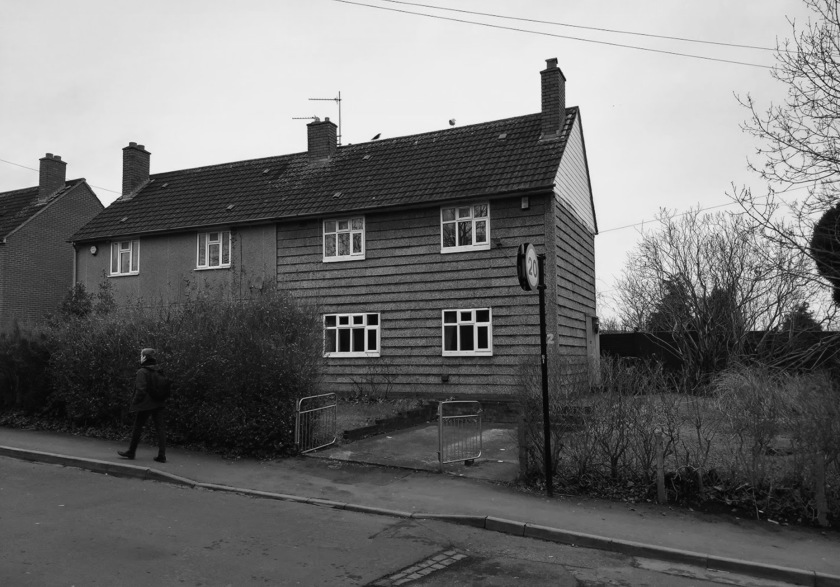
It was in spring when Norman and Audrey Dixon first reported that the council house in General Havelock Road, Sunderland, into which they had recently moved with their three young children was haunted in a rather colourful fashion, as recounted in the Birmingham Post for 23 October 1957:
[The ghost] takes the form of a zig-zag line [which] appears on the wall of their living room…. The first night they slept upstairs sheets were ripped off the bed and fingers dug into their chests, Mr Dixon said. “A few nights later I felt something clammy on my back and so did my wife. There seemed to be no air in the room. We staggered downstairs and took the family to my brother’s house.”
This case was taken seriously enough by the local vicar that he appealed to the Bishop of Jarrow, J.A. Ramsbotham, who visited the property and conducted a ten-minute blessing service on 22 March, including the sprinkling of holy water. But when journalist Ken Culley followed up (‘I was guest in the haunted house’, Newcastle Evening Chronicle, 25/03/1957) the Dixons told him that the exorcism had been effective for only 24 hours and that the “unwanted visitor” had returned in full force.
They too were eventually evicted after refusing to pay their rent in protest at the Council’s refusal to provide them with alternative accommodation. (Newcastle Journal, 29/10/1957.) Another family, the Rowes, moved into the house in November 1957 and reportedly found it “all quiet”, and that was that. (Newcastle Evening Chronicle, 05/11/1957.)
Swindon, Wiltshire, 1966
A brand new council house in Penhill Drive in Swindon was the subject of national press coverage when Gladys and Robert Tucker, who lived with their adult children Beryl and Victor, asked to be moved after they saw a shadowy figure on the landing and strange lights on the walls. (Daily Mirror, 04/04/1966) The council agreed to rehouse them, reluctantly, and had the house exorcised by a priest before reallocating it to new tenants. In his 1967 book Swindon: An Awkward Size for a Town Kenneth Hudson reported this incident as a blot upon the image of a town keen to present itself as modern and forward looking.
Newton-le-Willows, Lancashire, 1968
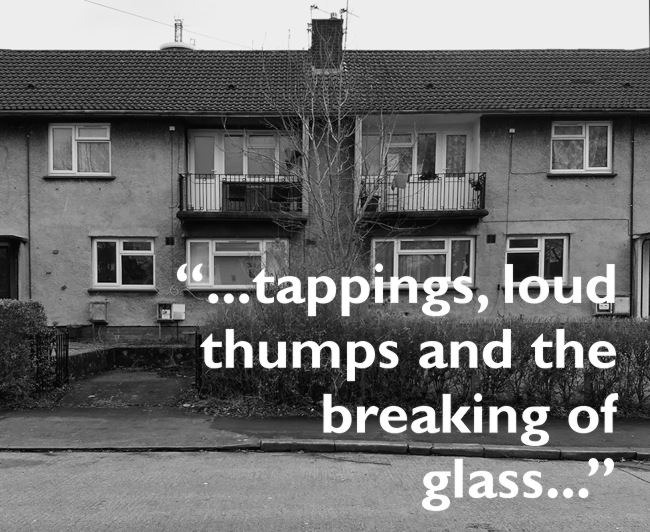
In March 1968, Gerald and Audrey Burke, 34 and 31, moved out of their council house on Fern Avenue as a result of “tappings, loud thumps and the breaking of glass”, and the ghost of “an old lady…. wearing a white hat”. Mrs Burke asked the Council to re-house the family. (Aberdeen Evening Express, 13/03/1968.)
It seems the Burkes were not the first tenants to complain of such occurrences (Coventry Evening Telegraph, 27/02/1968) and so the Council resorted to sending in, first, a Roman Catholic priest, Father Gerald Walker (Birmingham Daily Post, 27/02/1968), and then “psychic experts” – brothers Alan and James Bell, from Formby – to attempt to exorcise the property.
The Bells were convinced by the evidence they saw and urged the council to move the Burke family, even offering to rent the house themselves while they continued their investigations. (Coventry Evening Telegraph, 04/03/1968.)
I haven’t been able to pin down what happened next but I can say this: Fern Avenue no longer exists, even though nearby Ivy, Pine, Larch, Ash and Laurel avenues do.
John and Lynne Edwards, 1973.
Coventry, West Midlands, 1973
In 1973 it was a council house in Stoke Heath that scared away its residents. Lynne and John Edwards first moved their family into a single room at 63 Hill Side, before fleeing altogether, after they heard “whining noises and footsteps”, and felt the house turn freezing cold in in instant. (Coventry Evening Telegraph, 19/11/1973.)
* * *
After all that, it begins to feel as if not only is the council house not such an unusual setting in which to encounter a ghost but, in fact, a setting positively prone to hauntings.
What can possibly cause these relatively history-less houses, designed to be light and airy, to be such fertile ground for the uncanny?
In America the answer would surely be an ‘Indian burial ground’, as in Tobe Hooper’s 1982 film Poltergeist, which sees shiny new-build suburban houses haunted not by the ghosts of previous inhabitants but by those who once possessed the very land. (Sort of. It gets complicated in the sequels.) But, based on historic maps available via the National Library of Scotland, there’s no such obvious plot engine – no burned-down orphanage or gruesome battle site – at any of the other locations listed above, though a couple are near cemeteries.
Then again, it doesn’t take much age at all for a house to gain the potential for a haunting. In the 1968 haunting of another Coventry council house, this time at Treherne Road, the anxious 37-year-old resident, Miss Barbara Mills, connected a serious of spontaneous fires with stories she had heard of a wartime suicide at the property. (Birmingham Daily Post, 22/10/1968.) The Dixons in Sunderland invited a local psychic, James Long, to conduct a séance at the General Havelock Road house which resulted in a message from a drowned man, John McKenzie, who apologised for the trouble he had caused, but mentioned that there was also the “earthbound spirit of a woman” haunting the house. (Newcastle Journal, 29/04/1957.) Legends grow quickly, even in poor soil.
In more concrete terms (no pun intended) is there perhaps something about the way the houses were constructed? In the Sunderland case journalist Ken Culley slept in the haunted bedroom but, despite apparently making every effort to spook himself, saw no evidence of anything supernatural. What he did observe was that the construction of the house made it uncomfortably stuffy, while opening the window caused a localised breeze to swirl oddly around the foot of the bed, numbing his feet. Light and airy may have been the intention but large rooms with high ceilings, sparsely furnished, offer great potential for echoes, reflections and strange circulations.
Then there is the question of location, and here I’m going to indulge my own memories of growing up on an estate. Council developments often occupy what in the jargon of the psychogeographer are called ‘edgelands’, neither town nor country, and can resemble lonesome frontier towns. All that space, a joy on a summer afternoon, has its downsides: winds whistling across shopping precincts and playing fields, or along showpiece boulevards; long, dark gardens with no walls and too many shadows, butting on to fields or woodland; neighbours at arms’ length, and family further yet, back in the old country. A bedroom for the parents and one for each child sounds like the ideal unless you’re used to something more intimate and find yourself alone at 3 am listening to silence, staring at a black shape creeping across an excess of freshly-plastered wall. With that in mind, it’s perhaps unsurprising that many of the cases described above resulted in the afflicted families bunking up together in a single room, or crashing with neighbours or family. Could this be a sort of stress reaction to the trauma of being almost forcibly cleared from the so-called slums?
Roger Clarke’s observations on class are relevant here, too. He suggests that, at least until recently, middle class people were less likely to publicly report experiences of ghosts, even if they might admit to them privately. Talk of ghosts is viewed as evidence of either peasant stupidity (see above), or working class mendacity, and either way ‘showing off’ by talking about this kind of thing for whatever reason is rather vulgar.
Finally, there is the very fact of the stress of life on an estate. I should be clear here: in my experience, English council estates aren’t as bad as some people like to suggest; but nor are they, in practice, anything like Utopian. There is crime, and there is anti-social behaviour. One small example: our back door-knob used to rattle after dark when my Dad worked nights. A small thing, but terrifying. My Mum got into the habit of having my Uncle’s Army riot baton by her armchair or next to the bed, and I got out of the habit of sleeping too soundly, just in case intruders needed seeing off. Living like that, never quite relaxed, wears you down and sets you on edge. And, at the same time, you are also dealing with poverty which can leave you cold and hungry, and which at the same time can erode your sanity and sense of self.
“I cannot stand it much longer…. I am living on my nerves”, wrote Peasey the Earby chimney sweep with nine children to feed in his letter to the council. He was certainly haunted by something.