Council estates are grey, bleak, boring places. That’s what the propaganda says, anyway. What they don’t mention is how weird they can be, and on my estate Elvis Presley was a particular nexus for weirdness.
There were numerous small manifestations of his spirit. For example, I was at school with multiple Aarons, all born in the immediate wake of the death of The King of Rock and Roll, whose middle name it was. (I was nearly called Aaron until my parents, Elvis hating contrarians, realised the connection.)
There was at least one house with a shrine in the front window: candles, framed pictures, commemorative plates, and a brass statue of chunky mid-period Elvis mid-hip-swing. In the background was a wall-hanging depicting near death Elvis, picked out in light colours on black velvet. They sold those at Highbridge Market, I seem to recall, alongside similar tributes to Jim Morrison, Jimi Hendrix, and wolves at howling at the moon.
It was perhaps all of that which generated sufficient energy to fuel the resurrection of The King himself.
Sure, I was startled the first time I saw Elvis strutting around the estate in his famous white Vegas stage outfit, zip-up Chelsea boots and gold-framed shades, but it didn’t stand up to scrutiny. The sideburns were the right size and shape but definitely blonde, and the bell-bottomed jumpsuit, though a bold effort, lacked the polish, intricacy and glitter of the real thing. And would Elvis ever have carried round a portable music system playing his own greatest hits? Well, maybe, come to think of it.
The Bridgwater Elvis was a man whose passion for the Memphis Flash combined with grief at his passing to cause a permanent transformation, or rather permit a possession. I never saw him dressed any other way and he answered to Elvis’s name when piss-taking kids yelled it at him in street, not seeming to mind, enjoying it even. He identified as Elvis on a deep level and would probably have been more offended to be addressed by his own name.
When he died a few years ago his family made sure to list Firstname (Elvis) Lastname in the obituary. I wonder what’s on his headstone?
A few months ago I was with my parents having a pint overlooking the water in Bristol when my Mum said, out of nowhere, “My cousin Jimmy Dew was involved in a shipping disaster on the Severn.”
I naturally asked for more information but she didn’t have much – it happened in the sixties, she thought; and he was the skipper of a barge. When I got home I looked it up in the newspaper archives expecting to find a passing mention of some minor incident but what I discovered instead was the notorious Severn Bridge Disaster which saw the deaths of five men and ended with the demolition of the bridge.
Here’s what happened: at around 9 o’clock on the evening of 25 October 1960 a convoy of sixteen barges carrying various flammable oil products was travelling up the Severn towards Sharpness in Gloucestershire. As they passed Berkeley a heavy fog came down and two of the barges, Arkendale H and Wastdale H, overshot Sharpness. The Wastdale H was the vessel skippered by my distant cousin, James Dew, and was carrying 350 tons of petrol; the Arkendale was loaded with heating oil.
With the tide against them they struggled to come back towards the harbour and, at a narrow point in the river, collided. This sent them spinning out of control, stuck together, up the river and into the Severn Bridge.
The Severn Bridge, now generally referred to as the Severn Railway Bridge, was an iron structure completed in 1879. Though old it was still in active use by trains travelling across the river between Sharpness and Lydney, and by pedestrians. Fortunately, the stretch where the collision occurred was empty at 10:30, though a train had just passed through and was still on the bridge.
The conjoined and out-of-control barges hit hard enough to bring down one of the bridge’s piers (the upright bits) which sent chunks of the span above crashing into the Wastdale. That in turn caused its highly flammable cargo, already spilling into the water, to ignite and explode; the oil on the Wastdale soon caught, too.
The crews of both barges were cast overboard. George Thompson, skipper of the Arkendale, swam to safety, and his engineer was fished out of the water by rescuers after four hours. Cousin Jim boarded the Arkendale in an attempt to get it out of gear and then, when it caught fire, he stripped off before jumping into the water with a life-buoy. He turned up naked at a pub on the shore after three hours struggling in the water.
The next day, the fog being driven away by rain, the two barges lay smouldering on the mud flats while a helicopter from RAF South Cerney swept overhead, police searched the banks, and coastguard patrolled the river helped by local fishermen. They were looking for Percy Simmonds (34) and Robert Nibblett (25) of the Arkendale; and Jack Dudfield (46), Alex Bullock (40) and Malcolm Hart (17) of the Wastdale.
All five were found dead over the next few days.
Cousin Jim seems to have been quietly blamed for the disaster, even though he was officially cleared of any negligence. The Ministry for Transport suggested at the time of the inquiry that he made an “error of judgment” and he also described his own attempts to push the Arkendale off by revving into it (not technical nautical language but this is my understanding) as a “mistake” which only caused the two vessels to stick together ever more tightly. More recently BBC reporter Andy Vivian turned up official papers which seem to suggest that officials thought him “inept” and (as I read it) that he rather panicked under pressure.
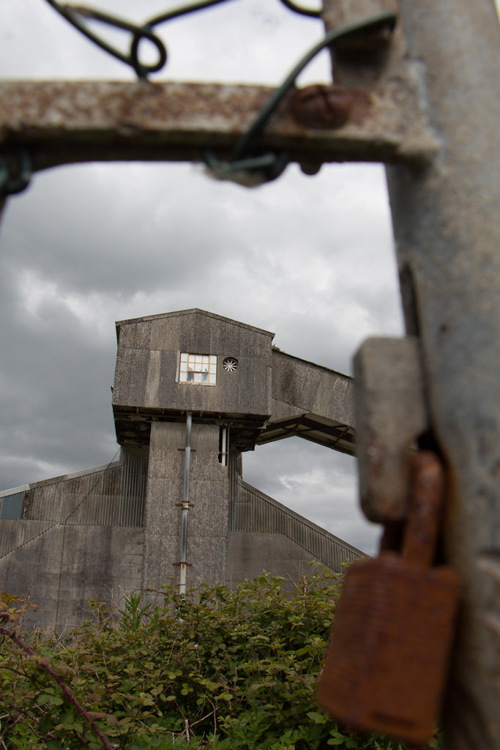
I don’t know what became of cousin Jim – it’s something I’ll look into – but I was amazed to discover that the wrecks of the two barges are still there near what little remains of the bridge.
“Modism, Mod living, is an aphorism for clean living under difficult circumstances.”
Peter Meaden, 1978
For a few years as a teenager and twentysomething I tried to do the mod thing but it didn’t really take. Practical modism requires a certain arrogance I don’t think I have, and certainly don’t know how to project.
It’s relatively easy to do ‘plastic mod’, buying items of uniform off the peg at mod shops, but real mods will let you know that’s not the point: you have to really like fashion, really care about sweaters, really commit to having a ‘hairdo’. Doing it properly, or even half-heartedly, takes a fair amount of money. And, ideally, you also need to be slim – a straight streak with no lumpy protuberances to spoil the cut of your suit.
So, all of that being out of reach, I let it go, though I still thrill at the sight of a Lambretta and listen to all the right music.
Looking back, though, I wonder if the appeal of modism to me, and perhaps to other young working class people, was something beyond the clothes, records and scooters: it was the clean precision of it all.
When I got together with my partner about twenty years ago this week she was into grunge and the scuzzier end of indie, at home in festival fields. Not long after we met one of her friends described me as “a clean boy”. It was not intended as a compliment, in my view – she meant to say that I was a bit boring, a swot. But it was true, in literal terms: I don’t like to be muddy or sweaty; ‘slumming it’ holds no thrill for me; I like clean socks, clean shirts, clean bedclothes, and being clean shaven.
I think I understand this instinct of mine. A council estate upbringing is almost the textbook definition of the “difficult circumstances” described by Peter Meaden, the original Ace Face and associate of The Who, in a 1978 interview. “Clean living” is the smallest, cheapest unit of defiance. (Disposable razors can be used multiple times if you dry the blade after use; a bar of soap lasts longer than shower gel and costs buttons.)
Later on, at university, it was a way of feeling in control of a distressing situation. Scrubbed clean, dressed and out of the door every morning before many of my peers had even thought about sliding out of bed and into last night’s T-shirt, I at least started each day fresh and sharp. One of the few things from Cambridge I look back on with any fondness are the bathing facilities: constant scalding hot water delivered via showers like firehoses, or cascading into luxuriously deep Edwardian tubs. The industrial laundry facilities weren’t bad either.
But I have to admit there was also a cringe in all this. It was a way of saying, “Yes, I might be here now, but my soul and body has already begun the ascent to a better place.” If I smelled of anything at all, or had a dirty collar, I subconsciously believed I would be marked out as a ‘prole’.
Of course my up-tightness did that far more effectively, and I daresay continues to do so.
“A man ought to have some coins to jingle in his pocket, even if it’s only coppers.”
My Mum used to say that when I was a boy as she sent me or Dad out of the door with 12p in small change scraped together from saucers and purse-corners, to make sure nobody would realise we were poor.
Poor. There’s a word.
A few years ago, having come through university trained to more-or-less pass in middle class environments, I ended up in a meeting at work where various well meaning people were trying to find a way to avoid describing children as poor. “You see, Ray, it’s stigmatising.” What they came up with as an alternative was ‘experiencing disadvantage’. I kept my mouth shut at the time but something about it made me angry. Perhaps it felt like a euphemism designed more for the comfort of the observer than out of concern for the Experiencers of Disadvantage, or maybe I didn’t like the suggestion that being poor, or being called poor, was anything to feel bad about. Being poor only feels shameful because nobody wants to admit to it.
Whatever the reason it made me want to stand up and shout I WAS POOR! Or maybe even I AM POOR! I’m not sure it’s a state you pass out of; it’s like a birthmark, or a lost limb.
The coins in the pocket are one face-saving fib among many. When you’re poor, you’re often far too busy to attend birthday parties and school trips, even though, of course, you’re not busy at all. You tell people you don’t like eating out, that you don’t like the cinema, or that you’re not interested in activities and clubs, even though you yearn for all those things. Or, rather, you would yearn if you hadn’t smothered the yearning before it had chance to cry out, convincing yourself that it’s true. “The cheaper version is every bit as good,” you say, daring anyone to doubt it, making it true through sheer force of desire.
You jingle, you swagger and bluff, and hope nobody calls you on it — “Shall we do rounds?”
Of course that doesn’t happen, as long as you know your place, where everybody has the same handful of nothing.
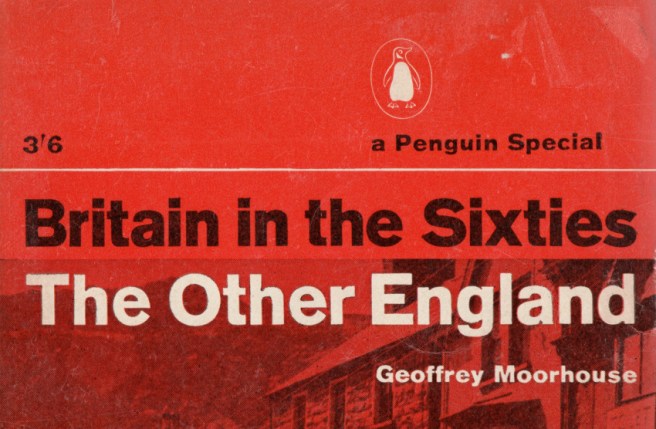
One of my favourite paperbacks is The Other England by Geoffrey Moorhouse (1931-2009) and here I want to share a few of his observations on a favourite city of mine: Plymouth, in Devon.
The book was published as a red Penguin Special in 1964 and contains a set of essays on every part of England except, pointedly, London, though of course a few digs are made along the way. It employs a mix of observation, political commentary and sly wit which makes it as fun to read as it is interesting.
When I lived in Penzance, Plymouth was the nearest ‘proper’ city (sorry, Truro) and a mere two hours away by train compared to three for Exeter (which feels distinctly less metropolitan) or four for Bristol, another great maritime city with which Plymouth shares a certain style and atmosphere.
Moorhouse sets the scene for his observations with a cinematic wide shot:
There is an element of surprise about Plymouth if you approach it from the East. After the bleak and haunted bulk of Dartmoor you don’t reasonably expect much in the way of civilization beyond; the idea of an ultra-modern city of 200,000 people sprawling down from that boggy plateau is faintly preposterous.
Plymouth doesn’t seem ultra-modern today and, indeed, is gaining considerable traction as a kind of living museum of mid-century planning and architecture. In 1964, however, it was ahead of the curve:
It was as early as 1943 that Plymouth, with the help of Sir Patrick Abercrombie, drafted its post-war plan. It decided that the city centre had been a pretty awful mess anyway, and that this was a chance to make something better of it. Instead of the narrow, wriggling maze bequeathed by generations of city fathers and commercial hardheads, there would be broad traffic and pedestrian ways keyed into a rectangular grid. The Plymouth Plan was something the town-planners from half Europe came to marvel at, for no one had thought of attempting anything like this before. Perhaps Plymouth got off the mark with this vision of the future just a bit too soon; if it had waited until Coventry and then the New Towns had hit upon the idea of shopping precincts totally devoid of traffic it would doubtless have been happy enough to follow suit.
Dingle’s in 2016.
Despite being from Bolton in Lancashire Moorhouse had a personal connection with Plymouth because, like many British men, he had lived there while serving in the Navy. In this book he recalls the excitement around the opening of the first of the city’s newly built shop, a department store, in 1951:
[You] couldn’t, as I remember, do much shopping in Dingle’s that Saturday, so congested was it with West Countrymen who had come not only to wonder at the extravagance of it all after years of buying from makeshift shops rigged up out of Nissen huts, but simply to travel up and down all day long on the escalators. It was the first time this new-fangled device had been known West of Bristol.
There’s an unfortunate hint of ‘Ho ho, get a load of these bumpkins’ in that last line but I don’t doubt it’s true.
Civic Centre and Council House.
Revisiting the city in the early 1960s Moorhouse found the transformation remarkable:
The city centre is now just about finished, a gleaming thing of Portland stone and as fine a shopping area as any you’ll find out of London; as the official guide book remarks, ‘Many London fashion houses and Bond Street tailors have seen fit to open branches in the Metropolis of the West’. It is true that hardly any of the buildings there quite dare us to accept a revolutionary line or two — thought out of Crownhill there is one of the most adventurous of our post-war churches with a free-standing altar and a flower-bed by the font. In the centre they have laid out a mosaic piazza, planted a swathe of trees…. and conjured up a pool beside the civic centre in which sailors are apt to bathe after a roistering night ashore.
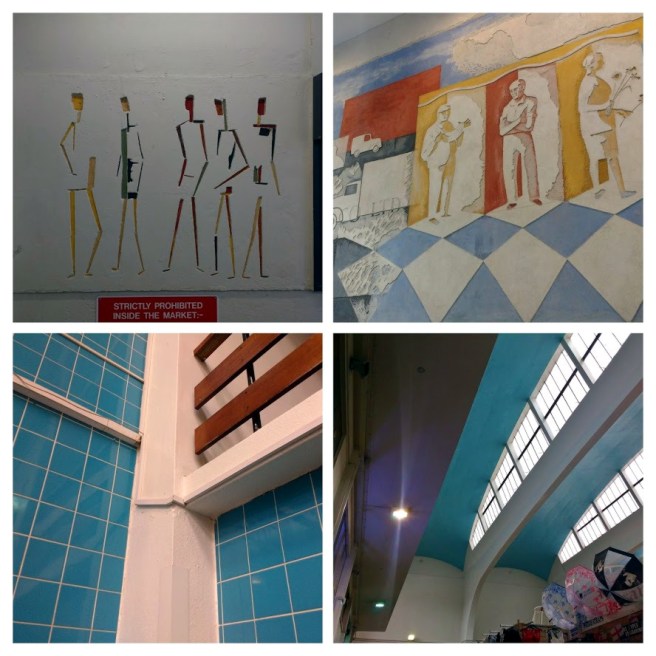
Plymouth Pannier Market, Walls & Pearn, 1959-60, as it looked in 2016.
He was quite won over by what he called a ‘smart and enterprising city centre’:
In its way it is all as exciting as a New Town, though they have meticulously reconstructed the Guildhall shell in a fanciful mixture of English and Italian Gothic, presumably to keep faith with the past. An almost tangible air of ambition hangs about this work of restoration and not long after the visitor arrives and starts investigating it dawns on him that Plymouth, having got well into its stride, doesn’t know where to stop.
That last thought suggests that, despite his admiration for the city, Moorhouse was aware that Plymouth’s post-war reconstruction was in the process of grinding to a halt. The grand architects’ plan was hobbled at various points (see this post from Municipal Dreams for details, or the account in John Grindrod’s 2013 book Concretopia)and long before the mid-1960s locals had begun to grumble about the vast empty spaces, the howling winds and how inhospitable it was for smaller independent businesses.
If you come across a copy of this book, do you pick it up — my copy cost £2 — and if you get chance, take it on a trip to Plymouth to trace for yourself the outlines of a more optimistic time.
It is it any wonder that the West Country, with its yin-yang of boredom and tranquillity, its distance from authority, its big skies and mystic tendencies, might have a drug habit?
A few months ago I was at my desk in Penzance (I’ve moved to Bristol since) when I heard a boom so loud I wondered if the earth might have cracked. A little later the air ambulance, that scarlet Valkyrie, flew so low overhead that my skull vibrated. A little later again I learned that what I’d heard was someone slamming their car into a bus stop seriously injuring a 16-year-old bystander. When the case came to court the gossip I’d picked up queuing in the grocers was confirmed:
A former addict who hadn’t slept for five days and mowed down a teenager whilst high on a cocktail of drugs claims she took the drugs to avoid the wrath of a masked gang who stabbed her boyfriend…. [She] was spared jail after her defence barrister told the court she’d taken the drugs to stay awake and was fleeing a violent gang who she felt were going to carry out a revenge attack on her when she crashed.
I’d picked up hints of that back story, too — sirens and cordons in the middle of the day, boarded windows, whispers in the pub, people threatening each other in the street, and incautious statements in the comments below news stories. I knew that there people dealing drugs in the flats near my house, on the estate near my house, and possibly in a house near my house.
This is all, I gather, part of an ongoing problem in the West Country. Despite the beauty of the landscape and ever more dominant beach-hut bourgeois tendency, the region is a target for big city drug dealers and, at the same time, an in-route for drugs with its many miles of coastline and secluded backroads. “Quieter counties, like Cumbria, or Devon and Cornwall are seen to have less proactive policing operations,” one ‘drug dealing insider’ is supposed to have told the Liverpool Echo.
Hence some bizarre headlines: a yacht stuffed with drugs is intercepted at Scilly and the skipper dies as he attempts to evade police by climbing the main mast; cottages and nuclear bunkers are rented, stripped, blacked out and turned into cannabis farms run by near-slaves everywhere from Cornwall to Wiltshire; secret factories are found beneath old caravans on Somerset farms; a young man in Exeter is attacked in a dispute between gangs of dealers and one of his assailants stabs him so hard that the blade snaps away in the wound. And so on.
I suppose I’ve always been vaguely aware of this side of West Country life. It has, after all, been going on for a long time. When Joe Strummer, late of punk band the Clash, relocated to Somerset in the 1990s he caused some local upset when he told an interviewer the reason for the move: “The drugs are better down here. It’s like the Wild West.” (I’m paraphrasing because I can’t find the original article — tips welcome.) A 1995 interview with electronic musician Richard James, AKA Aphex Twin, includes this passing observation:
Growing up in hippie Cornwall, drugs were part of local life. One of his earliest memories is the “funny smell” in the house of one of his mum’s friends. Sometimes he finds drugs come in handy when writing…. “I find it quite interesting, the way they make things turn out. It’s like using a different sequencer. Drugs just make things sound different.”
Is it true that planes from Holland used to land at the disused airfield at Westonzoyland in the middle of the night during the 1980s? That was certainly the gossip in Bridgwater and as a child I used to lie awake listening for them.
In his 2016 book The Swordfish and the Star, about the gritty reality of life on the Cornish coast, Gavin Knight records the connection between the Cornish fishing industry, drug smuggling, and drug use from the 1970s onwards:
In the front of the Swordfish people would be drinking but in the back, there was any drug you wanted. One time, to get to the bar, you had to step over a fisherman lying on the floor unconscious from coke.
The gentler 1960s drug culture came West, too, manifesting in the Glastonbury Festival and the St Ives hippy invasion. In 1966 Bristol publicans were trained by police on how to recognise the smell of weed using hemp burned over a gas stove (Birmingham Post, 25/08/66) while raids in Cornwall found LSD, cannabis and other drugs from Land’s end to St Agnes. (Times, 28/05/73.) Looe, a particular hot spot, even gained its own local drug squad, “known as Brian even to the people he was nicking”.
Go back far enough and you’ll find Samuel Taylor Coleridge composing the proto-psychedelic ‘Kubla Khan’ in Nether Stowey, Somerset, in what was probably an opium daze. It was published in the same 1816 volume as ‘The Pains of Sleep’ which is now generally reckoned to be an account of drug withdrawal:
…yester-night I pray’d aloud
In anguish and in agony,
Up-starting from the fiendish crowd
Of shapes and thoughts that tortured me:
A lurid light, a trampling throng,
Sense of intolerable wrong,
And whom I scorn’d, those only strong!
So, that yin-yang: hard work, hard lives, hard drugs. Dreamers and dancers, poets and rock stars. Visions and cramps. Men from Porlock and men from Merseyside.
Above: an easter bonnet competition at Sealed Motor Construction, Bridgwater, c.1973.
For years when I told people I was from Somerset their response would usually be something like “Oh, how lovely!” at which I would laugh inwardly, and grimly.
I knew that they were picturing a summer day at Minehead, the roaring log fire of a country inn, or perhaps Bath, or maybe even confusing it with Devon at its most lush and rolling. They were thinking about the cover art on Ravensburger jigsaw puzzles.
What they did not have in mind was the industrial estate on Wylds Road in Bridgwater where Grandpa vacuum-formed plastic cups for vending machines and Mum packed aerosol solvents. They weren’t picturing the heat and filth of the factory where my Dad worked nights making pistons, or the one before that where he waded in chemicals, or the one before that where he (and Mum, and her parents) put together waterproof motors, or… You get the idea. They didn’t have in mind the thundering lorries or freight trains and the infrastructure that served them.
Bridgwater was shaped by industry even if many of the factories have gone, and there are other places like it up and down the West Country. What I want to do here, for my own learning, is highlight some of those industrial towns and villages and the sheer, mad range of work undertaken in a part of the world more usually associated with tourism and agriculture. It’s nothing like complete and I’ll no doubt come back to this subject when I’ve done more reading.
From 1933, via the British Newspaper Archive.
1. At Bathampton outside Bath, for example, William Harbutt’s factory produced Plasticine, the non-drying modelling clay, from 1900 until 1983. This might sound like a bit of a joke but it was a substantial industrial operation. You can see some (small, watermarked) photos of the factory at Bath in Time.
2. Street, Somerset, was home to shoe manufacturing firm C &J. Clark, founded in 1825, and was the site of the original factory. Clark’s eventually had factories all across the West Country in places such as Radstock, Bridgwater and Minehead. The last, at Ilminster, closed in 2005. Clark’s head office is still in Street but the original Clark’s factory buildings have been absorbed into Clark’s Village, a rather characterless discount shopping centre with upmarket pretensions.
3. The Wansbrough paper mill at Watchet, Somerset, was a major local employer for several hundred years, from the middle of the 17th century. It closed in 2015.
Yeovil, also in Somerset, has been a centre for the manufacture of helicopters since the end of World War II. What was Westland Helicopters is now owned by an Italian firm, Leonardo, whose almost 3,000 staff build military and civilian models including a licenced version of the Apache Longbow for the British Army. Growing up I remember that the local news was always either ‘Westland in trouble’ or ‘Westland to expand’; a helicopter came and landed on the school playground one day but I’m not sure if they were recruiting for Westland, the armed forces, or both. An oral history project recording the experiences of workers at Westland is online here.
From 1960, via the British Newspaper Archive.
5. Centrax has been making industrial gas turbines and jet engine components since the 1940s and relocated to Newton Abbot in Devon in the 1950s. Today it employs around 700 people. From 1964 to 1979 one of the local football teams was called the Newton Abbot Dynamos and played at the Centrax Ground. (Very Soviet.)
6. Cornwall is of course known for mining and its landscape is marked by the debris, architecture and scars of this once great industry. At Geevor near Land’s End you can visit the remains of a tin mine that only ceased operating in 1990 and which is preserved much as it looked in those final days with lockers unemptied and curling calendars on the office walls. At Par outside St Austell a large and fully operational China clay works sits surrounded by fences on the seafront – a gritty two-finger salute to the tourist industry. China clay has been mined and processed in Cornwall since the 18th century and still employs around 2,000 people today.
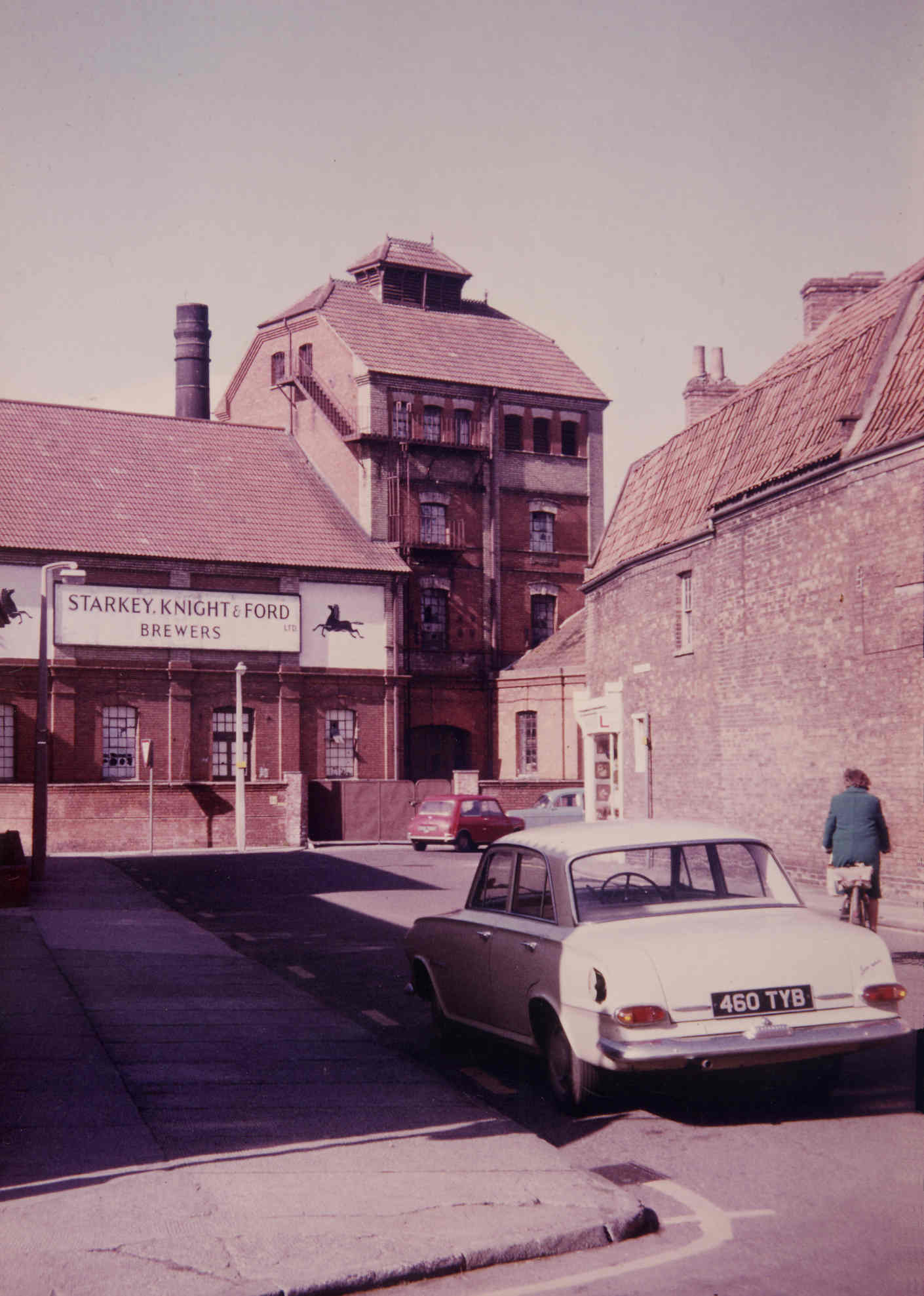
7. Bridgwater in Somerset and Tiverton in Devon shared a notable brewery in Starkey, Knight & Ford. It was taken over by Whitbread in 1962 and operations were concentrated in Tiverton which became Whitbread’s western outpost until operations ceased there in 1982. Devenish, another big West Country brewer, had breweries in Dorset (Weymouth) and Cornwall (Redruth), with the latter still working as a brewery into the 21st century. There are still substantial historic working breweries at, for example, St Austell in Cornwall, Bridport in Dorset (Palmer’s) and Devizes in Wiltshire (Wadworth).
* * *
For starters, then, that’s a vast range of industry, from toys to war machines, and I haven’t even touched on bricks, dairy products, seafood processing, furniture manufacturing, chewing gum, chocolate bars, semiconductors…
One day when I was about 13 I realised I could just walk out of town whenever I liked, with the only limits being time and the weather.
My home town is really one big outskirt – not confidently urban, but not quite rural either; a place where you can stand surrounded by concrete and factories while enveloped in the stink of manure.
I was raised as a town boy – the countryside was a thing you sped through in a car on the way to the seaside or Taunton – but couldn’t help wondering what was out there, beyond the sign that announced our twinning with La Ciotat and Uherské Hradiště. What was on those hills I could always see in the distance, where snow sometimes sat while town was as grey as ever? What was up that lane? Where did the filthy old river go?
First, I tested the boundaries, walking a little further each time. The motorway felt like a barrier but I crossed that easily enough, my flat feet slapping their way across a pavement barely used. On the other side, just barely, I found the hamlet of Horsey and thought, well, there it is: I’ve walked to another place. I tried the same on the other side of town, passing under the motorway this time, and found Dunwear.
Then I really stretched myself, walking beyond the point where the pavement ended, past the absolute feathertips of town. Trudging alongside the A39 was dangerous which added to the thrill but I knew the rules (face the traffic) and there were verges to retreat to if need be.
It’s impure countryside out that way: stalked by crackling pylons, littered with fast food wrappers and fly-tippings, and with the constant sound of the motorway boring away like a dental drill. At certain stretches it feels as if there’s more roadkill than road. But compared to the estate it was open, wild and fecund.
That time I made it to the King’s Sedgemoor Drain, which looks like a river but was built by men. There was a path that I wanted to follow but it seemed as if I’d already gone too far from home so I turned back.
Next time, I did go that way, stopping to eat a sandwich with a view across fields of gaudy yellow rapeseed, with the tower of Sutton Mallet Church in the distance. I may have read some poems, which was the kind of thing done by the kind of person I thought I wanted to be then. It was warm and insects as big as shuttlecocks made ceremonial flypasts. I thought, ah, there it is — this England I’ve heard so much about.
I went out time and again, taking different routes, going beyond and beyond again, until one day I was taken with the most pathetic, suburban version of exploration mania you can imagine and didn’t turn back when I should have. Stranded in Huntspill as night fell I found a payphone and called to be picked up. In the car home, with aching feet and muscles, I felt like Edmund Hillary.
All of this, I suppose, was training for life, a kind of straining at the leash. Timid and reticent as I was, and am, I never wanted to stay at home forever.
My life would be a lot easier if I didn’t have to spend all day, every day, looking after this obnoxious kid.
I’m trying to live a life here – to have fun, get things done, make the most of my allotted time – but there he is, bringing me down, looking up at me with that pathetic expression.
And he’s a coward. If I think of doing anything messy or dangerous he gets into a terrible state, holding me back with all his petulant strength. He’s much happier when we do the same things, in the same places, with no chance of humiliation. Every now and then I assert my authority and take a risk despite the kid’s pleading and it’s almost always worth it, which makes me resent the drag he generates all the more.
When I want to make conversation with strangers he distracts me with constant demands for attention, pulling at my sleeve, in agonies of shyness so that I stumble over my words and end up only half-engaged. When I come away, I’m as angry at myself as I am at the kid.
Can you believe I have to take him to work, too? Have you ever tried to project dynamism and ambition when there’s a child standing next to you giving the old stage whisper: “We shouldn’t be here. You’re making us look stupid. These people are laughing at us.”
The kid likes me to keep my head down because he equates being noticed with being mocked. He makes me eat too much, and bad food at that. He won’t let me wear anything too smart or stylish, pointing mournfully at his own clothes – the cheap coat from the market stall, the hand-me-down trousers, the black daps. I end up watching the same old films, the same TV programmes, because he finds some comfort in them and shuts up for a few bloody minutes.
He has catalogued every time I’ve ever put my foot in my mouth or done something stupid and will suddenly remind me of those moments when I’m feeling at peace or content. How does he know the worst possible time? Does he do it with malice?
In his nastiest moments, the kid even tries to stop me writing, though he’s the one that got me started on all this. He knows the more I write, the less time I have to address his constant, petty neediness. In fact, the more I write about him, the more he fades into the background. He’s telling me right now not to post this, not to share the link on Twitter, listing reasons it will backfire on me.
Of course he’s not all bad. If it wasn’t for the kid it would never occur to me to stop by the waterside and skim stones, or sit cross-legged building sandcastles. Every now and then – this is when I like him best – he laughs, and it’s a lighter, freer laugh than mine.
And when I see the kids some other people have to drag around with them – bruised, broken, full of rage – I know I got off easy.
A gentleman scientist fills a laboratory with primitive electrical equipment and, through experiments considered blasphemous by his peers, summons life.
This is the plot of one of the elemental gothic horrors, that’s true, but it is also something that really happened, not among the romantic mountain peaks of Mitteleuropa but on Somerset’s Quantock Hills. And the scientist was not a doomed young Byronic hero but a distinctly middle-aged Englishman called Andrew Crosse.
Crosse was born in July 1784 at Fyne Court, a country house built by his family in 1620s on the edge of the Quantocks between Bridgwater and Taunton. Though now we now think of the Quantocks as a landscape dominated by conifers it was then covered with ancient woodland, its heathlands bright with yellow furze and purple heather, pockmarked here and there with sandstone and limestone quarries, and richly populated with deer and other game animals. A place of ‘free, wild solitude,’ in the words of Crosse’s biographer, his widow Cornelia.
Andrew’s father, Richard, was strict to the point of being intimidating and though his mother cooed over her ‘little Andrew’ his parents sent him away to board with a tutor in Dorchester at the age of six. There he learned Ancient Greek, oddly before he had learned to write English, before moving on to a school in Bristol at the age of eight.
In Bristol, on a grim diet of black potatoes and ‘hashed mutton’, he developed a fascination with fireworks and electricity. His father had known the famous electrical experimenter Benjamin Franklin and perhaps that laid the foundations of his interest, but the real spur to action was a lecture he heard about at a tavern where he had got into the habit of taking meals to avoid the dreadful school dinners.
A school friend, John Jenkyns, provided Cornelia with a note for inclusion in her biography which recalled what came after that formative experience:
I dare say he has mentioned to you our first joint attempt in the science of electricity, and the wonderment occasioned to a circle of school boys by giving them a shock with a Leyden phial… charged by a broken glass of a barometer…
Crosse and Jenkyns used this contraption to tease – or, let’s be honest, bully – younger boys who were marched up to a terrifyingly gothic witch-like figure sitting next to a box. (The witch was Crosse in costume.) Inside the box there was a depiction of hell with a devil dancing in front of it, pitchfork in hand. (A clever trick in itself: the figure was hanging from a single human hair.) The little lads were made to look at this macabre scene for a moment before the jar was discharged, giving them a physical jolt to match and intensify the psychological one. (At my school the bullies just gave you a dead arm in the corridor but this is presumably what you’re paying for with private education.)
Andrew Crosse. (This picture is all over the internet but I can’t find the original source.)
Crosse left Bristol for Oxford in 1802 taking with him an ‘electrical machine’ that he had acquired from a ‘philosophical instrument maker’, and a hunger to learn more. After university he returned to Somerset and made an abortive attempt to study law while, now orphaned, he also managed the family estate. His true fascination could not be resisted, however, and he soon had a new electrical apparatus to play with – a huge cylindrical electrostatic generator attached to a battery made up of 50 Leyden jars. This machine was made by his friend George Singer, another electrician, as such scientists were then known, though the word now refers to a specific, less glamorous trade. They would spend all day running electrical experiments together and then, in the evening, walk on the Quantocks engaged in intellectual debate.
In around 1807 Crosse was inspired to begin a new line of investigation. He kept finding himself drawn to Holwell Cavern, a fissure in the limestone rock the roof of which was covered in star-like Aragonite crystal formations caused by the dripping of mineral laden water through the rock. A true man of the Romantic age, he of course wrote a poem about the cave, which begins:
Now pierce the hill’s steep side, where dark as night
Holwell’s rude cavern claims the torch’s light;
Where, breathless, dank, the fissure cleaves in twain
Th’ unchisell’d rock which threats to close again,
And swallow in its adamantine jaws
The bold explorer of creation’s laws.
Crosse later said: “I felt convinced at an early period that the formation and constant growth of the crystalline matter which lined the roof of this cave was caused by some peculiar upward attraction; and, reasoning more on the subject, I felt assured that it was electric attraction.”
He took water from the cave and, back in his lab at Fyne Court, connected it to a battery and ran a current through it. Nothing happened for days and he was about to give up when, after almost two weeks, he spotted sunlight glinting on crystals that had grown on one of the wires.
In the years that followed, he married, had children, and continued working on his ‘electrical poem’. He argued politics and philosophy with his brother Richard, and travelled to Plymouth where, from the deck of a hired boat, he caught a glimpse of Napoleon Bonaparte imprisoned aboard HMS Bellerophon.
Napoleon’s Bellerophon depicted in ‘Scene in Plymouth Sound’ by John James Chalon, 1815, via Royal Museums Greenwich.
He also continued his experiments, constructing an ‘atmospherical conductor’, a copper wire of about a mile in length which he used to attract lightning during thunderstorms and bad weather, creating ‘terrific… noise and brilliant light’. Crosse himself described how one experiment created “explosions… [and a] stream of fire too brilliant to look at”. Calmly harnessing the power of the atmosphere he used the electricity to boil liquids, fuse metals and cause fires. Locals would turn up at Fyne Court and ask to be zapped to cure their various ailments which, according to Crosse, sometimes worked. It is easy to see how this kind of experiment inspired the modern vision of the mad scientist.
As recounted in Brian Wright’s 2015 biography, it was Singer who convinced Crosse to talk at one of the regular lecture events hosted by the parachutist, balloonist and showman-scientist André-Jacques Garnerin at a London theatre. On the night of Crosse’s lecture on 28 December 1814 two more famous figures from history happened also to be present: Mary Shelley and her husband, the poet Percy Shelley.
We know from her diary that Mary took note of Crosse’s lecture, whether she paid attention to its details or not. A year and a half later, at the Villa Deodati on the shore of Lake Geneva, she would write her most famous book, Frankenstein. Did Crosse inspire Victor Frankenstein? Perhaps partly, or perhaps Frankenstein inspired Crosse, because back in the peace and quiet of Somerset he continued his experiments into batteries and crystallisation in relative obscurity for another 20 years, long after Mary Shelley’s book had become a bestseller.
Crosse was in his early fifties when an accidental discovery, and the equally accidental announcement of its results, brought him fame or, rather, infamy. In 1837 he carried out a month-long experiment attempting to grow crystals by electrifying a chunk of porous volcanic stone. On the 26th day he observed what looked like insects. Then, on the 28th day, to his astonishment, he saw them wiggle their legs. A few days later they wriggled free and began to move around the frame where the experiment was being conducted. They were, Crosse concluded, mites of the genus Acarus, and there were soon a hundred or more, some with six legs, others with eight. Where had they come from? And how on earth were they surviving in an acid solution?
Crosse mentioned this odd occurrence to some friends in what he thought was private conversation but one of the group was the editor of the Somerset Gazette and couldn’t resist running an account of the experiment. That article was picked up and reproduced or quoted in newspapers across the country, usually under the headline EXTRAORDINARY EXPERIMENT.
Outrage commenced almost at once. Who did Crosse think he was, claiming to have created life, and bragging everywhere about his amazing discovery which was obviously a complete con? Crosse was hurt by those accusations: he hadn’t made any such claims and certainly hadn’t sought to publicise his experiments. He was blamed for crop blight and received a letter calling him “a reviler of our holy religion” – in other words, he was accused of playing God.
For another decade he and other scientists attempted to replicate the results, often with success, but without reaching any convincing conclusion. Was the electricity reviving fossilised insect material in rocks or soil? Was the water contaminated, or the apparatus? Or had Crosse really discovered the secret to summoning life?
These days, the consensus is that the equipment probably was dirty — inevitable, almost, in those days of imperfect sanitising techniques. Hardly the stuff of legends, and Crosse certainly did not go on to ‘create’ any more substantial form of life such as, say, a murderous, misunderstood monster created from cadavers rifled from graveyards.
Even though Shelley wrote her novel twenty years before Crosse’s mite experiments, and though in reality the links are tenuous, in recent decades the connection has become indelible, and it is probably fair to say that the Thunder & Lightning man owes his lasting fame to Mary Shelley. Peter Haining, that master of the fun but unreliable horror-history hackjob, called his 1979 book about Crosse The Man Who Was Frankenstein which, clearly, he wasn’t. And, well, I’ve done it here, haven’t I?
There is something irresistible about the idea of so macabre a fiction having any basis in reality, especially when that reality occurred in the wooded hills and heathland of Somerset where the red deer roam.













 Precast Reinforced Concrete Heart
