I wrote the first words of this unusually structured story, about the ghost, or ghosts, haunting a canal lock, in about 2017. I finished it in 2023.
Those first lines weren’t written to be part of a story. They were the snippet of poetry which opens it and which were inspired by – that is, ripped off from – Wilfred Owen’s ‘Shadwell Stair’:
I am the ghost of Shadwell Stair. Along the wharves by the water-house, And through the cavernous slaughter-house, I am the shadow that walks there.
I came back to the lines I’d written, about Bristol’s evocatively-named Floating Harbour and Underfall, when I became obsessed with Totterdown Lock.
I walk or run past Totterdown Lock almost every day but didn’t notice it until I read something about it being filled in during World War II. You can see it here on a historic map.
This got me thinking about how the landscape of St Philips Marsh has changed over the years with successive waves of industrialisation.
Entire communities, like St Silas, have come and gone. Everywhere there are traces of old structures, old waterways, old street patterns.
I also wanted to capture something of the garbled nature of local ghost stories. “What I heard was…” and “The story I was always told is…” I don’t use Facebook much but I am a member of a couple of local history groups where this kind of half-remembered tale is often told.
Really, this was a way for me to tell a lot of small ghost stories, overlapping and contradicting each other, in a range of voices. A little like ‘Ten Empty Rooms’ in my last collection, Municipal Gothic.
The story was originally published, if that’s not too grand a word, in a homemade ‘zine of which I printed precisely 20 copies.
I gave those away to anyone who was interested. Just because I wanted to make something complete and whole, purely for the sake of making it.
What’s your personal ghost story?
One of my favourite conversational games is to ask people: “Have you got a ghost story?” Almost everybody does, it turns out.
The closest I’ve got isn’t from Totterdown Lock or the Feeder Canal but from the road that runs parallel, one block over.
Walking along Silverthorne Lane one damp, blustery evening, alone and surrounded by derelict industrial buildings, I distinctly felt the firm prod of a finger in the small of my back.
I span around, ready to defend myself from a mugger or weirdo. But, of course, there was nobody there.
I’ve thought about this a lot since it happened. Of course the setting might have had something to do with it – the shadows, the ruins.
Perhaps what I felt was a piece of litter blown into me by the gale.
Or maybe it was just a muscle spasm.
So… what’s your personal ghost story?
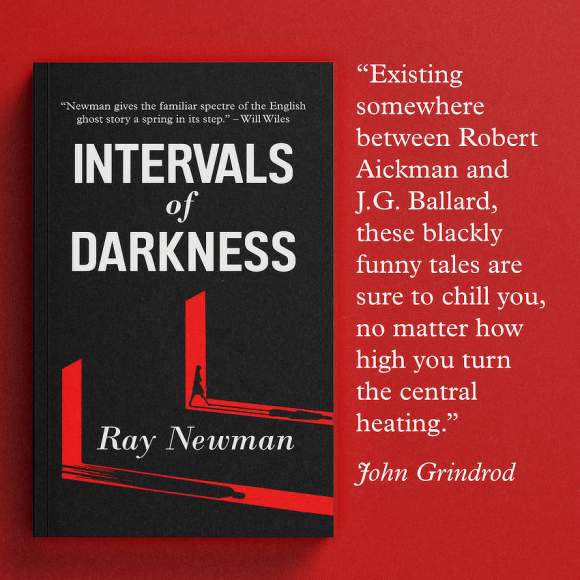
Intervals of Darkness will be published as a paperback and eBook on 7 September. You can pre-order the eBook now.
The inspiration for this story should be pretty obvious: British films with titles that begin ‘Night of the…’
That is, Night of the Demon from 1957 and Night of the Eagle from 1962.
The hero of the story is pretty obviously based on Dana Andrews, Brian Donlevy, Macdonald Carey, and other American actors who washed up in Britain when their careers began to founder.
Lots of low-budget British B-movies of the 1950s and 1960s have American stars looking bleary-eyed and rumpled round the edges, taking whatever work they could get.
A poster for 1962’s Night of the Eagle.
The story was also prompted by conversations with my pals Jamie Evans, Rory ffoulkes and Stephen Graves, at various points, about the extent to which folk horror is ‘played out’.
I wanted to have a go at writing a folk horror story which hit all the prescribed beats while also presenting some new images and ideas.
What are those prescribed beats? I don’t want to spoil the story but let’s just say that I think The Wicker Man is prime folk horror and Witchfinder General isn’t, really, despite its place in the canon.
Also in the mix were my memories of visits to Tewkesbury and Lübeck, which both have intriguing networks of alleys and courts – survivors of mediaeval street patterns. Tewkesbury also has its old Mythe Road – what a street name!
This story shares the name of its setting, Newhamstead, with another story in the collection, ‘British Chemicals’. As I said in the post about that piece, I’m not sure if they’re the same town or not. But I would be surprised if I don’t use the name again, when it feels right.
The idea of a village being absorbed into a post-war new town appealed to me because I’ve spent quite a bit of time thinking about new towns.
Finally, I should also admit that a significant inspiration – almost the spark for the story – was an American on Twitter sharing their astonishment the first time they heard a British person say, completely in earnest while offering to pour tea: “Shall I be mother?”
I lived in Penzance in Cornwall for six years, including several stormy, boarded-up off-seasons. This story is about how that felt – and about the distinctly haunted landscape.
I used to observe the coming and going of people throughout the year, and the rhythms of the tourist industry. Repainting and repointing in the run up to Easter. And the general air of exhaustion in early autumn.
I was especially struck by how silent Mousehole seemed in the gaps between holidays, when the second homes and rental properties were empty.
On Scilly, in Marazion, and in various other places, I’d pick up interesting details about how things worked – like the chip shop owners who shut for the winter and disappeared to Florida.
Another influence, though not directly referenced, was the Solomon Browne disaster of 1981. When the Penlee lifeboat went out in a storm to save crew and passengers aboard the MV Union Star. Sixteen people died including eight lifeboatmen from Mousehole.
This tragedy suffused the village and the area. The old lifeboat house was a permanent memorial on the coast path and The Ship Inn has a plaque and photographs of the lifeboat crew. Children and relatives of crew members still live in the area.
This sadness offers a strange contrast to the Instagram-friendly lifestyles of people from ‘up country’ who only come down when there’s a reasonable chance the sun will be out.
I can’t claim to have totally sussed Cornwall in six years. I doubt you could do that in four centuries. But I learned enough to tell this small story.
A note on ‘granfer’
A couple of stories in this collection use the West Country word ‘granfer’ – that is, grandfather.
I’ve heard it used naturally and without affectation in both Cornwall and Bristol, hundreds of miles apart.
The third story in Intervals of Darkness draws on research I did for an article published in Fortean Times a few years ago about a haunted factory.
My dad worked at the factory in question and we often talked about what might have made it feel spooky.
Point: the land was ancient, with old ghosts.
Counterpoint: everyone was exhausted and off their tits on chemical fumes.
This story, which Rowan Lee has suggested recalls the work of Nigel Kneale, is an attempt to explore that line between rational explanation and genuine supernatural experiences.
I also had in mind Danny Robins’s radio and TV series Uncanny which, especially in more recent episodes, has included ‘cases’ which seem less than convincing.
I asked myself in what context an account of a haunting might seem truly beyond doubt.
Perhaps being shared in private, behind closed doors, by someone who definitely isn’t seeking attention – and who has a strong commercial incentive not to have seen a ghost – might be convincing.
Working on this story on and off for the past couple of years I quizzed Dad to harvest convincing details.
Those were added to the stories I’ve been hearing for years about life working at British Cellophane, and other factories.
I also drew on my own teenage experiences of factory work, including the time I accidentally got high on solvents while cleaning a protective suit and floated across the shop floor giggling, unable to feel my legs.
Hints of worldbuilding?
The story takes place in a post-war new town called Newhamstead. That name also crops up
in another quite different story in Intervals of Darkness, ‘The Night of the Fox’.
I’ve always loved the way H.P. Lovecraft and his literary circle casually reused the names of places, characters, forbidden tomes, and monstrous entities.
That there’s no particular coherence in the way they are applied (despite later attempts by nerds to tidy things up) only adds to the sense of intrigue.
See also: those throwaway references in Star Wars to the Kessel Run and the Clone Wars.
So, I don’t know if the Newhamstead in these stories is the same place, exactly, or if this will one day add up to a ‘cycle’, but I couldn’t resist the deliberate internal reference.
The second story in Intervals of Darkness is unusual in that it’s not overtly supernatural – but it could have been, with a couple of tweaks, and is certainly, I think, weird.
It’s also one of the most personal, close-to-the-bone things I’ve ever written. In the sense that I sort of hoped my family wouldn’t read it.
It’s about a man who lives in a caravan on farmland, scraping a living with shift work.
This could describe more than one of my own late relatives, several people my parents have known over the years, and several people I’ve encountered in pubs up and down the West Country.
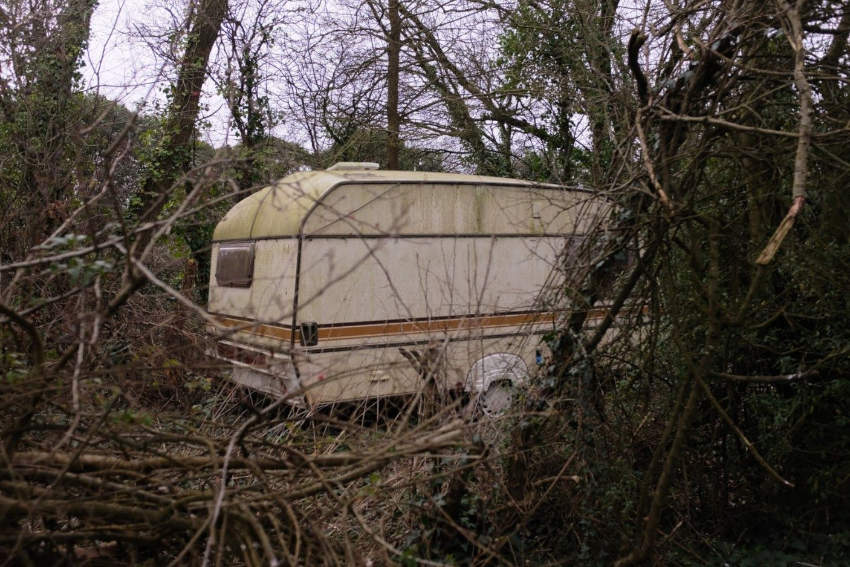
The specific trigger – the thing that put it on my to-write list – was a particular caravan in a particular field. It was overgrown, tangled among branches, and green with moss. And yet there were signs that someone was living in it.
(That’s it above.)
I stared at it for a long time, took a photograph or two. Then I thought about an uncle who died in a caravan in the corner of a field, and was discovered by my dad when he went round with his regular care package one weekend.
With a few wrong turns, that could have been Dad, too. Or me.
Eventually, I had a word with myself. Who else was going to write it if not me? And if I wrote it plainly, sincerely, honestly, I’d be using my small amount of privilege in a useful way.
Still, at first, I wanted to do what I usually do and hide behind the safety of a spooky story. An early draft ended, predictably, with more overtly supernatural events.
But, as with a story not in this collection, ‘The Architects’, I pulled back and let weirdness be a seasoning, rather than the sauce.
Writing it was an emotional experience. I had to stop several times, overcome with feeling, and even pushed to tears.
The feedback I’ve had since it was published at Minor Literatures suggests that people took the story as intended.
The Mark Yeo at Rooksbridge in Somerset.
On ‘reens’
The word ‘reens’ crops up quite often in my stories. That’s because I grew up in Somerset which is sliced all across with reens, or rhynes.
They’re drainage ditches – a human intervention in the landscape.
One near my parents’ house, the Mark Yeo, was created in the 13th century.
I find them romantic and mysterious in a very specific, unromantic, un-mysterious way.
Sometimes, they look like shimmering, infinite mirrors running towards distant hills.
And at other times, they’re full of beer cans and algae.
The story that opens Intervals of Darkness is an example of magically frictionless fiction.
I saw a call for submissions on the theme of ‘water’ and then, only a little while later, visited the wreck of the Mary Rose in Portsmouth.
Being me, I was drawn to the cabinets filled with skulls found aboard the wreck. What must it feel like to be killed in action, lie in the mud for several hundred years, and then be put on display?
The facial reconstructions added another layer of weirdness. In curatorial terms, this is good interpretation. It helps civilians like me understand the past more clearly, in human terms. But all those disclaimers, and the careful choice of language… Those reconstructions are just informed guesswork, really. And they always look a bit… wrong. Talk about the uncanny valley.
My other half says that she likes being with me when an idea for a story strikes me. She recalls it happening very obviously on this museum visit – “Must find notebook… Must write down… Haunted skull… Eye to eye with… Must find notebook…”
Then I did something at which I’m worryingly good: quickly absorbed a bunch of writing about ships, sailing, and archaeology, and synthesised it into some plausible bullshit. It wouldn’t fool anyone who knows a lot about those subjects (I suspect Steve Toase might fling the book into a fire) but it’s enough to sell the story to most readers, I think.
Having successfully begged for an extended submission deadline I hammered out a first draft of the story in a couple of hours. And not much changed in the rewrite.
Maybe that impassioned drafting gave it a boost. I don’t think it’s an exaggeration to say that Verity Holloway, editor of Cloister Fox magazine, snapped it up – and she’s told me again since what a great story she believes it to be.
This was also the story that signalled a slight change of direction from Municipal Gothic. Not every story I write has to be set in those working class environments where I feel most at home.
It’s also the first time I’ve written a story intended to evoke Nigel Kneale. I was thinking about his particular niche – that intersection of technology and the spirit world, as in The Stone Tape – and wondered if and how a computer-generated model might become possessed.
The first review, from Rowan Lee, mentioned Nigel Kneale, though not in connection with this story, so that thread obviously runs throughout the collection.
Blooper reel
In the original draft of the story I had my ship, Faerie, sailing from Falmouth to Portsmouth, but sinking in Mount’s Bay. Revising it for Intervals of Darkness I thought, hold on, that doesn’t make sense… So now, she was bound for Kinsale instead.
The first draft of the story had the eyes as being in the ‘stern’ of the skull but it got fixed in the edit. Look, I told you I was blagging this.
I’d have been shy about calling myself a ‘working class writer’ a decade or so ago. Which is ridiculous, with hindsight – because what else am I?
The stories in my last collection, Municipal Gothic, and in my upcoming book, Intervals of Darkness, are mostly attempts to process my experiences as a working class kid.
But if that working class kid could hear me, a university graduate and professional, referring to myself in these terms, he’d be furious.
“How can you call yourself working class?” he’d ask, “with all your privileges and relative comfort in life?”
Back then, I thought being working class was a binary state.
I read and admired books by people like Alan Sillitoe but also hated them for moving to London, or France, and becoming part of the literary establishment.
How could they write about working class life when they weren’t living it?
I was an idiot, of course.
How would Sillitoe have found the time and energy to write if he also had to do night shifts on a production line, you know, to keep his hand in?
And how long did I think it took to become middle class? It’s not an overnight process.
What I came to realise is that you don’t ever really shed working classness. It’s baked in. It shapes your attitudes to life and your perspective on the world. In the negative sense, the scars are permanent.
Sure, I got a desk job, wore a suit, and stopped worrying quite so much about money – but working classness continued to affect my ability to connect with people, to get promoted, and to experience basic human happiness.
If I experience the slightest financial shock – an unexpected bill, for example – I completely flip out, and revert to being an anxious child. Even if, once I’ve taken a breath and counted to ten, I can easily afford to deal with it.
My dreams were, and often still are, set on council estates and in council houses. My stories always drifted back to those same settings – pubs, terraced houses, small towns, factories… Even if I wanted to write middle class fiction, I’m not sure I could.
The characters in my stories are often aspects of my late dad, his brothers, or my mum and her family, or of people I knew growing up.
And sometimes they’re versions of me. A clue to that is if the character in question is uptight, bewildered, and slightly detached from their surroundings.
What makes a working class writer? In my opinion, they’re someone with personal, first-hand experience of working class life. (Not someone whose grandfather was a miner.) And whose writing, consciously or otherwise, attempts to make sense of that experience.
Often, perhaps too often, that can feel limiting. What if you don’t want to write grim social realism? What if you don’t want to constantly confront your own experiences of poverty? Or, on the flipside, to feel obliged to write inspiring stories about the power of working class community.
Personally, I don’t want to be a Working Class Writer. I want to be a writer. I want to write what I want to write.
And I don’t want to agonise constantly about whether I’m presenting my working class characters with sufficient nobility, or making the right political arguments.
So, sometimes, I might get it ‘wrong’. But it’s not out of stupidity or ignorance, it’s because I’m battling my own subconscious, or attempting to exorcise a ghost of my own.
Intervals of Darkness will be published as an eBook and paperback on 7 September 2024. You can pre-order the eBook now.
Alan Newman playing bass with The Blue Healers at Baptist Mills Studios in 2018.
Alan ‘Ginge’ Newman has died at the age of 75 after a lifetime of making and thinking about music.
He wasn’t a full-time musician, however, because like most people he had to work to support his family – that is, my mum, Eileen, my brother, Tim, and me. That he found time to pursue creative interests around night shifts, factory work, warehouse work, and even a stint digging graves, suggests just how strongly that flame burned.
He was born in 1948 at Woolavington on the Somerset Levels to Agnes and Ernest Newman, East Londoners who moved west for military service and war work and never went back. Alan loved Somerset, spoke with a wonderfully warm local accent, and flew a Somerset flag in his back garden until the day he died. Nonetheless, he felt those London roots, which manifested in an occasional imitation of his father shouting “Gertcha!” (via Chas & Dave) and his support for Arsenal.
His childhood was difficult in various ways. First, there was poverty. The Newmans lived throughout the 1950s in a rickety prefabricated house on a council estate appended to a village. He later recalled shivering beneath an Army greatcoat in an unheated bedroom with ice on the windows and he was utterly baffled by nostalgia for prefabs and post-war Britain.
Secondly, there was illness. Not expected to survive longer than a few minutes, he was named quickly by a nurse who borrowed his mother’s initials (Agnes Kathleen) to conjure up Alan Keith. He lived but thereafter spent months in hospital, and years in and out, with an undiagnosed respiratory condition.
Thirdly, there was the challenge of growing up in a family ruled over by a heavy-drinking, gambling, womanising bully whose time in the Royal Navy did nothing to sweeten his manners or temper.
It’s perhaps no wonder that Alan was an unruly child and teenager who drank his first pint of beer in a pub at the age of 12. Though ashamed of it for much of his life he spoke more openly in recent years about his adventures in joyriding and his juvenile criminal record for breaking into the village shop to steal cigarettes. In fact, one of his favourite stories was about returning from a screening of the 1962 film Some People at the Palace Cinema in Bridgwater to find his father furious after a visit from the police.
“Where have you been, boy?”
“In town to see Some People.”
“Oh, yeah? Some People? Well while you’ve been out, some bloody people have been here to see you.”
Though a scholar in his own way – more on that later – Alan didn’t enjoy school and was happier playing sports or, more often, mucking around with a gang of friends. He left Sydenham, the brand new comprehensive in Bridgwater at 15, with no qualifications and went straight into the world of work, where he would remain for 50 years.
He trained as an apprentice coachbuilder for a while, then became part of a demolition crew for Pollard’s of Bridgwater. “If you wanted something smashing with sledgehammers,” he later recalled, “you called the Newman boys.” There was also a stint in the Army which, to his great disappointment, was cut short because he failed a medical examination. (Or perhaps, as he once suggested, because he joined the Young Communist League hoping to meet liberated women, which wasn’t the done thing for people serving in the armed forces during the Cold War.)
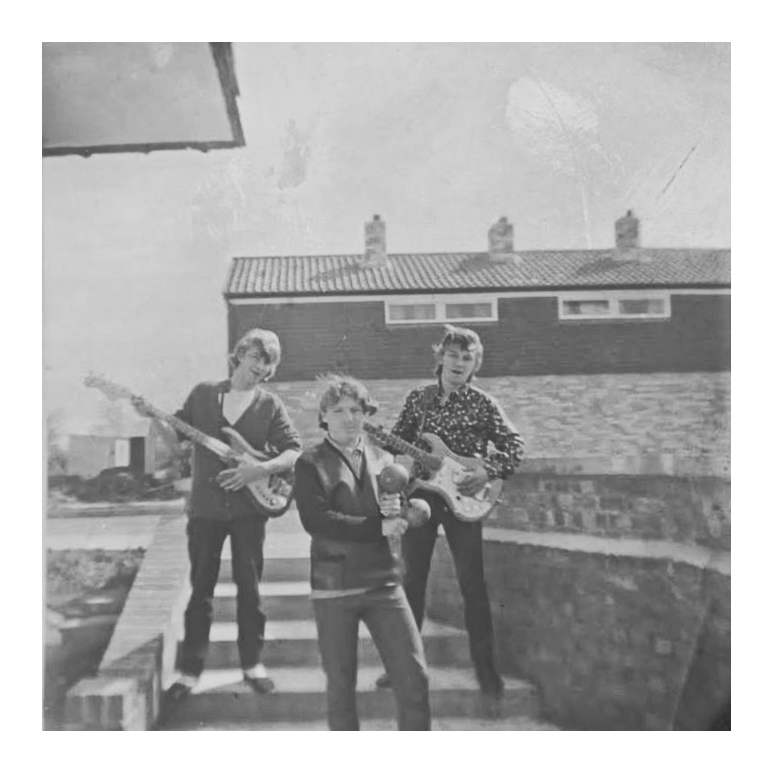
Alan (front, centre) with his brothers in one of the various incarnations of their band Ginger Ellis & the Dracos.
Like many teenagers in the 1960s he also developed an interest in rock’n’roll music and formed a succession of bands. Under a pseudonym he was lead singer and leader of Ginger Ellis & the Dracos. Later, in red velvet flares during the psychedelic era, he fulfilled the same role in The Keystone Kops, who even cut a single with ‘Can’t Stand No More’ on the A-side and ‘The Rise and Fall of a Persian Pig in E-Minor’ on the flip. Alan’s favourite band was The Rolling Stones whose first two albums, filled with R&B, rock’n’roll and blues covers, would form the template for his musical taste for decades to come.
Alan and Eileen met in 1970 in a Bridgwater pub on a busy Saturday night. He was 21, she was 17, and they were engaged by the following Thursday. They married in 1971. Drifting away from his own family he found a warm welcome from Eileen’s parents and the four of them became drinking buddies, chain smoking cigarettes, and playing the four-player card game euchre as they crawled the pubs of St John Street, Eastover, and into town.
Though he continued to buy and play records, loudly, he had less time to make music as he settled into a steady job at British Cellophane. Wading in troughs of solvent without adequate protection no doubt did some lasting damage but, at the time, he was simply happy to be bringing home the kind of money that paid for a house, a car, and a decent quality of life.
It was difficult to have children and took longer than expected. A secret Alan and Eileen kept for decades was that they ended up using the then pioneering technique of donor insemination (DI) via Dr Margaret Jackson’s clinic in Devon. Perhaps he felt embarrassed about this, or felt it to be a failing on his part, but as far as my brother and I are concerned, it shows the sheer generosity of his spirit. He suggested this because Eileen needed it, and committed fully to the experiment. And he was never less than doting as a father, and never gave us the slightest reason to doubt he loved us – which is not always the experience of people conceived through DI. When we learned the truth many years later, Alan’s first concern was whether it changed anything in his relationship with his sons. We were able to tell him that not only had nothing changed but, if anything, we respected and loved him all the more.
Alan loved to play darts and got pretty good at it as a pub landlord.
In the 1980s, Alan and Eileen took on a decrepit Whitbread pub in Exeter which they ran for several years. Alan had a real talent for engaging with customers and creating a sense of community. His turn as Widow Twankee in the pub pantomime was a surprising success, again revealing an instinct for creativity and performance at odds with his macho persona. Unfortunately, it is and always has been tough to make a living in a tied public house, and the experience bankrupted them.
Alan hated to be unemployed and resented living in a council house, which became necessary in the aftermath. It was in this low period that his dormant interest in blues music resurfaced – perhaps because he was now feeling it in his heart. He acquired a cheap electric guitar, a Gibson Les Paul copy, and tried to learn to play. When that didn’t work, he switched to the bass guitar and realised he had found his instrument. Our house began to throb to the sound of walking 12-bar patterns, or the sparse moodiness of the bass part for ‘Stormy Monday’.
Working long night shifts plus overtime operating a lathe at Wellworthy’s in Bridgwater he had little time and even less energy. Blues bands would form around him, rehearse for a while, then break apart. All the time he kept listening to blues music, reading about blues music, and lecturing anyone who would listen about the career of Muddy Waters, or chord progressions, or the meaning of the obtuse lyrics of 1930s acoustic blues songs. What is a peach-tree man? Alan could tell you. The house was filled with books such as Paul Oliver’s The Devil’s Music. He was often to be seen in the crowd at gigs in Bridgwater, Taunton and further afield, at a time when blues music was a staple part of the offer at pubs and social clubs across Somerset.
As a performer, things finally came together at around the turn of the millennium when Alan met his great friend Les Leiper and they formed the band Witch Doctor. At last, he was part of an efficient gigging band that played most weekends in pubs across the region, with the thump-thump-thump of Alan’s bass providing a steady clock. His proudest achievement was playing multiple gigs at The Old Duke in Bristol, a legendary jazz and blues venue where he’d previously seen some of his own favourite bands perform. When Alan eventually left Witch Doctor it was partly because, being a man of his time, he was unable to express his frustrations in words. Quitting was the easier option.
In the years that followed, he joined or formed many more blues bands, each one with its own unique style and set list. The Blue Healers, for example, gigged in Bristol and elsewhere. Alan’s problem was that he wanted to play blues music, and nothing but blues music, and, inevitably, most bands would start to talk about adding soul or classic rock tunes to the set. ‘Mustang Sally’, though a fine song, did not belong in the repertoire of a blues band. Nor did ‘Sweet Home Alabama’. Again, although he got better at having these conversations, he would often simply leave rather than deal with conflict or awkwardness.
Alan retired from his final job as a warehouseman at 67. He’d been doing heavy, physical work for most of his life, and his body had begun to creak. His lungs, never quite 100% functional, began to fail him and he was diagnosed with both asthma and chronic obstructive pulmonary disease (COPD). You can’t help but wonder about all those jobs – demolition in the era of asbestos, factory work with baths of solvents – and the cold dampness of his childhood home. Still, in retirement, with two beloved dogs, he started to get fit, rambling with Eileen over the Mendips and across the Levels.
Both being village kids, at heart, they moved to the country, settling in Rooks Bridge. He would stand and stare at the landscape, listen to the birds, and relish the fresh air. His bands sometimes rehearsed in a nearby stable, or in the kitchen at the house, and the neighbours would turn off their TVs to listen.
During the pandemic his lung conditions put him in a high risk category and was effectively trapped in the house for several months. This did him no good and he emerged from successive lockdowns seeming suddenly much older and far less robust. A chest infection in 2023 never quite cleared and dragged him down for over a year. Finally, in August 2024, it got him. He died while receiving care at Weston General Hospital, not long before dawn.
That urge to make music, and to create, was with him until the end. Shortly before he went to hospital for this final stay, he started talking about recording a podcast, and also snuck an advert onto Facebook when Eileen wasn’t looking: did anyone want to form a blues band for some low key rehearsals?
Alan Newman, born November 1948, died August 2024.
Everything about the American serial killer Charles Schmid sounds pathetic – so how was he able to command the loyalty of his teenage followers?
That’s a question grappled with by two films based on Schmid’s story, 1971’s The Todd Killings, directed by Barry Shear, and 1985’s Smooth Talk, directed by Joyce Chopra.
Both films ultimately share the same original source: a 1966 Life magazine article by Don Moser called ‘The Pied Piper of Tucson’.
That article is a masterpiece of true crime writing, available online, and also collected in a 2008 Library of America anthology. Moser painted a picture of a loser and weirdo who, in his early 20s, was still hanging around with school kids in Tucson, Arizona:
At the time of his arrest last November, Charles Schmid was 23 years old. He wore face make-up and dyed his hair. He habitually stuffed three or four inches of old rags and tin cans into the bottoms of his high-topped boots to make himself taller than his five-foot-three and stumbled about so awkwardly while walking that some people thought he had wooden feet. He pursed his lips and let his eyelids droop in order to emulate his idol, Elvis Presley. He bragged to girls that he knew 100 ways to make love, that he ran dope, that he was a Hell’s Angel.
But Schmid was somehow appealing to teenagers who saw not a creep but a local own-brand version of Elvis Presley:
He had a nice car. He had plenty of money from his parents, who ran a nursing home, and he was always glad to spend it on anyone who’d listen to him. He had a pad of his own where he threw parties and he had impeccable manners… He knew where the action was, and if he wore make-up—well, at least he was different… [To] the youngsters – to the bored and the lonely, to the dropout and the delinquent, to the young girls with beehive hairdos and tight pants they didn’t quite fill out, and to the boys with acne and no jobs – to these people, Smitty was a kind of folk hero. Nutty maybe, but at least more dramatic, more theatrical, more interesting than anyone else in their lives: a semi-ludicrous, sexy-eyed pied piper who, stumbling along in his rag-stuffed boots, led them up and down Speedway.
Schmid was more than “nutty”. He tortured at least one cat, for starters. Then, in May 1964 he convinced two young friends to accompany him as he kidnapped, raped and murdered 16-year-old Aileen Rowe. They helped him bury the body in the desert – and kept his secret.
A little later, in the summer of 1964, he met 16-year-old Gretchen Fritz at a swimming pool. He seduced her and they had a rocky year-long relationship. It culminated in the death of both Gretchen and her younger sister, Wendy, in August 1965. When he showed a friend called Richard Bruns where the bodies were buried in the desert, Bruns turned Schmid into the law.
Schmid was convicted of murder in August 1966 and sentenced to death. By June 1967 a film based on the story was in production.
Robert F. Lyons as Skipper Todd in The Todd Killings.
The Todd Killings: torn from today’s headlines!
The Todd Killings had a range of working titles like ‘Pied Piper of Tucson’, ‘The Pied Piper’ and ‘What Are We Going to Do Without Skipper?’
It was eventually released in 1971 with the action relocated from Tucson to the fictional town of Darlington, California.
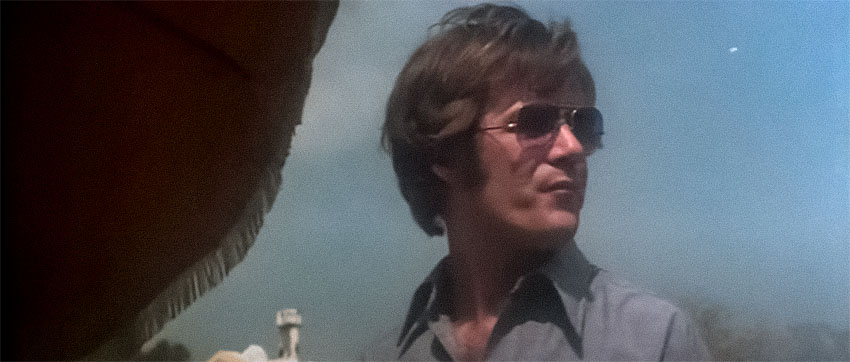
Schmid became ‘Skipper Todd’ played by Robert F. Lyons, with his look and lingo brought up to date. Skipper has shaggy Mick Jagger hair, tight bell bottoms, and a green dune buggy. He also plays folk rock songs on an acoustic guitar, almost like a spare member of The Monkees, or Charles Manson.
Lyons really is good looking, though, and brings to the part a commanding arrogance. The children follow him because he has the qualities of a leader. In odd, intercut scenes he is shown lying to a US Army recruiter to wriggle out of fighting in Vietnam where, actually, he might have thrived as another William Calley.
Updates and poetic licence aside, the film is an otherwise relatively faithful recounting of the facts of the case.
It has a particularly strong opening: Skipper is burying a body in the desert, helped by a devoted young girlfriend and a panicky boy.
This is not a whodunnit, or a did-he-do-it, like Psycho. That this young man is bad is established from shot number one.
From the off, we also empathise with the bored kids who are groomed by Skipper Todd, even as we want to shake them by the shoulders and urge them to break free.
We even begin to understand why they would reward his madness and violence with devotion. They are weak, and their parents are weak, too. He is good at spotting weakness and filling the gaps in people’s live. He has everyone, both boys and girls, under an erotic spell.
Did Charles Schmid ever see The Todd Killings? He died in prison in 1975 so it’s just about possible. If so, he would probably have found it flattering.
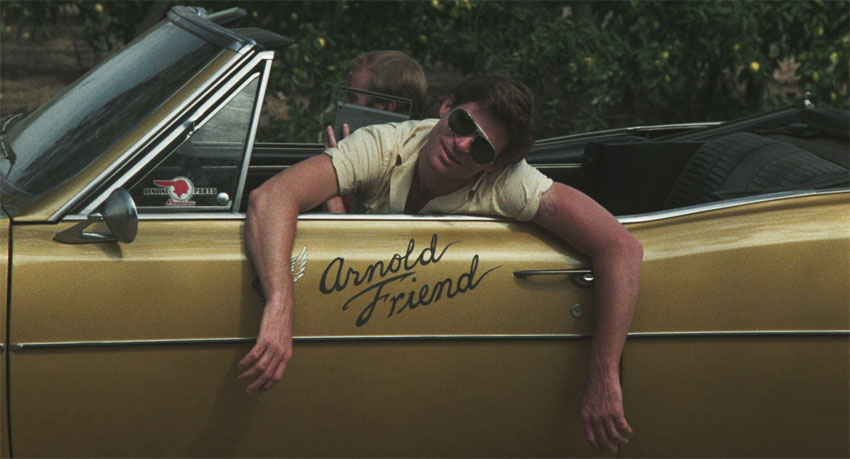
Treat Williams as Arnold Friend in Smooth Talk.
Smooth Talk: back to the future
More than a decade later a second film tackled the story more obliquely, and more artfully. Joyce Chopra’s Smooth Talk from 1985 was not based on Moser’s article but on a short story by Joyce Carol Oates, ‘Where Are You Going, Where Have You Been?’ first published in 1966.
In Oates’s version of the Schmid affair, which was distilled from Moser, the monstrous fake teenager is called Arnold Friend. He stalks, seduces and seizes a teenager called Connie while her well-to-do parents are out at a barbecue. It crams a lot into a few thousand words and presents small town America as a menacing, sickly place.
Smooth Talk expands on the short story significantly, using Oates’s original material to form only the final act of the film.
It also does something really clever with the period. Connie (Laura Dern) is a quintessential 1980s teenager straight out of a John Hughes movie, while Arnold Friend (Treat Williams) is a relic of the 1950s. He is a cheap knockoff of James Dean (Connie has posters of Dean on her bedroom wall) and therefore closer to the real Charles Schmid than Skipper Todd.
In this, there’s an echo of another film: Terence Malick’s Badlands from 1973, in which Martin Sheen based his performance as spree-killer Kit Carruthers on James Dean. Kit wasn’t based on Charles Schmid, however, but his near namesake, Charles Starkweather – another rural weirdo with a taste for teenage girls.
In some ways, Arnold Friend is a less complex character than Skipper Todd, or the real Charles Schmid. He’s a sinister stranger, not a ‘pied piper’ who everyone knows and admires. He’s clearly a much older man (Williams was 34 when he played the part), dressed anachronistically, and almost supernaturally sinister in his manner, like an avatar of the Devil after Connie’s living soul.
In this version of the story Arnold Friend doesn’t kill anybody – as far as we know. He stalks Connie and, eventually, convinces her to go for a ride. This is roughly where Oates’s story ends and in that version we’re left to speculate on her fate. But if you know it’s inspired by Schmid your speculation is likely to favour murder.
In the film, Connie returns. She is changed – an adult, now, and no longer innocent. But she is, at least, not dead and buried in the desert.
In almost every way Smooth Talk is the better film. Not least because it makes Friend/Schmid an exterior menace and puts in the turbulent mind of one of his victims.
The Schmids, they’re multiplying
There is something particularly dark and rich about this story which must be why filmmakers keep coming back to it.
There’s Dead Beat from 1994, which seems almost impossible to see; Lost from 2005, adapted from a novel by horror writer Jack Ketchum; and Dawn from 2014, which focuses on the sister of one of Schmid’s victims.
Schmid is not the only killer to have inspired multiple movies, though. In fact, it’s unusual for a notable serial killer not to have inspired multiple movies.
Leopold and Loeb are practically a sub-genre (Rope, Compulsion, Swoon). So is Ed Gein – the original model for six decades of psycho-slashers, from Norman Bates to Leatherface. And Badlands is by no means the only take on the Charles Starkweather and Caril Ann Fugate story.
As a writer of fiction I find it almost maddening that real life generates stories that are so much more out there than anything I could invent. If I’d created Charles Schmid as a character it wouldn’t have occurred to me to give him white foundation make-up, a fake mole, and shoes full of crushed tin cans. Real criminals are often both dumber and more interesting than their fictional counterparts.
More importantly, I don’t know if I’d have been able to look at Schmid through the eyes of a teenager and have them think, “That guy is cool, I love him, I’ll do whatever he says.”
Main image: A digital sketch based on several different photos of Charles Schmid composited, traced, and treated with textures and filters.
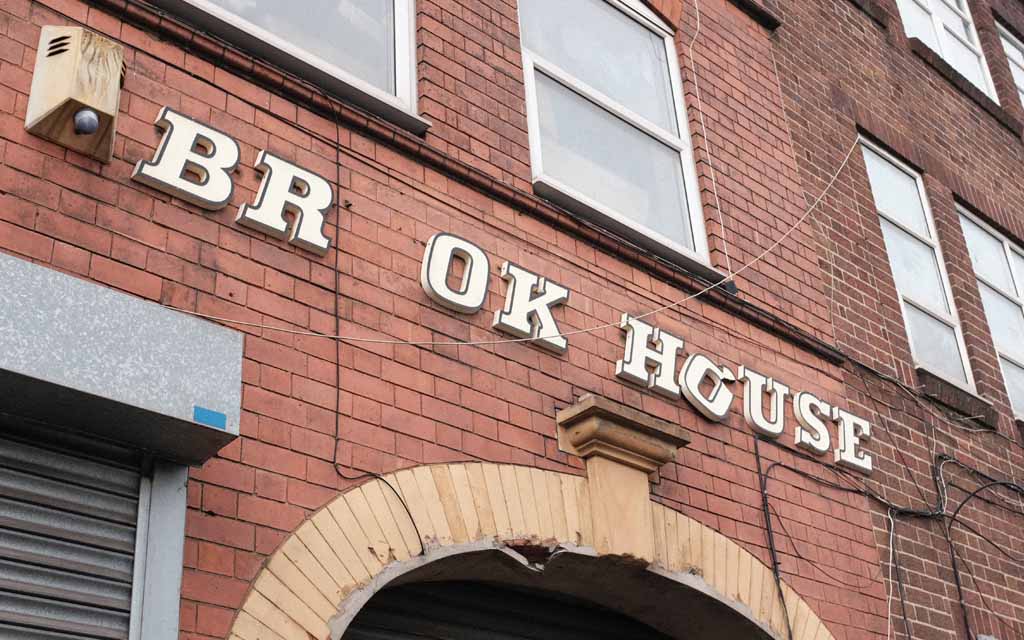
What is that font? You know, THAT font? The chunky italic lettering you see on launderettes and council blocks, on post-war churches and new town butcher’s shops, across the UK.
The font you’re thinking of might well be ‘Festive’, a lettering style designed by Maurice Ward of Ward & Co, a sign-making company in Bristol, founded in 1952.
Launched in the early 1960s, Ward’s ‘Inter-signs’ product, manufactured under the Lettercast brand, used injection moulding.
Lettersigns was available in two styles, Festive and Block, and made it possible for anyone to mount their own custom signs with professional-looking 3D lettering.
Or, of course, the specific sign you’re thinking of might be in one of any number of similar lettering styles in the broader category of ‘Egyptian italic’.
Samples of lettering styles similar to Festive cobbled together by me from various sources including The Studio Book of Alphabets, 1963.
Those include:
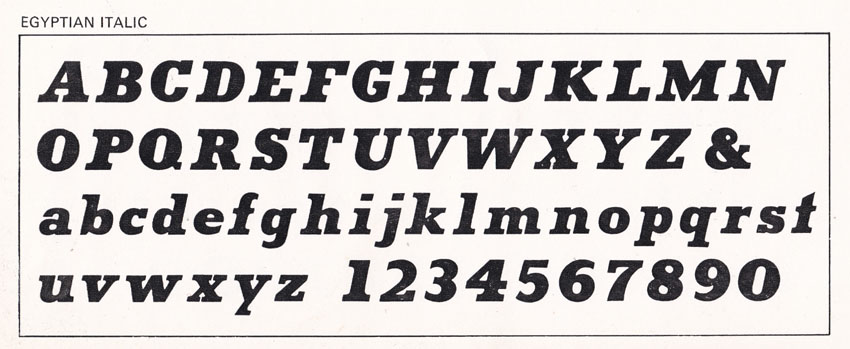
Egyptian Italic (an earlier Ward & Co style)
Festival Egyptian (an official style of the Festival of Britain)
Stymie Bold Italic
Clarendon Bold Italic
Profil
Amigo No. 1
First, then, let’s pin down how to spot Festive in particular.
How to spot Festive
Trade catalogues from Wards of Bristol include samples of Festive in print.
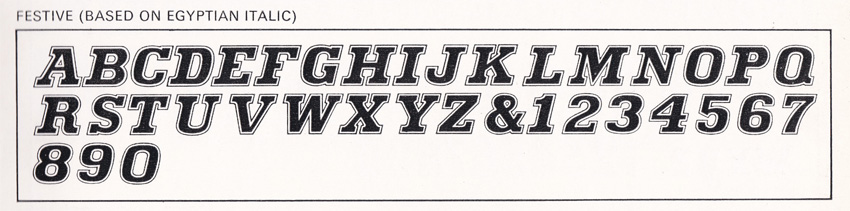
From this, we can see the most distinctive features of Festive, which can help us distinguish it from similar lettering styles in the wild.
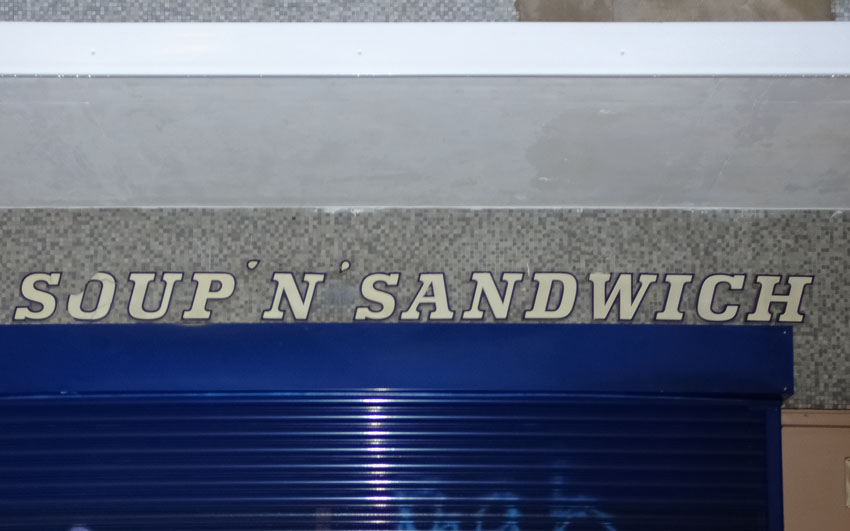
A sample of Festive from a Ward’s catalogue from, I think, 1971.A shop sign in Bristol in Festive, author’s own photo.
First, there’s the unexpected serif at the apex of the capital A.
Then there’s the relative flatness of the round letters, like C and G.
And, of course, there’s the built-in beading – that outer line that traces the edge of each letter.
The origins of Festive
There’s a clue right there in the name: like almost every bit of flair in Britain’s mid-20th century public spaces, it came indirectly from the 1951 Festival of Britain.
One of its official lettering styles was ‘Festival Egyptian’, as depicted in the typographic handbook for designers.
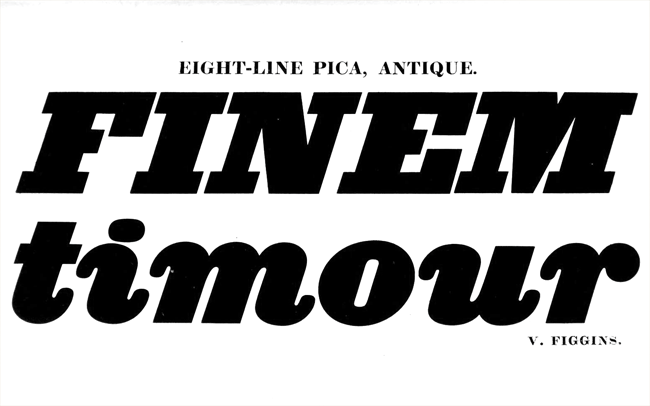
But why Egyptian? In around 1817, London type founder Vincent Figgins created a typeface he referred to as ‘Antique’.
An 1834 sample of an italic variation of Antique. SOURCE: archive.org
It was fat, bold and easy to read from a distance.
Earlier examples of this style have been found but Figgins commercialised it and prompted imitations from other foundries worldwide.
These days, they’re known as slab serif fonts but in the 19th century, they were usually referred to as antique, after Figgins; or as either Ionic or Egyptian, in variations on the theme.
You can certainly see in Antique, especially when italicised, the seeds of the 20th century launderette signs and tower block titling.
But these in-your-face, ungainly display typefaces went out of fashion, like everything associated with the Victorians. They spoke of slums, music halls and Gothic mausoleums. They weren’t fit for the world of motor cars, aeroplanes and Streamline Moderne.
Then, in the 1930s, a revival began, achieving its full flowering with the 1951 Festival of Britain. This is documented in detail by Paul Rennie in this 2001 essay (PDF) but here are the key points.
First, the cover of John Betjeman’s first book Ghastly Good Taste, published in 1933 when he was still in his twenties, showcased a jumble of Victorian typefaces.
Then, in 1938, came Nicolette Gray’s book Nineteenth Century Ornamented Typefaces, celebrating Victorian lettering styles.
And in the same year, the architect and townscape designer Gordon Cullen personally produced (non-italic) slab serif lettering for the starkly modern Finsbury Health Centre. It is clearly ahead of its time and wouldn’t look out of place on a municipal building erected 20 years later.
Though the British Government generally clung to clean, uncluttered sans serif typefaces such as Gill Sans for official posters (Keep Calm and Carry On, chaps) advertising designers and publishers dabbled in Victorian styles throughout the 1940s.
After World War II, In the run up to the Festival, committees and working groups were put together to consider every small detail, including typography. Gordon Cullen and Nicolette Gray were both on the Festival of Britain Typographic Panel.
Once the Festival was over, Festival style lingered. Lettering catalogues from the 1950s and 60s include, for example, Egyptian Italic, Rockwell Italic and Ultra Bodoni Italic.
A sample of Egyptian Italic from a Ward’s catalogue of 1971.
Maurice Ward wrote this of his Egyptian Italic, the immediate precursor to Festive, in a catalogue from 1962:
[This] face, together with its vertical counterpart is a harmonious combination of the best features of the Egyptian family of characters and is perfectly suited as an architectural letter on buildings. The popularity of these Egyptians is unquestionably due to the Festival of Britain in 1951 and no face characterises more aptly the word ‘Festive’.
And when Ward & Co (Lettercast) launched Festive in around 1963 it was labelled as “based on Egyptian Italic”, which was in turn a take on Festival Egyptian.
The A from Egyptian Italic (left) and from Festive (right).
Feelings about fonts
What’s fascinating about Festive is how it moves people emotionally, and obsesses them.
The writer Jason Hazeley has been trying to identify it for years, for example, referring to it as “That Font” or “Everywhere Bold Italic”.
And he is not alone. For a generation of British people, it represents the vanishing landscape of their childhoods, tied into ideas of nostalgia and even hauntology.
Graphic designers have often resorted to Profil as a close match – and, of course, Festive was never really intended to be used in print.
On social media, including a popular Flickr group, Stymie Bold Italic has incorrectly been used to describe this entire category of lettering styles.
It’s only recently, however, that illustrator and designer Richard Littler of Scarfolk fame managed to unlock the mystery – or, at least, bring together all the threads.
When he put out a call on social media his significant reach across multiple platforms, with exactly the right kind of people, brought to light:
The latter, a spectacular piece of work, has been sitting there for anyone to find since 2020, in a different domain of geekiness – if only type nerds had known to search ‘Inter-signs’ and ‘Lettercast’.
Personally, I’m a bit embarrassed not to have got there sooner. Back in 2020 I spent some time researching this seriously. I got in touch with Andy Ward, Maurice Ward’s son, who tipped me off to Egyptian Italic, and sent me photocopies of material he had at hand, at home, during lockdown.
And then Christine Daniel sent me photos of the back of some sign letters in her collection with ‘Inter-signs’ clearly marked on the back. But I couldn’t quite make those final links.















 Precast Reinforced Concrete Heart
