Categories
Fiction Film & TV weird fiction

12 thoughts about liminal horror

The new film Backrooms directed by Kane Parsons has everyone talking about ‘liminal horror’. As someone who writes stories which might fit into this bracket, I’m excited to have a new sub-genre to ponder.

Here are some initial thoughts – reactions, almost – to a phrase I had not heard until about three days ago.

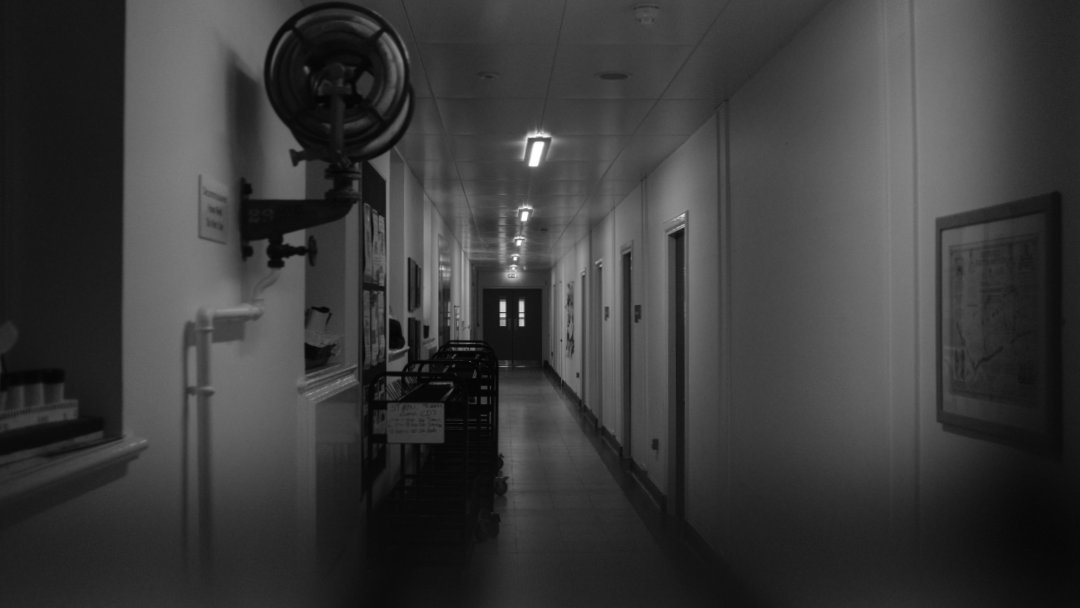
1. In liminal horror the space itself is the source of the unease, not the ghosts or monsters that lurk within it. A still image of an empty room can evoke the appropriate sense of unease, partly because it is empty.
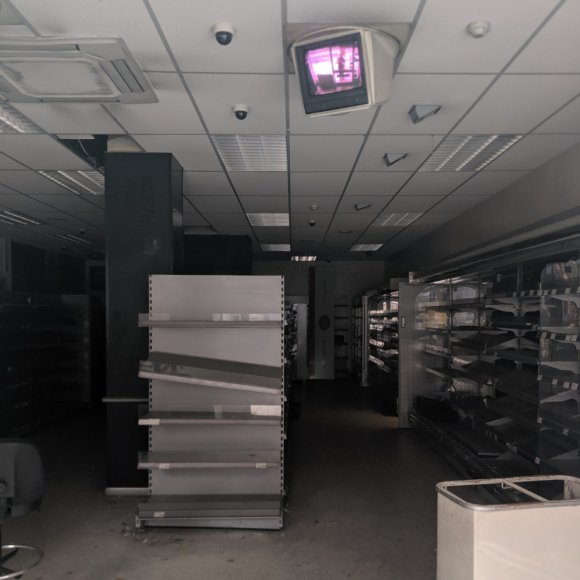
An empty, abandoned shop with bare shelves, dark shadows, and security monitor on the ceiling glowing purple.

2. “It’s bigger on the inside…” Perhaps liminal horror is about spaces that should not be and that make no sense. A long corridor is creepy; a corridor that seems infinitely long is deeply unsettling. H.P. Lovecraft wrote about spaces with non-Euclidean geometry just as he referred to impossible colours. You might also think of the deliberately disconcerting geometry of Hill House in Shirley Jackson’s The Haunting of Hill House. Or even the land that somehow sits beyond the back of the wardrobe in the works of C.S. Lewis.

3. Do we hate these eerie spaces, or yearn for them? It’s a love-hate relationship. We call it liminal horror but there’s also a romantic allure about places that are silent, empty, blank… Where we might lose ourselves, slip between walls, and be left alone for two fucking minutes. In Genki Kawamura’s Exit 8, the other liminal horror film currently doing the rounds, the protagonist finds himself on a subway station corridor that he soon learns is an impossible space and a trap. But at the beginning, for a moment, he is free from the noise and aggression of the city – and from his responsibilities. Did he perhaps want this?
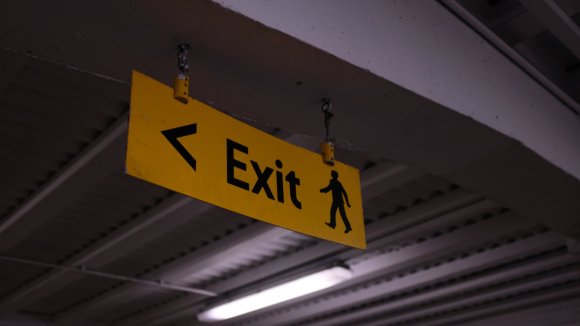
A dangling yellow exit sign in a brutalist car park with poor lighting.

4. Did Lucio Fulci get there first? I know, I know, I’m always on about Fulci’s 1981 film The Beyond, which I don’t even think is a good film, and certainly isn’t one I’d recommend to everyone. But the ending has the protagonists run down a staircase in a hospital and find themselves in the labyrinthine basement of a hotel from which they had earlier fled. They continue their flight until the basement opens up into an infinite, foggy plain strewn with shrouded corpses. That feels like liminal horror to me.
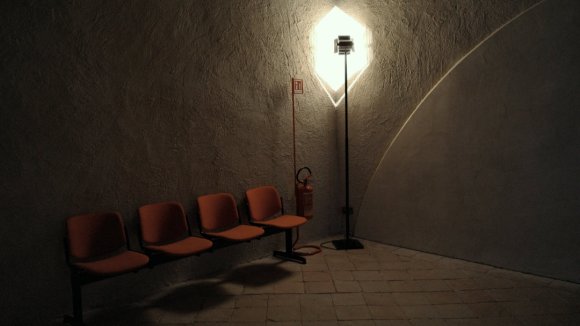
Four seats against a concrete wall in a dark corner of an institutional building.

5. These are some other things that are coming to mind, but I don’t know if they’re liminal horror:

  • the mausoleum in Phantasm
  • the wasteland and abandoned industrial buildings of Stalker
  • the near-abandoned apartment block in Dark Water
  • the shopping mall in Dawn of the Dead
  • Dave Bowman’s tacky hotel room in space in 2001: A Space Odyssey
  • Judgement City in Albert Brooks’s comedy Defending Your Life
  • Being John Malkovich and the floor between 7 and 8
  • that perfectly white room where Willie Wonka shrinks Mike Teavee

6. “Alright, cunt, what happens?” – Reece Shearsmith. Liminal horror as internet meme doesn’t need a plot, or characters. It can just be, “Whoah, look at this weird door I found,” or, “Check out this hallway!” But books, stories and films generally do require things to happen to people. But does this spoil the fun? Perhaps liminal horror is a rare sub-genre that might work best in virtual reality.
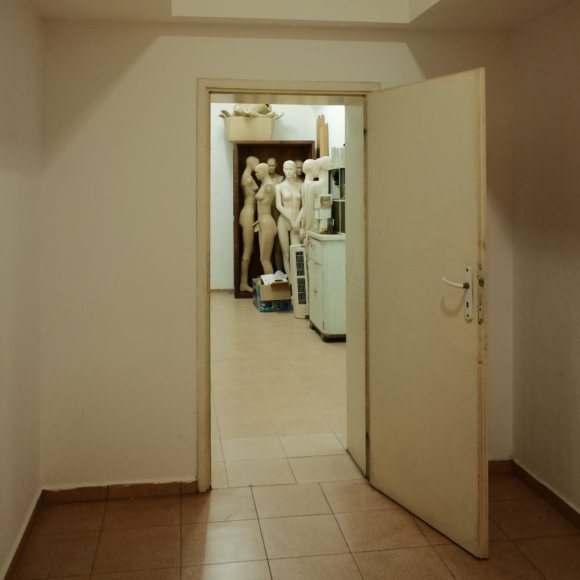
A door in a dingy basement through which can be seen a group of creepy white mannequins gathered around a wardrobe.

7. Oh, actually, never mind Fulci – perhaps Elizabeth Jane Howard got there first. At the end of her story ‘Three Miles Up’ from 1951 concludes with a canal boat exiting a channel not on the map into “a sheet, an infinity, of water stretched ahead; oily, silent, and still, as far as the eye could see, with no country edging it, nothing but water to the low grey sky above it.” Infinite, edgelesss and endless feel like the qualities we’re looking for here.

8. Are the spaces where liminal horror stories take place related to ideas of heaven, purgatory or hell? I mentioned Defending Your Life above which isn’t a horror film but, like the sitcom The Good Place which I’m sure it inspired, suggests that death might feel like being in a waiting room. “I’m in the waiting room now,” is something my mum actually says when pondering her mortality. Waiting rooms, like corridors, are spaces between spaces, checkpoints or chokepoints on a journey rather than the final destination.
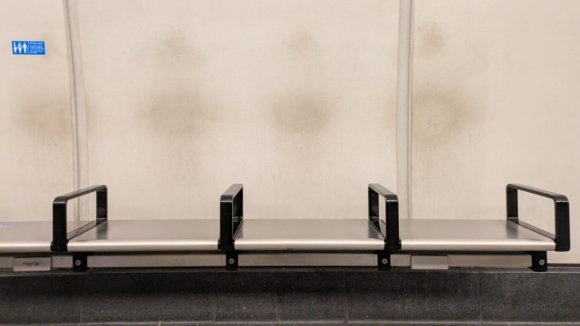
A bench on the London Underground with dirty smudges on the wall showing where people have been sitting.
Ghosts of the Elizabeth Line, London.

9. Fog creates instant liminality. It erases the edges, swallows the horizon, silences the world, and leaves you floating in space. It turns any house into The House on the Borderland.

10. So, every single haunted house story is liminal horror? So, John Carpenter’s The Fog is liminal horror? So, any story where they find tunnels hidden beneath a building is liminal horror? Well, yes, maybe, I don’t know, that’s what I’m trying to work out. But perhaps the missing component in my thinking above is that the weird spaces in which liminal horror occurs need to be modern, or at least not antique. In liminal horror, the lights are probably on; they’re probably fluorescent; and they’re probably humming. They’re probably not domestic settings, either, but institutional: hotels, schools, transport hubs, office blocks. They’re bland, beige and functional. Is there some element of the Kafkaesque here – the fear of being lost in the system?
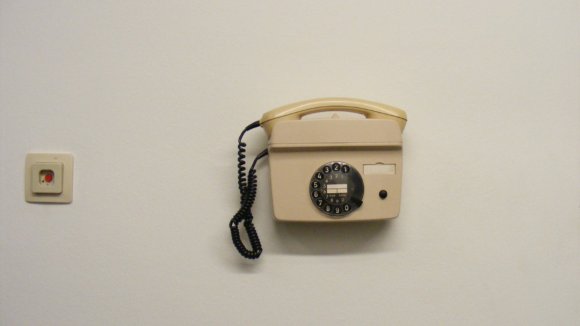
An old beige institutional telephone on a white wall.

11. Liminal horror is in the eye of the beholder. When I wrote about the creepiness of hotels, someone on BlueSky got mad at me because they just didn’t understand what I was talking about. Hotels are nice! Stop saying things are uncanny when they’re not! It’s just a hallway. It’s just an empty space. It’s only a storeroom.
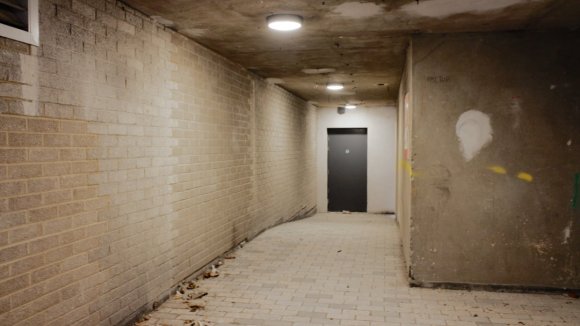
A doorway at the end of a concrete hallway.

12. Sorry I keep using the word ‘liminal’. It’s one that many people avoid using these days. I usually avoid it myself. How else might we describe this sub-genre or trend? I’ve heard ‘analogue horror’ thrown around, referring to the use of filters to evoke VHS recordings and other vintage media. That’s not about spaces but it can help sell their reality and their feeling of being outside time. Today, I saw ‘ordinary horror’ for the first time, via Zachary Gillan, but Andrea Capra, the author of the book of that title, means something very specific: “the horror that haunts our world, and that we may encounter firsthand”. I feel some connections between liminal horror, analogue horror, and various forms of lo-fi ambient music – analogue hiss and crackle, ASMR-adjacent field recordings, a hypnotic waiting room quality. So, perhaps ambient horror would work, too.


My latest collection of stories Thin Places in Hard Concrete has a story about a motorway interchange and a recreation of a medieval palace in an underground bunker, among other contenders for the liminal horror tag. It’s available as an eBook or paperback from Amazon wherever you are. For starters, here’s where you’ll find it if you’re in the UK or US:

I’ve chosen not to apply digital rights management (DRM) to the eBook file so you can download it as an ePub file or PDF to read on whichever device you like, such as a Kobo.

Categories
Intervals of Darkness therapy

The self-loathing of the working class writer

I’d have been shy about calling myself a ‘working class writer’ a decade or so ago. Which is ridiculous, with hindsight – because what else am I?

The stories in my last collection, Municipal Gothic, and in my upcoming book, Intervals of Darkness, are mostly attempts to process my experiences as a working class kid.

But if that working class kid could hear me, a university graduate and professional, referring to myself in these terms, he’d be furious.

“How can you call yourself working class?” he’d ask, “with all your privileges and relative comfort in life?”

Back then, I thought being working class was a binary state.

I read and admired books by people like Alan Sillitoe but also hated them for moving to London, or France, and becoming part of the literary establishment.

How could they write about working class life when they weren’t living it?

I was an idiot, of course.

How would Sillitoe have found the time and energy to write if he also had to do night shifts on a production line, you know, to keep his hand in?

And how long did I think it took to become middle class? It’s not an overnight process.

What I came to realise is that you don’t ever really shed working classness. It’s baked in. It shapes your attitudes to life and your perspective on the world. In the negative sense, the scars are permanent.

For the first twenty years of my life, I was steeped in my working classness, even through four years at a not-very-working-class university.

Sure, I got a desk job, wore a suit, and stopped worrying quite so much about money – but working classness continued to affect my ability to connect with people, to get promoted, and to experience basic human happiness.

If I experience the slightest financial shock – an unexpected bill, for example – I completely flip out, and revert to being an anxious child. Even if, once I’ve taken a breath and counted to ten, I can easily afford to deal with it.

My dreams were, and often still are, set on council estates and in council houses. My stories always drifted back to those same settings – pubs, terraced houses, small towns, factories… Even if I wanted to write middle class fiction, I’m not sure I could.

The characters in my stories are often aspects of my late dad, his brothers, or my mum and her family, or of people I knew growing up.

And sometimes they’re versions of me. A clue to that is if the character in question is uptight, bewildered, and slightly detached from their surroundings.

What makes a working class writer? In my opinion, they’re someone with personal, first-hand experience of working class life. (Not someone whose grandfather was a miner.) And whose writing, consciously or otherwise, attempts to make sense of that experience.

Often, perhaps too often, that can feel limiting. What if you don’t want to write grim social realism? What if you don’t want to constantly confront your own experiences of poverty? Or, on the flipside, to feel obliged to write inspiring stories about the power of working class community.

Personally, I don’t want to be a Working Class Writer. I want to be a writer. I want to write what I want to write.

And I don’t want to agonise constantly about whether I’m presenting my working class characters with sufficient nobility, or making the right political arguments.

So, sometimes, I might get it ‘wrong’. But it’s not out of stupidity or ignorance, it’s because I’m battling my own subconscious, or attempting to exorcise a ghost of my own.

Intervals of Darkness will be published as an eBook and paperback on 7 September 2024. You can pre-order the eBook now.

Categories
books Fiction municipal gothic

Municipal Gothic: 13 ghost stories

Council estates, motorway underpasses, bypass hotels, concrete cathedrals and run-down pubs. Places we all know, that we see where we live in suburbs and towns. Why shouldn’t they be haunted?

Municipal Gothic, my new collection of ghost stories, shows that they very much can be. It is now available as a paperback via Amazon, at £8.99 in the UK, $12 in the US and around the world at various prices.

In these thirteen stories you’ll meet a demonic black dog tasked with administering a lineal curse in the age of sperm donation; a witch’s familiar forced to live off fried chicken bones; an architect whose buildings can drive you mad; headless villains, and more.

It includes a revised version of ‘Modern Buildings in Wessex’, originally published as a zine or chapbook to some acclaim in 2020. It’s ghost story in the form of an architectural guide – M.R. James meets Ian Nairn.

David Southwell, of Hookland fame, is a fan of this particular piece which is how I got up the nerve to ask him to supply a foreword for the collection. He has plenty of interesting things to say about how ghost stories work, about working class fiction and, of course, about the power of plausible fake ephemera to conjure places that don’t exist.

In a similar vein, you’ll also find a new piece: ‘An Oral History of the Greater London Exorcism Authority’. Inspired by the kind of self-congratulatory in-house publications put out by public bodies in the 1970s and 80s, and by my love of institutional branding, it started life as a few mocked-up images on Twitter…

…but before long, I knew I’d have to write something more substantial to back up those ideas. It became an exercise in tone of voice – could I write first-hand testimony from multiple people? (Neville Hutchinson, the GLEA engineer who does not believe, and his colleague Ernest ‘Cabbage’ Lacomber are my favourites, I think.)

‘The Curse Follows the Seed’ is, as they say, ‘a very personal piece’ for reasons you might be able to work out when you’ve read it. It was the first story I wrote with the concept of municipal gothic in mind. Has anyone ever before set a key scene in a story in the area by the bins in a supermarket car park? I can’t help myself.

Other stories in the collection evolved from an abandoned novel. Why, when I try to write social realism, do ghosts, premonitions and black dogs keep turning up? See ‘Who Took Mary Cook’ for evidence of this.

Certain pieces emerged slowly, over the course of years, as I worked on them with my Wednesday night writers’ group. I must thank Andy Hamilton, Corinne Dobinson, Mike Manson and Piers Marter, and others who have come and gone, for their encouragement and advice. They saw scraps of ideas and helped me find the way, as with ‘Protected By Occupation’, which first landed with them in 2019 as a scrappy period piece inspired by the Lamb Inn haunting (PDF, bris.ac.uk).

Please do buy a copy of the book and let me know what you think. Or, more importantly, let Amazon and Goodreads know what you think – a quick rating and review is worth more than you can imagine.