Categories
Intervals of Darkness

Story-by-story: The Horns in the Earth

Lots of my weird stories are also supposed to be at least a little bit funny. The self-regarding literary psychogeographer who narrates ‘The Horns in the Earth’ gave me lots of opportunities for humour.

For example, I had great fun coming up with titles for his books – Avenues and Alleyways: an exploration of the back passages of Britain is a particularly puerile example.

But this character is also a reflection of me. His constant stream-of-consciousness search for ways to jam disparate ideas together into a coherent story is a bit like how I write fiction:

I found shards of crockery, chunks of blue glass and an ink bottle, and several pieces of terracotta with fractured text: ‘Ginger beer’. A century’s-worth of crap that had tumbled down the slope from the houses on the ridge above… Hold on, I thought – is this a metaphor for something? These post-war dormitory estates as human landfill. Dumping grounds on the edge for people towns and cities don’t want. A nation divided. Yes, this was good, definitely worth tugging at.

This is another story set largely on council estates.

I had in mind, as I often do, Southmead and Lockleaze in Bristol; the Sydenham estate in Bridgwater where I grew up; and the Treneere estate in Penzance, where I spent hours wandering when I lived in Cornwall.

I took an alleyway from one, a recreation ground from another, an arcade of shops from a third, the wind-swept square of a fourth…

I’m so familiar with the textures and feel of places like this that writing it comes naturally. In fact, my dreams are often set on council estates – usually a distorted version of Sydenham – as if that’s the default game map for my subconscious.

An overgrown wooded bank on an industrial estate with the corner of a former council building and a rusting shipping container.
The site of the ancient Chapel of St. Anne.

Another important influence on this story is an ancient religious site near where I live, near the CO-OP, round the back of an industrial estate.

In St. Anne’s Woods there’s a wooded valley with a holy well.

It’s surrounded by iron railings and the tree above it is covered with tattered rags – the remains of face masks hung there as a sort of offering during the pandemic.

There’s often a burned out moped nearby.

The well was associated with the Chapel of St. Anne which stood about 350 metres away. It was destroyed by Henry VIII. In 1486, his father Henry VII made a pilgrimage to the chapel and the well.

So, I’m gently mocking psychogeographers, while also indulging in a little psychogeography myself.

Cake and eat it, me.

‘The Horns in the Earth’ is also the closest I’ve got to indulging in a trope I dislike: the scary youth in a hoodie.

Without wanting to self censor, I challenged myself when I noticed the story drifting that way, and I hope I’ve done something slightly more interesting than simply say: aren’t working class kids terrifying?

That the narrator finds them so perhaps tell us something important about him.

A quote from Verity Holloway: "Impressively eerie and packed with shocks... moments of powerful poignancy and startling strangeness. You'll want to linger over these stories." Next to it is the cover of Intervals of Darkness with a black background and red details. The illustration is of a person casting a long shadow. Nearby is another shadow suggesting a lurking but hidden figure.

Intervals of Darkness will be published on 7 September. You can pre-order the eBook now.

Categories
Intervals of Darkness

Story-by-story: Father Paul

What if the bearded hippy vicar who used to guest star at my school assemblies had to deal with the events of The Exorcist? That simple question was the seed for this story.

The vicar who came to my school wasn’t called Paul but he did have a beard and an acoustic guitar. He was a Cambridge graduate and softly well spoken.

And his church on the estate was a post-war modernist building, with concrete columns and parquet floors, at which I attended harvest festivals, christenings and weddings.

But I can’t say that my character of Father Paul is ‘based’ on this real vicar because when I knew him, I was a child – and not one who regularly went to church.

In other words, Father Paul is a creation inspired by memories of vague impressions.

The main thing I took from the real vicar is the title ‘Father Paul’. Because our vicar was always called ‘Father…’ even though he was Church of England.

When I shared drafts of this story with various critical friends, a couple picked me up on this detail, thinking they’d found a mistake. But (a) that’s how it was and (b) it turns out lots of CoFE vicars get called ‘Father’ informally; some dislike it, most don’t.

Also in the mix was (and I might almost say ‘as ever’) the Enfield poltergeist, the classic working class English haunting. Chris Coates has written a pleasingly snarky debunking of the Enfield case.

Personally, I don’t believe for one moment that anything supernatural happened in that particular house.

For this story, I asked myself, how would an unequivocally real poltergeist case look and feel? What would need to happen for somebody level-headed to really believe in what they were seeing?

And how might a cunning demon or devil go about denying an exorcist documentary evidence of the facts as part of its mischief?

Finally, as I’m sure many people will notice, there’s a touch of a famous British folk horror film here, too, which I won’t name because it would probably constitute a spoiler to do so.

When you’ve read the story, let me know if you’ve worked out which film I mean.

More generally, the landscape of Bristol, and of my hometown, both of which were urbanised rapidly after World War II, continues to inspire me.

Concrete laid over old orchards. Council houses on hills and in valleys with who knows what beneath the mud.

Place names borrowed by local government officials from those of farms, fields, lost manor houses, and other landmarks otherwise wiped from the map.

How many exorcisms do we need?

I’m very conscious that poltergeists and exorcisms might be played out, or at least hard to find new approaches towards.

In this case, I hope that the setting (an English council estate), the quirk of a non-Catholic exorcist, and the streak of folk horror, might make it feel fresh.

Having said that, for more in a similar vein, I recommend The Borderlands, a somewhat successful 2013 film about Catholic priests sent to exorcise a church in Devon.

A quote from Thom Willis: "You don't know what you're getting next – Cronenberg in a dingy terrace, Tim Powers jumping at shadows, M.R. James in a piss-soaked alley. The canvas feels bigger than Municipal Gothic."

Intervals of Darkness will be published on 7 September. You can pre-order the eBook now.

Categories
Intervals of Darkness

Story–by-story: Tales from the Levels: Remembrance

This lost episode of a 1970s children’s television series came to me in a dream. Usually dream stories are nonsense but this one, to my astonishment, worked.

Here’s the dream:

Cons: A bad night's sleep.
Pros: Dreamt several episodes of a lost BBC anthology series from the 1970s called Tales from the Fens. A post from BlueSky: "Each week, a different supposed folk tale from East Anglia, in grainy 16mm. The Tale of roaming Gramps Pfaster and his mourning tokens a particular highlight."

You’ll note that, in the dream, it was Tales from the Fens, but I don’t know East Anglia well enough (yet) to write that.

So I brought it closer to home, to Somerset.

The dream gave me a premise and some details but, of course, I had to do a lot to turn it into a coherent piece of fiction.

I also found myself thinking about Jeremy Deller’s nationwide art installation to mark the centenary of the start of World War I, ‘We’re Here Because We’re Here’, from 2014.

There is also, of course, that story from Sapphire & Steel with the ghost of a soldier from World War I haunting a railway station. (Which I think Jeremy Deller must also have had in mind.)

Having dreamt of a TV show, I had to make it a TV show, which also happens to tie into my interest in grainy old BBC ghost stories for Christmas, and Tales of the Unexpected, and similar.

Let’s be honest, this is pure nostalgic, hauntological fan service.

The final component was the idea that Bernard Miles might be the narrator of the story. Miles is perhaps best known for his performance as Joe Gargery in David Lean’s 1946 film of Great Expectations. He was also famous for his stage and screen performances in rural dialects.

Though he specialised in the accents of counties surrounding London, I reckon he could easily have stretched to a Somerset accent with a little time to prep. And I think he’s exactly the kind of person an ITV subsidiary might have approached for a job like this in 1970.

I dithered a little about how much storytelling business to include. In the end, I went heavy on it at the start, and at the end, but let it fade out in the middle. Because I suspect that, as with attempts to write in regional accents, it would get pretty annoying after a while.

Somerset place names

People who know Somerset will notice that I’ve rendered a couple of place names as they’re spoken rather than as they’re spelled.

In reality, Chidgey is Chedzoy and Muchney is Muchelney.

My thinking was, though, that surely Mr Miles would be given them as spoken in his script, right?

But also, I just take a certain homesick pleasure in these little details.

A quote from Thom Willis: "You don't know what you're getting next – Cronenberg in a dingy terrace, Tim Powers jumping at shadows, M.R. James in a piss-soaked alley. The canvas feels bigger than Municipal Gothic."

Intervals of Darkness will be published on 7 September. You can pre-order the eBook now.

Categories
Intervals of Darkness

Story-by-story: While You Were Out

The inspirations for this story about a delivery driver feel blindingly obvious to me – I wonder if anyone will see the connection?

First, there’s the nightmare logic of the films of Lucio Fulci and, in particular, The Beyond from 1981.

I find it hard to argue that The Beyond is a great film.

It has all the usual problems of Italian exploitation horror – bad dubbing, odd pacing, nonsense plot – plus the particularly dense layer of dinge and sleaze that seems to ooze from Fulci’s pores and over everything he makes.

So I’m not necessarily saying you should watch it.

But don’t be mistaken: I love it. At least, I keep rewatching it, and thinking about it.

Because, for all its flaws, it is full of breathtaking images, and its disjointedness begins to feel like a feature rather than a bug.

The ending, in particular, I find astonishing.

Our heroine and hero escape from pursuers by running into the basement of one building, only to find themselves in the basement of another, right across town.

This makes no sense.

What makes even less sense is that they then find themselves walking across an infinite plain strewn with corpses.

“And you will face the sea of darkness, and all therein that may be explored,” says the voiceover, gravely.

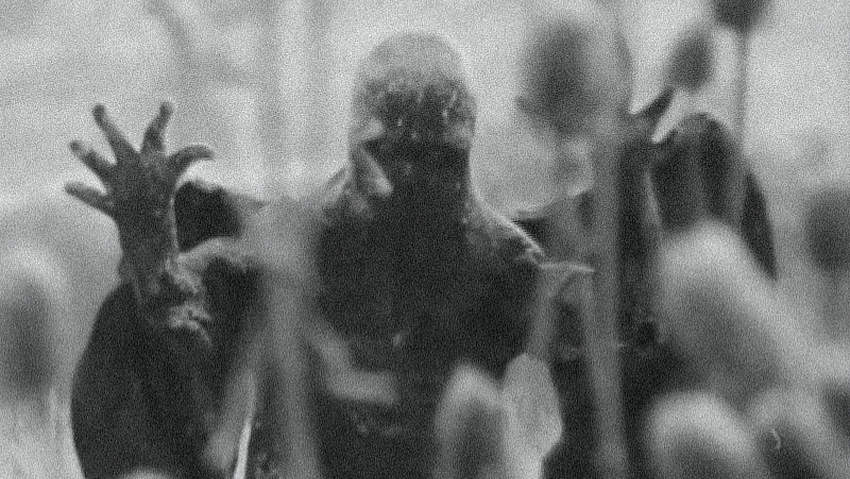
A still from The Beyond which shows two people on a plain surrounded by scattered, vaguely human forms.

The other inspiration, very obvious, I think, is Robert Aickman’s wonderful 1967 story ‘The Cicerones’, in which a tourist explores a cathedral on the Continent and meets a series of unnerving tour guides as space and time distort around him:

Then something horrible seemed to happen; or rather two things, one after the other. Trant thought first that the stone panel he was staring at so hard seemed somehow to move; and then that a hand had appeared round one upper corner of it. It seemed to Trant a curiously small hand… the stone opened further, and from within emerged a small, fair-haired child… ‘Hullo,’ said the child, looking at Trant across the black marble barrier and smiling.

So, when writing ‘While You Were Out’, I kept challenging myself to make it not make sense in the same pleasing way.

To achieve this you really need to tap into the feeling of dreams or nightmares – the strange segues, the instability of objects or people, the sense of wading through glue.

The setting, a group of tower blocks on the edge of an English city, is not based on any one place but it does borrow from Barton Hill and Redcliffe in Bristol, where I live.

There’s also something of Gleadless Valley near Sheffield which I visited on a bleak November day a few years ago.

And the elevators, stairwells and corridors are straight out of various tower blocks I have known, including one in East London where my partner’s father lived for a while.

The chink of departing coin

When I wrote this post about being a working class writer last week it prompted writer Joel Morris to talk about characters who feel “the chink of departing coin”.

Bogdan, the delivery driver who is the main character in this story, is under pressure to meet unrealistic targets. And stress is part of what makes him vulnerable to strange experiences.

Throughout Intervals of Darkness there are characters who make bad decisions because they need the money. As well as feeling true to life – or, at least, true to my own experiences – this also brings a new energy source to the stories.

One of the characters in ‘British Chemicals’, for example, takes speed and works through his break periods because he’s just become a father and needs all the overtime he can get.

A quote from Verity Holloway: "Impressively eerie and packed with shocks... moments of powerful poignancy and startling strangeness. You'll want to linger over these stories." Next to it is the cover of Intervals of Darkness with a black background and red details. The illustration is of a person casting a long shadow. Nearby is another shadow suggesting a lurking but hidden figure.

Intervals of Darkness will be published on 7 September. You can pre-order the eBook now.

Categories
Intervals of Darkness

Story-by-story: Competing Theories With Regard to the Origins of the Ghost of Totterdown Lock

I wrote the first words of this unusually structured story, about the ghost, or ghosts, haunting a canal lock, in about 2017. I finished it in 2023.

Those first lines weren’t written to be part of a story. They were the snippet of poetry which opens it and which were inspired by – that is, ripped off from – Wilfred Owen’s ‘Shadwell Stair’:

I am the ghost of Shadwell Stair.
       Along the wharves by the water-house,
       And through the cavernous slaughter-house,
I am the shadow that walks there.

I came back to the lines I’d written, about Bristol’s evocatively-named Floating Harbour and Underfall, when I became obsessed with Totterdown Lock.

I walk or run past Totterdown Lock almost every day but didn’t notice it until I read something about it being filled in during World War II. You can see it here on a historic map.

This got me thinking about how the landscape of St Philips Marsh has changed over the years with successive waves of industrialisation.

Entire communities, like St Silas, have come and gone. Everywhere there are traces of old structures, old waterways, old street patterns.

I also wanted to capture something of the garbled nature of local ghost stories. “What I heard was…” and “The story I was always told is…” I don’t use Facebook much but I am a member of a couple of local history groups where this kind of half-remembered tale is often told.

Really, this was a way for me to tell a lot of small ghost stories, overlapping and contradicting each other, in a range of voices. A little like ‘Ten Empty Rooms’ in my last collection, Municipal Gothic.

The story was originally published, if that’s not too grand a word, in a homemade ‘zine of which I printed precisely 20 copies.

I gave those away to anyone who was interested. Just because I wanted to make something complete and whole, purely for the sake of making it.

What’s your personal ghost story?

One of my favourite conversational games is to ask people: “Have you got a ghost story?” Almost everybody does, it turns out.

The closest I’ve got isn’t from Totterdown Lock or the Feeder Canal but from the road that runs parallel, one block over.

Walking along Silverthorne Lane one damp, blustery evening, alone and surrounded by derelict industrial buildings, I distinctly felt the firm prod of a finger in the small of my back.

I span around, ready to defend myself from a mugger or weirdo. But, of course, there was nobody there.

I’ve thought about this a lot since it happened. Of course the setting might have had something to do with it – the shadows, the ruins.

Perhaps what I felt was a piece of litter blown into me by the gale.

Or maybe it was just a muscle spasm.

So… what’s your personal ghost story?

A quote from John Grindrod: "Existing somewhere between Robert Aickman and J.G. Ballard, these blackly funny tales are sure to chill you, no matter how high you turn the central heating." Next to it is the cover of Intervals of Darkness with an illustration of someone being stalked through a dark chamber pierced by shafts of light.

Intervals of Darkness will be published as a paperback and eBook on 7 September. You can pre-order the eBook now.

Categories
Intervals of Darkness

Story-by-story: Night of the Fox

The inspiration for this story should be pretty obvious: British films with titles that begin ‘Night of the…’

That is, Night of the Demon from 1957 and Night of the Eagle from 1962.

The hero of the story is pretty obviously based on Dana Andrews, Brian Donlevy, Macdonald Carey, and other American actors who washed up in Britain when their careers began to founder.

Lots of low-budget British B-movies of the 1950s and 1960s have American stars looking bleary-eyed and rumpled round the edges, taking whatever work they could get.

A minimalist 1960s film poster with a vicious looking eagle and a screaming woman.
A poster for 1962’s Night of the Eagle.

The story was also prompted by conversations with my pals Jamie Evans, Rory ffoulkes and Stephen Graves, at various points, about the extent to which folk horror is ‘played out’.

I wanted to have a go at writing a folk horror story which hit all the prescribed beats while also presenting some new images and ideas.

What are those prescribed beats? I don’t want to spoil the story but let’s just say that I think The Wicker Man is prime folk horror and Witchfinder General isn’t, really, despite its place in the canon.

Also in the mix were my memories of visits to Tewkesbury and Lübeck, which both have intriguing networks of alleys and courts – survivors of mediaeval street patterns. Tewkesbury also has its old Mythe Road – what a street name!

This story shares the name of its setting, Newhamstead, with another story in the collection, ‘British Chemicals’. As I said in the post about that piece, I’m not sure if they’re the same town or not. But I would be surprised if I don’t use the name again, when it feels right.

The idea of a village being absorbed into a post-war new town appealed to me because I’ve spent quite a bit of time thinking about new towns.

In 2017, I co-wrote a book about pubs under the name ‘Ray Bailey’ and spent time visiting places like Harlow and Stevenage. And I’ve written here about the uncanny potential of new towns.

Finally, I should also admit that a significant inspiration – almost the spark for the story – was an American on Twitter sharing their astonishment the first time they heard a British person say, completely in earnest while offering to pour tea: “Shall I be mother?”

What a weird country this is.

A quote from Thom Willis: "“You don’t know what you're getting next – Cronenberg in a dingy terrace, Tim Powers jumping at shadows, M.R. James in a piss-soaked alley. The canvas feels bigger than Municipal Gothic.” Next to it is the cover of the book with someone being stalked through a dark space by an unseen figure.

Intervals of Darkness will be published on 7 September. You can pre-order the eBook now.

Categories
books Intervals of Darkness

Story-by-story: Second Homes

I lived in Penzance in Cornwall for six years, including several stormy, boarded-up off-seasons. This story is about how that felt – and about the distinctly haunted landscape.

I used to observe the coming and going of people throughout the year, and the rhythms of the tourist industry. Repainting and repointing in the run up to Easter. And the general air of exhaustion in early autumn.

I was especially struck by how silent Mousehole seemed in the gaps between holidays, when the second homes and rental properties were empty.

(See also: Bait, dir. Mark Jenkin, 2019.)

On Scilly, in Marazion, and in various other places, I’d pick up interesting details about how things worked – like the chip shop owners who shut for the winter and disappeared to Florida.

Another influence, though not directly referenced, was the Solomon Browne disaster of 1981. When the Penlee lifeboat went out in a storm to save crew and passengers aboard the MV Union Star. Sixteen people died including eight lifeboatmen from Mousehole.

This tragedy suffused the village and the area. The old lifeboat house was a permanent memorial on the coast path and The Ship Inn has a plaque and photographs of the lifeboat crew. Children and relatives of crew members still live in the area.

This sadness offers a strange contrast to the Instagram-friendly lifestyles of people from ‘up country’ who only come down when there’s a reasonable chance the sun will be out.

I can’t claim to have totally sussed Cornwall in six years. I doubt you could do that in four centuries. But I learned enough to tell this small story.

A note on ‘granfer’

A couple of stories in this collection use the West Country word ‘granfer’ – that is, grandfather.

I’ve heard it used naturally and without affectation in both Cornwall and Bristol, hundreds of miles apart.

I like it because it adds a bit of regional texture without doing the impenetrable Jarge Balsh thing.

In another story, however, I have ‘gramps’. One reason for that is that, as a kid in Somerset, I heard it used quite frequently – but never ‘granfer’.

The other quite weird reason for ‘gramps’ over ‘granfer’ I’ll reveal in a later post in this series.

A quote from Verity Holloway: "Impressively eerie and packed with shocks... moments of powerful poignancy and startling strangeness. You'll want to linger over these stories." Next to it is the cover of Intervals of Darkness with a black background and red details. The illustration is of a person casting a long shadow. Nearby is another shadow suggesting a lurking but hidden figure.

Intervals of Darkness will be published on 7 September. You can pre-order the eBook now.

Categories
books Intervals of Darkness

Story-by-story: British Chemicals

The third story in Intervals of Darkness draws on research I did for an article published in Fortean Times a few years ago about a haunted factory.

My dad worked at the factory in question and we often talked about what might have made it feel spooky.

Point: the land was ancient, with old ghosts.

Counterpoint: everyone was exhausted and off their tits on chemical fumes.

This story, which Rowan Lee has suggested recalls the work of Nigel Kneale, is an attempt to explore that line between rational explanation and genuine supernatural experiences.

I also had in mind Danny Robins’s radio and TV series Uncanny which, especially in more recent episodes, has included ‘cases’ which seem less than convincing.

I asked myself in what context an account of a haunting might seem truly beyond doubt.

Perhaps being shared in private, behind closed doors, by someone who definitely isn’t seeking attention – and who has a strong commercial incentive not to have seen a ghost – might be convincing.

Working on this story on and off for the past couple of years I quizzed Dad to harvest convincing details.

Those were added to the stories I’ve been hearing for years about life working at British Cellophane, and other factories.

I also drew on my own teenage experiences of factory work, including the time I accidentally got high on solvents while cleaning a protective suit and floated across the shop floor giggling, unable to feel my legs.

Hints of worldbuilding?

The story takes place in a post-war new town called Newhamstead. That name also crops up 

in another quite different story in Intervals of Darkness, ‘The Night of the Fox’.

I’ve always loved the way H.P. Lovecraft and his literary circle casually reused the names of places, characters, forbidden tomes, and monstrous entities.

That there’s no particular coherence in the way they are applied (despite later attempts by nerds to tidy things up) only adds to the sense of intrigue.

See also: those throwaway references in Star Wars to the Kessel Run and the Clone Wars.

So, I don’t know if the Newhamstead in these stories is the same place, exactly, or if this will one day add up to a ‘cycle’, but I couldn’t resist the deliberate internal reference.

A quote from Rowan Lee: "Newman returns to haunted Britain with fourteen more wonderful stories... Fans of folk horror and weird fiction find a lot to love..." Next to it is the cover of Intervals of Darkness with a black background an illustration, in red, of a person casting a long shadow as they emerge from a doorway. Another shadow is nearby, implying the presence of a second, unseen person.

Intervals of Darkness will be published on 7 September. You can pre-order the eBook now.

Categories
books Intervals of Darkness

Story-by-story: Men Who Live in Caravans

The second story in Intervals of Darkness is unusual in that it’s not overtly supernatural – but it could have been, with a couple of tweaks, and is certainly, I think, weird.

It’s also one of the most personal, close-to-the-bone things I’ve ever written. In the sense that I sort of hoped my family wouldn’t read it.

It’s about a man who lives in a caravan on farmland, scraping a living with shift work.

This could describe more than one of my own late relatives, several people my parents have known over the years, and several people I’ve encountered in pubs up and down the West Country.

The specific trigger – the thing that put it on my to-write list – was a particular caravan in a particular field. It was overgrown, tangled among branches, and green with moss. And yet there were signs that someone was living in it.

(That’s it above.)

I stared at it for a long time, took a photograph or two. Then I thought about an uncle who died in a caravan in the corner of a field, and was discovered by my dad when he went round with his regular care package one weekend.

With a few wrong turns, that could have been Dad, too. Or me.

But, fretting about class, I tied myself in knots over this for a while.

Did I have the right to tell this story?

Was it inherently snobbish or sneering?

Eventually, I had a word with myself. Who else was going to write it if not me? And if I wrote it plainly, sincerely, honestly, I’d be using my small amount of privilege in a useful way.

Still, at first, I wanted to do what I usually do and hide behind the safety of a spooky story. An early draft ended, predictably, with more overtly supernatural events.

But, as with a story not in this collection, ‘The Architects’, I pulled back and let weirdness be a seasoning, rather than the sauce.

Writing it was an emotional experience. I had to stop several times, overcome with feeling, and even pushed to tears.

The feedback I’ve had since it was published at Minor Literatures suggests that people took the story as intended.

A drainage channel alongside a narrow country lane. There are reeds at its banks and algae on its surface. The landscape is flat.
The Mark Yeo at Rooksbridge in Somerset.

On ‘reens’

The word ‘reens’ crops up quite often in my stories. That’s because I grew up in Somerset which is sliced all across with reens, or rhynes.

They’re drainage ditches – a human intervention in the landscape.

One near my parents’ house, the Mark Yeo, was created in the 13th century.

I find them romantic and mysterious in a very specific, unromantic, un-mysterious way.

Sometimes, they look like shimmering, infinite mirrors running towards distant hills.

And at other times, they’re full of beer cans and algae.

A quote from John Grindrod: "Existing somewhere between Robert Aickman and J.G. Ballard, these blackly funny tales are sure to chill you, no matter how high you turn the central heating." Next to it is the cover of Intervals of Darkness with a black background and red details. The illustration is of a person casting a long shadow. Nearby is another shadow suggesting a lurking but hidden figure.

Intervals of Darkness will be published on 7 September. You can pre-order the eBook now.

Categories
books Intervals of Darkness

Story-by-story: Poor Ned’s Head

The story that opens Intervals of Darkness is an example of magically frictionless fiction.

I saw a call for submissions on the theme of ‘water’ and then, only a little while later, visited the wreck of the Mary Rose in Portsmouth.

Being me, I was drawn to the cabinets filled with skulls found aboard the wreck. What must it feel like to be killed in action, lie in the mud for several hundred years, and then be put on display?

The facial reconstructions added another layer of weirdness. In curatorial terms, this is good interpretation. It helps civilians like me understand the past more clearly, in human terms. But all those disclaimers, and the careful choice of language… Those reconstructions are just informed guesswork, really. And they always look a bit… wrong. Talk about the uncanny valley.

My other half says that she likes being with me when an idea for a story strikes me. She recalls it happening very obviously on this museum visit – “Must find notebook… Must write down… Haunted skull… Eye to eye with… Must find notebook…”

Then I did something at which I’m worryingly good: quickly absorbed a bunch of writing about ships, sailing, and archaeology, and synthesised it into some plausible bullshit. It wouldn’t fool anyone who knows a lot about those subjects (I suspect Steve Toase might fling the book into a fire) but it’s enough to sell the story to most readers, I think.

Having successfully begged for an extended submission deadline I hammered out a first draft of the story in a couple of hours. And not much changed in the rewrite.

Maybe that impassioned drafting gave it a boost. I don’t think it’s an exaggeration to say that Verity Holloway, editor of Cloister Fox magazine, snapped it up – and she’s told me again since what a great story she believes it to be.

This was also the story that signalled a slight change of direction from Municipal Gothic. Not every story I write has to be set in those working class environments where I feel most at home.

It’s also the first time I’ve written a story intended to evoke Nigel Kneale. I was thinking about his particular niche – that intersection of technology and the spirit world, as in The Stone Tape – and wondered if and how a computer-generated model might become possessed.

The first review, from Rowan Lee, mentioned Nigel Kneale, though not in connection with this story, so that thread obviously runs throughout the collection.

Blooper reel

  • In the original draft of the story I had my ship, Faerie, sailing from Falmouth to Portsmouth, but sinking in Mount’s Bay. Revising it for Intervals of Darkness I thought, hold on, that doesn’t make sense… So now, she was bound for Kinsale instead.
  • The first draft of the story had the eyes as being in the ‘stern’ of the skull but it got fixed in the edit. Look, I told you I was blagging this.
A quote from Verity Holloway: "Impressively eerie and packed with shocks... moments of powerful poignancy and startling strangeness. You'll want to linger over these stories." Next to it is the cover of Intervals of Darkness with a black background and red details. The illustration is of a person casting a long shadow. Nearby is another shadow suggesting a lurking but hidden figure.

Intervals of Darkness will be published on 7 September. You can pre-order the eBook now.