Lightning drew a blue outline around the spires and towers of the castle on the mountaintop. Captain Rauch, high on his charger, pointed with his cavalry sword.
‘There, Doctor Kleist,’ he rumbled. ‘Do you see?’
Kleist lifted his skeletal features and peered from beneath his brimmed hat. His blue eyes gleamed. He waited a split second and then, as thunder cracked, said with perfect diction: ‘Castle. Grafenstein.’
Both men steadied their horses.
‘Grafenstein,’ repeated Rauch uncertainly, a fine line appearing between his dark eyebrows. ‘Yes, Grafenstein.’
Kleist pressed delicate fingertips to the ornate golden crucifix around his neck and snapped the reins to drive the horse along the strangely flat path into the forest that surrounded the mountain.
Only a few moments later, it seemed, they arrived at the castle gate. Once again Rauch’s natural haughtiness was tempered by confusion.
‘I don’t remember… How…’
He looked back to where the woods should be and saw a nothingness.
Kleist seemed untroubled. He dismounted and tied his horse to a railing. He straightened his heavy woollen frock coat, adjusted the fox fur collar, and clapped his gloved hands.
‘At last, his reign of terror will come to an end and the people of Kronstadt will be free from the malign master of Castle–’
He stopped and stared at the carved coat of arms above the gate. Text in German blackletter read ‘Schloss Krolek’.
‘Castle Krolek.’
Rauch drew alongside, towering above Kleist, and glowered.
‘Count Krolek of Castle Krolek, of course.’
‘Of course.’
As they passed through the gate, Rauch reached out to touch its grey stone and felt it crumble beneath his fingers, scattering white flakes.
They crossed the moat and approached the great door which opened before them like a giant mouth awaiting food. Kleist held up his crucifix and waved a gloved hand at Rauch, urging him to do the same.
As they crossed the threshold, Kleist shuddered and clapped a hand to Rauch’s chest.
‘Did you feel that?’
Rauch nodded.
There had been some strange shift, like a cut in time, though neither man could put the feeling into words.
The entrance hall of the castle was brightly lit and luxuriously decorated. Flames roared in an enormous stone fireplace.
Rauch looked back. Beyond the door where the courtyard and moat had been a moment before, the nothingness had further encroached.
‘Kleist, look!’
Kleist ignored him. He had already begun to stalk the great hall, inspecting its stonework and tapestries with his long fingers. He paused when he reached the fireplace and looked up at the portrait that hung above it. He stepped back and gasped. It was Rauch, crudely painted, in a black cloak and the ceremonial uniform of a Wallachian boyar.
‘You admire the portrait of my ancestor,’ said Rauch from the staircase.
Kleist felt a fluttering in his mind and his eyes misted for a moment. He heard himself say, involuntarily, ‘Count Krolek!’
‘I bid you welcome to my home,’ said Krolek, who was no longer… who had he been? Kleist had already forgotten not only Rauch’s name but also his very existence. Krolek wore a red lined cape and a velvet jacket the colour of dried blood. His voice was low and resonant and there was a combination of hatred and arrogance at odds with the words he spoke.
Kleist reached for the cross at his neck and for the pistol at his side.
‘Do not move, Krolek. This is loaded with silver bullets blessed by the priest at Kronstadt… I mean, at Carslbad – and dressed with Holy Water!’
Krolek’s eyes burned red.
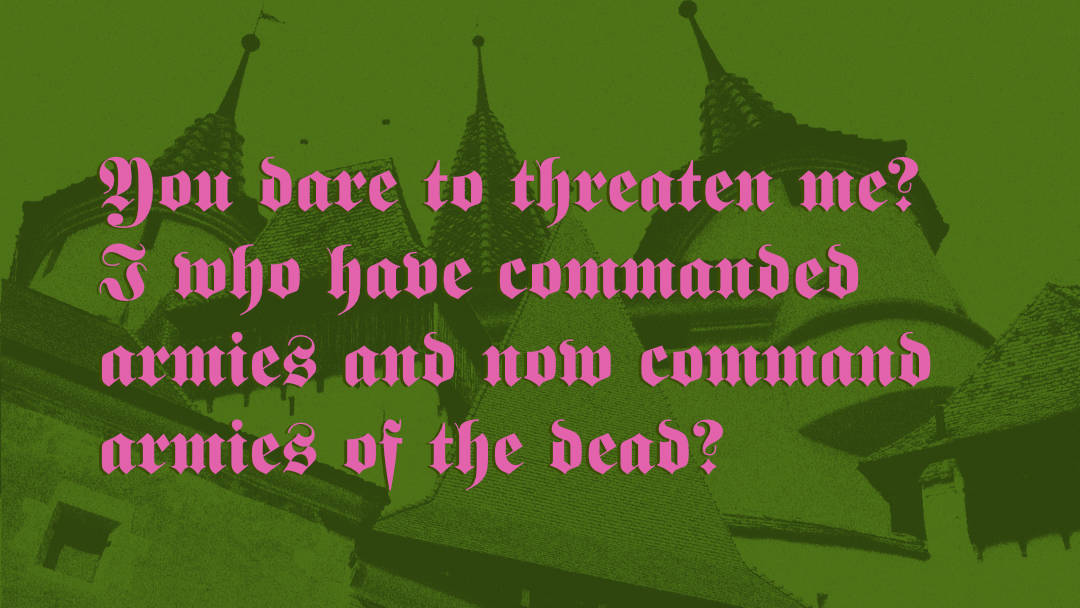
‘You dare to threaten me? I who have commanded armies and now command armies of the dead? I who have in my veins the blood of… of…’
Krolek’s powerful voice faltered. He looked up and became mesmerised by something.
Kleist followed his gaze. There was no ceiling above, only that same blacker-than-night nothingness. Turning slowly Kleist realised that there was also darkness behind him where a castle wall ought to be.
Then, to his left, another wall began to move.
‘What black magic of yours is this, Krolek?’
Another wall slid between Kleist and Krolek, locking with the first, blocking Krolek from sight. Objects shifted around Kleist, whirling and drifting into place, until he was surrounded.
The pistol in his hand had become a scalpel, his coat a surgical apron. His eyebrow arched as he turned the blade to catch the beam of a vivid pink light. He forgot the nothingness for a moment, and forgot he had ever been Kleist. His work with the human brain was too important to be distracted.
Beyond the wall, Rauch-Krolek was lost. When the walls moved, the nothingness surrounded him for a moment and he found himself adrift on the staircase in blank space. He tried ascending the stairs and found himself on a landing with a large stone eagle. On its plinth were carved the words ‘The House of Zarkhov’. The nothingness advanced behind him like a rising tide. He swore in Russian-accented English and bounded up another flight of steps. The eagle confronted him again but this time with the name ‘Pengellis’ carved into its base. Why was he running? Oh, yes, for revenge on Baron Pengellis for what he had done to the girls of the village, including his own sister, while he, Captain Trelawny, was away at sea. Black water, or something like water, lapped at his boots, forcing him up another storey. Again he found the eagle, the very same eagle, with the worst name of all: Frankenstein.
Kleist-Frankenstein leapt at him with a scalpel causing him to drop the feathered policeman’s helmet from the crook of his arm. He clapped a hand to his arm which was now bleeding freely, his blood too vivid and viscous to make sense.
‘You can’t stop me now, Inspector Becker, you must know that.’
He swiped again and caught Rauch-Krolek-Becker’s face. A line of blood appeared at one, as if a child had marked him with school poster paint.
‘My experiments with transplanting multiple human consciousnesses into a single brain are almost complete. No meddling policeman–’
‘Look!’ said Becker.
Frankenstein smiled and kept his eyes fixed on both the tip of his blade and the stiff-backed Saxon police officer.
For a moment, the nothingness swallowed Frankenstein’s lower leg. The smile left his face. When the shadow withdrew like a lapping wave he was weak and confused.
‘We’d better go up another floor,’ said Becker softly.
For the first time, there was complete silence. The music they were used to hearing, that called their names in brass, had ceased.
‘You first,’ said Frankenstein, gesturing with his scalpel, still trying to dominate the situation.
Somewhere on the flight of steps, as his neat elastic-sided boots pressed into deep red carpet, the scalpel became a British Army pistol and Inspector Becker grew a goatee beard.
This time, the Eagle bore the name ‘Corbeau’. Becker was no longer Becker but his old friend Colonel Gautier, scourge of the satanists. When Gautier addressed him by a new name, he was not surprised.
‘Hold fast, Henniker,’ he said, raising a finger to his ear. ‘Hark – the ritual has begun!’
There was a sound, a deep hum, that might have been chanting, Henniker supposed. It seemed to come from a double door before them. The door was white with gilded trim. On either side were statues of Anubis on white plaster columns.
Gautier turned to Henniker and planted his hands on the smaller man’s shoulders.
‘In our many adventures together, we have never come across a villain as dastardly as Corbeau. Are you with me? I should not judge you if you walked back down–’
He stopped. The steps had gone. There was now only a floor with black and white tiles leading to an entrance hall.
‘I mean…’ Gautier shook his head, touched his brow, and found the line. ‘I should not judge you if you walked out of the door and left me to do psychic battle with this rogue alone.’
Henniker shook his head and raised his service pistol.
‘I’m with you, old man, just as I was at the Devil’s Wood in sixteen.’
As they advanced on the door, jaws fixed, they didn’t notice the walls behind them sliding out of place, or the floor falling away as if into space.
Gautier flung open the door and they burst onto a plain, empty, flagstoned terrace. Lichen grew on the slabs. There were cigarette ends scattered about.
There was no ritual, no Corbeau.
Gautier whirled around. The door behind them was an ordinary door set into an ordinary English country house of no particular distinction.
Kleist-Frankenstein-Henniker dropped his scalpel-gun-sword which landed with a tinkle-clunk-clatter and approached the balcony.
Below was a park where a man in a yellow anorak was walking a dog. The red roof of a number sixteen bus passed above the trees.
Wind whipped at Rauch-Krolek-Gautier’s wig which, in broad daylight, looked absurd.
Henniker shivered. He was, after all, a frail old man.
With brotherly care, Gautier guided him back through the door, into the house, where the eagle, the nothingness, and a thousand monsters awaited them.
This story originally appeared in issue 3 of the General Witchfinders Zine in September 2025.


