
Hotels are fundamentally weird places and the sense of unease they prompt is powerful fuel for weird stories.
Even before we consider aspects of the uncanny, and the hotel in weird fiction, the very concept of the hotel is troubling.
You’re telling me I’m going to a strange town to sleep in a strange room, in a strange house, where someone I don’t know has a master key to my room?
It’s no wonder I barely get a wink of sleep whenever I’m away from home.
I have stayed in some objectively odd hotels over the years. The converted U-Boat factory in Gdańsk, for example, which aimed for industrial minimalism but whose concrete walls throbbed with memories of Nazism.
In Lithuania, one hotel had a display of KGB bugging and recording equipment that had been removed from the walls during its renovation.
Back home in the UK, my mind turns to a genteel bed and breakfast in Gloucestershire that hadn’t been decorated in about forty years. There were faded paintings of Spitfires, Hurricanes and the Queen on every flat vertical surface. In the corner of my room was a small door which I opened to find a cupboard filled with box after box of children’s drawings and schoolbooks from, I’d guess, the nineteen-seventies.
In the Scottish Highlands, there was a would-be boutique hotel whose lobby came with a chaise longue strewn with sinister porcelain dolls, and whose owner had a way of making tourist tips sound like threats: “I’m only trying to help you…”
Chain hotels are no better. In one, my partner and I only discovered there was a connecting door to the next room when its occupant burst in looking for the bathroom. He was almost as terrified as us.
In another we were kept awake all night by local youths roaming the corridors banging on doors and smoking pungent weed.
Bad things do happen in hotel rooms, too – those private spaces for hire where, even if you can no longer sign in as ‘Mr and Mrs Smith’, you are at least free from surveillance or supervision.
For the Brutal Bristol zine I wrote about the history of a brutalist Premier Inn in Bristol, now demolished, which was used by a grooming gang. It was all too easy for people to believe in conspiracy theories around the Elm Guest House. Hoteliers spy on their guests. And sometimes, guests leave corpses behind.

The hotel in weird fiction
I was prompted to think about the hotel in connection with weird fiction by reading Daisy Johnson’s The Hotel. It’s a collection of stories originally written for BBC Radio Four all of which are set in and around the same fenland hotel.
It feels to me as if Johnson was trying to exorcise every single anxiety she’s ever felt while visiting hotels, whether caused directly by the strangeness of the buildings themselves (what’s behind that door?) or the social situations that bring us to them. There’s a particularly effective pair of stories about a hen party in which an actual monster is less scary than the cruelty of old friends.
Critics have rightly noted a connection between Johnson’s creation and The Overlook Hotel from Stephen King’s The Shining, via Stanley Kubrick’s 1980 film adaptation of that novel.
The Overlook is a brilliant creation, and of the best haunted houses in fiction, alongside Shirley Jackson’s Hill House. Here’s my favourite line from the book:
It was empty and silent, the only sound that curious subaural echo that seems to linger in all large rooms, from the largest cathedral to the smallest home-town bingo parlour.
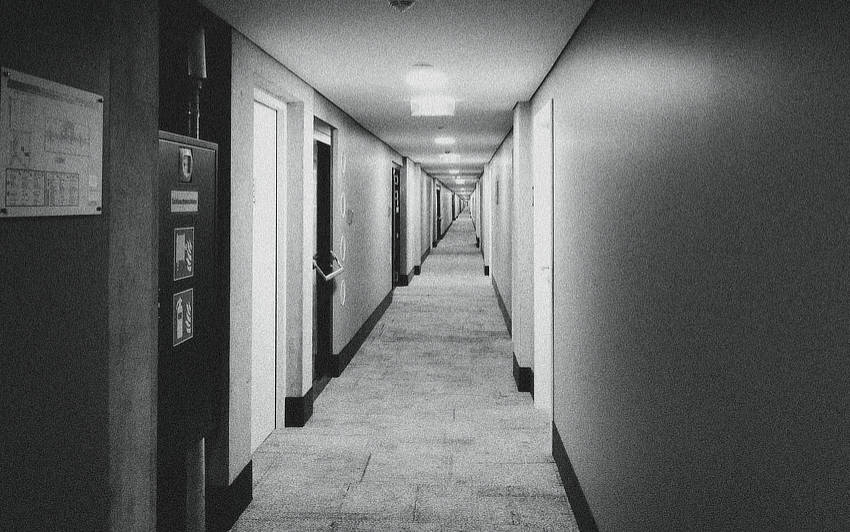
Hotels are bigger than our houses, and often as big as palaces. There might be hundreds of other guests, or none. We can easily find ourselves alone on seemingly endless corridors, lined with endless doors. King, and Kubrick, mine these in-between spaces for all they’re worth.
Neither the Overlook nor Daisy Johnson’s hotel are especially old buildings but both have managed to accumulate many ghosts in their short lives. A private house might have, say, twenty occupants in a hundred years, whereas even a small hotel could have that many people pass through in a single weekend. Many lives are overlaid there.
In Joanna Hogg’s film 2022 film The Eternal Daughter Tilda Swinton plays a woman staying at a country hotel out of season, surrounded by dense fog. She is accompanied by her elderly mother, also played by Swinton. It’s an unsettling, confusing film, which plays with ideas of time and memory – and what are ghosts if they’re not memories? We might visit the same hotel every year, or years apart, and feel that we’re picking up where we left off, stepping into another life, or other timestream.
Another feature of The Overlook as presented in the film of The Shining is that, like Hill House, it does not make sense as a coherent space. There are many analyses of the layout of The Overlook online, some treating these problems as ‘goofs’ or continuity errors, others acknowledging that they might contribute to our unease.
This gives us a link to the traditional English ghost story which was often quite capable of high weirdness.
In his tale ‘Number 13’ M.R. James gives us a hotel room that shrinks and expands as an impossible room next door appears and disappears during the night:
He started to go down to breakfast. Rather late, but Number 13 was later: here were his boots still outside his door—a gentleman’s boots. So then Number 13 was a man, not a woman. Just then he caught sight of the number on the door. It was 14. He thought he must have passed Number 13 without noticing it. Three stupid mistakes in twelve hours were too much for a methodical, accurate-minded man, so he turned back to make sure. The next number to 14 was number 12, his own room. There was no Number 13 at all.
A welcome you’ll never forget
We’re supposed to feel welcome in hotels; the industry is called ‘hospitality’. But in horror or weird fiction, they can be either cold, or positively hostile.
The Bates Motel from Robert Bloch’s Psycho, filmed by Alfred Hitchcock in 1960, is a famous example of a hotel that lures in guests, then devours them. There are peep holes, so no privacy, and the doors do not keep predators out of the rooms. The chambers of the Bates Motel are very unsafe spaces.
Robert Aickman’s 1975 story ‘The Hospice’ is about a travelling salesman who gets lost on country roads and checks into a country hotel. The events that occur during the course of his stay follow nightmare logic – and are, in fact, very much like some of my own recurring nightmares. He wants to leave, but can’t, with various obstacles placed in his way.
Are the guests there against their wills? Are some of them ghosts? Has there been a murder?
Aickman’s technique here, as usual, is to leave us asking questions, and to withhold answers.
His story also makes me wonder about the overlap between hotels and other bed-and-board institutions – hospitals, care homes, mental health care facilities, halfway houses, and prisons.
In 2025, of course, they also perform the role of refugee asylum facilities. They weren’t designed for this, and their guests are not on holiday. But that doesn’t stop mobs assailing them from outside, turning the hotel into a trap.
Hotels in my stories
I could easily write a hundred stories about hotels. As set out above, I often find discomfiting – even the most benign examples.
Why do Premier Inns have those weird purple-tinted Lovecraftian landscape prints on their walls? Who left that handwritten love letter in the drawer? What do the Gideons know that I don’t?
In practice, I restrain myself, and it’s only ‘Alice Li is Snowed Under’ in my collection Municipal Gothic that really explores this setting. It was inspired by the many years I spent doing too much travelling for work.
As I was, Alice is an earnest twentysomething trying to make a career in the Civil Service and, like me, she is an introvert who welcomes the loneliness of hotels – up to a point.
When the hotel becomes snowed in, she is forced to stop working, and to be alone with her own thoughts, and with a visitation that makes her confront an unresolved question. The blank, bland offers nowhere to hide.
There is also, however, a strange old country hotel in my retro folk horror story ‘The Night of the Fox’ and a truly horrible one-star dosshouse in ‘The Horns in the Earth’. Both are in my other collection Intervals of Darkness.
There’s also another story I’m working on inspired by a stay at a chain hotel in central London the night before an early train. There, I was kept awake by the sound of drilling during the night, which the manager insisted was not happening.
When all you want is to sleep, a malevolent hotel that insists on preventing that from happening is pretty close to the ultimate horror.



























 Precast Reinforced Concrete Heart