Categories
council Somerset

Some Forgotten Fields

Bridgwater sky.

Sydenham Road was where town met the countryside — where the grey council prefabs pointed their rear ends at the tall golden grass of The Fields.

The Fields seemed infinite and wild to me as a frankly cowardly child. There were things concealed in the growth I did not care to encounter – hunks of rusting metal; plastic bags full of hardened glue, all sniffed out; the remains of illicit bonfires; and, most terrifying, nests of adders. In autumn low mist would lie on The Fields, and only on The Fields, like a gathering of ghosts. On one of the rare occasions I did dare to explore my foot got sucked into mud and I lost a trainer to the avaricious earth, which felt to me like a near-death experience.

There was no formal access to The Fields from the estate because, after all, why would we need to go there when we had public greens and playgrounds? (I once found a bag of dead rabbits behind the tank-shaped climbing frame in the park on Chamberlin Avenue.) All that meant was that kids clambered over back-fences, crushing the chain-link to the ground over the course of years, while certain enterprising residents installed their own back gates. During the day, and especially during the summer holidays, that meant cousins and friends could run in and out of each other’s gardens using folk paths worn through the vegetation. At night it facilitated more sinister goings-on – the whine of ‘borrowed’ mopeds and motorbikes, muttering, scurrying, cold torchlight, clothes-line raids, and outright burglary.

They started building on The Fields when I was about 10-years-old, and I wasn’t sure if it was good or bad news. On the one hand, I knew it would bring the wilderness into line – no more snakes or child traps, and an end to the sinister whispering of the grass beneath my bedroom window in the blue small hours. On the other hand, I disliked change — I sulked when they installed double-glazing and pebble-dashed the council houses — and this amounted to a fundamental reordering of the very landscape. Much as The Fields scared me they were also natural and beautiful in their own way and it felt wrong to turn them into yet more streets. Perhaps I also picked up on grown-up grumbling: a council house with something even approaching a natural view is a coveted thing and here They came to take the view away.

During the building The Fields became fearsome in a different way. First, infrastructure had to be laid, which meant heavy plant roaring all day long and then lying around, yellow and silent, after hours. Tarpaulins flapped and snapped in the wind, louder and more alarming than the grass had ever been. And concrete pipes were set about waiting to be laid underground, half-heartedly fenced off, with signs to warn kids away. But my best friend wouldn’t be warned away from anything.

I can’t remember how we met. I was shy and small; he was swaggering, round-fisted, and a year older. We wrote and drew comics together, planned elaborate bases, and pooled our collections of toy cars to make a museum in his parents’ garden shed. We played American football, too – he taught me to throw the ball with a twist so it would spin and find its target, and insisted that we tackle each other with full force despite the absence of armour or helmets. (I wonder, with hindsight, whether he had decided it was his duty to toughen me up in preparation for secondary school.)

Like a lot of intense childhood friendships, though, it couldn’t last, and as the building went on I lost him to The Fields and the company of naughtier, more adventurous kids than me. He kept ringing the doorbell and inviting me right to the end – “Coming over Fields?” – but I was too afraid and so he would go without me.

Then one day my uncle turned up, white-faced, and sat me down to tell me the bad news: my best friend was dead. A concrete pipe he had been clambering around and inside had rolled free of its anchoring and crushed him.

So when I say I lost him to The Fields, I really mean I lost him.

Within a few years The Fields became the Bower Estate – hundreds of just-too-small red-brick private houses arranged in whirls and loops along dusty new artery roads. Now the frontier with the countryside is old Bower Lane beyond which there is a stretch of flat farmland right up to the motorway. It’s muddy alright, but not wild or free. Enclosed, carefully tended, and private, it is no haunt for serpents or ghosts.

Categories
west country

Where is the West Country?

This blog post has two purposes: first, to introduce this new project of mine; and secondly, to answer a question fundamental to it – where exactly is the West Country?

What I’m hoping to do this year is really focus on the part of the world I’m from, learn more about it, and share what I discover on the way. I’ll be doing that primarily via Twitter (@wildwestward) but with occasional blog posts here when I need more space to stretch out.

It’s weird to admit that I need to learn more about the West Country. I was brought up in Somerset, spent several years in Devon as a child, lived in Cornwall from 2011 to 2017, and have recently moved to Bristol. My ancestry includes pilots on the Bristol Channel, Somerset sheep rustlers and servants at seaside retreats. When I go Home (with all the complexities that word entails) it is to Bridgwater, and I say ‘gurt’ without the slightest irony.

The beach at Burnham on Sea.

The problem is that being from the West Country, I wasn’t interested in the West Country. As a kid I wanted to read books about Los Angeles, New York, Berlin, London, outer space… Places utterly different to Bridgwater or Exeter. I’ve read near-as-dammit every word of Raymond Chandler but not one lick of Laurie Lee; I’ve devoured Dickens but dodged Daphne Du Maurier; I had to read Hardy at school but resisted, perhaps because all that gloomy, doomed, class-crisis bumkpinry seemed too close to home.

I only developed a slight, sneaking interest when I went to university and homesickness kicked in. That’s when I started buying second-hand books with titles like Rambles in Somerset or the Penguin guide to Devon. But still, even now, I’m more confident navigating east London where I lived for eight years than the Somerset Levels where my Dad grew up.

So that’s part of the plan for this year – to read as far as possible only books by people from, or books about, the West Country. (Suggestions are welcome.)

And that brings me to the first big question.

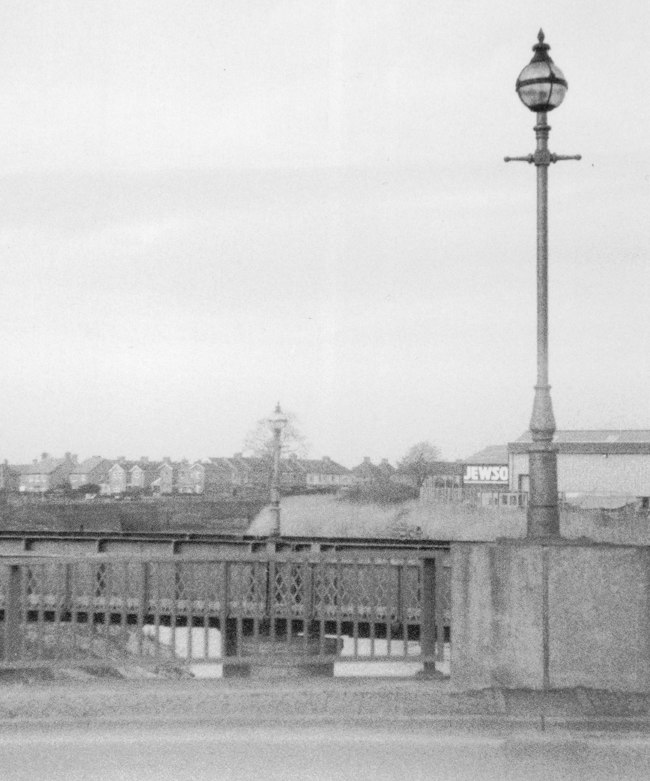
Motorway Bridge at Topsham.

The Shape of the West

One of the reasons I like the concept of the West Country is that it is vague with soft edges but as I suspect I’m going to get asked – indeed, have already been asked – which regions I consider to be within scope, I’ve decided to probe the term.

Maybe it’s “the five south-western counties of England” (Wiltshire, Dorset, Somerset, Devon, Cornwall) as argued by John Payne, who excludes Gloucestershire as mostly “Cotswold country”.

Perhaps it’s just Devon and Cornwall, as many practical guidebooks not prone to navel-gazing over identity seem to suggest?

(I realise this last bothers some Cornish people who see this kind of thing — and, indeed, the whole idea of the West Country — as the first step on the slippery slope to full-blown Devonwall annexation by England.)

In the world of local TV, BBC West covers Bristol,  and parts of Dorset, Gloucestershire, Somerset and Wiltshire; while BBC South West serves another chunk of Dorset, the rest of Somerset, Devon, Cornwall and Scilly. (The remaining bit of of Dorset is covered by BBC South — what a carve up!)

Fisherman on a Cornish windowsill.

Thomas Hardy’s Wessex includes not only Devon, Dorset, Somerset and Wiltshire but also Berkshire, Hampshire and Oxfordshire. It excludes Cornwall. The ancient Kingdom of the West Saxons from which it draws its name shifted its boundaries and influence over time but like Hardy’s Wessex (to simplify grossly) stretches further up and closer to London than most ideas of the West Country might allow.

The South West Region defined by the government includes Bristol, Cornwall, Devon, Dorset, Gloucestershire, Somerset and Wiltshire. Another bureaucratic body, the EU, says that a cheese can only be described as ‘West Country Farmhouse Cheddar’ if it is produced in Cornwall, Devon, Dorset or Somerset.

And, finally, I’ve always thought of the Great Western Railway line that runs out of London Paddington all the way to Penzance as a kind of spine for the West Country. As a result, I tend to look up on Swindon and even Reading as far appendages of the West Country. Maybe Paddington counts, too, like our Voyager probe poking into the western side of the capital.

So, for now, here’s my conclusion: the heart of the West Country is Devon and Somerset; neighbouring counties are deeply entangled; but the next counties out again might or might not be in the West Country, depending on the angle from which you view them, or which story is being told.

I hope that doesn’t mortally offend anyone. I suspect my view will change the more I learn and read, or perhaps you want to try to change my mind. To which I say, go for it!

Categories
Somerset

Old Familiar Rooms

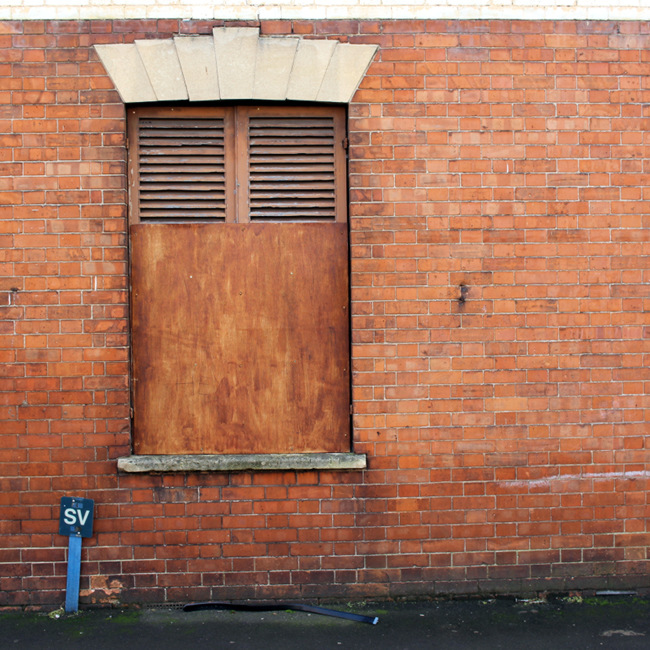
Blank window.

Yesterday, I went Home.

When I say Home, I mean Bridgwater in Somerset — a town I haven’t lived in since the 1990s, where I didn’t live for large chunks of my childhood, and where even my parents no longer live. But I was nursed there, went to junior school, secondary school and sixth-form college there, and so it is and always will be Home.

Perhaps I felt more than usually moved by the experience this time because I really had no reason to be there. I was delivering some Christmas presents to a cousin but, honestly, I half engineered that as an excuse to visit. No, this time, I was there because I wanted to be, with the express intention of giving the old place my full attention.

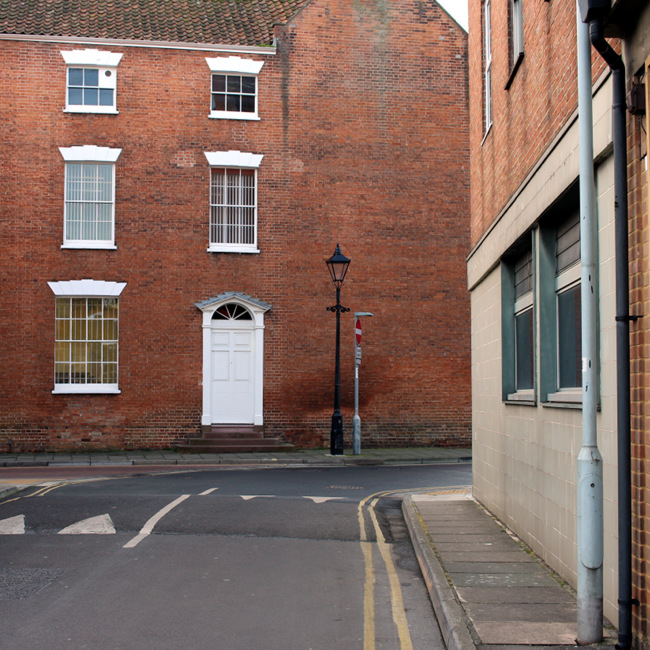
I felt quite overcome at times, standing opposite the house where my uncle died, passing my cousin’s workshop, and then wandering through terraced streets where various members of my family lived at one time or another. I didn’t remember the curve of the road or the beautiful soft-edged red brick. Its Victorian completeness, or complete Victorianness, had never struck me before.

For a full minute I stared at a derelict property, boarded up as long as I remember it, and somehow as faded and poignant in real life as an unlabelled Polaroid from the back of a discarded album. How could something so small, so mean, be so beautiful?

Dead street.

That habit some people have of reflexively dismissing their home towns as ‘dumps’, ‘toilets’, ‘the arse end of nowhere’, has never afflicted me. I’ve always insisted that I am fond of Bridgwater even though I know — of course I do — that there’s nothing much to recommend it to strangers. (Carnival, perhaps?) Hating one’s home-town has always struck me as a bit of a cliche, to be frank, like introducing yourself as ‘A bit of a cynic’, or saying that your band’s music ‘defies classification’. A sort of low-fat alternative to any actual personality.

Still, that contempt for the familiar must have been lurking, even if I didn’t acknowledge it. When I was 17 I was tasked with writing a script for a short film at Bridgwater College and what poured out was a grotesque stream of consciousness full of cracked paving stones, foul sewers, and grim reflections on the town’s sinister history. “Where did this come from?” asked the lecturer when I handed it in, perhaps concerned that I had previously unsuspected psychiatric problems.

On this visit, the same fear and loathing manifested in a strange tug of emotions. Much as I was delighted to be there I could also feel a tightening in my spine — a sort of shudder-in-waiting as my fight-or-flight response came out of sleep mode. It was as if my stranded teenage anxiety met me off the train and was following me around like an insinuating familiar.

I also caught myself trudging at times. Though I knew I should be move to be once again on Monmouth Street, for example, my legs and brain conspired to loop me back in where I left off. For whole stretches I forgot to look at all, as if I had somewhere to be by a certain time (I didn’t) — town is town is town.

Railway cottages.

Perhaps its natural to have that desire-hate, comfort-fear, fascination-boredom relationship with places you truly know.

As it is, this time the balance tipped towards the positive. I saw things for the first time that I’d seen a thousand times — ghost signs, the gorgeousness of the old Edwardian cinema, the sprinkle of classical buildings at Cornhill that speak of a time when the town had pretensions, and even the space-age oddness of the stillborn shopping mall. I looked at — was mesmerised by — the golden reeds on the riverbank backlit by a bone idle winter sun that had barely lifted itself above the bandstand in Blake Gardens.

I suppose my advice might be that if you’re going to wherever you call home for Christmas, and dreading it because it scares or bores you, or some mixture of both, try looking at it as a stranger might. Forget what you know, forget the well-practised routes your muscle memory insists upon, and let yourself love it.

Categories
Uncategorized

Smoke & Mirrors

Grandpa smoking.

I’ve never smoked but I spent my childhood in smoky rooms, surrounded by grandparents and parents, aunts and uncles, all smoking.

Bronzed fingers, yellow nails, picking at cellophane and gold paper. Those fingers flicking at lighters, pressing a fresh cigarette to the orange glow of another already underway, or pushing one through the bars towards the orange-purple flames of a gas fire. Those fingers hooked around cigarettes, lifting them to lips that kissed me goodnight or spat into tissues to wash my sticky face.

The smoke itself had a warm smell of home, not the wholesome smell of a wood fire but sweeter and dirtier. Like an animal. It created its own fog, sepia toning as practical effect, until breathing was like chewing and my eyes ached and ran wet. And there was no escape: “Shut that window, it’s bloody knottling.”

There were ashtrays on tables, windowsills, the arms of chairs, all full of smooth grey dust and bent filter tips, some with lipstick stains. Ashtrays were souvenirs, gifts and ornaments — the lozenge of green and red glass, the magic machine with the button to open the trap, the porcelain Whitbread promotional piece the size of a toilet seat, the vintage car with the red plastic seats — and yet nobody could ever find one, which is how cigarette ended up in tea cups or the empty foil trays from Sunday’s jam tarts.

All the houses were tanned brown, nicotine jam on every smooth surface, from fireplace tiles to the smoked grey plastic lid of the Hi-Fi. Scrape it with a nail and it would come away, pleasingly, in curls. There were burns in odd places, like either the tracks of tiny meteors or wormholes, depending where and how the tip of the fag had landed.

Player's No 6.

Smoking was a mode of personal expression: Uncle Ernie’s meagre roll-ups, Grandpa Newman’s stubby naval non-filters, Dad’s attention-grabbing pipes, his mate Mark’s cigars, all made some sort of statement. Some brands were ladylike, others masculine, and everyone had a preference.

I asked my Grandpa Roland what he wanted for Christmas every year and he always gave the same reply: “Packet of fags.” (Players No. 6.)

We woke to morning coughs — to the sound of lungs trying break the belts that bound them with a hack, hack, hack, rattle and release, and then repeat. Later there were inhalers and oxygen tanks, and yet still cigarettes. Give up smoking or you will die, the doctors said, and most of my relatives looked from cigarette to doctor and back again, and took another drag.

I sometimes miss the smoke, the smell, and especially the smokers, happily smoking, sharing cigarettes to show their affection for each other, sitting in a cloud they made together.

But, like I say, I’ve never smoked.

Categories
Uncategorized

The Comprehensive Club

The Comprehensive Club (exterior)

Do you know the Comprehensive Club on Pall Mall? It’s an extremely exclusive institution whose members are required to have attended a non-selective state school.

It’s housed in a plain brutalist building built in around 1964, and quite discreetly advertised. The bar is a pub, the restaurant a canteen, and instead of leather armchairs and grandfather clocks it’s all knackered but comfortable sofas, and plastic school chairs. There are TVs and lots of noise and if you want a cup of tea, there’s the kettle, make it yourself.

But for some reason – I’m vague on the details – membership is much sought after by posh types. They grovel and beg to be admitted but, no, they’re simply not the right sort of people. It sometimes seems as if the committee takes a perverse pleasure in humiliating them as it turns them down in favour of someone from one troubled council estate or another. The chair can sometimes be heard to mutter, “Taste of their own bloody medicine…”

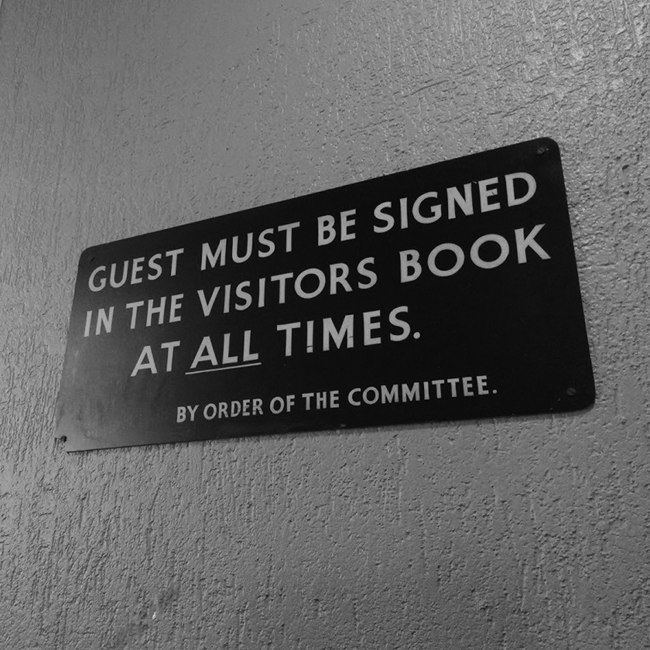
"Guests must be signed in the visitors books at all times."

Other than the comprehensive school requirement, the rules are quite simple. First, only fifteen new members may join in any given year, based on their personal achievements, and bearing in mind the circumstances of their upbringing. Secondly, members must avoid wearing jackets, ties, black tie, gowns, or any other symbols of formality at any time. And, finally, it is a serious offence to do anything to belittle, embarrass or otherwise ‘lord it over’ (those are the words in the constitution) any other member. If someone wants to eat chips with their fingers, mind your own business.

But beyond that, despite having been a member for 25 years or so, I’m not entirely clear about how it all works – about the practical details. Where does the money come from? Surely the members can’t be expected to pay huge fees, unless it’s only for people who’ve somehow got rich, which would hardly be desirable. I’ve never been asked for a penny. Another thing: what does it offer that the real world doesn’t? Why not just go to the pub, or a café? And isn’t the idea of an exclusive club, even on these terms, just a bit… wrong?

Truth be told, I go there less often these days. I don’t need it as much as I did in my teens and twenties when I found it a refuge – somewhere my manners could never be too clumsy, my tastes never too crude – and, at the same time, a delicious means for exacting revenge against the public school set. In fact, as the weight on my shoulders has lifted, and the wounded creature that used to whisper in my ear has become less insistent, I sometimes wonder if the Comprehensive Club ever existed at all.

Categories
Somerset

Clatter, Pop, Hiss, Clang

Industrial wasteland.
Bridgwater c.1999.

Through the scratched visor I can see my hands in heavy duty gauntlets fumbling another dented aerosol into the cradle and slamming down the handle. The nail on the end of the lever pierces the can and the gas escapes with a satisfying bang, followed by a nosebleed of Hammer Horror red as the penetrant dye inside leaks into the oil drum beneath. I give it a shake to release the last of the liquid and hurl the crumpled shell into the skip at my side with another pleasing sound – this time, a cymbal crash.

This was my summer job between school and sixth-form college – puncturing cans that for one reason or another hadn’t passed quality assurance – and I rather enjoyed it. For the first time in years, and for the only time for years to come, I didn’t have revision or reading to do, and the mindlessness of the task suited the state of my post-GCSE brain.

For a dorkish introvert like me the situation was perfect, too. I’d worked on the shop floor in the factory proper for several stretches and found the constant supervision and chatter more exhausting than the labour itself. Out in the yard, it was different. Once or twice a day the foreman would appear from the side door to ask me how it was going, or just give a questioning thumbs up; sometimes someone would turn up with a fork lift and dump another load of cans into the TO DO box, usually with obvious glee at my misfortune; but mostly I was left alone. Looking through a chain-link fence and out across blonde-tipped wild grass, I could breathe.

River scene in black and white.
View along the river Parrett to the Wylds Road Industrial Estate c.1997.

Well, breathe is the wrong word. I had to wear a forest green body suit, coarse on the inside and glossy out, to protect me from being sprayed with solvents. The mask preserved my eyes and also insulated me from the worst of the fumes, but meant I could hear myself respire, and had to peer through a warm fog of my own making. It was hot in there under the kind of summer sun I’m sure they cancelled after about 2001 and I sweated like tinned ham.

Because it was so hot, my favourites among the dinged and mislabelled cans were the ‘air dusters’ which when popped gave out a magical breath of cold wind, dusted my gloves with ice and chilled my fingertips.

Oddly, doing this job is the only time I’ve ever been high. At the end of the day I had to clean my suit, removing the grey, sticky layer created by one puff after another of solvent, dye, orange-scented label remover, varnish, lubricant, and any number of other goops and greases. I did this job in a stairwell using rags and a can of the firm’s strongest ‘degreaser’. My induction, which took about five minutes altogether, included a stern warning to do this with the door open, which having grown up on anti-glue-sniffing propaganda in the 1980s I took very seriously. But one day, somehow, the stop slipped and the door betrayed me, gliding soundlessly into its frame. Innocently, I kept spraying until the job was done, but when I stood up my legs had disappeared. I knew they were there, I could see them, but I was hovering above the ground. I smirked, then frowned, then giggled, then felt sick. I realised what had happened and drifted out on to the shop floor. Oddly, nobody noticed that I was levitating, though I was sure everyone was looking at me – all those eyes! I bobbed up to the first person who crossed my path and said, earnest as ever, ‘I think I’ve abused solvents by mistake.’ As they guided me outside, manoeuvring me like a loose barrage balloon, I oscillated between laughter and seasickness. I gave someone my Klix key, I think, which is how I ended up with a beige plastic cup of foul, powdery vending machine orange pop which definitely tipped the scale from hilarity to nausea. My legs rematerialised after a few minutes along with a crushing headache. I haven’t felt inclined to repeat the experience.

For months after I finished the job I dreamed about it – a looping cinemagraph of concrete and blue sky soundtracked by the distant digestive grumbling of the factory and the clatter, POP, hiss, clang of one can after another.

Categories
council

Cutting the Brie the Wrong Way

Frosty fen.
Cambridge, c.1998.

I haven’t written about my time at Cambridge for various reasons, including a sense that my experience 20 years ago probably isn’t relevant today – that the weird world of public school rituals, boating clubs and silly gowns was fading then and so must surely have completely disappeared by 2017.

Only, it turns out, it hasn’t, so here’s how it went for me.

I grew up working class, mostly on a council estate in Somerset, and went to a comprehensive that was very near the top of the Ofsted Hard as Nails League Table. From there, I was one of a handful of kids who went on to do A levels at the local sixth-form college. There, rather to my surprise, I continued to do well academically and was identified as Oxbridge material by an ambitious college administration. They put all of us swots into special coaching sessions run by an inspirational lecturer, the son of a Nottinghamshire miner who went to Oxford in the 1970s and kept a bust of Lenin on the desk in his classroom. When he told us that, yes, Oxbridge was full of weird posh people but, no, that didn’t mean we should avoid it, it carried weight. We had as much right to be there as anyone else; we shouldn’t let them keep the best stuff to themselves out of fear or misplaced humility.

It all felt as if it happened by accident, to be frank – just a matter of taking what was for me the easiest path, filling in the forms that were put in front of me, tackling one hurdle at a time. I got an interview which took place on a frosty winter day and gave me my first taste of the problems I would have later. I was told to wear a suit, which meant finding the money to buy one; and we couldn’t afford a hotel, even if had been the kind of people who even thought to stay in them. (A reminder: the bar for ‘expensive’ is low when you have bugger all.) So Dad drove through the night and I arrived angry and exhausted at breakfast-time.

The other interview applicants were somewhat reassuring. There were a couple of northerners with proper accents who seemed as anxious as me, and several people who, although clearly Home Counties middle class, had a relatably similar comprehensive-n-college background to mine. The interviews, which seemed almost designed to sabotage people like me, went well, partly thanks to the preparation I’d had at sixth-form, and partly through adrenalin. I remember arguing slightly too vigorously with a pair of terrifying college fellows that Eastenders was as interesting as Wordsworth and that the half-rhymes were the most interesting thing in Wilfred Owen’s poems. It turns out they like this kind of thing – ‘independent thought’ – and so that was that, I was in.

* * *

What people sometimes fail to understand about growing up working class – or at least as I experienced it in the 1980s and 90s – is how scared and innocent it can leave you in some important ways, even if you seem bullish and practical in others. Public transport is expensive so you don’t take it, which is how I got to the age of 18 being unsure how to use trains or buses. I could count the number of times I’d eaten in restaurants on one hand, and had never eaten Chinese food or take-away curry. I’d never seen an olive, or houmous. I’d only been abroad once, on a three-day educational trip to Brussels sponsored by the EU. I didn’t know what ‘smart casual’ meant, or that Earl Grey tea is supposed to taste like Fairy Liquid. I didn’t realise that it was frightfully vulgar to discuss money or politics, or how to make polite small talk over glasses of wine. By contrast, all the upper- and middle-class kids I met in my first week seemed like globetrotting sophisticates: they’d had gap years, spoke multiple languages, and seemed to have been trained in cocktail chat and advanced canapé consumption techniques.

Things only got worse when I realised that there was a tier above this – the blazer-wearing rugby and rowing sorts who were so posh they didn’t even have to pretend to be pleasant or polite, and could behave more or less however they liked. I spent several years just flat out avoiding them, scurrying round the edges of the College, hoping I wouldn’t encounter a drunk member of the pride enraged by, say, a complicated door mechanism, or the complexities of operating a kettle.

Money was a persistent problem, even in those tail-end days of grants. I tried to live off a pound a day, not wanting to tell my parents I needed more cash because they didn’t have it, and having been told by the College not to do any part-time work under any circumstances. So in my first term I lost about two stone and was constantly hungry. (This seems insane now I see it in black-and-white but it’s true.) I eventually cracked and told my tutor that I was getting a job and they could stick it if they didn’t like it, which magically unlocked a bursary fund, after a brief round of mildly humiliating means testing which required my parents to provide copies of their bank statements. Even that only covered living, with nothing left over for having fun. That wouldn’t have been so bad if the rich kids hadn’t been having lots of very loud, visible fun all around me – weekends away, parties, restaurant dinners, fancy clothes, and skiing holidays paid for with their loans ‘because my Dad says I might as well take it, given the low rate of interest’.

(Some of this is probably on me — I am capable of having absolutely no fun under almost any circumstances.)

But the hardest thing was that oppressive sense of cultural alienation. I had a meltdown about this at one point and, in desperation, unloaded in near hysterics during what was meant to be an academic supervision. I chose the right teacher to talk to – someone who had come to Cambridge from Africa and had an experience far more stressful and bewildering than mine. “The whole place is designed to make you feel like an outsider,” he said, with uncharacteristic feeling. “Everything they do, all the rituals and manners, even the way the buildings are designed, is intended to exclude people like us. Do not let them achieve what they want.

I never stopped feeling like an oik – someone once loudly mocked me for cutting a slice of brie the wrong way, which is the elevator pitch version of my time at Cambridge – but I did eventually stop thinking it was my fault.

I learned to spend as much time as possible away from the College, wandering around reassuringly normal housing estates outside Cambridge, or sitting on benches at the Grafton Centre, which felt a bit like being in my home town. This wasn’t homesickness — it was pining for the real world, and a reminder that it was that lot inside the College walls who were the freaks, not me. I found friends who didn’t make me feel like shit because I didn’t know which way to pass the port, and who liked sitting around drinking tea while we listened to records — something I could afford.

I left with a good degree (having no fun meant I had time to read all the books and revise),  a certain confidence in the quality of my intellect, and several important relationships that are still going strong today.

Other than that, I don’t feel like a ‘Cambridge man’, or have lingering affection for my College. I don’t have any ties or scarves, have dodged every reunion to date, and when the College kept bothering me for money I asked them firmly to stop phoning, emailing and writing. Our business with each other, as far as I’m concerned, concluded the day I walked away with my degree. Cambridge is an ex I dumped after a long, dysfunctional relationship.

So, when young people from similar backgrounds to mine ask if they should go to Cambridge, I find it hard to give a straight answer. One the one hand, not going is a kind of surrender – letting them have it all to themselves – and if it’s not quite world-as-oyster dream I was sold I guess my degree did get me as far as interview stage for my first couple of jobs after university. At the same time, I feel duty bound to be honest with them about my experience, so at least they’ll know what they’re getting into.

Cambridge is what Cambridge is.

Categories
Somerset

The Old Country

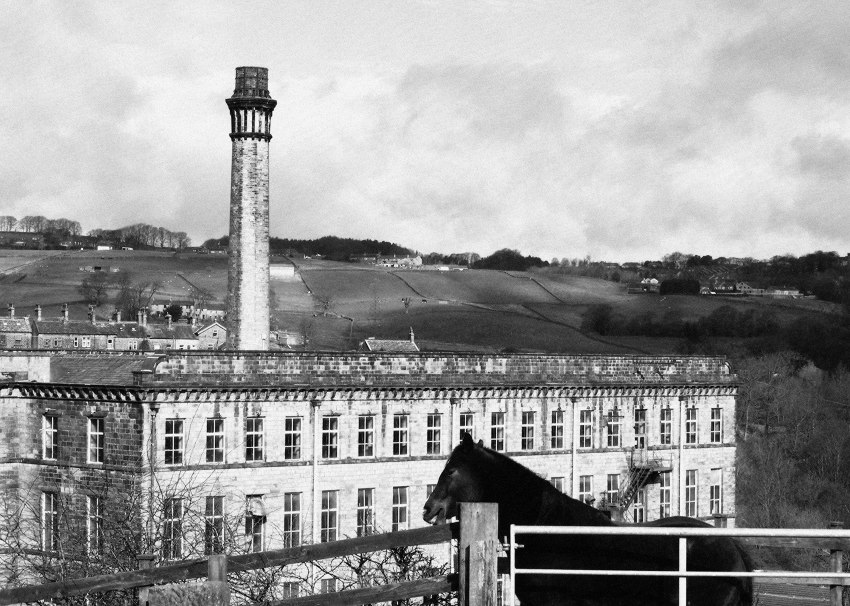
A mill against hills, watched by a horse.

I’m Northern like Tony Soprano was Italian.

My Mum is from Lancashire but moved to Somerset when she was a child. She came with an accent (mostly intact 50 years on) and a fully formed Northern identity. I grew up surrounded by Lancastrians who talked constantly and longingly about the North, in Northern accents, sometimes while eating plates of tripe and onions. (That’s not a glib joke.) I heard all about Uncle John and his bus route in the Ribble Valley, endless jokes about the horrors of Yorkshire, and tales of a bastard ancestor whose personal motto was: ‘I’m Joshua Sykes of Stockport and I give a bugger for no man.’

Mum, pining for the Old Country more than my un-sentimental uncle, was the most prone to wallow in her lost Northerness. Even now after a glass of whisky she’ll recite her favourite dialect poem which (as my memory has it) begins: “As I were walking oer Thraitle Bridge I met me owd pal Mickey Plum and what dost tha think he says?” (There are numerous variations.) She calls buses ‘buzzes’ and – a sign that her Lancastrian accent operates at a fundamental level and not as a nostalgic pretence – cannot say Google; instead, it is ‘Goodle’.

My Grandpa looked a bit like Stan Laurel (another member of the Northern diaspora, who ended up further afield) and, apparently left with a damaged internal thermostat by his time as a prisoner of war in eastern Europe, hated any kind of draught. That’s why I remember him best in a kind of sound-and-motion second-long mental snapshot, shouting wearily “Door, door, door, door, DOOR!” whenever I left it open. He chewed the vowels and swallowed the R so that the word was more like dour, or dawer, or maybe dore. I wish I had the technical language to describe his accent. It definitely wasn’t a ‘daw’ at any rate, and he was definitely from Ozzlewtwizzle, not ‘Oswald Twist-el’.

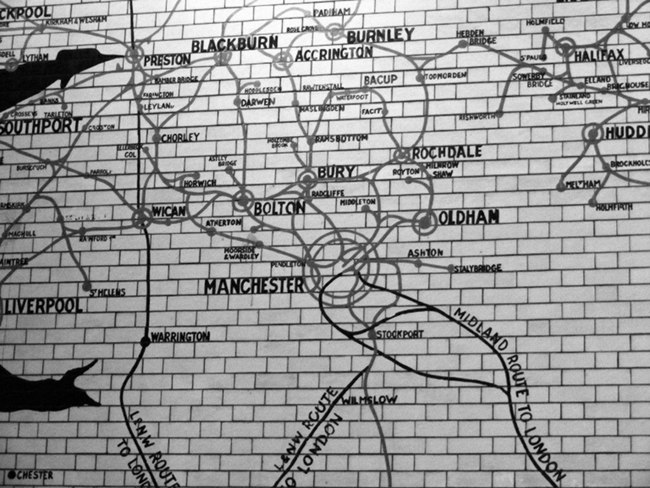
Map of the North West at Manchester Victoria Station.

Oh, yes – Oswaldtwistle, Darwen, Bacup, Rawtenstall… I know the names of all these exotic places and how to pronounce them. ‘Bury’ is almost impossible to say correctly if you haven’t heard it said time and again by native speakers, using secret vowels not in general circulation. When I hear a Southerner say Berry, Dar-wenn, Backup or Raaaaaw-ten-stawl I think they sound bloody daft even though, remember, I’m not Northern, don’t sound Northern, and have never been to any of these places. Watching Juliet Bravo on TV as a child Mum would say to me, ‘They film this in Bacup you know’ and in anger and shame would snap at me in shops when I touched the goods: ‘Put that down! Are you from Bacup? That’s a Bacup look!’ (What a strange slur against one particular Lancashire town – that its natives can’t look at an object without manhandling it.)

I say I don’t sound Northern but there are lots of Northern words and phrases in my vocabulary. Nan was often ‘out of flunter’ and I started using that ironically as a teenager, like Billy Liar teasing Councillor Duxbury. Now, I just find it useful – the perfect word to describe a state somewhere between depression and exhaustion. And decades of hearing Mum call Uncle Norman ‘kid’ or ‘our kid’, and vice versa, has left me prone to referring to my own brother the same way quite instinctively, despite the Gallagher brothers’ brief ownership of this curtly affectionate term in the national consciousness.

A few months ago I was in a crowded pub and need to ask Mum across the room if she wanted a drink. Some previously unused software kicked into life and I mee-mawed, just as I’d seen her and Nan do so many times. She understood and mee-mawed back so that we were able to establish that, yes, she did want a drink, just a half, and, no, not lager — bitter this time, Doom Bar rather than Bass. It was all so fast and instinctive that it took me a moment to realise what had happened at which point I felt quite overcome at so effortlessly using a skill my grandmother had learned in cotton mills in the Rossendale Valley 80-odd years ago and that I had somehow inherited.

The first time I went to the North as a child felt important. It was for a great uncle’s funeral in Bury but we found time to explore. Mum had talked about the market for years with the sadness of an exiled Russian princess recalling the Winter Palace so we had to go there. I remember eating meat and potato pies (still an obsession) and being almost offended when someone told me my mild West Country accent sounded like Ian Botham’s.

In the years that followed we frequently went on holiday to Blackpool, Cleveleys and Fleetwood, popping into Manchester or Bury to visit relatives or shop. I loved it but didn’t feel at home the way Mum did. Of course. Because I wasn’t.

Years later I worked in various places across the North, alongside Northern colleagues, and it didn’t take me long to work out that whatever connection I might feel with the North Country, they saw me as hopelessly Southern. I didn’t understand the geography (true), the tensions, the dialects, or the culture. My belief that I had any claim on Northerneness when really all I had was a secondhand understanding of a particular version of a part of Lancashire of the 1950s was a handicap, not an asset.

Which brings me back to Tony Soprano. There’s an episode in the first season of The Sopranos where Tony and his cronies go back to the Old Country on business only to realise just how little they have in common with their supposed kin. The Italians find them vulgar, crude, stupid; and the Americans find the Italians irritating. An optimistic reading is that this leads them to appreciate their identity as Americans but there’s a sadness in it, too, as a key foundation of their identity is knocked out from under them.

In a small, muddy, mediocre way, my ancestors were migrants too, roaming all over the country in the 19th century chasing agricultural jobs, then industrial work, or service, so that I can claim connections all over England but no deep roots in any one part. Which is true of most non-aristocratic English people, I suspect.

These days, I am trying to be from Somerset, which is where I was born and mostly grew up. I say ‘trying’ because, despite it all, I’m more confident about how to pronounce Crawshawbooth than Muchelney.

Categories
crime

True Crime

Policeman.
A mural in South London.

There are lots of problems with ‘true crime’ writing.

First, so much of it feels as if it’s been written by a sweaty Dennis Franz-alike wearing a dirty vest in a seedy hotel. As if the writers would actually like to be doing the kinds of things they’re writing about, and are writing for people who feel the same. Pornography for repressed psychos, basically, or at least the chronically morbid.

Then there’s the stuff that goes out of its way not to wallow in the gore and physical horror but instead attempts to ‘tell the stories’ of those murdered and of those left behind. Sometimes it has a noble purpose — to ensure that the true weight of the crime is underscored as justice is administered; to keep the story in the news so that the case won’t be closed; or simply re-balancing attention from killer to victim. Too often, though, this also feels like pornography, albeit of a more subtle kind: ‘I can’t imagine what it must be like…’ (But with a shudder that sits somewhere between fear and thrill.)

Still other examples turn the police into unblemished heroes (The Badge);  massage them into archetypes (crusading, compassionate) for the sake of a neat narrative. It is about strong men struggling with demons, refusing to give up. This is another kind of fantasy, albeit often a reassuring one.

I’m thinking about all this because I’ll admit I used to be one of those weirdos who is somewhat interested in the Jack the Ripper case. It was something I came to as a teenager via Sherlock Holmes, and I guess Hammer Horror — not the best route, I now realise. At first, I was more interested in Victorian London, and books about Jack the Ripper were merely a useful, easily available vehicle for accounts of, for example, Jewish social clubs in Whitechapel in the 1880s, or the lives of those who slept hanging in rows on ropes for want of a bed.

Later, I began to feel a nagging irritation at the fact the case offered no closure. How could someone kill six women (the number is debated) and get away with it? Surely some papers would turn up, or a DNA test, wouldn’t they? (There is a whole industry devoted to ‘startling new evidence’.) My theory — because one had to have a theory — was that ‘Jack’ would prove to be the most boring, anonymous 20 to 35-year-old living on or near Flower & Dean Street, and definitely not a mad doctor or prince or whatever else.

I can pinpoint the moment when I realised this was not a healthy thing to be interested in — to have as something even vaguely resembling a ‘hobby’, for goodness sake. It was when a friend booked places on a Jack the Ripper tour of the East End one autumn evening during which the guide, with, I thought, evident glee, declared: ‘…and cut her open from vagina to breastbone’. He made the motion with his hand as he said it. The Americans on the tour giggled but I thought, very Englishly, ‘Steady on.’ He was quite the showman, he had a living to make, I understand all that, but it wasn’t right, and it cast the whole business into sharp relief.

I still have a couple of books about the case on my shelf (both long discredited, I gather) which I catch myself dipping into from time to time, but I haven’t bought any more since. I have also read other bits of true crime writing such as David Simon’s Homicide and the Library of America anthology. I listened to the first series of Serial like everyone else on the planet. The fact that true crime podcasts so often include long-winded justifications for their own existence betrays that their creators doubt their own motives: corpses + grief = subscribers.

Some of the true crime writing I’ve encountered, I enjoyed, if that’s the right word, but some gave me that sick feeling. So much of it concentrates on the killing of women, accurately reflecting the sad ways of the world, no doubt, but leaving me queasily asking… Why am I reading this? And why did they write it?

In recent years, driven primarily by determined female historians, thinking around the Ripper case in particular has moved on. It won’t be solved and in talking endlessly about the murderer, and especially in depicting him as a semi-mythical satanic figure akin to Spring-Heeled Jack rather than a sad arsehole, we do the victims a disservice. So, the new thinking goes, let’s look at and talk about them as whole people, who lived long, full lives before they became merely ‘victims’, if we absolutely must continue to dwell on this horrible case. To which end, Hallie Rubenhold is working on a book about the victims of Jack the Ripper due out next year; and Dr Fern Riddell’s Tweet thread on the same subject, from 2013, is here.

If Jack the Ripper destroyed Mary Ann Nichols, Annie Chapman, Elizabeth Stride, Catherine Eddowes, and Mary Kelly, and got away with it, the best justice we can now hope for is to put them back together with greater completeness and reverence than their humble lives might otherwise have prompted.

Categories
buildings concrete history Somerset

War Still Echoes

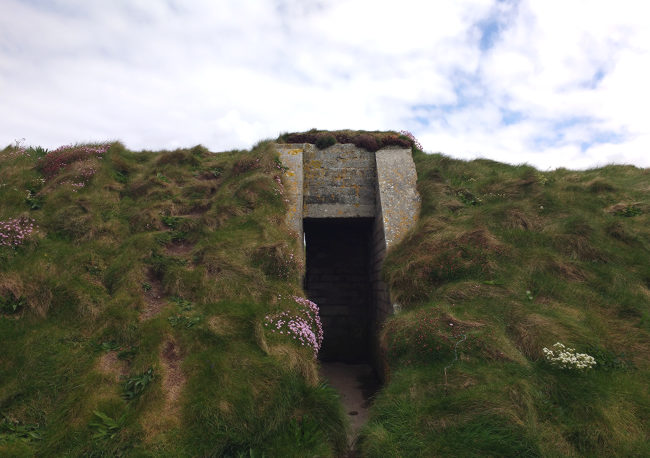
Inside a shelter.
The Spitfire base at Perranporth, Cornwall.

The recent surge in the visibility of fascism and fascist imagery is depressing. It’s become a cliche to say it but here goes: we had a war and settled this a while back, didn’t we?

What I’ve been thinking about lately, in particular, is how that ‘while back’ doesn’t even feel all that far back.

Yes, that feeling is partly a result of my being a relic of the 1970s but, really, you don’t have to look far, even in the leafy suburbs, small towns and countryside of Britain, to see great concrete chunks of World War II just lying around, like tombstones.

I went for a run up and around Purdown in Bristol the other day. My aim was to get to the base of the telecoms tower I’ve been able to see on the horizon for the last few weeks. Once I’d got past that, however, I was amazed to find myself picking a path through what were obviously the overgrown remains of gun emplacements.

Officially known as the Purdown Heavy Anti-Aircraft Battery this site was first militarised in 1939 and the concrete structures were erected in 1940. Locally it was the source of the legend of ‘Purdown Percy‘, a supposedly secret, supposedly massive gun that could be heard across the city.

Fantastic as I found this survival I wasn’t surprised by its existence because, honestly, it sometimes feels like a challenge to go for a walk or ramble without stumbling across something like this.

Spitfire base, Perranporth.

On the Cornish coast in April my other half and I found ourselves diverted through the remains of a Spitfire base at Perranporth — overgrown, yes, but so complete that a Battle of Britain fighter squadron could probably operate out of it by this time next week if need be.

In my home town of Bridgwater pill boxes surround the railway station and line the canal all the way Taunton — brutal brick and concrete structures designed for no purpose other than war and preserved at first, I’ve always assumed, because no-one quite believed the peace would hold with Russia rampant; and then just forgotten about.

Even in London, built on and overbuilt and developed to a high shine, you can still see painted signs on Smith Square pointing to air raid shelters, and the remains of shelters themselves in parks and on side streets. Just look at the Citadel in St James’s Park, as I used to do on the way into work most mornings for about a decade — a bunker so bullying and intrusive, like a beached warship, that it has almost become invisible.

The war is still with us, even as those who remember it firsthand slip away from us.

The war is still The War.

The warning still rings.