Categories
weird fiction

Broken Veil: indescribable horrors gently whispered in your ear

The six-part podcast series Broken Veil, created and presented by Joel Morris and Will Maclean, exploits the inherent ‘truthiness’ of the podcast format to chill its audience.

When the first episode landed a few weeks ago I wasn’t sure if it was an attempt to jump on the Uncanny bandwagon by telling a supposedly true ghost story, or a clever fiction.

    I suspected the latter thanks to the involvement of Maclean, best known for his 2020 novel The Apparition Phase. It didn’t take long to spot tells which confirmed that, yes, this was a drama – albeit one that felt, at times, uncomfortably real.

    Those tells? Acting as if you’re not acting is difficult, for one thing. Broken Veil is cleverly directed to minimise this problem with actors apparently briefed on the story they need to tell and encouraged to improvise around a loose script.

    Conversations recorded on noisy microphones, in noisy cafes, in open spaces, or in moving vehicles, also dragged it a touch closer to verisimilitude.

    I’ve listened to a lot of audio drama that feels like stage school kids in sound-proofed studios, over-egging their performances, and slurping their tea too aggressively, too near the microphone. Broken Veil felt light years ahead of that. But still not completely, seamlessly, perfectly convincing, even if it got very near.

    Despite deciding that it was fiction, there continued to be moments when I doubted myself. Perhaps it was more complex than I’d realised. Perhaps some of the incidents described were real, and only some were fictional, or fictionalised.

    The spooky, moody, Scandi-noir score was another tick in the ‘feels real’ column. This is how true crime and supernatural podcasts tend to sound.

    Another was the way episodes were edited to finish on revelations and cliffhangers. Co-creator Morris is an expert in understanding and documenting the patterns and structures behind stories, and comedy, and he applies that expertise here to apply the unwritten rules of of non-fiction podcasting.

    Just as real non-fiction podcasts tend to do, it also went off on tangents, and gave over whole episodes to what felt like ‘side quests’. Each made the story feel more complex and more confusing, in pleasing ways. When the real actress Gabrielle Glaister (Bob from Blackadder) turned up playing herself it worked both as a standalone story and as a ‘convincer’.

    Horror, or weird fiction, often thrives in that space between truth and fantasy. To paraphrase Fox Mulder from The X-Files (a reference point for Broken Veil) “We want to believe.”

    Like Morris and Maclean, I’m of the generation that saw Ghostwatch air live on the BBC in 1992. It was clearly labelled as a drama, with an on-screen writing credit for Stephen Volk. But it employed non-actors like Sarah Greene and Michael Parkinson, and the look and feel of live TV, to play with the audience’s perceptions of reality.

    Other touchpoints in a similar vein are Alternative 3, a 1977 mockumentary which was originally scheduled for 1 April but actually aired much later in the year, and so fooled many viewers; and The Blair Witch Project, which triggered the found footage movie boom of the early 21st century.

    Throughout Broken Veil’s short arc the hosts frequently invoke cultural references like these, along with myths and legends of the paranormal that a certain type of British child has latched onto and absorbed for decades.

    The Philadelphia Experiment gets a mention, for example, as does Matthew Hopkins, the Witchfinder General, and the ‘backrooms’ internet meme.

    All of these are shortcuts to the mood the creators want to create: paranoid, hauntological, psychogeographical – layers of muddled meaning on worn-out, overdubbed tape.

    As with many weird stories, the opening is the strongest section. It’s when the sense of reality is strongest and the story being told feels most plausible. A challenge for creators of weird fiction is that setting up a mystery is fun, and it’s what people enjoy. They think they want a solution but no explanation you can provide will be as pleasurable as drifting, bewildered, in the unknown.

    If there’s a problem with Broken Veil, it’s the pacing. Though it’s been a success, at least in terms of podcast charts and critical commentary, it was a side project for two busy creatives, and that shows in its brief run, and hurried denouement.

    The final episode in particular felt like several weeks’ worth of content crammed together into too small a space. And of course the opaque solution half provided wasn’t wholly satisfactory – how could it be?

    I would have been quite happy to listen to a longer, slower version of this podcast that revealed small nuggets of information over months. And I wouldn’t have minded had it never resolved.

    Just being in this world, with two softly-spoken, slightly geeky hosts murmuring strange stories to each other, was pleasure enough.

    Broken Veil is available through all the usual podcast services.

    Categories
    Film & TV

    These other Londons: the imagined city of the backlots

    London, like New York, is often too busy, and too much in flux, to play itself on film. So, time after time, filmmakers rebuild it on backlots – with varying degrees of accuracy.

    Each of these other Londons represents a particular vision of the city, and conveys the creators’ preconceptions, prejudices and perspectives.

    Even the best of them never quite look real. On high definition video, more than ever, we can see that ‘bricks’ are lines etched into plaster, and that their streets merge with painted ‘flats’ or matte paintings.

    They’re fantasies. But are they any worse than, say, Dublin, or Riga, or Budapest, with every stone and brick the wrong colour, putting on their best cockney accents?

    I’ll take the artistry and illusion of a backlot set over Prague scattered with red buses and phone boxes any day. (Even if that backlot is, itself, in Prague.)

    Stand-in Londons in Hollywood

    Old Hollywood loved to build Londons.

    Cedric Gibbons created one at MGM for David Copperfield, directed by George Cukor in 1935. On screen, the backlot construction was supplemented with matte paintings.

    Parts of that set, later known as ‘Copperfield Court’ or ‘Copperfield Courtyard’, were used in other productions, including on TV, for years to come.

    What looks like a Victorian or Georgian terrace with an ornate bow-fronted shop.
    Copperfield Courtyard at MGM in 1949. SOURCE: The Phantom of the Backlots.

    At Universal, before Frankenstein, James Whale directed a version of Waterloo Bridge, released in 1931. For that production, a misty wartime London was created by Charles Hall, including a replica of the bridge itself that used forced perspective to suggest scale.

    A vista of London with Waterloo Bridge in the foreground, bustling with people.
    A scene from Waterloo Bridge, 1931.

    Hall and Whale were both British and perhaps this added to the relative realism of the production.

    In his 1976 book Caligari’s Cabinet and Other Grand Illusions production designer Léon Barsacq shares a promotional image from the 1933 production of Noël Coward’s Cavalcade by Frank Lloyd for Fox. Barsacq also quotes the text that came with the photograph:

    “Why! This is a section of the Strand!” exclaimed Miriam Jordan, whose home is in London, when taken to the London ‘set’ for ‘Cavalcade’ on the Fox Films lot. In the background is a typical London building and at the left is an exact replica of a small London park. Natives of the British Empire and world travelers are amazed at the fidelity with which William Darling, art director of Fox Films studios, reproduced London street scenes. Even the lamp posts are authentic.

    Even after the war, when many Americans had seen Britain for themselves, Hollywood continued to film London under the Californian sun.

    Dock walls and cobbled streets at night while various men prepare to rumble.
    A scene from Kiss the Blood off My Hands, 1948, showing a recreation of Wapping in Hollywood.

    Burt Lancaster starred in and produced the British-set Kiss the Blood off My Hands – one of the all-time great film noir titles – in 1948. It was shot at Universal on an extensive recreation of the East End of London, and Wapping in particular, that supposedly represented 30 blocks of houses, warehouses and wharves.

    At the other end of the scale, there was the brightly coloured, sugar-icing version of London seen in Mary Poppins, shot at the Disney studios in Burbank. Along with many matte paintings there was also a large physical set for Cherry Tree Lane, with more forced perspective, including on the cherry trees.

    Backup Londons near London

    Why recreate London when you’re on the outskirts of the real thing? Why not film on the actual streets? For convenience. Because London changes too fast for historical drama. And, perhaps, because an air of fantasy might be desirable.

    In 1961, Cliff Richard, ‘the British Elvis’, was a huge star. The Young Ones was to be his first serious star vehicle, directed by Sidney J. Furie, and the budget justified the construction of a “quite extensive backlot town” of “relatively anonymous West London streets”,  as described by Jonathan Bignell.

    Cliff Richard and Carole Gray dancing on a fake London street with shop fronts, red phone boxes, and a bench.
    A scene from The Young Ones, 1961.

    Bignell’s particular interest is that this set lingered on and was used and reused, dressed and redressed, to represent not only London but also locations around the world in British TV shows such as The Saint, The Champions and Randall and Hopkirk (Deceased).

    A police officer guards a hole in the road on a fake London street.
    The Counterfeit Constable, 1964.

    A little later, at Shepperton, a 1964 French production, The Counterfeit Constable, called for the construction of another London in miniature.

    These streets also hung about and, with tweaks, represented everything from the 18th century city in Moll Flanders to post-apocalyptic future London in one of the Doctor Who films.

    The never-never London of Sherlock Holmes

    The backup London at Shepperton described above was also used, with adjustments, in the 1965 Hammer film A Study in Terror, starring John Neville as Sherlock Holmes.

    Over the years, however, Holmes has prompted the construction of several elaborate Londons in his own right.

    A London street set under construction with scaffolding holding up flimsy facades.
    The set for The Private Life of Sherlock Holmes under construction. SOURCE: Library of Congress.

    In 1969, Alexander Trauner built a long stretch of Baker Street at Pinewood for Billy Wilder’s The Private Life of Sherlock Holmes. (He’d previously constructed a very convincing Paris for Wilder’s Irma la Douce in Los Angeles.)

    This set would also linger on, decaying, and appear in distinctly less prestigious British productions such as Carry on at Your Convenience.

    A version of Baker Street with terraced houses opening their doors straight onto the pavement.
    Baker Street at Granada. SOURCE: Horslip5 on Flickr.

    A decade or so later, Granada in Manchester set about bringing Sherlock Holmes to TV with Jeremy Brett in the lead role. For this expensive production it constructed its own Baker Street – just around the corner from its recreation of a red-brick Manchester terrace for the long-running soap opera Coronation Street.

    This set is particularly interesting because it’s one many British children visited over the years as part of the Granada Studios Tour. I went myself, as a dorky teenage Holmesian, and felt as if I’d gone to heaven. (Years later, I worked on the real Baker Street for about six months, and there was no romance about that at all.)

    When Guy Ritchie filmed his Sherlock Holmes with Robert Downey Jr., released in 2009, he also had a large scale Baker Street set to play with – albeit one built for a Harry Potter film and refitted. Rather than forced perspective, as employed by Trauner 40 years earlier, this set was extended with green screen and CGI. It was not an improvement, in artistic terms.

    Recreating the East End

    London’s East End is another common target for cinematic recreators – not least because the real East End was so extensively changed by, first, the Blitz, and then post-war remodelling.

    Sherlock Holmes and Dr Watson walk through the East End after Jack the Ripper has committed another murder.
    Murder by Decree, 1979.

    In Murder by Decree, a 1979 Sherlock Holmes film directed by Bob Clark and starring Christopher Plummer, Baker Street is played by Barton Street, a well-preserved thoroughfare in Westminster. But the East End, where Jack the Ripper stalks, was constructed at Elstree (Whitechapel streets) and Shepperton (docks and wharves). It’s very convincing, even sharing the screen with real locations in Bermondsey.

    Twenty or so years later a film with a very similar plot, From Hell, directed by the Hughes Brothers, was shot on a set outside Prague designed by Martin Childs. Released in 2001, it fell between the cracks as the internet came into being, and the set is unfortunately not well documented. In ‘production notes’ of uncertain provenance at cinema.com Childs is quoted as saying:

    “We couldn’t find anyplace here that resembled Whitechapel from all angles, so we ended up building it in the middle of a field. It became the unexpected highlight of this entire enterprise… We were very lucky that Prague was undergoing a major restoration and digging up many of its streets… because we were able to borrow cobblestones from the city…”

    This set included versions of The Ten Bells pub and Nicholas Hawksmoor’s Christ Church, Spitalfields. The film might not be a masterpiece but the set might have been.

    Another perhaps surprisingly careful reconstruction of the East End appears in Till Death Us Do Part, the 1969 feature film adaptation of the TV sitcom starring Warren Mitchell as Alf Garnett.

    A view of an East End street with railway line, pub, and terraced houses.
    From the trailer for Till Death Us Do Part.

    Several streets and corners are recreated in loving detail, with the brick convincingly soot blackened, and a railway arch to terminate the street. This neat capsule set allows director Norman Cohen to take us from the 1930s to the 1960s by changing details such as the brewery branding on the very realistic pub.

    What it’s very like, in fact, is the Coronation Street set mentioned above or, jumping forward to the mid-1980s, the set constructed at BBC Elstree for another long-running soap, Eastenders

    Albert Square, which has been on TV every week since 1985, was supposedly based largely on Fassett Square in Dalston, and offers a snapshot of pre-gentrification East London. The set was carefully weathered and distressed to resemble real East London streets and I suspect fooled many people into thinking it was filmed on location.

    Over the years, the set expanded, gaining new offshoot streets and details. In recent years, rebuilt and refined for the high-definition age, it’s even, finally, gained some modern flats and new-build townhouses.

    The bland Bulgarian London

    One of my favourite recreations of London – as in, one with which I am grimly fascinated – is at Nu Boyana Studios outside Sofia, Bulgaria.

    Its standing London street set was built, I believe, for the 2016 action thriller London Has Fallen, and includes a version of the forecourt and entrance to St Paul’s Cathedral. More importantly, it also has several streets that reflect what too much of London really feels like today.

    A bland London street with an Irish pub and a shop or two.
    SOURCE: Nu Boyana on Facebook.

    There are bland modern flats, like those which have filled in every available gap in East London. There are bland modern shop fronts painted in shades of grey. There are rows of bland Mayfair houses, too neat and too tidy, where it’s clear nobody actually lives. There’s a bland Irish theme pub that looks like no fun at all. There’s even a Patisserie Valerie.

    This set crops up in cheap Christmas movies and cheap action movies – the type that go straight to streaming, and maybe feature an older actor just long enough to feature his face prominently on the poster.

    I’m pretty sure I see it in adverts, too, providing a shiny, simple version of London without any of the grime or graffiti.

    I could go on…

    There are so many other Londons.

    The streets of Poplar constructed for Call the Midwife in the grounds of stately home in Surrey, for example; the fantastical Fleet Street built at Pinewood for Tim Burton’s Sweeney Todd; the Soho built for Julien Temple’s Absolute Beginners; the other Soho constructed on an airfield for Amazon’s Good Omens; or the 1930s suburban street slowly bombed to bits in John Boorman’s blitz memoir Hope & Glory; or…

    Well, like I say, I could go on.

    Together, these many peculiar, partial Londons add up to a complete imaginary city that helps us see and appreciate the real one in all its infinite depth.

    Categories
    Fiction

    FICTION: The Short Stay

    All they want to do is get out of their wet clothes but the key doesn’t work. As Hannah struggles, Joe stands behind her sniffing the warm, musty air of the corridor.

    ‘Stinks of mice.’

    Hannah tries pulling the key out a little as she turns it. She tries pulling up on the door handle. She tries pushing the key harder into the door.

    ‘Let me try,’ says Joe.

    He pushes her aside, reaches for the key, and turns it without the slightest trouble.

    ‘Easy, see?’

    The flat is smaller than it looked in the photographs on the booking website. The laminate flooring is scuffed and there is a vegetal smell.

    Joe lugs his bag into the bedroom leaving Hannah to carry her own.

    ‘Fucking rail replacement fucking buses,’ says Joe, more to himself than to her. ‘“Let’s spend Christmas somewhere different,” she says. Oh, yeah, nice one. I don’t know why we ever bother going anywhere with the state of the trains in this country.’

    ‘Never mind,’ says Hannah. ‘We’ll have an early night tonight and explore the city properly tomorrow.’

    Joe hangs his sodden black trenchcoat over the back of a chair and pulls his wet shirt away from his bony torso. Looking around he puffs out, despairing and disbelieving.

    ‘Merry Christmas to us, and happy anniversary.’

    ‘This is just a base, though, isn’t it?’ says Hannah, her voice beginning to crack.

    ‘You’d better change,’ he replies. ‘You look like a drowned cat.’

    Hannah pushes a snake of dyed black hair behind her ear, her bangles rattling, and slides her glasses up her nose.

    Joe won’t look at her. As he heads to the bathroom with their shared toiletry bag he slides past without making contact.

    Alone, Hannah listens to the room for a moment. It has no sound at all. It’s too small and too full of furniture to reverberate. She wonders how many flats they managed to squeeze into the former warehouse when they converted it. Too many, anyway.

    She hears the sounds of Joe using the toilet, the flush, the shower. Bathroom smells, shit and lime-scented gel, fill the small flat.

    She removes her dripping dress and stands in her underwear, shivering and goose-bumped, while she unpacks her bag. She puts on pyjama bottoms and an oversized t-shirt and heads to the combined sitting room and dining area.

    There are two windows looking out over an office block. Only a few lights are on – a meeting room on the first floor, an office on the sixth – so the wall of glass forms a blank, black mirror. She moves and spots her own reflection, sees herself doubled, distorted, reflected, shadowed. The flat’s windows open a few inches, not enough to jump from, but enough to let in frosty air and sounds from the street below: a whisper, a shrieking laugh, and the crunch of broken glass.

    Joe emerges from the bathroom wrapped in a towel. His fine white hair is plastered to his head and his body looks thinner and paler than ever.

    ‘All yours,’ he says and disappears into the bedroom.

    Hannah goes into the bathroom and locks the door. She can’t use the toilet because it’s not private enough for her to relax, but she sits on the seat for a while. There’s no window, only an extractor fan that hums at an irritating frequency. After a while she gives up and gets up to wash. Before she picks up the soap, she removes her wedding ring. It’s a struggle to get it over the knuckle, over the swell of flesh it pushes before it, but sheer force does the job. She places the ring carefully on the glass shelf above the sink. The metal clicks into place as if magnetised. Hannah washes her hands, neck and face, then dries herself with the only other towel in the flat. She flosses, cleans her teeth, and ties her hair up with an elasticated band.

    When she reaches for the wedding ring, it is gone.

    Her fingers crab and scrape around. She inspects the full length of the glass shelf. She drops to her knees and looks beneath the sink, finding only a tangle of cobwebs and hair. She looks under the bath and behind the toilet. She checks the plughole. No, it couldn’t have fallen down there, the strainer would have caught it. She pats the pockets of her pyjama bottoms. Finally, she looks into the toilet bowl where perhaps, she thinks, it might have rolled, which would be just her luck. Nothing.

    ‘What are you doing in there? Come to bed so I can turn the light off.’

    Hannah feels a flutter in her heart.

    She opens the door and, hesitating, steps across the hall to the bedroom.

    He is already curled up beneath the duvet, his head almost buried.

    ‘I’ve lost my wedding ring,’ she says in a weak voice.

    Joe emerges and peers at her, blinking and small-eyed.

    ‘What? When?’

    ‘Just now. Freshening up.’

    He groans.

    ‘It can’t have gone far. We’ll find it in the morning. I’ll find it.’

    She climbs into bed and reaches out for Joe.

    ‘Christ, you’re cold,’ he says, when her hand brushes his back.

    He turns off the bedside lamp.

    Exhausted but awake, Hannah lies and listens. Apart from Joe’s soft snoring, there is something else in the silence – the non-sound of someone holding their breath and holding still.

    The morning is bright and Joe’s mood has improved a little. He even makes the coffee, bringing two cups into the bedroom.

    ‘Four sachets they’ve given us, and four little pots of fake milk. Stingy bastards.’

    Hannah draws her knees up beneath the duvet and hugs them with one curled arm, the other lifting the steaming coffee cup to her mouth at intervals. Joe stares at his phone which, perhaps subconsciously, he angles so that Hannah can’t see the screen.

    ‘Can you have a look for my ring?’ she asks.

    ‘What? Oh, yeah, sure. In a minute.’

    After a second or two he looks up from his screen and turns to her.

    ‘Why do you take your wedding ring off at all?’

    ‘It’s more hygienic,’ she says. ‘I don’t want it to get dirty under there.’

    ‘Yeah, but if you leave it on you’re putting it in hot soapy water. So it gets cleaned. It’s probably more hygienic that way, if anything.’

    He turns back to his phone, chews his thumbnail to tidy the edges.

    ‘It’s supposed to symbolise eternity, isn’t it?’ he mutters. ‘Commitment. I never take mine off.’

    ‘What I don’t understand is how I lost it. It definitely didn’t roll and there’s nowhere for it to go.’

    Joe puts his phone on the bedside table and limps into the bathroom groaning. She watches as he inspects the shelf, the sink, the floor, the plughole.

    ‘Probably got taken by the house elves,’ he says as he comes back to the bedroom. ‘Try asking for it back.’

    ‘How does that work?’

    Stretching a t-shirt over his head and angular arms Joe says, muffled: ‘Hey, house elves – may I please have my wedding ring back? Like that.’

    Hannah mutters the request under her breath. It doesn’t work, at least not immediately.

    Joe spends another ten minutes investigating the bathroom before they go out and emerges with a shrug.

    ‘Sometimes there are gaps around the pipework but everything is sealed tight in there. I don’t know how you do it, I really don’t.’

    Over an expensive breakfast at a cafe with oatmeal coloured walls and smashed avocado on sourdough toast Hannah says:

    ‘Let’s just forget about the ring and try to have a nice Christmas anyway. Just the two of us, somewhere new. We need to decorate the flat a bit. Brighten it up. And get some treats in.’

    ‘Beer. Wine. Gin.’

    They spend the morning of the day before Christmas Eve shopping, buying a tiny tree with twinkling fibre-optic lights, a plastic wreath, and a candle that’s supposed to smell of fir trees. Joe lugs two heavy bags back from the supermarket and opens his first can of beer at exactly midday as he flips through channels on the TV.

    As she lays out slices of ham, cheese and salami on a plate, and cuts a supermarket baguette into small rounds, Hannah looks at her hands. They look different without the ring, obviously, but do they look better?

    ‘We should go to the pub or something,’ says Joe after lunch, two cans of beer down. ‘While there’s still, like, an hour of daylight.’

    They wrap up in coats, scarves, and hats and head out into the city. There are Christmas lights up in the centre and a busker is playing ‘Jingle Bells’ on an accordion. Hannah leads them to the cathedral which they circle, but Joe doesn’t want to go inside. The light begins to die and the grey sky turns flat, first, then begins to shade to blue. They drift back to the shopping precinct and its bright lights.

    ‘That place looks cosy,’ says Joe, spotting a half-timbered pub called Ye Olde Bear. He heads through the door and Hannah follows. It’s crowded and hot with half the customers in novelty Christmas jumpers. Joe pushes his way to the bar and raises a hand to get the attention of the barman. His wedding ring, a thick, plain band, glints amid the fairy lights. He orders Hannah’s usual half of lager and a pint of cider for himself.

    Because it’s Christmas, when the usual rules don’t apply, they both drink too much. Hannah’s usual limit is three pints but she ends up drinking five. Dinner is two cheese rolls and a packet of crisps. Joe is on eight pints when he decides to switch to single malt whisky, because it’s Christmas, and Hannah agrees to have one, too, because it’s Christmas, and suddenly, it’s nearly midnight and the pub is closing around them.

    They go from giggling arm-in-arm to arguing in no time at all. They both need the toilet but Joe insists on pissing behind a wheelie bin, prolonging her discomfort. He wants to find a kebab shop. She begins to cry, for no particular reason, just everything, and he raises his voice without meaning to.

    ‘Go back to the flat, then! Take the key! I’ll see you there when I’ve had my chicken doner.’

    ‘You want me to walk back on my own, in the dark, in a strange city?’

    ‘Fuck sake… Come with me, then!’

    ‘I really need a wee.’

    He shoves the keyring into her hands.

    ‘I’ll see you there in, like, fifteen minutes.’

    Hannah watches him stagger away and wonders what it is she feels, other than heartburn from the whisky and a pressing pain in her bladder.

    The next morning, Christmas Eve, she wakes with a head that feels like concrete and a papery mouth. Joe is not with her. She croaks his name then checks her phone. There are several missed calls and messages from Joe, each more desperate than the last. She must have fallen asleep, or passed out, leaving him stuck in the street outside all night. The last message reads:

    ‘Will sleep in park. Fuck you.’

    Dressing hurriedly, wanting to vomit, she rushes out and downstairs, trying to work out which park he might have meant. She calls him and listens to his phone ring as she walks over frosty cobbles. He doesn’t answer.

    The nearest park is by the riverside. She makes a complete circuit, checking each bench and shelter, looking at the single-person tents concealed in the hedgerows and copses. She shouts his name, screams it, constantly redialling his number.

    ‘What if he comes back to the flat and I’m not there?’ she thinks after a while. She returns to wait for him.

    Wide awake now, shaking with cold and adrenalin, she sits down in the kitchen. She closes her eyes, breathes out, breathes in, breathes out, breathes in, but calm never comes.

    Her eyes pop open when something slams into the tabletop.

    There in front of her something is spinning and shining. She is mesmerised. It slows to a teeter and then falls flat on its side. Her wedding ring. 

    She sees the second ring fall, seeming to appear from somewhere just above her head, before it hits the table with force. It is thicker and heavier and begins to roll. To stop it reaching the table’s edge she reaches out and slaps it flat.

    It feels hot.

    She looks at her palm.

    A perfect red circle has been burned into the skin.


    Image based on a photograph by Luwadlin Bosman at unsplash.com

    Categories
    Film & TV

    The infinite supply of BBC ghost stories for Christmas

    There are only eight episodes of the BBC Ghost Story for Christmas, produced between 1971 and 1978. That’s not enough. Here are some suggestions for where to go next.

    First, let’s address a technicality: the 1968 adaptation of M.R. James’s ‘Oh, Whistle, and I’ll Come to You, My Lad’ directed by Jonathan Miller was a standalone film in the Omnibus strand.

    It inspired A Ghost Story for Christmas and is often spoken about as part of that strand. In the unlikely event you haven’t seen it – start there!

    Seven of the eight core episodes were directed by Lawrence Gordon Clark. He wrote the first two before handing over that duty to people like John Bowen and David Rudkin.

    The final episode of that original run, ‘The Ice House’, from 1978, was written by Bowen and directed by Derek Lister.

    The short films and television episodes listed below aren’t all ghost stories. And they weren’t all produced by the BBC.

    Some are lighter, some are darker. Some are quite cinematic, others distinctly low-budget studio productions.

    I’ve chosen them because they trigger in me something of the same feeling I get from, say, ‘Lost Hearts’, an M.R. James adaptation with a period setting, or from ‘Stigma’, which has an original story and a contemporary setting.

    If I’ve omitted a film you like, it might be because I don’t know about it – do leave suggestions in the comments. But it’s probably more likely at this point that I do know about it but decided it didn’t fit.

    ‘The Beast’ from the 1982 West Country Tales series, for example, doesn’t feel to me like the same thing at all, enjoyable as it is.

    1. Dead of Night: The Exorcism, 1972

    Written and directed by Don Taylor this episode of the anthology series Dead of Night works as both (a) a terrifying ghost story and (b) a commentary on class. It has a group of well-to-do friends gathering for Christmas in an old working man’s cottage which one couple has bought and renovated. The title hints at a twist.

    BFI DVD (out of print) | YouTube

    2. Dead of Night: A Woman Sobbing, 1972

    Another story from the same anthology series which combines social commentary with effective, shiver-inducing horror. John Bowen’s script is about unhappy marriages, the sidelining of middle-aged women, and menopausal depression. Anna Massey is a brilliant actress and there’s less scenery chewing than in some TV plays of the period. And the sobbing woman, symbolic as she may be, is as creepy as hell.

    BFI DVD (out of print) | YouTube

    3. Wessex Tales: The Withered Arm

    Adapted from a Thomas Hardy story this has the perfect mix of bleak landscapes, horrifying moments, and stillness. It’s got a distinct folk horror feel, too.

    BBC iPlayer

    4. Beasts: Baby, 1976

    The whole of this series written by Nigel Kneale is interesting, and very much worth watching. But this is the episode which feels, to me, closest in tone to the work of Lawrence Gordon Clark and his collaborators. It’s about a haunted house, essentially, with Jane Wymark as a pregnant woman and Simon MacCorkindale as her VERY SHOUTY husband. They find a mummified animal in the walls of their cottage and (probably) supernatural occurrences ensue.

    Network DVD (out of print, eBay) | YouTube

    5. Mr. Humphreys and his Inheritance, 1976

    A 1970s M.R. James adaptation ought to hit all the right notes but this very short adaptation of a lesser-known James story is flawed and slight. It was made by Yorkshire Television as an educational piece to demonstrate the power of music in film which means it has intrusive music throughout. The pay-off is worth 15 minutes of anyone’s time, though – one of those psychedelic, nightmare images that works so well on grainy 16mm film.

    YouTube

    6. A Child’s Voice, 1978

    This is often described online as a BBC production, presumably as a bit of search engine optimisation clickbaitery. Not only is it not a BBC production – it is not even British. It was produced by the Irish company B.A.C. Films and filmed, I believe, in Dublin, with an Irish director, Kieran Hickey, and Irish crew. The script is by a Brit, though – film critic David Thomson. It stars T.P. McKenna as a writer who has a cult following reading his own ghost stories on the radio late at night. Then a character from one of those stories begins to call him on the telephone…

    YouTube

    7. Tarry-Dan Tarry-Dan Scarey Old Spooky Man, 1978

    A recent discovery for me, this BBC production was written by Peter McDougall and directed by John Reardon. It’s set and was shot in Cornwall and tells the story of a troubled young man who becomes obsessed with a local tramp, and has nightmares about the stained glass in a local church. It’s Penda’s Fen adjacent but with a grittier, tougher feel, as Kim Newman has written about on his blog

    YouTube

    8. Casting the Runes, 1979

    This is a big one being an M.R. James adaptation directed by Lawrence Gordon Clark, but for ITV (Yorkshire Television) rather than the BBC. It updates the story to 1970s Leeds and makes great use of bleak, snowy locations. It also makes the protagonist a woman (Jan Francis) and has her working in TV journalism, instead of academia. It’s atmospheric and unsettling but, like the original story, also has an element of suspense and adventure.

    Network DVD (out of print, eBay) | YouTube

    9. Ghost in the Water, 1982

    This was made for children and it shows, being more Grange Hill than Lawrence Gordon Clark. It’s about working class children investigating a haunting in the industrial landscape of the English Midlands – all canals, comprehensive schools and council estates. The lead actors are amateurs and their performances sit somewhere between monotonous and annoying. But, still, that arguably adds to the unusual feel of the piece. It was directed by Renny Rye and based on a story by Edward Chitham.

    BBC DVD (Google it) | YouTube

    10. Classic Ghost Stories: Wailing Well, 1986

    This series of five 15-minute Jackanory-style readings of M.R. James stories by Robert Powell is more effective than you might expect. They’re all good but I’ve singled out this one as a story that hasn’t, as far as I know, been adapted elsewhere. They were offered as extras on my BFI DVD set of the BBC Christmas ghost stories and are also available as a standalone disc.

    BFI DVD | YouTube

    11. The Woman in Black, 1989

    I hesitate to mention this as it’s so well known, and feature length. But the mood and feel is so close to the work of Lawrence Gordon Clark that I can’t exclude it from the list. It was also hard to see for a long time, until the defunct label Network released a Blu-ray in 2020. It was adapted for ITV by Nigel Kneale from Susan Hill’s 1983 novel and was filmed partly on location at Osea in Essex. It’s fantastically moody and also has one legendary jump scare that still works even when you know it’s coming.

    Network Blu-ray (Google it) | Amazon Prime streaming

    12. Ghosts: Three Miles Up, 1995

    An adaptation of Elizabeth Jane Howard’s classic of weird fiction made for a short-lived BBC anthology series. It takes some liberties with the original story but catches some of the mood – and also borrows from Lawrence Gordon Clark that love of desolate but beautiful English landscapes. It’s about two brothers who try to fix their relationship by going on a canal boat holiday together. It’s already going badly when they pick up a strange girl and things get really strange.

    YouTube

    Categories
    Fiction

    FICTION: Dead in a ditch

    Where is the worst place you could end up haunting? I reckon my spots a contender. It was bad from day one, standing knee deep in the green water of a ditch, looking down on my own smashed body in the half-submerged hatchback.

    Then it took them three months to find me, even right there by the main road between town and the village, because the reeds were high. I watched my body bloat and fart bog gas and liquify. I watched rats and insects help themselves to my flesh. I saw my bones emerge like the wreckage of a ship on the shoreline with the tide sliding out.

    I tried not to look. I took an interest in the clouds in the big sky above the levels, and in the trees as they began to yellow at the edges and drop their leaves. I watched sunrises, sunsets, and stared at the stars – I could see them so clearly out there in total darkness. I counted cars, too, as they flew by. You’re going too fast, I thought, and remembered that people kept saying that to me, too.

    Then, when the trees were bare with black branches, a car passed slowly enough that a child in the back seat saw the low sun catch the roof of the wreck. The car stopped at a layby a little way along the road into town. I could hear the burr of its engine and the tick of its hazard lights above the breath of the westerly wind. The police car came a little later and the road was closed. Then an ambulance. Then, just after dark, a forensics team with floodlights and tents. Finally, a pickup truck from a garage in town arrived and, by dawn, the car was gone, and it was just me and the dirty water around my jeans.

    Mum and Dad came, parking at the roadside. Cars kept passing at twenty above the limit, one or two honking their horns in irritation at the blockage in the road. My parents couldn’t see or hear me as I murmured to them: ‘It’s alright, don’t miss me, don’t feel pain for me…’ Before they departed they left a stuffed monkey, a bunch of flowers in a heavy stone pot, and a card I couldn’t read. In the weeks that followed I watched the card blow away in the wash from an articulated lorry, the monkey turn ragged and grow green mould, and the flowers rot to black stalks. I didn’t see Mum and Dad again. I suppose they drove the long way round to town after that, so as not to have to think about me.

    After a long while I got tuned into the other dead around and about. There was a pale smudge in the field opposite that I thought must once have been a woman. She seemed young and was always stooped, always weeping. The sound sometimes carried on the wind. She might have been there since the Civil War, or long before. One night in June I watched a Douglas C-47 with black and white invasion stripes on its tail pass silently overhead and fade out of existence somewhere over the old airfield. I learned that the famous Headless Horseman was real, too, though less glamorous than in the stories they told around town. He passed by, once a month or so, and was a nasty old thing. He had a dirty tunic streaked with brown blood and his head was in his lap, crushed and misshapen, but still screaming. He was always in a hurry to be somewhere. On summer evenings, if there wasn’t too much traffic, and the wind was right, I could hear the sounds of the battle of 1685 being replayed on the field outside the village. The teachers from the village school used to take us there to camp out, and tell us ghost stories as we toasted bread over a fire.

    Years must have passed before I saw Dani again. I’d dropped her off in town before making that last journey and I suppose she had no reason to come to the village after I’d gone. Then one day, there she was, in the driver’s seat of her own hatchback, framed in the open window. She was a little older but no less beautiful. After the car had passed I realised there was also someone in the passenger seat. An hour later, she drove back and I saw her for another two seconds, a face in shadow, her hands on the wheel. I also saw that the man sitting next to her had a broad chest and tidy beard.

    I’d always wondered how eternity would work. Wouldn’t you get bored? In life, I could hardly sit still, and was always after a distraction or a thrill. That’s probably why I drove so fast all the time, to feel not-boredom for a few minutes. But boredom, it turns out, is only a problem for the living. It comes out of being anxious the whole time about your status and how much you’ve achieved. It does us all right in the survival game. It keeps us moving and exploring. In death, though, you let time wash over you in an endless stream. I wasn’t waiting. I didn’t expect anything, or hope for anything. I just was, and just am.

    If there was anything I longed for, and longing’s too strong a word, it was to see Dani again. When I died, the wires that connected me to the world were cut, but the cut wasn’t clean. An intermittent contact made me feel something, or remember how it felt to feel something, or something like that.

    She passed along the road many times after that. Alone in the car; with the man; following a removal van; dressed for work in her supermarket uniform; dressed for a Christmas party in a sparkling silver dress, with the man in a shimmering suit; and in a wedding dress in a vintage car with ribbons tied to its radiator. Their car got bigger, the backseat gained a baby seat, then a baby, then two babies. They drove too fast, of course, because everyone did. The car hugged the bend, lifted a little one one side, always ready to tip.

    Through cycles of sun and moon, summer and winter, flood and drought, I stood there with water boatmen skidding around my knees, and rats circling. The creatures knew I was there, somehow, in some simple way, because they never touched me, or went through me, or whatever would have happened.

    There was no way for me to make any difference in the world, I knew that for sure. Still, I always wanted Dani’s car to break down as it passed me, so I thought hard about it, and one day, it did. I felt as if I’d made it happen. The engine cut out and she began to drift. She guided it into the verge and put on the hazard lights. Then she got out and walked along the road directly in front of me.

    Her fine blonde hair had just begun to turn grey and there were new folds and grooves around her eyes. Speaking into her phone she said:

    ‘About halfway, yes, just past Crockford Farm.’

    It was the first time I’d heard her voice in all these years and I experienced something like a memory of how it felt to yearn for someone. I remembered, for a sliver of a moment, how a sweet harvest apple tasted and what it meant to smell the sea.

    While she waited for the mechanics to come, she leaned on a gate and, resting her chin on her arms, looked out over a field of yellow rapeseed.

    Did she remember this was where it had happened? Did she ever know?

    The recovery vehicle came, its orange lights throwing twists of fire on the surface of the filthy ditchwater. Within a few minutes the engine of her car was turning over. She put the radio on and I heard two bars of a song I didn’t know before she waved to the mechanic and sped off.

    Over the years, Dani kept passing, back and forth, like an irregular pendulum, village to town, town to village. The car changed, and she changed, but I didn’t.

    Her children got their own cars, which they drove much too fast, and I wondered if she ever used my story as a warning.

    One day, after I suppose decades must have gone by, Dani appeared dressed in black in the back of a limousine, following a hearse.

    A few years after that, the hearse passed again, and this time Dani’s children were in the black car that followed.

    That night, the Headless Horseman passed, screaming mad, as usual. I screamed back.


    The cover of Intervals of Darkness with quotes from John Grindrod and Rowan Lee.

    If you enjoyed this story you’ll probably also enjoy my collections Intervals of Darkness (2024) and Municipal Gothic (2022).

    Categories
    Intervals of Darkness

    Introducing Intervals of Darkness

    My new book, Intervals of Darkness, with 14 weird stories, is now out.

    You can buy it as a paperback or eBook more-or-less anywhere in the world, including

    From the ghosts of marching soldiers haunting marshland to delivery drivers lost in nightmarish tower blocks, and from reanimated skulls to psychogeographers encountering ancient spirits on council recreation grounds, it’s a wide-ranging collection direct from my subconscious to you.

    I hope you enjoy it.

    Praise for Intervals of Darkness

    “Newman returns to haunted Britain with fourteen more wonderful stories… Fans of folk horror and weird fiction will find a lot to love in this collection.” – Rowan Lee in her review at The Harvest Maid’s Revenge

    “Impressively eerie and packed with shocks, Intervals of Darkness ushers the reader through 1970s grime and Gothic opulence, with moments of powerful poignancy and startling strangeness. You’ll want to linger over these stories.” – Verity Holloway, editor of Cloister Fox and author of Pseudotooth and The Others of Edenwell

    “Housing estates, factories, tower blocks and caravans, nowhere is safe from Ray Newman’s dark imagination. Existing somewhere between Robert Aickman and JG Ballard, these blackly funny tales are sure to chill you, no matter how high you turn the central heating. It’s every bit the equal of Municipal Gothic, and if anything it’s darker and stranger.” – John Grindrod, author of Concretopia, Iconicon and Outskirts

    “You don’t know what you’re getting next – Cronenberg in a dingy terrace, Tim Powers jumping at shadows, M.R. James in a piss-soaked alley. The canvas feels bigger than Municipal Gothic.” Thom Willis, editor of Microwrites

    “Witty, creepy, moving, and brilliantly written weird fiction…” – Jamie Evans

    “Chilling, atmospheric and darkly witty.” – Stephen Graves, director of The Dead of Winter

    How I wrote these stories

    I’ve written a ‘behind the scenes’ breakdown of each story in the collection without, I hope, any spoilers. A friend has been reading each story, then reading my notes, and that’s probably a good approach.

    Categories
    Intervals of Darkness

    Story-by-story: Industrial Byproducts

    This is, I suppose, an example of working class, social realist body horror – a story about what tough work does to human flesh.

    It started life as a passage in a novel I was working on which I used to describe, only half joking, as War & Peace on a council estate. Why should only aristocratic families get the dynastic epic treatment?

    That book featured characters not based on members of my family, but certainly borrowing details of their biographies, and mannerisms, mixed up until they were no longer quite recognisable.

    The specific incident that prompted this story, though, did involve my late father.

    For a long stretch he worked nights as a lathe operator at a piston factory. He’d come home in the morning with curls of metal embedded in his fingers – like splinters, but worse. He or my mum would remove them before he could go to bed.

    That also got me thinking about how my mum and aunties, and various women I worked with in factories, would eventually resign themselves to cropping their hair and trimming back their nails, to make factory work easier

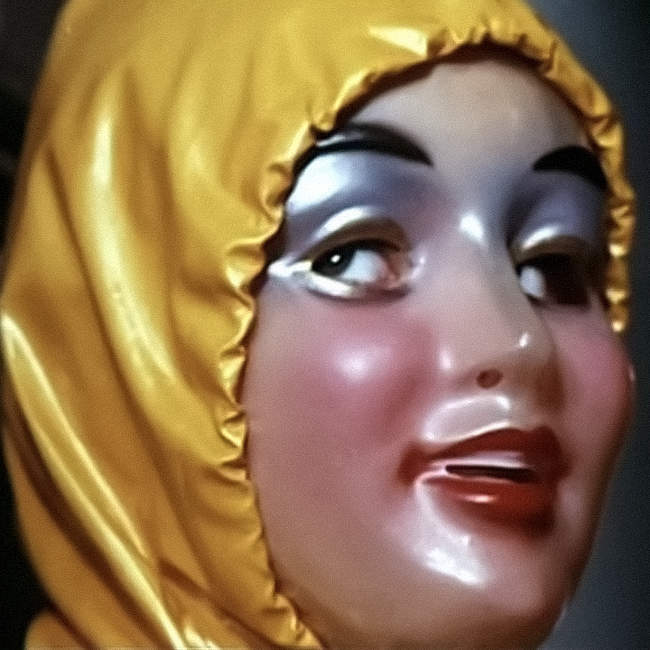
    ‘Industrial Byproducts’ takes that process to its logical conclusion, perhaps also inspired by this amazing, or awful, advert from the 1980s which burned itself into my brain when I was a child:

    I could tie myself in knots worrying about whether I’ve got all these details right, or whether they reveal some internalised snobbery, or whatever.

    But if part of the point of writing is catharsis, and if we value honesty, I need to crush that urge to self censor. I need to let it, whatever it is, stream out.

    The last lines of this story were painful to write. They’re even more painful to read back from the other side of the loss of my dad.

    Catharsis. Honesty. Confronting the things that scare us most.

    A quote from Verity Holloway: "Impressively eerie and packed with shocks... moments of powerful poignancy and startling strangeness. You'll want to linger over these stories." Next to it is the cover of Intervals of Darkness with a black background and red details. The illustration is of a person casting a long shadow. Nearby is another shadow suggesting a lurking but hidden figure.

    Intervals of Darkness, a collection of 14 weird stories, is out today as an eBook and paperback:

    Categories
    Intervals of Darkness

    Story-by-story: The Unbidden Guest

    Funny story: I stole the title of this period horror story set in 19th century Milan from P.G. Wodehouse, who gave us ‘Jeeves and the Unbidden Guest’ in 1916.

    For me, writing weird stories, or ghost stories, is often about an initial flare of inspiration, like the striking of a match.

    When I saw the title of the Wodehouse story I thought: “Wow, that sounds like something from M.R. James or H.P. Lovecraft.”

    I amused myself for a while by imagining how Jeeves might handle a haunting – “Perhaps you might invite one of your fellow members of the Drones Club, Mr Carnacki, to join us at Totleigh Towers, sir…”

    Then, on holiday in Milan, the title popped up again and collided in my brain with a vague memory of The Aspern Papers by Henry James which I last read about 30 years ago, and the fantastic BBC film Schalcken the Painter, based on a story by Le Fanu.

    Although most of my recent stories have had contemporary or post-war settings I’ve always enjoyed writing pastiche, and used to produce lots of faux-Edwardiana. So this was a slight departure, but not a major detour.

    To get started, I found and devoured a slew of 19th century travel memoirs by British poets and writers, partly to train my brain on the prose style, and partly to, frankly, steal some of their descriptions of the historic city.

    Having a narrator who is himself a stranger in town adds a degree of separation. If I get anything wrong, there’s his stupidity to blame.

    Having ploughed through Byron at university, stanza after stanza, canto after canto, and Shelley as a teenager, I also enjoyed the challenge of writing some suitably bad poetry for my hero, James Lemuel Madin.

    Again, it didn’t need to be good because he’s more Thomas Thorne from Ghosts than John Keats. Bumptious. Bigheaded. Convinced of his own brilliance.

    Someone in my writing group read an early version of this story and said: “I don’t like him very much.” To which I’d say, correct. I don’t like him very much either.

    That Madin’s best-known poem is an epic called Scholomance is (a) another point of connection between two of my stories and (b) adds another layer of Gothic spookiness, Scholomance being the mythical school of black magic mentioned in Bram Stoker’s Dracula.

    Here’s the other story I’ve written that mentions Scholomance. There might be more to come.

    A quote from Rowan Lee: "Newman returns to haunted Britain with fourteen more wonderful stories... Fans of folk horror and weird fiction will find a lot to love."

    Intervals of Darkness will be published tomorrow, Saturday 7 September. You can pre-order the eBook now.

    Categories
    Intervals of Darkness

    Story-by-story: Winter Wonderland

    I published this story here on the blog last December as part of my own emerging tradition of sharing a ghost story for Christmas.

    It’s not really a ghost story, though, so much as a tale of horror, in a few ways.

    First, it has more nasty physicality than I usually go for – more bone and blood.

    And there’s actually a moment in the story that appalled me as I wrote it. Bloody hell, where did that come from?

    The answer is, my subconscious, which I tried really hard to set free as I wrote all of these stories, but especially this one.

    This story also came out of conversations with my friend Jamie Evans who is a fan of Rod Serling and often talks about the concept of ‘cosmic justice’.

    His own excellent stories often follow this pattern: introduce us to someone truly awful, make clear that they deserve whatever they’re getting, then give the reader the satisfaction of watching them get it.

    Then there’s the pleasure of subverting, or perverting, the idea Christmas. Many writers of weird fiction, and makers of horror movies, have explored this over the years, perhaps starting with Dickens.

    Christmas is supposed to be a happy time of family gatherings, peace on earth, and goodwill to all men. When you lace it with alienation, violence, and monstrous creatures, the juxtaposition can be delightful.

    Check out the early slasher movie Black Christmas or the 2010 film Rare Exports for more of that.

    Another strain of real world horror is, of course, financial and social.

    The narrator of this story knows more about their parents’ money problems than any child should, and is weary before their age. 

    “It me”, as people used to say. I grew up poor and, as a child, was constantly aware of what we could and could not afford, and could tell when money was particularly tight.

    So I used to do things like tearing up letters about school trips and throwing them away on the way home to avoid stressing my parents out.

    I now realise, though, that I had one great privilege: parents who cared for and loved me, and upon whom I could rely. But there were plenty of children at school and on the estate who didn’t have that.

    And there are plenty of kids in the city where I live who are dealing with neglectful, selfish or chaotic parents right now.

    A pen and ink drawing of a grotto in a mound in a dark wood. There is a sign that reads "Good children welcome".
    My original illustration for ‘Winter Wonderland’.

    The lost illustration

    One thing I’m a little sad not to have carried over to Intervals of Darkness is the illustration I drew to accompany this story when I first published it.

    It’s quite cool, I think. I should probably get it framed and add it to my gallery of spooky art.

    A quote from Verity Holloway: "Impressively eerie and packed with shocks... moments of powerful poignancy and startling strangeness. You'll want to linger over these stories." Next to it is the cover of Intervals of Darkness with a black background and red details. The illustration is of a person casting a long shadow. Nearby is another shadow suggesting a lurking but hidden figure.

    Intervals of Darkness will be published on Saturday 7 September. You can pre-order the eBook now.

    Categories
    Intervals of Darkness

    Story-by-story: The Pallbearers

    This is the shortest story in the collection and was inspired by a paragraph in The Valley, Elizabeth Clarke’s 1969 memoir of Welsh country life.

    She describes the care with which the men of the village carry a coffin from a remote farmhouse to the chapel on the day of a funeral.

    It’s poignant rather than horrifying but I read her book over a couple of bleak, misty days in an out-of-season coastal town where we’d gone to scatter some ashes.

    On the train home, under heavy cloud, her brief account filtered through my subconscious and emerged as a first draft typed in some discomfort on a fold-down railway table.

    As with other stories in this collection, its location shifted from the source to the West Country, and I had the landscape of the Mendip Hills in mind in particular.

    The characters have names of people from school, from my estate, from war memorials, and from cemeteries.

    I collect the names of the dead in a notebook for later use – a macabre habit in its own right. I also share them on BlueSky with the hashtag #CemeteryNames.

    Like many of my nightmares (I’m a terrible one for nightmares) it’s about struggling to complete a task, or a journey, as the very ground beneath your feet slows you down, or trips you up.

    It’s a very short story, so this is a very short blog post.

    A quote from Rowan Lee: "Newman returns to haunted Britain with fourteen more wonderful stories... Fans of folk horror and weird fiction will find a lot to love."

    Intervals of Darkness will be published on Saturday 7 September. You can pre-order the eBook now.