These days, I have reached a fragile accord with sleep, but for a long time it, or rather its absence, dominated my life.
In my twenties I struggled with sleep. I never had any trouble getting off but staying under seemed impossible, and I had often given up by 4:30 or 5 am and was up and dressed, just me and the mice.
Then I realised: I’d become one of those tiresomely tired people who responds to the polite question “How are you?” with “Ugh, exhausted.” This could not go on; steps had to be taken.
I started taking naps in the office canteen at lunchtime, until my boss made it clear he didn’t approve.
I tried giving up caffeine (no difference), I tried exercise (good in other ways, but didn’t help my sleep).
I drank more (really didn’t help), less (a great improvement, but only for one night) and different: whisky gave me mad dreams and indigestion, cocoa did nothing, fruit tea did nothing, steamed milk did nothing…
Nytol worked brilliantly – absolutely knocked me out, so that I woke feeling completely renewed – but, again, only for one night.
Hot baths, soothing music, fancy lamps and alarms, writing a pre-sleep diary, eating lighter meals, ditching carbs, sleeping on the floor, nice pyjamas, new pillows, a new bed, everything, anything. No joy.
Eventually I accepted the facts of the matter: it was my brain.
That led me to the doctor, which led me to counselling at a terraced house in Chingford where I travelled after work on a bus every Friday for two months.
My only mission was to sort out my sleep. Other than insomnia, I thought, my life was pretty good, and I was sure I was fundamentally happy.
Talking out loud, though, I realised there was some weird stuff going on:
“I usually wake up first at about 1 am. I feel very alert and sit up to check the back garden.”
“What do you mean, check the back garden?”
“Just, you know, stare out into the dark until my eyes adjust, to make sure there’s nobody out there.”
“Like who?”
“Burglars.”
“Interesting. Have you been burgled?”
“Well, not recently, but…”
This took me back to the council estate and the people who used to raid our shed every other night, who stole our bikes, and rattled the back door from time to time. That’s when, between the ages of about 10 and 17, I got into the habit of staying up late watching the garden; of waking up throughout the night to look outside, hoping to catch them; and getting up early to see what damage they’d done.
Remembering that took me to university where staying up late was normal, and getting up early felt like an evolutionary advantage. I’d usually read a book or two by breakfast, and spent an hour or two in the library before most of my peers had stirred in search of lunch. So not sleeping became an embedded habit, and I powered through it on adolescent adrenaline.
But reflecting on university also took me into what turned out to be a foul well of pent up resentment, sadness and minor humiliations, the weight of which had slowly built up on my shoulders so that I hadn’t noticed myself being pushed down.
It all became clear: I wasn’t exhausted because I wasn’t sleeping – I was exhausted because I was burned out by going from estate to school to work to university to work to work to work… No gap year, barely a pause for breath, and no second chance if I failed.
Counselling, I’m pleased to say, dealt with all that – I’m lucky enough to have been easy to fix with a bit of talking, which I know isn’t how it goes for everyone – and by the final session I felt a million times better, but…
I still couldn’t sleep. The counsellor, I sense, was a bit exasperated by this.
“Would people know you’ve slept badly and feel tired if you didn’t tell them?” he asked eventually. “Does your work suffer? Are you less effective? Does it stop you socialising?”
“Well, no, I don’t think so.”
“So don’t tell people. It can be your secret. Why not just let yourself be.”
With that finger-snap, everything seemed to change. I stopped talking about sleep (or at least, stopped constantly talking about sleep) and learned to accept it.
And you know the punchline: because I stopped worrying about it, I did begin to sleep a little better. Not well – I still don’t sleep well – but a touch deeper, a few minutes longer throughout the night. Waking up in the dark no longer felt like a personal failure, just a fact of life. I almost learned to like it.
At some point, I’m not quite sure when, I even stopped checking the garden for burglars.
The days after especially restless nights can still feel difficult but I’ve grown philosophical: like the man said, nobody knows, and bad sleep last night increases the chances of good sleep tonight, or tomorrow, or maybe the night after, but soon.
In the meantime, think of all those extra hours for reading, writing, for just being.
Endings are good, so let’s have one: a year since I left Cornwall for Bristol, and half a year since this project began, it feels done.
What have I learned? That there’s a lot more to learn, for starters.
One of the aims of this project was to jolt me from a rut, to make me look at towns and villages that didn’t previously have a place in my consciousness, and in that respect, it worked. I’ve read books, looked at maps, and even (money and time permitting) got on buses and trains.
Work in progress: a map of the fictional West Country, from Boskenna to Sandford. pic.twitter.com/zNPE1tBuXC
The fun, silly stuff — the trivia — turned up in surprising places, and hardly ever when I was actually looking for it. I have no doubt there’s plenty more to stumble upon, and I hope to keep stumbling. Only the other night I learned that Paul the psychic World Cup octopus was hatched in Weymouth.
I have also reached some conclusions about the West Country. Despite having lived there for six years, and knowing that it was distinct and different, I never really doubted that Cornwall was part of the West Country. Having got to know Gloucestershire a little, at the other end of the scale, it seems absurd to consider those two places part of a single entity.
The Ghost Exhibition at Frampton Feast, Gloucestershire, 1887.
At the same time, lots of the photos I Tweeted — of folk traditions, or tower blocks, or mysterious moorlands — look, I have to admit, as if they could be anywhere in the country.
The West Country is more real to me than ever, but perhaps the idea of the West Country has slipped away.
Take the wrong path through Torquay, in the wrong weather, and it can seem a decaying place.
Despite the very point of the English Riviera being the gentleness of the climate the buildings look weather-beaten. Their paint peels and they are streaked by gulls and pigeons. “You have to keep on top of it,” one local stopped to tell me as I stared up at one particularly forlorn building. “Lick of paint, keep it in good repair, or round here nature sort of comes and starts to take it back.”
Hotels and bed-and-breakfast establishments with grand names have ageing Perspex signs that are missing letters, or sagging under the weight of crowns of nails intended to keep incontinent birds away. It’s as if they’re one good season away from the full refurbishment they need, but always one full refurbishment away from that good season.
There are too many junctions that make no allowance for pedestrians, or rather treat them as a nuisance to be managed, prodded out of the way of traffic by fences and obstacles. Boy racers fly through town using the gravitational pull of roundabouts to boost acceleration, although sometimes what looks at first glance like a Hot Hatch is actually just a Hatch being driven by a hunched pensioner hammering the pedal for fear that the car won’t make it up a steep hill.
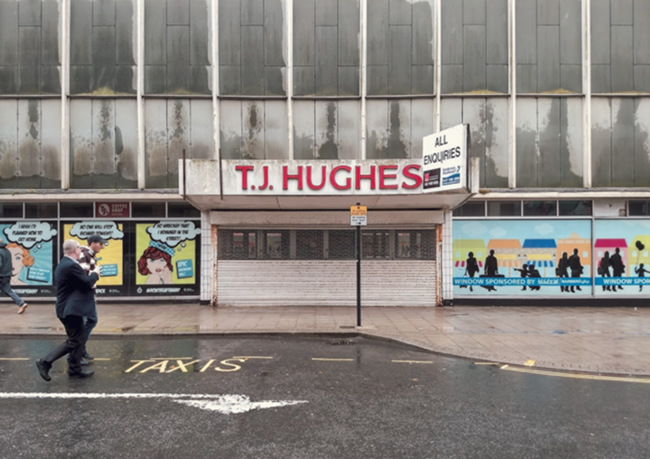
An entire row of shops in what ought to be a prime location is derelict, near collapse, while a huge post-modernist mall with galleries and walkways dominates the centre. The old market hall, built in the 1850s and with a plaque from the local historical society, has been gutted and partitioned so that the interior, like a reverse Tardis, barely has the grandeur of a Portakabin.
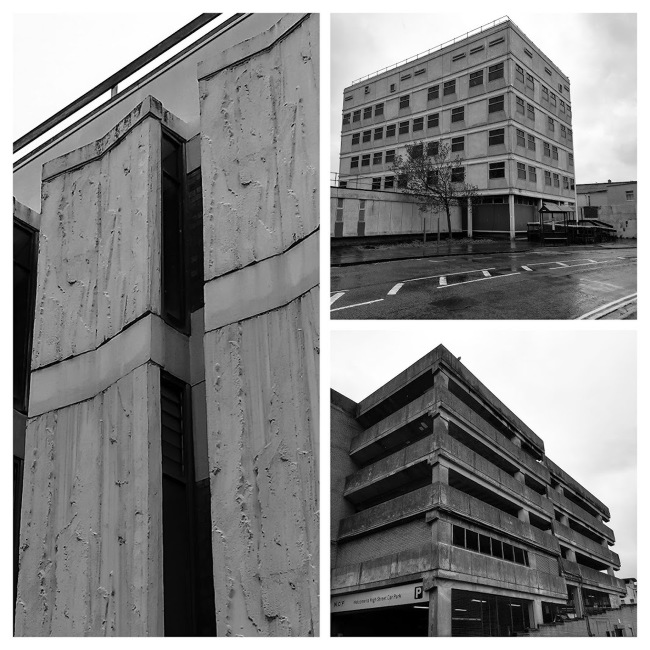
A leisure centre lurks beyond the promenade – a last dry breath of brutalism from the 1980s, the grey Atlantic Wall intimidation exercise of its exterior undercut by a curl of fibreglass waterslide that pops out and back in again like some parasite. At ground level it is all warning signs, cameras and black grilles, some of which blast sickly-warm chlorinated air across the weed-covered car park.
The landmark Pavilion Theatre on the seafront is a beautiful Edwardian building that, scaled up, would look at home in Monte Carlo, except it is derelict and boarded up – too precious to demolish, but too much trouble to use, and so being left to rust and rot.
And yet come at Torquay from another angle, in the sun, in a better mood, and the Riviera fantasy of GWR posters and The Persuaders lives on. The marina is full of yachts, some of them sleek and substantial, and the streets nearby accordingly full of yacht people – tanned, posh and loud. Motorboats motor across the bay as middle-aged couples in designer clothes (men sockless, women perfumed) stroll arm-in-arm, summoning the spirit of Nice.
Even the bland modern blocks on the hillsides add their own glamour, evoking the aggressive development of the coastlines of the Mediterranean.
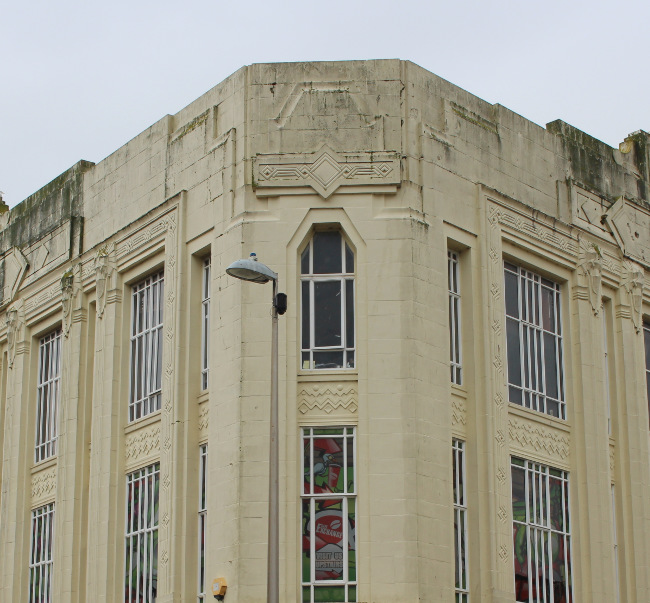
My favourite parts of town, though, are those reserved for purposes other than tourism or shopping: the remarkable Central Church with its concrete launch gantry; the boldly Art Deco council offices, and more modest library of the same vintage; the Edwardian town hall; and St Andrews with its rows of dignified white war graves.
Torquay, I think, is a deeper town than all the seaside superficiality might suggest, with plenty more to discover yet.
An outstretched hand brushing the stalks until, yes, this one, and then a soft snap. Tidy it up first, nipping it off with a thumbnail at the thick part above the knee; then stripping away the sheath to reveal the brighter green inside; and, finally, trimming straggling lower seed spikes to leave a neat arrowhead. It is ready.
When Jarge Balsh, the comic hero of William Jones’s once popular Somerset bumpkin stories, first appeared in 1925 it was with grass in his mouth:
One did not need to be a Sherlock Holmes to realise that he was connected with the agricultural industry. His boots and leggings were generously plastered with samples of the usual contents of the farm-yard, whilst to his slouch hat and old bottle-green morning coat there still adhered strands of hay…. Halting before me, and spreading his legs, he thrust his hands deeper into the cross pockets of his corduroy breeches, and changed the straw he was sucking to the other side of his mouth…. “Be you the young gent as is gwain ta bide wee widder Toop? ‘Cos if ye be, I be come vor ‘ee.”
The depiction of Balsh on the title page of the book cemented the image:
The prepared rapier of grass lightly bridges the lower teeth and lip, its feather-duster-head in the distance bouncing with each step, shaking its hair. Chewing the stalk destroys it quickly so instead it is held gently in place by the jaws and worked by the tongue like a rudder, pulling it in to make the seedhead swing out, and pushing it out to bring the brush swishing back to the centre. Relax the jaws and it droops; thrust the lower jaw out and the grass comes up to eye level. Up, down, left, right, swish, swirl – simple but absorbing.
Along with tractors, cider and smocks, the chewing of grass crops up over and over in lists of West Country stereotypes, often in the defensive form “There’s more to Devon/Somerset than…” There’s some embarrassment perhaps in the idea of being seen to ruminate dumbly, further evidence of the supposed animal stupidity of the bumpkin.
And yet it doesn’t take much to work out that chewing grass is a habit claimed, or disclaimed, by rural communities all over the country, and indeed around the world. Grass is not, after all, a scarce commodity, and the urge to nibble on it, I would say, is very nearly instinctive.
Eventually the bruised stalk begins to release its sap in the mouth – a bitter, raw taste that has a strange effect on the other senses. With a length of grass in the mouth birdsong seems louder, while traffic sounds diminish. The aroma of wildflowers intensifies. This is the easiest, cheapest, most innocent of psychedelic experiences.
I don’t believe chewing grass is something we, or anyone, should feel defensive over, or self-conscious about, whether alone on a quiet lane, or among the faux-rurality of the unkempt meadow-land in Hyde Park, sick for home.
There is no more sap, no more structure – the grass has become tasteless and is nearing collapse. Take it out, throw it away — it doesn’t matter, grass is free — then stretch out the hand, brush the stalks, until, yes….
My snapshot image of Weston from childhood is of great, clean whitewashed walls weaponised by the sun.
Blackpool was seedy – knickers for a nicker, pants for a pound, and drunks scrapping in the street – and Burnham-on-Sea was boring. But Weston… Weston was glamorous. Squint and you could be in Miami, or Nice. It was the posh seaside.
Revisiting it in 2018, especially on a rainy day, lifts the spell. There is more grey and more dereliction than I remember, and a sense that Weston’s problems – the same problems afflicting many towns – are breaking through its plaster façade.
Though it may seem less pristine than 30 years ago, however, I find in it greater depth and detail as an adult.
Alleyways and back streets reveal Victorian details, ghost signs, beerhouses and post-modern oddities.
There’s Art Deco.
There’s plenty of post-war modernism.
And concrete brutalism.
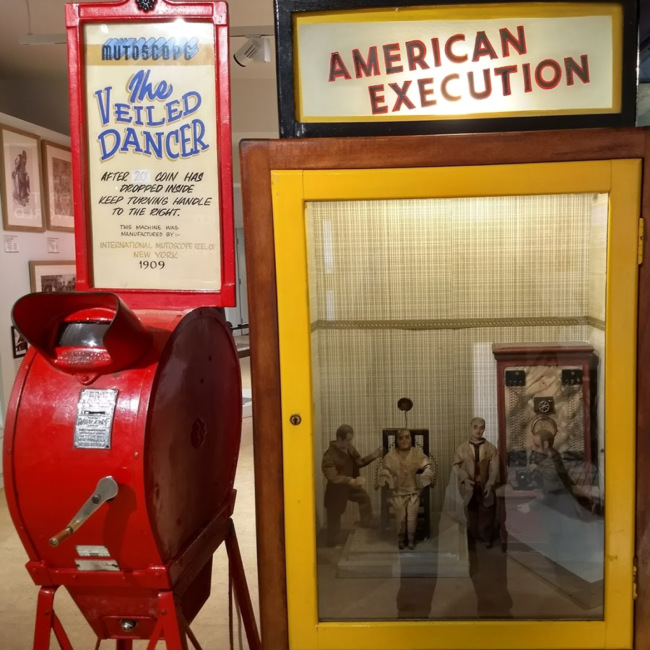
The museum, recently reopened, is small but dense: look down on an architectural model of a post-war Weston that never was; feed 20p to the What the Butler Saw machine and watch the imprisoned ghost of a long-dead dancer perform with a length of silk; and place a hand on a stretch of railing from the old pier where millions of fingers sticky with ice cream and rock have been before. The narrative also does a good job of bringing home the extent to which Weston was Blitzed – something that surprised me, and which helps explain some of the buildings above.
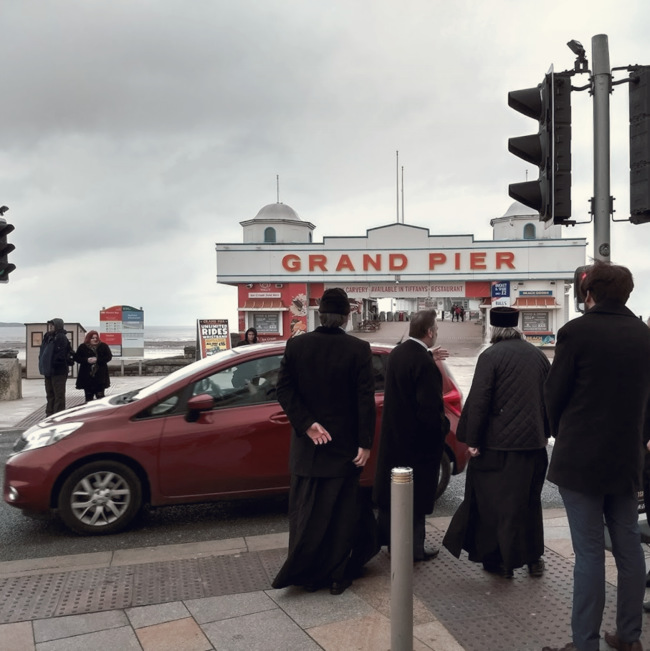
The pier is good, even in its post-2008-fire incarnation: worth walking up and down three or four times for the thrill of feeling truly at sea, and a little nearer mysterious Steep Holm.
And there are memories. Having thought it long gone I stumbled upon Revolver Records the very smell of which – tobacco, damp, worn-in leather jackets – transported me back to standing at my Dad’s side as he flipped through racks of vinyl looking for who knows what.
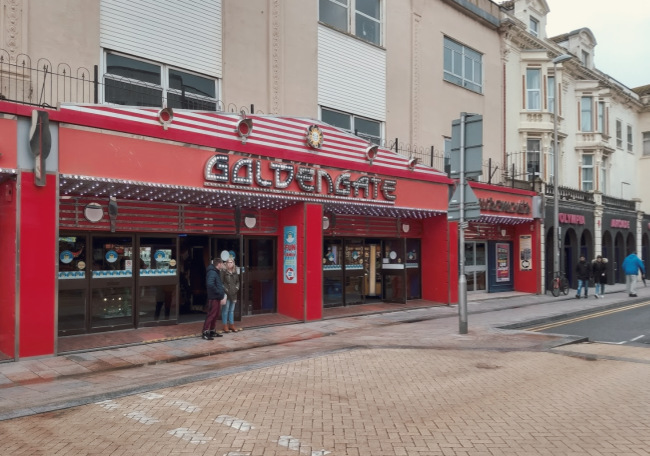
And I approached the Golden Gate amusement arcade from just the right angle to trigger a specific recollection: coming to Weston in about 1992 with the express purpose of experiencing virtual reality. At 14 I’d read William Gibson, was buying Wired most months, and fancied myself quite the cyberpunk in my Hi-Tec trainers and generic sweatshirt from Highbridge market. I went with two friends and we had to queue for about 20 minutes to pay £1.50 each for five minutes play time on a supposed combat flight simulator that actually consisted of a nausea inducing field of blue (sky) and green (ground) with occasional blocks of grey jerking across it.
I’m glad I now live near enough to Weston to visit whenever I like. I suspect there’s plenty more to find yet.
In Britain hauntings occur in ancient manor houses, old inns, and Gothic asylums – places whose very age makes them groan and creak, where shadows sit deep, and which are scarred by the lingering imprint of lives lived and lost. And yet arguably the most famous British ghost story of the 20th century took place somewhere quite different: in a humble council house, only half a century old, in Enfield, north London.
This turns out to be far from the only such instance, however, and was certainly not the first.
“The world of the ghost is riddled with class,” wrote Roger Clarke in his 2012 Natural History of Ghosts, “and the poltergeist is occasionally tagged as ‘the council house ghost’.”
Here are just a few examples of that particular, peculiar phenomenon.
Weedon Bec, Northamptonshire, 1947-50
The tenants of a red-brick council house on Queen Street, built only in 1945-46, reported having seen a figure glide through the hall and then disappear. Mrs Thomas Bicknell (her own name is not given) first saw the ghost in around 1947, as reported in the Northampton Mercury and Herald for 6 January 1950:
She and her late husband, Mr Thomas Bicknell – a man with 23 years’ service in the Royal Artillery and not given to imagining things – had just finished a game of cards when they heard a rustling and tapping noise coming from the direction of the hall… Their dog, a large Airedale retriever, rose to its feet, raised its hackles and growled… Mr Bicknell went into the hall but could see nothing. The dog went up the stairs, still growling, and his master followed. Again there was nothing, but as he turned to descend the stairs, he saw a ghostly figure glide through the hall, go into the kitchen, and disappear. Mrs Bicknell, sitting in the living room, saw it too.
After her husband died, Mrs Bicknell saw the ghost a second time, on Christmas Eve 1949, doing the same gliding and disappearing act. When her distress story was reported at a council meeting it was met with laughter. “This added amenity warrants an increase in the rent,” said Mr D.H. Jelley, following in the grand gentlemanly tradition of scoffing at superstitious proletarians.
Earby, Lancashire, 1954
Mr E. Peasey, a chimney sweep, evacuated his wife and nine children to a single downstairs room in their council house at 1 Melrose Street as a result of ‘queer things’ happening upstairs, and multiple ghostly apparitions. Here’s a summary from the Burnley Express and News for 16 October that year:
[For] three years doors had opened on their own, footsteps had been heard overhead, crockery had flown into the air and pictures had gone crooked… One of the boys, 14-year-old [Bobby] described a shadow in his bedroom. At first he thought it was a reflection but it advanced to the middle of his room and then began to tickle his feet and scratch him… The ‘thing’ was white, with no arms or legs, and when an alarm clock went off it had backed into the corner and disappeared… Ten-year-old Kathleen described seeing two hooded figures “floating” and similar shapes were described by others in the family.
Another report, from the Barnoldswick and Earby Times for 15 October, adds more details: a bright light seen in an upstairs room, door knobs turning on their own, and two of the children waking their father to report that they had “seen a man in Daddy’s attic”. A small twist: this was apparently an older slum property with gaslighting rather than a modern council house and the story came to light precisely because Mr Peasey wrote to the council requesting a move to just such a new-build.
Sedgley, West Midlands, 1954
From the same year and month as the tale above comes the minor story of a haunting in Sedgley in the West Midlands in which the tenant, an unnamed woman, supposedly asked the council sanitary inspector to fumigate for ghosts while he was hunting rats on the property. It was reported in the Birmingham Gazette for 29 October 1954 as a “Nowt So Queer as Folk” sidebar scant on details, and with a decidedly unfunny punchline: evidence of haunting in her daughter’s bedroom was chalked up to the resident vermin, and the family were evicted for failing to maintain the house properly.
Sunderland, County Durham/Tyne & Wear, 1957
It was in spring when Norman and Audrey Dixon first reported that the council house in General Havelock Road, Sunderland, into which they had recently moved with their three young children was haunted in a rather colourful fashion, as recounted in the Birmingham Post for 23 October 1957:
[The ghost] takes the form of a zig-zag line [which] appears on the wall of their living room…. The first night they slept upstairs sheets were ripped off the bed and fingers dug into their chests, Mr Dixon said. “A few nights later I felt something clammy on my back and so did my wife. There seemed to be no air in the room. We staggered downstairs and took the family to my brother’s house.”
This case was taken seriously enough by the local vicar that he appealed to the Bishop of Jarrow, J.A. Ramsbotham, who visited the property and conducted a ten-minute blessing service on 22 March, including the sprinkling of holy water. But when journalist Ken Culley followed up (‘I was guest in the haunted house’, Newcastle Evening Chronicle, 25/03/1957) the Dixons told him that the exorcism had been effective for only 24 hours and that the “unwanted visitor” had returned in full force.
They too were eventually evicted after refusing to pay their rent in protest at the Council’s refusal to provide them with alternative accommodation. (Newcastle Journal, 29/10/1957.) Another family, the Rowes, moved into the house in November 1957 and reportedly found it “all quiet”, and that was that. (Newcastle Evening Chronicle, 05/11/1957.)
Swindon, Wiltshire, 1966
A brand new council house in Penhill Drive in Swindon was the subject of national press coverage when Gladys and Robert Tucker, who lived with their adult children Beryl and Victor, asked to be moved after they saw a shadowy figure on the landing and strange lights on the walls. (Daily Mirror, 04/04/1966) The council agreed to rehouse them, reluctantly, and had the house exorcised by a priest before reallocating it to new tenants. In his 1967 book Swindon: An Awkward Size for a Town Kenneth Hudson reported this incident as a blot upon the image of a town keen to present itself as modern and forward looking.
Newton-le-Willows, Lancashire, 1968
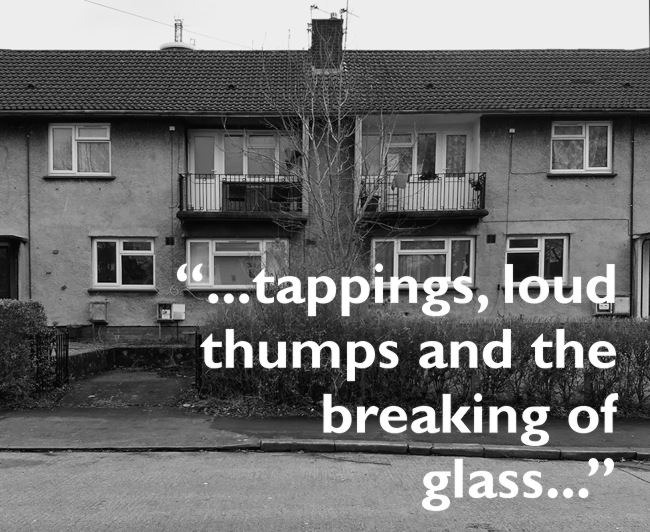
In March 1968, Gerald and Audrey Burke, 34 and 31, moved out of their council house on Fern Avenue as a result of “tappings, loud thumps and the breaking of glass”, and the ghost of “an old lady…. wearing a white hat”. Mrs Burke asked the Council to re-house the family. (Aberdeen Evening Express, 13/03/1968.)
It seems the Burkes were not the first tenants to complain of such occurrences (Coventry Evening Telegraph, 27/02/1968) and so the Council resorted to sending in, first, a Roman Catholic priest, Father Gerald Walker (Birmingham Daily Post, 27/02/1968), and then “psychic experts” – brothers Alan and James Bell, from Formby – to attempt to exorcise the property.
The Bells were convinced by the evidence they saw and urged the council to move the Burke family, even offering to rent the house themselves while they continued their investigations. (Coventry Evening Telegraph, 04/03/1968.)
I haven’t been able to pin down what happened next but I can say this: Fern Avenue no longer exists, even though nearby Ivy, Pine, Larch, Ash and Laurel avenues do.
John and Lynne Edwards, 1973.
Coventry, West Midlands, 1973
In 1973 it was a council house in Stoke Heath that scared away its residents. Lynne and John Edwards first moved their family into a single room at 63 Hill Side, before fleeing altogether, after they heard “whining noises and footsteps”, and felt the house turn freezing cold in in instant. (Coventry Evening Telegraph, 19/11/1973.)
* * *
After all that, it begins to feel as if not only is the council house not such an unusual setting in which to encounter a ghost but, in fact, a setting positively prone to hauntings.
What can possibly cause these relatively history-less houses, designed to be light and airy, to be such fertile ground for the uncanny?
In America the answer would surely be an ‘Indian burial ground’, as in Tobe Hooper’s 1982 film Poltergeist, which sees shiny new-build suburban houses haunted not by the ghosts of previous inhabitants but by those who once possessed the very land. (Sort of. It gets complicated in the sequels.) But, based on historic maps available via the National Library of Scotland, there’s no such obvious plot engine – no burned-down orphanage or gruesome battle site – at any of the other locations listed above, though a couple are near cemeteries.
Then again, it doesn’t take much age at all for a house to gain the potential for a haunting. In the 1968 haunting of another Coventry council house, this time at Treherne Road, the anxious 37-year-old resident, Miss Barbara Mills, connected a serious of spontaneous fires with stories she had heard of a wartime suicide at the property. (Birmingham Daily Post, 22/10/1968.) The Dixons in Sunderland invited a local psychic, James Long, to conduct a séance at the General Havelock Road house which resulted in a message from a drowned man, John McKenzie, who apologised for the trouble he had caused, but mentioned that there was also the “earthbound spirit of a woman” haunting the house. (Newcastle Journal, 29/04/1957.) Legends grow quickly, even in poor soil.
In more concrete terms (no pun intended) is there perhaps something about the way the houses were constructed? In the Sunderland case journalist Ken Culley slept in the haunted bedroom but, despite apparently making every effort to spook himself, saw no evidence of anything supernatural. What he did observe was that the construction of the house made it uncomfortably stuffy, while opening the window caused a localised breeze to swirl oddly around the foot of the bed, numbing his feet. Light and airy may have been the intention but large rooms with high ceilings, sparsely furnished, offer great potential for echoes, reflections and strange circulations.
Then there is the question of location, and here I’m going to indulge my own memories of growing up on an estate. Council developments often occupy what in the jargon of the psychogeographer are called ‘edgelands’, neither town nor country, and can resemble lonesome frontier towns. All that space, a joy on a summer afternoon, has its downsides: winds whistling across shopping precincts and playing fields, or along showpiece boulevards; long, dark gardens with no walls and too many shadows, butting on to fields or woodland; neighbours at arms’ length, and family further yet, back in the old country. A bedroom for the parents and one for each child sounds like the ideal unless you’re used to something more intimate and find yourself alone at 3 am listening to silence, staring at a black shape creeping across an excess of freshly-plastered wall. With that in mind, it’s perhaps unsurprising that many of the cases described above resulted in the afflicted families bunking up together in a single room, or crashing with neighbours or family. Could this be a sort of stress reaction to the trauma of being almost forcibly cleared from the so-called slums?
Roger Clarke’s observations on class are relevant here, too. He suggests that, at least until recently, middle class people were less likely to publicly report experiences of ghosts, even if they might admit to them privately. Talk of ghosts is viewed as evidence of either peasant stupidity (see above), or working class mendacity, and either way ‘showing off’ by talking about this kind of thing for whatever reason is rather vulgar.
Finally, there is the very fact of the stress of life on an estate. I should be clear here: in my experience, English council estates aren’t as bad as some people like to suggest; but nor are they, in practice, anything like Utopian. There is crime, and there is anti-social behaviour. One small example: our back door-knob used to rattle after dark when my Dad worked nights. A small thing, but terrifying. My Mum got into the habit of having my Uncle’s Army riot baton by her armchair or next to the bed, and I got out of the habit of sleeping too soundly, just in case intruders needed seeing off. Living like that, never quite relaxed, wears you down and sets you on edge. And, at the same time, you are also dealing with poverty which can leave you cold and hungry, and which at the same time can erode your sanity and sense of self.
“I cannot stand it much longer…. I am living on my nerves”, wrote Peasey the Earby chimney sweep with nine children to feed in his letter to the council. He was certainly haunted by something.
Until I read the below passage in a 1945 edition of the Taunton Courier it had never occurred to me that the place where I grew up had once been nameless.
Regarding Eastover housing scheme, it was reported that the Minister of Health agreed in principle to the proposal to acquire 75 acres of land between Bath-road and Weston Zoyland-road. The District Valuer was instructed to negotiate for acquisition of the land, and it was decided that the site should in future be referred to as the Sydenham Estate. [1]
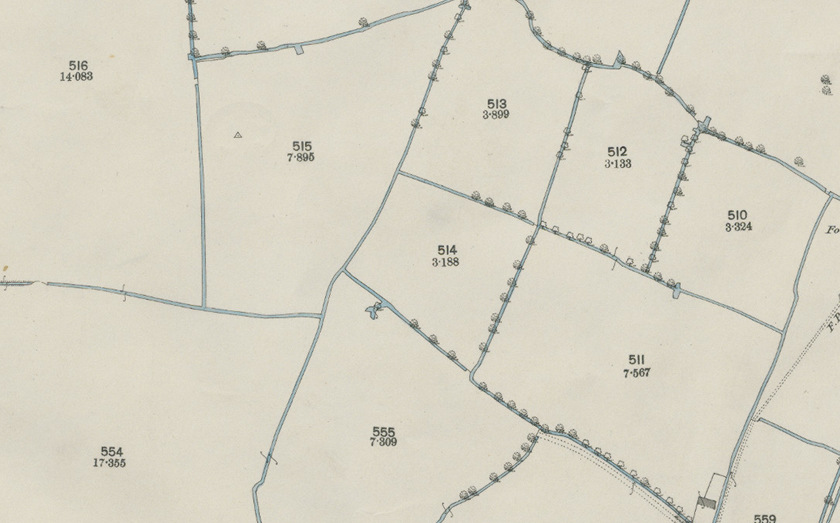
Not a place, then, but a void between places, and that’s certainly how it looks on historic maps of Bridgwater:
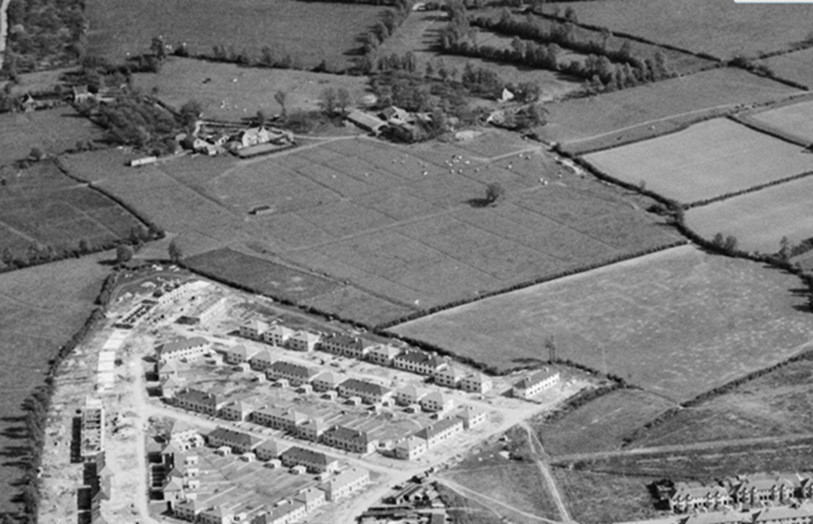
But maps, and especially this type of administrative map, do tend to reduce anything but the densely urban to an off-white nothing. The abstract above – that snow drift and irregular fishnet – actually represents a pattern of fields stretching out behind Bower Farm. (The buildings of Bower Farm were demolished years ago, swallowed up by another estate – private, this time – and on its site are now a shopping arcade with a Tesco Metro and a Chinese restaurant.) Thought not named on the map I’d bet anything those fields were known as Bower Fields, even if the mapmakers didn’t know it.
Bower Estate would have been a good a name for the council development that grew there in the 1940s and 1950s but instead it took its name from the Manor of Sydenham, on the other side of the main Bath Road.
Bower Farm (rear) and the first houses on the new Sydenham Estate, 1947. SOURCE: Britain from Above.
The present Sydenham House was built c.1500 for the Percival family. It was marched past by the Duke of Monmouth on his way to the fateful Battle of Sedgemoor in 1685, and was later the site of a noted incident of nocturnal levitation, but otherwise sat quiet and alone in the flat landscape. Then, in the 1930s, Bridgwater burst its boundaries and the British Cellophane factory was built on land adjoining Sydenham House. Trapped in a no-mans-land between this huge new development and the railway line the house became inaccessible and invisible, and was largely forgotten. The name lingered, though, having been given to Sydenham Terrace, a row of red-brick workers cottages built in 1865, and to the grander Sydenham Villa.
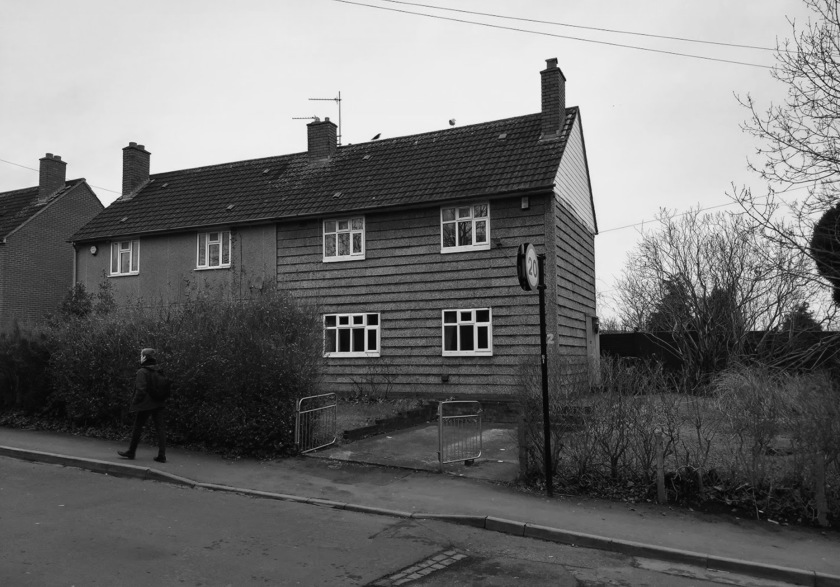
Oh, yes – brick. Bridgwater was a brick-making town, and the West Country a brick-making region, and the fact that the houses at this new place, the Sydenham Estate, were to be built in concrete caused some controversy. BRIDGWATER WANTS BRICK HOUSES read one 1948 headline [2] and the town council were repeatedly criticised for failing to take advantage of a supposed 10 million local bricks ready for use. Not Bridgwater bricks, though, replied the council, and anyway, where are the bricklayers to turn them into homes? [3] The town wanted to build 2,000 houses, public and private, as quickly as possible and there was no room for sentiment. [4]
SOURCE: Me.
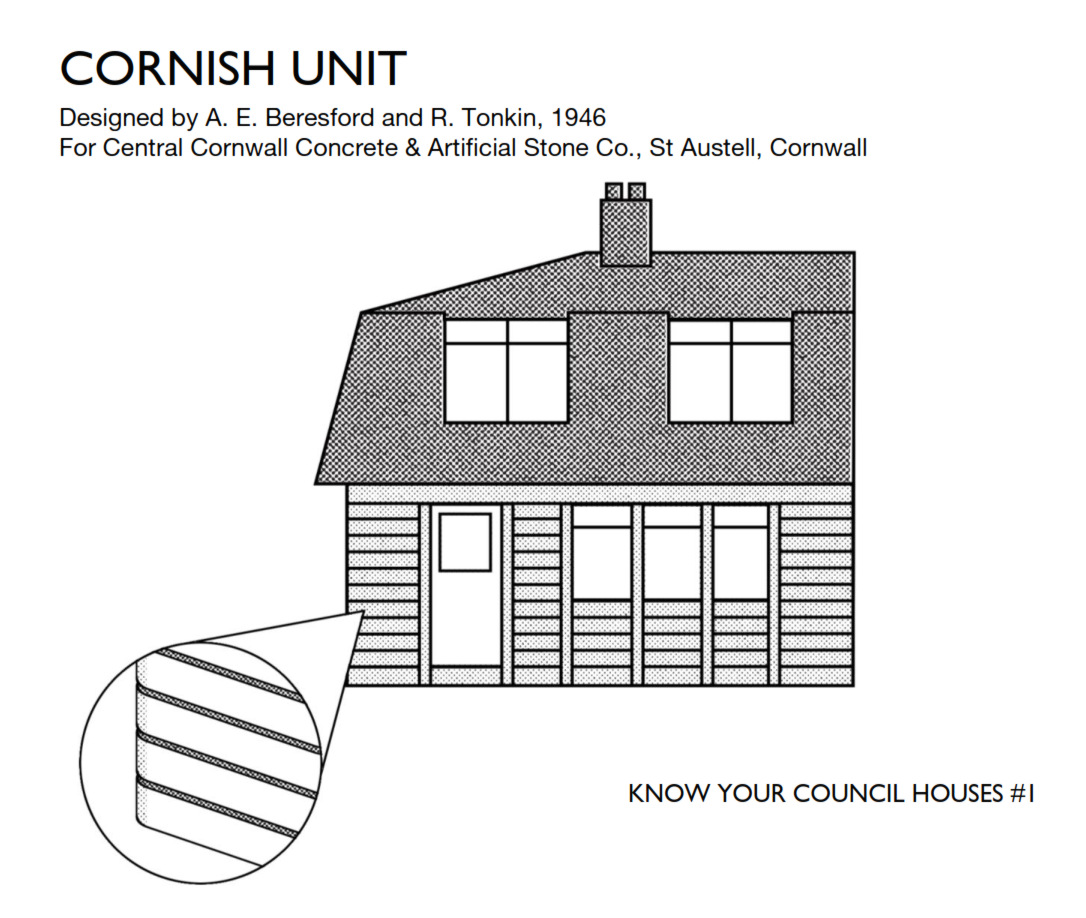
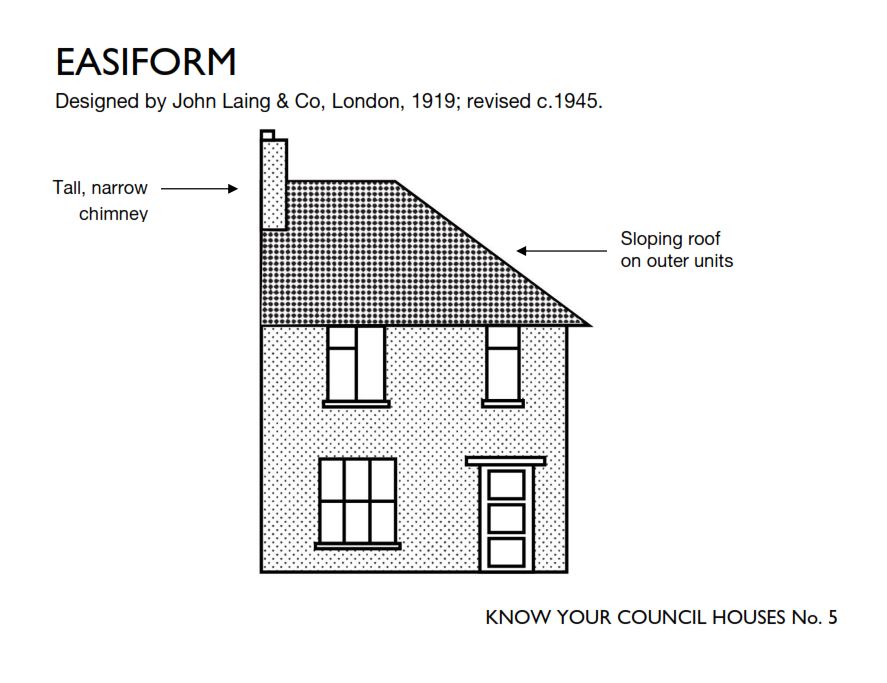
Perhaps this was a mistake. A place being created from nothing, in the middle of nowhere, literally on the wrong side of the tracks, could have used something to tie it to the town of which it was supposed to belong. As it was those Laing Easiform and Cornish Unit concrete houses not only seemed alien but were also the same as thousands of others up and down the country, which meant the Sydenham Estate could have been anywhere. Shown photographs with only the name for a caption, wouldn’t most people guess that it is in south London? Later on, in the late 1950s, when permission was given for a brewery to build a pub on the estate, magistrates quietly objected to the suggested name, The Lorna Doone. It was changed, accordingly, to The Withy Cutter in reference to the Somerset levels willow industry. [5] Too little, too late.
SOURCE: Me.
When Sydenham really became a place, it was defined by negatives. It was referred to on the news as ‘the troubled Sydenham Estate’, and my peers called it The ‘Nam. This was a self-deprecating joke – it was hardly South Central Los Angeles – but also reflected a low-key ghetto mentality. We’re stuck out here together, us versus them, and it’s a combat situation. Who ‘they’ were depended on context. Within the estate, Sydenham Road and Longstone Avenue had a wary rivalry, each convinced the other was a no-go area; and the Sydenham Estate as a whole was set against the Hamp Estate on the other side of town, where we kids were warned never to go. (Of course when I did go, I found a twin – approximately the same kinds of houses, an exact clone of the shopping arcade, and a secondary school which looked like an off-kilter version of mine.)
But Sydenham, barely baked, seems to be fading away. Sydenham Villa, on the other side of Bath Road from the estate, was demolished as long ago as the 1950s. In around 1991 my secondary school ditched the doubly toxic Sydenham Comprehensive label in favour of ‘East Bridgwater Community School’. Then, in 2011, Sydenham ceased to exist as a council ward, replaced by Fairfax and Dunwear, two new wards that split the estate through the middle and effectively deny its existence. Estate agents marketing houses in the area tend to refer to them as being “on the east side of town” or, even more vaguely, “a popular residential location”. I wonder if this place, conjured into existence in 1945, will make its hundred years.
1. 6 October 1945, p.5.
2. Taunton Courier, 4 December 1948, p.3.
3. Taunton Courier, 5 January 1946, p.6.
4. Taunton Courier, 6 October 1945, p.5.
5. Taunton Courier, 29 March 1958, p.8.
Many musicians have tried to sound like the Beatles and most have failed because what makes the Beatles great and enduring is an essential, alchemical quality of Beatlesness.
Before I get into this, here’s my history with the Beatles. I grew up in a family where the Beatles weren’t especially important. My Dad liked them and had most of their records, but he much preferred the Rolling Stones and the Kinks; Mum hated the Beatles, having pledged her allegiance to the Small Faces in 1965; and the other influential baby boomer in my life, Uncle Norman, was all about the Beach Boys and the Ventures. I think I decided for myself, as a teenage swot trying to work out what music was all about, that the Beatles were essentially crap – excessively revered, too sentimental, too self-indulgent. I mean, brass bands? No thanks.
Then, during my first year at university, I got religion – a sudden conversion, listening to ‘Strawberry Fields’ over and over again during a thunderstorm, in the circle of light from an Anglepoise. By the time I was 24, my obsession had led me to write 30,000 words on the subject of Revolver that got near to being published as a book before the publisher got taken over, and in e-book form elicited kind comments from various quarters including Rolling Stone. That got it out of my system, or at least the bootleg-seeking, mono-is-best part of the madness.
Every now and then, though, I come back to the Beatles and listen to them obsessively for a week or two. Or, as in the most recent resurgence of interest, their imitators.
Pastiche has always intrigued me. You can learn a lot about H.P. Lovecraft or Sherlock Holmes by reading attempts to imitate them which never quite reach the mark but, in failing, tell us something about the original. Exposing yourself to work that makes you say, “Oh, no – Conan Doyle would never do that,” is a particularly effective way of discerning the outlines of what Conan Doyle did.
The Beatles are an especially productive seed for pastiche and ‘Beatlesque’ is a word that can be applied, and has been applied, to almost every artist from ABBA to the Chemical Brothers at one point or another.
That’s partly because in their psychedelic pomp the Beatles were so much about easily borrowed surface decoration. Use a Mellotron, a piccolo trumpet, a megaphone, some backwards loops, or a sitar, and you immediately have a sprinkle of Beatle dust over your song. Reprise the opening track at the end of your album and provide the bare bones of a concept, perhaps a few spoken words to segue from one song to another, and you’re a step closer. So why does a track such as, say, ‘King Midas in Reverse’ by the Hollies, though it ticks the boxes, not sound like the Beatles? The voices, for starters.
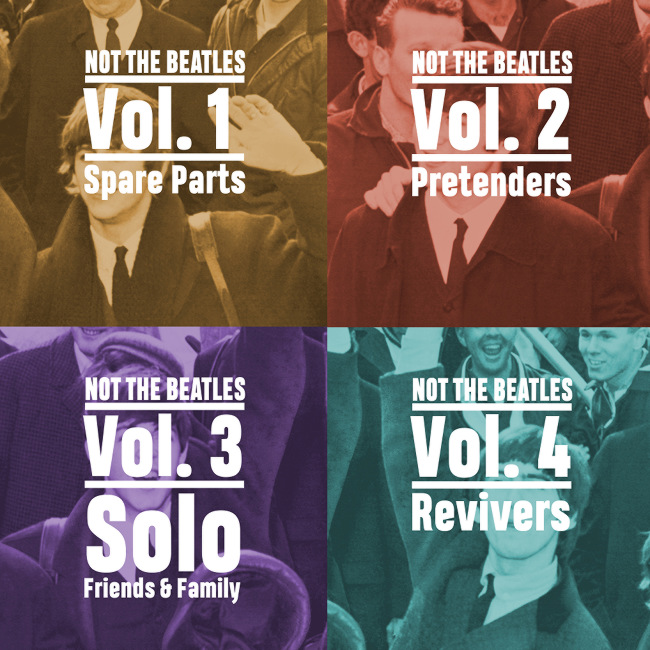
John Lennon’s adenoidal Scouse growl and Paul McCartney’s pretty-boy, pouting purr, apart or combined into a super-weapon, don’t sound like anything or anyone else. Though just occasionally, someone else will give it a shot. One of my favourite Beatles pastiches, which I discovered 20 years ago on a compilation called Circus Days, isn’t on Spotify and so I couldn’t include it on the playlist above (Vol. 2: Pretenders) but is on YouTube. Listen to the vocal on this first verse:
For a moment, for a few seconds, that sounds so like McCartney it’s unnerving. Then they had to ruin it by doing something stupid like hiring a child chorus. In general, the most effective Beatles pasticheurs are either those blessed with a soundalike, or shameless enough simply to do an impression which, even when it sounds daft, still triggers a response in the pleasure centres. Neil Innes’s John Lennon impression is broad but basically accurate, which is a good part of why it’s possible to use Rutles songs, “do a poo poo” and all, as a kind of methadone for Beatles addiction.
The other problem for would-be imitators is that the Beatles weren’t formulaic, or at least the formula mutated so quickly from one record to the next that its shape is hard to discern. Anybody can pick a Beatles song and copy it but they’ll just have that one song, not the key to the entire sound. There are, though, certain techniques and tricks that immediately summon the spirit of the Beatles, such as what Andy Partridge of XTC has called ‘banana fingers piano’ – that insistent, rudimentary thumping that McCartney used time and again. The ‘Tomorrow Never Knows’ drum beat is almost the basis of its own sub-genre; and the same might be said for the ‘Taxman’ bassline, and bubbling McCartney notice-me bass more generally.
Production, the sonic texture of the recordings, is important too. Even in an age when you can buy sample libraries of every keyboard at Abbey Road and play them through painstaking digital recreations of the original mixing desk and compressors, the sound seems somehow out of reach. Some attempts end up sounding too clean or too cold, while others lean too far the other way and end up lacking sizzle and crispness. The Beatles weren’t muddy, even when they were dense. Again, the word alchemy springs to mind: those people, those instruments, that space, in that moment, created something greater than the sum of the parts.
Finally, there’s something about energy levels. No pop song ever sounds quite as frantically exciting as ‘Twist and Shout’ or ‘It Won’t Be Long’, or as perfectly mellow and distant as ‘A Day in the Life’. Some of that I suspect came from the Beatles’ confidence, later shading into arrogance, and perhaps it’s hard to broadcast confidence when you’re imitating somebody else, because you don’t really believe who you are is good enough.
Of the bands seeking to imitate the early Beatles (see volumes 2 and 4 above) the most successful are those which manage to capture a little of the amphetamine frenzy, the bite of the guitars, and those voices. ‘Jealousy’ by the Poppees is a notably convincing attempt that I reckon would fool 80 per cent of non-obsessives. Wannabe Sgt Peppers get closest when they are able to wriggle into that tiny gap between shoddy (a cheap organ parps into a cheap reverb unit in lieu of a brass section; a synthesiser that sounds more like a B&Q doorbell than a Lowrey) and cheesy (Mantovani strings where they should be Bernard Herrmann; excessively harmonious harmonies).
But Beatlesness is so ethereal that it doesn’t look the same to any two people. The message boards and comment threads I read researching my playlists were full of people saying that this band or that sounds exactly like the Beatles when, frankly, they don’t. I cannot hear the Beatles in Crowded House, for example, but the chances are you won’t hear the Beatles in some of my choices, either. Sometimes it’s only there fleetingly or partially anyway.
Your thoughts on Beatlesness are very welcome. In the meantime, I hope you enjoy the playlists.
If you want to listen to all the tracks from the four playlists embedded above on shuffle there’s also a master list, ‘Not the Beatles Vol. X: Everything’. I got a lot of ideas from this website in particular — do have a look.
A thief, conman, beggar, trickster, adventurer and teller of tall tales, Bampfylde Moore Carew is the most famous West Countryman they never tell you about in school.
I first learned of his existence in a book called Somerset Legends by Berta Lawrence, published in 1973. I bought a copy for 10p in a sale of cancelled books at Bridgwater Library when I was about 13.
Reading this was the first time it ever occurred to me that my home county might be anything other than rather flat and rather dull, and I took the book away with me to university, and then to London, as an antidote to homesickness.
Now, thanks to the magic of online book archives, I’ve been able to go back to Ms. Lawrence’s source, namely a book called The Life and Adventures of Bampfylde Moore Carew, published in 1745.
We would probably now recognise it as having been ghost-written for Carew by one Robert Goadsby, though its status as autobiography-biography, or perhaps even a form of picaresque proto-novel, remains muddy.
It is almost certainly a pack of fibs built around some kernels of truth, but was nonetheless a bestseller in its day and reprinted, with further embellishments, many times in the century that followed.
Here’s the story it tells, as the precursor to the embroidered gangster memoirs of today, with a few details taken from other sources, and quotations taken from this Project Gutenberg version of an 1850s reprint.
Carew was born in July 1693 in Bickleigh, a village near Tiverton in Devon. His father was the rector of Bickleigh and his family was well-to-do.
He was sent to Blundell’s, the famous West Country private school, at the age of 12, but (according to his own account) ran away rather than face punishment for tearing up farmland with his horse-riding hunting pals and a pack of hounds.
He joined a band of gypsies and made a living with them through trickery and petty crime. As a well-spoken, gentlemanly figure he was uniquely well placed to win over respectable folk and relieve them of their money, as in the case of Mrs Musgrove of Monkton just outside Taunton, in Somerset. (Now best known for its garden centre – such romance!) She called on young Carew having heard that he was an expert gypsy-trained treasure diviner.
When he came, she informed him that she suspected a large quantity of money was buried somewhere about her house, and if he would acquaint her with the particular place, she would handsomely reward him. Our hero consulted the secrets of his art upon this occasion, and after long toil and study informed the lady, that under a laurel-tree in the garden lay the treasure she anxiously sought for; but that her planet of good fortune did not reign till such a day and hour, till which time she should desist from searching for it; the good lady rewarded him very generously with twenty guineas for his discovery. We cannot tell whether at this time our hero was sufficiently initiated in the art, or whether the lady mistook her lucky hour, but the strict regard we pay to truth obliges us to confess, that the lady dug below the roots of the laurel-tree without finding the hidden treasure.
This is a classic con-man story in which the mark positively asks to be ripped off because of her greed, and her stupidity — perhaps one of the earliest in print?
Eventually he was convinced to come in from the field and return to Bickleigh where he was welcomed with tears of gladness and the ringing of church bells. But having had a taste of freedom and adventure, he got bored and went back to the gypsies, via their camp at Tiverton, and set out on a new phase of his career: he became a fake shipwrecked seaman.
Our hero’s wit was now set to work, by what stratagems he might best succeed. The first that occurred to his thoughts was that of equipping himself with an old pair of trowsers, enough of a jacket to cover his nakedness, stockings such as nature gave, shoes (or rather the body of shoes, for soles they had none) which had leaks enough to sink a first rate man of war, and a woollen cap, so black that one might more safely swear it had not been washed since Noah’s flood, than any electors can that they receive no bribes. Being thus attired, our hero changed his manners with his dress; he forgot entirely his family, education, and politeness, and became neither more nor less than an unfortunate shipwrecked seaman.
He learned the jargon and the manners of a sailor and in this persona conned multiple people out of “a considerable booty”, before reinventing himself again as a simple Kentish farmer who had lost his cattle in a flood:
His habit was now neat but rustic; his air and behaviour simple and inoffensive; his speech in the Kentish dialect; his countenance dejected; his tale pitiful—wondrous pitiful; a wife and seven helpless infants being partakers of his misfortunes; so that if his former stratagem answered his wishes, this did still more so, he now getting seldom less than a guinea a day.
Next, he adopted the persona of Mad Tom, a half-naked lunatic, roving the countryside and observing human nature, learning more “than most of our youths who make the Grand Tour”.
Carew the trickster disguised as a ghost at South Molton, Devon.
From Dartmouth in Devon He travelled to Newfoundland where he acquired a “fierce and large dog” and stayed just long enough to learn enough about fishing and sailing to take his shipwrecked mariner act to the next level.
On his return, via Newcastle, he fell in love, eloping with one Miss Gray, marrying her in Bath, and settling in Bristol, where they turned heads with their dandy dress.
Going back on the road, he impersonated a clergyman to prey on Quakers; developed a wheeze whereby he would turn up anywhere there had been a notably large fire and pretend to be a survivor, with a singed hat for evidence; and strapped himself up to portray the part of a one-legged beggar.
Circling back to Bristol, he pretended to be the son of a Newfoundland gentleman whom he vaguely resembled, lately arrived in England and in need of credit on clothes and provisions.
On one occasion he witnessed a shipwreck off the Dorset coast and had the presence of mind to strip and fling himself into the surf to be rescued as a survivor or, as he tells it, to attempt to rescue one of the crew like some kind of superman, only to be quite innocently mistaken for a member of the ship’s crew.
Eventually, all this caught up with him and he was arrested at Barnstaple in Devon, and taken to court in Exeter, from where he was transported to Maryland in the American colonies.
You might think this was the end of Carew’s West Country career but, no, he somehow escaped custody, convinced some Native Americans to remove his irons, and made his way back to England via Philadelphia, New York and various other fascinating places out of the scope of my project.
He carried on where he had left off (shipwrecked sailor act, turban-wearing Greek, French smuggler, Presbyterian parson, and so on), got caught again, and sent back to Maryland, from where he escaped a second time. (If he was making this up, he could have done with a firmer editor – who would invent this repetitive narrative structure?)
In the third and final phase of his career as a conman he tried some bigger schemes, such as convincing a group of his school friends to join him at St Matthew’s Fair in Bridgwater, Somerset, in the guise of a group of crippled, deaf, dumb, blind beggars. The mayor, though, suspected the trick and had them thrown in prison for vagrancy, but contrived to let them escape so that he could see which of them broke into a run on leaving their cell and then re-arrest them on more serious charges. (This sounds like something from one of the sillier spaghetti westerns to me.)
Although the book presents all of this with a sort of smirk, and its sales are evidence that people found Carew’s antics to some degree charming or at least entertaining, his admitted tendency to prey on the bereaved is simply grim.
For example, he tricked a man whose son had died at sea into giving him money in exchange for a supposedly first-hand account of his death and burial, which of course Carew knew nothing about that he had not learned from gossip around the village.
In another instance, at Buckfastleigh in Devon, he got an accomplice to dress as a victim’s dead grandmother as part of another ‘hidden treasure’ con:
In order for the execution of this scheme, Coleman put a woman’s cap on his head, washed his face, and sprinkled meal on it while wet, stuck the broken pieces of a tobacco-pipe between his teeth, and wrapping his body in a white sheet, planted himself in the road that Collard and Mr. Carew were to come; the moon at this time shone very bright, which gave an additional horror to the pretended spectre. Our hero, by virtue of his supposed profound learning and most mysterious science, spoke to it in an unknown language, to the following effect:—“High, wort, bush rumley to the toggy cull, and ogle him in the muns;” at which command the terrific hobgoblin fiercely advanced up to poor Collard…
But this couldn’t go on forever and eventually, having made a small fortune.
Growing old and ill, Carew retired to a cottage in the West Country, published his memoir, and died in 1759.
Wing’s Diner, a much buzzed-about fried chicken pop-up currently operating out of the kitchen at Small Bar on Bristol’s King Street, has a more complex recipe than might at first be obvious.
Fried chicken, chicken and waffles, wings, dirty fries… Wing’s Diner seems to talk with an American accent. But when Kevin Bradshaw and Wayne Chung break down their cooking techniques a hidden influence emerges.
“We take the American aspect of buttermilking our chicken,” says Kevin, referring to the practice of marinating the chicken in buttermilk for 24 hours. “On the Asian side, we double-fry it. You do the first fry, let it rest, and then do the second fry when the order comes in, which gets the skin good and crispy.”
The name of the operation is another subtle clue: Wayne is Wing, and the apostrophe that looks at first like a typo actually indicates his ownership of the business.
“My parents ran a take away in Kingswood, called Chung’s Fish Bar,” says Wayne. “I’ve always cooked and been around cooking.” He shows forearms peppered with small burns from years spent operating deep-fat fryers. “Scars everywhere! That’s from frying fish, chicken balls, that sort of thing. The seasoning and the double-fry, that’s what I learned from my parents.”
“We used to work together in a law firm on Queen’s Square, in human resources and IT support, and we also used to live together,” says Kevin. Indeed, there is something brotherly in the way these two softly-spoken young men interact with each other, only underlined by their matching black t-shirts and red baseball caps. “We used to cook for each other and have… not cook-offs, exactly, but we would try to do outdo each other,” says Wayne. “It was therapeutic.”
After ten years working in an office, Kevin, now 35, took some time off, went travelling, and on his return began working as a cook on the summer festival circuit. Meanwhile, he and Wayne made frequent trips to London for gigs where they were inspired by hip fried chicken operations such as Chick’n’Sours and BIRD. “Seeing how busy they were, we started thinking, why isn’t there anything like this in Bristol?” says Kevin. “We started frying at home, trying techniques. We bought some books on frying chicken, tried some different recipes, different sauces. About two years ago we thought, let’s go for it – let’s do a pop-up supper club for some friends.”
It didn’t go well but was successful enough to convince them that there was the seed of something in the idea and so, after a few more such events carried off with increasing polish, they moved into operating pop-ups in short stints at various pubs around the city. They settled for good at Small Bar at the end of 2017 and expect to stay there, if not for good, then at least for the foreseeable future.
In general, attempts to reinvent or elevate junk food (or street food if you want to be dainty about it) can often be a disappointment. I don’t recall being impressed with many of the products of the supposed gourmet burger boom of the past decade, for example, and don’t get me going on the upstarts who had the nerve to attempt to reboot the East End beigel from a converted Renault van within spitting distance of the legendary 24-hour beigel shops of Brick Lane. Fried chicken, though, seems a fair target, being much talked about on imported TV shows such as Man vs. Food and in the American foodie press but hard to find in the UK outside high street chains. There is no native tradition to trample over, and plenty of room for improvement.
Wayne and Kevin aren’t pretentious and won’t be lured into criticising KFC or local legends Miss Millie’s – “There’s a time and a place,” says Kevin – but have clearly identified a gap in the market for something a cut above. “We do want people, hopefully, to be able to taste the difference between a KFC breast burger and one of ours,” says Wayne. But accessibility is also important which is the primary reason they don’t lean on organic or free range in their pitch. “We try to source higher welfare meat when possible but we can’t be charging £15, £20 for a meal that is essentially comfort food,” says Wayne, brow furrowed. As it is, £10 for a two-piece chicken meal with fries or rice feels highly competitive with standard pub grub prices, which is a fairer comparison.
But what about the food – is the bubbling hype justified? Some of the side dishes and specials still feel like works in progress (purple sweet potato waffles didn’t do much for me, for example) but the chicken, the main event, is as close to perfect as I’ve ever encountered. A golden crust of peaks, troughs and promontories, crunches like cornflakes. The meat is heavily (that is, correctly) seasoned, and the buttermilk renders it moist despite the rigours of a double-dip in hot oil. The thigh is challengingly fatty, a quite intense textural experience, while the breast is milder, cleaner and only a little less satisfying. Sweet pickled daikon (radish) and various sweet, sour and spicy sides cut through the salt and richness. The lack of bones might offend purists who like to see the remains of a vanquished enemy spread before them at the end of a meal, but it works for me, making for a neat eat in a busy bar.
But never mind my opinion – what does Wayne’s Mum think? “She really likes it,” says Wayne, not sounding quite convinced, “but I think she’d prefer me to be running a Chinese take away.”
Disclosure: I ate at Wing’s Diner twice out of my own pocket but Wayne and Kevin also provided a portion of chicken during my interview with them.
















 Precast Reinforced Concrete Heart