
When they’ve built flats or superstores on the last of our wastelands, where will stories happen? Where will we go to play dangerous games?
Think of a 1970s British crime drama and you might well picture Jags and Ford Granadas chasing each other round nowhere spaces strewn with rubbish and ruins.
And any number of films stage their denouements on wasteland – because that’s where you end up when you’ve nowhere else to run.
It is a blank space, an urban version of the wild west, where confrontations between goodies and baddies can play out without civilians getting in the way.
Where did the wasteland come from?
It’s perhaps no surprise that the popularity of the word began to soar from the 1920s onward.
Until then, the life of cities took place in their centres – factories, offices, housing, ports and public transport.
But in the 20th century, that began to change.
Wasteland is primarily a product of the decline of industry. In his 1969 book Derelict Britain John Barr explained the extent of the problem of wasteland in post-war Britain:
First of all, industrial wastelands are a visual affront. They offend the eye, they offend what is one of the world’s most civilised landscapes… To tolerate dereliction spattering that landscape, to expect people to live amidst dereliction, is not civilised… Derelict land, and the industrial junk left behind when industry has made its profit and fled, is dangerous to life.
There was also the clearance of ‘slums’ and the movement of the population out to suburbs and new towns.
And, of course, there was World War II. The Blitz created spectacular wastelands in the hearts of cities such as London and Bristol.
What wastelands mean
T.S. Eliot’s 1922 poem The Waste Land (significant ‘the’, wasteland as two words) addresses the collapse of western civilization brought about by the industrial revolution and the technological age.
For the 1979 album Setting Sons Paul Weller of The Jam wrote a song called ‘Wasteland’ which equates industrial dereliction with childhood freedom. It is only there “amongst the smouldering embers of yesterday” that the song’s working class narrator feels free to express feelings of love.
In the atomic age, wasteland also offered a taste of what might be – a vision of what our homes and streets could become with one well-placed missile.
On film, as well as being logistically convenient for location shooting, wasteland represented similar ideas.
Wastelands on screen
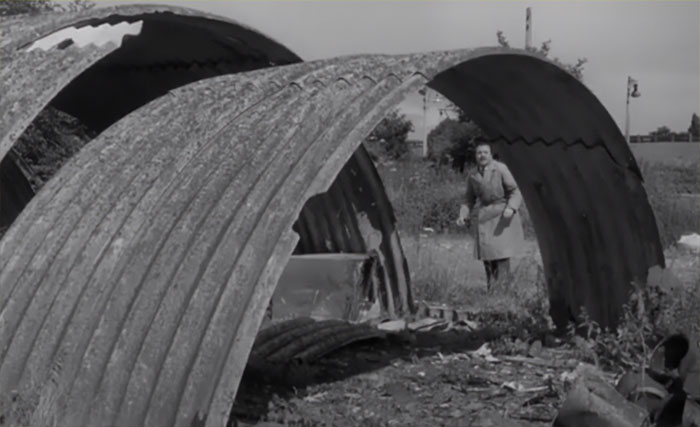
In Seance on a Wet Afternoon (Bryan Forbes, 1964) wasteland is vital to the unhinged kidnap plot enacted by Billy and Myra (Richard Attenborough and Kim Stanley) as a promotional stunt for her work as a psychic.
Among tall grass, rusting Nissen huts and the remains of a half-demolished greyhound racing track, Billy prepares for the kidnap by dying his hair and hiding his motorbike.
Then, when he has the child in his custody, he returns to the same place to dump the stolen car and ditch his disguise.
The wasteland is a place between worlds, and between lives.
By passing through this wild space, he is able to leave civilization behind and transform himself from a timid suburban husband into a criminal capable of anything.
In The Small World of Sammy Lee (Ken Hughes, 1963) Anthony Newley plays a Soho nightclub compere who gets in debt with the wrong people.
His desperate attempts to raise money, against the clock, take him from one part of London to another.
Eventually, though, he runs out of road and winds up on a stretch of Thameside wasteland after dark.
There is nobody there to see or care as he is beaten half to death by his bookie’s enforcer.
In Bronco Bullfrog (Barney Platts-Mills, 1969) a young working class man called Del (Del Walker) tries to find somewhere to be alone with his girlfriend Irene (Anne Gooding).
They are frustrated at every turn, with interfering parents denying them privacy in both modernist flats and Victorian terraced houses.
Though it is far from ideal, like the protagonists of Paul Weller’s song, they resort to an inbetween space: a ruined building on wasteland in Stratford, East London. It is dirty, damp, overgrown and covered with graffiti, and this doesn’t work out either.
The Bashers is a remarkable documentary from 1963. Filmed by the BBC in Bristol it depicts the lives of youths in Barton Hill whose neighbourhood has great stretches of wasteland, awaiting the construction of new blocks of flats.
They don’t have much but they do have this remarkable resource and so entertain themselves by building giant bonfires, and battling gangs from rival neighbourhoods.
The authorities didn’t like this kind of thing, of course, and another place we see wasteland is in one of the most famous public information films. Lonely Water from 1973 shows children playing on the edge of a flooded quarry, among rusting cars and other fly-tipped rubbish.
Villains and tough cops
It’s in the gritty crime film that wasteland really comes into its own. Police corruption scandals and tabloid coverage of the Kray twins triggered a cycle of these in Britain from the late 1960s and through the 1970s.
The final act of Villain (Michael Tuchner, 1971) sees Ronnie Kray-alike Vic Dakin (Richard Burton) on the run in the aftermath of a robbery.
He ends up on a vast area of wasteland at Nine Elms in Battersea, being chased through the ruins of a gas works and a British Rail goods depot.
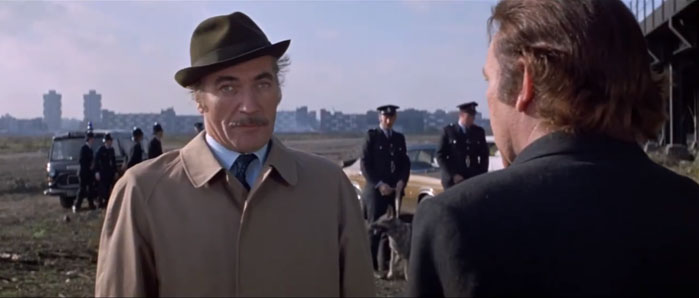
In Sitting Target (Douglas Hickox, 1972) the final scenes take place in a distinct type of wasteland location: a dusty, cluttered transport depot full of workmen’s sheds, parked buses and freight cars.
Here, Harry Lomart (Oliver Reed) is able to pursue his nemesis, using a red jeep to crash into their car time and again, spinning them around a space that already feels half like a graveyard.
Again, the idea seems to be that this is the end of the line. It’s where you end up when there’s nowhere else to go and where, if you’re lucky, you might just about be able to lose yourself.
This isn’t uniquely British. We see similar settings in American crime films from the same period, and in Italy especially. Italian films about tough cops, known as poliziotteschi, invariably include a car chase or shootout on wasteland on the outskirts of Rome, Milan, Turin, or some other città violenta.
When the villain and the tough cop made it to British TV, the wasteland went with them.
The very first shot of the very first regular episode of The Sweeney, broadcast in January 1975, is of a stretch of cracked concrete, where a van races towards a bright yellow Ford Capri. They’re tooling up for a blag, you see, and where else can you do that except on wasteland?
The same episode concludes with a brutal brawl on what looks like a bombsite. It’s like watching boys play cops and robbers and probably not the first time this particular bit of wasteland was used for that purpose.
Turning waste into money
In 1980, crime drama The Long Good Friday arguably signalled the end of the wasteland era. Harry Shand (Bob Hoskins) is an East End gangster looking to go straight by getting in early on the London docklands property development boom.
In the decades that followed, London would lose much of its wasteland as Canary Wharf rose from the rubble, and other cities have followed the same pattern.
That barren landscape beyond Tower Bridge would have one last starring role, though, with the remains of Beckton gas works doubling for Vietnam in Stanley Kubrick’s Full Metal Jacket.
Now they’re almost gone, some of us have started to feel nostalgic for those wastelands. They were dangerous, mysterious and wide open.
Those that remain, pending development, are invariably locked down tight, with heavy security and surveillance.
For our own protection, of course, so we don’t end up like the victim of a 1970s public information film, drowned or crushed.
And to make sure squatters can’t get in and make use of these otherwise barren spaces to park vans or caravans.
But where are we supposed to have our showdowns now?
Or hold hands amongst the punctured footballs and rusting bicycles?
 Precast Reinforced Concrete Heart