Categories
1959 books reading1959

Three pulp paperbacks about juvenile psychopaths

What happens when angry young men are more than angry? These three roughly contemporary books give us portraits of youths struggling with their own murderous instincts.

I came to The Furnished Room, Big Man and The Dead Beat one at a time after finding tatty old paperbacks in charity shops or roadside book swap boxes.

All three were written during a period of anxiety about juvenile delinquency and a simultaneous growth in popular discussion of psychopathy.

The term ‘psychopath’ was popularised in the 1940s and a slew of novels and movies from that point on portrayed a particularly chilling type of killer. Being outwardly in control, and even charming, they were able to walk and live among us.

Joseph Cotten’s Uncle Charlie in Alfred Hitchcock’s brilliant 1943 film Shadow of a Doubt is one example. Patricia Highsmith’s The Talented Mr Ripley introduced us to the chameleonic Tom Ripley in 1955.

At the same time, young people were beginning to seem dangerously out of control, with motorbikes, switchblades, and a lack of respect for authority.

That’s the context in which the following three pulp paperbacks emerged.

Little boys to broken men

Big Man is the earliest, published in 1959. Its author was prolific novelist Evan Hunter, born Salvatore Lombino, and best known for a series of police procedural novels written under the name Ed McBain. He wrote this book as Richard Marsten and it reflects something of that sense of fractured personae.

It’s written from the point of view of Frankie, a young man living in poverty with an alcoholic mother, and drawn into petty crime by sheer boredom. Petty crime leads to organised crime where, after resisting, he embraces his true murderous self.

The 87th Precinct novels are set in an anonymised fantasy of New York where Manhattan is Isola, Queens is Bethtown, the river is the Harb, and so on. Big Man is set in New York proper, where Hunter grew up and which he knew at street level. 

This authenticity shines through in his portrayal of the everyday lives of idle young men with no coin in their pockets and every reason to feel detached from the world. That Frankie’s best friend Jobbo has appalling body odour sets the tone: this is a world where sweat stinks.

These early chapters are similar in mood to The Incident, a 1967 film based on a 1963 TV play, about two young men who terrorise a New York City subway car. In both cases, the thesis is that the road to murder begins at robbery, and robbery comes as much from a need for something to do as from the urge to acquire.

For Frankie, the lure of organised crime isn’t so much money but also a sense of family, respect, and affection. The mob boss is a father figure – someone who tells Frankie he is a good boy and has value.

Even through Frankie’s unreliable narration we see, of course, that he is being preyed upon and manipulated. Through favours owed, debts incurred, steps taken from which there is no walking back, he is drawn away from society and becomes ever more tangled in a shadow world with its own values.

What really sets the book apart is Frankie’s relationship with his two lovers. Frankie is torn between two women – a sexually insatiable gangster’s moll who has been with the whole crew, and the nice neighbourhood girl who wants to start a family.

It is shocking when he shoots the former on the indirect order of his boss. It is absolutely devastating when he puts a bullet in the head of the second because she has become a hindrance to his career.

Hunter plays with our prejudices: promiscuous girls who get involved with criminals put themselves in the firing line, but nice girls who just want their boys to go straight? They deserve a happy ending.

By the end of the novel, Frankie has become a killing machine, like a soldier trained for combat. He follows orders and shoots when he’s told to shoot.

He is also cursed with the knowledge that if he can bring death to the others so swiftly and easily, then death can come to him the same way.

A suburban house in America.
SOURCE: Library of Congress.

The killer is in the house

Robert Bloch’s The Dead Beat was published in 1960 and tells the story of another blank, murderous young man.

Larry Fox is a dead beat jazz pianist who finds a way to break out of the world of crime, prostitution and drugs and into the nice suburban home of a nice suburban family.

His great skill is being able to present as a good boy when it suits him – or maybe these are actually glimpses of the real Larry, or another Larry, battling Bad Larry for supremacy?

As Good Larry, he’s bashful, well-spoken and polite. He’s musically talented and has hopes to study composition at university. This is catnip for the middle class saviours who take him in and nurse him when they find him unconscious in the back of their car. Especially the women.

But Bad Larry plans to get revenge on his former accomplices in a robbery and will fuck, rob, drug and manipulate anyone who gets in his way, or can help him achieve his goal.

Bloch doesn’t expect the reader to read between the lines. He has his characters debate matters of juvenile delinquency and ‘the beatnik problem’ which gives him an excuse to insert chunks of his thesis into the text:

It all began with World War One, I suppose. Up until then, the traditional role of the young man in this country was that of an apprentice. In rural communities he started as a hired hand or helped his father on the farm. In the cities he entered business as a clerk or a messenger or an office boy. Youth accepted a subordinate position unquestioningly, even when the industrial era developed… War is the great glorifier of youth… Our economic leaders, through the media of advertising, assure us that it is the duty of everyone to appear young; to buy products which enhance the illusion of immaturity. Our books, magazines, motion pictures and television programs inform us, not too subtly, that romance and adventure are the exclusive property of young people between the ages of seventeen and twenty-five. Nobody over that age ever falls in love or experiences anything of lasting significance, except for a few oddball characters thrown in for comedy relief.

Bloch was primarily a writer of horror stories and the scary idea in this story is that adults cannot tell good boys from bad ones. That nice young man your daughter is dating might be a hophead, a junkie, a pervert or a killer – better not let him in. Especially not if he reminds your wife of when she was young.

A Victorian terraced house in West London.

The kitchen sink killer

Crossing the Atlantic, Laura Del-Rivo’s The Furnished Room was published in 1961 and filmed as West 11 in 1963.

In many ways it sits alongside British social realist novels like Saturday Night and Sunday Morning or, closer in tone and setting, Absolute Beginners. The difference is that Del-Rivo introduces a gun into the mix turning it into something like a crime novel, or one of Georges Simenon’s romans durs.

Joe Beckett is another semi-intellectual, but a reader rather than a musician. Like Larry Fox, he is capable of making himself presentable, as long as nobody gets close enough to notice the grubbiness of his shirt or smell his unwashed socks. To some people he reads as clever, almost an intellectual, although his drug-fuelled lectures don’t stand up to the scrutiny of really intelligent people.

As with the protagonists of many other British novels of the period, he is too full of fury to be constrained by the drudgery of a nine to five job, or by love and marriage. Unlike Arthur Seaton, however, he decides that committing a murder might fix the emptiness inside him.

Haunting the cafes and bedsits of West London, Joe meets a classic British type: the faux-military conman with a range of regimental ties to suit whichever story he is telling on any given day. Keen to inherit from an aged aunt, he draws Joe into a scheme apparently inspired by Strangers on a Train.

That standard crime plot isn’t where the excitement lies in this story, though. That’s in Joe’s battle with his own worst instincts. He has constant intrusive psychopathic, paedophilic and fascistic fantasies. Reading about Nazi concentration camps thrills him:

Beckett’s immediate reaction had been a burst of sadistic joy. He knew that if, at that precise moment, he had seen a woman prisoner with her arms yearning for a lost child, he would have kicked her in the face. The shooting of the new detachment had pleased his sense of order. They were damn nuisances, screaming and panicking like that. Shooting them was the only orderly thing to do. He loathed the prisoners for their ugliness, their suffering, and their lack of pride. The photographs of these degraded sufferers, squatting behind their barbed wire, had revolted him so much that he had thought it a pity that the whole lot hadn’t been gassed. He had preferred the photographs of the Nazi guards, who had at least looked clean and self-respecting.

This book in particular feels like a commentary on present day alt-right, manosphere and incel cultures.

All three books force us to inhabit the minds of boys who don’t know how to love, even if they sometimes get close.

Those are the moments when we want them to break through the barriers, to untangle the complex feelings that threaten to break through their anger, resentment and hatred.

But they can’t do it. So they reach for guns and point them at innocent people.

Categories
crime Film & TV

The Todd Killings, Smooth Talk, and the allure of the creep

Everything about the American serial killer Charles Schmid sounds pathetic – so how was he able to command the loyalty of his teenage followers?

That’s a question grappled with by two films based on Schmid’s story, 1971’s The Todd Killings, directed by Barry Shear, and 1985’s Smooth Talk, directed by Joyce Chopra.

Both films ultimately share the same original source: a 1966 Life magazine article by Don Moser called ‘The Pied Piper of Tucson’.

That article is a masterpiece of true crime writing, available online, and also collected in a 2008 Library of America anthology. Moser painted a picture of a loser and weirdo who, in his early 20s, was still hanging around with school kids in Tucson, Arizona:

At the time of his arrest last November, Charles Schmid was 23 years old. He wore face make-up and dyed his hair. He habitually stuffed three or four inches of old rags and tin cans into the bottoms of his high-topped boots to make himself taller than his five-foot-three and stumbled about so awkwardly while walking that some people thought he had wooden feet. He pursed his lips and let his eyelids droop in order to emulate his idol, Elvis Presley. He bragged to girls that he knew 100 ways to make love, that he ran dope, that he was a Hell’s Angel.

But Schmid was somehow appealing to teenagers who saw not a creep but a local own-brand version of Elvis Presley:

He had a nice car. He had plenty of money from his parents, who ran a nursing home, and he was always glad to spend it on anyone who’d listen to him. He had a pad of his own where he threw parties and he had impeccable manners… He knew where the action was, and if he wore make-up—well, at least he was different… [To] the youngsters – to the bored and the lonely, to the dropout and the delinquent, to the young girls with beehive hairdos and tight pants they didn’t quite fill out, and to the boys with acne and no jobs – to these people, Smitty was a kind of folk hero. Nutty maybe, but at least more dramatic, more theatrical, more interesting than anyone else in their lives: a semi-ludicrous, sexy-eyed pied piper who, stumbling along in his rag-stuffed boots, led them up and down Speedway.

Schmid was more than “nutty”. He tortured at least one cat, for starters. Then, in May 1964 he convinced two young friends to accompany him as he kidnapped, raped and murdered 16-year-old Aileen Rowe. They helped him bury the body in the desert – and kept his secret.

A little later, in the summer of 1964, he met 16-year-old Gretchen Fritz at a swimming pool. He seduced her and they had a rocky year-long relationship. It culminated in the death of both Gretchen and her younger sister, Wendy, in August 1965. When he showed a friend called Richard Bruns where the bodies were buried in the desert, Bruns turned Schmid into the law.

Schmid was convicted of murder in August 1966 and sentenced to death. By June 1967 a film based on the story was in production.

A screengrab from The Todd Killings showing Skipper Todd with bushy long hair, shades, and a wide collared shirt.
Robert F. Lyons as Skipper Todd in The Todd Killings.

The Todd Killings: torn from today’s headlines!

The Todd Killings had a range of working titles like ‘Pied Piper of Tucson’, ‘The Pied Piper’ and ‘What Are We Going to Do Without Skipper?’

It was eventually released in 1971 with the action relocated from Tucson to the fictional town of Darlington, California.

Schmid became ‘Skipper Todd’ played by Robert F. Lyons, with his look and lingo brought up to date. Skipper has shaggy Mick Jagger hair, tight bell bottoms, and a green dune buggy. He also plays folk rock songs on an acoustic guitar, almost like a spare member of The Monkees, or Charles Manson.

Lyons really is good looking, though, and brings to the part a commanding arrogance. The children follow him because he has the qualities of a leader. In odd, intercut scenes he is shown lying to a US Army recruiter to wriggle out of fighting in Vietnam where, actually, he might have thrived as another William Calley.

Updates and poetic licence aside, the film is an otherwise relatively faithful recounting of the facts of the case.

It has a particularly strong opening: Skipper is burying a body in the desert, helped by a devoted young girlfriend and a panicky boy.

This is not a whodunnit, or a did-he-do-it, like Psycho. That this young man is bad is established from shot number one.

From the off, we also empathise with the bored kids who are groomed by Skipper Todd, even as we want to shake them by the shoulders and urge them to break free.

We even begin to understand why they would reward his madness and violence with devotion. They are weak, and their parents are weak, too. He is good at spotting weakness and filling the gaps in people’s live. He has everyone, both boys and girls, under an erotic spell.

Did Charles Schmid ever see The Todd Killings? He died in prison in 1975 so it’s just about possible. If so, he would probably have found it flattering.

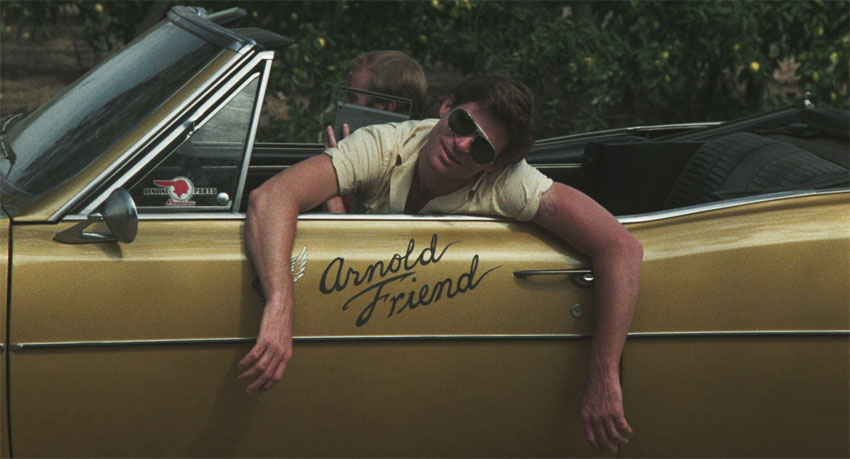
A man with muscular arms and sunglasses leans over the door of a gold convertible. His head is tipped to one side. The name Arnold Friend is painted in script letters on the side of the car.
Treat Williams as Arnold Friend in Smooth Talk.

Smooth Talk: back to the future

More than a decade later a second film tackled the story more obliquely, and more artfully. Joyce Chopra’s Smooth Talk from 1985 was not based on Moser’s article but on a short story by Joyce Carol Oates, ‘Where Are You Going, Where Have You Been?’ first published in 1966.

In Oates’s version of the Schmid affair, which was distilled from Moser, the monstrous fake teenager is called Arnold Friend. He stalks, seduces and seizes a teenager called Connie while her well-to-do parents are out at a barbecue. It crams a lot into a few thousand words and presents small town America as a menacing, sickly place.

Smooth Talk expands on the short story significantly, using Oates’s original material to form only the final act of the film.

It also does something really clever with the period. Connie (Laura Dern) is a quintessential 1980s teenager straight out of a John Hughes movie, while Arnold Friend (Treat Williams) is a relic of the 1950s. He is a cheap knockoff of James Dean (Connie has posters of Dean on her bedroom wall) and therefore closer to the real Charles Schmid than Skipper Todd.

In this, there’s an echo of another film: Terence Malick’s Badlands from 1973, in which Martin Sheen based his performance as spree-killer Kit Carruthers on James Dean. Kit wasn’t based on Charles Schmid, however, but his near namesake, Charles Starkweather – another rural weirdo with a taste for teenage girls.

In some ways, Arnold Friend is a less complex character than Skipper Todd, or the real Charles Schmid. He’s a sinister stranger, not a ‘pied piper’ who everyone knows and admires. He’s clearly a much older man (Williams was 34 when he played the part), dressed anachronistically, and almost supernaturally sinister in his manner, like an avatar of the Devil after Connie’s living soul.

In this version of the story Arnold Friend doesn’t kill anybody – as far as we know. He stalks Connie and, eventually, convinces her to go for a ride. This is roughly where Oates’s story ends and in that version we’re left to speculate on her fate. But if you know it’s inspired by Schmid your speculation is likely to favour murder.

In the film, Connie returns. She is changed – an adult, now, and no longer innocent. But she is, at least, not dead and buried in the desert.

In almost every way Smooth Talk is the better film. Not least because it makes Friend/Schmid an exterior menace and puts in the turbulent mind of one of his victims.

The Schmids, they’re multiplying

There is something particularly dark and rich about this story which must be why filmmakers keep coming back to it.

There’s Dead Beat from 1994, which seems almost impossible to see; Lost from 2005, adapted from a novel by horror writer Jack Ketchum; and Dawn from 2014, which focuses on the sister of one of Schmid’s victims.

Schmid is not the only killer to have inspired multiple movies, though. In fact, it’s unusual for a notable serial killer not to have inspired multiple movies.

Leopold and Loeb are practically a sub-genre (Rope, Compulsion, Swoon). So is Ed Gein – the original model for six decades of psycho-slashers, from Norman Bates to Leatherface. And Badlands is by no means the only take on the Charles Starkweather and Caril Ann Fugate story.

As a writer of fiction I find it almost maddening that real life generates stories that are so much more out there than anything I could invent. If I’d created Charles Schmid as a character it wouldn’t have occurred to me to give him white foundation make-up, a fake mole, and shoes full of crushed tin cans. Real criminals are often both dumber and more interesting than their fictional counterparts.

More importantly, I don’t know if I’d have been able to look at Schmid through the eyes of a teenager and have them think, “That guy is cool, I love him, I’ll do whatever he says.”

Main image: A digital sketch based on several different photos of Charles Schmid composited, traced, and treated with textures and filters.

Categories
bristol Cornwall Devon Dorset history Somerset west country

Rogue One: The Strange Career of Bampfylde Moore Carew

Bampfylde Moore Carew.

A thief, conman, beggar, trickster, adventurer and teller of tall tales, Bampfylde Moore Carew is the most famous West Countryman they never tell you about in school.

I first learned of his existence in a book called Somerset Legends by Berta Lawrence, published in 1973. I bought a copy for 10p in a sale of cancelled books at Bridgwater Library when I was about 13.

Reading this was the first time it ever occurred to me that my home county might be anything other than rather flat and rather dull, and I took the book away with me to university, and then to London, as an antidote to homesickness.

Now, thanks to the magic of online book archives, I’ve been able to go back to Ms. Lawrence’s source, namely a book called The Life and Adventures of Bampfylde Moore Carew, published in 1745.

We would probably now recognise it as having been ghost-written for Carew by one Robert Goadsby, though its status as autobiography-biography, or perhaps even a form of picaresque proto-novel, remains muddy.

It is almost certainly a pack of fibs built around some kernels of truth, but was nonetheless a bestseller in its day and reprinted, with further embellishments, many times in the century that followed.

Here’s the story it tells, as the precursor to the embroidered gangster memoirs of today, with a few details taken from other sources, and quotations taken from this Project Gutenberg version of an 1850s reprint.

Carew was born in July 1693 in Bickleigh, a village near Tiverton in Devon. His father was the rector of Bickleigh and his family was well-to-do.

He was sent to Blundell’s, the famous West Country private school, at the age of 12, but (according to his own account) ran away rather than face punishment for tearing up farmland with his horse-riding hunting pals and a pack of hounds.

And this is where his life got interesting.

He joined a band of gypsies and made a living with them through trickery and petty crime. As a well-spoken, gentlemanly figure he was uniquely well placed to win over respectable folk and relieve them of their money, as in the case of Mrs Musgrove of Monkton just outside Taunton, in Somerset. (Now best known for its garden centre – such romance!) She called on young Carew having heard that he was an expert gypsy-trained treasure diviner. 

When he came, she informed him that she suspected a large quantity of money was buried somewhere about her house, and if he would acquaint her with the particular place, she would handsomely reward him. Our hero consulted the secrets of his art upon this occasion, and after long toil and study informed the lady, that under a laurel-tree in the garden lay the treasure she anxiously sought for; but that her planet of good fortune did not reign till such a day and hour, till which time she should desist from searching for it; the good lady rewarded him very generously with twenty guineas for his discovery.  We cannot tell whether at this time our hero was sufficiently initiated in the art, or whether the lady mistook her lucky hour, but the strict regard we pay to truth obliges us to confess, that the lady dug below the roots of the laurel-tree without finding the hidden treasure.

This is a classic con-man story in which the mark positively asks to be ripped off because of her greed, and her stupidity — perhaps one of the earliest in print?

Eventually he was convinced to come in from the field and return to Bickleigh where he was welcomed with tears of gladness and the ringing of church bells. But having had a taste of freedom and adventure, he got bored and went back to the gypsies, via their camp at Tiverton, and set out on a new phase of his career: he became a fake shipwrecked seaman.

Our hero’s wit was now set to work, by what stratagems he might best succeed.  The first that occurred to his thoughts was that of equipping himself with an old pair of trowsers, enough of a jacket to cover his nakedness, stockings such as nature gave, shoes (or rather the body of shoes, for soles they had none) which had leaks enough to sink a first rate man of war, and a woollen cap, so black that one might more safely swear it had not been washed since Noah’s flood, than any electors can that they receive no bribes.  Being thus attired, our hero changed his manners with his dress; he forgot entirely his family, education, and politeness, and became neither more nor less than an unfortunate shipwrecked seaman.

He learned the jargon and the manners of a sailor and in this persona conned multiple people out of “a considerable booty”, before reinventing himself again as a simple Kentish farmer who had lost his cattle in a flood:

His habit was now neat but rustic; his air and behaviour simple and inoffensive; his speech in the Kentish dialect; his countenance dejected; his tale pitiful—wondrous pitiful; a wife and seven helpless infants being partakers of his misfortunes; so that if his former stratagem answered his wishes, this did still more so, he now getting seldom less than a guinea a day.

Next, he adopted the persona of Mad Tom, a half-naked lunatic, roving the countryside and observing human nature, learning more “than most of our youths who make the Grand Tour”.

Carew the trickster disguised as a ghost at South Molton, Devon.

From Dartmouth in Devon He travelled to Newfoundland where he acquired a “fierce and large dog” and stayed just long enough to learn enough about fishing and sailing to take his shipwrecked mariner act to the next level.

On his return, via Newcastle, he fell in love, eloping with one Miss Gray, marrying her in Bath, and settling in Bristol, where they turned heads with their dandy dress.

Going back on the road, he impersonated a clergyman to prey on Quakers; developed a wheeze whereby he would turn up anywhere there had been a notably large fire and pretend to be a survivor, with a singed hat for evidence; and strapped himself up to portray the part of a one-legged beggar.

Circling back to Bristol, he pretended to be the son of a Newfoundland gentleman whom he vaguely resembled, lately arrived in England and in need of credit on clothes and provisions.

On one occasion he witnessed a shipwreck off the Dorset coast and had the presence of mind to strip and fling himself into the surf to be rescued as a survivor or, as he tells it, to attempt to rescue one of the crew like some kind of superman, only to be quite innocently mistaken for a member of the ship’s crew.

Eventually, all this caught up with him and he was arrested at Barnstaple in Devon, and taken to court in Exeter, from where he was transported to Maryland in the American colonies.

You might think this was the end of Carew’s West Country career but, no, he somehow escaped custody, convinced some Native Americans to remove his irons, and made his way back to England via Philadelphia, New York and various other fascinating places out of the scope of my project.

A parade of convicts.
British convicts in chains ready for transportation, via Early American Crime.

He carried on where he had left off (shipwrecked sailor act, turban-wearing Greek, French smuggler, Presbyterian parson, and so on), got caught again, and sent back to Maryland, from where he escaped a second time. (If he was making this up, he could have done with a firmer editor – who would invent this repetitive narrative structure?)

In the third and final phase of his career as a conman he tried some bigger schemes, such as convincing a group of his school friends to join him at St Matthew’s Fair in Bridgwater, Somerset, in the guise of a group of crippled, deaf, dumb, blind beggars. The mayor, though, suspected the trick and had them thrown in prison for vagrancy, but contrived to let them escape so that he could see which of them broke into a run on leaving their cell and then re-arrest them on more serious charges. (This sounds like something from one of the sillier spaghetti westerns to me.)

Although the book presents all of this with a sort of smirk, and its sales are evidence that people found Carew’s antics to some degree charming or at least entertaining, his admitted tendency to prey on the bereaved is simply grim.

For example, he tricked a man whose son had died at sea into giving him money in exchange for a supposedly first-hand account of his death and burial, which of course Carew knew nothing about that he had not learned from gossip around the village.

In another instance, at Buckfastleigh in Devon, he got an accomplice to dress as a victim’s dead grandmother as part of another ‘hidden treasure’ con:

In order for the execution of this scheme, Coleman put a woman’s cap on his head, washed his face, and sprinkled meal on it while wet, stuck the broken pieces of a tobacco-pipe between his teeth, and wrapping his body in a white sheet, planted himself in the road that Collard and Mr. Carew were to come; the moon at this time shone very bright, which gave an additional horror to the pretended spectre.  Our hero, by virtue of his supposed profound learning and most mysterious science, spoke to it in an unknown language, to the following effect:—“High, wort, bush rumley to the toggy cull, and ogle him in the muns;” at which command the terrific hobgoblin fiercely advanced up to poor Collard…

But this couldn’t go on forever and eventually, having made a small fortune.

Growing old and ill, Carew retired to a cottage in the West Country, published his memoir, and died in 1759.