Categories
history science Somerset

Frankenstein in the Quantocks

POSTER: "Andrew Crosse -- the man who created life!"

A gentleman scientist fills a laboratory with primitive electrical equipment and, through experiments considered blasphemous by his peers, summons life.

This is the plot of one of the elemental gothic horrors, that’s true, but it is also something that really happened, not among the romantic mountain peaks of Mitteleuropa but on Somerset’s Quantock Hills. And the scientist was not a doomed young Byronic hero but a distinctly middle-aged Englishman called Andrew Crosse.

Crosse was born  in July 1784 at Fyne Court, a country house built by his family in 1620s on the edge of the Quantocks between Bridgwater and Taunton. Though now we now think of the Quantocks as a landscape dominated by conifers it was then covered with ancient woodland, its heathlands bright with yellow furze and purple heather, pockmarked here and there with sandstone and limestone quarries, and richly populated with deer and other game animals. A place of ‘free, wild solitude,’ in the words of Crosse’s biographer, his widow Cornelia.

Fyne Court before the fire of 1894, via the National Trust website.

Andrew’s father, Richard, was strict to the point of being intimidating and though his mother cooed over her ‘little Andrew’ his parents sent him away to board with a tutor in Dorchester at the age of six. There he learned Ancient Greek, oddly before he had learned to write English, before moving on to a school in Bristol at the age of eight.

In Bristol, on a grim diet of black potatoes and ‘hashed mutton’, he developed a fascination with fireworks and electricity. His father had known the famous electrical experimenter Benjamin Franklin and perhaps that laid the foundations of his interest, but the real spur to action was a lecture he heard about at a tavern where he had got into the habit of taking meals to avoid the dreadful school dinners.

A school friend, John Jenkyns, provided Cornelia with a note for inclusion in her biography which recalled what came after that formative experience:

I dare say he has mentioned to you our first joint attempt in the science of electricity, and the wonderment occasioned to a circle of school boys by giving them a shock with a Leyden phial… charged by a broken glass of a barometer…

Crosse and Jenkyns used this contraption to tease – or, let’s be honest, bully – younger boys who were marched up to a terrifyingly gothic witch-like figure sitting next to a box. (The witch was Crosse in costume.) Inside the box there was a depiction of hell with a devil dancing in front of it, pitchfork in hand. (A clever trick in itself: the figure was hanging from a single human hair.) The little lads were made to look at this macabre scene for a moment before the jar was discharged, giving them a physical jolt to match and intensify the psychological one. (At my school the bullies just gave you a dead arm in the corridor but this is presumably what you’re paying for with private education.)

Andrew Crosse. (This picture is all over the internet but I can’t find the original source.)

Crosse left Bristol for Oxford in 1802 taking with him an ‘electrical machine’ that he had acquired from a ‘philosophical instrument maker’, and a hunger to learn more. After university he returned to Somerset and made an abortive attempt to study law while, now orphaned, he also managed the family estate. His true fascination could not be resisted, however, and he soon had a new electrical apparatus to play with – a huge cylindrical electrostatic generator attached to a battery made up of 50 Leyden jars. This machine was made by his friend George Singer, another electrician, as such scientists were then known, though the word now refers to a specific, less glamorous trade. They would spend all day running electrical experiments together and then, in the evening, walk on the Quantocks engaged in intellectual debate.

A battery of Leyden jars.
Leyden jars as depicted in an 1894 medical textbook.

In around 1807 Crosse was inspired to begin a new line of investigation. He kept finding himself drawn to Holwell Cavern, a fissure in the limestone rock the roof of which was covered in star-like Aragonite crystal formations caused by the dripping of mineral laden water through the rock. A true man of the Romantic age, he of course wrote a poem about the cave, which begins:

Now pierce the hill’s steep side, where dark as night
Holwell’s rude cavern claims the torch’s light;
Where, breathless, dank, the fissure cleaves in twain
Th’ unchisell’d rock which threats to close again,
And swallow in its adamantine jaws
The bold explorer of creation’s laws.

Crosse later said: “I felt convinced at an early period that the formation and constant growth of the crystalline matter which lined the roof of this cave was caused by some peculiar upward attraction; and, reasoning more on the subject, I felt assured that it was electric attraction.”

He took water from the cave and, back in his lab at Fyne Court, connected it to a battery and ran a current through it. Nothing happened for days and he was about to give up when, after almost two weeks, he spotted sunlight glinting on crystals that had grown on one of the wires.

In the years that followed, he married, had children, and continued working on his ‘electrical poem’. He argued politics and philosophy with his brother Richard, and travelled to Plymouth where, from the deck of a hired boat, he caught a glimpse of Napoleon Bonaparte imprisoned aboard HMS Bellerophon.

A painting of ships.
Napoleon’s Bellerophon depicted in ‘Scene in Plymouth Sound’ by John James Chalon, 1815, via Royal Museums Greenwich.

He also continued his experiments, constructing an ‘atmospherical conductor’, a copper wire of about a mile in length which he used to attract lightning during thunderstorms and bad weather, creating ‘terrific… noise and brilliant light’. Crosse himself described how one experiment created “explosions… [and a] stream of fire too brilliant to look at”. Calmly harnessing the power of the atmosphere he used the electricity to boil liquids, fuse metals and cause fires. Locals would turn up at Fyne Court and ask to be zapped to cure their various ailments which, according to Crosse, sometimes worked. It is easy to see how this kind of experiment inspired the modern vision of the mad scientist.

As recounted in Brian Wright’s 2015 biography, it was Singer who convinced Crosse to talk at one of the regular lecture events hosted by the parachutist, balloonist and showman-scientist André-Jacques Garnerin at a London theatre. On the night of Crosse’s lecture on 28 December 1814 two more famous figures from history happened also to be present: Mary Shelley and her husband, the poet Percy Shelley.

We know from her diary that Mary took note of Crosse’s lecture, whether she paid attention to its details or not. A year and a half later, at the Villa Deodati on the shore of Lake Geneva, she would write her most famous book, Frankenstein. Did Crosse inspire Victor Frankenstein? Perhaps partly, or perhaps Frankenstein inspired Crosse, because back in the peace and quiet of Somerset he continued his experiments into batteries and crystallisation in relative obscurity for another 20 years, long after Mary Shelley’s book had become a bestseller.

Crosse was in his early fifties when an accidental discovery, and the equally accidental announcement of its results, brought him fame or, rather, infamy. In 1837 he carried out a month-long experiment attempting to grow crystals by electrifying a chunk of porous volcanic stone. On the 26th day he observed what looked like insects. Then, on the 28th day, to his astonishment, he saw them wiggle their legs. A few days later they wriggled free and began to move around the frame where the experiment was being conducted. They were, Crosse concluded, mites of the genus Acarus, and there were soon a hundred or more, some with six legs, others with eight. Where had they come from? And how on earth were they surviving in an acid solution?

Sketch of a bug.
Pierre Turpin’s drawing of Acarus Crossii made using a microscope, from The Annals of Electricity, Magnetism and Chemistry, May 1838, via Google Books.

Crosse mentioned this odd occurrence to some friends in what he thought was private conversation but one of the group was the editor of the Somerset Gazette and couldn’t resist running an account of the experiment. That article was picked up and reproduced or quoted in newspapers across the country, usually under the headline EXTRAORDINARY EXPERIMENT.

Outrage commenced almost at once. Who did Crosse think he was, claiming to have created life, and bragging everywhere about his amazing discovery which was obviously a complete con? Crosse was hurt by those accusations: he hadn’t made any such claims and certainly hadn’t sought to publicise his experiments. He was blamed for crop blight and received a letter calling him “a reviler of our holy religion” – in other words, he was accused of playing God.

For another decade he and other scientists attempted to replicate the results, often with success, but without reaching any convincing conclusion. Was the electricity reviving fossilised insect material in rocks or soil? Was the water contaminated, or the apparatus? Or had Crosse really discovered the secret to summoning life?

These days, the consensus is that the equipment probably was dirty — inevitable, almost, in those days of imperfect sanitising techniques. Hardly the stuff of legends, and Crosse certainly did not go on to ‘create’ any more substantial form of life such as, say, a murderous, misunderstood monster created from cadavers rifled from graveyards.

Even though Shelley wrote her novel twenty years before Crosse’s mite experiments, and though in reality the links are tenuous, in recent decades the connection has become indelible, and it is probably fair to say that the Thunder & Lightning man owes his lasting fame to Mary Shelley. Peter Haining, that master of the fun but unreliable horror-history hackjob, called his 1979 book about Crosse The Man Who Was Frankenstein which, clearly, he wasn’t. And, well, I’ve done it here, haven’t I?

There is something irresistible about the idea of so macabre a fiction having any basis in reality, especially when that reality occurred in the wooded hills and heathland of Somerset where the red deer roam.
Categories
council Somerset

Some Forgotten Fields

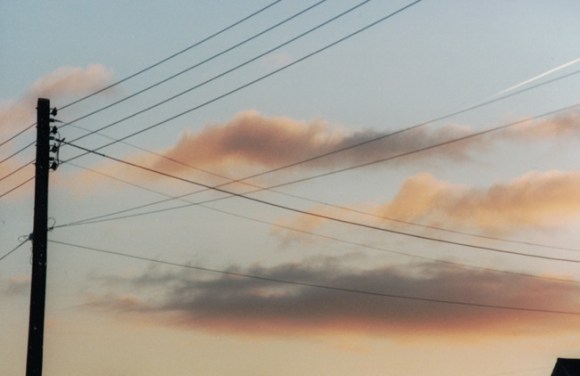
Bridgwater sky.

Sydenham Road was where town met the countryside — where the grey council prefabs pointed their rear ends at the tall golden grass of The Fields.

The Fields seemed infinite and wild to me as a frankly cowardly child. There were things concealed in the growth I did not care to encounter – hunks of rusting metal; plastic bags full of hardened glue, all sniffed out; the remains of illicit bonfires; and, most terrifying, nests of adders. In autumn low mist would lie on The Fields, and only on The Fields, like a gathering of ghosts. On one of the rare occasions I did dare to explore my foot got sucked into mud and I lost a trainer to the avaricious earth, which felt to me like a near-death experience.

There was no formal access to The Fields from the estate because, after all, why would we need to go there when we had public greens and playgrounds? (I once found a bag of dead rabbits behind the tank-shaped climbing frame in the park on Chamberlin Avenue.) All that meant was that kids clambered over back-fences, crushing the chain-link to the ground over the course of years, while certain enterprising residents installed their own back gates. During the day, and especially during the summer holidays, that meant cousins and friends could run in and out of each other’s gardens using folk paths worn through the vegetation. At night it facilitated more sinister goings-on – the whine of ‘borrowed’ mopeds and motorbikes, muttering, scurrying, cold torchlight, clothes-line raids, and outright burglary.

They started building on The Fields when I was about 10-years-old, and I wasn’t sure if it was good or bad news. On the one hand, I knew it would bring the wilderness into line – no more snakes or child traps, and an end to the sinister whispering of the grass beneath my bedroom window in the blue small hours. On the other hand, I disliked change — I sulked when they installed double-glazing and pebble-dashed the council houses — and this amounted to a fundamental reordering of the very landscape. Much as The Fields scared me they were also natural and beautiful in their own way and it felt wrong to turn them into yet more streets. Perhaps I also picked up on grown-up grumbling: a council house with something even approaching a natural view is a coveted thing and here They came to take the view away.

During the building The Fields became fearsome in a different way. First, infrastructure had to be laid, which meant heavy plant roaring all day long and then lying around, yellow and silent, after hours. Tarpaulins flapped and snapped in the wind, louder and more alarming than the grass had ever been. And concrete pipes were set about waiting to be laid underground, half-heartedly fenced off, with signs to warn kids away. But my best friend wouldn’t be warned away from anything.

I can’t remember how we met. I was shy and small; he was swaggering, round-fisted, and a year older. We wrote and drew comics together, planned elaborate bases, and pooled our collections of toy cars to make a museum in his parents’ garden shed. We played American football, too – he taught me to throw the ball with a twist so it would spin and find its target, and insisted that we tackle each other with full force despite the absence of armour or helmets. (I wonder, with hindsight, whether he had decided it was his duty to toughen me up in preparation for secondary school.)

Like a lot of intense childhood friendships, though, it couldn’t last, and as the building went on I lost him to The Fields and the company of naughtier, more adventurous kids than me. He kept ringing the doorbell and inviting me right to the end – “Coming over Fields?” – but I was too afraid and so he would go without me.

Then one day my uncle turned up, white-faced, and sat me down to tell me the bad news: my best friend was dead. A concrete pipe he had been clambering around and inside had rolled free of its anchoring and crushed him.

So when I say I lost him to The Fields, I really mean I lost him.

Within a few years The Fields became the Bower Estate – hundreds of just-too-small red-brick private houses arranged in whirls and loops along dusty new artery roads. Now the frontier with the countryside is old Bower Lane beyond which there is a stretch of flat farmland right up to the motorway. It’s muddy alright, but not wild or free. Enclosed, carefully tended, and private, it is no haunt for serpents or ghosts.

Categories
Somerset

Old Familiar Rooms

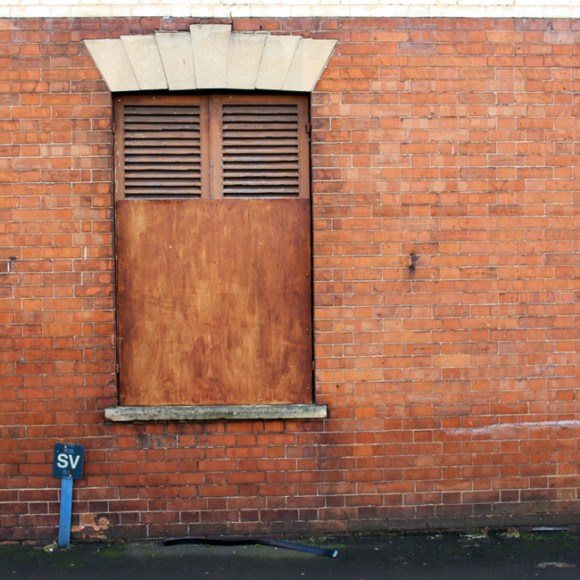
Blank window.

Yesterday, I went Home.

When I say Home, I mean Bridgwater in Somerset — a town I haven’t lived in since the 1990s, where I didn’t live for large chunks of my childhood, and where even my parents no longer live. But I was nursed there, went to junior school, secondary school and sixth-form college there, and so it is and always will be Home.

Perhaps I felt more than usually moved by the experience this time because I really had no reason to be there. I was delivering some Christmas presents to a cousin but, honestly, I half engineered that as an excuse to visit. No, this time, I was there because I wanted to be, with the express intention of giving the old place my full attention.

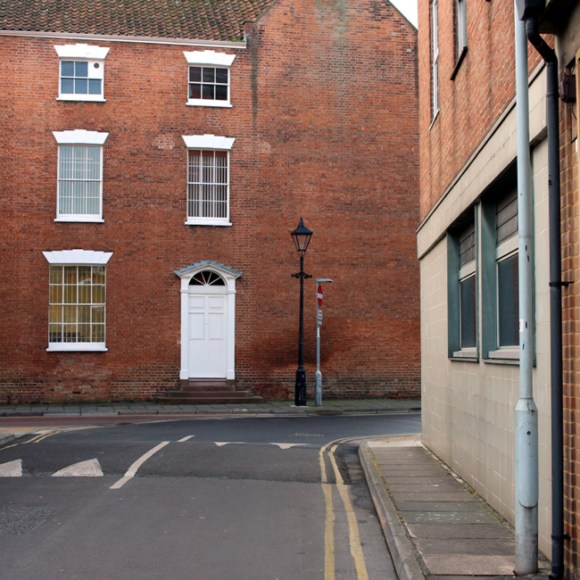
I felt quite overcome at times, standing opposite the house where my uncle died, passing my cousin’s workshop, and then wandering through terraced streets where various members of my family lived at one time or another. I didn’t remember the curve of the road or the beautiful soft-edged red brick. Its Victorian completeness, or complete Victorianness, had never struck me before.

For a full minute I stared at a derelict property, boarded up as long as I remember it, and somehow as faded and poignant in real life as an unlabelled Polaroid from the back of a discarded album. How could something so small, so mean, be so beautiful?

Dead street.

That habit some people have of reflexively dismissing their home towns as ‘dumps’, ‘toilets’, ‘the arse end of nowhere’, has never afflicted me. I’ve always insisted that I am fond of Bridgwater even though I know — of course I do — that there’s nothing much to recommend it to strangers. (Carnival, perhaps?) Hating one’s home-town has always struck me as a bit of a cliche, to be frank, like introducing yourself as ‘A bit of a cynic’, or saying that your band’s music ‘defies classification’. A sort of low-fat alternative to any actual personality.

Still, that contempt for the familiar must have been lurking, even if I didn’t acknowledge it. When I was 17 I was tasked with writing a script for a short film at Bridgwater College and what poured out was a grotesque stream of consciousness full of cracked paving stones, foul sewers, and grim reflections on the town’s sinister history. “Where did this come from?” asked the lecturer when I handed it in, perhaps concerned that I had previously unsuspected psychiatric problems.

On this visit, the same fear and loathing manifested in a strange tug of emotions. Much as I was delighted to be there I could also feel a tightening in my spine — a sort of shudder-in-waiting as my fight-or-flight response came out of sleep mode. It was as if my stranded teenage anxiety met me off the train and was following me around like an insinuating familiar.

I also caught myself trudging at times. Though I knew I should be move to be once again on Monmouth Street, for example, my legs and brain conspired to loop me back in where I left off. For whole stretches I forgot to look at all, as if I had somewhere to be by a certain time (I didn’t) — town is town is town.

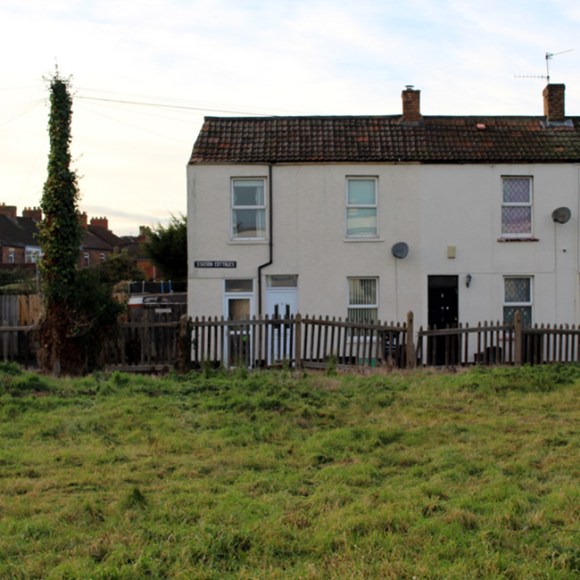
Railway cottages.

Perhaps its natural to have that desire-hate, comfort-fear, fascination-boredom relationship with places you truly know.

As it is, this time the balance tipped towards the positive. I saw things for the first time that I’d seen a thousand times — ghost signs, the gorgeousness of the old Edwardian cinema, the sprinkle of classical buildings at Cornhill that speak of a time when the town had pretensions, and even the space-age oddness of the stillborn shopping mall. I looked at — was mesmerised by — the golden reeds on the riverbank backlit by a bone idle winter sun that had barely lifted itself above the bandstand in Blake Gardens.

I suppose my advice might be that if you’re going to wherever you call home for Christmas, and dreading it because it scares or bores you, or some mixture of both, try looking at it as a stranger might. Forget what you know, forget the well-practised routes your muscle memory insists upon, and let yourself love it.

Categories
Somerset

Clatter, Pop, Hiss, Clang

Industrial wasteland.
Bridgwater c.1999.

Through the scratched visor I can see my hands in heavy duty gauntlets fumbling another dented aerosol into the cradle and slamming down the handle. The nail on the end of the lever pierces the can and the gas escapes with a satisfying bang, followed by a nosebleed of Hammer Horror red as the penetrant dye inside leaks into the oil drum beneath. I give it a shake to release the last of the liquid and hurl the crumpled shell into the skip at my side with another pleasing sound – this time, a cymbal crash.

This was my summer job between school and sixth-form college – puncturing cans that for one reason or another hadn’t passed quality assurance – and I rather enjoyed it. For the first time in years, and for the only time for years to come, I didn’t have revision or reading to do, and the mindlessness of the task suited the state of my post-GCSE brain.

For a dorkish introvert like me the situation was perfect, too. I’d worked on the shop floor in the factory proper for several stretches and found the constant supervision and chatter more exhausting than the labour itself. Out in the yard, it was different. Once or twice a day the foreman would appear from the side door to ask me how it was going, or just give a questioning thumbs up; sometimes someone would turn up with a fork lift and dump another load of cans into the TO DO box, usually with obvious glee at my misfortune; but mostly I was left alone. Looking through a chain-link fence and out across blonde-tipped wild grass, I could breathe.

River scene in black and white.
View along the river Parrett to the Wylds Road Industrial Estate c.1997.

Well, breathe is the wrong word. I had to wear a forest green body suit, coarse on the inside and glossy out, to protect me from being sprayed with solvents. The mask preserved my eyes and also insulated me from the worst of the fumes, but meant I could hear myself respire, and had to peer through a warm fog of my own making. It was hot in there under the kind of summer sun I’m sure they cancelled after about 2001 and I sweated like tinned ham.

Because it was so hot, my favourites among the dinged and mislabelled cans were the ‘air dusters’ which when popped gave out a magical breath of cold wind, dusted my gloves with ice and chilled my fingertips.

Oddly, doing this job is the only time I’ve ever been high. At the end of the day I had to clean my suit, removing the grey, sticky layer created by one puff after another of solvent, dye, orange-scented label remover, varnish, lubricant, and any number of other goops and greases. I did this job in a stairwell using rags and a can of the firm’s strongest ‘degreaser’. My induction, which took about five minutes altogether, included a stern warning to do this with the door open, which having grown up on anti-glue-sniffing propaganda in the 1980s I took very seriously. But one day, somehow, the stop slipped and the door betrayed me, gliding soundlessly into its frame. Innocently, I kept spraying until the job was done, but when I stood up my legs had disappeared. I knew they were there, I could see them, but I was hovering above the ground. I smirked, then frowned, then giggled, then felt sick. I realised what had happened and drifted out on to the shop floor. Oddly, nobody noticed that I was levitating, though I was sure everyone was looking at me – all those eyes! I bobbed up to the first person who crossed my path and said, earnest as ever, ‘I think I’ve abused solvents by mistake.’ As they guided me outside, manoeuvring me like a loose barrage balloon, I oscillated between laughter and seasickness. I gave someone my Klix key, I think, which is how I ended up with a beige plastic cup of foul, powdery vending machine orange pop which definitely tipped the scale from hilarity to nausea. My legs rematerialised after a few minutes along with a crushing headache. I haven’t felt inclined to repeat the experience.

For months after I finished the job I dreamed about it – a looping cinemagraph of concrete and blue sky soundtracked by the distant digestive grumbling of the factory and the clatter, POP, hiss, clang of one can after another.

Categories
Somerset

The Old Country

A mill against hills, watched by a horse.

I’m Northern like Tony Soprano was Italian.

My Mum is from Lancashire but moved to Somerset when she was a child. She came with an accent (mostly intact 50 years on) and a fully formed Northern identity. I grew up surrounded by Lancastrians who talked constantly and longingly about the North, in Northern accents, sometimes while eating plates of tripe and onions. (That’s not a glib joke.) I heard all about Uncle John and his bus route in the Ribble Valley, endless jokes about the horrors of Yorkshire, and tales of a bastard ancestor whose personal motto was: ‘I’m Joshua Sykes of Stockport and I give a bugger for no man.’

Mum, pining for the Old Country more than my un-sentimental uncle, was the most prone to wallow in her lost Northerness. Even now after a glass of whisky she’ll recite her favourite dialect poem which (as my memory has it) begins: “As I were walking oer Thraitle Bridge I met me owd pal Mickey Plum and what dost tha think he says?” (There are numerous variations.) She calls buses ‘buzzes’ and – a sign that her Lancastrian accent operates at a fundamental level and not as a nostalgic pretence – cannot say Google; instead, it is ‘Goodle’.

My Grandpa looked a bit like Stan Laurel (another member of the Northern diaspora, who ended up further afield) and, apparently left with a damaged internal thermostat by his time as a prisoner of war in eastern Europe, hated any kind of draught. That’s why I remember him best in a kind of sound-and-motion second-long mental snapshot, shouting wearily “Door, door, door, door, DOOR!” whenever I left it open. He chewed the vowels and swallowed the R so that the word was more like dour, or dawer, or maybe dore. I wish I had the technical language to describe his accent. It definitely wasn’t a ‘daw’ at any rate, and he was definitely from Ozzlewtwizzle, not ‘Oswald Twist-el’.

Map of the North West at Manchester Victoria Station.

Oh, yes – Oswaldtwistle, Darwen, Bacup, Rawtenstall… I know the names of all these exotic places and how to pronounce them. ‘Bury’ is almost impossible to say correctly if you haven’t heard it said time and again by native speakers, using secret vowels not in general circulation. When I hear a Southerner say Berry, Dar-wenn, Backup or Raaaaaw-ten-stawl I think they sound bloody daft even though, remember, I’m not Northern, don’t sound Northern, and have never been to any of these places. Watching Juliet Bravo on TV as a child Mum would say to me, ‘They film this in Bacup you know’ and in anger and shame would snap at me in shops when I touched the goods: ‘Put that down! Are you from Bacup? That’s a Bacup look!’ (What a strange slur against one particular Lancashire town – that its natives can’t look at an object without manhandling it.)

I say I don’t sound Northern but there are lots of Northern words and phrases in my vocabulary. Nan was often ‘out of flunter’ and I started using that ironically as a teenager, like Billy Liar teasing Councillor Duxbury. Now, I just find it useful – the perfect word to describe a state somewhere between depression and exhaustion. And decades of hearing Mum call Uncle Norman ‘kid’ or ‘our kid’, and vice versa, has left me prone to referring to my own brother the same way quite instinctively, despite the Gallagher brothers’ brief ownership of this curtly affectionate term in the national consciousness.

A few months ago I was in a crowded pub and need to ask Mum across the room if she wanted a drink. Some previously unused software kicked into life and I mee-mawed, just as I’d seen her and Nan do so many times. She understood and mee-mawed back so that we were able to establish that, yes, she did want a drink, just a half, and, no, not lager — bitter this time, Doom Bar rather than Bass. It was all so fast and instinctive that it took me a moment to realise what had happened at which point I felt quite overcome at so effortlessly using a skill my grandmother had learned in cotton mills in the Rossendale Valley 80-odd years ago and that I had somehow inherited.

The first time I went to the North as a child felt important. It was for a great uncle’s funeral in Bury but we found time to explore. Mum had talked about the market for years with the sadness of an exiled Russian princess recalling the Winter Palace so we had to go there. I remember eating meat and potato pies (still an obsession) and being almost offended when someone told me my mild West Country accent sounded like Ian Botham’s.

In the years that followed we frequently went on holiday to Blackpool, Cleveleys and Fleetwood, popping into Manchester or Bury to visit relatives or shop. I loved it but didn’t feel at home the way Mum did. Of course. Because I wasn’t.

Years later I worked in various places across the North, alongside Northern colleagues, and it didn’t take me long to work out that whatever connection I might feel with the North Country, they saw me as hopelessly Southern. I didn’t understand the geography (true), the tensions, the dialects, or the culture. My belief that I had any claim on Northerneness when really all I had was a secondhand understanding of a particular version of a part of Lancashire of the 1950s was a handicap, not an asset.

Which brings me back to Tony Soprano. There’s an episode in the first season of The Sopranos where Tony and his cronies go back to the Old Country on business only to realise just how little they have in common with their supposed kin. The Italians find them vulgar, crude, stupid; and the Americans find the Italians irritating. An optimistic reading is that this leads them to appreciate their identity as Americans but there’s a sadness in it, too, as a key foundation of their identity is knocked out from under them.

In a small, muddy, mediocre way, my ancestors were migrants too, roaming all over the country in the 19th century chasing agricultural jobs, then industrial work, or service, so that I can claim connections all over England but no deep roots in any one part. Which is true of most non-aristocratic English people, I suspect.

These days, I am trying to be from Somerset, which is where I was born and mostly grew up. I say ‘trying’ because, despite it all, I’m more confident about how to pronounce Crawshawbooth than Muchelney.

Categories
buildings concrete history Somerset

War Still Echoes

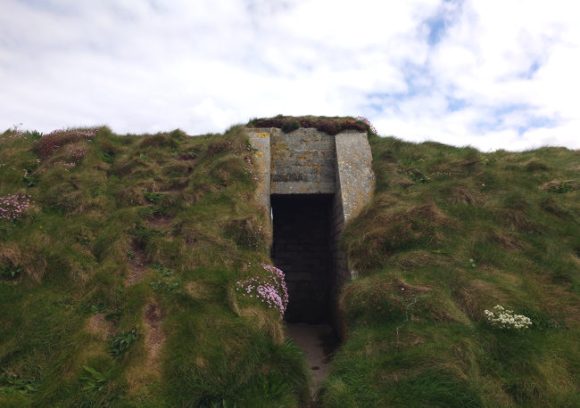
Inside a shelter.
The Spitfire base at Perranporth, Cornwall.

The recent surge in the visibility of fascism and fascist imagery is depressing. It’s become a cliche to say it but here goes: we had a war and settled this a while back, didn’t we?

What I’ve been thinking about lately, in particular, is how that ‘while back’ doesn’t even feel all that far back.

Yes, that feeling is partly a result of my being a relic of the 1970s but, really, you don’t have to look far, even in the leafy suburbs, small towns and countryside of Britain, to see great concrete chunks of World War II just lying around, like tombstones.

I went for a run up and around Purdown in Bristol the other day. My aim was to get to the base of the telecoms tower I’ve been able to see on the horizon for the last few weeks. Once I’d got past that, however, I was amazed to find myself picking a path through what were obviously the overgrown remains of gun emplacements.

Officially known as the Purdown Heavy Anti-Aircraft Battery this site was first militarised in 1939 and the concrete structures were erected in 1940. Locally it was the source of the legend of ‘Purdown Percy‘, a supposedly secret, supposedly massive gun that could be heard across the city.

Fantastic as I found this survival I wasn’t surprised by its existence because, honestly, it sometimes feels like a challenge to go for a walk or ramble without stumbling across something like this.

Spitfire base, Perranporth.

On the Cornish coast in April my other half and I found ourselves diverted through the remains of a Spitfire base at Perranporth — overgrown, yes, but so complete that a Battle of Britain fighter squadron could probably operate out of it by this time next week if need be.

In my home town of Bridgwater pill boxes surround the railway station and line the canal all the way Taunton — brutal brick and concrete structures designed for no purpose other than war and preserved at first, I’ve always assumed, because no-one quite believed the peace would hold with Russia rampant; and then just forgotten about.

Even in London, built on and overbuilt and developed to a high shine, you can still see painted signs on Smith Square pointing to air raid shelters, and the remains of shelters themselves in parks and on side streets. Just look at the Citadel in St James’s Park, as I used to do on the way into work most mornings for about a decade — a bunker so bullying and intrusive, like a beached warship, that it has almost become invisible.

The war is still with us, even as those who remember it firsthand slip away from us.

The war is still The War.

The warning still rings.

Categories
concrete council Somerset Uncategorized

Smiling Somerset

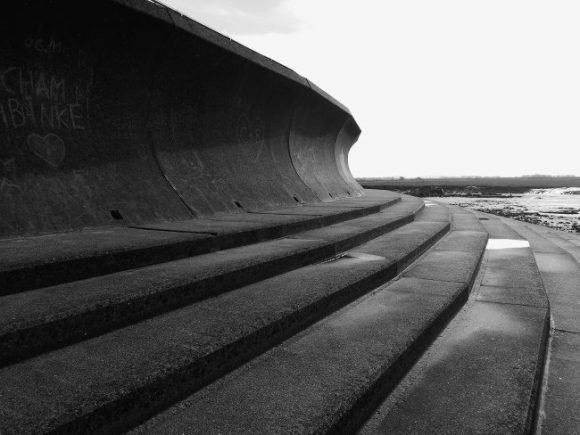
Grey concrete in black-and-white.
The sea wall at Burnham.

When I tell people I’m from Somerset they usually say, ‘Oh, lovely!’ recalling holidays they’ve had. But my home town, Bridgwater, isn’t lovely. I mean, I love it, but it’s a working town, with barely a touch of twee about it.

When I bumped into one of my former A level tutors in a pub in London years after leaving home he described Bridgwater as being ‘Like Barnsley or Bolton dropped into the middle of the rural West Country.’ Someone else once summed it up as ‘a small town with inner-city problems’. And a graffito left in the town centre, on display for many years, was pithier: ‘All this town cares about is fucking carnival.’

I should explain Carnival. It takes place every November and is the town’s pulse — an obsession for many and something of which the town is rightly proud. To understand the scale and drama of the event you can do worse than listen to this excellent episode of The Untold narrated by Grace Dent and produced by Polly Weston which goes behind the scenes of  a friendship rent asunder by competing carnival club loyalties.

One of my favourite things is to make habitually unimpressed sophisticates watch videos of Carnival on YouTube; imagining bumpkins prancing about on the back of flat-bed lorries, their jaws drop when they see the fully illuminated mechanically animated behemoths thundering along in clouds of noise and steam. It is amazing. Barmy, brash, camp, yes, but truly amazing.

Then there are the holiday resorts of Burnham and Weston where the sea is merely a concept, once popular with working class Brummies and northerners who would pass us on the motorway as we headed towards Fleetwood and Blackpool. Again, there was no twee in Burnham, just full-throated fun when there was sufficient booze and sun, or oppressive uniform greyness when there wasn’t.

Wintry scene with morning colours of pale purple and orange.
Frozen nettles on the Somerset levels.

When I started to take myself for long walks as a teenager, it was along the banks of drainage ditches, in the orbit of the sinister Royal Ordnance Factory. However far I walked, I could always hear the sore throat of the motorway and occasionally military aircraft would thunder low overhead. There were pillboxes everywhere, unremarked upon, brutalist cubes in the middle of otherwise pretty fields.

As a young man my council estate conditioning and a comprehensive school cringe made even the most ordinarily pleasant town or village feel intimidatingly posh so that for many years the prettier side of Somerset felt all but inaccessible. It didn’t matter, though, because I liked the flat, grim, gritty, gleefully tacky version that I understood. I never called it a ‘shithole’ like some of the other aloof university-bound kids. I never really wanted to leave.

More recently, fuelled by homesick reading, and with the chip on my shoulder finally beginning to disintegrate as I enter middle age, I’ve begun to explore — to appreciate the nature, architecture and deep history of a place I thought I knew. I’ve realised it’s not all institutional severity — there are orchards, forests, cliffsides, ancient churches and a thousand other delights. And I like that version of Somerset too, even if I still feel like a tourist there.