
Categories
Somerset

Obituary: Alan Newman, a lifelong bluesman from the Somerset Delta

Alan ‘Ginge’ Newman has died at the age of 75 after a lifetime of making and thinking about music.

He wasn’t a full-time musician, however, because like most people he had to work to support his family – that is, my mum, Eileen, my brother, Tim, and me. That he found time to pursue creative interests around night shifts, factory work, warehouse work, and even a stint digging graves, suggests just how strongly that flame burned.

He was born in 1948 at Woolavington on the Somerset Levels to Agnes and Ernest Newman, East Londoners who moved west for military service and war work and never went back. Alan loved Somerset, spoke with a wonderfully warm local accent, and flew a Somerset flag in his back garden until the day he died. Nonetheless, he felt those London roots, which manifested in an occasional imitation of his father shouting “Gertcha!” (via Chas & Dave) and his support for Arsenal.

His childhood was difficult in various ways. First, there was poverty. The Newmans lived throughout the 1950s in a rickety prefabricated house on a council estate appended to a village. He later recalled shivering beneath an Army greatcoat in an unheated bedroom with ice on the windows and he was utterly baffled by nostalgia for prefabs and post-war Britain.

Secondly, there was illness. Not expected to survive longer than a few minutes, he was named quickly by a nurse who borrowed his mother’s initials (Agnes Kathleen) to conjure up Alan Keith. He lived but thereafter spent months in hospital, and years in and out, with an undiagnosed respiratory condition.

Thirdly, there was the challenge of growing up in a family ruled over by a heavy-drinking, gambling, womanising bully whose time in the Royal Navy did nothing to sweeten his manners or temper.

It’s perhaps no wonder that Alan was an unruly child and teenager who drank his first pint of beer in a pub at the age of 12. Though ashamed of it for much of his life he spoke more openly in recent years about his adventures in joyriding and his juvenile criminal record for breaking into the village shop to steal cigarettes. In fact, one of his favourite stories was about returning from a screening of the 1962 film Some People at the Palace Cinema in Bridgwater to find his father furious after a visit from the police.

“Where have you been, boy?”

“In town to see Some People.”

“Oh, yeah? Some People? Well while you’ve been out, some bloody people have been here to see you.”

Though a scholar in his own way – more on that later – Alan didn’t enjoy school and was happier playing sports or, more often, mucking around with a gang of friends. He left Sydenham, the brand new comprehensive in Bridgwater at 15, with no qualifications and went straight into the world of work, where he would remain for 50 years.

He trained as an apprentice coachbuilder for a while, then became part of a demolition crew for Pollard’s of Bridgwater. “If you wanted something smashing with sledgehammers,” he later recalled, “you called the Newman boys.” There was also a stint in the Army which, to his great disappointment, was cut short because he failed a medical examination. (Or perhaps, as he once suggested, because he joined the Young Communist League hoping to meet liberated women, which wasn’t the done thing for people serving in the armed forces during the Cold War.)
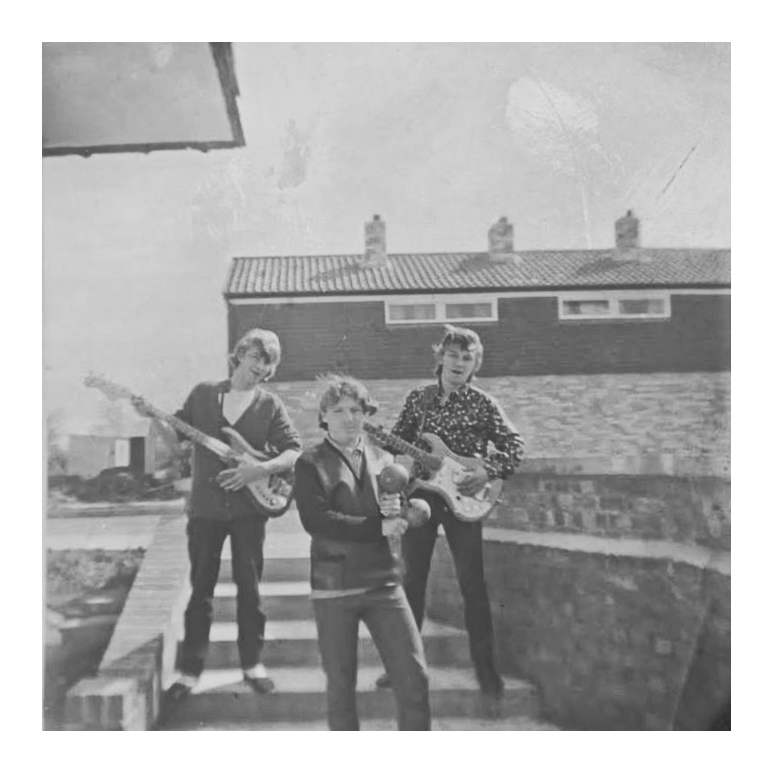
Three young men on the steps of a 1960s council house. One has a guitar, one has a bass guitar, and one is holding maracas. They're dressed in typical 1960s style.
Alan (front, centre) with his brothers in one of the various incarnations of their band Ginger Ellis & the Dracos.

Like many teenagers in the 1960s he also developed an interest in rock’n’roll music and formed a succession of bands. Under a pseudonym he was lead singer and leader of Ginger Ellis & the Dracos. Later, in red velvet flares during the psychedelic era, he fulfilled the same role in The Keystone Kops, who even cut a single with ‘Can’t Stand No More’ on the A-side and ‘The Rise and Fall of a Persian Pig in E-Minor’ on the flip. Alan’s favourite band was The Rolling Stones whose first two albums, filled with R&B, rock’n’roll and blues covers, would form the template for his musical taste for decades to come.

Alan and Eileen met in 1970 in a Bridgwater pub on a busy Saturday night. He was 21, she was 17, and they were engaged by the following Thursday. They married in 1971. Drifting away from his own family he found a warm welcome from Eileen’s parents and the four of them became drinking buddies, chain smoking cigarettes, and playing the four-player card game euchre as they crawled the pubs of St John Street, Eastover, and into town.

Though he continued to buy and play records, loudly, he had less time to make music as he settled into a steady job at British Cellophane. Wading in troughs of solvent without adequate protection no doubt did some lasting damage but, at the time, he was simply happy to be bringing home the kind of money that paid for a house, a car, and a decent quality of life.

It was difficult to have children and took longer than expected. A secret Alan and Eileen kept for decades was that they ended up using the then pioneering technique of donor insemination (DI) via Dr Margaret Jackson’s clinic in Devon. Perhaps he felt embarrassed about this, or felt it to be a failing on his part, but as far as my brother and I are concerned, it shows the sheer generosity of his spirit. He suggested this because Eileen needed it, and committed fully to the experiment. And he was never less than doting as a father, and never gave us the slightest reason to doubt he loved us – which is not always the experience of people conceived through DI. When we learned the truth many years later, Alan’s first concern was whether it changed anything in his relationship with his sons. We were able to tell him that not only had nothing changed but, if anything, we respected and loved him all the more.

A man with curly ginger hair and a ginger moustache proudly displaying a trophy in front of a darts board.
Alan loved to play darts and got pretty good at it as a pub landlord.

In the 1980s, Alan and Eileen took on a decrepit Whitbread pub in Exeter which they ran for several years. Alan had a real talent for engaging with customers and creating a sense of community. His turn as Widow Twankee in the pub pantomime was a surprising success, again revealing an instinct for creativity and performance at odds with his macho persona. Unfortunately, it is and always has been tough to make a living in a tied public house, and the experience bankrupted them.

Alan hated to be unemployed and resented living in a council house, which became necessary in the aftermath. It was in this low period that his dormant interest in blues music resurfaced – perhaps because he was now feeling it in his heart. He acquired a cheap electric guitar, a Gibson Les Paul copy, and tried to learn to play. When that didn’t work, he switched to the bass guitar and realised he had found his instrument. Our house began to throb to the sound of walking 12-bar patterns, or the sparse moodiness of the bass part for ‘Stormy Monday’.

Working long night shifts plus overtime operating a lathe at Wellworthy’s in Bridgwater he had little time and even less energy. Blues bands would form around him, rehearse for a while, then break apart. All the time he kept listening to blues music, reading about blues music, and lecturing anyone who would listen about the career of Muddy Waters, or chord progressions, or the meaning of the obtuse lyrics of 1930s acoustic blues songs. What is a peach-tree man? Alan could tell you. The house was filled with books such as Paul Oliver’s The Devil’s Music. He was often to be seen in the crowd at gigs in Bridgwater, Taunton and further afield, at a time when blues music was a staple part of the offer at pubs and social clubs across Somerset.

As a performer, things finally came together at around the turn of the millennium when Alan met his great friend Les Leiper and they formed the band Witch Doctor. At last, he was part of an efficient gigging band that played most weekends in pubs across the region, with the thump-thump-thump of Alan’s bass providing a steady clock. His proudest achievement was playing multiple gigs at The Old Duke in Bristol, a legendary jazz and blues venue where he’d previously seen some of his own favourite bands perform. When Alan eventually left Witch Doctor it was partly because, being a man of his time, he was unable to express his frustrations in words. Quitting was the easier option.

In the years that followed, he joined or formed many more blues bands, each one with its own unique style and set list. The Blue Healers, for example, gigged in Bristol and elsewhere. Alan’s problem was that he wanted to play blues music, and nothing but blues music, and, inevitably, most bands would start to talk about adding soul or classic rock tunes to the set. ‘Mustang Sally’, though a fine song, did not belong in the repertoire of a blues band. Nor did ‘Sweet Home Alabama’. Again, although he got better at having these conversations, he would often simply leave rather than deal with conflict or awkwardness.

Alan retired from his final job as a warehouseman at 67. He’d been doing heavy, physical work for most of his life, and his body had begun to creak. His lungs, never quite 100% functional, began to fail him and he was diagnosed with both asthma and chronic obstructive pulmonary disease (COPD). You can’t help but wonder about all those jobs – demolition in the era of asbestos, factory work with baths of solvents – and the cold dampness of his childhood home. Still, in retirement, with two beloved dogs, he started to get fit, rambling with Eileen over the Mendips and across the Levels.

Both being village kids, at heart, they moved to the country, settling in Rooks Bridge. He would stand and stare at the landscape, listen to the birds, and relish the fresh air. His bands sometimes rehearsed in a nearby stable, or in the kitchen at the house, and the neighbours would turn off their TVs to listen.

During the pandemic his lung conditions put him in a high risk category and was effectively trapped in the house for several months. This did him no good and he emerged from successive lockdowns seeming suddenly much older and far less robust. A chest infection in 2023 never quite cleared and dragged him down for over a year. Finally, in August 2024, it got him. He died while receiving care at Weston General Hospital, not long before dawn.

That urge to make music, and to create, was with him until the end. Shortly before he went to hospital for this final stay, he started talking about recording a podcast, and also snuck an advert onto Facebook when Eileen wasn’t looking: did anyone want to form a blues band for some low key rehearsals?

Alan Newman, born November 1948, died August 2024.

Categories
history Somerset

The Ghost Factory

Growing up in the shadow of the British Cellophane factory in Bridgwater, Somerset, I often heard stories of its ghosts.

The factory opened in 1937 as a joint project between the French firm that owned the rights to the process for mass-manufacturing cellulose film and British textile company Courtaulds.

It was built on fields next to Sydenham House, a 16th century mansion with its own stock of strange tales as recounted in Berta Lawrence’s 1973 book Somerset Legends. The Duke of Monmouth, she suggests, haunts a bedroom where he is said to have stayed (‘said’ always being a danger sign in such stories) before the Battle of Sedgemoor in July 1685. The room overlooked an oak tree, and some years later a member of the Perceval family was lifted by “some invisible spirit out of the chamber beyond his window-bars and, by levitation, set in the oak’s branches”. The house was also the scene of violence during the peasants’ revolt of 1381.

In the 20th century, the house was used by Courtaulds for corporate hospitality and, beyond the security boundary, hidden behind foliage, attained semi-legendary status among local children. I was taken to the garden once as a child, on a hot but darkly overcast day, and found it unsettling – the perfect setting for a timeslip.

I spent most of my childhood living within five minutes’ walk of the factory and its famous stink – it was often called ‘Smellophane’ – and my father worked there in the 1970s and 1980s, as did the parents of many of my peers. Every Thursday morning, as I was walking to school, they’d test the emergency sirens, adding to the collective sense of Cold War dread.

The first person to tell me a ghost story about the factory was my childhood best friend whose father worked in the section of Courtaulds dedicated to the production of non-woven synthetic fabrics. I asked my friend if he remembered what he’d told me all those years ago and his reply (edited for clarity) was as follows:

Late one night Dad saw someone in a checked shirt at the end of the production line. There wouldn’t have been many people about at that time so he went to investigate but the person had gone and the only door nearby was locked. The bloke couldn’t have gone anywhere else. It turned out someone from the other shift had died in just that spot (drowned, I think, in a cooling tank, or dragged under the rollers) and had been wearing the same clothes as the figure Dad saw.

As an 8-year-old I’d simply enjoyed shuddering at this story but I find myself wondering today if his father – quite a joker – might have been teasing him. My friend thinks not: “Mum said he was absolutely convinced at the time and quite shaken.”

I also remember a variant of this ‘drowned in a vat’ tale told by another school contemporary: a figure spotted on a high gantry, then apparently falling from the edge into a tank; emergency services called, the vessel drained, but no body found.

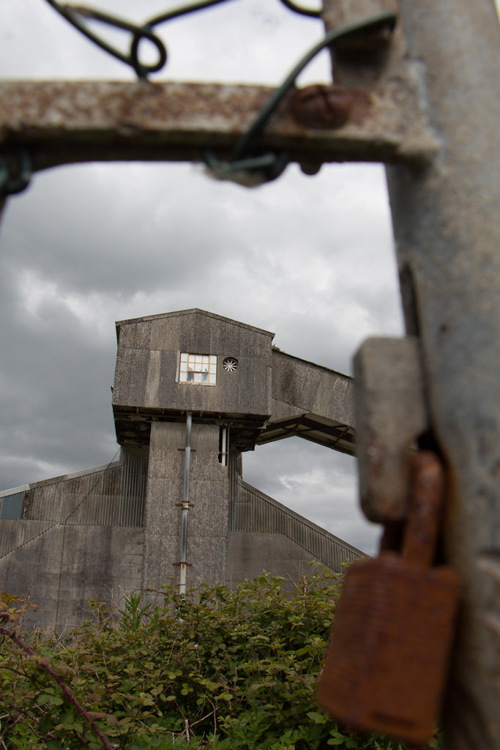
Adapted from ‘British Cellophane’ by Noel Jenkins, via Geograph, under CC BY-SA 2.0.

I asked my own father if he’d ever found working on the site unnerving. He talked at length about the general twitchiness of factory life, especially working nights, practically alone in vast, echoing spaces, and the long stretches of boredom between bouts of strenuous labour. But as to specifics, he said:

The only experience I had was of something that passed through a corridor. It might have been that somebody opened a door and it was a cold chill or something… It was weird. It wasn’t something I saw, just felt.

My younger brother suggested I get in touch with a friend of his who worked on the site in its final years, who wrote:

[One] of the machines there, called C2, killed a guy back the 1970s and it was definitely creepy in that area. [He] was pulled into a huge heated steamrolling press. [There was no] reverse mechanism and the firemen had to sledgehammer the machine apart to peel him out.

With prompting, Dad recalled a similar story from British Cellophane – strangely similar, you might say – about an operator who got cocky while threading a length of film through the moving parts of a machine. He was pulled into the workings and then when the machine reached full speed it “tore his limb right from his shoulder, voom! He Dropped dead.”

My suspicion is that these were scare stories, garbled and embellished as they spread, perhaps intended to reinforce the importance of safety procedures, or merely to wind up new recruits. The arm-ripping incident my father recounted of course happened ‘a few years’ before he joined the firm, like all good urban myths.

It’s hard to prove that something didn’t happen but I can say that I have not been able to find any record of any events like these in newspapers, even though relatively less gruesome accidents at the factory were reported. A painter died during construction of the plant; a laboratory apprentice fell from a landing stage with no barrier and later died; a foreman dropped dead while walking along a gantry; and Raymond Culverwell set a legal precedent when a truck crushed his leg: being late back from his tea break, the Court of Appeal ruled, he was not entitled to compensation. Gruesome limb-tearing and crushing incidents at other industrial sites were frequently covered so the press were clearly interested.

After a version of this story first appeared in Fortean Times in 2018, however, I heard from Gavin Hogg whose grandfather, George Rogers, worked at Cellophane in the 1950s and 60s, and died there in 1963. He asked his mother for more detail:

He was killed in an accident during the night-shift (22:00 – 06:00) and she writes that he was on his own at the time (I don’t know if she means just in the immediate area, or the whole factory). The official inquest verdict was death by misadventure.

There was no compensation or any financial help for my grandmother and her two daughters – my Mum would have been 21 at the time and her younger sister would have been around 16-17.

Mum says that the factory destroyed all the evidence after the accident and changed the machinery.

A little digging turned up an account of the inquest from June 1963, which set out the details: at about 5am, Mr Rogers was alone, his colleague having stepped outside for a few moments, and accidentally put an amount of vinylidine chloride into a hot vessel rather than a cool one, whereupon it instantly vaporised and gassed him to death.

Again, no falls into vats, or torn limbs, but this does echo my own father’s explanation for the uneasy atmosphere in the factory, which is simultaneously more down-to-earth and scarier than any ghost. The premises was, he says, often dense with chemical fumes, and he would frequently find himself wading in pools of toluene, a liquid solvent known to cause hallucinations. It’s easy to see how that sort of thing might combine with the disorientation of shift work, and those grim shock tales, to generate paranoia, confusion and even strange visions.

Though none of that, of course, explains how Perceval got into the oak tree.

Categories
Somerset

West Country Stereotypes #1: Chewing Grass

A woodcut of a rural type.
By William Nicholson, 1898.

An outstretched hand brushing the stalks until, yes, this one, and then a soft snap. Tidy it up first, nipping it off with a thumbnail at the thick part above the knee; then stripping away the sheath to reveal the brighter green inside; and, finally, trimming straggling lower seed spikes to leave a neat arrowhead. It is ready.

When Jarge Balsh, the comic hero of William Jones’s once popular Somerset bumpkin stories, first appeared in 1925 it was with grass in his mouth:

One did not need to be a Sherlock Holmes to realise that he was connected with the agricultural industry. His boots and leggings were generously plastered with samples of the usual contents of the farm-yard, whilst to his slouch hat and old bottle-green morning coat there still adhered strands of hay…. Halting before me, and spreading his legs, he thrust his hands deeper into the cross pockets of his corduroy breeches, and changed the straw he was sucking to the other side of his mouth…. “Be you the young gent as is gwain ta bide wee widder Toop? ‘Cos if ye be, I be come vor ‘ee.”

The depiction of Balsh on the title page of the book cemented the image:

Jarge Balsh, 1926.

The prepared rapier of grass lightly bridges the lower teeth and lip, its feather-duster-head in the distance bouncing with each step, shaking its hair. Chewing the stalk destroys it quickly so instead it is held gently in place by the jaws and worked by the tongue like a rudder, pulling it in to make the seedhead swing out, and pushing it out to bring the brush swishing back to the centre. Relax the jaws and it droops; thrust the lower jaw out and the grass comes up to eye level. Up, down, left, right, swish, swirl – simple but absorbing.

Along with tractors, cider and smocks, the chewing of grass crops up over and over in lists of West Country stereotypes, often in the defensive form “There’s more to Devon/Somerset than…” There’s some embarrassment perhaps in the idea of being seen to ruminate dumbly, further evidence of the supposed animal stupidity of the bumpkin.

And yet it doesn’t take much to work out that chewing grass is a habit claimed, or disclaimed, by rural communities all over the country, and indeed around the world. Grass is not, after all, a scarce commodity, and the urge to nibble on it, I would say, is very nearly instinctive.

Eventually the bruised stalk begins to release its sap in the mouth – a bitter, raw taste that has a strange effect on the other senses. With a length of grass in the mouth birdsong seems louder, while traffic sounds diminish. The aroma of wildflowers intensifies. This is the easiest, cheapest, most innocent of psychedelic experiences.

I don’t believe chewing grass is something we, or anyone, should feel defensive over, or self-conscious about, whether alone on a quiet lane, or among the faux-rurality of the unkempt meadow-land in Hyde Park, sick for home.

Paul McCartney
Paul McCartney By Barry Lategan, 1969, via Paige Sterling.

There is no more sap, no more structure – the grass has become tasteless and is nearing collapse. Take it out, throw it away — it doesn’t matter, grass is free — then stretch out the hand, brush the stalks, until, yes….

Categories
Somerset

Impressions of Weston-super-Mare

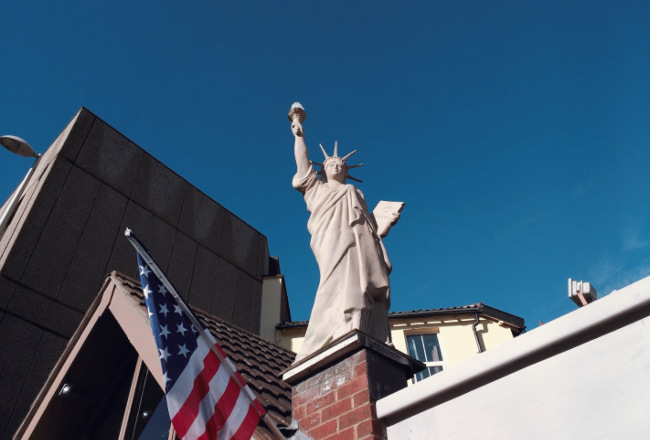
Statue of Liberty

My snapshot image of Weston from childhood is of great, clean whitewashed walls weaponised by the sun.

Blackpool was seedy – knickers for a nicker, pants for a pound, and drunks scrapping in the street – and Burnham-on-Sea was boring. But Weston… Weston was glamorous. Squint and you could be in Miami, or Nice. It was the posh seaside.

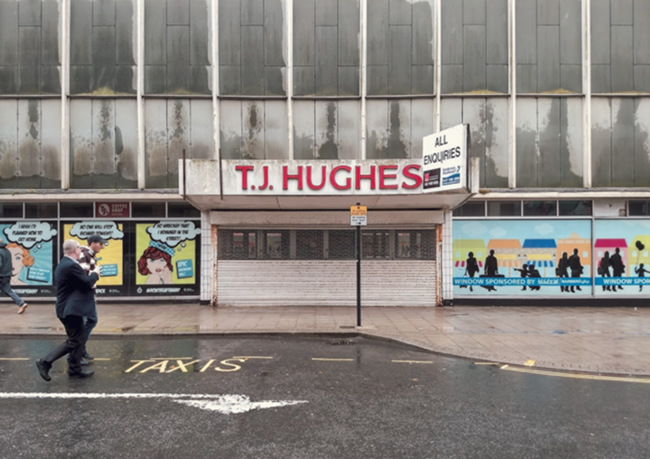
Revisiting it in 2018, especially on a rainy day, lifts the spell. There is more grey and more dereliction than I remember, and a sense that Weston’s problems – the same problems afflicting many towns – are breaking through its plaster façade.

Abandoned retail unit streaked with rain.

Though it may seem less pristine than 30 years ago, however, I find in it greater depth and detail as an adult.

Victorian back street building.

Alleyways and back streets reveal Victorian details, ghost signs, beerhouses and post-modern oddities.

Abbey National logo on wall.

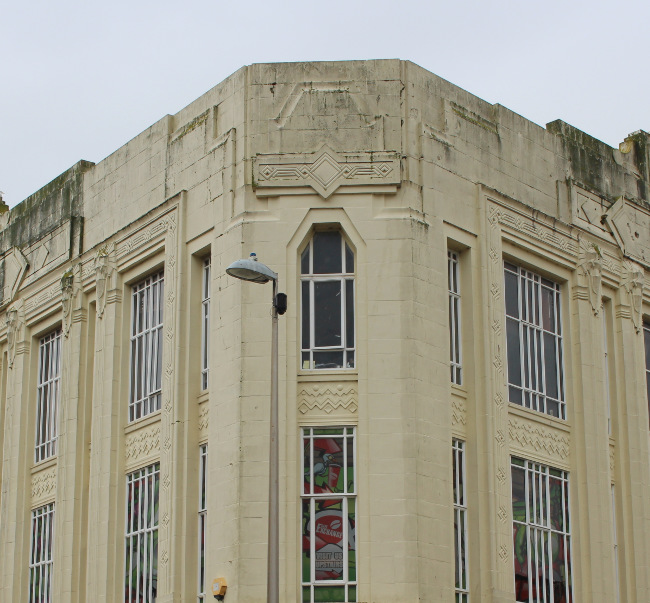
There’s Art Deco.

ODEON cinema. Former Burton's building. A house near the station.

There’s plenty of post-war modernism.

Post-war church.

Post-war mosaic tiling.

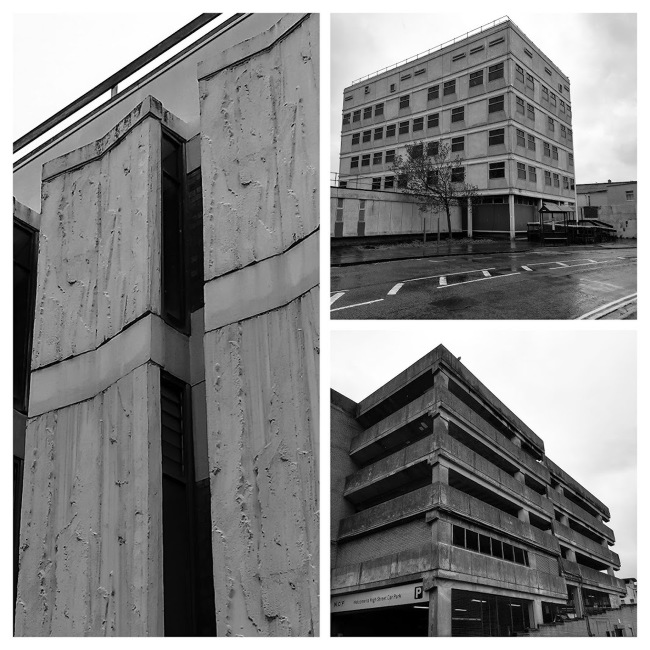
And concrete brutalism.

Collage of brutalist buildings.

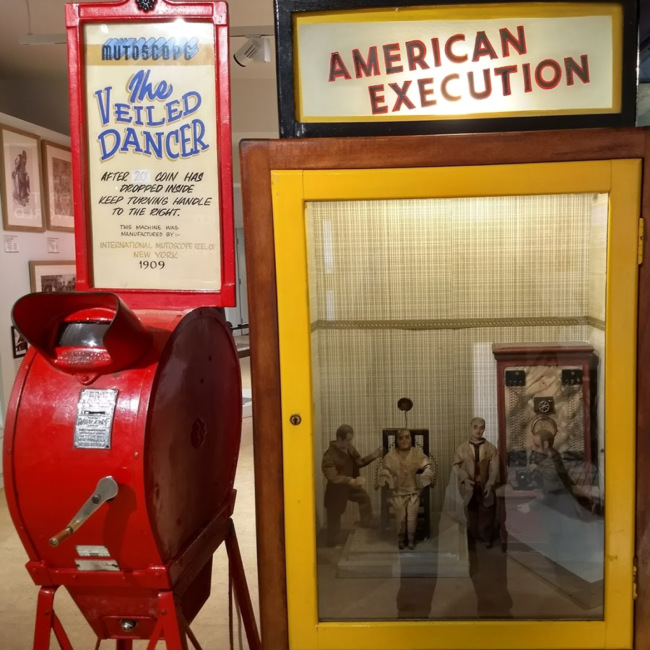
The museum, recently reopened, is small but dense: look down on an architectural model of a post-war Weston that never was; feed 20p to the What the Butler Saw machine and watch the imprisoned ghost of a long-dead dancer perform with a length of silk; and place a hand on a stretch of railing from the old pier where millions of fingers sticky with ice cream and rock have been before. The narrative also does a good job of bringing home the extent to which Weston was Blitzed – something that surprised me, and which helps explain some of the buildings above.

Amusement machines. Architectural model.

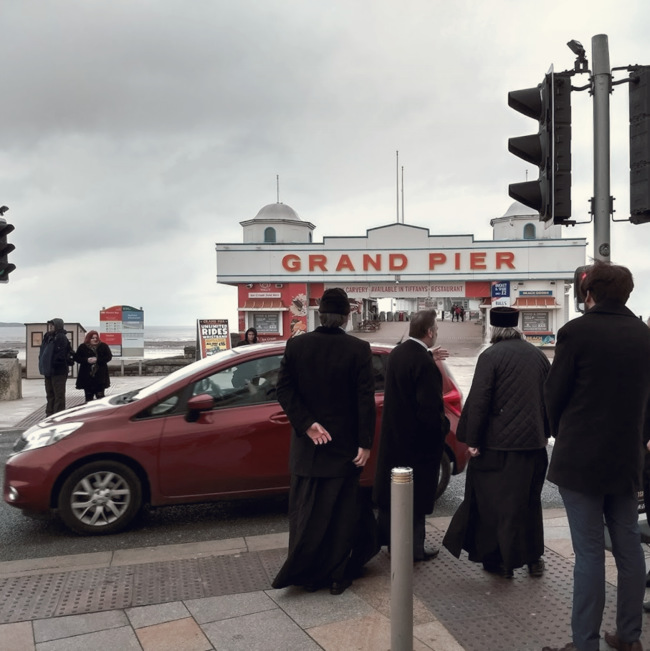
The pier is good, even in its post-2008-fire incarnation: worth walking up and down three or four times for the thrill of feeling truly at sea, and a little nearer mysterious Steep Holm.

Priests near a pier.

And there are memories. Having thought it long gone I stumbled upon Revolver Records the very smell of which – tobacco, damp, worn-in leather jackets – transported me back to standing at my Dad’s side as he flipped through racks of vinyl looking for who knows what.

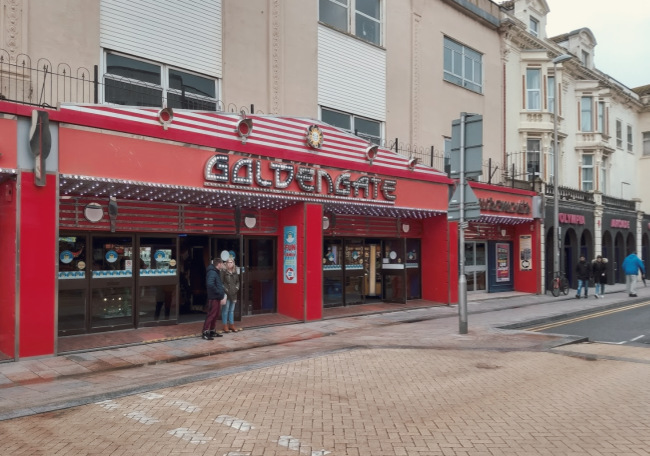
Amusement arcade in red.

And I approached the Golden Gate amusement arcade from just the right angle to trigger a specific recollection: coming to Weston in about 1992 with the express purpose of experiencing virtual reality. At 14 I’d read William Gibson, was buying Wired most months, and fancied myself quite the cyberpunk in my Hi-Tec trainers and generic sweatshirt from Highbridge market. I went with two friends and we had to queue for about 20 minutes to pay £1.50 each for five minutes play time on a supposed combat flight simulator that actually consisted of a nausea inducing field of blue (sky) and green (ground) with occasional blocks of grey jerking across it.

I’m glad I now live near enough to Weston to visit whenever I like. I suspect there’s plenty more to find yet.

Categories
concrete council Somerset

A Place Called Nowhere

Until I read the below passage in a 1945 edition of the Taunton Courier it had never occurred to me that the place where I grew up had once been nameless.

Regarding Eastover housing scheme, it was reported that the Minister of Health agreed in principle to the proposal to acquire 75 acres of land between Bath-road and Weston Zoyland-road. The District Valuer was instructed to negotiate for acquisition of the land, and it was decided that the site should in future be referred to as the Sydenham Estate. [1]

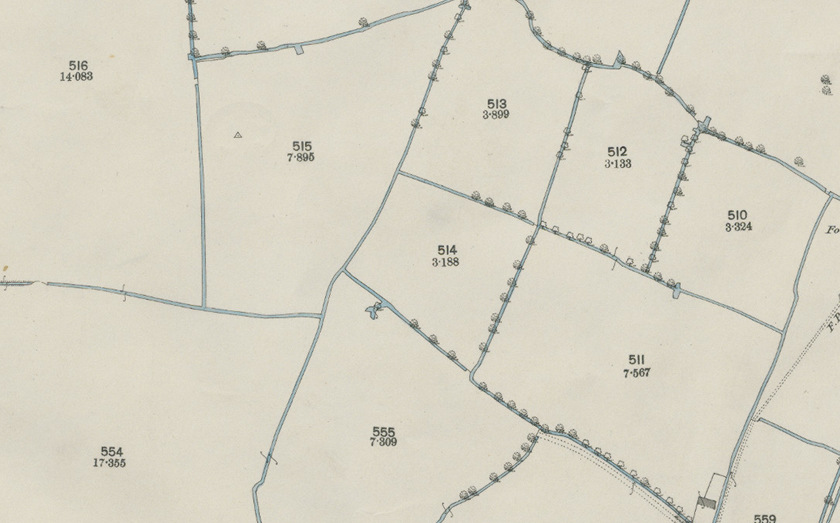
Not a place, then, but a void between places, and that’s certainly how it looks on historic maps of Bridgwater:

A map of field patterns.
SOURCE: Know Your Place West.

But maps, and especially this type of administrative map, do tend to reduce anything but the densely urban to an off-white nothing. The abstract above – that snow drift and irregular fishnet – actually represents a pattern of fields stretching out behind Bower Farm. (The buildings of Bower Farm were demolished years ago, swallowed up by another estate – private, this time – and on its site are now a shopping arcade with a Tesco Metro and a Chinese restaurant.) Thought not named on the map I’d bet anything those fields were known as Bower Fields, even if the mapmakers didn’t know it.

Bower Estate would have been a good a name for the council development that grew there in the 1940s and 1950s but instead it took its name from the Manor of Sydenham, on the other side of the main Bath Road.

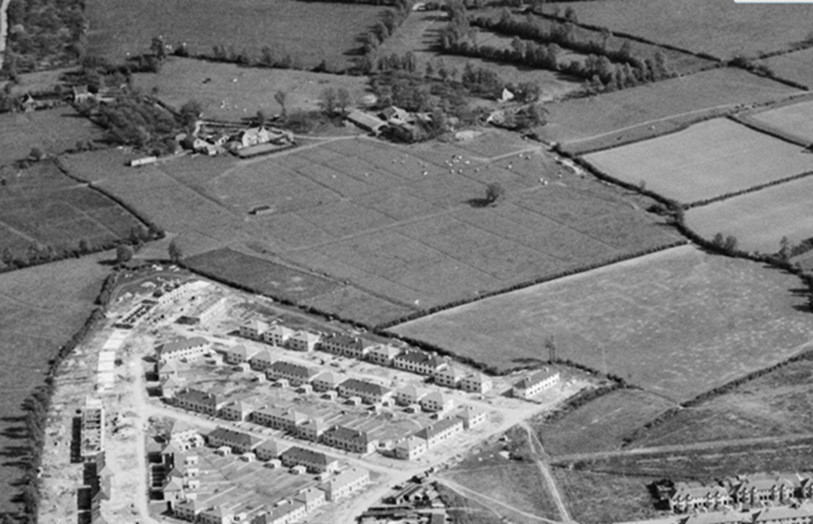
1947 aerial photo in black and white.
Bower Farm (rear) and the first houses on the new Sydenham Estate, 1947. SOURCE: Britain from Above.

The present Sydenham House was built c.1500 for the Percival family. It was marched past by the Duke of Monmouth on his way to the fateful Battle of Sedgemoor in 1685, and was later the site of a noted incident of nocturnal levitation, but otherwise sat quiet and alone in the flat landscape. Then, in the 1930s, Bridgwater burst its boundaries and the British Cellophane factory was built on land adjoining Sydenham House. Trapped in a no-mans-land between this huge new development and the railway line the house became inaccessible and invisible, and was largely forgotten. The name lingered, though, having been given to Sydenham Terrace, a row of red-brick workers cottages built in 1865, and to the grander Sydenham Villa.

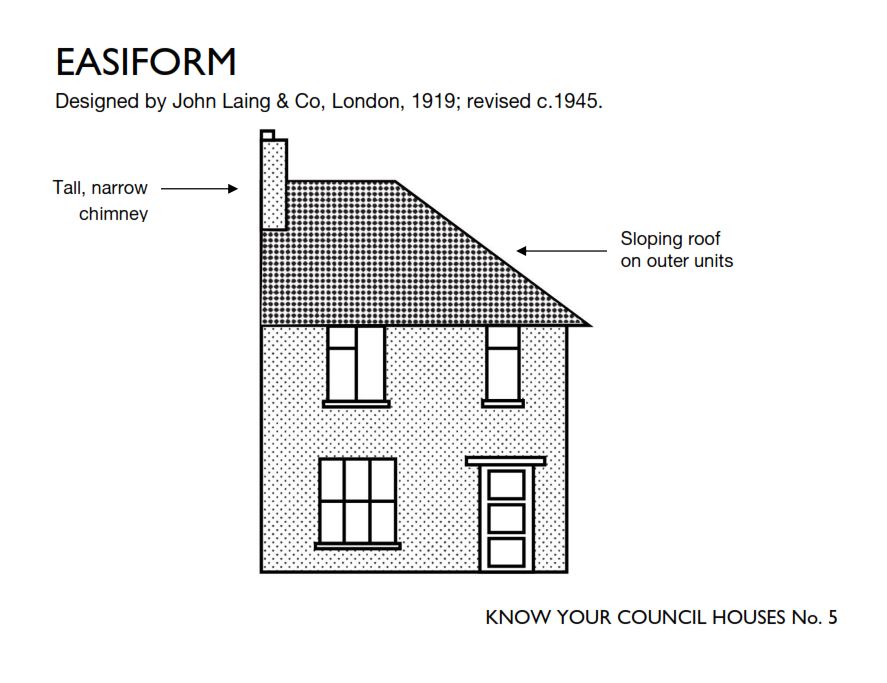
Oh, yes – brick. Bridgwater was a brick-making town, and the West Country a brick-making region, and the fact that the houses at this new place, the Sydenham Estate, were to be built in concrete caused some controversy. BRIDGWATER WANTS BRICK HOUSES read one 1948 headline [2] and the town council were repeatedly criticised for failing to take advantage of a supposed 10 million local bricks ready for use. Not Bridgwater bricks, though, replied the council, and anyway, where are the bricklayers to turn them into homes? [3] The town wanted to build 2,000 houses, public and private, as quickly as possible and there was no room for sentiment. [4]

Drawing of a council house.
SOURCE: Me.

Perhaps this was a mistake. A place being created from nothing, in the middle of nowhere, literally on the wrong side of the tracks, could have used something to tie it to the town of which it was supposed to belong. As it was those Laing Easiform and Cornish Unit concrete houses not only seemed alien but were also the same as thousands of others up and down the country, which meant the Sydenham Estate could have been anywhere. Shown photographs with only the name for a caption, wouldn’t most people guess that it is in south London? Later on, in the late 1950s, when permission was given for a brewery to build a pub on the estate, magistrates quietly objected to the suggested name, The Lorna Doone. It was changed, accordingly, to The Withy Cutter in reference to the Somerset levels willow industry. [5] Too little, too late.

Drawing of a council house.
SOURCE: Me.

When Sydenham really became a place, it was defined by negatives. It was referred to on the news as ‘the troubled Sydenham Estate’, and my peers called it The ‘Nam. This was a self-deprecating joke – it was hardly South Central Los Angeles – but also reflected a low-key ghetto mentality. We’re stuck out here together, us versus them, and it’s a combat situation. Who ‘they’ were depended on context. Within the estate, Sydenham Road and Longstone Avenue had a wary rivalry, each convinced the other was a no-go area; and the Sydenham Estate as a whole was set against the Hamp Estate on the other side of town, where we kids were warned never to go. (Of course when I did go, I found a twin – approximately the same kinds of houses, an exact clone of the shopping arcade, and a secondary school which looked like an off-kilter version of mine.)

But Sydenham, barely baked, seems to be fading away. Sydenham Villa, on the other side of Bath Road from the estate, was demolished as long ago as the 1950s. In around 1991 my secondary school ditched the doubly toxic Sydenham Comprehensive label in favour of ‘East Bridgwater Community School’. Then, in 2011, Sydenham ceased to exist as a council ward, replaced by Fairfax and Dunwear, two new wards that split the estate through the middle and effectively deny its existence. Estate agents marketing houses in the area tend to refer to them as being “on the east side of town” or, even more vaguely, “a popular residential location”. I wonder if this place, conjured into existence in 1945, will make its hundred years.

1. 6 October 1945, p.5.
2. Taunton Courier, 4 December 1948, p.3.
3. Taunton Courier, 5 January 1946, p.6.
4. Taunton Courier, 6 October 1945, p.5.
5. Taunton Courier, 29 March 1958, p.8.

Categories
bristol Cornwall Devon Dorset history Somerset west country

Rogue One: The Strange Career of Bampfylde Moore Carew

Bampfylde Moore Carew.

A thief, conman, beggar, trickster, adventurer and teller of tall tales, Bampfylde Moore Carew is the most famous West Countryman they never tell you about in school.

I first learned of his existence in a book called Somerset Legends by Berta Lawrence, published in 1973. I bought a copy for 10p in a sale of cancelled books at Bridgwater Library when I was about 13.

Reading this was the first time it ever occurred to me that my home county might be anything other than rather flat and rather dull, and I took the book away with me to university, and then to London, as an antidote to homesickness.

Now, thanks to the magic of online book archives, I’ve been able to go back to Ms. Lawrence’s source, namely a book called The Life and Adventures of Bampfylde Moore Carew, published in 1745.

We would probably now recognise it as having been ghost-written for Carew by one Robert Goadsby, though its status as autobiography-biography, or perhaps even a form of picaresque proto-novel, remains muddy.

It is almost certainly a pack of fibs built around some kernels of truth, but was nonetheless a bestseller in its day and reprinted, with further embellishments, many times in the century that followed.

Here’s the story it tells, as the precursor to the embroidered gangster memoirs of today, with a few details taken from other sources, and quotations taken from this Project Gutenberg version of an 1850s reprint.

Carew was born in July 1693 in Bickleigh, a village near Tiverton in Devon. His father was the rector of Bickleigh and his family was well-to-do.

He was sent to Blundell’s, the famous West Country private school, at the age of 12, but (according to his own account) ran away rather than face punishment for tearing up farmland with his horse-riding hunting pals and a pack of hounds.

And this is where his life got interesting.

He joined a band of gypsies and made a living with them through trickery and petty crime. As a well-spoken, gentlemanly figure he was uniquely well placed to win over respectable folk and relieve them of their money, as in the case of Mrs Musgrove of Monkton just outside Taunton, in Somerset. (Now best known for its garden centre – such romance!) She called on young Carew having heard that he was an expert gypsy-trained treasure diviner. 

When he came, she informed him that she suspected a large quantity of money was buried somewhere about her house, and if he would acquaint her with the particular place, she would handsomely reward him. Our hero consulted the secrets of his art upon this occasion, and after long toil and study informed the lady, that under a laurel-tree in the garden lay the treasure she anxiously sought for; but that her planet of good fortune did not reign till such a day and hour, till which time she should desist from searching for it; the good lady rewarded him very generously with twenty guineas for his discovery.  We cannot tell whether at this time our hero was sufficiently initiated in the art, or whether the lady mistook her lucky hour, but the strict regard we pay to truth obliges us to confess, that the lady dug below the roots of the laurel-tree without finding the hidden treasure.

This is a classic con-man story in which the mark positively asks to be ripped off because of her greed, and her stupidity — perhaps one of the earliest in print?

Eventually he was convinced to come in from the field and return to Bickleigh where he was welcomed with tears of gladness and the ringing of church bells. But having had a taste of freedom and adventure, he got bored and went back to the gypsies, via their camp at Tiverton, and set out on a new phase of his career: he became a fake shipwrecked seaman.

Our hero’s wit was now set to work, by what stratagems he might best succeed.  The first that occurred to his thoughts was that of equipping himself with an old pair of trowsers, enough of a jacket to cover his nakedness, stockings such as nature gave, shoes (or rather the body of shoes, for soles they had none) which had leaks enough to sink a first rate man of war, and a woollen cap, so black that one might more safely swear it had not been washed since Noah’s flood, than any electors can that they receive no bribes.  Being thus attired, our hero changed his manners with his dress; he forgot entirely his family, education, and politeness, and became neither more nor less than an unfortunate shipwrecked seaman.

He learned the jargon and the manners of a sailor and in this persona conned multiple people out of “a considerable booty”, before reinventing himself again as a simple Kentish farmer who had lost his cattle in a flood:

His habit was now neat but rustic; his air and behaviour simple and inoffensive; his speech in the Kentish dialect; his countenance dejected; his tale pitiful—wondrous pitiful; a wife and seven helpless infants being partakers of his misfortunes; so that if his former stratagem answered his wishes, this did still more so, he now getting seldom less than a guinea a day.

Next, he adopted the persona of Mad Tom, a half-naked lunatic, roving the countryside and observing human nature, learning more “than most of our youths who make the Grand Tour”.

Carew the trickster disguised as a ghost at South Molton, Devon.

From Dartmouth in Devon He travelled to Newfoundland where he acquired a “fierce and large dog” and stayed just long enough to learn enough about fishing and sailing to take his shipwrecked mariner act to the next level.

On his return, via Newcastle, he fell in love, eloping with one Miss Gray, marrying her in Bath, and settling in Bristol, where they turned heads with their dandy dress.

Going back on the road, he impersonated a clergyman to prey on Quakers; developed a wheeze whereby he would turn up anywhere there had been a notably large fire and pretend to be a survivor, with a singed hat for evidence; and strapped himself up to portray the part of a one-legged beggar.

Circling back to Bristol, he pretended to be the son of a Newfoundland gentleman whom he vaguely resembled, lately arrived in England and in need of credit on clothes and provisions.

On one occasion he witnessed a shipwreck off the Dorset coast and had the presence of mind to strip and fling himself into the surf to be rescued as a survivor or, as he tells it, to attempt to rescue one of the crew like some kind of superman, only to be quite innocently mistaken for a member of the ship’s crew.

Eventually, all this caught up with him and he was arrested at Barnstaple in Devon, and taken to court in Exeter, from where he was transported to Maryland in the American colonies.

You might think this was the end of Carew’s West Country career but, no, he somehow escaped custody, convinced some Native Americans to remove his irons, and made his way back to England via Philadelphia, New York and various other fascinating places out of the scope of my project.

A parade of convicts.
British convicts in chains ready for transportation, via Early American Crime.

He carried on where he had left off (shipwrecked sailor act, turban-wearing Greek, French smuggler, Presbyterian parson, and so on), got caught again, and sent back to Maryland, from where he escaped a second time. (If he was making this up, he could have done with a firmer editor – who would invent this repetitive narrative structure?)

In the third and final phase of his career as a conman he tried some bigger schemes, such as convincing a group of his school friends to join him at St Matthew’s Fair in Bridgwater, Somerset, in the guise of a group of crippled, deaf, dumb, blind beggars. The mayor, though, suspected the trick and had them thrown in prison for vagrancy, but contrived to let them escape so that he could see which of them broke into a run on leaving their cell and then re-arrest them on more serious charges. (This sounds like something from one of the sillier spaghetti westerns to me.)

Although the book presents all of this with a sort of smirk, and its sales are evidence that people found Carew’s antics to some degree charming or at least entertaining, his admitted tendency to prey on the bereaved is simply grim.

For example, he tricked a man whose son had died at sea into giving him money in exchange for a supposedly first-hand account of his death and burial, which of course Carew knew nothing about that he had not learned from gossip around the village.

In another instance, at Buckfastleigh in Devon, he got an accomplice to dress as a victim’s dead grandmother as part of another ‘hidden treasure’ con:

In order for the execution of this scheme, Coleman put a woman’s cap on his head, washed his face, and sprinkled meal on it while wet, stuck the broken pieces of a tobacco-pipe between his teeth, and wrapping his body in a white sheet, planted himself in the road that Collard and Mr. Carew were to come; the moon at this time shone very bright, which gave an additional horror to the pretended spectre.  Our hero, by virtue of his supposed profound learning and most mysterious science, spoke to it in an unknown language, to the following effect:—“High, wort, bush rumley to the toggy cull, and ogle him in the muns;” at which command the terrific hobgoblin fiercely advanced up to poor Collard…

But this couldn’t go on forever and eventually, having made a small fortune.

Growing old and ill, Carew retired to a cottage in the West Country, published his memoir, and died in 1759.

Categories
food Somerset

The Famous Bridgwater Manchip

Bridgwater Famous Manchips

I ate my first manchip when I was around 8-years-old.

Dad pulled up outside in the sky blue Cortina and came running into the house – actually running — holding a paper bag transparent with hot grease. He was shiny-faced with excitement, a rare occurrence in those days of night-shifts, money troubles and headaches.

“Manchips! Bloody manchips!”

He said it as if my brother and I should know what a manchip was.

We, thrilled to see Dad thrilled, couldn’t wait to see what was going to emerge from the wrapping.

“Ooh, ow, hot, Jesus wept!” he said, throwing the thing from hand to hand.

This was why he’d been in such a hurry: the manchip, we learned, is a dish best served dangerously hot.

There were two in the bag; my brother and I got half each.

What we were presented with was a pocket of flaky, rolled pastry filled with semi-molten jam and dusted with granulated sugar. It was lardy and not especially sweet, the jam a mere smear. It was, frankly, a let-down after all the hype but we played along and ate up while Dad, apparently reverting to childhood for five bites, made yum-yum noises and licked jam off his factory-scarred fingertips.

Perhaps we confessed our disappointment or maybe Dad just guessed but, either way, I never saw another manchip. That is, until December 2017, with my 40th birthday looming, when I made a return trip to the old home town.

Walking up Cranleigh Gardens and waiting to cross St John Street I saw a chalkboard sign outside Judith’s Bakery: “Bridgwater Famous Manchips Sold Here”. Bridgwater’s famous manchips? This being the 21st century I Googled it while I waited for the lights to change and was astonished to read that, yes, the manchip is Bridgwater’s own contribution to the culinary catalogue.

The origins of the manchip, like those of most even slightly interesting things, are vague. They are sometimes also called ‘manchits’ or ‘manchets’, and the Oxford English Dictionary traces the similar ‘manchet’, meaning fine wheat bread, back to the 15th century.

A more obvious Bridgwater connection occurred to me, though: I was at school with several Manchips, and the Manchip or Manship clan has been a prominent one in Bridgwater for a couple of centuries. In fact, if you look up distribution of the surname Manchip in 1881 you find that every single one, give or take, lived in Somerset.

Nobody seems to have pinned down the exact origins of the Bridgwater manchip though Glyn Hughes has tracked down a 1938 reference to lardy pastries using that name which would seem to demolish the popular myth that it was a response to rationing during World War II.

Armed with the variant spellings I was able to find a tantalising reference to ‘french rolls and manchets’ in the precis of an 1885 book about St Mary’s Church in Bridgwater and (this is a bit complicated) an 1899 letter to the Taunton Courier in which a correspondent recalled a Taunton baker, Mr Betty, “famous for the excellence of his breakfast manchips” (20/09). Perhaps most useful, though, is this letter to the Taunton Courier printed on 22 June 1946, which contains reference to the foodstuff itself:

The reference to Manchets in last week’s Herald carried my memory back 50 or 60 years to the days when small boys went through the streets of towns in this part of England very early in the morning, crying “Hot Rolls and Butter Manchets” or “Buttered Manchips” or “Buttery Mansions” or some other variation of the last two words. These Manchets, Manchips, or Mansions were a plain kind of flat dough cake, or tea cake, kept hot, cut open and buttered for breakfast…. [As] far as my memory serves me they were eaten in my young days only, or at any rate mainly, at breakfast time.

That’s odd, isn’t it? No jam. Not notably lardy.

I’m going to keep looking for more information but here’s my current assumption: ‘manchip’ was being used to describe a kind of fancy roll in Somerset during the 19th century but its use dwindled until it was reinvented during or after World War II as something sweeter and more pastry-like.

Regardless of its origins, my second ever manchip, eaten hot on the platform at Bridgwater station as I waited for a train back to Bristol, was delicious – fat slicking the tongue, just enough fruit acid to tame it, and flakes of pastry falling like gold leaf around my feet. Once I’d dusted myself down and wiped my fingers on the paper bag, I knew I owed Dad an apology.

Categories
Cornwall history Somerset west country

High Times Out West

Illustration: Strummer, Coleridge, the Star Inn and Glastonbury Tor
Incorporates an image of Joe Strummer by John Coffey under Creative Commons.

It is it any wonder that the West Country, with its yin-yang of boredom and tranquillity, its distance from authority, its big skies and mystic tendencies, might have a drug habit?

A few months ago I was at my desk in Penzance (I’ve moved to Bristol since) when I heard a boom so loud I wondered if the earth might have cracked. A little later the air ambulance, that scarlet Valkyrie, flew so low overhead that my skull vibrated. A little later again I learned that what I’d heard was someone slamming their car into a bus stop seriously injuring a 16-year-old bystander. When the case came to court the gossip I’d picked up queuing in the grocers was confirmed:

A former addict who hadn’t slept for five days and mowed down a teenager whilst high on a cocktail of drugs claims she took the drugs to avoid the wrath of a masked gang who stabbed her boyfriend…. [She] was spared jail after her defence barrister told the court she’d taken the drugs to stay awake and was fleeing a violent gang who she felt were going to carry out a revenge attack on her when she crashed.

I’d picked up hints of that back story, too — sirens and cordons in the middle of the day, boarded windows, whispers in the pub, people threatening each other in the street, and incautious statements in the comments below news stories. I knew that there people dealing drugs in the flats near my house, on the estate near my house, and possibly in a house near my house.

This is all, I gather, part of an ongoing problem in the West Country. Despite the beauty of the landscape and ever more dominant beach-hut bourgeois tendency, the region is a target for big city drug dealers and, at the same time, an in-route for drugs with its many miles of coastline and secluded backroads. “Quieter counties, like Cumbria, or Devon and Cornwall are seen to have less proactive policing operations,” one ‘drug dealing insider’ is supposed to have told the Liverpool Echo.

Hence some bizarre headlines: a yacht stuffed with drugs is intercepted at Scilly and the skipper dies as he attempts to evade police by climbing the main mast; cottages and nuclear bunkers are rented, stripped, blacked out and turned into cannabis farms run by near-slaves everywhere from Cornwall to Wiltshire; secret factories are found beneath old caravans on Somerset farms; a young man in Exeter is attacked in a dispute between gangs of dealers and one of his assailants stabs him so hard that the blade snaps away in the wound. And so on.

I suppose I’ve always been vaguely aware of this side of West Country life. It has, after all, been going on for a long time. When Joe Strummer, late of punk band the Clash, relocated to Somerset in the 1990s he caused some local upset when he told an interviewer the reason for the move: “The drugs are better down here. It’s like the Wild West.” (I’m paraphrasing because I can’t find the original article — tips welcome.) A 1995 interview with electronic musician Richard James, AKA Aphex Twin, includes this passing observation:

Growing up in hippie Cornwall, drugs were part of local life. One of his earliest memories is the “funny smell” in the house of one of his mum’s friends. Sometimes he finds drugs come in handy when writing…. “I find it quite interesting, the way they make things turn out. It’s like using a different sequencer. Drugs just make things sound different.”

Is it true that planes from Holland used to land at the disused airfield at Westonzoyland in the middle of the night during the 1980s? That was certainly the gossip in Bridgwater and as a child I used to lie awake listening for them.

In his 2016 book The Swordfish and the Star, about the gritty reality of life on the Cornish coast, Gavin Knight records the connection between the Cornish fishing industry, drug smuggling, and drug use from the 1970s onwards:

In the front of the Swordfish people would be drinking but in the back, there was any drug you wanted. One time, to get to the bar, you had to step over a fisherman lying on the floor unconscious from coke.

The gentler 1960s drug culture came West, too, manifesting in the Glastonbury Festival and the St Ives hippy invasion. In 1966 Bristol publicans were trained by police on how to recognise the smell of weed using hemp burned over a gas stove (Birmingham Post, 25/08/66) while raids in Cornwall found LSD, cannabis and other drugs from Land’s end to St Agnes. (Times, 28/05/73.) Looe, a particular hot spot, even gained its own local drug squad, “known as Brian even to the people he was nicking”.

Go back far enough and you’ll find Samuel Taylor Coleridge composing the proto-psychedelic ‘Kubla Khan’ in Nether Stowey, Somerset, in what was probably an opium daze. It was published in the same 1816 volume as ‘The Pains of Sleep’ which is now generally reckoned to be an account of drug withdrawal:

…yester-night I pray’d aloud
In anguish and in agony,
Up-starting from the fiendish crowd
Of shapes and thoughts that tortured me:
A lurid light, a trampling throng,
Sense of intolerable wrong,
And whom I scorn’d, those only strong!

So, that yin-yang: hard work, hard lives, hard drugs. Dreamers and dancers, poets and rock stars. Visions and cramps. Men from Porlock and men from Merseyside.

Categories
Cornwall Devon Dorset Somerset Wiltshire

Industrial Light & Magic

Above: an easter bonnet competition at Sealed Motor Construction, Bridgwater, c.1973.

For years when I told people I was from Somerset their response would usually be something like “Oh, how lovely!” at which I would laugh inwardly, and grimly.

I knew that they were picturing a summer day at Minehead, the roaring log fire of a country inn, or perhaps Bath, or maybe even confusing it with Devon at its most lush and rolling. They were thinking about the cover art on Ravensburger jigsaw puzzles.

What they did not have in mind was the industrial estate on Wylds Road in Bridgwater where Grandpa vacuum-formed plastic cups for vending machines and Mum packed aerosol solvents. They weren’t picturing the heat and filth of the factory where my Dad worked nights making pistons, or the one before that where he waded in chemicals, or the one before that where he (and Mum, and her parents) put together waterproof motors, or… You get the idea. They didn’t have in mind the thundering lorries or freight trains and the infrastructure that served them.

Bridgwater was shaped by industry even if many of the factories have gone, and there are other places like it up and down the West Country. What I want to do here, for my own learning, is highlight some of those industrial towns and villages and the sheer, mad range of work undertaken in a part of the world more usually associated with tourism and agriculture. It’s nothing like complete and I’ll no doubt come back to this subject when I’ve done more reading.

Advertisement for Plasticine.
From 1933, via the British Newspaper Archive.

1. At Bathampton outside Bath, for example, William Harbutt’s factory produced Plasticine, the non-drying modelling clay, from 1900 until 1983. This might sound like a bit of a joke but it was a substantial industrial operation. You can see some (small, watermarked) photos of the factory at Bath in Time.

Men scowling at the camera.
The Clarks factory at Street in (I’d guess) about 1930, via Wikimedia Commons.

2. Street, Somerset, was home to shoe manufacturing firm C &J. Clark, founded in 1825, and was the site of the original factory. Clark’s eventually had factories all across the West Country in places such as Radstock, Bridgwater and Minehead. The last, at Ilminster, closed in 2005. Clark’s head office is still in Street but the original Clark’s factory buildings have been absorbed into Clark’s Village, a rather characterless discount shopping centre with upmarket pretensions.

Men on stacks of paper.
The paper mill in via the Exmoor Magazine/Contains Art.

3. The Wansbrough paper mill at Watchet, Somerset, was a major local employer for several hundred years, from the middle of the 17th century. It closed in 2015.

Woman looking into the camera.
The Westland factory, in pre-helicopter days, via the Heritage Lottery Fund/Westland Oral History Project.

Yeovil, also in Somerset, has been a centre for the manufacture of helicopters since the end of World War II. What was Westland Helicopters is now owned by an Italian firm, Leonardo, whose almost 3,000 staff build military and civilian models including a licenced version of the Apache Longbow for the British Army. Growing up I remember that the local news was always either ‘Westland in trouble’ or ‘Westland to expand’; a helicopter came and landed on the school playground one day but I’m not sure if they were recruiting for Westland, the armed forces, or both. An oral history project recording the experiences of workers at Westland is online here.

Job advertisement.
From 1960, via the British Newspaper Archive.

5. Centrax has been making industrial gas turbines and jet engine components since the 1940s and relocated to Newton Abbot in Devon in the 1950s. Today it employs around 700 people. From 1964 to 1979 one of the local football teams was called the Newton Abbot Dynamos and played at the Centrax Ground. (Very Soviet.)

Industrial buildings.
China clay works by Kev P Bur via Flickr under Creative Commons.

6. Cornwall is of course known for mining and its landscape is marked by the debris, architecture and scars of this once great industry. At Geevor near Land’s End you can visit the remains of a tin mine that only ceased operating in 1990 and which is preserved much as it looked in those final days with lockers unemptied and curling calendars on the office walls. At Par outside St Austell a large and fully operational China clay works sits surrounded by fences on the seafront – a gritty two-finger salute to the tourist industry. China clay has been mined and processed in Cornwall since the 18th century and still employs around 2,000 people today.

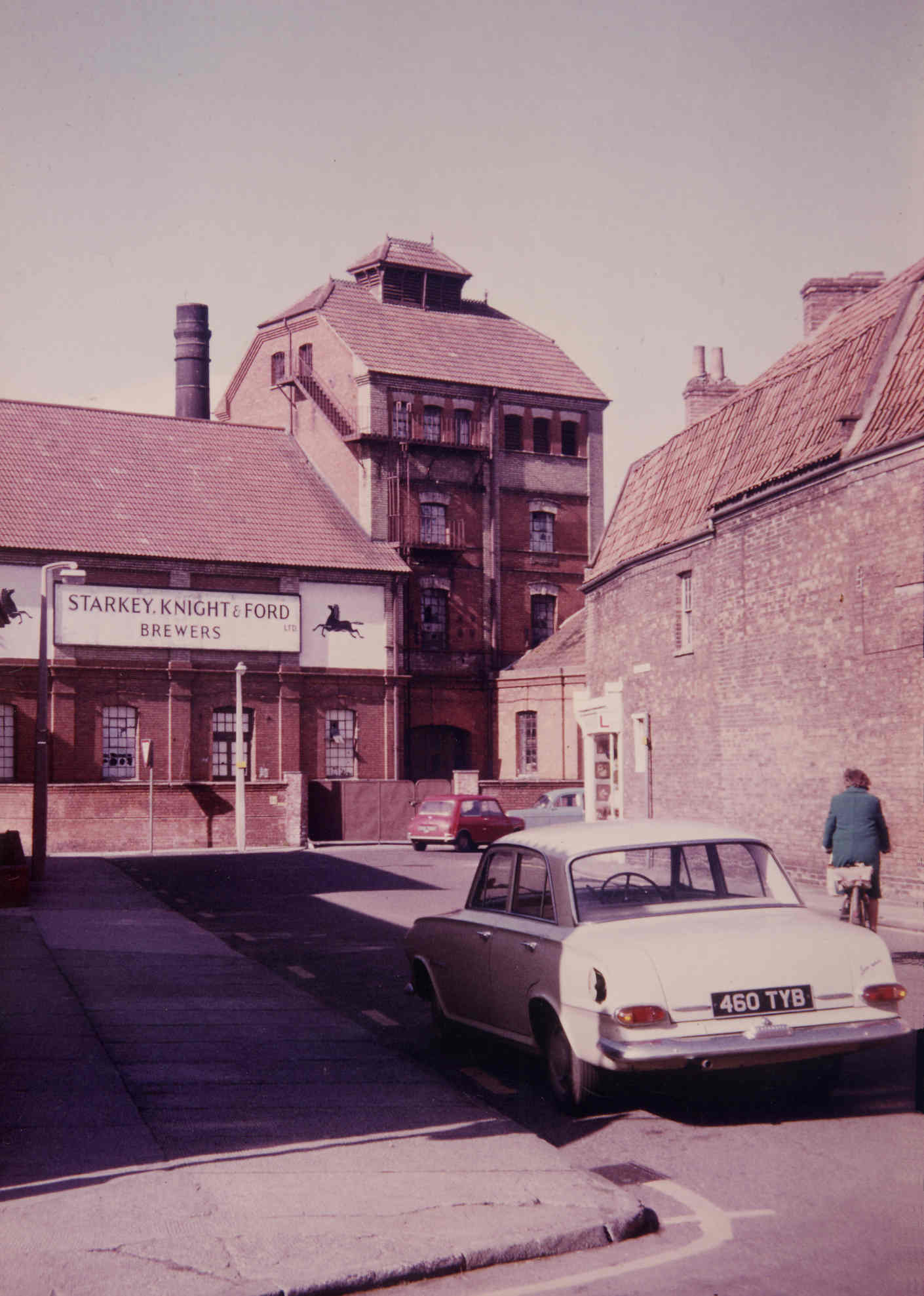
Brewery buildings with a vintage car.
The derelict Bridgwater brewery in 1969 via the Brewery History Society.

7. Bridgwater in Somerset and Tiverton in Devon shared a notable brewery in Starkey, Knight & Ford. It was taken over by Whitbread in 1962 and operations were concentrated in Tiverton which became Whitbread’s western outpost until operations ceased there in 1982. Devenish, another big West Country brewer, had breweries in Dorset (Weymouth) and Cornwall (Redruth), with the latter still working as a brewery into the 21st century. There are still substantial historic working breweries at, for example, St Austell in Cornwall, Bridport in Dorset (Palmer’s) and Devizes in Wiltshire (Wadworth).


* * *

For starters, then, that’s a vast range of industry, from toys to war machines, and I haven’t even touched on bricks, dairy products, seafood processing, furniture manufacturing, chewing gum, chocolate bars, semiconductors…

Categories
concrete Somerset

Striking Out

Underneath a motorway bridge.

One day when I was about 13 I realised I could just walk out of town whenever I liked, with the only limits being time and the weather.

My home town is really one big outskirt – not confidently urban, but not quite rural either; a place where you can stand surrounded by concrete and factories while enveloped in the stink of manure.

I was raised as a town boy – the countryside was a thing you sped through in a car on the way to the seaside or Taunton – but couldn’t help wondering what was out there, beyond the sign that announced our twinning with La Ciotat and Uherské Hradiště. What was on those hills I could always see in the distance, where snow sometimes sat while town was as grey as ever? What was up that lane? Where did the filthy old river go?

First, I tested the boundaries, walking a little further each time. The motorway felt like a barrier but I crossed that easily enough, my flat feet slapping their way across a pavement barely used. On the other side, just barely, I found the hamlet of Horsey and thought, well, there it is: I’ve walked to another place. I tried the same on the other side of town, passing under the motorway this time, and found Dunwear.

Then I really stretched myself, walking beyond the point where the pavement ended, past the absolute feathertips of town. Trudging alongside the A39 was dangerous which added to the thrill but I knew the rules (face the traffic) and there were verges to retreat to if need be.

A tractor on a country road.

It’s impure countryside out that way: stalked by crackling pylons, littered with fast food wrappers and fly-tippings, and with the constant sound of the motorway boring away like a dental drill. At certain stretches it feels as if there’s more roadkill than road. But compared to the estate it was open, wild and fecund.

That time I made it to the King’s Sedgemoor Drain, which looks like a river but was built by men. There was a path that I wanted to follow but it seemed as if I’d already gone too far from home so I turned back.

Next time, I did go that way, stopping to eat a sandwich with a view across fields of gaudy yellow rapeseed, with the tower of Sutton Mallet Church in the distance. I may have read some poems, which was the kind of thing done by the kind of person I thought I wanted to be then. It was warm and insects as big as shuttlecocks made ceremonial flypasts. I thought, ah, there it is — this England I’ve heard so much about.

I went out time and again, taking different routes, going beyond and beyond again, until one day I was taken with the most pathetic, suburban version of exploration mania you can imagine and didn’t turn back when I should have. Stranded in Huntspill as night fell I found a payphone and called to be picked up. In the car home, with aching feet and muscles, I felt like Edmund Hillary.

All of this, I suppose, was training for life, a kind of straining at the leash. Timid and reticent as I was, and am, I never wanted to stay at home forever.

First stop Bawdrip, next stop the world.