Categories
Fiction

FICTION: Local Legends

I’ve extracted the text from the booklet The Boiled Egg Lady and Other Local Legends of East Bristol which I found on an online auction site earlier this year. It doesn’t seem to have been reprinted; Bristol Libraries don’t have a copy; and I have not been able to track down the authors.

Introduction

This small monograph was compiled by members of the St Philips Folklore and History Society in order to record that which would otherwise be lost. As members of the community, these are stories we have heard ourselves in pubs, clubs, schools and butcher’s shop queues. You may choose to dismiss them as nonsense but, true or not, they carry a flavour of the place – and of the fears and anxieties of the people who live and work on and around the Marsh.

C.F. Rawlins, Editor, August 1993

A crude sketch of a man with a beard and dark hair looking vaguely malevolent.
The 598 Man as sketched by a supposed eyewitness in 1988, reproduced in The Boiled Egg Lady and Other Local Legends of East Bristol, 1993.

The 598 Man

Mass hysteria, or something more sinister? In the summer of 1988 multiple people in St George reported an encounter with a strange man driving a yellow Bedford van. Strange because he spoke as if through gritted teeth, had a heavy black beard, and an oddly immobile face.

Usually encountered at dawn, he would pull up alongside young men walking to work, or to school, and ask for help. Assuming he needed directions, they were surprised to be asked: “One piece of information, please – does the number five nine eight mean anything to you?” Of course they all said no, and after a moment, the 598 man drove away. What would have happened if someone did know the number?

On two occasions, he was said to have stopped a little further along the way, where a younger man appeared from a side street or alleyway and jumped into the passenger seat before the van sped off.

A black and white sketch of a sinister person concealed behind a fence with long thin fingers protruding through a gap.
Charlie Grabknuckle, artist unknown, reproduced in The Boiled Egg Lady and Other Local Legends of East Bristol.

Charlie Grabknuckle 

This is the name given to a mysterious bogeyman figure said to lurk beneath the many railway arches and tunnels that cover the industrial landscape of St Philips Marsh.

The great game for children between the wars was to find a gap in a fence or in brickwork and dare each other to insert a hand, inviting Charlie Grabknuckle to take it. Invariably, a child already secreted in that place would play the part of Charlie, seizing the proffered hand and refusing to let go.

After the war, the myth of Charlie metamorphosed and he became a more sinister character, supposedly able to pull any child through a gap, however small, by breaking their bones. Thus tenderised he would, of course, eat them.

It can be no coincidence that, over the decades, many unfortunates and outcasts have indeed been found living beneath those railway arches – or, worse, been found dead.

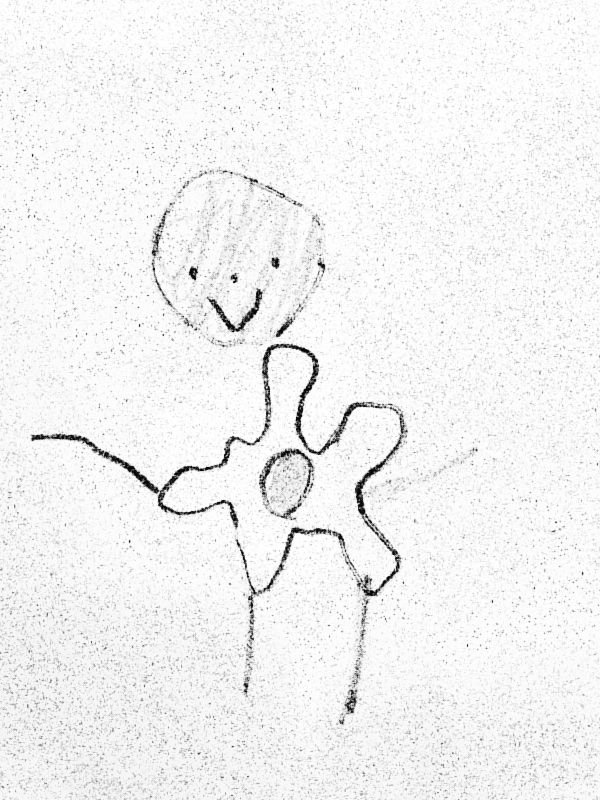
A child's drawing of a smiling woman with a fried egg for a body.
An unknown child’s drawing of the Boiled Egg Lady reproduced in The Boiled Egg Lady and Other Local Legends of East Bristol.

The Boiled Egg Lady

In November 1957 the Bristol Evening Post reported that children at a junior school in Brislington were playing truant because they were afraid of ‘the Boiled Egg Lady’.

The initiating rumour was that an old woman had offered hard boiled eggs to two boys on their way to school, inviting them into her house. Within days, several other children had reported encountering the same woman, and the story became embellished. Now, there was a shadowy figure waiting in the house – supposedly the woman’s son, an escaped murderer. Police actually spoke to an elderly woman who lived in one of the terraces off the Feeder Road, at a house identified by one of the two boys who started the rumour. A childless widow, she had been in the habit of speaking to children on their way to school, and was heartbroken when asked to stop doing so. 

That was that, until a decade or so later when stories about the Boiled Egg Lady once again began to circulate, only now the story had evolved, inspired more by that evocative phrase than by anything in fact. The landscape had also changed, with mass demolition of terraces, schools, churches and factories, creating something of an eerie wasteland.

By 1968, teenagers were daring each other to traverse this space where, in the dark, the Boiled Egg Lady would be waiting for them. In this version, she took the form of a seductive young woman in a red dress. Any young man who stopped to speak to her would be asked “Do you think I’m pretty?” Of course, she was, so they would answer “Yes.” She would then remove her long dark hair – a wig – and with fingertips prise open the top of her completely bald head to reveal… Who knows? Because of course her victims fled before they could see, or were found dead.

There is no concrete record of any such incident, although several children did die playing on wasteland and construction sites during the 1960s and 1970s. Even now, it can feel a melancholy place at night.

Scarecrow Hill

Perhaps it was a prank, or perhaps a project by an art student. Whatever lay behind it, the discovery of fifteen rather horrible scarecrows on a slope at Netham Park on the 3rd of September 1974 caused considerable upset. They were found at dawn and soon a crowd from the neighbourhood had gathered to see the sinister scene. They seemed authentic enough, crafted from wood and jointed with grubby string, and decked out in old clothes of considerable vintage. Weatherworn and decayed, they seemed to have been outdoors for many years, but certainly not in this spot. Council park keepers came and took them away the same day.

That wasn’t the end of the story, however, for when the scarecrows were examined by police, several items of their clothing were found to belong to people who had gone missing or been murdered in and around Bristol in the preceding decades.

Since that time, individual scarecrows have sometimes appeared on the slope. Some theorists have noted that their appearance often coincides with the first anniversary of the disappearance of some person or another. They are promptly taken away and rarely discussed, though their number, including the original fifteen, is now said to be close to thirty.

The Blitz Babies

This story goes back to the end of World War II when Bristol was still half in ruins and its people were psychologically scarred from the experience of German bombing. It has been connected with various former bomb sites in Barton Hill and Lawrence Hill. Many of those sites were left uncleared and undeveloped until the 1970s. Throughout the 1960s, people reported hearing babies crying on these sites and, assuming they’d been abandoned, would scramble over rubble and through weeds in search of these unfortunate children. Of course they found nothing. 

In one account, two children did find a baby, blackened by fire, screaming furiously. When they returned with police to examine the site, bones were found beneath the soil – far beneath the soil, long buried. There are, of course, those who point out that foxes can sound a lot like crying babies, and perhaps that’s all the blitz babies were.

In some of the council housing blocks built on these former bombsites, tenants have reported cold spots, eerie atmospheres and, yes, the sound of babies crying at night. If not foxes, then perhaps thin partition walls are to blame in this instance.

The Naked Swimmer

This is the newest of the local myths or legends in this collection, having emerged as recently as 1979. Where the Feeder Canal meets the River Avon at Netham Lock there have been frequent sightings of somebody swimming, naked, beneath the dirty water. Only beneath, however, for this curious swimmer never seems to need to surface.

Police investigated the first sighting as a potential case of indecent exposure and arrested a man found sunbathing on the manmade protuberance that marks the entrance to the canal. He insisted he had not been swimming and had worn swimming trunks at all times.

One rumour is that the so-called Naked Swimmer is actually some amphibious creature or reptile, rather than a human. An albino seal, perhaps, or a white-bellied crocodile, escaped from some private collection.

Another theory is that it was invented by some enterprising parent to deter children from paddling in the hazardous waters where stomach bugs are as big a risk as underwater obstacles.

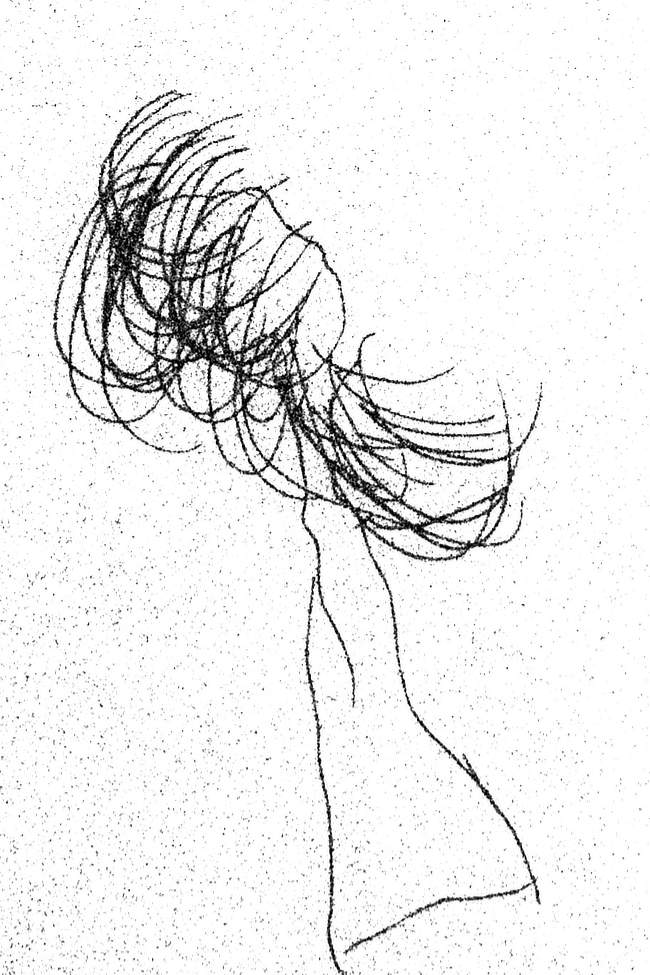
A child's drawing of a vaguely feminine shape with lots of mad dark hair and a sort of white dress.
Hairy Jane as drawn by Jessica, aged 6, at a history and folklore open day at Bristol Central Library, 1992, reproduced in The Boiled Egg Lady and Other Local Legends of East Bristol.

Hairy Jane of Combfactory Lane

Walk backwards up Combfactory Lane between midnight and four in the morning and you’ll be sure to bump into Hairy Jane – literally so. Nobody has seen her but many have felt her long hair tangle around their limbs and throat, until they tear themselves free and flee.

There are too many stories, none of them in agreement, about her nature or origin. In one version of the tale, she escaped from a travelling circus, where she was an exhibit in the sideshows, and survived on the streets by capturing and eating cats or rats. In another, she was employed at the comb factory that gave the narrow cut through its name until her hair began to grow and didn’t stop. A slight variation on that account has it that her impossibly long, unruly hair became caught in one of the comb cutting machines and she was dragged to her gory death.

Spiderman Bridge

The story goes that, on dark winter evenings, people passing through the short, unlit tunnel beneath the railway line at the bottom of Cole Road hear a voice: “Spare a little change?” But there’s nobody there. Until, that is, they look up and see a bearded man in ragged clothes splayed against the red brick above, clinging on with filthy fingers and toes.

The Unscheduled Stop

Bus drivers working out of Lawrence Hill depot have for many years told new recruits about the danger of making unscheduled stops, however much a passenger might insist. There are good operational reasons for this, of course, but stories have also circulated for years about what might happen to a poor driver when such a stop is made.

For example, one veteran – we’ll call him Ted – tells of being asked to stop his bus near Avonvale Cemetery. The passenger, a young woman, asked nicely, and as it was late, and there was freezing fog, he decided to be gallant. No sooner had she departed the now empty bus, however, than another passenger boarded – an old man with pale, drawn features and a shabby black suit. He paid for his ticket with a handful of dirty old coins and took a seat near the driver. Bill could see him quite clearly in his rear view mirror. As the bus neared the junction with Church Road, Bill glanced back again and was startled to note that the passenger had gone. Pulling over, he got out of his cab to check in case the old man had slumped or fallen. He found only a length of filthy white cloth of the type used to wrap corpses.

Ted also talks of a colleague, a friend of a friend, who stopped in much the same place thirty years before, when flagged down by a man carrying a heavy package. After a few stops, this passenger departed the bus by the back door. A few moments later, the conductor shouted for the driver to stop. The man had left his package on the bus – with blood oozing through the brown paper. When opened, it was found to contain no less than twelve human hands, of various sizes and colours, and in varying degrees of decay.

Others

Many other stories are known only in passing and are still being researched by the Society. We should be grateful to hear from anyone who can tell us about:

  • The Phantom Social Worker (St George, 1950s)
  • The Avonvale Ghoul (St George, c.1968)
  • The Underground Theatre (Lawrence Hill, 1920s)
  • The Fox Tail Man (Easton, 1920s)
  • The German Lodger (Lawrence Hill, 1940s)
  • The Men in Blue Suits (Pile Marsh, c.1956)
  • Bonfire Billy (Barton Hill, 1960s)

Look, I put Fiction’ right up there in the title of the post. I just think Bristol ought to have more decent ghosts and urban legends, so I made some up.

But perhaps some of them will take, if they make it into the rumour mill.

Or maybe someone will message me to say that, actually, they saw Bonfire Billy themselves – that poor young man who decided to sleep in the Barton Hill bonfire stack one cold November, not realising that it was due to be lit that very night…

Categories
Fiction

FICTION: The Newhamstead Goblin

You stop calling the police after a while, d’yer know worrimean? What’s the point? Either they don’t come at all, or by the time they turn up, the bloody thing’s gone to ground.

They think we’re daft enough up here as it is, up at Longwood. Normal for Longwood – NFL. That’s what the doctors write on your clipboard at the hospital. It means they think you’re either mental, or thick.

So, yeah, you don’t call the police. You just learn to live with it. Well, you have to, don’t you, know worrimean? Life’s too short, intit?

In practice, that means, one, trying to get home before dark. If you can’t, get a cab to the door, and get in quick.

Two, keep your doors and windows shut and locked after dark – which is easier said than done with these summers we have nowadays, don’t get me started! And before you say it, yes, we’ve tried nets over the windows, which is how we lost two dogs and a toddler back in 2015. ‘Mystery disappearance’ my arse. We all knew what did it. We told them. But they don’t believe you, do they?

Oh, and three, you keep your curtains drawn, because it’ll look in, if it can, and that’s no good. Best case, it puts you right off your tea, with them bloody eyes. Literally, I mean. Bloody. The eyes. Worst case scenario, you end up sort of mesmerised. That’s what they say happened to old Graham Dodd. Saw it, he did, and stared at it, and then climbed out the window. From the second floor of Thorncombe House, mind, so, well, you don’t need me to describe it.

Right, four: don’t answer your door after dark, even if it’s someone you know. God knows how but it’s got a way of speaking to you. I heard it once and I’d have sworn blind our Darren was outside. Your first thought is, oh, shit, I’d better let him in before that bloody thing gets him. Then you think, hang on, Darren’s in Corfu this week. Then it stops knocking and starts scratching like it’s going to burrow right through the wood.

In the daytime it’s alright. You don’t see it, not a sign. Maybe the odd footprint. Maybe a big pile of shit. Maybe an upturned car. You ignore it, though. Well, you have to, don’t you? You just get on with your life.

They asked me once, the lads from the Railwayman’s Club, did I want to go on a hunt for it. I said, no thank you, bugger that for a game of soldiers. Well, they did it anyway, out with their air rifles and cricket bats until dawn. Nothing. Sod all. Except when Kev Parsonage got home, it had been all through his house and ripped the place to shreds.

Have I seen it? Many times. Oh yes. Many times. First time, I’d have been about fourteen, not long after we moved here from up country. Nobody warns you, because they know you won’t believe them. They just wait for you to catch on yourself. I was out kicking a ball around the green, wondering why all the other lads hadn’t come out again after tea. Then I looked straight down Longwood Avenue, and I couldn’t make any sense of it at all. There was too much of it, in one way, but not enough at the same time. Too many arms and legs, that’s what I thought, but I couldn’t quite count them. The way it moved… Now, hold on, how do I put this? It was as if it wasn’t taking steps so much as shifting between them. Like… Like… Like dirty water pouring from one container into another. Does that sound daft? And the eyes. They were like old bike lamps, which was fine, until the bastard blinked.

Last time I saw it was about a week ago. Forgot to put the bins out, decided to risk nipping down the path to the gate after dark. Got most of the way there when, boom, there it is, eating something from the gutter, down into the drain, with that… What would you call it, oh, my bloody memory, that, um, that sort of trunk it has.

I should have taken a picture, I suppose. Then you’d understand. Maybe you wouldn’t. I’ve seen other people’s photos and it just looks like… Well, it don’t look like nothing. There’s literally nothing to see. A load of old dead leaves in the gutter, a tarp caught on the brambles, streetlights in a puddle. Nothing. It’s as if it knows how to make sure you can’t see it.

Trust me, though, that’s what it was – that’s what’s done this to you. I probably scared it off before it had finished, driving through with my lights on full beam. I’d like to help you, I really would, but I should never have stopped. And, like I say, you stop calling the police after a while, because they don’t come. They don’t believe you.

I’d best be on my way, mate. Let it finish what it started.

It’s for the best all round.


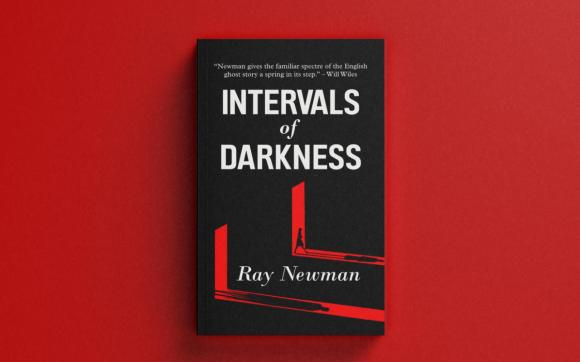
A quote from Verity Holloway: "Impressively eerie and packed with shocks... moments of powerful poignancy and startling strangeness. You'll want to linger over these stories." Next to it is the cover of Intervals of Darkness with a black background and red details. The illustration is of a person casting a long shadow. Nearby is another shadow suggesting a lurking but hidden figure.

If you enjoyed ‘The Newhamstead Goblin’ check out Intervals of Darkness, my most recent collection of weird stories, which is available as an eBook and paperback.

Categories
Fiction weird fiction

FICTION: Mothership

Penny does not expect to hear the roar of an invisible dragon on the path on the edge of a potato field. It takes a moment for her to think to look up.

The hot air balloon passing above her head is too low and too large. Its white sphere stands out sharply against dense black clouds.

Should it even be in the air on a day like this, with a gale blowing up and rain beginning to spot the cracked soil? Penny misjudged the weather for her walk but is dressed for it in waterproof trousers and hooded jacket. Perhaps the pilot of the balloon also misread or ignored the weather forecast. Or has a deathwish.

The wicker basket beneath the balloon is only a few metres above her head. She stops and waits for it to go by, and to progress beyond the line of red-studded bramble bushes ahead. She knows very little about balloons but understands that they have little control over their direction, being at the mercy of layers of wind at different altitudes. She hopes this one, this colossal pearlescent object, will avoid the fourteenth century tower of St. Leonard’s Church which lies a mile or so ahead.

As the balloon moves ahead she expects to see its pilot come into view above the edge of the basket. This does not happen, though someone must be there to trigger the burner, which turns the pearl orange for a second. The balloon does not rise.

In fact, even as the wind whips at the synthetic fabric of her waterproofs and pulls strands of her dark hair across her face, the balloon seems to slow. Then it stops altogether, fixing itself in the air, as if a pause button has been pressed. The hawthornes to Penny’s left are shaken by the growing gale and lurch forward. A torn cement sack tumbles across the field to her right, a tangle of white, brown and blue. But the balloon does not move, at least not forward, because, yes, like an elevator, it is descending gently.

The basket rolls slightly on contact with the pale brown earth, rights itself, settles flat. The structure of the balloon sits solidly, neither sagging nor swaying.

Penny takes a few steps and calls out in her high, nasal voice: ‘Hello? Is everything okay? Do you need help?’ She can barely hear herself and knows that her words have been lost.

The balloon waits.

Rain comes harder, tearing across her rucksack and back. She moves instinctively towards the balloon hoping it might offer shelter, skipping awkwardly over ruts in the ground, stumbling in her sturdy boots.

Close by, the balloon has the bulk of an office block. Its perfect white shell throws out a soft internal light, as if the sun itself has fallen, weakened, from the sky.

The burner exhales flame and it sounds like a weary sigh, or an exhortation. Penny is overcome with a sense that to ignore it would be rude, or hostile. The rain lashes her forward as she hurries to the basket, throws her rucksack over the worn leather of the rim, and climbs in after it.

The basket is empty. There is no pilot, no flask of hot tea, no warm blanket. Here, though, the wind is diminished, and the rain cannot reach. She feels like a child in the arms of a great mother.

Flames rise above her head. Mother sighs. The balloon begins to rise.

Categories
Fiction weird fiction

FICTION: Do Not Eat

Do you get the urge or is it just me? You’re walking along and you see a half-eaten sandwich lying on the ground, covered with bits of grit and crawling with ants, and you think: I want to eat that.

You don’t, obviously. But you think it.

Like how you consider throwing your wallet into the river every time you cross the bridge in town. Or feel your hand edging towards the emergency brake on the train during your commute, specifically because there’s a sign telling you not to. That’s exactly what it’s like when you see a plastic glass half full of cola sitting on a wall and you think, I want to drink that, and eat the chunks that are floating in it, whatever they are. Do you really never get that? Really? I do. All the time.

You don’t do it, as I say, obviously you don’t do it, but it’s touch and go sometimes. When nobody’s looking, when you’ve had a really bad day and everything’s turned to absolute shit, you think, if I eat something I’ll feel better. And if you’re going to eat something, why not that scoop of ice cream that’s been dropped on the pavement and is still mostly solid, even though it’s sent out sticky brown runners towards the gutter? Imagine just scooping it up in your fingers and sticking it in your mouth in one neat move. If you get it right you could leave behind the bit that’s been in contact with the pavement and just get the good stuff that’s probably hardly even been licked. You get so you don’t mind a bit of lick, anyway. People snog strangers all the time – how is a bit of lick on an ice cream any different?

It started when I was a washer-up in a chain restaurant as a teenager. The stuff that used to come back uneaten! Chicken nuggets from the kids’ meals, they’re the ones that tempt you the most, and cakes. Imagine throwing away good food like that and then going home to an economy burger, oven chips, and frozen peas. So, yes, you do eat the odd bit here and there, when they look fairly clean and intact. Nobody notices and nobody cares. It’s like a little bonus, a little treat, and all for free.

One particularly bad shift, though, when the manager had been snippy with me, and I knew it wouldn’t be much better at home, I confess that I did once give myself an extra treat and eat some gristle left over from a steak. It had been chewed and spat out. I chewed it again myself, like gum, while I used the extendable hose to rinse gravy from a pile of plates. You chew and chew and eventually it softens up. That’s why people chew gum, because it’s calming and meditative.

Licking ketchup and melted cheese from the insider of a discarded burger wrapper, that’s another good one. It’s like you’ve eaten the burger without having eaten the burger. Sometimes, when the wrapper’s been out all night, blowing round the retail park car park, it’ll have picked up crunchy bits of glass or splinters of wood. You clear the paper with your tongue and it leaves you feeling clean, too, like you’ve groomed the dirt off your own body.

Nobody eats the salad from a kebab, have you noticed that? On Saturday and Sunday mornings you can pick up all sorts: trampled iceberg lettuce salad, pickled chilli peppers, pitta breads soaked with grease and garlic sauce where the bread has become like a sponge in the morning dew. Get your five a day.

A bit of mold doesn’t even do any harm. You eat blue cheese, don’t you? They say it’s good for you to put bacteria into your gut. There was a whole bag of shopping once, hanging on a railing. A pack of pittas gone blue all over, a cucumber rotten in its plastic sleeve. You can slurp that like an ice pop. You can’t just leave it hanging there. You can’t just walk past, letting good food go to waste, even if it does leave you feeling too full to move. Beats feeling empty inside, that’s what I say.

Or what about those full plastic bottles you find in the gutter? It might be apple juice or beer, it might not, but waste not want not. You’ve got to scratch the itch sometimes, you’ve got to give into the urge.

Some people take roadkill home and cook it. They have freezers full of the stuff. I say, why go to all that bother? The good stuff is like jerky, dried naturally in the sun, seasoned with engine oil and brake fluid. Does your mouth water when you smell petrol? Mine does. Chicken wings, too – it’s like eating chicken wings. Lots of little bones to chew the tough meat from. You really feel as if you’ve earned your meal.

When people feed good bread to the ducks, that breaks my heart. There’s kids starving and they’re throwing bread into the pond in the park – are you serious? It’s not even good for ducks to eat bread, is it? If you have a small net, it’s easy enough to fish the bread out out, or you can just use your hands. The texture is like nothing else. Municipal caviar, I call it.

Dregs from drinks cans, too. Lots of variety, a little dribble of lots of different things, cider or Fanta or whatever, and you can always spit out the cig ends and the insects.

I like a mystery, a blind taste test. You don’t always know what’s in a holdall you find dumped on a verge, do you? There’s no way to be sure if it’s been there a while. You just have to get stuck in and enjoy it for what it is, all of it, pounds and pounds of raw, sweating meat. Almost enough to fill the infinite empty space inside you – not quite, but almost. The only problem is that sometimes you worry you might have helped to dispose of evidence, when they start talking about that holdall on the news, but how are you to know?

I find there’s really no need to go home at all these days, or to go to work, not when you can eat three square meals a day out and about for free. You just need to have a good eye and a strong stomach. And your stomach gets stronger, too, the more you do it. What’s at home, anyway? Much better to be in the fresh air, enjoying all of nature’s bounty.

Oh, see there, under the brambles – a yoghurt pot that looks to be, yes it is, almost half full. Now, don’t you get the urge to eat that? Don’t you? Is it just me?


A quote from Verity Holloway: "Impressively eerie and packed with shocks... moments of powerful poignancy and startling strangeness. You'll want to linger over these stories." Next to it is the cover of Intervals of Darkness with a black background and red details. The illustration is of a person casting a long shadow. Nearby is another shadow suggesting a lurking but hidden figure.

If you enjoyed ‘Do Not Eat’ check out Intervals of Darkness, my most recent collection of weird stories, which is available as an eBook and paperback.

Categories
Fiction

FICTION: The Short Stay

All they want to do is get out of their wet clothes but the key doesn’t work. As Hannah struggles, Joe stands behind her sniffing the warm, musty air of the corridor.

‘Stinks of mice.’

Hannah tries pulling the key out a little as she turns it. She tries pulling up on the door handle. She tries pushing the key harder into the door.

‘Let me try,’ says Joe.

He pushes her aside, reaches for the key, and turns it without the slightest trouble.

‘Easy, see?’

The flat is smaller than it looked in the photographs on the booking website. The laminate flooring is scuffed and there is a vegetal smell.

Joe lugs his bag into the bedroom leaving Hannah to carry her own.

‘Fucking rail replacement fucking buses,’ says Joe, more to himself than to her. ‘“Let’s spend Christmas somewhere different,” she says. Oh, yeah, nice one. I don’t know why we ever bother going anywhere with the state of the trains in this country.’

‘Never mind,’ says Hannah. ‘We’ll have an early night tonight and explore the city properly tomorrow.’

Joe hangs his sodden black trenchcoat over the back of a chair and pulls his wet shirt away from his bony torso. Looking around he puffs out, despairing and disbelieving.

‘Merry Christmas to us, and happy anniversary.’

‘This is just a base, though, isn’t it?’ says Hannah, her voice beginning to crack.

‘You’d better change,’ he replies. ‘You look like a drowned cat.’

Hannah pushes a snake of dyed black hair behind her ear, her bangles rattling, and slides her glasses up her nose.

Joe won’t look at her. As he heads to the bathroom with their shared toiletry bag he slides past without making contact.

Alone, Hannah listens to the room for a moment. It has no sound at all. It’s too small and too full of furniture to reverberate. She wonders how many flats they managed to squeeze into the former warehouse when they converted it. Too many, anyway.

She hears the sounds of Joe using the toilet, the flush, the shower. Bathroom smells, shit and lime-scented gel, fill the small flat.

She removes her dripping dress and stands in her underwear, shivering and goose-bumped, while she unpacks her bag. She puts on pyjama bottoms and an oversized t-shirt and heads to the combined sitting room and dining area.

There are two windows looking out over an office block. Only a few lights are on – a meeting room on the first floor, an office on the sixth – so the wall of glass forms a blank, black mirror. She moves and spots her own reflection, sees herself doubled, distorted, reflected, shadowed. The flat’s windows open a few inches, not enough to jump from, but enough to let in frosty air and sounds from the street below: a whisper, a shrieking laugh, and the crunch of broken glass.

Joe emerges from the bathroom wrapped in a towel. His fine white hair is plastered to his head and his body looks thinner and paler than ever.

‘All yours,’ he says and disappears into the bedroom.

Hannah goes into the bathroom and locks the door. She can’t use the toilet because it’s not private enough for her to relax, but she sits on the seat for a while. There’s no window, only an extractor fan that hums at an irritating frequency. After a while she gives up and gets up to wash. Before she picks up the soap, she removes her wedding ring. It’s a struggle to get it over the knuckle, over the swell of flesh it pushes before it, but sheer force does the job. She places the ring carefully on the glass shelf above the sink. The metal clicks into place as if magnetised. Hannah washes her hands, neck and face, then dries herself with the only other towel in the flat. She flosses, cleans her teeth, and ties her hair up with an elasticated band.

When she reaches for the wedding ring, it is gone.

Her fingers crab and scrape around. She inspects the full length of the glass shelf. She drops to her knees and looks beneath the sink, finding only a tangle of cobwebs and hair. She looks under the bath and behind the toilet. She checks the plughole. No, it couldn’t have fallen down there, the strainer would have caught it. She pats the pockets of her pyjama bottoms. Finally, she looks into the toilet bowl where perhaps, she thinks, it might have rolled, which would be just her luck. Nothing.

‘What are you doing in there? Come to bed so I can turn the light off.’

Hannah feels a flutter in her heart.

She opens the door and, hesitating, steps across the hall to the bedroom.

He is already curled up beneath the duvet, his head almost buried.

‘I’ve lost my wedding ring,’ she says in a weak voice.

Joe emerges and peers at her, blinking and small-eyed.

‘What? When?’

‘Just now. Freshening up.’

He groans.

‘It can’t have gone far. We’ll find it in the morning. I’ll find it.’

She climbs into bed and reaches out for Joe.

‘Christ, you’re cold,’ he says, when her hand brushes his back.

He turns off the bedside lamp.

Exhausted but awake, Hannah lies and listens. Apart from Joe’s soft snoring, there is something else in the silence – the non-sound of someone holding their breath and holding still.

The morning is bright and Joe’s mood has improved a little. He even makes the coffee, bringing two cups into the bedroom.

‘Four sachets they’ve given us, and four little pots of fake milk. Stingy bastards.’

Hannah draws her knees up beneath the duvet and hugs them with one curled arm, the other lifting the steaming coffee cup to her mouth at intervals. Joe stares at his phone which, perhaps subconsciously, he angles so that Hannah can’t see the screen.

‘Can you have a look for my ring?’ she asks.

‘What? Oh, yeah, sure. In a minute.’

After a second or two he looks up from his screen and turns to her.

‘Why do you take your wedding ring off at all?’

‘It’s more hygienic,’ she says. ‘I don’t want it to get dirty under there.’

‘Yeah, but if you leave it on you’re putting it in hot soapy water. So it gets cleaned. It’s probably more hygienic that way, if anything.’

He turns back to his phone, chews his thumbnail to tidy the edges.

‘It’s supposed to symbolise eternity, isn’t it?’ he mutters. ‘Commitment. I never take mine off.’

‘What I don’t understand is how I lost it. It definitely didn’t roll and there’s nowhere for it to go.’

Joe puts his phone on the bedside table and limps into the bathroom groaning. She watches as he inspects the shelf, the sink, the floor, the plughole.

‘Probably got taken by the house elves,’ he says as he comes back to the bedroom. ‘Try asking for it back.’

‘How does that work?’

Stretching a t-shirt over his head and angular arms Joe says, muffled: ‘Hey, house elves – may I please have my wedding ring back? Like that.’

Hannah mutters the request under her breath. It doesn’t work, at least not immediately.

Joe spends another ten minutes investigating the bathroom before they go out and emerges with a shrug.

‘Sometimes there are gaps around the pipework but everything is sealed tight in there. I don’t know how you do it, I really don’t.’

Over an expensive breakfast at a cafe with oatmeal coloured walls and smashed avocado on sourdough toast Hannah says:

‘Let’s just forget about the ring and try to have a nice Christmas anyway. Just the two of us, somewhere new. We need to decorate the flat a bit. Brighten it up. And get some treats in.’

‘Beer. Wine. Gin.’

They spend the morning of the day before Christmas Eve shopping, buying a tiny tree with twinkling fibre-optic lights, a plastic wreath, and a candle that’s supposed to smell of fir trees. Joe lugs two heavy bags back from the supermarket and opens his first can of beer at exactly midday as he flips through channels on the TV.

As she lays out slices of ham, cheese and salami on a plate, and cuts a supermarket baguette into small rounds, Hannah looks at her hands. They look different without the ring, obviously, but do they look better?

‘We should go to the pub or something,’ says Joe after lunch, two cans of beer down. ‘While there’s still, like, an hour of daylight.’

They wrap up in coats, scarves, and hats and head out into the city. There are Christmas lights up in the centre and a busker is playing ‘Jingle Bells’ on an accordion. Hannah leads them to the cathedral which they circle, but Joe doesn’t want to go inside. The light begins to die and the grey sky turns flat, first, then begins to shade to blue. They drift back to the shopping precinct and its bright lights.

‘That place looks cosy,’ says Joe, spotting a half-timbered pub called Ye Olde Bear. He heads through the door and Hannah follows. It’s crowded and hot with half the customers in novelty Christmas jumpers. Joe pushes his way to the bar and raises a hand to get the attention of the barman. His wedding ring, a thick, plain band, glints amid the fairy lights. He orders Hannah’s usual half of lager and a pint of cider for himself.

Because it’s Christmas, when the usual rules don’t apply, they both drink too much. Hannah’s usual limit is three pints but she ends up drinking five. Dinner is two cheese rolls and a packet of crisps. Joe is on eight pints when he decides to switch to single malt whisky, because it’s Christmas, and Hannah agrees to have one, too, because it’s Christmas, and suddenly, it’s nearly midnight and the pub is closing around them.

They go from giggling arm-in-arm to arguing in no time at all. They both need the toilet but Joe insists on pissing behind a wheelie bin, prolonging her discomfort. He wants to find a kebab shop. She begins to cry, for no particular reason, just everything, and he raises his voice without meaning to.

‘Go back to the flat, then! Take the key! I’ll see you there when I’ve had my chicken doner.’

‘You want me to walk back on my own, in the dark, in a strange city?’

‘Fuck sake… Come with me, then!’

‘I really need a wee.’

He shoves the keyring into her hands.

‘I’ll see you there in, like, fifteen minutes.’

Hannah watches him stagger away and wonders what it is she feels, other than heartburn from the whisky and a pressing pain in her bladder.

The next morning, Christmas Eve, she wakes with a head that feels like concrete and a papery mouth. Joe is not with her. She croaks his name then checks her phone. There are several missed calls and messages from Joe, each more desperate than the last. She must have fallen asleep, or passed out, leaving him stuck in the street outside all night. The last message reads:

‘Will sleep in park. Fuck you.’

Dressing hurriedly, wanting to vomit, she rushes out and downstairs, trying to work out which park he might have meant. She calls him and listens to his phone ring as she walks over frosty cobbles. He doesn’t answer.

The nearest park is by the riverside. She makes a complete circuit, checking each bench and shelter, looking at the single-person tents concealed in the hedgerows and copses. She shouts his name, screams it, constantly redialling his number.

‘What if he comes back to the flat and I’m not there?’ she thinks after a while. She returns to wait for him.

Wide awake now, shaking with cold and adrenalin, she sits down in the kitchen. She closes her eyes, breathes out, breathes in, breathes out, breathes in, but calm never comes.

Her eyes pop open when something slams into the tabletop.

There in front of her something is spinning and shining. She is mesmerised. It slows to a teeter and then falls flat on its side. Her wedding ring. 

She sees the second ring fall, seeming to appear from somewhere just above her head, before it hits the table with force. It is thicker and heavier and begins to roll. To stop it reaching the table’s edge she reaches out and slaps it flat.

It feels hot.

She looks at her palm.

A perfect red circle has been burned into the skin.


Image based on a photograph by Luwadlin Bosman at unsplash.com

Categories
Fiction

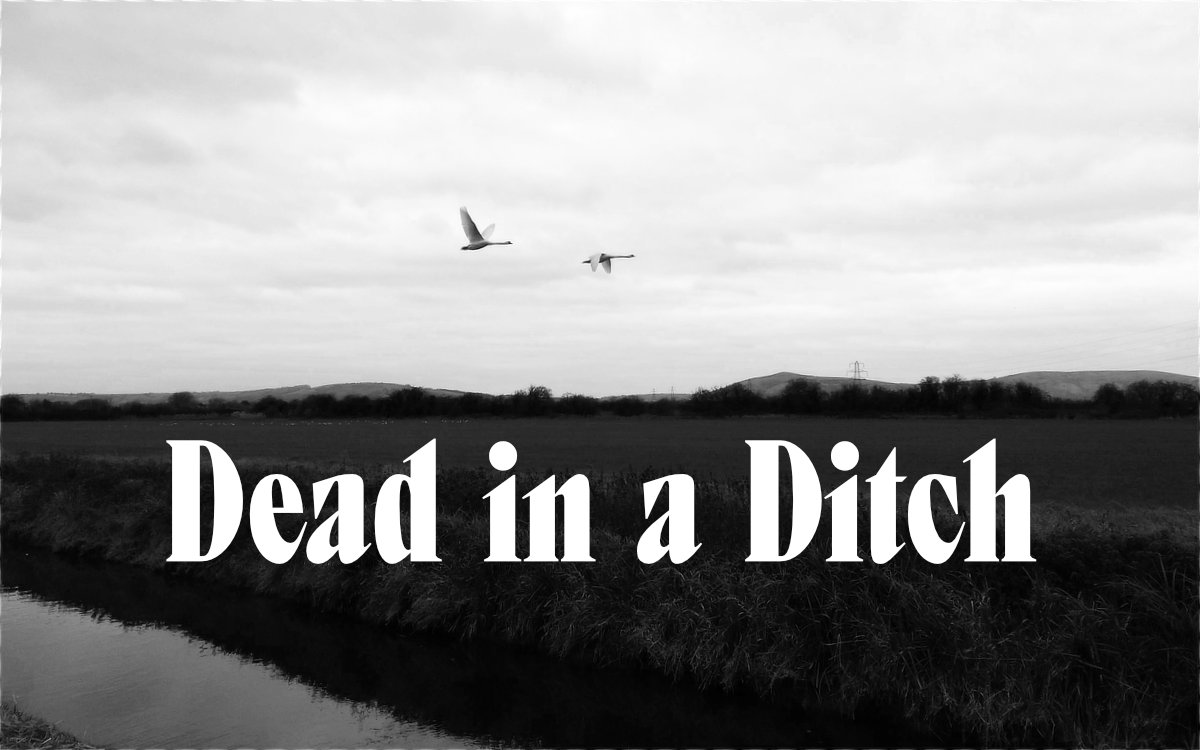
FICTION: Dead in a ditch

Where is the worst place you could end up haunting? I reckon my spots a contender. It was bad from day one, standing knee deep in the green water of a ditch, looking down on my own smashed body in the half-submerged hatchback.

Then it took them three months to find me, even right there by the main road between town and the village, because the reeds were high. I watched my body bloat and fart bog gas and liquify. I watched rats and insects help themselves to my flesh. I saw my bones emerge like the wreckage of a ship on the shoreline with the tide sliding out.

I tried not to look. I took an interest in the clouds in the big sky above the levels, and in the trees as they began to yellow at the edges and drop their leaves. I watched sunrises, sunsets, and stared at the stars – I could see them so clearly out there in total darkness. I counted cars, too, as they flew by. You’re going too fast, I thought, and remembered that people kept saying that to me, too.

Then, when the trees were bare with black branches, a car passed slowly enough that a child in the back seat saw the low sun catch the roof of the wreck. The car stopped at a layby a little way along the road into town. I could hear the burr of its engine and the tick of its hazard lights above the breath of the westerly wind. The police car came a little later and the road was closed. Then an ambulance. Then, just after dark, a forensics team with floodlights and tents. Finally, a pickup truck from a garage in town arrived and, by dawn, the car was gone, and it was just me and the dirty water around my jeans.

Mum and Dad came, parking at the roadside. Cars kept passing at twenty above the limit, one or two honking their horns in irritation at the blockage in the road. My parents couldn’t see or hear me as I murmured to them: ‘It’s alright, don’t miss me, don’t feel pain for me…’ Before they departed they left a stuffed monkey, a bunch of flowers in a heavy stone pot, and a card I couldn’t read. In the weeks that followed I watched the card blow away in the wash from an articulated lorry, the monkey turn ragged and grow green mould, and the flowers rot to black stalks. I didn’t see Mum and Dad again. I suppose they drove the long way round to town after that, so as not to have to think about me.

After a long while I got tuned into the other dead around and about. There was a pale smudge in the field opposite that I thought must once have been a woman. She seemed young and was always stooped, always weeping. The sound sometimes carried on the wind. She might have been there since the Civil War, or long before. One night in June I watched a Douglas C-47 with black and white invasion stripes on its tail pass silently overhead and fade out of existence somewhere over the old airfield. I learned that the famous Headless Horseman was real, too, though less glamorous than in the stories they told around town. He passed by, once a month or so, and was a nasty old thing. He had a dirty tunic streaked with brown blood and his head was in his lap, crushed and misshapen, but still screaming. He was always in a hurry to be somewhere. On summer evenings, if there wasn’t too much traffic, and the wind was right, I could hear the sounds of the battle of 1685 being replayed on the field outside the village. The teachers from the village school used to take us there to camp out, and tell us ghost stories as we toasted bread over a fire.

Years must have passed before I saw Dani again. I’d dropped her off in town before making that last journey and I suppose she had no reason to come to the village after I’d gone. Then one day, there she was, in the driver’s seat of her own hatchback, framed in the open window. She was a little older but no less beautiful. After the car had passed I realised there was also someone in the passenger seat. An hour later, she drove back and I saw her for another two seconds, a face in shadow, her hands on the wheel. I also saw that the man sitting next to her had a broad chest and tidy beard.

I’d always wondered how eternity would work. Wouldn’t you get bored? In life, I could hardly sit still, and was always after a distraction or a thrill. That’s probably why I drove so fast all the time, to feel not-boredom for a few minutes. But boredom, it turns out, is only a problem for the living. It comes out of being anxious the whole time about your status and how much you’ve achieved. It does us all right in the survival game. It keeps us moving and exploring. In death, though, you let time wash over you in an endless stream. I wasn’t waiting. I didn’t expect anything, or hope for anything. I just was, and just am.

If there was anything I longed for, and longing’s too strong a word, it was to see Dani again. When I died, the wires that connected me to the world were cut, but the cut wasn’t clean. An intermittent contact made me feel something, or remember how it felt to feel something, or something like that.

She passed along the road many times after that. Alone in the car; with the man; following a removal van; dressed for work in her supermarket uniform; dressed for a Christmas party in a sparkling silver dress, with the man in a shimmering suit; and in a wedding dress in a vintage car with ribbons tied to its radiator. Their car got bigger, the backseat gained a baby seat, then a baby, then two babies. They drove too fast, of course, because everyone did. The car hugged the bend, lifted a little one one side, always ready to tip.

Through cycles of sun and moon, summer and winter, flood and drought, I stood there with water boatmen skidding around my knees, and rats circling. The creatures knew I was there, somehow, in some simple way, because they never touched me, or went through me, or whatever would have happened.

There was no way for me to make any difference in the world, I knew that for sure. Still, I always wanted Dani’s car to break down as it passed me, so I thought hard about it, and one day, it did. I felt as if I’d made it happen. The engine cut out and she began to drift. She guided it into the verge and put on the hazard lights. Then she got out and walked along the road directly in front of me.

Her fine blonde hair had just begun to turn grey and there were new folds and grooves around her eyes. Speaking into her phone she said:

‘About halfway, yes, just past Crockford Farm.’

It was the first time I’d heard her voice in all these years and I experienced something like a memory of how it felt to yearn for someone. I remembered, for a sliver of a moment, how a sweet harvest apple tasted and what it meant to smell the sea.

While she waited for the mechanics to come, she leaned on a gate and, resting her chin on her arms, looked out over a field of yellow rapeseed.

Did she remember this was where it had happened? Did she ever know?

The recovery vehicle came, its orange lights throwing twists of fire on the surface of the filthy ditchwater. Within a few minutes the engine of her car was turning over. She put the radio on and I heard two bars of a song I didn’t know before she waved to the mechanic and sped off.

Over the years, Dani kept passing, back and forth, like an irregular pendulum, village to town, town to village. The car changed, and she changed, but I didn’t.

Her children got their own cars, which they drove much too fast, and I wondered if she ever used my story as a warning.

One day, after I suppose decades must have gone by, Dani appeared dressed in black in the back of a limousine, following a hearse.

A few years after that, the hearse passed again, and this time Dani’s children were in the black car that followed.

That night, the Headless Horseman passed, screaming mad, as usual. I screamed back.


The cover of Intervals of Darkness with quotes from John Grindrod and Rowan Lee.

If you enjoyed this story you’ll probably also enjoy my collections Intervals of Darkness (2024) and Municipal Gothic (2022).

Categories
Fiction

FICTION: The Fugitive

In the late afternoon, slow-moving cloud came in off the mountains and burst over Maxton City. Main Street had just been macadamed the year before and the rain turned it into a stream.

Dan Todd used the storm as an excuse to drop into the Turkey Inn on his way home from the newspaper office. He had already dawdled and detoured. He was avoiding the road home, and the one-pot dinner he knew was being kept warm on the stove.

That damn black pot. The thought of it made his gut hurt. Hazel always did use too much salt, and never trimmed the fat off the meat. Which would be fine, which he could live with, if she cooked it long enough for the damn fat to render out, but damn her, she never did. It just stewed like white rubber, and then he wouldn’t sleep with it sitting on his gut.

The Turkey was an old wooden building, one of the oldest in Maxton. In recent years, however, the old half-height saloon doors had been replaced with shining new ones in chrome and glass. They looked out of place but a travelling salesman from the city had dazzled old Jim with talk of modernisation, hygiene and glamour. It was true that  they kept the dust out in summer. Dan pushed his way in and let the door swing behind him.

The bar was gloomy, and downright dark towards the back. Jim ought to have switched on the lamps, what with the storm having made it so dark outside, but he always waited until six o’clock. It was a point of principle.

The barroom was long and thin. The counter was of polished wood with big cut glass mirrors on the wall behind. A row of stools lined the bar and there were wooden booths with benches along the opposite wall. There was a cigarette machine, a gum machine, and a cardboard sign that said ‘Please pay when served’.

Music was coming from a radio on the counter, a big city dance band strangled through a small speaker. Dan didn’t recognise the song but could hear somebody crooning about the moon and loneliness.

Dan took off his hat, revealing fine, fair hair, and slapped the felt brim firmly against his hand. Rainwater scattered on the floor. He hung the hat on the stand by the door. Then he shook off his coat and hung that up, too. He used his handkerchief to wipe raindrops from his spectacles as he approached the bar.

‘Beer, if you please.’

Jim was a round, blank-faced man bald except for tussocks of hair above his ears. He poured a mug of Old Joe’s Lager Beer and placed it on a napkin on the bar.

Dan glanced along the counter to the only other customer.

He was a hunched, miserable looking man in a heavy plaid jacket with a sheepskin lining. His head hung over an almost-empty beer mug that was clutched in his thick, dark hands.

Dan had few friends. He didn’t need them. But that night, he wanted to talk, and he heard himself saying: ‘Buy you a beer, friend?’

The man looked up.

Dan had never seen such eyes. They were like those of a whipped dog, or a seasick stowaway. The whites were the colour of slow-baked cream.

‘Had a couple already,’ he growled.

Dan began to turn away.

‘Could handle another.’

Jim looked at Dan, who nodded. As Dan lifted himself onto a stool, Jim placed the beer in front of the stranger.

‘Obliged to ya,’ said the stranger. He pushed his spent glass away and lifted the fresh one, glittering with dew, in Dan’s direction.

‘Name’s Dan Todd,’ said Dan. ‘What do I call you?’

The man on the other stool turned slowly to look over his shoulder, the movement creaky and apparently painful. He turned back and glanced at Dan from under black, unruly brows.

‘Call me Grant.’

‘That your first name or your last?’

Grant took a long gulp of beer and rubbed foam from his stubble-covered upper lip.

Now he was settled next to Grant, Dan could detect a musk about the man that he didn’t like. Men often had a smell after a day’s work. Heck, even he needed to shower after a day baking in that miserable office which the old man insisted on keeping sealed like a diving bell. Grant’s smell, though, was rotten, as if he was sick and didn’t yet know it. It came out of his pores and in his breath whenever he turned a little towards Dan.

‘Hope you don’t mind a little company,’ said Dan, hoping that Grant would send him away.

‘I ain’t a big talker but I don’t mind listening,’ said Grant.

‘You might regret saying that, friend,’ said Dan with a dry laugh. He took his beer mug in his strong right hand and sipped a little. ‘I’ve got a lot on my mind.’

Grant rolled his yellow eyes towards Dan and waited.

‘Well, it’s just that, oh, well, a fellow gets so damn bored.’

‘Bored how?’

‘See, the thing is, I’ve never lived anywhere but Maxton,’ said Dan. ‘I didn’t even go to college, and I missed the war. Started writing for the paper when I was fourteen and I’ve been there ever since. I suppose it’s been quite different for you?’

‘I know the road, that’s true,’ said Grant. ‘Six states and five countries.’

With a sigh, Dan said, ‘Gosh. Doing what?’

‘Picking fruit. Crewing boats. Driving trucks. Peeling taters.’

‘I should have done all of that before I married,’ said Dan. ‘I should have done everything. Are you married?’

‘Was.’

‘Then you know how it is. The same conversations, the same dinners on the table, the same old flower arrangement on the stand in the hall.’

Grant grunted.

‘Sounds tough.’

Before Dan could reply Grant shivered as if an earthquake had shaken his body.

‘Got a fever?’ asked Dan, leaning back in his stool. ‘Get caught in the storm?’

‘Hungry, mostly,’ said Grant. ‘Ain’t eaten today.’

Dan waved a hand at Jim. The barkeep had slunk away to the far end of the bar to watch the rain on the glass but saw the movement from the corner of his eye.

‘Couple of sandwiches,’ he said.

Jim nodded and disappeared through a door into the kitchen.

‘You was saying about your wife,’ said Grant. ‘Them flowers in the hall.’

Dan knew he wasn’t really interested. It was just that he’d rather hear Dan talk than talk himself. Dan rubbed a hand through his damp hair and pushed his glasses tight to the bridge of his nose.

‘I shouldn’t have said anything,’ said Dan. ‘It’s not gentlemanly.’

‘You was saying about the dinners and the conversations.’

There was a suggestion of bitterness in Grant’s voice now. Jealousy, perhaps, Dan thought.

‘I don’t mean to complain,’ said Dan. ‘I don’t mean to boast either. We’re just like any other couple that’s been married five years. Not sick of each other, exactly, but—’ Well, he thought, maybe sick of each other is exactly right. ‘I like apple pie but I don’t want to eat it every damn day.’

Grant finished his beer in a single long pull as Jim returned with two thin, greasy sandwiches. Nobody came to the Turkey to eat. Grant flicked at one sandwich with a dirty nail, peeled back the bread, let it drop.

‘Another beer,’ Grant said.

‘Put it on my tab,’ said Dan. ‘I’ll take another, too.’

There was a sudden change in the air in the bar and the door made a booming sound as it was thrown open. Two men entered, followed by a gust of wind carrying about equal amounts of dust and rain.

Both were dressed in hunting clothes, plaid shirts and woolen caps, but Dan noticed immediately that they were wearing polished black city shoes.

‘Howdy,’ said one of the men with a broad, childlike smile. He was grey-haired, lean and tall. He looked everywhere but at Grant.

His companion was younger with rough red hair and a sharp jaw. His big teeth didn’t quite fit in his mouth. He looked directly at Grant and thereafter his eyes didn’t move from the shaggy figure at the bar.

‘What’ll it be?’ asked Jim.

‘Two beers,’ said the older man.

‘Not for me,’ said the other, still staring at Grant. ‘Coke, if you have it, or root beer.’

They took seats at the end of the bar, one looking at Grant, the other pointedly not.

‘My wife was a wonder,’ growled Grant, almost under his breath.

Dan turned so that his back blocked Grant from view. He did not know why he did this, only that he did not like the young red-haired man, not at all.

‘Not too good with the flowers or conversations but–’ He gave a low, howling whistle. ‘She was sure nice to be around. Sure knew how to make a feller feel like a million dollars.’

‘Then why did you leave her? Or let her go?’

Their conversation was now being held at a whisper and sounded more conspiratorial than perhaps they knew.

‘Somebody killed her,’ said Grant. He took hold of the beer glass in front of him and gave it four quarter turns with his dirty fingertips until it was back where it started.

Dan swallowed.

‘Somebody?’

‘Not me,’ said Grant, wearily. ‘Somebody. Something. They never did find out.’

‘Something? Who do you mean, “they”?’

Dan glanced towards the two men at the end of the bar and then back at Grant.

‘Who are those men?’

‘I ain’t never seen ‘em before today.’

‘Well, I just don’t know what to think,’ said Dan. He took a mouthful of beer, struggled to swallow, as if he’d forgotten how.

‘Don’t think nothing. We’ll finish our beers and then I’ll walk out of here. They’ll follow me and something will happen, who knows what. But it won’t matter none to you because you’ll be home with that wife of yours soon enough, feeling glad you ain’t me.’

For the first time, Grant laughed. It was a rough, raw bark.

‘The grass is always greener, they say,’ said Grant, ‘except there ain’t nobody looking at my lawn and wishing it was theirs.’

Grant drank some beer. He and Dan sat in silence for a minute before he drank the rest.

As he pushed back the stool it scraped on the boards and the two detectives, or special agents, or whatever they were, looked sharply in Grant’s direction. There was no jollity in the older man’s face now, and the younger man looked ready to wrestle a mountain bobcat.

Grant didn’t offer to shake Dan’s hand, which Dan was glad about, having seen his filthy nails and the blisters on his palms.

‘See you around,’ Grant said as he pushed past and headed for the bar’s front door. On the mat, he pulled up the collar of his plaid jacket and retrieved a woollen hat from his jacket pocket. He pulled the hat on tight, and low over his eyes. Then he stepped out into the blue evening light.

The moment the door was closed, the older of the two detectives threw a bill on the bar.

‘Keep the change.’

They rushed out into the street after Grant.

At last, when it was just Dan in front of the counter and Jim behind it, the two men spoke.

‘Policeman, I reckon. They believe he killed his wife,’ said Dan.

‘No smoke without fire,’ said Jim. ‘That feller stank of Folsom.’

‘I wouldn’t know,’ said Dan.

‘Some reporter,’ said Jim with a smile.

Jim checked his watch and switched on the lights. They filled the empty bar with queasy yellow light. The dance band on the radio finished with a flourish and a soap company spokesman began talking about how to avoid ‘scummy dishpan film’.

‘I’d better be going,’ said Dan. He looked at his glass of beer but didn’t finish it.


When he stepped outside he found the sky clear, the storm having blown on clean through the valley, and dusk coming on. There was a full, round moon rising faintly above the spikes of the ponderosa pine trees on the foothills.

Main Street was quiet, in that just-scrubbed silence that comes after a storm, and Dan could hear his own footsteps on the sidewalk as he tramped towards home. He was crying, just a little, because of the cold air in his eyes, he told himself, though he was thinking of Hazel and how sweet it would be to sit with her in front of the radio, even if there was nothing to talk about.

He could tell her about Grant, he supposed, but he wouldn’t. It would scare her, in lots of different ways.

The next morning Dan left his house under a cold, clear sky, feeling rested and fortunate. He passed the fine old houses on the street, each spaced apart with room for a paddock or orchard, and smiled. Some had cars or pickup trucks parked outside, none of them new, but all well cared for and clean.

As he neared the end of the road, he saw that there were big black cars parked along the edge of the forest that led into the foothills. There were men in uniform, too. As he came closer, Dan saw Pete Nachel, the Sheriff, and two of his deputies. Pete was a tall man with a moustache whose points reached his jaw, like Wyatt Earp. His hat was trimmed with a gold cord. There were men from out of town, too, in black suits and black hats.

‘Morning, Dan,’ said Pete as Dan approached. ‘Hear any trouble here last night?’

Dan stopped and peered into the trees.

‘Walked this way at about six thirty yesterday evening and all was well. What’s the problem?’

Pete looked towards the out-of-towners who were busy supervising a photographer.

‘Couple of G-Men dead in the gully. Followed one of them public enemies up this way. Been tracking him for months. Man named Grant.’

Dan swallowed hard and licked his dry lips.

‘Golly. And he shot ‘em?’

Pete pursed his lips and shook his head slowly.

‘Well, no. They’re cut up pretty bad. They say he done it with a knife. In a frenzy, they say. That’s how his wife got it.’

‘Did they find a knife?’

Pete squinted and tipped his head to one side.

‘Well, maybe it was a knife, maybe it wasn’t.’

‘What do you mean?’

Pete took off his hat and drew his long fingers through his thin hair.

‘This is still wild country round here, Dan, and I say an animal done it.’ He nodded firmly. ‘Biting and tearing, damn near minced… Yes, an animal. Can’t be nothing else. A man couldn’t have done it, not like that.’

Dan stood silently, staring down into the darkest part of the forest, and thought to himself: Old Grant never did eat that sandwich, hungry as he was.

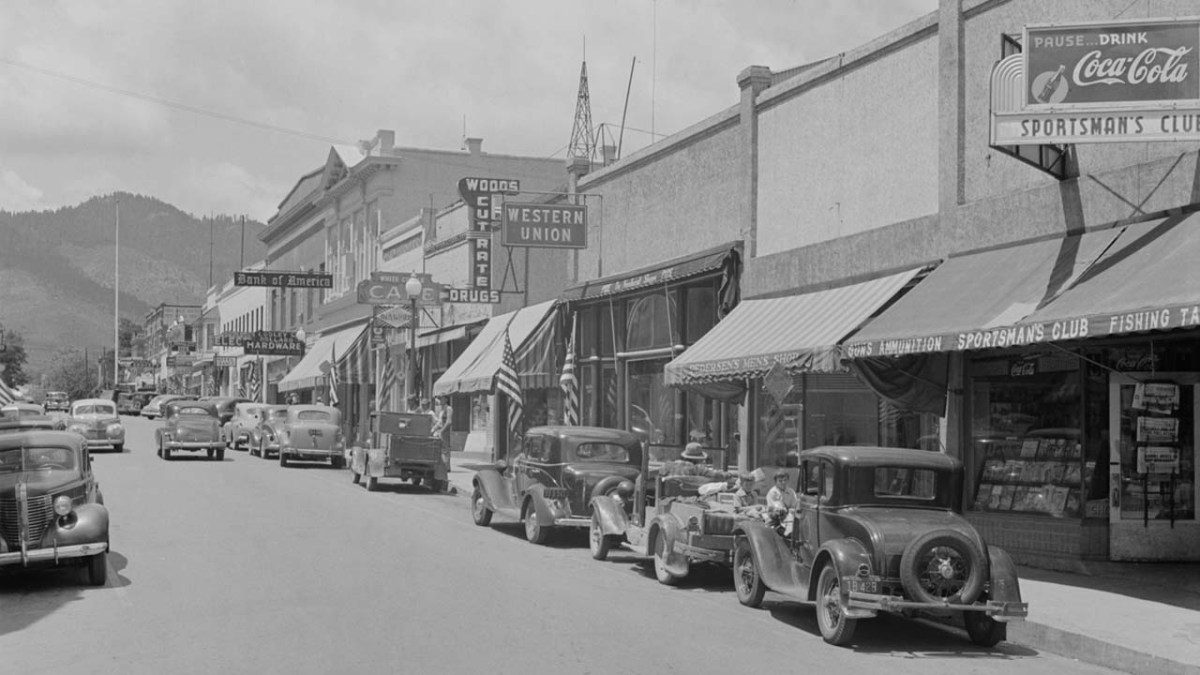
Main image: Yreeka, California, by Lee Russell, 1942, in the public domain via the Library of Congress.

Categories
Fiction Film & TV

FICTION: Scholomance, dir. Ewart Stangebye, 1927

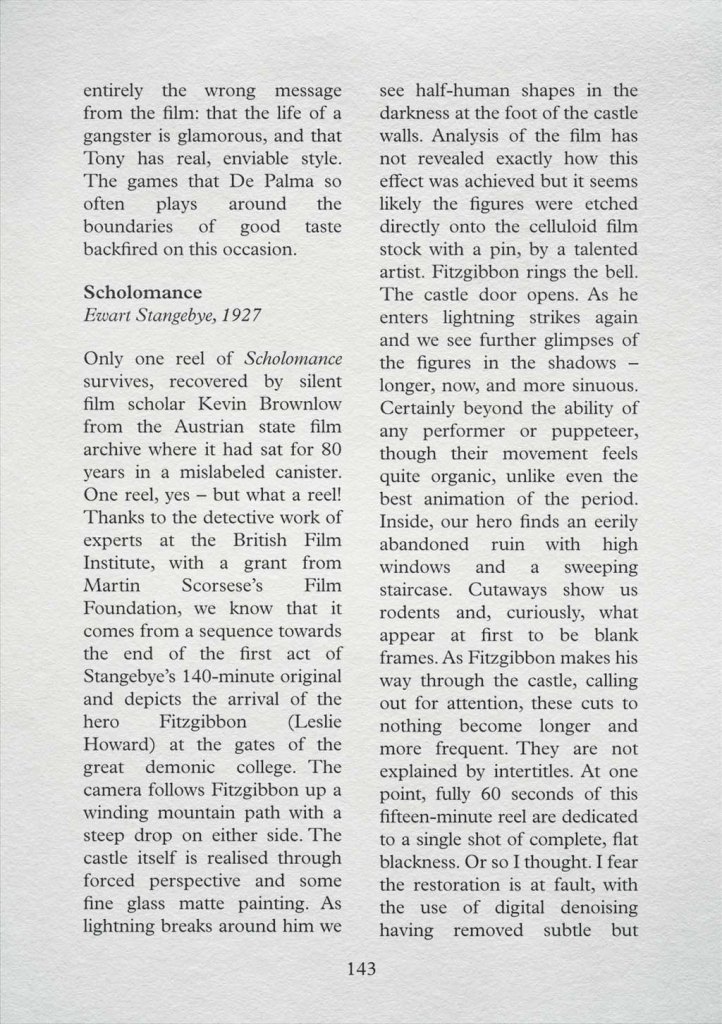
A page from a film guide that opens with the tail-end of a review: "...entirely the wrong message from the film: that the life of a gangster is glamorous, and that Tony has real, enviable style. The games that De Palma so often plays around the boundaries of good taste backfired on this occasion. Scholomance, Ewart Stangebye, 1927. Only one reel of Scholomance survives, recovered by silent film scholar Kevin Brownlow from the Austrian state film archive where it had sat for 80 years in a mislabeled canister. One reel, yes – but what a reel! Thanks to the detective work of experts at the British Film Institute, with a grant from Martin Scorsese’s Film Foundation, we know that it comes from a sequence towards the end of the first act of Stangebye’s 140-minute original and depicts the arrival of the hero Fitzgibbon (Leslie Howard) at the gates of the great demonic college. The camera follows Fitzgibbon up a winding mountain path with a steep drop on either side. The castle itself is realised through  forced perspective and some fine glass matte painting. As lightning breaks around him we see half-human shapes in the darkness at the foot of the castle walls. Analysis of the film has not revealed exactly how this effect was achieved but it seems likely the figures were etched directly onto the celluloid film stock with a pin, by a talented artist. Fitzgibbon rings the bell. The castle door opens. As he enters lightning strikes again and we see further glimpses of the figures in the shadows – longer, now, and more sinuous. Certainly beyond the ability of any performer or puppeteer, though their movement feels quite organic, unlike even the best animation of the period. Inside, our hero finds an eerily abandoned ruin with high windows and a sweeping staircase. Cutaways show us rodents and, curiously, what appear at first to be blank frames. As Fitzgibbon makes his way through the castle, calling out for attention, these cuts to nothing become longer and more frequent. They are not explained by intertitles. At one point, fully 60 seconds of this fifteen-minute reel are dedicated to a single shot of complete, flat blackness. Or so I thought. I fear the restoration is at fault, with the use of digital denoising having removed subtle but..." It continues on the next page.
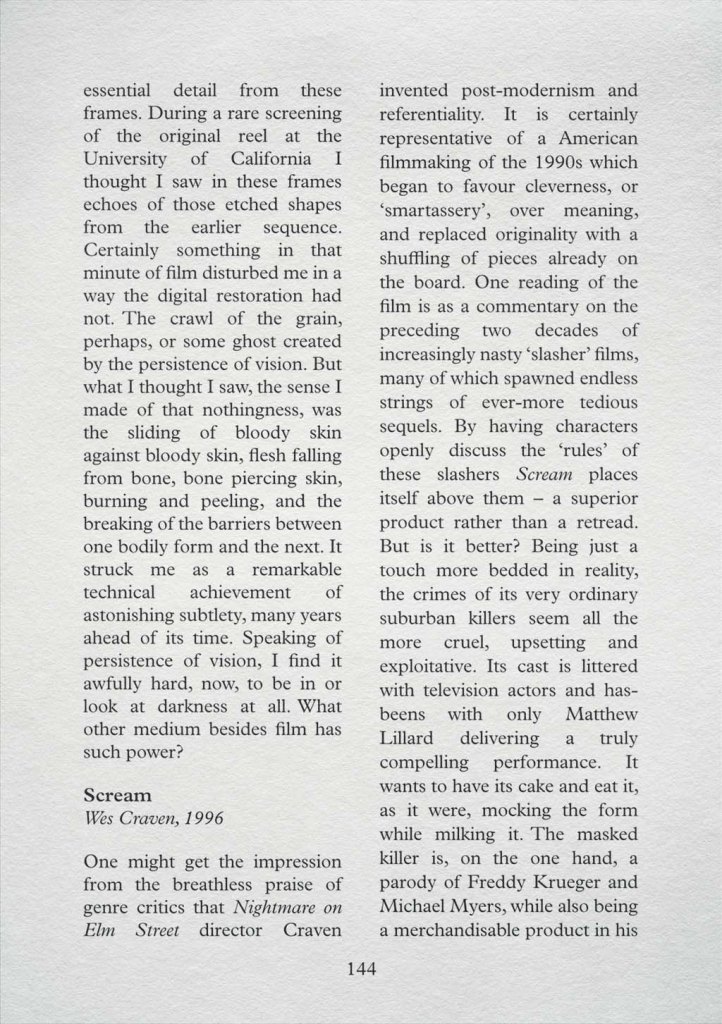
The following page from the same film guide: "...essential detail from these frames. During a rare screening of the original reel at the University of California I thought I saw in these frames echoes of those etched shapes from the earlier sequence. Certainly something in that minute of film disturbed me in a way the digital restoration had not. The crawl of the grain, perhaps, or some ghost created by the persistence of vision. But what I thought I saw, the sense I made of that nothingness, was the sliding of bloody skin against bloody skin, flesh falling from bone, bone piercing skin, burning and peeling, and the breaking of the barriers between one bodily form and the next. It struck me as a remarkable technical achievement of astonishing subtlety, many years ahead of its time. Speaking of persistence of vision, I find it awfully hard, now, to be in or look at darkness at all. What other medium besides film has such power? Scream, Wes Craven, 1996: One might get the impression from the breathless praise of genre..."
Categories
Fiction municipal gothic

FICTION: Winter Wonderland

When Dad turned up with tickets for Winter Wonderland, Tyler and I were truly astonished, for several reasons.

First, we hadn’t seen Dad since October, when he and Mum had one of their dramas. He stayed out all night and she waited for him. When we went to school, he still hadn’t turned up. He wasn’t there when we got home and she only laid three places for dinner. We knew better than to ask.

Secondly, it had already been agreed this was going to be a Little Christmas. In our family, this was an important concept. When Mum and Dad were flush, or had managed to patch things up with one or both sets of grandparents, we might get a Big Christmas. That meant proper presents, a proper Christmas dinner, and maybe even a proper tree. But most years were Little Christmases, where we each got a few things in a stocking and Christmas dinner was whatever Mum could conjure up from the freezer and the cupboards. One year, we had instant mash with Bisto and burgers.

Thirdly, even when there was a little bit of money around, Dad never bought us anything. It never occurred to him to treat or spoil us, or even to pretend to find fifty pence behind our ears. If he had coins in his pocket, he spent them on himself. Or very occasionally on Mum, if he was trying to heal a wound. Clothes, usually – skimpier and more gaudy than anything she would ever buy herself.

So, when he arrived on the doorstep, pink faced and cider breathed, chuckling and prancing like a clown, we simply didn’t believe him. He waved the envelope at us and pinched our cheeks.

‘Who’s the best Dad in the world, eh? My lovely girl and my lovely boy.’

You can now read the rest of this story in my collection Intervals of Darkness available as an eBook and paperback from 7 September 2024.

The cover of Intervals of Darkness by Ray Newman. It is mostly black with an illustration showing two doorways bathed in red light. Someone is striding out of one doorway casting a long shadow. In the other doorway is just a shadow, implying an unseen figure.

Declaration on the use of generative AI

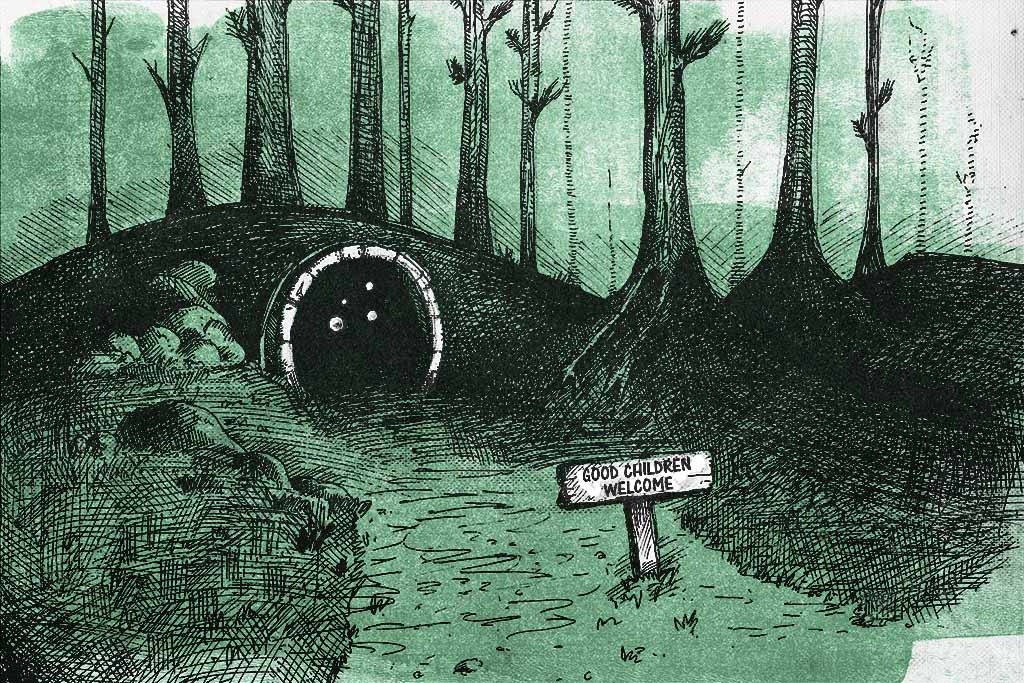
I didn’t use any AI tools, such as ChatGPT, to write the story. I drew the illustration myself with pen, on paper, and then edited it in Photoshop, which did include a small clean-up on the signpost using Adobe’s Generative Fill (Adobe Firefly).

Categories
buildings Fiction

FICTION: The Architects

‘I think I’d like to see Mountvale again,’ said Julian German from the tangle of his duvet.

Esther German, on her way to the airing cupboard with unnecessary haste, paused in the doorway of his room and peered at him. She smoothed a towel over her arm.

‘Did you say something, Jules?’

‘I said, woman, that I would like to see Mountvale one last time.’

Esther removed her glasses and let them hang around her neck on their beaded strap. She blinked and twitched.

‘Mountvale?’

‘Christ give me strength… Mountvale school. Bloody Mountvale. Again, meaning another time; once more.’

Esther came into the room with its smell of antiseptic cream and sweat. She lowered herself into the dusty steel-framed chair against the wall. Its feet scraped on the dull parquet. Julian winced.

‘The weather’s awful. Wouldn’t you rather spend the day in? I can find a film for you to watch.’

Julian put his hands behind his head.

‘No, I bloody wouldn’t. I want to see that school. One last time.’

‘I don’t see why. It’s a very ordinary building and–’

‘Russell Cavendish brought it up the other day. Said somebody from Historic England was talking about getting it listed. Unique example of post-war construction.’

‘But Russell–’

‘The first use of curtain walling in the whole county,’ Julian went on.

Esther looked towards the large window, speckled with rain and streaked with green moss at its corners.

Julian shook his head and growled.

‘Are you going to drive me or shall I drive myself?’

Julian had always been too tall to sit comfortably in cars. Even now, with a hump in his back and a couple of inches lost to the erosion of his spinal cartilage, he looked uncomfortable in the passenger seat of the Citroen.

Esther leaned forward against the steering wheel, thin wrists at ten to two. Her lips were pulled back from her teeth as she squinted past the windscreen wipers.

A passing van threw a fine mist from the road.

‘Left,’ snapped Julian, pointing with bunched arthritic fingers.

Esther ignored him.

He grabbed at the steering wheel.

‘Bloody left, woman! Left.’

She slapped his hand away and he winced.

‘Don’t panic, darling. I’m driving, not you, and I know the way.’

He stroked the translucent skin where she’d made contact, inspecting for a bruise, and pouted.

‘Do you? Know the way, I mean? I didn’t see you look at a map before we left.’

‘I don’t need a map.’

‘Typical woman. Why bloody plan anything?’

At a roundabout, she took the right exit. Julian leaned towards the window, scanning the road signs. He looked over his shoulder.

‘Where the bloody hell are we going now?’

‘It’s funny,’ said Esther, her voice unsteady. ‘The listing thing. Nothing we worked on was built to last, was it?’

‘Speak for your bloody self,’ said Julian, forgetting for a moment his anxiety over the route. ‘I always saw my work in context as part of the broader sweep of history.’

‘Our work,’ said Esther.

‘Oh, for God’s sake…  Yes, yes, technically, yes.’

‘And do try not to lecture. I’m not one of your students.’

He shrugged and folded his arms.

‘You were never a preservationist, anyway,’ she went on. ‘Knock it all down, you used to say.’

Julian didn’t reply.

Esther took her eyes off the road for a moment and saw that he’d fallen asleep, quite suddenly, as he often did in the car.

‘This isn’t the way to Mountvale,’ Julian bellowed.

‘I do wish you’d wear your hearing aid, darling. Then you’d know how loud you’re being.’

‘I don’t need it. My hearing is fine. And this is completely the wrong direction.’

They were on a country lane, now, passing through a village with a Norman church.

‘I thought we might go somewhere else instead of Mountvale,’ said Esther.

‘Where the hell are we?’

He saw and recognised the pub and so knew the village.

‘There’s a layby up ahead. You can turn there.’

‘Wouldn’t you like to stop for lunch? You could have a pint of beer.’

‘Don’t mother, me woman. For one thing, you’ve had no bloody practice. Just turn the car around and take me to Mountvale.’

Esther did as she was told, struggling with the gear stick as she conducted a five-point turn in ever-heavier rain.

‘I’m sorry,’ said Julian after a few moments, once he’d got his way. ‘About the mothering business. I forget sometimes.’

‘It’s alright, darling,’ said Esther. She sounded weary.

‘I’d have been a dreadful father, anyway.’

‘You certainly aren’t a terribly good husband.’

Julian laughed.

‘That’s my girl,’ he said, reaching across to pat her thigh. ‘As good as you get, eh?’

She brushed him away.

‘I’m driving.’

As they got nearer to Mountvale, in the early winter twilight, Julian became agitated again.

‘This is the estate, isn’t it? It’s changed a lot.’

‘Well, a lot of lives have been lived here,’ said Esther. ‘These buildings were always meant to be used.’

‘Plastic windows. Pebbledash. Pastel paint. Dreadful. Why did they cover the concrete?’ He raised his chin in lecturing mode. ‘It had such purity.’

‘But we didn’t have to look at it every day, did we? Or live in it, or work in it.’

‘Not that old argument!’ said Julian raising his voice and twisting in his seat.

She took advantage of his distraction to make a deliberate wrong turn.

‘Goldfinger lived in his tower, didn’t he?’

‘For a short while. But Le Corbusier lived in a fishing cottage. And Lubetkin lived in a Georgian townhouse.’

‘I’d have gladly lived on any of the estates where we worked. Our house, the house I designed for us–’

‘That we designed.’

‘Yes, yes, our house is true to the principles, isn’t it?’

Esther didn’t reply to that, not even to mention the draughts that blew through the open plan living area, or the water that gathered on the fatally flat roof all year round.

They were on a crescent, now, with a rippling concrete road and prefabricated homes. The house lights and streetlights had begun to come on.

‘This isn’t the way,’ said Julian. ‘I’m sure I remember…’ His mouth opened and closed as he tried to grip onto something. Spit gathered in the corners of his lips. He slammed a hand onto the dashboard.

‘Central square, community centre, health centre, shopping parade, schools complex opposite – primary, junior, secondary. These crescents are at the other end of the estate.’

‘You’re quite right, so they are,’ said Esther quietly.

‘What?’

She didn’t repeat herself, just flipped on the indicator and entered the final phase of the journey.

It couldn’t be avoided, now.

She parked the car half on the kerb and turned off the engine. The lights died with it.

They sat together in silence as rain sounded on the roof and windscreen.

Julian sighed.

‘Where’s my umbrella?’

Esther reached into the back seat and found it for him.

He undid his seatbelt and got out. After a struggle he got the umbrella up and lifted it. In his swollen hand, over his big head, it looked absurd, like something from Jacques Tati.

As he shuffled to the black cast-iron gate, Esther remembered when his stride was long and confident. She pulled the hood of her well-worn anorak over her head and joined him.

She looped her arm through his and they shivered together.

The gate and fence were still there but beyond was wasteland: concrete, wild grass, scattered bricks and litter.

‘The school’s gone,’ he said quietly.

‘Yes.’

 A large sheet of clear plastic trapped in brambles snapped and boomed.

‘But Russell said…’

‘Russell’s been gone a long time, too, darling.’

‘Gone?’

‘Three years.’

‘A highly significant building, he said, and now…’

‘Not significant enough. And with too much asbestos.’

Julian snatched his arm away.

‘A sound material, in its day. Hindsight is a bloody fine thing.’

‘Come on, Jules, let’s go home. Aren’t you hungry?’

Julian didn’t move except to raise a hand to the railings. He wrapped his fingers around the rusting metal and the wind filled his eyes with water.

The next morning, the sun made golden stripes on the far wall of the bedroom as it passed through the blinds.

‘Esther! Where the hell are you? 

Esther’s footsteps sounded along the parquet in the hall. She appeared in the doorway, small and exhausted.

‘I’ve had a thought.’

‘Yes?’

‘I’d like to see Mountvale one last time.’

Esther blinked and sighed.

‘Mountvale?’