Categories
1959 books reading1959

Reading 1959: Memento Mori

Confession: this is the first Muriel Spark I’ve ever read, and I don’t know anything about her except what I gleaned from the brief bio in the back of the book, and a vague sense that she’s Important.

Memento Mori tells the story of an interconnected group of Londoners, most in their seventies and eighties – novelists, poets, theatrical types, academics, and their resentful servants and children.

The twin engines of the plot are, first, a series of anonymous phone calls in which, one after another, the characters are told, “Remember you must die”; and, secondly, a dark tale of wills, infidelity and blackmail.

At times, there are echoes of Agatha Christie, but without the familiar structure, and of Patricia Highsmith and Shirley Jackson, both specialists in drawing suspense from fibs, foibles and fading sanity.

My favourite characters are Godfrey, a selfish octogenarian whose failure in life is masked by upper class entitlement, and Mrs Pettigrew, the sinister 73-year-old housekeeper who exploits him. Within hours of arriving to takeover the running of the home Godfrey shares with his senile wife, Charmian, Mrs Pettigrew is showing her stocking-tops to Godfrey in exchange for pound notes. Soon after, creeping around the house making copies of keys, she has ferreted out his every secret and is pressuring him to change his will in her favour.

As someone who spent 30+ years immersed in crime fiction and thrillers, I’ll admit to feeling a prickle of irritation that the loose-end of the phone calls isn’t wrapped up. But once I’d accepted the most likely answer – the voice on the line, which sounds different to each recipient, might be the Grim Reaper himself – I started to file this alongside Robert Aickman, and felt happier.

Does it say much about 1959? I don’t think so. Class structures aside, the reflections on growing old and the weird mutations of very long relationships, seem utterly timeless.

But, still, it’s a funny, emotionally truthful, acidic little book that I’m delighted to have been pushed towards by this project of mine.

Categories
1959 books reading1959 Uncategorized

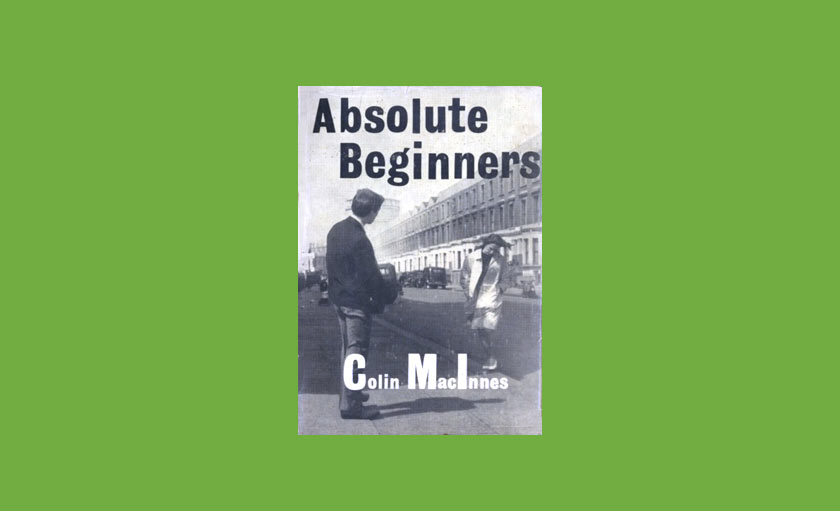
Reading 1959: Absolute Beginners

Colin MacInnes’s Absolute Beginners is an invigorating virtual reality experience – a hot London summer spent swimming in the primordial soup of a teenager’s head.

If No Love for Johnnie was about a generation struggling to break free from Victorian tradition, the misery of slum-life and the trauma war, then Absolute Beginners presents what is left when the cocoon is finally shed.

The nameless 18-year-old protagonist didn’t fight in the war, though he is a ‘Blitz baby’, and doesn’t care for the ‘sad, gloomy and un-contemporary’.

He successfully presents himself as cynical for the first half of the book, professing to care about nothing, not even the ever-present threat of atomic war. He seems to despise his pathetic cuckold of a father, his promiscuous mother, and his hopeless half brother. At one point, just when the reader might be warming to him, he exploits a girl’s heroin problem for his own ends.

But a steady tap, tap, tap of optimism and enthusiasm begins to shine through: he loves his on-off girlfriend, Crepe Suzette, wholeheartedly.

He loves jazz, too. Really loves it, not for show, but in his bones: it ‘sends him’.

He takes pornographic photos to pay the rent but all the time he is slowly turning into a real photographer – into an unashamed artist.

When he is really tested, when he is asked to prove his humanity as race riots turn West London into a warzone, he cannot pretend to be other than an idealist. He sides with the underdogs, against the racists, and risks his neck to do the right thing in a pocket civil war.

Ultimately he can’t even conceal the love he feels for his parents. “Don’t be a c–t,” says his his mother at one point, but we, and he, know what she really means.

Almost everyone in this book behaves surprisingly, from the proto-hippy pimp who turns out to be a bright-eyed fascist, to the retired Admiral who refuses to be homophobic for the TV cameras. These characters are hard to grasp and all the more real for it.

But Absolute Beginners was written in the late 1950s, and so perhaps Crepe Suzette is lacking a dimension or two – a manic pixie dream girl with the sex dial turned up. On the whole, the female characters aren’t as convincing or as interesting as the male characters, even Big Jill the lesbian pimp.

After a stretch where it seems black characters might be treated merely as a background mass, individuals emerge, though still primarily as non-player-characters for the white protagonist to react against or move towards. Some of his best friends are black, and all that.

(But, come on, let’s be fair: compare this with the grimmer, greyer angry young man novels where there are hardly any non-white characters, and in which women are generally either fantasy figures or ambition-crushing marriage traps.)

Quibbles aside, spat out of the far end of Absolute Beginners, my heart was beating fast. I could still see the colours, hear the beat, and the roar of the Vespa. I felt 20 again. I wanted to go out on to the streets and do something to make things better. (And, very badly, to see my Dad for a pint.)

Categories
books reading1959

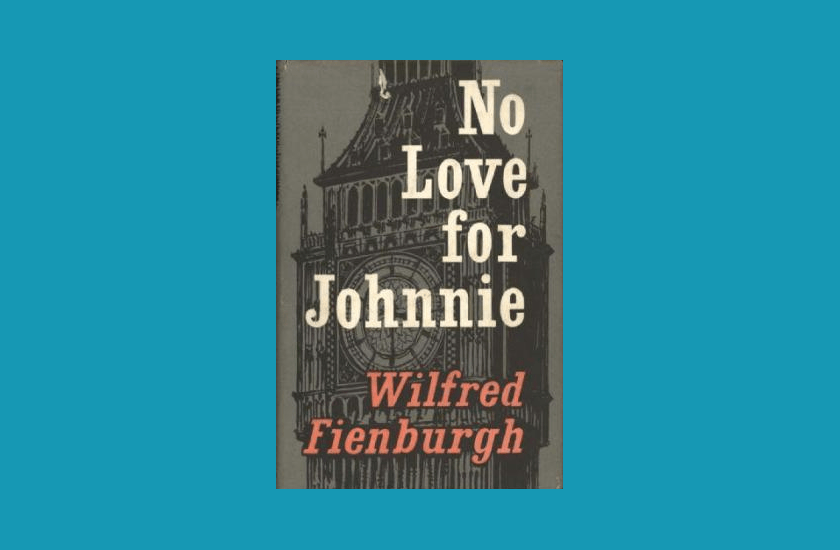
Reading 1959: No Love for Johnnie

This felt like a good week to be reading a drama about the underlying loneliness and emotional frailty of a Westminster big shot, written by a serving MP.

No Love for Johnnie is really a 1958 novel but its publication was delayed due the death of the author, Wilfred Fienburgh, in a car crash at Mill Hill in north London in February that year.

Is the depiction of the handsome, sexually inexperienced, unhappy, arrogant, insecure, vain Johnnie Byrne MP actually Fienburgh laying himself bare?

Byrne was brought up in the fictional Yorkshire town of Bradley, Fienburgh in Bradford. Byrne served in World War II, reaching the rank of captain from the ranks, while Fienburgh was demobbed as a major. Byrne became an MP in 1950, Fienburgh in 1951.

Perhaps we can conclude that Fienburgh was getting something off his chest in depicting the collapse of Johnnie Byrne’s left wing idealism, and the mid-life crisis brought on by his passionless marriage. Or maybe he was just wargaming the worst-case scenario — picturing at 37 where he might be in five years time.

As someone who didn’t grow up embroiled in Labour party politics, this was a fascinating crash course for me: the battle between the left and right of the party, the philosophical debates over whether it is acceptable to compromise on left wing values for the sake of gaining and retaining power, and the need to switch between modes in Westminster on Wednesday and the constituency clinic on Friday morning.

One glimpse into the moment when this book was written is that Byrne owes his career in large part to his good looks and a strong performance on television in the run up to the general election. This really was something Labour was focused on at the end of the 1950s, even sending selected MPs on training courses to learn how to work the camera. (I’m delighted to find that the newspapers and books from 1959 I’m reading echo each other so clearly.)

Byrne lives on edge, constantly judging whether to flatten his vowels and speak plainly, or slip into an affected officers’ mess drawl, or use the neutral high register he has cultivated for conspiring with fellow MPs. Ignore the political plot and this is yet another story about a man cast adrift by social mobility, confused about his place in the world, able to fit in anywhere but really belonging nowhere. (See also Hoggart’s Uses of Literacy, 1957.)

Two novels into #Reading1959 certain themes are beginning to emerge. First, everyone is miserable because they can’t have sex until they’re married, so they end up marrying the first person they even slightly fancy, blind to their incompatibilities. In the case of Johnnie Byrne, it’s a Bradley lass, Alice, who is busy with her own political career as a leading light in the Communist Party of Great Britain. Not only is she emotionally cold but, Johnnie later discovers, her politics are the cause of the stalling of his career — the Prime Minister can’t give him a Cabinet role while she is in the picture, with her connections to Moscow.

Secondly, there’s the war, of course. Naive young men forced to grow up observing atrocities, reeducated in the brothels of Belgium, and turned into gentlemen by accident as pips appear on their tunics. For Byrne, the war isn’t about trauma, it’s about guilt. He wasn’t an effective leader of men, he was a coward, and he knows it, even if the world believes otherwise. A flashback to the taking of a French farmhouse sometime after D-Day reads like a Commando comic (“Bren gun…. Pass a Bren.”) until the moment when Byrne’s entire platoon is cut down by machine gun fire while he hides, vomiting, in a hayloft.

There are stretches where this book reads like pure pulp — titillation, cheap drama, obvious words and stock phrases dumped on the page — but where it works is in the honesty with which it depicts the unravelling of the male brain. When Byrne fails to get a Cabinet job, his wife leaves him, and he immediately becomes obsessed with getting a young girlfriend to make up for the lost years. His fling with Pauline, a self-assured 20-year-old he meets at a party, is passionate but brief, and then becomes merely sad: he stalks her to her family’s home in Yorkshire after she tries to get away from him, where he ends up dressed in one of her Dad’s too-small spare suits, while she refuses to play the part in his fantasy he demands.

At the end of the book, he still has nobody to love, and nobody to love him back, but he knows who he is: a grasping, arrogant, ambitious coward who would rather accept the job of Deputy Postmaster General, and the rather remote prospect of a Cabinet job when he’s proved his worth, than change.