Categories
1959 books reading1959

Reading 1959: Memento Mori

Confession: this is the first Muriel Spark I’ve ever read, and I don’t know anything about her except what I gleaned from the brief bio in the back of the book, and a vague sense that she’s Important.

Memento Mori tells the story of an interconnected group of Londoners, most in their seventies and eighties – novelists, poets, theatrical types, academics, and their resentful servants and children.

The twin engines of the plot are, first, a series of anonymous phone calls in which, one after another, the characters are told, “Remember you must die”; and, secondly, a dark tale of wills, infidelity and blackmail.

At times, there are echoes of Agatha Christie, but without the familiar structure, and of Patricia Highsmith and Shirley Jackson, both specialists in drawing suspense from fibs, foibles and fading sanity.

My favourite characters are Godfrey, a selfish octogenarian whose failure in life is masked by upper class entitlement, and Mrs Pettigrew, the sinister 73-year-old housekeeper who exploits him. Within hours of arriving to takeover the running of the home Godfrey shares with his senile wife, Charmian, Mrs Pettigrew is showing her stocking-tops to Godfrey in exchange for pound notes. Soon after, creeping around the house making copies of keys, she has ferreted out his every secret and is pressuring him to change his will in her favour.

As someone who spent 30+ years immersed in crime fiction and thrillers, I’ll admit to feeling a prickle of irritation that the loose-end of the phone calls isn’t wrapped up. But once I’d accepted the most likely answer – the voice on the line, which sounds different to each recipient, might be the Grim Reaper himself – I started to file this alongside Robert Aickman, and felt happier.

Does it say much about 1959? I don’t think so. Class structures aside, the reflections on growing old and the weird mutations of very long relationships, seem utterly timeless.

But, still, it’s a funny, emotionally truthful, acidic little book that I’m delighted to have been pushed towards by this project of mine.
Categories
1959 books reading1959 Uncategorized

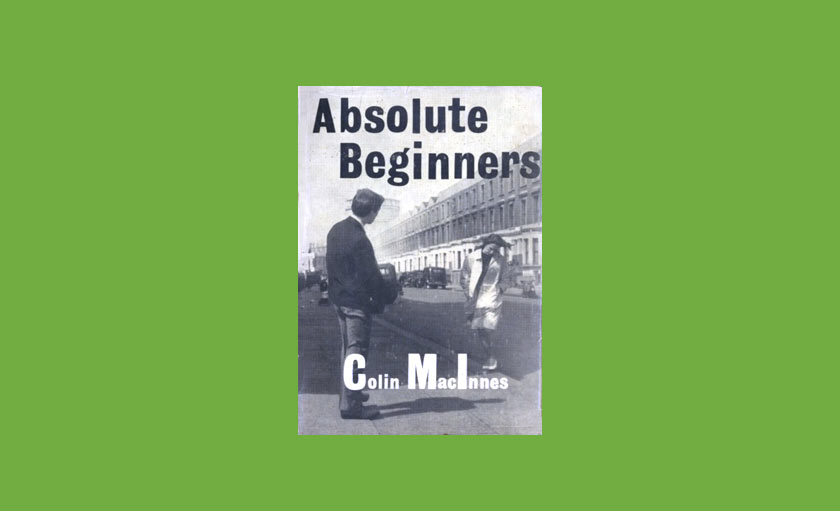
Reading 1959: Absolute Beginners

Colin MacInnes’s Absolute Beginners is an invigorating virtual reality experience – a hot London summer spent swimming in the primordial soup of a teenager’s head.

If No Love for Johnnie was about a generation struggling to break free from Victorian tradition, the misery of slum-life and the trauma war, then Absolute Beginners presents what is left when the cocoon is finally shed.

The nameless 18-year-old protagonist didn’t fight in the war, though he is a ‘Blitz baby’, and doesn’t care for the ‘sad, gloomy and un-contemporary’.

He successfully presents himself as cynical for the first half of the book, professing to care about nothing, not even the ever-present threat of atomic war. He seems to despise his pathetic cuckold of a father, his promiscuous mother, and his hopeless half brother. At one point, just when the reader might be warming to him, he exploits a girl’s heroin problem for his own ends.

But a steady tap, tap, tap of optimism and enthusiasm begins to shine through: he loves his on-off girlfriend, Crepe Suzette, wholeheartedly.

He loves jazz, too. Really loves it, not for show, but in his bones: it ‘sends him’.

He takes pornographic photos to pay the rent but all the time he is slowly turning into a real photographer – into an unashamed artist.

When he is really tested, when he is asked to prove his humanity as race riots turn West London into a warzone, he cannot pretend to be other than an idealist. He sides with the underdogs, against the racists, and risks his neck to do the right thing in a pocket civil war.

Ultimately he can’t even conceal the love he feels for his parents. “Don’t be a c–t,” says his his mother at one point, but we, and he, know what she really means.

Almost everyone in this book behaves surprisingly, from the proto-hippy pimp who turns out to be a bright-eyed fascist, to the retired Admiral who refuses to be homophobic for the TV cameras. These characters are hard to grasp and all the more real for it.

But Absolute Beginners was written in the late 1950s, and so perhaps Crepe Suzette is lacking a dimension or two – a manic pixie dream girl with the sex dial turned up. On the whole, the female characters aren’t as convincing or as interesting as the male characters, even Big Jill the lesbian pimp.

After a stretch where it seems black characters might be treated merely as a background mass, individuals emerge, though still primarily as non-player-characters for the white protagonist to react against or move towards. Some of his best friends are black, and all that.

(But, come on, let’s be fair: compare this with the grimmer, greyer angry young man novels where there are hardly any non-white characters, and in which women are generally either fantasy figures or ambition-crushing marriage traps.)

Quibbles aside, spat out of the far end of Absolute Beginners, my heart was beating fast. I could still see the colours, hear the beat, and the roar of the Vespa. I felt 20 again. I wanted to go out on to the streets and do something to make things better. (And, very badly, to see my Dad for a pint.)

Categories
1959 buildings history

Reading My Way Through 1959

I’m planning to spend 2019 reading only novels from 1959, with some extra homework on the side.

Why? Because in 2017, I set myself a similar reading challenge – only books by women – and it helped me focus. I read more, and more widely, and more books that were new to me. I discovered some new favourite writers (such as Edna O’Brien) and the habit stuck: I continued to read more books by women in 2018, and feel better for it.

But in 2018, with no specific challenge, I read less overall, and caught myself lazily returning to old favourites out of which I have already chewed all the flavour.

So, for this year, I needed a challenge, and focusing on a specific time period seemed like a good idea. The mid-20th century happens to be where my head is at a lot of the time anyway. It also happens to be when the Big Novel I’m working on is mostly set, so this also doubles as research.

I landed on 1959 specifically by asking my handful of discerning Twitter followers to choose between 80 years ago, 70, 60, and 50. (It was close – 1969 nearly won.)

As of this morning, I’ve started reading Free Fall by William Golding, which I found on Wikipedia’s list of British novels published in 1959, and then happened to stumble across in a secondhand bookshop in Osterley on Sunday. “Perhaps you found this book on a stall fifty years hence which is another now”, he writes eight pages in, bending my mind somewhat, despite being ten years out. It’s not quite my usual thing – very self-consciously literary, prose verging on Joycean – but it seems to have hooks in me already.

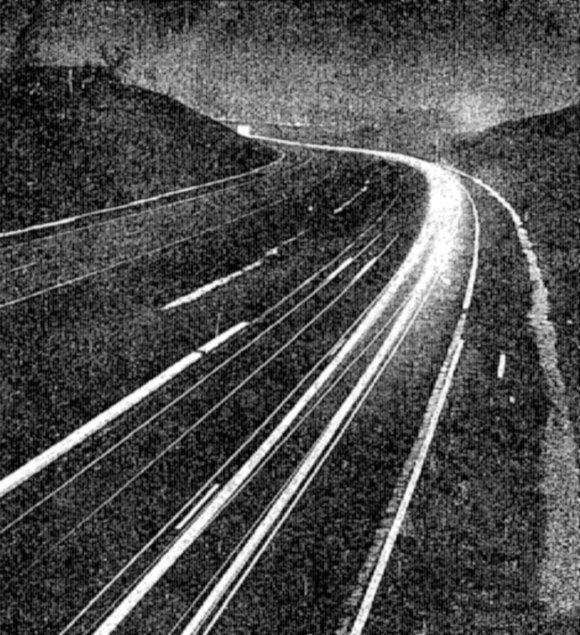
A low resolution image of streaks of light on a curving road.
From the front page of the Manchester Guardian for 1 January 1959: ‘The lights of south-bound vehicles on the Preston Motorway’.

On the side, though, I’m also going to try to do something I’ve been thinking about for years: reading a daily newspaper for each day of 1959.

This has never been easier than today with local libraries offering access to The Times and the Guardian, and the incredible British Newspaper Archive providing scans of all kinds of local and national titles.

On 1 January 1959 the Manchester Guardian was declaring A PROSPEROUS NEW YEAR with “Industrial shares index at highest level ever”. It reported that actor Alec Guinness had been awarded a knighthood, and that the West had rejected Nikita Khruschev’s suggestion that Berlin be made a “free city”. Meanwhile, in Cyprus, EOKA issued a defiant new year message for the British government: “We will emerge from our present peaceful attitude as FULLY armed avengers to return the blows.”

Postcard of Coventry Cathedral.

Given my interest in post-war architecture, I was also interested to read this:

To-day, for the first time, hymns and prayers have sounded in Coventry’s new cathedral. They came not from the choice and chapter but from the unaccustomed voices of the masons and labourers, tilers and glaziers and plumbers, whose hands are raising the walls of what to-oday we heard called “This great fortress of God in Coventry.”

Unfortunately, an opinion piece on racial tension, and a surge in white nationalist tendencies, suggests that there’s little shelter from the problems of 2019 to be found in desk-bound time travel.

I’ll also be making a point of listening to music from 1959, and watching films and TV from the same year, without being exclusive about it. I’m looking forward to rewatching Room at the Top for starters, which I last saw as a teenager in Steven Bennison’s media studies class at Bridgwater College.

If anyone feels like joining in, or borrowing this idea but wallowing in a different year, go for it – I always enjoy company on these expeditions.