Categories
1959 books reading1959

Three pulp paperbacks about juvenile psychopaths

What happens when angry young men are more than angry? These three roughly contemporary books give us portraits of youths struggling with their own murderous instincts.

I came to The Furnished Room, Big Man and The Dead Beat one at a time after finding tatty old paperbacks in charity shops or roadside book swap boxes.

All three were written during a period of anxiety about juvenile delinquency and a simultaneous growth in popular discussion of psychopathy.

The term ‘psychopath’ was popularised in the 1940s and a slew of novels and movies from that point on portrayed a particularly chilling type of killer. Being outwardly in control, and even charming, they were able to walk and live among us.

Joseph Cotten’s Uncle Charlie in Alfred Hitchcock’s brilliant 1943 film Shadow of a Doubt is one example. Patricia Highsmith’s The Talented Mr Ripley introduced us to the chameleonic Tom Ripley in 1955.

At the same time, young people were beginning to seem dangerously out of control, with motorbikes, switchblades, and a lack of respect for authority.

That’s the context in which the following three pulp paperbacks emerged.

Little boys to broken men

Big Man is the earliest, published in 1959. Its author was prolific novelist Evan Hunter, born Salvatore Lombino, and best known for a series of police procedural novels written under the name Ed McBain. He wrote this book as Richard Marsten and it reflects something of that sense of fractured personae.

It’s written from the point of view of Frankie, a young man living in poverty with an alcoholic mother, and drawn into petty crime by sheer boredom. Petty crime leads to organised crime where, after resisting, he embraces his true murderous self.

The 87th Precinct novels are set in an anonymised fantasy of New York where Manhattan is Isola, Queens is Bethtown, the river is the Harb, and so on. Big Man is set in New York proper, where Hunter grew up and which he knew at street level. 

This authenticity shines through in his portrayal of the everyday lives of idle young men with no coin in their pockets and every reason to feel detached from the world. That Frankie’s best friend Jobbo has appalling body odour sets the tone: this is a world where sweat stinks.

These early chapters are similar in mood to The Incident, a 1967 film based on a 1963 TV play, about two young men who terrorise a New York City subway car. In both cases, the thesis is that the road to murder begins at robbery, and robbery comes as much from a need for something to do as from the urge to acquire.

For Frankie, the lure of organised crime isn’t so much money but also a sense of family, respect, and affection. The mob boss is a father figure – someone who tells Frankie he is a good boy and has value.

Even through Frankie’s unreliable narration we see, of course, that he is being preyed upon and manipulated. Through favours owed, debts incurred, steps taken from which there is no walking back, he is drawn away from society and becomes ever more tangled in a shadow world with its own values.

What really sets the book apart is Frankie’s relationship with his two lovers. Frankie is torn between two women – a sexually insatiable gangster’s moll who has been with the whole crew, and the nice neighbourhood girl who wants to start a family.

It is shocking when he shoots the former on the indirect order of his boss. It is absolutely devastating when he puts a bullet in the head of the second because she has become a hindrance to his career.

Hunter plays with our prejudices: promiscuous girls who get involved with criminals put themselves in the firing line, but nice girls who just want their boys to go straight? They deserve a happy ending.

By the end of the novel, Frankie has become a killing machine, like a soldier trained for combat. He follows orders and shoots when he’s told to shoot.

He is also cursed with the knowledge that if he can bring death to the others so swiftly and easily, then death can come to him the same way.

A suburban house in America.
SOURCE: Library of Congress.

The killer is in the house

Robert Bloch’s The Dead Beat was published in 1960 and tells the story of another blank, murderous young man.

Larry Fox is a dead beat jazz pianist who finds a way to break out of the world of crime, prostitution and drugs and into the nice suburban home of a nice suburban family.

His great skill is being able to present as a good boy when it suits him – or maybe these are actually glimpses of the real Larry, or another Larry, battling Bad Larry for supremacy?

As Good Larry, he’s bashful, well-spoken and polite. He’s musically talented and has hopes to study composition at university. This is catnip for the middle class saviours who take him in and nurse him when they find him unconscious in the back of their car. Especially the women.

But Bad Larry plans to get revenge on his former accomplices in a robbery and will fuck, rob, drug and manipulate anyone who gets in his way, or can help him achieve his goal.

Bloch doesn’t expect the reader to read between the lines. He has his characters debate matters of juvenile delinquency and ‘the beatnik problem’ which gives him an excuse to insert chunks of his thesis into the text:

It all began with World War One, I suppose. Up until then, the traditional role of the young man in this country was that of an apprentice. In rural communities he started as a hired hand or helped his father on the farm. In the cities he entered business as a clerk or a messenger or an office boy. Youth accepted a subordinate position unquestioningly, even when the industrial era developed… War is the great glorifier of youth… Our economic leaders, through the media of advertising, assure us that it is the duty of everyone to appear young; to buy products which enhance the illusion of immaturity. Our books, magazines, motion pictures and television programs inform us, not too subtly, that romance and adventure are the exclusive property of young people between the ages of seventeen and twenty-five. Nobody over that age ever falls in love or experiences anything of lasting significance, except for a few oddball characters thrown in for comedy relief.

Bloch was primarily a writer of horror stories and the scary idea in this story is that adults cannot tell good boys from bad ones. That nice young man your daughter is dating might be a hophead, a junkie, a pervert or a killer – better not let him in. Especially not if he reminds your wife of when she was young.

A Victorian terraced house in West London.

The kitchen sink killer

Crossing the Atlantic, Laura Del-Rivo’s The Furnished Room was published in 1961 and filmed as West 11 in 1963.

In many ways it sits alongside British social realist novels like Saturday Night and Sunday Morning or, closer in tone and setting, Absolute Beginners. The difference is that Del-Rivo introduces a gun into the mix turning it into something like a crime novel, or one of Georges Simenon’s romans durs.

Joe Beckett is another semi-intellectual, but a reader rather than a musician. Like Larry Fox, he is capable of making himself presentable, as long as nobody gets close enough to notice the grubbiness of his shirt or smell his unwashed socks. To some people he reads as clever, almost an intellectual, although his drug-fuelled lectures don’t stand up to the scrutiny of really intelligent people.

As with the protagonists of many other British novels of the period, he is too full of fury to be constrained by the drudgery of a nine to five job, or by love and marriage. Unlike Arthur Seaton, however, he decides that committing a murder might fix the emptiness inside him.

Haunting the cafes and bedsits of West London, Joe meets a classic British type: the faux-military conman with a range of regimental ties to suit whichever story he is telling on any given day. Keen to inherit from an aged aunt, he draws Joe into a scheme apparently inspired by Strangers on a Train.

That standard crime plot isn’t where the excitement lies in this story, though. That’s in Joe’s battle with his own worst instincts. He has constant intrusive psychopathic, paedophilic and fascistic fantasies. Reading about Nazi concentration camps thrills him:

Beckett’s immediate reaction had been a burst of sadistic joy. He knew that if, at that precise moment, he had seen a woman prisoner with her arms yearning for a lost child, he would have kicked her in the face. The shooting of the new detachment had pleased his sense of order. They were damn nuisances, screaming and panicking like that. Shooting them was the only orderly thing to do. He loathed the prisoners for their ugliness, their suffering, and their lack of pride. The photographs of these degraded sufferers, squatting behind their barbed wire, had revolted him so much that he had thought it a pity that the whole lot hadn’t been gassed. He had preferred the photographs of the Nazi guards, who had at least looked clean and self-respecting.

This book in particular feels like a commentary on present day alt-right, manosphere and incel cultures.

All three books force us to inhabit the minds of boys who don’t know how to love, even if they sometimes get close.

Those are the moments when we want them to break through the barriers, to untangle the complex feelings that threaten to break through their anger, resentment and hatred.

But they can’t do it. So they reach for guns and point them at innocent people.

Categories
1959 books

Reading 1959: The Tin Drum

The Tin Drum -- original cover design by Grass.

The final book for this year’s reading project is a suitably dense full stop of a novel that forced me to attempt a revival of long-dormant skills of critical interpretation.

Günter Grass’s magic-realist historical epic was published in German in 1959 and in English in 1961. Grass, born in 1927, served in the Waffen-SS as a conscripted child soldier at the end of World War II. He won the Nobel Prize for Literature in 1999.

A very brief summary: Oskar Matzerath is born in Danzig, a city both German and Polish, in 1921; at the age of three, he decides to stop growing, and so remains a child throughout the rise of Nazism; he expresses himself through compulsive drumming and, every now and then, by smashing glass with his scream. Oskar’s family evolves, dissolves and reconstitutes as he falls into the orbit of one character after another, from Bebra the Nazi propaganda dwarf to the bedridden jazz musician Klepp. The war ends, Danzig becomes Gdansk, Oskar decides to give up his drum and grow, at last, before washing up in Düsseldorf and, finally, a madhouse.

You could, I suppose, take it at face value as a macabre fantasy story about a man-child with supernatural powers. As a Stephen King novel with extra eels, however, it’s a failure, being episodic, rambling and bewildering for long stretches.

No, it’s obviously about Germany and the madness of the 20th century. The reader’s job is to unpick more specific meaning from the rock-slide of imagery and symbolism.

Let’s start with the easy stuff, then: Oskar, who cannot say for sure whether his father is the German Matzerath or the Pole Bronski, represents Danzig-Gdansk, or Prussia more generally. Both he and the city exist in a state of permanent, unsustainable tension.

What about the horse’s skull crawling with eels the sight of which makes Oskar’s mother vomit before driving her to commit slow suicide by gorging on fish? This feels like a pivotal moment and suggests war, holocaust and the destabilisation of Europe through its infestation by nationalism. But it’s also about the human body – we all rot, we’re all meat and slime and bone.

The erotics of disgust are a constant theme throughout the book. Bullying children make Oskar eat a ‘stew’ of bodily fluids; the smell beneath his grandmother’s skirts reminds him of mushrooms; his first lover eats a particularly stomach-churning mixture of Oskar’s spit and sweet ‘fizz powder’; he fondles the beautiful scars that cover the back of a pugnacious acquaintance; another lover wallows, unwashed, in a filthy bed; Oskar pickles the severed finger of an almost-lover retrieved by a rented dog from a field of tall grass; and so on.

Oskar, the deformed, malevolent pervert, stands for Germany, a deformed, perverted nation.

It’s hard not to see Oskar’s reluctant decision to abandon his drum and start the agonising business of accelerated growth after the war as a reference to West Germany’s apparent overnight conversion into a modern, prosperous nation. Oskar almost seems to become respectable, self-sufficient and productive but the veneer is thin: at night, he’s still capable of crawling naked into a hallway and writhing on the coconut matting in a kind of sexual fit.

I’m going to be thinking about this book for a long time, I suspect, and dipping back in to enjoy, if that’s the right word, specific episodes.

The account of a post-war Düsseldorf nightclub where people peel overpriced onions and join in bouts of collective crying, for example, or Oskar’s tour of the concrete fortresses along the Normandy coast as part of a wartime cabaret troupe, both work as unsettling short stories.

What does it tell us about 1959? Nothing new, perhaps, but it underlines the dominance at this precise moment of the twin topics of sex and war. If processing the war was difficult for American and British writers, it was altogether more intense for Germans, forced to contend with guilt, the redrawing of borders and the snapping from existence of entire cities.

Categories
1959 books

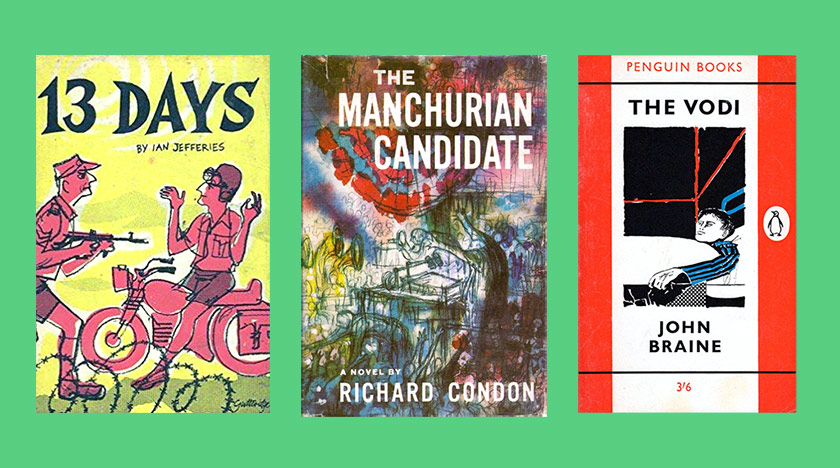
Reading 1959: 13 Days, The Manchurian Candidate, The Vodi

Three books from 1959.

The three most recent books in my #reading1959 project were Thirteen Days by Ian Jefferies,The Manchurian Candidate by Richard Condon,  and The Vodi by John Braine. They fit together oddly well.

One common theme emerging in many of the books from 1959 I’ve read this year is the legacy of war – PTSD, institutionalisation, lives arrested or derailed, and a sense of the world recovering from a nervous breakdown.

The Manchurian Candidate takes the Korean War as its starting point, telling a wonderfully compelling story of paranoia and brainwashing. The 1962 film is better known than the book and perhaps rightly so: the book was essentially written as a movie pitch and is far less subtle or convincing. In fact, it’s positively baroque.

Sergeant Raymond Shaw is an unlikable man, unpopular with his platoon. He is identified by a Chinese-Soviet brainwashing project as the perfect candidate to be programmed as an assassin, not least because of his privileged upbringing as the stepson of a rapidly rising American politician.

The early chapters, set in Korea and depicting the brainwashing in progress, are the best. Shaw’s cold-blooded murder of his comrades, under hypnosis and in front of an audience of Communist dignitaries, is chilling.

There’s also something grimly fascinating in Shaw’s uneasy friendship with his former commanding officer, Ben Marco, each having been forced to like the other through hypnotism. There’s material enough there for an entire extra novel.

Shaw’s mother is the other standout character – a controlling, social climbing psychopath who nailed a puppy’s feet to the floor as a child and maintains her perky attitude with shots of heroin between embassy balls. She both uses her son for political gain – the Chinese fix it so that he is awarded the Congressional Medal of Honor, making him a valuable PR tool – and (just when you think it can’t ramp any higher) seduces him while he’s hypnotised.

What makes the book difficult to enjoy in 2019 is exactly that hysterical, over-the-top tone, which carries through into the writing style. It’s part wannabe beat prose, part Mickey Spillane, all pure ham:

There is an immutable phrase at large in the languages of the world that places fabulous ransom on every word in it: The love of a good woman. It means what it says and no matter what the perspective of or stains of the person who speaks it, the phrase defies devaluing. The bitter and the kind can chase each other around it, this mulberry bush of truth and consequence, and the kind may convert the bitter and the biter may emasculate the kind but neither can change its meaning because the love of a good woman does not give way to arbitrage.

The typically pulpy attitude to women doesn’t help, either. We’re supposed to like Marco and root for him, for example, but he uses women and even occasionally hits them if they won’t do what he wants, the latter being presented as evidence of his impressive virility. No thanks. Otherwise, women are mad bitches (see above), sexy angels (Marco’s fiance) or plot devices to move forward the stories of Important and Vigorous Men.

***

Thirteen Days (or 13 Days in some printings) is also about foreign wars and the madness they encourage in otherwise ordinary men.

Set in Palestine in 1948, it presents another Sergeant, Sergeant Craig of the Royal Engineers, who has embraced the chaos and corruption of the Middle East and lives a maverick life of arms smuggling and artful skiving.

A characteristic moment is his admission that, building a vital water storage tank for a far-flung British Army base, he made up for a lack of concrete by using boulders in the foundations, only because of a lack of boulders he actually used dead donkeys: “What with the heat and everything they must have swelled. But anyway, the foundations cracked…”

Something about him brings to mind Len Deighton’s unnamed insubordinate spy, christened Harry Palmer on film, but Craig also has something in common with the protagonist of Absolute Beginners – a young man who’s not quite as hard or impervious as he likes to think.

When idealism surfaces, unexpectedly, he becomes allied to the Jewish cause, falls in love with a beautiful young woman who works as a driver for a paramilitary group and ultimately has his heart broken when all this proves to be more than a game.

The details of Army life and of the landscape are well drawn, clearly based on the author’s own first-hand experience (Ian Jefferies is a pseudonym), as is the sense of detachment and unreality triggered by being forced to live so far from home, with so little purpose.

Thirteen Days is an interesting book but hard to latch onto: is it supposed to satire, or a straight-up thriller? (Check out the cover, above, which suggests Doctor in the House.) It succeeds best when it settles on the latter and gives us a stretch of suspenseful action into the finale.

***

John Braine’s The Vodi is a peculiar and rather brilliant book, up to a point.

Dick Corvey is recovering from tuberculosis in a sanitarium in the north of England from where he reflects on his life and misfortunes, battling the onset of bitterness as much as TB.

Structurally, there are echoes of Free Fall, All in a Lifetime and No Love For Johnnie, with memory and The Now intermingled throughout.

What gives the book its interest is the bleakness of tone – the north here is all shadows, decay and drizzle – and, of course, the Vodi. The Vodi is an organised crime gang made up of goblin-like minions under the control of the monstrously fat Nelly. The Vodi controls the district, torturing and ruining the lives of its victims, primarily out of spite. There’s a hint of Arthur Machen in it but also of Cruella De Vil.

Dick and his best friend Tom invent the Vodi as boys but Dick persists in clinging to the idea as a luckless adult. A key moment in the book, the point at which Dick and Tom diverge, is when Tom disavows the existence of the Vodi immediately after his first sexual experience with a girl. Tom goes on to take control of his own destiny, embrace risk, and eventually finds success; Dick bounces from Army to clerical job to sanitarium to sanitarium job, passive and pathetic.

And that’s Braine’s argument, in the end: that you have to fight, strive and desire. Only when Dick falls in love with a nurse, Evelyn, do things change for him. Evelyn loves him but becomes engaged to another man because she can’t bring herself to shackle herself to a sad case like Dick. Tempted as he is to blame the Vodi and surrender, his passion for her prompts him to discover the inner resources he needs to overcome the disease and make the bold decisions necessary to become a full personality.

***

War, the maddening power of institutions, sinister controlling forces, the struggle to work out what being a man really means… As the final stretch of #reading1959 begins, a thesis is certainly beginning to form.

And though this wasn’t the plan when I started out, it’s all proving very handy for my current writing project, a crime novel based on a true story and set in the late 1950s. Surface detail is easy but I feel as if I’ve really got into the psychology of the time.

Categories
1959 books reading1959

Reading 1959: Starving artists and haunted boarding schools

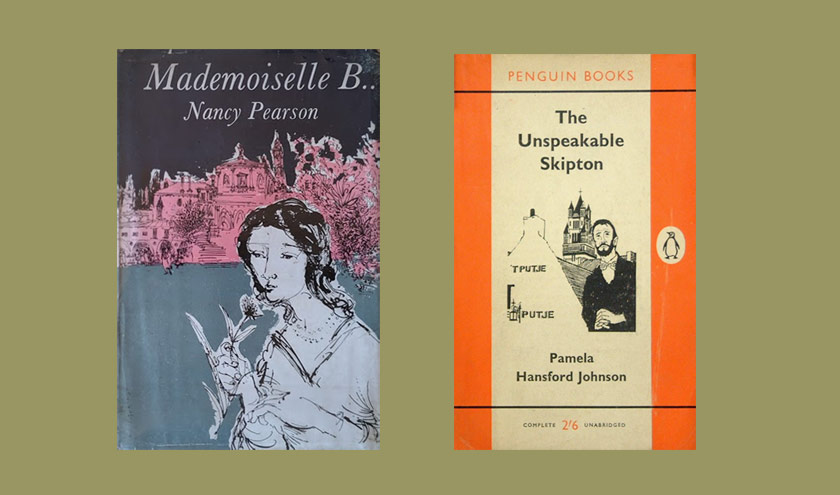
Mademoiselle B... and The Unspeakable Skipton

In search of obscurities from 1959, I decided to look through book review columns from that year in the newspaper archives.

It was The Times that threw up The Unspeakable Skipton by Pamela Hansford Johnson and Mademoiselle B… by Nancy Pearson.

The former has gone into my top ten discoveries from this year. Pitched as a satire, it’s actually dreadfully sad, telling the story of a lonely, poverty-stricken English writer living in Bruges, pushing away anyone who might care for him.

A pompous, pretentious snob, Daniel Skipton regards himself as a Great Writer, having had limited success with a literary novel a decade or so earlier. He writes around 240 words a day of his new novel, filling the rest of his time with scrounging, petty con artistry and a little pimping.

The atmosphere is close to Highsmith’s Ripley novels or perhaps Simenon – oily canals, brown cafes, drab brothels and decaying aristocratic houses.

Though not a crime novel, it might be considered a story of suspense.

The book covers a few weeks during which a party of English tourists is in town. They’re drawn together because he hopes to exploit them, taking them to live sex shows and restaurants, while they find him amusing. Meanwhile, a wild card is in play – an Italian count who might or might not be what he seems.

I spent the last 50 pages fretting over whether Skipton’s rather pathetic Big Score would come together – as his guts growl and health fails, will he be able to afford to eat, or be sent back to scavenging in bins?

He’s not likeable, that’s the point, except that, as the book wears on, a grudging respect forms: he really is committed to being an artist and his constant hustling is in service of that ideal.

And the stream of spite is preemptive and defensive – he hates himself more than anyone else could possibly hate him.

And it turns out it’s still in print, so not obscure at all – I’m just ignorant.

What does it tell us about 1959? In some ways, it feels as if it could have been written in the 1930s, except that objects, attitudes and acts which might have been kept off stage two decades earlier are proudly out on display.

* * *

Mademoiselle B… is less brilliant but still deserves to be better known. Or at least known at all – Goodreads doesn’t even list it, as far as I can see.

It’s a short book, barely a novel, that seems to have been sold as a titillating tale of forbidden lesbian love.

In fact, it’s a gentle, melancholy story of a schoolgirl’s fascination with a young teacher who is either mad, or haunted, or a little of both.

The setting, a boarding school in France, is depicted in perfect detail, from the rotten stink of the canteen to the sinister presence of ever watchful, elderly surveillants. There is always discordant, hesitant piano music somewhere in the far distance.

Boredom and seclusion breed tension and send everyone slightly insane, turning petty disagreements into soap opera and crushes into great passions. When the narrator leaves the school to convalesce on the coast, and has the company of other young people in less Gothic surroundings, she all but forgets Mademoiselle B.

What I didn’t expect, but enjoyed enormously, was the supernatural element which gave a flavour of the Tanzschule from Argento’s Suspiria or one of those ‘women running away from a mansion at night’ paperbacks.

The girls all believe the school is haunted by its past residents, whose portraits hang on the walls, and Mademoiselle B seems especially sensitive to this idea. She feels their hands holding hers in the dark, they whisper her name, and one particular attentive ghost comes to her room at night.

At the great end-of-term ball with which the book climaxes, it’s strongly hinted that she might be right, as mysterious, uncanny masked figures mingle with pupils in fancy dress

Its relevance to 1959? The faint Hammer Horror vibe, perhaps? It’s certainly an interesting book to read alongside A Separate Peaceanother tale of gay love (no it isn’t, or is it?) in a boarding school environment published in the same year.

Categories
1959 books reading1959

Reading 1959: Schooldays, Regency, Cold War

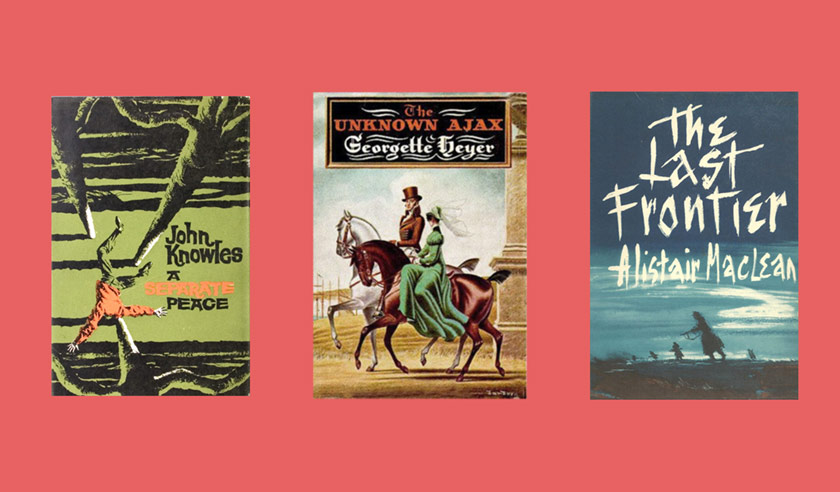
Covers of the three books.

One thing I’m keen to do in exploring novels from 1959 is to read widely – not just the most critically acclaimed books, those reckoned to be in The Canon, but also genre fiction, popular writing and books which have fallen out of fashion. This set, which I read on holiday, contributes to that aim.

A Separate Peace by John Knowles is considered a classic in the US and is, I gather, widely read in schools but I first heard of it in January this year.

It is set in a boys boarding school in New England during World War II and revolves around the intense friendship between the charismatic, athletic Phineas and the academically-minded, sour-witted Gene.

According to some readings, they are in love, though that is never made explicit and was denied by the author. Either way, the closeness of their relationship tips over into hatred for a brief, mad moment and the rest of the book deals with the fallout, against a backdrop of the end of childhood and the threat of conscription.

The landscape, the school, its culture and personalities are beautifully depicted. When Knowles described thawing snow, you feel it; when he writes about the stink of a locker room, your nose curls.

There’s also something startling in the reality of the human relationships the book depicts – of the fine line between affection and animosity, and the constant shifting of allegiance and the balance of power within groups of friends.

On Twitter, I described it as a cross between Brideshead Revisited and Lord of the Flies and, having thought on it for a week, still think that’s about right, flippant as it sounds.

How does it fit into 1959? Well, it’s another example of processing the experience of World War II; and, despite Knowles’s denial of the gay subtext, it also feels like part of an increasing honesty in writing about sex and relationships.

* * *

Georgette Heyer’s The Unknown Ajax is a funny thing – Jane Austen fan fiction, essentially, but more broadly-drawn than the model. If I say that if Hammer Films had fancied branching out into romance, they might have done it justice, does that hint at the tone?

The plot is a good one: the irascible Lord Darracott is reluctantly forced to acknowledge an estranged heir after his son and grandson are killed in a boating accident – Major Hugo Darracott, a giant, uncouth Yorkshireman who has been serving in the Napoleonic wars.

He is not made welcome by the family, especially the independent-minded Anthea, who is expected by her grandfather, his lordship, to marry the Major to keep control of the family fortune in trusted hands.

Hugo, of course, wins them over with his good nature and resourcefulness. After much gothic melodrama around smugglers, ghosts and hidden passageways, there is a twist that most readers will have seen coming from about page ten, but is no less satisfying when it arrives.

At times, it feels like being battered with a dictionary of slang. Having taken the trouble to research the speech and dialect of the Regency, Heyer seems determined to use every nugget, so hardly a line of dialogue is without one or two examples: wet-goose, widgeon, mushroom, once-a-week beaux, and so on. She also likes exclamation marks! In imitation of 18th and early 19th century writers, no doubt, but too much for modern readers!

Heyer is regarded as faintly ridiculous these days, although she remains very much in print, and invented a genre. Unfortunately, I can see why – anyone submitting this manuscript to a publisher in 2019 would be told it was lacking subtlety, riddled with cliches and too derivative. That doesn’t mean I didn’t like The Unknown Ajax, though: it is fun, highly digestible and rich in period detail. And I’ve just bought my Mum a copy.

What marks this out as a product of 1959? The camp quality, perhaps, and the fact that Hugo Darracott is yet another war veteran protagonist, albeit from the wrong war.

* * *

Alistair MacLean is one of those writers whose books I recall being everywhere when I was growing up – a whole shelf at the library, on the revolving racks at the Read-and-Return, cluttering the bargain bins in secondhand bookshops, and then overwhelming charity shops in the 1990s.

His most famous novels, thanks to their film adaptations, are probably Where Eagles Dare, Ice Station Zebra and The Guns of Navarone. His 1959 effort, The Last Frontier, is less well-known, though it too was adapted for the screen, as The Secret Ways starring Richard Widmark, in 1961.

There’s a certain pleasure in reading even bad thrillers. Between coshings, shootings, chases and bouts of torture, there’s rarely time to catch breath and think about the quality of the writing. Unfortunately, this book comes with long stretches of tedious expository dialogue which leave the mind free to reflect on the terrible prose and creaking plot mechanics.

It is set in Hungary in the years immediately following the 1956 uprising and concerns a British agent, Reynolds, who is sent behind the iron curtain to extract a kidnapped scientist with the help of the anti-communist underground.

Reynolds is at first presented as a machine – as a man so perfectly trained that nothing can sway him from his mission, who doesn’t ask questions, who reacts rather than thinks. A whole novel of that would have been interesting to read but, unfortunately, it doesn’t take long for Reynolds to become careless, sentimental, and lovelorn.

At various points, we are expected to believe in disguises so good that they can fool someone who knows both the person being impersonated and the impersonator in extended conversation at close quarters.

We are supposed to accept that the Hungarian secret service, the AVO, is run by a bunch of sinister oddballs who can be fooled by a bit of unsophisticated fibbing.

And chemical torture, it turns out, can be resisted if you try really hard.

All of this would be bearable if the book wasn’t so earnest – if it accepted itself as a bit of fun rather than a serious exposé of the evils of totalitarianism and a treatise on world peace.

Here’s the thing: Ian Fleming’s James Bond novels, for all their problems, are ageing well as literature; and if you want dourness without silliness, Le Carre is your man. I just can’t see what MacLean brings to the party. I’d rather read John Gardner.

The 1959 factor? The Cold War in general, and a fear of brainwashing in particular. (I’ve got The Manchurian Candidate, also from 1959, on my to-read pile.)

Categories
1959 books reading1959

Reading 1959: Cider With Rosie and unexpected folk horror

The cover of the 1973 edition of Cider With Rosie

The first moment when it occurred to me that I might have the wrong idea about Laurie Lee’s autobiographical novel of life in rural Gloucestershire between the wars was a casual, almost approving mention of incest.

It is thrown into a run-through of various village characters:

John-Jack spent his time by the Bulls Cross signpost staring gloomily into Wales. Silent, savage, with a Russian look, he lived with his sister Nancy, who had borne him over the course of years five children of remarkable beauty.

Before I get to the murder, drowning, haunting, near-death experiences and rape, let me set out what I expected from this book: The Darling Buds of May, I think. Early evening ITV, yellow filters and the gentle romance of rural life.

Every edition I’ve ever encountered, including the hundred or so dusty copies in the store cupboard at my secondary school, has a cover design signalling that kind of lightness. Or, at least at first glance; there is, now I know to look for it, something sinister in Roger Coleman’s illustration for the early 1970s Penguin edition I read – a touch of Don’t Torture a Duckling, the uncanny gaze of a child too knowing.

I didn’t actually think of folk horror until almost half way through the book and a chapter entitled ‘Public Death, Private Murder’. In it, Lee tells the story of a traveller, a local boy made good, who returns to the village for Christmas. Flashing his money, boasting and insulting the locals, he makes himself the target for a gang which beats him, steals his wallet, and leaves him to die in a snowdrift. The horror – the stuff that wicker men are made of – comes in the reaction of the villagers:

[The] young men who gathered in that winter ambush continued to live among us. I saw them often about the village: simple jokers, hard-working, mild – the solid heads of families. They were not treated as outcasts, nor did they appear to live under any special strain. They belonged to the village and the village looked after them.

The very next vignette concerns Miss Flynn, a promiscuous young woman driven half-mad by the torturing presence of the ‘sick spirit’ of her late mother. She is found dead and naked in a pond by the milkman, having apparently drowned herself. Lee’s point is that death is part of village life, but this chapter approaches the mood of Wisconsin Death Trip at points:

The wet winter days seemed at times unending, and quite often they led to self-slaughter. Girls jumped down wells, young men cut their veins, spinsters locked themselves up and starved.

Our narrator himself is intimate with death. He dies as a baby, and comes close again later in life, surviving a harrowing illness that “put a stain of darkness upon my brow and opened a sinister door in my brain, a door through which I am regularly visited by messengers whose words just escape me, by glimpses of worlds I can never quite grasp”.

To balance death, of course, there is sex, but that too has the Summerisle look about it, enough to make Edward Woodward spit:

Our village was no pagan paradise, neither were we conscious of showing tolerance. It was just the way of it. We certainly committed our share of statutory crime. Manslaughter, arson, robbery, rape cropped up regularly… Quiet incest flourished where the roads were bad; some found their comfort in beasts; and there were the usual friendships between men and boys who walked through the fields like lovers…. Sometimes our sinners were given hell, taunted and pilloried, but their crimes were absorbed in the local scene and their punishment confined to the parish.

As it nears it conclusion, with the boy Laurie in the grip of adolescence, thrusting away at the fertile earth, we are given a final, sustained moment of suspenseful horror straight out of The Blood on Satan’s Claw: the plotting and attempted execution of the gang rape of a demonstratively Christian girl. In the exploitation film version of this story, the rape would be depicted in grim detail, but here the girl brushes away her would be assailants who are left feeling embarrassed and ashamed.

Cider with Rosie isn’t folk horror because it isn’t a horror story, but, still, I wonder what Ben Wheatley might do with it all. I’d especially like to see his handling of the two-headed talking sheep that appears during thunderstorms.

Categories
1959 books reading1959

Reading 1959: The Listening Walls by Margaret Millar

The Listening Walls.

This novel is a proper bit of pulp: private eyes, seedy hotels, subsumed lust and bloody murder, served up without pause for breath, in violently stripped back prose.

It begins with a pair of friends, both highly-strung in different directions, on holiday in Mexico City. Wilma, self-dramatising and something of an emotional leech, picks away at Amy, who is repressed and nervous, cruelly dropping hints that she is having an affair with Amy’s husband, Rupert. When Wilma goes flying from a hotel balcony in an apparent suicide, Rupert comes to take Amy back to the US. Before her brother, Gill, can see her, however, she has some sort of breakdown and disappears to New York. Believing that Rupert has killed her, Gill hires a private detective, Dodd, whose investigation becomes the story’s main thread thereafter.

The best parts of this book are those dealing with Dodd, and the portrait of the Mexican hotel.

Dodd is first presented as a grasping, vaguely repellent cynic, but becomes more appealing as we spend time with him: he is right to treat Gill with disdain, it turns out, and is gruffly sympathetic towards those who really deserve it, such as Rupert’s lovelorn secretary, Miss Burton, who goes to dance classes purely for the sake of human contact.

My first instinct was that the portrayal of the hotel was, frankly, racist: the staff are dirty, smelly and conniving, and they steal. Staff are urged to tell American visitors the tap water is the cleanest in the city, though the manager himself only drinks bottled water. Consuela, the chambermaid, uses towels to mop her own sweat and then lays them out for guests. Every service and facility is an opportunity overcharge. True to life or not, it’s pretty sour stuff.

But then something interesting happens: for large stretches of the opening section especially, we find ourselves in Consuela’s head, and she becomes a full and fascinating character, more sympathetic than most of the Americans. She both loves and hates her boyfriend, a layabout American conman; she despairs at his gambling, but also believes one day it will make her rich; and her treatment of hotel guests is half pride, half class warfare.

The book’s reputation, insofar as it has one, relies on the twist. I don’t think Millar is a great writer – or, at least, can’t see that she put huge care into this particular book, which feels as if it was written in a week – but I do think she did something clever with the plot, laying a trap for the mystery-literate reader – surely it was Amy who went off the balcony, not Wilma, right? I thought I’d solved the case from page three and so the ending really did surprise me.

What does this book tell us about 1959? That the nerve-jangling sound of jet engines overhead was part of a new cold war reality. That America was just realising it had become an imperial power. And that sex hadn’t quite broken free of its leash.

Categories
1959 books

Reading 1959: All in a Lifetime by Walter Allen

This 1959 novel almost seems like a cocktail of the others I’ve read so far.

Like Memento Mori, it is about old age and the legacies of long lives. Like No Love for Johnnie, it is about the Labour Party and the personal price of politics. Like Free Fall, it tells the story of a man’s life, from slum to war to self-knowledge, with time and memory tangled in sometimes bewildering ways.

All in a Lifetime is about Billy Ashted, an artisan silverworker from an unspecified Midlands city (Allen was from Birmingham) who, at the end of his life, decides to write a memoir in the form of a letter to his sister, Lizzie. At first, he seems resistant to the idea, feeling pressured to work on the book by his successful adult children of whom he is simultaneously proud and resentful.

This opening stretch, I have to confess, I found hard going – nuggets of narrative, glimpses of character, constantly broken off or jumbled together, repel the reader rather than drawing them in. Slowly, though, the book begins to flow as Billy gets more absorbed in his task, and longer, more satisfying vignettes emerge.

Billy’s friendship with George, an intellectually curious young man who takes Billy under his wing, from evening class to the zinc-topped tables of the local pie shop to a makeshift laboratory in his parents’ wash-house, is beautifully drawn. “For the first time in my life I had a friend”, he says, recalling the ecstasy this realisation brought. Throughout the book, and throughout the course of Billy’s life, every time it seems as if George might have slipped from Billy’s grasp, lost to national fame and the rituals of Westminster, they are brought back together and discover that nothing has fundamentally changed between them.

When Billy decides, impulsively and against George’s counsel, to go to New York, it comes as a real surprise, and this section is perhaps the best in the book. The atmosphere aboard a Titanic-era liner is evoked skilfully, from the stink of steerage to the below-decks musical melange, to the deliciousness of the oranges in Billy’s small stash of fresh fruit. Billy’s openness and likeability are underlined, without him declaring it, as his fellow passengers adopt him and protect him from his own innocence. On arrival, Billy becomes the original Englishman in New York, scared and excited in equal measure, and surprised to learn that it has no inner-city terraced streets or pie shops.

Another fascinating thread concerns two sons who exist off-stage. There is the wayward youngest son, Tom, whom Billy describes startlingly and bluntly as a psychopath. We learn, eventually, that Tom is a conman, a bogus war hero, habitually in trouble with the law, and prone to financially exploiting his respectable, responsible brothers, Will and Phil. And there is the oldest son, Harry, killed in World War I, summoned back to life from the most hidden part of Billy’s memory for the first time quite late in the book. Both boys haunt Billy in different ways.

The novel’s portrait of British working class political life in the early 20th century will make it a worthwhile discovery for many. From the Labour Party general election victory of 1924, to the failure of the General Strike, to the arrival of Mosley and the BUF, Billy is there, Zelig-like, swept along and unsure of himself.

What makes Billy such an appealing character, in the end, is his capacity for self-interrogation and honesty. Why, he wonders, did George ruin his life and career for the sake of an affair while he, Billy, never felt the urge to be unfaithful? “I have dipped into the works of Professor Freud: I have not been able to recognise myself, my own nature, in his pages,” he says, before acknowledging that perhaps he was broken in some more complex way, with “a natural talent for sublimation”.

When he says, frankly, that he doesn’t particularly care for or about his grandchildren, but cannot help himself loving the undeserving Tom, it rings absolutely true.

By the end of the book, we have a grasp of all the strands of Billy’s life, and understand his exhaustion: the world he grew up in has gone, the three people to whom he was closest (his wife, George, and his rigidly religious brother Horace) are dead, and there is nothing left that anyone can say to him or show him he hasn’t already seen.

The book’s disorderly chronology, we realise, is a product of the disintegration of his mind, and of terminal nostalgia – of a life flashing before the eyes.

Categories
1959 books crime

Reading 1959: The Galton Case

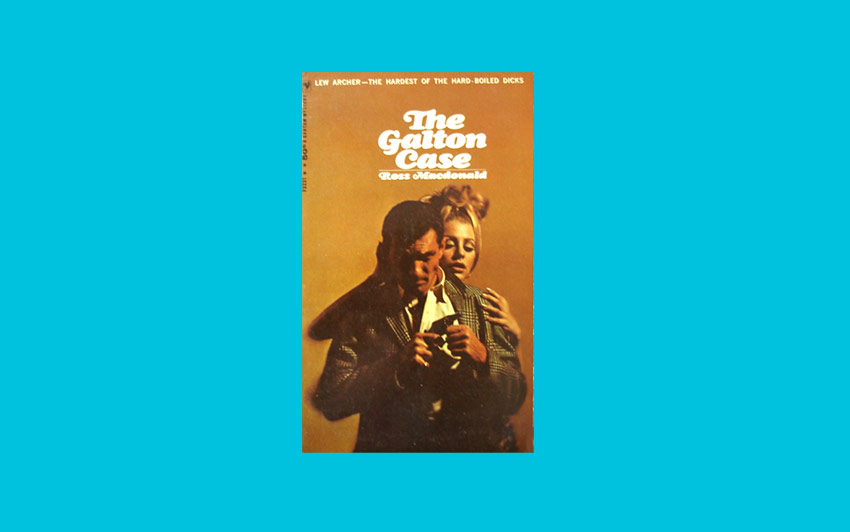
The Galton Case

Ross Macdonald’s hardboiled crime novel is closer to Raymond Chandler in tone and style than any other book I’ve encountered.

The prose isn’t quite there – Chandler dropped fragments from half-visible poems on to every page – but the hard California sunlight, the squalor and snobbery, and the neither-tarnished-nor-afraid protagonist are.

Well, hold on, I’ll go a bit further: there are moments where Macdonald’s prose made me wince, as in his description of a pretty girl as ‘doe-eyed’. Minimalism conceals a lot; this small choice reveals it.

The story, though, is reminiscent of Chandler’s The Little Sister, but perhaps better engineered. Though the action (involving multiple aeroplanes, car and $3 motel after another) runs from California to Canada via the American Midwest, everything connects neatly, and all the apparent coincidences are proved to be nothing of the sort.

Is John Galton Jr a Tom Ripley to be feared, or a poor orphan to be pitied? Prince Charming, or Norman Bates? That tension is a powerful engine to build a mystery around.

Lew Archer shares about 80 per cent of his DNA with Philip Marlowe but would be more fun to share an office with. He doesn’t drink as much, seems a more functional human being, and isn’t as prone to pointless self-sacrifice.

I might go so far as to recommend Macdonald over Chandler to those interested in reading their first hardboiled detective novel. Being a little less showy in his writing, less weirdly obsessed with chivalry, and markedly less sour, he is probably less likely to alienate than Chandler, while still being stylish and sharp.

Categories
1959 books

Reading 1959: A Travelling Woman

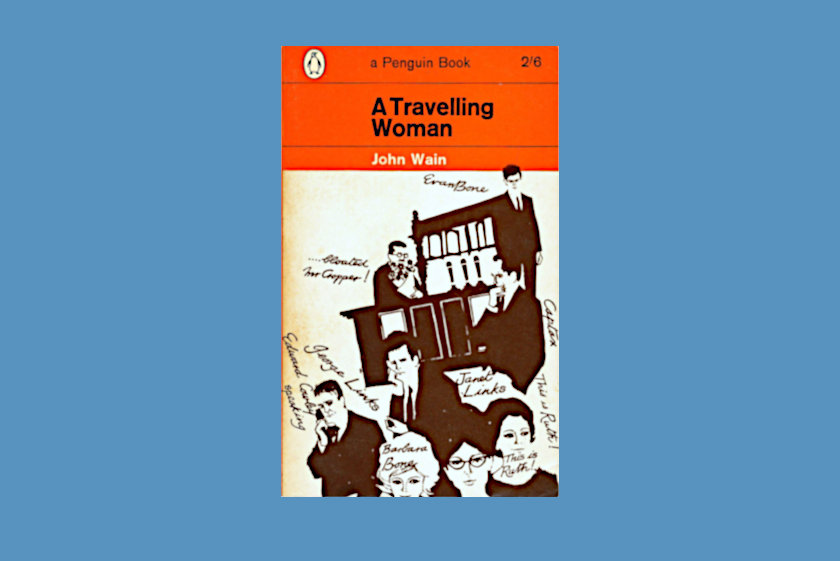
I picked up John Wain’s A Travelling Woman purely because I liked the cover of the Penguin paperback edition from 1963, with an illustration by Adrian Bailey, and because it was first published in 1959.

It tells the story of George Links, a selfish commuter-town manchild who is unhappy in his marriage and job, and obsessed with the service of his own pleasure.

When his wife, Janet, pushes him to see a therapist in London, his drinking companion, Captax, points out that this provides the perfect opportunity to spend some time away from home indulging the pursuit of other women.

Captax directs him towards the Cowleys who have an attic room they let to lodgers, and so Links meets Ruth, a sad woman whose husband, Edward, is a philosopher lost in grappling with the question of religious faith. Links falls in love with Ruth and has a brief affair with her which not only revives his mood but also his marriage. Until, inevitably, it all falls apart.

For the first hundred pages or so, I frankly disliked this book. It seemed glib and seedy – a portrayal of a world in which men take women, and where women are either prizes or puzzles, but not quite people. It’s true that Wain goes out of his way to make George Links unlikable – he is pedantic about grammar, short-tempered, and thick-headed; and Ruth tells him to his face that she doesn’t like him, more than once. Nonetheless, we spend most of the book in his head, while Captax and others reassure him in his betrayal of his wife. Like playing a first-person rotten bastard simulator on the PS4.

But the synopsis on the back of the Penguin paperback has it right when it says “what began as light-hearted Restoration comedy in modern dress becomes a grim tragedy of emotional maturity”. One by one, the opportunities for happy endings are cut off: Links loses his wife, then Ruth, and ends up living in a seedy hotel; Captax find his heart, but then has it broken within a fortnight; Evan and Barbara Bone, another unhappy couple on the periphery of the plot, break up, too.

Only the Cowleys seem to emerge intact, perhaps because they have a son, Teddy, and maybe because they’ve already given up on the idea of romance when the book begins.

The book surges in strength when the focus shifts from George Links to Janet Links – when we see how his behaviour breaks her. The fact that he shows her renewed affection and gives her the impression that the marriage is revived only makes its sudden collapse all the more humiliating.

Janet Links has her romantic idealism shattered and becomes a harder, meaner person, but perhaps more resilient. Captax experiences love and realises the true price of meddling in other people’s marriages.

The lesson George Links learns is that he is not, after all, the centre of the universe – that other people have inner lives, desires and feelings, too. Which makes me wonder if this is, in a sense, a portrait of the psychopathic tendencies of many half-formed young men. One odd interlude, with that in mind, which is thrown away in a paragraph or two, is the suggestion that George is attracted to Ruth and Edward Cowley’s young son, Teddy, because he is in love with the child’s mother and admires his father. What a dark twist that would have been for 1959.