After World War II, a second great wave of housing estate building began, with off-the-peg urban landscapes pushing up against the shrinking countryside. The Sydenham Estate in Bridgwater, Somerset, was one such manifestation.
Until I read this passage in a 1945 edition of the Taunton Courier it had never occurred to me that where I grew up had once been nameless – not a place but a void between them:
Regarding Eastover housing scheme, it was reported that the Minister of Health agreed in principle to the proposal to acquire 75 acres of land between Bath-road and Weston Zoyland-road. The District Valuer was instructed to negotiate for acquisition of the land, and it was decided that the site should in future be referred to as the Sydenham Estate.
On pre-war Ordnance Survey maps it is just a series of numbered cells – digits afloat in paper snow. But maps, and especially administrative maps, tend to reduce anything but the densely urban to an off-white nothing. In fact, those numbers represent individual fields on farmland stretching out behind Bower Farm. Bower Estate would have been a good name for the council development that grew there in the 1940s and 1950s but instead the authorities got its new name from the Manor of Sydenham, on the other side of the main Bath Road.
The present Sydenham House was built c.1500 for the Percival family. It was marched past by the Duke of Monmouth on his way to the Battle of Sedgemoor in 1685, and was later the site of a famous incident of nocturnal levitation, but otherwise sat quiet and alone in the flat landscape. Then, in the 1930s, Bridgwater burst its boundaries yet again and the British Cellophane factory was built on land adjoining Sydenham House. Trapped in a no-man’s-land between industry and the railway line, used by Courtauld’s Ltd for hospitality and meetings, it became inaccessible, invisible, and forgotten. The name lingered, though, having been given to Sydenham Terrace, a row of red-brick cottages built in 1865, and to a grand Victorian house called Sydenham Villa.
Oh, yes – red brick. Bridgwater was a brick-making town, and the West Country a brick-making region more generally, and the fact that the houses at this new place, the Sydenham Estate, were to be built from concrete caused some controversy in the late 1940s. BRIDGWATER WANTS BRICK HOUSES read one 1948 headline as the town council were repeatedly criticised for failing to take advantage of a supposed stockpile of 10 million local bricks ready for use. Not Bridgwater bricks, though, replied the council, and anyway, where was the manpower required to turn them into homes?
The town wanted to build 2,000 houses, public and private, as quickly as possible and there was no room for sentiment, so concrete it would be.
Perhaps this was a mistake. A place being created from nothing, in the middle of nowhere, literally on the wrong side of the tracks, could have used something to tie it to the town of which it was supposed to belong.
As it was, those Laing Easiform and Cornish Unit prefabricated concrete houses not only seemed alien but were also the same as thousands of others up and down the country, which meant the Sydenham Estate could have been anywhere. Shown photographs with only the name for a caption, wouldn’t most people guess that it is in south London?
Sydenham was constructed around a kilometre long boulevard called Parkway, down the central green spine of which marched crackling pylons. The streets that branched off Parkway were closed loops, leading nowhere. Sydenham Road, one of the four half-mile-long crescents, had an advantage, however: it formed the eastern edge and backed onto what everyone called The Fields.
The Fields were what remained of Bower Farm, overgrown and beautiful in their own way, with waving blonde grass and the remains of orchards, like something out of Laurie Lee. There was no formal access to The Fields from the estate because, after all, why would we want to wander there when we had public greens and playgrounds? All that meant, though, was that kids clambered over back-fences, crushing the chain-link to the ground over the course of years, while certain enterprising residents installed their own back gates in breach of the tenancy regulations. During the day, and especially during the summer holidays, that meant cousins and friends could run in and out of each other’s gardens using folk paths worn through the vegetation. At night it facilitated more sinister goings-on – muttering, scurrying, cold torchlight, clothes-line raids, and outright burglary.
As a frankly cowardly child The Fields scared me. There were things concealed in the grass that I didn’t care to encounter – hunks of rusting farm machinery, plastic bags full of hardened glue, all sniffed out; the remains of illicit bonfires; and, most terrifying of all, nests of adders. In autumn, low mist would lie on The Fields, and only on The Fields, like gatherings of ghosts.
They started building on The Fields when I was about 11-years-old, and I wasn’t sure if it was good or bad news. On the one hand I knew it would bring the wilderness into line – no more snakes or child traps, and an end to the sinister whispering of the grass beneath my bedroom window. On the other hand, I disliked change. I sulked when they installed double-glazing and pebble-dashed the council houses, but this was more drastic again – a fundamental reordering of the very landscape. Much as The Fields unnerved me, they also provided a contrast to the concrete and municipal repetition of the estate, and it felt simply wrong to turn them into yet more streets. Within a few years The Fields became the Bower Estate. Hundreds of just-too-small red-brick private houses arranged in whorls and loops along dusty new artery roads.
Sydenham, meanwhile, became a place, but one defined by negatives. It was referred to on the news as ‘the troubled Sydenham Estate’, and my peers called it The ‘Nam. This was a self-deprecating joke, of course, but also reflected a low-key ghetto mentality. We’re stuck out here together, us versus them, and it’s a combat situation. Who ‘they’ were depended on context. Within the estate, Sydenham Road and Longstone Avenue had a wary rivalry, each convinced the other was a no-go area; and the Sydenham Estate as a whole was set against the Hamp Estate on the other side of town, where we kids were warned never to go. Of course when I did go, I found a twin – approximately the same kinds of houses, an exact clone of the shopping arcade, and a secondary school which looked like an off-kilter version of mine.
Because of this reputation, steps, as they say, were taken, and Sydenham seems to be fading away. In around 1991 my secondary school ditched the doubly toxic Sydenham Comprehensive label in favour of ‘East Bridgwater Community School’. Then, in 2011, Sydenham ceased to exist as a council ward, replaced by Fairfax and Dunwear, two new wards that split the estate through the middle and effectively deny its existence. Estate agents marketing houses in the area tend to refer to them as being “on the east side of town” or, even more vaguely, “a popular residential location”.
But those Cornish Units and Easiforms, designed to last a few years at best, are still there 70 years on, albeit with raw concrete disguised by paint and pebble-dash. They invaded, they persisted, and they saw the countryside off. There are no orchards anymore – no adders, no whispering grass, no wild frontier.
Crime novels, current wisdom dictates, should be around 80,000 words long. That’s enough to fill 300-400 pages and so feel like good value to a contemporary reader. The problem is, that’s too long.
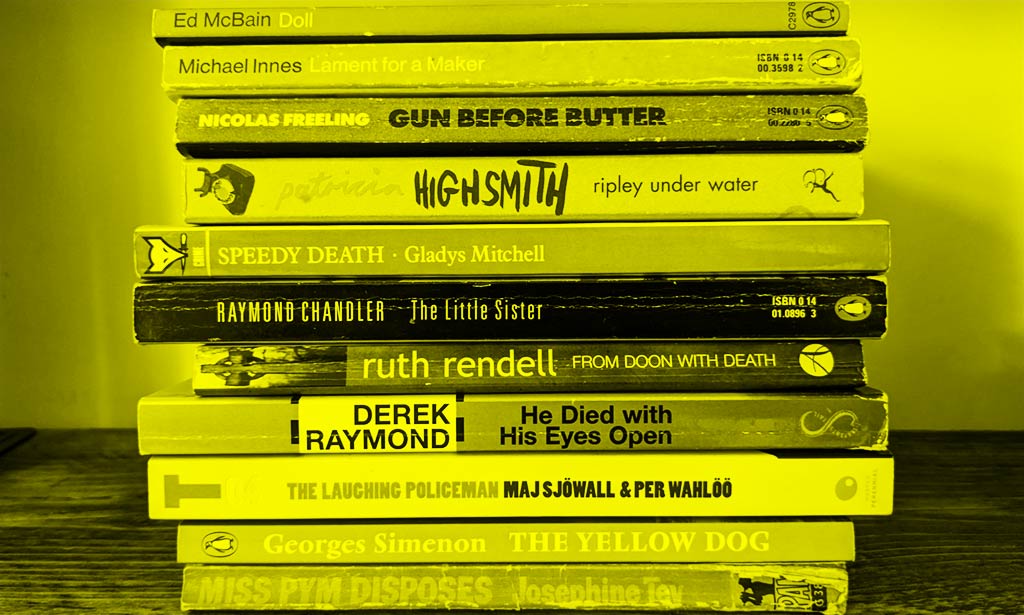
Most of my favourite crime novelists wrote short and lean. Ed McBain, Georges Simenon, Gladys Mitchell, Ruth Rendell, Raymond Chandler, Jim Thompson, Sjöwall & Wahlöö… All of these writers produced classics at around 150-220 pages, or 50-60,000 words.
When I’m deciding what to read, I’m often drawn to slim paperbacks – the kind that fit in your inside pocket. It’s partly about time and patience, of course, but that tight page count also signals efficient writing.
Maybe longer crime novels are better
Perhaps the fact that crime novels have grown longer is good news. Perhaps it means they’re deeper and more complex. Well, not in my experience.
Last year, I made a point of reading a stack of recently published books to help me improve the commercial prospects of my own work-in-progress. While I enjoyed most of what I read, and even recommended some of those books to other people, I did notice quite a bit of what felt like padding.
For example, one character spent a lot of time in Waitrose browsing ready meals. Then unpacking her shopping. Then cooking per the instructions given on the packaging. Then eating while pondering an office romance.
The protagonist of another book undertook renovation work on a flat. This had nothing to do with the plot; it did not reveal anything much about the character other than that they weren’t very good at DIY; and slowed the story down when it should have been accelerating.
You might say diversions like the above add realism and make characters more relatable but I can’t help thinking that if the target word count had been 60,000 words, these would have been the first sections lost to the red pen of a surgical editor. Or, at least, condensed to a single line: ‘She spent too long at the supermarket choosing what to eat for dinner, ate alone, and fell asleep on the sofa.’
I’m a slasher… of words
The first draft of my current project is finished at just over 70,000 words. The voice of the industry is telling me to flog it to 80,000 words, somehow – perhaps by introducing an aimless sub-plot or two, a prologue that will probably annoy people, or some extended moping and brooding by my protagonist.
But my own instinct is in the other direction. I want to hack away at descriptions, get characters from A to B faster and make the dialogue more sparse. If I follow that urge, I reckon I’ll be left with – hey, fancy that! – about 60,000 words.
General writing advice agrees: kill your darlings, remove filler words, combine or remove characters, make sure every scene moves the plot forward or develops your characters, and so on.
I think I’ve decided that I want to write a tight, economical crime novel of the type I like to read. That might well reduce its already slim chances of getting published – “Yeah, thanks for sending us half a book – are you planning to write the rest of it at some point?” – but it will feel right to me.
Although evidence seems to suggest that readers are hungry for long books, I’m hopeful the tide might turn. There’s certainly a growing backlash against films that don’t earn running times of more than two hours and I’m certainly drawn to anything at 90 minutes or less.
Georges Simenon’s Maigret novels aren’t cosy mysteries. They’re not hardboiled pulp. Nor are they flat period dramas, per ITV. They are intense doses of atmosphere and place presided over by a central character as solid as Paris limestone.
Between 1931 and 1972, Simenon, a Belgian, wrote 75 compact novels about Inspector Jules Maigret of the Paris CID. The first ten appeared in a rush in 1931 with seven more in 1932 and a steady flow thereafter.
The plots tend to be mechanically simple but psychologically complex. Typically, it’s something like this:
a body is found
there are a handful of suspects, perhaps even only one
Maigret gets to know the family, village or town
he doggedly pursues the case
tensions mounts
someone cracks
Maigret presses things home to a sad end
It’s rare to reach the end of a Maigret novel and feel surprised at the outcome. It is, however, quite common to feel bereft at leaving a place and a community in which you’ve spent a week – even when the book has only taken two hours to read, and even if that place was greasy, seedy and flyblown.
Most of the novels have a specific location. Sometimes, it’s a neighbourhood in Paris – Montmartre, Saint-Cloud, the Marais. Often, Maigret is called to some insular settlement, such as the waterside community around Lock 14 on the Marne Canal, or the seaside town of Concarneau. Maigret is also a tourist, his investigations taking him to Bremen, Liege, Delfzijl and even New York.
At times, it almost feels as if Simenon is writing for the screen, limiting the action to a single set, or a handful of locations. The Shadow in the Courtyard, AKA Maigret Mystified, from 1931, could be performed on stage with a few tweaks, the story taking place almost entirely in an apartment block overlooking a courtyard and a small chemical laboratory. Maigret at Piccrat’s revolves around a seedy strip club where the detective spends hours just drinking, talking and observing.
Simenon’s writing is lean verging on skeletal, more Hemingway than Chandler. Somehow, though, he sketches the spaces – the light, the haze, the smell of onion soup, the silence between buses passing on the road beyond a wall – and the faces: “Old Mathilde’s eyes, grey-green as jellyfish…”
What most interests Simenon, and his avatar, Maigret, are desperate people. Bigamists, gamblers, jealous wives, junkie heirs, alcoholic countesses, petty psychopaths, blackmailers, vagrants… Anyone who has lost control of their life, who is spiralling downward and outward, will find Maigret trudging beside them, infuriatingly patient, pipe rattling between his teeth. He makes them sweat. He gets too close and stays there.
Where to start
The first Maigret novel to be published was Peter the Lett, AKA Pietr the Latvian, so that’s an obvious place to begin. I’d suggest skipping it, though, and starting with a stronger later entry in the series.
The sidekicks change, Maigret ages a little, and France changes a lot, but each is a self-contained piece so you certainly don’t need to fret about reading them in order.
I haven’t read every Maigret novel yet, unlike a former colleague who always had one in his pocket in case of emergencies, but some I’ve particularly enjoyed, and would recommend, are:
The Yellow Dog, 1931
The Carter of the Providence, AKA The Crime at Lock 14, 1931
Maigret at Piccrat’s, AKA The Strangled Stripper, 1950
The recent Penguin editions with more accurate titles and translations are good and helpfully numbered for those who do like to do things in order. There’s something special about reading a tatty paperback from the 1950s or 60s, though, and as these books were bestsellers, you can still find them at reasonable prices.
St. James’s Square – an entire piece of the Georgian city of Bristol that simply doesn’t exist in 2021 – intrigues me.
My current novel project is set in Bristol in the 1950s when much of the city centre had been destroyed or damaged in the Blitz and post-war rebuilding was just getting underway. I have my protagonist living in what remains of St. James’s Square which means I’ve had to try to get a feel for this stolen place.
It’s not only that the buildings have been demolished – the pattern of the streets has fundamentally changed, like the site of some atrocity everybody wants to forget. What is there now? A chain hotel forecourt and a dual carriageway, pointedly cutting across the old lines.
Making my way to work from Horfield to the city centre for several years, I walked over the grave of St James’s Square most mornings and often stopped to see if I could find any trace at all.
Cumberland Street, behind St James’s Square.
Cumberland Street, which runs behind the brutalist slabs of the Hilton and Holiday Inn, is the last connection. Enter it from Brunswick Square, pass the surviving red-brick Georgian terrace and you’ll eventually reach a pedestrian footpath that goes under and through the hotel. It always feels to me as if, on the right day, at the right time, that footpath might lead to St James’s Square, as in H.P. Lovecraft’s 1925 story ‘He’. It’s never happened yet, unfortunately.
The passageway that ought to lead to the square but doesn’t.
The surviving Brunswick and Portland squares also offer hints of how their missing sibling might have felt. Laid out in a line, the three were constructed one after the other, St James’s Square being the first, with houses in place by 1716. Enclosed and private, clamshell hoods over every door, it perhaps felt more like a relic of the 17th century than its larger, grander siblings. But squint, catch the right angle, and there’s surely a family resemblance. Look into the corners, away from the garden and eccentrically designed church, and Portland Square in particular catches something of the feel of the photographs of St James’s Square I’ve seen.
Portland Square – is this Blitz damage?
Yes, there are photographs. Old Bristol was particularly well-photographed compared to some cities and between Know Your Place, the Bristol Post archive and the comprehensive works of Reece Winstone, I’ve harvested quite a few images. Two of my favourites, though, are in Walter Ison’s book Georgian Buildings of Bristol, first published in 1952.
SOURCE: The Georgian Buildings of Bristol, Walter Ison, 1952.
Other pictures online capture St James’s Square in its later years, approaching its doom. As happened in many British cities, Georgian houses built for gentlefolk became workshops, warehouses and institutional buildings. There was a large YMCA hall, for example. From the 1920s onward, Ison says, “its disintegration was rapid”:
During the late war more than half the total of houses, including the forest and least spoiled, was destroyed, and only the mutilated and disfigured ranges on the north and east sides remain… The surviving north row consists of two double-houses, Nos 6 and 7, and two single houses, Nos 8 and 9… These fronts have been suffered greatly in appearance by the partial removal of the crowning cornice, and by the brickwork having been rendered and generally defaced by painted signs.
This is the St James’s Square in which parts of my novel are set – a square that is no longer square, facing demolition. Portland Square, again, helps catch a little of how that might have felt, with half of the west side of the square still occupied by miraculously extant tottering ruins.
A little further away, across Stokes Croft and up the hill towards Kingsdown, there is also King Square – formerly genteel houses, sign-covered commercial properties and discarded strong cider cans piled around the wastebins.
St James’s Square, the square that isn’t there, disappeared for good in the 1960s, making way for new roads and a roundabout suitable for mid-20th century traffic. As local historian Eugene Byrne has written, “As you wait at the traffic lights where Bond Street joins the St James Barton roundabout, you are on the spot where the YMCA Hall used to be.”
I hope that reading my book will bring the Square back from the dead, even if I’ve taken some artistic licence to create a single surviving townhouse in that post-war period where my lead character lives, surrounded by dusty Georgian furniture and faded paintings, soon to be displaced.
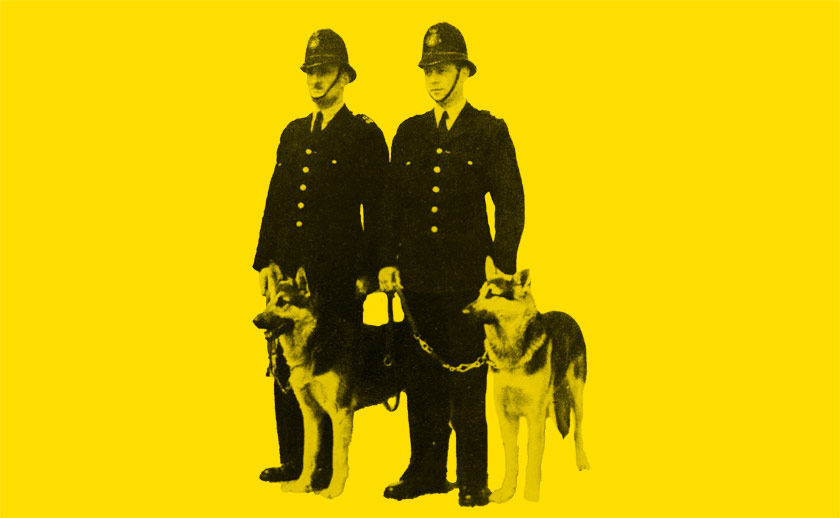
Bristol City Constabulary got its first police dogs in 1957 – a pair of Alsatian puppies named Kylow and Kudos. Why did it take so long?
These days, we’re all used to seeing those white DOG SECTION vans parked up, and to seeing footage of specialist dogs being handled by police officers. Some are trained to find drugs, others to detect the most minute traces of long-buried bodies.
In the 1950s, however, they were still quite new to policing in Britain and not all forces had their own dogs. There’s a pretty comprehensive history of their slow arrival here, starting in the 1850s, accelerating in the 1920s, and gaining serious commitment from the late 1940s onward.
That article argues that it was the expense of training and keeping dogs that led to the slow uptake; but I also think there must have been something about them that was seen as fundamentally un-British. Snarling Alsatians pulling at their leashes… This was the stuff of Colditz and the Gestapo, at odds with the myth of the bobby on the beat.
Headlines from the 1950s increasingly often refer to ‘police dogs’ being mobilised in manhunts in Yorkshire, Lancashire, Devon and elsewhere. Somerset Constabulary’s police dog, Brenda, was acquired in 1956 and she and her handler, PC Ray Fear, became minor celebrities. POLICE, PLUS BRENDA, MAKE QUICK ARRESTS read one headline in 1958.
Bristol, despite being a big, bustling city with a bit of a crime problem, was late to the party. It only acquired Kylos and Kudos after they were obliged to borrow dogs from Dorset Constabulary in the hunt for two missing children.
What became of Kylow and Kudos, I’m not sure. Were they effective? Did they have long careers? You might think that there would be something in the newspaper archives but, no, unlike Brenda, they didn’t attract ongoing coverage.
One last thing I would really like to know is where those names came from and why no journalist at the time thought to ask that question.
This is the first in a series of posts highlighting aspects of the research I undertook for my work-in-progress, a dark crime novel set in 1950s Bristol.
Leipzig to Berlin to Klaipeda to Karlshamn to Stockholm to London.
Elleman spends six weeks in a safehouse in Ladbroke Grove, learning English from the Daily Mirror and Sexton Blake magazines.
At first, he thinks his insomnia is a stress response. London sounds different to Leipzig, smells different; he misses church bells and Bach on Sunday mornings.
The interrogators keep strange hours, too – a man and a woman, he with a moustache and pipe, she limping and fine-boned. They ask him questions at dawn, at midnight, on rainy afternoons. He draws organisation charts, picks faces from catalogues of mugshots and surveillance photographs – Henschke, Tiepelt, Brosig, all of them. He reproduces schematics from memory.
The first time a full twenty-four hours passes without a minute of sleep, he doesn’t notice. He moves from bare bedroom to bare bathroom to bare sitting room as the grey day comes and goes. When night falls, he shaves, startled at his own red-flooded eyes in the mirror. He puts on a clean, new English shirt and a new English tie in moss green. Then he goes to the window and watches the street.
Red buses, black cabs, Ford cars with impotent fins. In the orange circle of the street lamp he sees pretty girls in short skirts, men in pinstripes, then, after midnight, only vagrants and slow policemen in black overcoats. Dawn comes, with drizzle.
‘You didn’t sleep last night,’ says the woman. She offers him a French cigarette. Elleman notices her smell: garlic and mothballs. ‘Not at all.’
‘Didn’t I?’
She pushes a photograph across the kitchen table.
He blinks, eyelids scraping over eyeballs like fine sandpaper.
‘You’re watching me.’
‘Why can’t you sleep?’
Elleman looks at the photograph and feels his soul slide sideways. He doesn’t remember standing there in the bay window like that with his mouth open in a scream.
She shows him another picture, then another.
‘Ten o’clock, two o’clock, four o’clock…’ says the woman.
‘Pills, perhaps?’ says Elleman.
The pills don’t work. They make him drowsy and upset his stomach, forcing him to sit for hours in the claustrophobic toilet with its stained copies of the Picture Post. But still no rest.
This time, he catches himself screaming and realises there is no sound, or at least not one his ears can detect. He wonders if the dogs can hear him, or the foxes under the brambles in the railway cutting.
The street light flickers, triggering a feather-edged memory of what he knows, somehow, to be the Soviet military hospital at Wünsdorf.
‘But that’s strange,’ he says to himself. ‘I’ve never been there.’
‘Let me make you some coffee,’ says the woman. She grinds a fig with the beans and presents it in a dainty cup she has brought in her handbag.
‘It’s how they do it in Vienna,’ she says.
‘When can I leave the apartment?’ asks Elleman. ‘Some air might help.’
‘I’ll need to discuss this with my colleague.’
After three nights and days without sleep, the memory of Wünsdorf gains substance – or perhaps the hallucination becomes more vivid: he is on his back under swinging lights, squeaking wheels beneath, amid the stink of pickled cabbage and vodka sweat. Someone says, in Ukrainian-accented Russian, ‘We’ll crack him open like a boiled egg.’
‘Dr Elleman,’ says the woman as she presents him with another Viennese coffee, ‘I should be delighted to take you for a turn on Wormwood Scrubs.’
‘Not Hyde Park?’
‘The Scrubs will be safer.’
The streets on the way are dirty and the terraces have aggressively blank, haunted gaps where strange weeds grow. As the breeze touches his face, bringing with it a little of her sweet bedsit perfume, Elleman imagines he hears a voice speaking imperfect German: ‘We must aim for maximum effect.’
‘When do you think I might start work?’ he asks as they cross a wide, quiet road. ‘I miss the laboratory. And work will help me sleep.’
‘There’s no chance, I’m afraid,’ she says. A sympathetic smile, a pat on the arm. ‘You’ve failed clearance.’
Elleman feels the scream rising. He opens his mouth to let it out and vomits, then collapses. A car pulls up and before he knows what has happened, two men in overcoats and small brown hats have thrown him onto the back seat.
‘Queen Alex, I think,’ the woman says to the driver.
At the hospital, they make him sleep. Not pills but injections – the nuclear option. His brain and body shut down.
When he wakes up it feels as if a century has passed. He knows at once he is outside, lying on the ground. He sees soft grey sky and hears gulls crying. He sighs with pleasure at the cool air flowing over his skin and stretches, shudders, smiles. There is grass beneath him, and sand.
‘I’m afraid we couldn’t get it out,’ says the woman. He rolls his head from one side to the other trying to locate her. She is sitting on steps leading up to the passenger door of a twin-rotor helicopter. She is smoking.
‘Hmm?’ says Elleman.
‘The thing the Russians put in your head. We couldn’t get it out. It sent the Geiger counter crazy. You’re a dangerous man to be around.’
She flicks away her cigarette end and waves a hand. The rotors begin to turn.
‘You didn’t know?’ she shouts, holding her hair back to stop it blowing into her eyes.
He blinks.
‘I’m sorry,’ she says.
She retreats into the helicopter and closes the door. It judders and lifts, kicking up grit, then howls away. For a moment, there is silence – no gulls, no people, just distant waves.
Elleman sits up and looks down at his hospital gown. His head does ache. It does feel heavy. He notices a sign in red – LIVE FIRE KEEP CLEAR – and realises they have placed him at the centre of a great painted target.
Then he detects, far away, the sound of an Avro Vulcan beginning its bombing run.
Grandpa’s hand feels like soft, rumpled leather. His nails are thick, curved and brown. His black Harrington jacket smells of tobacco and sweat. When he smiles, only one side of his mouth turns up. He’s been dead since 1990 but I can remember him in 3D, HD, stereo surround.
I remember more things, in finer detail, than many other people, or so I gather. As a writer, that’s handy. I can summon places, people and textures from storage and describe them.
As a human being, it’s sometimes a problem. Once or twice a day I’ll wince with embarrassment or sigh with sadness at something that happened more than thirty-five years ago.
“It’s weird that you remember literally every moment of your childhood,” someone said recently, which prompted a conversation with members of my family about how their memories work.
My Mum swears that her earliest memory is of Grandpa, her dad, leaning over a balcony in a checked dressing gown. When she asked her late mum about this she all but spat out her tea: this moment, she thought, could only have occurred when Mum was a nine-month-old baby in her pram, looking up at the house from the garden.
My brother, on the other hand, got quite emotional admitting to us that he didn’t really remember Grandpa at all. He died when my brother was nine, not even that young, but my brother doesn’t have deep memory banks. He lives in the present and doesn’t do nostalgia. It’s interesting, too, that he’s the mathematician-scientist in the family and proclaims himself totally uninterested in the visual arts.
Outside the family, there’s my friend Jack and his photographic memory. We only discovered this when, years ago, he recalled some minor historical detail.
“How do you remember stuff like that?” someone asked.
“Same as anyone else,” he said, shrugging. “I just picture the front page of the newspaper for that day and then, you know, read the headlines and then zoom in on the story for the details.”
My partner’s sister is similarly gifted and seems able to remember useful things like what everyone in the family ate at her twelfth birthday meal and who got what for Christmas in 1987. She’s also got a knack for recalling sporting statistics and who won what at which Olympics back to 1984.
I sometimes doubt my own memory, though. Am I a good writer because I have a good memory, or does my memory seem good because I’m imaginative?
In the last few years I’ve been working on novels set in the 1950s and seem to be able to draw on memory to fill in their details, too. Not my memories but secondhand memories from my parents, grandparents and other relatives, filled in with details I’ve plucked from family photos, film, television, novels and goodness knows where else.
I remember holding Grandpa’s hand, the curve of his fingernails, the smell of his jacket… Or I have a few sketched lines, a single fuzzy frame, and, like one of those machine learning demonstrations that lights up the internet every other week, my brain fills in the gaps with guesswork and borrowed textures.
The neighbourhood. Quiet, curving streets where children play in the road, making way now and then for a wood-panelled station wagon or Chevy pick-up. The houses are probably painted white, with white wooden fences, and perfectly green lawns. There might be a paperboy slinging rolled copies of the local daily. TVs are always on and always showing black-and-white movies or Looney Tunes cartoons. Kids have Star Wars posters on their bedroom walls and play games on Atari consoles. Teenagers listen to pop music on chunky Sony Walkmans. There will certainly be tall, tanned dads watering lawns and washing cars and faintly glamorous moms cradling brown bags overflowing with shopping. For dinner, it’s Wendy’s or McDonald’s, accompanied by cans of Coke or Tab for the kids and Budweiser for Dad. And it is always Independence Day, or Halloween, or Christmas – golden hour glow, warm autumn leaves, perfect snow. America is on top, life is good, adventure is just round the corner.
I spent my early years on a concrete council estate in a small town in Somerset but, like Rick Deckard in Blade Runner finding succour in his implanted memories, the images that spring to mind when I think of childhood are often American in flavour. That’s because, like many people my age, I grew up largely in front of a rented Rumbelow’s TV, absorbing the sunny glow of Spielburbia.
Spielburbia is a name for the American suburb as envisioned by Steven Spielberg. It manifests in films he directed such as E.T. the Extra-Terrestrial (1982), those he produced such as Back to the Future (dir. Robert Zemeckis, 1985) and others which simply imitated his style in pursuit of a share of his incredible commercial success. As far as I can tell, the term Spielburbia was first used by Tony Williams, disparagingly, in his 1996 book Hearths of Darkness, with reference to Poltergeist, a pop horror film that Spielberg produced and was long thought to have shadow-directed over Tobe Hooper’s shoulder. Williams sees Spielburbia as a reflection of an ‘infantile mindset’. To those living through less than perfect childhoods and, worse, the crushing weight of adventureless adulthood, that is precisely its appeal.
My gateway to Spielburbia was a branch of Ritz Video on the Sydenham Estate shopping arcade in Bridgwater. That’s where my parents rented, in big yellow boxes, also-ran kids adventure films like D.A.R.Y.L., The Boy Who Could Fly, The Explorers and Flight of the Navigator, all of which I saw long before E.T. or Close Encounters. When I talked about this with my brother, he recalled the colour-coding system that dictated the rental price: E.T. was expensive, D.A.R.Y.L. was cheap. So we watched D.A.R.Y.L. and loved it. Television was also important, five- or six-year-old big-budget American movies being the key events in what continuity announcers called ‘a very special Christmas here on BBC1’, or bank holiday matinees.
To a child in Britain in the 1980s, Spielburbia was both familiar and alien. We had kids on bikes. We had fences. We had plastic action figures and even American footballs, for which there was a brief craze in the UK at the tail-end of the decade. But it lacked the scale or glamour. The bikes were rusty non-brands from Halfords. The fences were steel mesh, also rusting. There was no mountain behind our estate – no pine forest or field of corn.
The cinematic Spielburbia came into being, I think, with Spielberg’s first big hit, Jaws, released in 1975. Though set on a tourist island, not in the suburbs, the feel is there in the scenes of Chief Brody’s domestic life and the arrival of tourists on Fourth of July weekend. Spielberg has a delicate touch when it comes to portraying the barely-blessed lives of ordinary Americans – adults and children bickering and laughing together over unmade beds, coffee machines and bowls of sugary cereal. In Jaws, Martin Brody awakes reluctantly and stumbles stiff-legged across the bedroom to check on the kids in the yard. “In Amity, you say yaaahd,” says Ellen Brodie, teasing. “They’re in the yaaahd, not too faaaah from the caaaah. How’s that?” replies Martin. “Like you’re from New York,” says Ellen. While Brodie fields a garbled call about a missing swimmer, his son Michael swaggers into the kitchen and proudly shows off a wound – the result of playing on poorly-maintained back-garden swings against his father’s instructions.
Swings! A minor detail but, oddly, a recurring one in the run of Spielberg’s movies from Jaws to Poltergeist. I’d bet any money his own childhood home had a set. And that mention of New York is important too: this is not New York City, or Los Angeles or Chicago – the default urban settings that define many cult films of the 1970s. The appeal of Spielburbia is that, at least until killer sharks, aliens or sinister government agents arrive on the scene, it is not ‘gritty’ or dangerous. It is – I can’t avoid the word any longer – ‘sleepy’.
Spielberg’s next film, Close Encounters from 1977, develops the idea. Centreing on a family man, Roy Neary, played by Richard Dreyfuss, it grounds the fantastical alien visitation plot with a portrait of a down-to-earth lower-middle-class suburb in Muncie, Indiana. Muncie – the very word sounds like an adjective, something from The Meaning of Liff, perhaps meaning dull or bland. The neighbourhood provides a pointedly sane backdrop against which Neary’s UFO-induced madness plays out. Spielberg delights in the background details: backyard swings, again; dads in shorts washing cars and boats on sloping driveways; children practicing their baseball swings, or riding bikes.
Though set in Indiana, in the American Midwest, it was actually filmed in Mobile, Alabama, in the southeastern US. That Spielberg could make this substitution tells us something: American suburbs are American suburbs, utterly interchangeable. Or, if you prefer, universal. The house that played the part of the Neary home is in a post-World-War-II housing development called Colonial Heights – an arrangement of near-identical single-storey houses along meandering streets designed to go nowhere in particular. It is a classic example of ‘tract housing’.
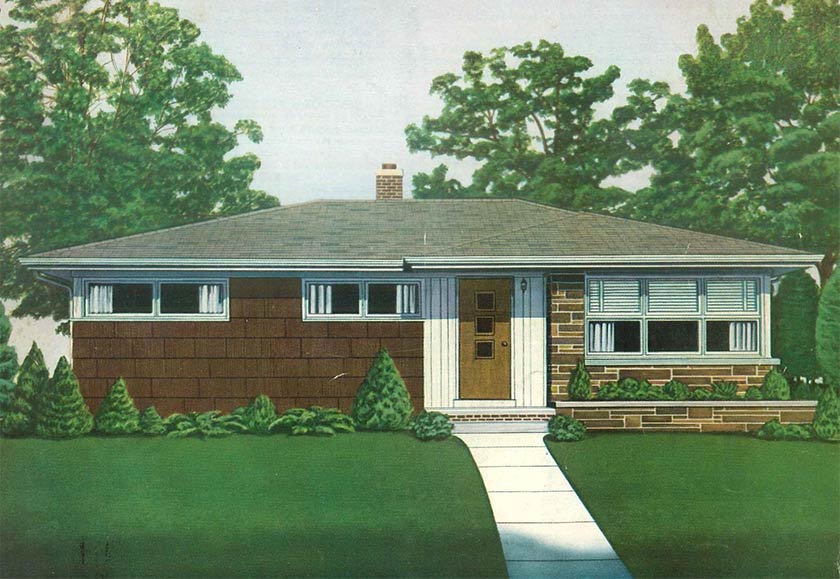
From ‘Homes for Your Street and Mine’, 1950, via Archive.org.
Tract housing, sometimes known as ‘cookie-cutter housing’, was primarily a post-World-War-II phenomenon. As the US population grew, increasing by 50 per cent between 1940 and 1970, millions of Americans moved from rural settlements into urban and suburban settings. By 1970, there were around 75 million Americans living in the suburbs – more than the entire population of the UK.
This suburbanisation was brought about by the advent of techniques for mass-producing appealing homes, and of heavy-duty construction vehicles which made it possible to clear great areas of agricultural land, wilderness or even desert plains. Hills could be flattened, terracing imposed, and landscapes composed – new spaces into which thousands of individual homes could be dropped with maximum efficiency.
The most famous examples might be the Levittowns built by Abraham Levitt & Sons in New York, Pennsylvania, New Jersey, Puerto Rico and Maryland between 1947 and 1970. The houses were built on production lines and could be erected in a single day.
While many applauded the democratisation of home-ownership this brought, the uniformity of this new suburban architecture – it’s sheer bloody munciness – unnerved some. What had happened to American individualism? A 1950 catalogue for the tellingly named Standard Homes Company entitled Homes for Your Street or Mine boasts that the designs within were ‘standardized to avoid waste… America’s best planned small homes’. The utopian illustrations depicting ‘The Lorain’, ‘The Lexington’, ‘The Wayne’ immediately bring to mind Spielburbia.
These suburbs also came in for criticism from those who saw in them the potential for ever-greater alienation and detachment from society – where were the neighbourhood bars or diners? Where were people supposed to congregate when not at work? Ray Oldenburg, author of The Great Good Place, published in 1989, saw the loss of this vital ‘third place’ from American culture after World War II as the root of many societal ills:
What opportunity is there for two men who both enjoy shooting, fishing or flying to get together and gab if their families are not compatible? Where do people entertain and enjoy one another if, for whatever reason, they are not comfortable in one another’s homes? Where do people have a chance to get to know one another casually and without commitment before deciding whether to involve other family members in their relationship? Tract housing offers no such places.
Ira Levin’s 1972 novel The Stepford Wives, made into a film in 1975, takes the uniformity of suburbia to its logical conclusion – if all the houses are the same, why not all the people? His sour, satirical take has housewives killed and replaced by compliant robots.
Spielberg isn’t unaware of suburbia’s downsides. As Roy Neary has his breakdown in Close Encounters, for example, the neighbours gather to watch, gawping from their driveways or leaning out of bedroom windows. When he speaks to them – ‘Good morning!’ – they ignore him. These people are crammed together and yet miles apart. But, overall, his take on suburbia is fond.
Spielberg himself grew up in just such a post-war neighbourhood, in Phoenix, Arizona. Joseph McBride made the pilgrimage while researching his 1997 biography of the director:
When a visitor enters Steven’s old neighborhood in Phoenix today, with its 1950s-era ranch houses still lining a broad, tranquil street crisscrossed by friendly kids riding bicycles, the feeling is inescapable: You’re not only going back in time, you’re entering a Spielberg movie.
Nowadays, anyone can visit Spielberg’s childhood home at 3443 North 49th Street thanks to Google Street View and to do so is startling – McBride is absolutely right, and it’s easy to imagine Spielberg location hunting, always seeking somewhere that felt just like home. Whereas others of his generation rejected suburban upbringings and wrote songs or novels mocking square life, Spielberg apparently yearned for it.
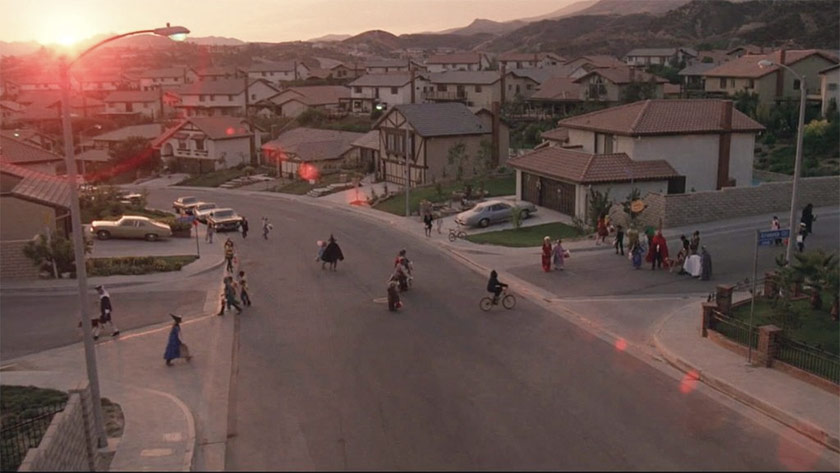
A scene from E.T. the Extra Terrestrial
The two films in which Spielburbia really comes into focus are both from 1982: E.T. the Extra Terrestrial, directed by Spielberg, and Poltergeist, which he wrote and produced.
E.T. takes the growing list of tropes – or tics, perhaps – from Jaws and Close Encounters and amplifies them. For example, Spielburbia is defined by an abundance of mass-produced toys. In Close Encounters, Roy Neary tinkers with a model train set while a music-box in the shape of Pinnochio plays ‘When You Wish Upon a Star’. By the time we get to E.T., however, with the action playing out primarily in an eleven-year-old’s bedroom, there are moments when it feels like a commercial. ‘This is Greedo,’ says Elliot, showing his friend from outer space his Star Wars figures, ‘and then this is Hammerhead. See, this is Walrus Man. And this is Snaggletooth. And this is Lando Calrissian.’ A Texas Instruments Speak’n’Spell machine is even part of the contraption E.T. builds to ‘phone home’.
In E.T. we’re treated to sweeping crane shots of the suburb, filmed and set in the San Fernando Valley outside Los Angeles, and the majority of the action takes place there. Children on BMX bikes use their knowledge of the topography – its back alleys, broken fences and empty lots – to evade capture. Near the end of the film, a glimpse of a half-finished development on a new tract of land, into which the children escape, threatens to turn this into a film about the suburbs. Poltergeist, released in the same month of the same year, completes that journey.
The family man at the centre of Poltergeist, Steve Freeling (Craig T. Nelson), doesn’t just live in a suburb – he’s a salesman for the development company that built the bland but pleasant Cuesta Verde estate. Early in the film, director Tobe Hooper plays a sly trick, fading from a shot of the cluttered Freeling family kitchen to what looks like the same room stripped bare. Then Steve walks in with a couple who are considering buying what turns out to be a different house. ‘l can’t tell one house from the other,’ says the potential buyer.
At first, Cuesta Verde seems almost perfect, with all the Spielburbian signifiers. Then its flaws become apparent – the houses are crammed so close together that the Nearys and their neighbours keep switching the channels on each other’s TVs. As the haunting begins we learn that the truth is grimmer yet: the land on which the houses were built was a former cemetery and though the headstones were moved, the corpses were left in place beneath backyards and porches.
Perhaps this is the moment where Spielberg soured on Spielburbia, or at least moved on. He would not himself direct or write any more films with this setting, leaving his disciples to carry the baton.
If 1982 had the ‘Summer of Spielberg’, 1985 was the summer of Spielburbia, seeing the release of four notable films in the sub-genre.
Back to the Future was written by Robert Zemeckis and Bob Gale and directed by Zemeckis, with Spielberg in the producer’s seat. Like Poltergeist, it offers a critical portrayal of the suburbs, taking advantage of the time travel plot to show a post-war Californian development, Lyon Estates, in both its well-worn 1980s incarnation and as a mere aspiration in 1955. ‘Live in the home of tomorrow…. Today!’ reads an advertising hoarding outside gates which open onto a tract of dusty land that is naked but ready.
The Goonies, directed by Richard Donner and based on a story by Spielberg, who also hovered around the set. It takes elements of E.T. – the child’s-eye view, the pursuit by sinister adults – and fuses it with the skeletons, subterranean tunnels and treasures of the Indiana Jones movies.
Neither Explorers, directed by Spielberg protege Joe Dante, or D.A.R.Y.L, had any involvement from the man himself, but both took components of Close Encounters and E.T., shook them up and glued them back together.
Even after 1985, the films kept coming – Flight of the Navigator and The Boy Who Could Fly from 1986, for example – but Spielburbia began to feel like a cliche and the movies like ever-weaker echoes.
Then, in 1989, Joe Dante directed The ‘Burbs, which might be said to put a neat full stop on this first phase. Dante’s films always walk a fine line between sincerity and satire and The ‘Burbs, which features Tom Hanks in an early outing for his ‘America’s Dad’ persona, tackles the strangeness of the suburbs head on while also celebrating them. Unlike Spielberg’s own suburban-set fantasies, which used real streets in real towns, The ‘Burbs was filmed on the backlot at Universal Studios. It used a set known as ‘Colonial Street’ which you will have seen in hundreds of TV shows and films – The Munsters lived there, as did the Desperate Housewives.
For twenty years or so after The ‘Burbs, Spielburbia was more or less neglected on film, even if a generation of us homesick for it, and for the comfort of childhood, drifted back there when the opportunity arose. Then in 2011 one of those children, director J.J. Abrams, revived Spielburbia in his own film, Super 8. Set in Ohio in 1979, it takes the masterlist of tropes and ticks them off one by one as a band of plucky kids on bikes take on both aliens and the military-industrial complex. It kicked off a run of similarly self-conscious homages including, most notably, the Duffer Brothers’ Netflix-produced Stranger Things, now approaching its fourth season, as well as a distinctly Spielburbian take on Stephen King’s scary clown story IT spread across two films.
What are people yearning for when they watch these films and TV shows? For some of us, it’s straightforward nostalgia for the pop culture we consumed as kids. For others – those who grew up in Ronald Reagan’s America – it must be a fond memory of a time when things felt less complicated.
And, dare I say it, Spielburbia is terribly, unashamedly white. Not only are there no black neighbours but scarcely anyone not presented as Anglo-Saxon or Irish. The first Levittowns were explicitly racist, with contracts stipulating that only members of ‘the caucasian race’ were allowed to buy or let. Spielberg, who often describes himself as having been the only Jew in his neighbourhood as a child, even turned Jewish actor Richard Dreyfuss into Roy Neary, apparently an Irish-American. It’s a dream of the 1980s as the 1960s or 1950s – a continuation of the American Graffiti tendency of Spielberg’s friend and frequent collaborator George Lucas.
More than anything, though, Spielburbia is a mood. Whatever outlandish events might be occurring, thanks to Industrial Light & Magic or the devil or visitors from space, as viewers, we’re invited to remember the best moments of being eleven years old. We’re reminded of sharing meals with our imperfect parents, around cluttered tables, knowing that there were toys to be played with upstairs and outside, in the golden light of the evening, streets to roam. Whether it’s Muncie, Indiana, or Bridgwater, Somerset, or a muddling of the two in memory, the feeling is real.
This piece originally appeared in the ‘zine The Happy Place published by the Bristol Writers’ Group in June 2020. You can still get paper copies. Our next ‘zine, Stepping Out, is due imminently and we’ll be performing new pieces as part of the Bristol Festival of Literature on 21 October. Get a ticket here.
A few people have asked if there’s another novel on the way, and there is.
As if today, 29 June 2020, I’m 47,500 words done on another crime novel, which will be 80-90,000 words when complete.
This one is set in Bristol in the 1950s and features a character I hope will fuel an entire series of books – a detective, of course.
I like him a lot. He’s not boring. He doesn’t listen to opera or drive a vintage car. He does things I don’t expect him to do – always pleasing.
I’ve been sharing chunks of it with my writers’ group for a while and so far, the reactions have been largely positive. And it can be a fairly brutal forum, so this is encouraging.
I’ll be honest, writing during the height of the coronavirus crisis wasn’t easy.
It didn’t seem important, for one thing – at least not as important as refreshing Twitter every five minutes for a fresh shot of condensed doom.
At the same time, when I did sit down to wrote, constant background anxiety made every word harder to extract.
I’m in the flow, now, though, thank God.
One job I’m not looking forward to is rewriting the whole thing in the present tense. Having devoured a few currently popular crime novels, I decided to give it a go and it was an obvious, immediate improvement.
Books set in the past always bear the risk of feeling distant; this small tweak transports the reader and makes the action feel way more vivid.
But 40,000+ words now need fixing.
I guess it’s one way to force a close edit of my own text.
At my current pace, it should be done by the end of September. Then I need to put it aside for a while, rewrite, edit, edit, edit, edit and…
Send it away with great hope and low expectations in January 2021, perhaps?
Here’s the story: I like rummaging through boxes of ephemera in bookshops and antiques markets, which is how I came across my original copy of the 1968 booklet Modern Buildings in Wessex by the architectural critic Stewart Brayne.
I bought it for 50p because of my interest in post-war buildings but soon discovered that there’s a lot more to it than that.
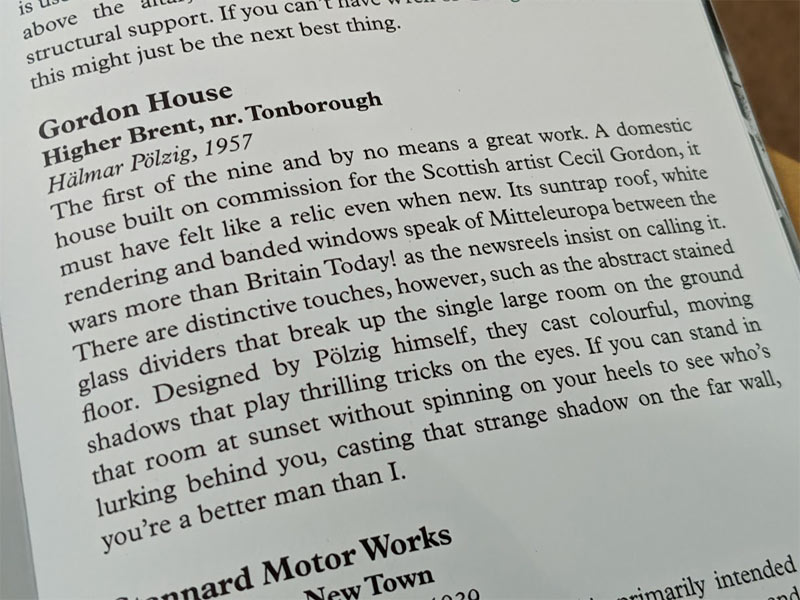
Among notes on schools and civic centres, there are entries concerning the work of émigré architect Hälmar Pölzig who built extensively in Wessex:
And that’s just the start…
* * *
I really do like ephemera.
And I really do like post-war buildings, especially as described by Ian Nairn.
Nairn’s London from 1966 is one of my very favourite books, especially this entry:
I also love the stories of H.P. Lovecraft and M.R. James, Universal horror films, folk horror and all that eerie Scarred for Life TV from the 1970s and 80s.
I first wrote a version of this story 15 or more years ago, with a character inspired by Nikolaus Pevsner exploring the buildings of a backwater Somerset town. It was a rewrite of ‘Shadows over Innsmouth’, essentially, and didn’t quite click.
Somehow, though, it must have been locked away in the back of my brain, evolving and ripening, until a few weeks ago, I suddenly thought, oh, yeah, that’s how to do it.
It’s not just a short story – it’s an object, a work of pastiche.
I’m really happy with how it’s turned out, from the typography (like Nairn’s London, the body copy is set in Plantin) to the photos to the cover design.
I’ve only had 50 copies printed because, honestly, when you draw a Venn diagram of people who like Ian Nairn and those who like creeping horror, I don’t think the overlap is huge.
If you want a copy, get in touch. It’s got 20 pages and costs £5 delivered. Email me (raymondnewman@gmail.com) or DM via Twitter (@MrRayNewman) to sort out payment and postage.











 Precast Reinforced Concrete Heart