
Categories
crime Film & TV

The Todd Killings, Smooth Talk, and the allure of the creep

Everything about the American serial killer Charles Schmid sounds pathetic – so how was he able to command the loyalty of his teenage followers?

That’s a question grappled with by two films based on Schmid’s story, 1971’s The Todd Killings, directed by Barry Shear, and 1985’s Smooth Talk, directed by Joyce Chopra.

Both films ultimately share the same original source: a 1966 Life magazine article by Don Moser called ‘The Pied Piper of Tucson’.

That article is a masterpiece of true crime writing, available online, and also collected in a 2008 Library of America anthology. Moser painted a picture of a loser and weirdo who, in his early 20s, was still hanging around with school kids in Tucson, Arizona:

At the time of his arrest last November, Charles Schmid was 23 years old. He wore face make-up and dyed his hair. He habitually stuffed three or four inches of old rags and tin cans into the bottoms of his high-topped boots to make himself taller than his five-foot-three and stumbled about so awkwardly while walking that some people thought he had wooden feet. He pursed his lips and let his eyelids droop in order to emulate his idol, Elvis Presley. He bragged to girls that he knew 100 ways to make love, that he ran dope, that he was a Hell’s Angel.

But Schmid was somehow appealing to teenagers who saw not a creep but a local own-brand version of Elvis Presley:

He had a nice car. He had plenty of money from his parents, who ran a nursing home, and he was always glad to spend it on anyone who’d listen to him. He had a pad of his own where he threw parties and he had impeccable manners… He knew where the action was, and if he wore make-up—well, at least he was different… [To] the youngsters – to the bored and the lonely, to the dropout and the delinquent, to the young girls with beehive hairdos and tight pants they didn’t quite fill out, and to the boys with acne and no jobs – to these people, Smitty was a kind of folk hero. Nutty maybe, but at least more dramatic, more theatrical, more interesting than anyone else in their lives: a semi-ludicrous, sexy-eyed pied piper who, stumbling along in his rag-stuffed boots, led them up and down Speedway.

Schmid was more than “nutty”. He tortured at least one cat, for starters. Then, in May 1964 he convinced two young friends to accompany him as he kidnapped, raped and murdered 16-year-old Aileen Rowe. They helped him bury the body in the desert – and kept his secret.

A little later, in the summer of 1964, he met 16-year-old Gretchen Fritz at a swimming pool. He seduced her and they had a rocky year-long relationship. It culminated in the death of both Gretchen and her younger sister, Wendy, in August 1965. When he showed a friend called Richard Bruns where the bodies were buried in the desert, Bruns turned Schmid into the law.

Schmid was convicted of murder in August 1966 and sentenced to death. By June 1967 a film based on the story was in production.
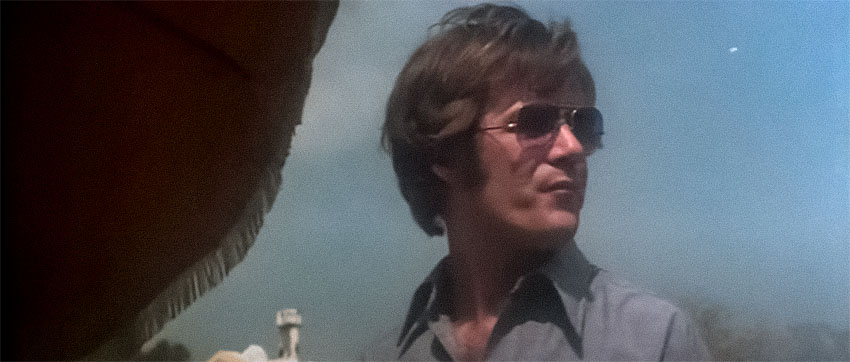
A screengrab from The Todd Killings showing Skipper Todd with bushy long hair, shades, and a wide collared shirt.
Robert F. Lyons as Skipper Todd in The Todd Killings.

The Todd Killings: torn from today’s headlines!

The Todd Killings had a range of working titles like ‘Pied Piper of Tucson’, ‘The Pied Piper’ and ‘What Are We Going to Do Without Skipper?’

It was eventually released in 1971 with the action relocated from Tucson to the fictional town of Darlington, California.

Schmid became ‘Skipper Todd’ played by Robert F. Lyons, with his look and lingo brought up to date. Skipper has shaggy Mick Jagger hair, tight bell bottoms, and a green dune buggy. He also plays folk rock songs on an acoustic guitar, almost like a spare member of The Monkees, or Charles Manson.

Lyons really is good looking, though, and brings to the part a commanding arrogance. The children follow him because he has the qualities of a leader. In odd, intercut scenes he is shown lying to a US Army recruiter to wriggle out of fighting in Vietnam where, actually, he might have thrived as another William Calley.

Updates and poetic licence aside, the film is an otherwise relatively faithful recounting of the facts of the case.

It has a particularly strong opening: Skipper is burying a body in the desert, helped by a devoted young girlfriend and a panicky boy.

This is not a whodunnit, or a did-he-do-it, like Psycho. That this young man is bad is established from shot number one.

From the off, we also empathise with the bored kids who are groomed by Skipper Todd, even as we want to shake them by the shoulders and urge them to break free.

We even begin to understand why they would reward his madness and violence with devotion. They are weak, and their parents are weak, too. He is good at spotting weakness and filling the gaps in people’s live. He has everyone, both boys and girls, under an erotic spell.

Did Charles Schmid ever see The Todd Killings? He died in prison in 1975 so it’s just about possible. If so, he would probably have found it flattering.
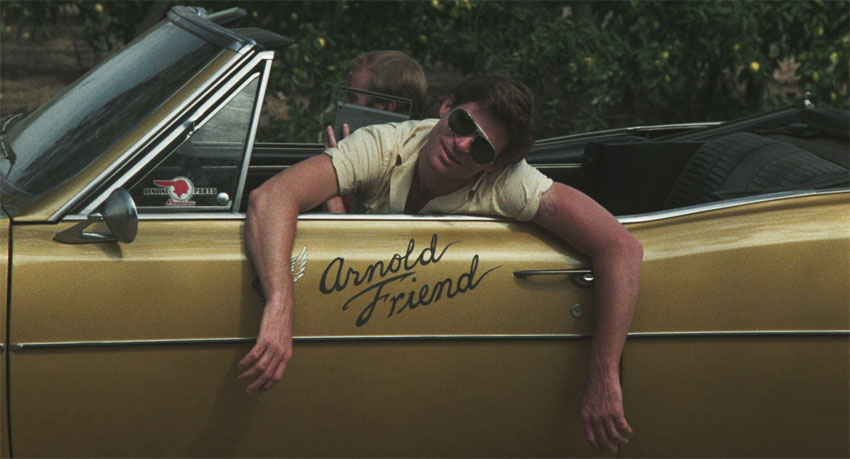
A man with muscular arms and sunglasses leans over the door of a gold convertible. His head is tipped to one side. The name Arnold Friend is painted in script letters on the side of the car.
Treat Williams as Arnold Friend in Smooth Talk.

Smooth Talk: back to the future

More than a decade later a second film tackled the story more obliquely, and more artfully. Joyce Chopra’s Smooth Talk from 1985 was not based on Moser’s article but on a short story by Joyce Carol Oates, ‘Where Are You Going, Where Have You Been?’ first published in 1966.

In Oates’s version of the Schmid affair, which was distilled from Moser, the monstrous fake teenager is called Arnold Friend. He stalks, seduces and seizes a teenager called Connie while her well-to-do parents are out at a barbecue. It crams a lot into a few thousand words and presents small town America as a menacing, sickly place.

Smooth Talk expands on the short story significantly, using Oates’s original material to form only the final act of the film.

It also does something really clever with the period. Connie (Laura Dern) is a quintessential 1980s teenager straight out of a John Hughes movie, while Arnold Friend (Treat Williams) is a relic of the 1950s. He is a cheap knockoff of James Dean (Connie has posters of Dean on her bedroom wall) and therefore closer to the real Charles Schmid than Skipper Todd.

In this, there’s an echo of another film: Terence Malick’s Badlands from 1973, in which Martin Sheen based his performance as spree-killer Kit Carruthers on James Dean. Kit wasn’t based on Charles Schmid, however, but his near namesake, Charles Starkweather – another rural weirdo with a taste for teenage girls.

In some ways, Arnold Friend is a less complex character than Skipper Todd, or the real Charles Schmid. He’s a sinister stranger, not a ‘pied piper’ who everyone knows and admires. He’s clearly a much older man (Williams was 34 when he played the part), dressed anachronistically, and almost supernaturally sinister in his manner, like an avatar of the Devil after Connie’s living soul.

In this version of the story Arnold Friend doesn’t kill anybody – as far as we know. He stalks Connie and, eventually, convinces her to go for a ride. This is roughly where Oates’s story ends and in that version we’re left to speculate on her fate. But if you know it’s inspired by Schmid your speculation is likely to favour murder.

In the film, Connie returns. She is changed – an adult, now, and no longer innocent. But she is, at least, not dead and buried in the desert.

In almost every way Smooth Talk is the better film. Not least because it makes Friend/Schmid an exterior menace and puts in the turbulent mind of one of his victims.

The Schmids, they’re multiplying

There is something particularly dark and rich about this story which must be why filmmakers keep coming back to it.

There’s Dead Beat from 1994, which seems almost impossible to see; Lost from 2005, adapted from a novel by horror writer Jack Ketchum; and Dawn from 2014, which focuses on the sister of one of Schmid’s victims.

Schmid is not the only killer to have inspired multiple movies, though. In fact, it’s unusual for a notable serial killer not to have inspired multiple movies.

Leopold and Loeb are practically a sub-genre (Rope, Compulsion, Swoon). So is Ed Gein – the original model for six decades of psycho-slashers, from Norman Bates to Leatherface. And Badlands is by no means the only take on the Charles Starkweather and Caril Ann Fugate story.

As a writer of fiction I find it almost maddening that real life generates stories that are so much more out there than anything I could invent. If I’d created Charles Schmid as a character it wouldn’t have occurred to me to give him white foundation make-up, a fake mole, and shoes full of crushed tin cans. Real criminals are often both dumber and more interesting than their fictional counterparts.

More importantly, I don’t know if I’d have been able to look at Schmid through the eyes of a teenager and have them think, “That guy is cool, I love him, I’ll do whatever he says.”

Main image: A digital sketch based on several different photos of Charles Schmid composited, traced, and treated with textures and filters.

Categories
fonts

That mysterious font is Festive, not Stymie

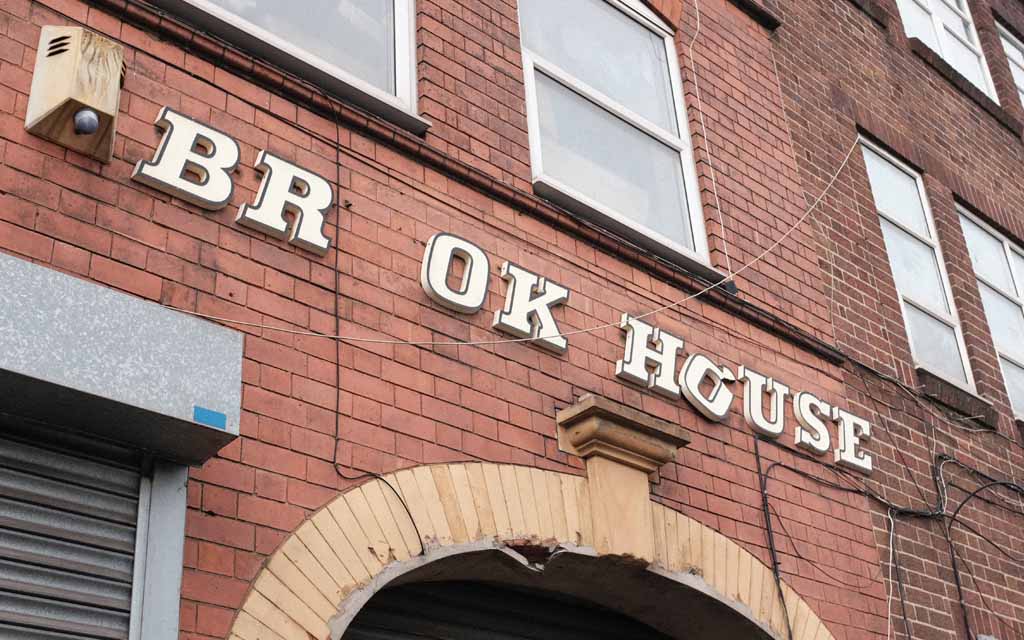
What is that font? You know, THAT font? The chunky italic lettering you see on launderettes and council blocks, on post-war churches and new town butcher’s shops, across the UK.

The font you’re thinking of might well be ‘Festive’, a lettering style designed by Maurice Ward of Ward & Co, a sign-making company in Bristol, founded in 1952.

Launched in the early 1960s, Ward’s ‘Inter-signs’ product, manufactured under the Lettercast brand, used injection moulding.

Lettersigns was available in two styles, Festive and Block, and made it possible for anyone to mount their own custom signs with professional-looking 3D lettering.

Or, of course, the specific sign you’re thinking of might be in one of any number of similar lettering styles in the broader category of ‘Egyptian italic’.

Samples of Profil, Clarendon Bold Italic, Stymie Bold Italic and Amigo No. 1, four similar looking chunky italic fonts with serifs.
Samples of lettering styles similar to Festive cobbled together by me from various sources including The Studio Book of Alphabets, 1963.

Those include:

  • Egyptian Italic (an earlier Ward & Co style)
  • Festival Egyptian (an official style of the Festival of Britain)
  • Stymie Bold Italic
  • Clarendon Bold Italic
  • Profil
  • Amigo No. 1

First, then, let’s pin down how to spot Festive in particular.

How to spot Festive

Trade catalogues from Wards of Bristol include samples of Festive in print.

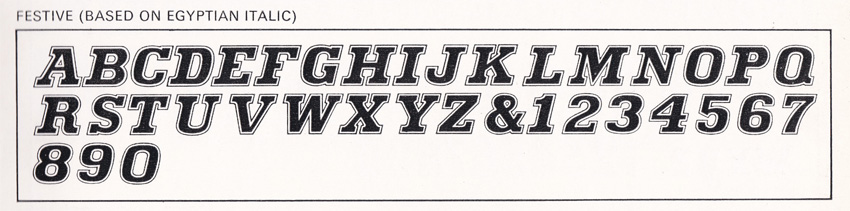
From this, we can see the most distinctive features of Festive, which can help us distinguish it from similar lettering styles in the wild.

A sample of a letter style with capitals A to Z and numbers 0 to 9.
A sample of Festive from a Ward’s catalogue from, I think, 1971.
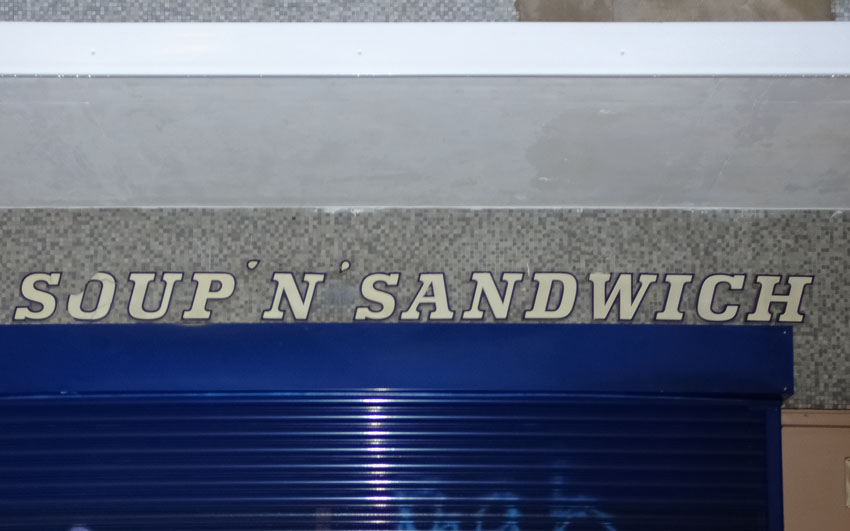
A sign on a shop in Bristol advertising SOUP 'n' SANDWICH.
A shop sign in Bristol in Festive, author’s own photo.

First, there’s the unexpected serif at the apex of the capital A.

Then there’s the relative flatness of the round letters, like C and G.

And, of course, there’s the built-in beading – that outer line that traces the edge of each letter.

The origins of Festive

There’s a clue right there in the name: like almost every bit of flair in Britain’s mid-20th century public spaces, it came indirectly from the 1951 Festival of Britain.

One of its official lettering styles was ‘Festival Egyptian’, as depicted in the typographic handbook for designers.

A big 3D italic letter E with the word EGYPTIAN overlaid in the same style.
A page from A Specimen of Display Letters Designed for the Festival of Britain 1951 via Chris Mullen at The Visual Telling of Stories.

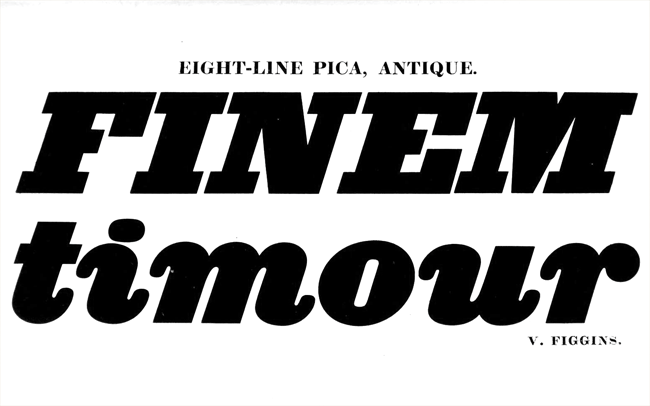
But why Egyptian? In around 1817, London type founder Vincent Figgins created a typeface he referred to as ‘Antique’.

A sample of Eight-Line Pica Antique with big chunky italic letters with serifs.
An 1834 sample of an italic variation of Antique. SOURCE: archive.org

It was fat, bold and easy to read from a distance.

Earlier examples of this style have been found but Figgins commercialised it and prompted imitations from other foundries worldwide.

These days, they’re known as slab serif fonts but in the 19th century, they were usually referred to as antique, after Figgins; or as either Ionic or Egyptian, in variations on the theme.

You can certainly see in Antique, especially when italicised, the seeds of the 20th century launderette signs and tower block titling.

But these in-your-face, ungainly display typefaces went out of fashion, like everything associated with the Victorians. They spoke of slums, music halls and Gothic mausoleums. They weren’t fit for the world of motor cars, aeroplanes and Streamline Moderne.

Then, in the 1930s, a revival began, achieving its full flowering with the 1951 Festival of Britain. This is documented in detail by Paul Rennie in this 2001 essay (PDF) but here are the key points.

First, the cover of John Betjeman’s first book Ghastly Good Taste, published in 1933 when he was still in his twenties, showcased a jumble of Victorian typefaces.

Then, in 1938, came Nicolette Gray’s book Nineteenth Century Ornamented Typefaces, celebrating Victorian lettering styles.

And in the same year, the architect and townscape designer Gordon Cullen personally produced (non-italic) slab serif lettering for the starkly modern Finsbury Health Centre. It is clearly ahead of its time and wouldn’t look out of place on a municipal building erected 20 years later.

The sign on the Finsbury Health Centre in chunky serif letters.
The Finsbury Health Centre in 1979. SOURCE: Gillfoto, via Wikimedia Commons, under a Creative Commons Attribution-Share Alike 3.0 Unported licence.

Though the British Government generally clung to clean, uncluttered sans serif typefaces such as Gill Sans for official posters (Keep Calm and Carry On, chaps) advertising designers and publishers dabbled in Victorian styles throughout the 1940s.

After World War II, In the run up to the Festival, committees and working groups were put together to consider every small detail, including typography. Gordon Cullen and Nicolette Gray were both on the Festival of Britain Typographic Panel.

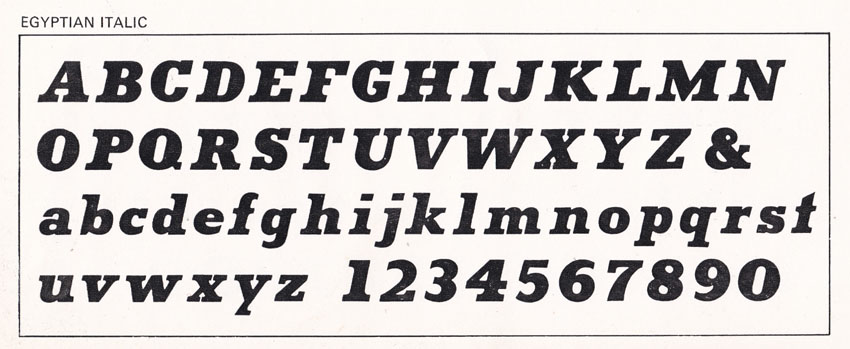
Once the Festival was over, Festival style lingered. Lettering catalogues from the 1950s and 60s include, for example, Egyptian Italic, Rockwell Italic and Ultra Bodoni Italic.

A sample of a letter style with capitals A to Z, lower case letters a to z, and numbers 0 to 9.
A sample of Egyptian Italic from a Ward’s catalogue of 1971.

Maurice Ward wrote this of his Egyptian Italic, the immediate precursor to Festive, in a catalogue from 1962:

[This] face, together with its vertical counterpart is a harmonious combination of the best features of the Egyptian family of characters and is perfectly suited as an architectural letter on buildings. The popularity of these Egyptians is unquestionably due to the Festival of Britain in 1951 and no face characterises more aptly the word ‘Festive’.

And when Ward & Co (Lettercast) launched Festive in around 1963 it was labelled as “based on Egyptian Italic”, which was in turn a take on Festival Egyptian.

Two very similar capital letter As. One has no outer line and no serif at the top.
The A from Egyptian Italic (left) and from Festive (right).

Feelings about fonts

What’s fascinating about Festive is how it moves people emotionally, and obsesses them.

The writer Jason Hazeley has been trying to identify it for years, for example, referring to it as “That Font” or “Everywhere Bold Italic”.

And he is not alone. For a generation of British people, it represents the vanishing landscape of their childhoods, tied into ideas of nostalgia and even hauntology.

Graphic designers have often resorted to Profil as a close match – and, of course, Festive was never really intended to be used in print.

On social media, including a popular Flickr group, Stymie Bold Italic has incorrectly been used to describe this entire category of lettering styles.

It’s only recently, however, that illustrator and designer Richard Littler of Scarfolk fame managed to unlock the mystery – or, at least, bring together all the threads.

When he put out a call on social media his significant reach across multiple platforms, with exactly the right kind of people, brought to light:

The latter, a spectacular piece of work, has been sitting there for anyone to find since 2020, in a different domain of geekiness – if only type nerds had known to search ‘Inter-signs’ and ‘Lettercast’.

Personally, I’m a bit embarrassed not to have got there sooner. Back in 2020 I spent some time researching this seriously. I got in touch with Andy Ward, Maurice Ward’s son, who tipped me off to Egyptian Italic, and sent me photocopies of material he had at hand, at home, during lockdown.

And then Christine Daniel sent me photos of the back of some sign letters in her collection with ‘Inter-signs’ clearly marked on the back. But I couldn’t quite make those final links.

A Tweet from Christine Daniel showing some of her collection of plastic Inter Signs letters with trademark information on the back.
SOURCE: Twitter/X.

Together, though, we got there. The mystery has been solved. What a relief.

With thanks to Christine Daniel, Jason Hazeley, Richard Littler, Paul Rhodes and Andy Ward.

Categories
Fiction

FICTION: The Fugitive

In the late afternoon, slow-moving cloud came in off the mountains and burst over Maxton City. Main Street had just been macadamed the year before and the rain turned it into a stream.

Dan Todd used the storm as an excuse to drop into the Turkey Inn on his way home from the newspaper office. He had already dawdled and detoured. He was avoiding the road home, and the one-pot dinner he knew was being kept warm on the stove.

That damn black pot. The thought of it made his gut hurt. Hazel always did use too much salt, and never trimmed the fat off the meat. Which would be fine, which he could live with, if she cooked it long enough for the damn fat to render out, but damn her, she never did. It just stewed like white rubber, and then he wouldn’t sleep with it sitting on his gut.

The Turkey was an old wooden building, one of the oldest in Maxton. In recent years, however, the old half-height saloon doors had been replaced with shining new ones in chrome and glass. They looked out of place but a travelling salesman from the city had dazzled old Jim with talk of modernisation, hygiene and glamour. It was true that  they kept the dust out in summer. Dan pushed his way in and let the door swing behind him.

The bar was gloomy, and downright dark towards the back. Jim ought to have switched on the lamps, what with the storm having made it so dark outside, but he always waited until six o’clock. It was a point of principle.

The barroom was long and thin. The counter was of polished wood with big cut glass mirrors on the wall behind. A row of stools lined the bar and there were wooden booths with benches along the opposite wall. There was a cigarette machine, a gum machine, and a cardboard sign that said ‘Please pay when served’.

Music was coming from a radio on the counter, a big city dance band strangled through a small speaker. Dan didn’t recognise the song but could hear somebody crooning about the moon and loneliness.

Dan took off his hat, revealing fine, fair hair, and slapped the felt brim firmly against his hand. Rainwater scattered on the floor. He hung the hat on the stand by the door. Then he shook off his coat and hung that up, too. He used his handkerchief to wipe raindrops from his spectacles as he approached the bar.

‘Beer, if you please.’

Jim was a round, blank-faced man bald except for tussocks of hair above his ears. He poured a mug of Old Joe’s Lager Beer and placed it on a napkin on the bar.

Dan glanced along the counter to the only other customer.

He was a hunched, miserable looking man in a heavy plaid jacket with a sheepskin lining. His head hung over an almost-empty beer mug that was clutched in his thick, dark hands.

Dan had few friends. He didn’t need them. But that night, he wanted to talk, and he heard himself saying: ‘Buy you a beer, friend?’

The man looked up.

Dan had never seen such eyes. They were like those of a whipped dog, or a seasick stowaway. The whites were the colour of slow-baked cream.

‘Had a couple already,’ he growled.

Dan began to turn away.

‘Could handle another.’

Jim looked at Dan, who nodded. As Dan lifted himself onto a stool, Jim placed the beer in front of the stranger.

‘Obliged to ya,’ said the stranger. He pushed his spent glass away and lifted the fresh one, glittering with dew, in Dan’s direction.

‘Name’s Dan Todd,’ said Dan. ‘What do I call you?’

The man on the other stool turned slowly to look over his shoulder, the movement creaky and apparently painful. He turned back and glanced at Dan from under black, unruly brows.

‘Call me Grant.’

‘That your first name or your last?’

Grant took a long gulp of beer and rubbed foam from his stubble-covered upper lip.

Now he was settled next to Grant, Dan could detect a musk about the man that he didn’t like. Men often had a smell after a day’s work. Heck, even he needed to shower after a day baking in that miserable office which the old man insisted on keeping sealed like a diving bell. Grant’s smell, though, was rotten, as if he was sick and didn’t yet know it. It came out of his pores and in his breath whenever he turned a little towards Dan.

‘Hope you don’t mind a little company,’ said Dan, hoping that Grant would send him away.

‘I ain’t a big talker but I don’t mind listening,’ said Grant.

‘You might regret saying that, friend,’ said Dan with a dry laugh. He took his beer mug in his strong right hand and sipped a little. ‘I’ve got a lot on my mind.’

Grant rolled his yellow eyes towards Dan and waited.

‘Well, it’s just that, oh, well, a fellow gets so damn bored.’

‘Bored how?’

‘See, the thing is, I’ve never lived anywhere but Maxton,’ said Dan. ‘I didn’t even go to college, and I missed the war. Started writing for the paper when I was fourteen and I’ve been there ever since. I suppose it’s been quite different for you?’

‘I know the road, that’s true,’ said Grant. ‘Six states and five countries.’

With a sigh, Dan said, ‘Gosh. Doing what?’

‘Picking fruit. Crewing boats. Driving trucks. Peeling taters.’

‘I should have done all of that before I married,’ said Dan. ‘I should have done everything. Are you married?’

‘Was.’

‘Then you know how it is. The same conversations, the same dinners on the table, the same old flower arrangement on the stand in the hall.’

Grant grunted.

‘Sounds tough.’

Before Dan could reply Grant shivered as if an earthquake had shaken his body.

‘Got a fever?’ asked Dan, leaning back in his stool. ‘Get caught in the storm?’

‘Hungry, mostly,’ said Grant. ‘Ain’t eaten today.’

Dan waved a hand at Jim. The barkeep had slunk away to the far end of the bar to watch the rain on the glass but saw the movement from the corner of his eye.

‘Couple of sandwiches,’ he said.

Jim nodded and disappeared through a door into the kitchen.

‘You was saying about your wife,’ said Grant. ‘Them flowers in the hall.’

Dan knew he wasn’t really interested. It was just that he’d rather hear Dan talk than talk himself. Dan rubbed a hand through his damp hair and pushed his glasses tight to the bridge of his nose.

‘I shouldn’t have said anything,’ said Dan. ‘It’s not gentlemanly.’

‘You was saying about the dinners and the conversations.’

There was a suggestion of bitterness in Grant’s voice now. Jealousy, perhaps, Dan thought.

‘I don’t mean to complain,’ said Dan. ‘I don’t mean to boast either. We’re just like any other couple that’s been married five years. Not sick of each other, exactly, but—’ Well, he thought, maybe sick of each other is exactly right. ‘I like apple pie but I don’t want to eat it every damn day.’

Grant finished his beer in a single long pull as Jim returned with two thin, greasy sandwiches. Nobody came to the Turkey to eat. Grant flicked at one sandwich with a dirty nail, peeled back the bread, let it drop.

‘Another beer,’ Grant said.

‘Put it on my tab,’ said Dan. ‘I’ll take another, too.’

There was a sudden change in the air in the bar and the door made a booming sound as it was thrown open. Two men entered, followed by a gust of wind carrying about equal amounts of dust and rain.

Both were dressed in hunting clothes, plaid shirts and woolen caps, but Dan noticed immediately that they were wearing polished black city shoes.

‘Howdy,’ said one of the men with a broad, childlike smile. He was grey-haired, lean and tall. He looked everywhere but at Grant.

His companion was younger with rough red hair and a sharp jaw. His big teeth didn’t quite fit in his mouth. He looked directly at Grant and thereafter his eyes didn’t move from the shaggy figure at the bar.

‘What’ll it be?’ asked Jim.

‘Two beers,’ said the older man.

‘Not for me,’ said the other, still staring at Grant. ‘Coke, if you have it, or root beer.’

They took seats at the end of the bar, one looking at Grant, the other pointedly not.

‘My wife was a wonder,’ growled Grant, almost under his breath.

Dan turned so that his back blocked Grant from view. He did not know why he did this, only that he did not like the young red-haired man, not at all.

‘Not too good with the flowers or conversations but–’ He gave a low, howling whistle. ‘She was sure nice to be around. Sure knew how to make a feller feel like a million dollars.’

‘Then why did you leave her? Or let her go?’

Their conversation was now being held at a whisper and sounded more conspiratorial than perhaps they knew.

‘Somebody killed her,’ said Grant. He took hold of the beer glass in front of him and gave it four quarter turns with his dirty fingertips until it was back where it started.

Dan swallowed.

‘Somebody?’

‘Not me,’ said Grant, wearily. ‘Somebody. Something. They never did find out.’

‘Something? Who do you mean, “they”?’

Dan glanced towards the two men at the end of the bar and then back at Grant.

‘Who are those men?’

‘I ain’t never seen ‘em before today.’

‘Well, I just don’t know what to think,’ said Dan. He took a mouthful of beer, struggled to swallow, as if he’d forgotten how.

‘Don’t think nothing. We’ll finish our beers and then I’ll walk out of here. They’ll follow me and something will happen, who knows what. But it won’t matter none to you because you’ll be home with that wife of yours soon enough, feeling glad you ain’t me.’

For the first time, Grant laughed. It was a rough, raw bark.

‘The grass is always greener, they say,’ said Grant, ‘except there ain’t nobody looking at my lawn and wishing it was theirs.’

Grant drank some beer. He and Dan sat in silence for a minute before he drank the rest.

As he pushed back the stool it scraped on the boards and the two detectives, or special agents, or whatever they were, looked sharply in Grant’s direction. There was no jollity in the older man’s face now, and the younger man looked ready to wrestle a mountain bobcat.

Grant didn’t offer to shake Dan’s hand, which Dan was glad about, having seen his filthy nails and the blisters on his palms.

‘See you around,’ Grant said as he pushed past and headed for the bar’s front door. On the mat, he pulled up the collar of his plaid jacket and retrieved a woollen hat from his jacket pocket. He pulled the hat on tight, and low over his eyes. Then he stepped out into the blue evening light.

The moment the door was closed, the older of the two detectives threw a bill on the bar.

‘Keep the change.’

They rushed out into the street after Grant.

At last, when it was just Dan in front of the counter and Jim behind it, the two men spoke.

‘Policeman, I reckon. They believe he killed his wife,’ said Dan.

‘No smoke without fire,’ said Jim. ‘That feller stank of Folsom.’

‘I wouldn’t know,’ said Dan.

‘Some reporter,’ said Jim with a smile.

Jim checked his watch and switched on the lights. They filled the empty bar with queasy yellow light. The dance band on the radio finished with a flourish and a soap company spokesman began talking about how to avoid ‘scummy dishpan film’.

‘I’d better be going,’ said Dan. He looked at his glass of beer but didn’t finish it.


When he stepped outside he found the sky clear, the storm having blown on clean through the valley, and dusk coming on. There was a full, round moon rising faintly above the spikes of the ponderosa pine trees on the foothills.

Main Street was quiet, in that just-scrubbed silence that comes after a storm, and Dan could hear his own footsteps on the sidewalk as he tramped towards home. He was crying, just a little, because of the cold air in his eyes, he told himself, though he was thinking of Hazel and how sweet it would be to sit with her in front of the radio, even if there was nothing to talk about.

He could tell her about Grant, he supposed, but he wouldn’t. It would scare her, in lots of different ways.

The next morning Dan left his house under a cold, clear sky, feeling rested and fortunate. He passed the fine old houses on the street, each spaced apart with room for a paddock or orchard, and smiled. Some had cars or pickup trucks parked outside, none of them new, but all well cared for and clean.

As he neared the end of the road, he saw that there were big black cars parked along the edge of the forest that led into the foothills. There were men in uniform, too. As he came closer, Dan saw Pete Nachel, the Sheriff, and two of his deputies. Pete was a tall man with a moustache whose points reached his jaw, like Wyatt Earp. His hat was trimmed with a gold cord. There were men from out of town, too, in black suits and black hats.

‘Morning, Dan,’ said Pete as Dan approached. ‘Hear any trouble here last night?’

Dan stopped and peered into the trees.

‘Walked this way at about six thirty yesterday evening and all was well. What’s the problem?’

Pete looked towards the out-of-towners who were busy supervising a photographer.

‘Couple of G-Men dead in the gully. Followed one of them public enemies up this way. Been tracking him for months. Man named Grant.’

Dan swallowed hard and licked his dry lips.

‘Golly. And he shot ‘em?’

Pete pursed his lips and shook his head slowly.

‘Well, no. They’re cut up pretty bad. They say he done it with a knife. In a frenzy, they say. That’s how his wife got it.’

‘Did they find a knife?’

Pete squinted and tipped his head to one side.

‘Well, maybe it was a knife, maybe it wasn’t.’

‘What do you mean?’

Pete took off his hat and drew his long fingers through his thin hair.

‘This is still wild country round here, Dan, and I say an animal done it.’ He nodded firmly. ‘Biting and tearing, damn near minced… Yes, an animal. Can’t be nothing else. A man couldn’t have done it, not like that.’

Dan stood silently, staring down into the darkest part of the forest, and thought to himself: Old Grant never did eat that sandwich, hungry as he was.

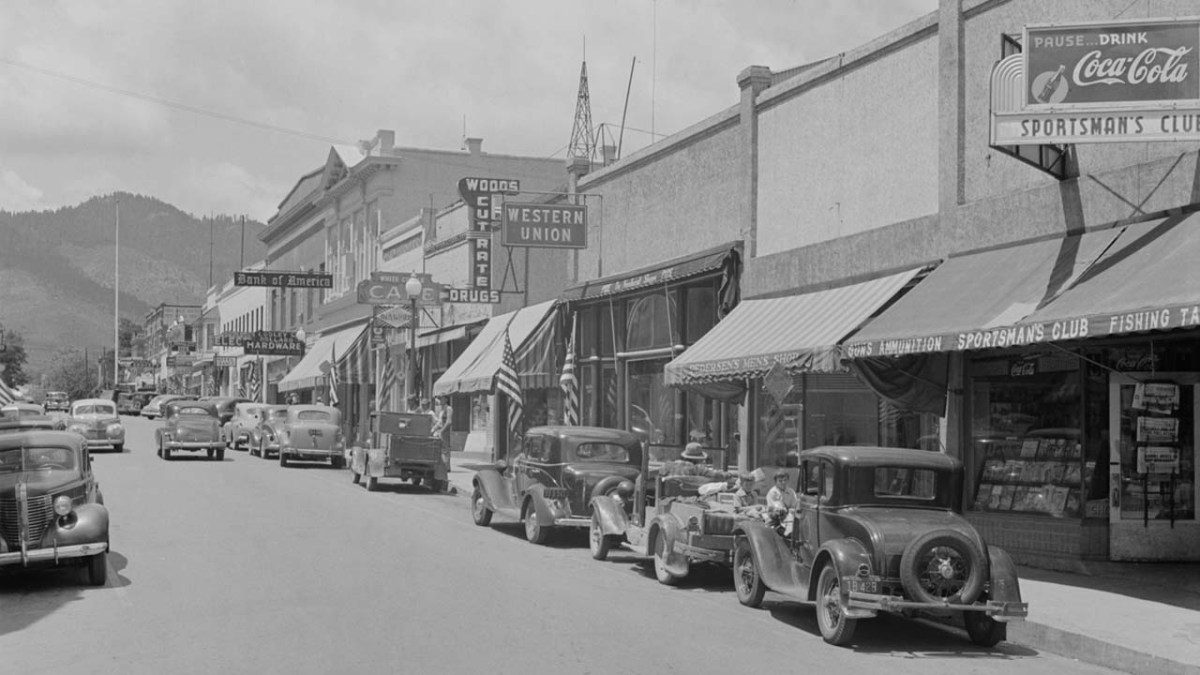
Main image: Yreeka, California, by Lee Russell, 1942, in the public domain via the Library of Congress.

Categories
Fiction Film & TV

FICTION: Scholomance, dir. Ewart Stangebye, 1927

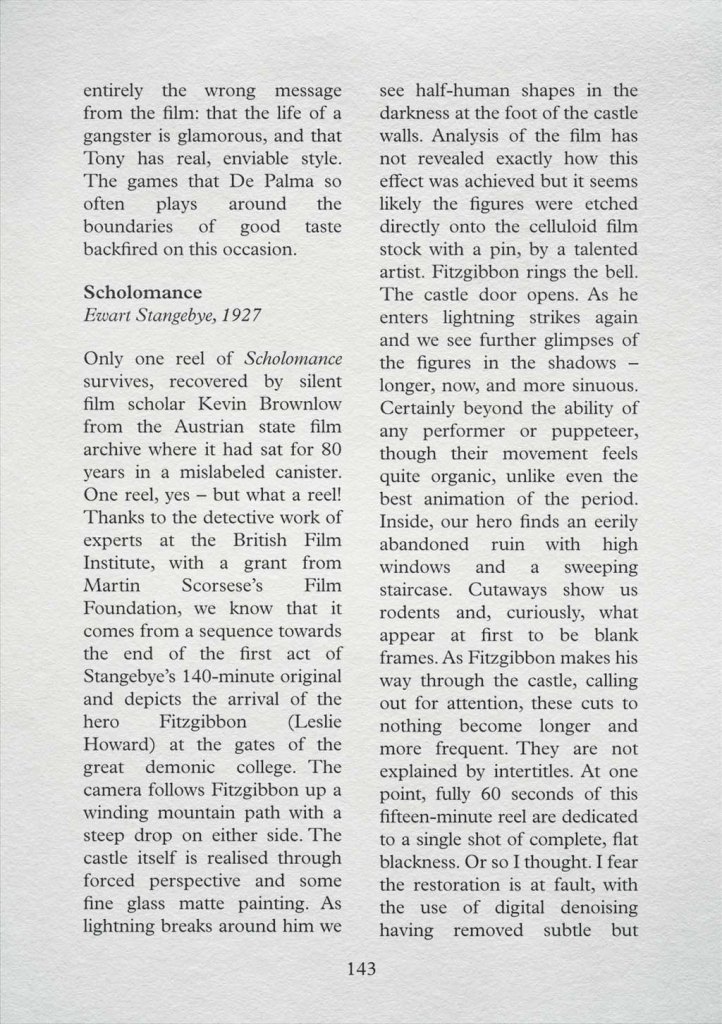
A page from a film guide that opens with the tail-end of a review: "...entirely the wrong message from the film: that the life of a gangster is glamorous, and that Tony has real, enviable style. The games that De Palma so often plays around the boundaries of good taste backfired on this occasion. Scholomance, Ewart Stangebye, 1927. Only one reel of Scholomance survives, recovered by silent film scholar Kevin Brownlow from the Austrian state film archive where it had sat for 80 years in a mislabeled canister. One reel, yes – but what a reel! Thanks to the detective work of experts at the British Film Institute, with a grant from Martin Scorsese’s Film Foundation, we know that it comes from a sequence towards the end of the first act of Stangebye’s 140-minute original and depicts the arrival of the hero Fitzgibbon (Leslie Howard) at the gates of the great demonic college. The camera follows Fitzgibbon up a winding mountain path with a steep drop on either side. The castle itself is realised through  forced perspective and some fine glass matte painting. As lightning breaks around him we see half-human shapes in the darkness at the foot of the castle walls. Analysis of the film has not revealed exactly how this effect was achieved but it seems likely the figures were etched directly onto the celluloid film stock with a pin, by a talented artist. Fitzgibbon rings the bell. The castle door opens. As he enters lightning strikes again and we see further glimpses of the figures in the shadows – longer, now, and more sinuous. Certainly beyond the ability of any performer or puppeteer, though their movement feels quite organic, unlike even the best animation of the period. Inside, our hero finds an eerily abandoned ruin with high windows and a sweeping staircase. Cutaways show us rodents and, curiously, what appear at first to be blank frames. As Fitzgibbon makes his way through the castle, calling out for attention, these cuts to nothing become longer and more frequent. They are not explained by intertitles. At one point, fully 60 seconds of this fifteen-minute reel are dedicated to a single shot of complete, flat blackness. Or so I thought. I fear the restoration is at fault, with the use of digital denoising having removed subtle but..." It continues on the next page.
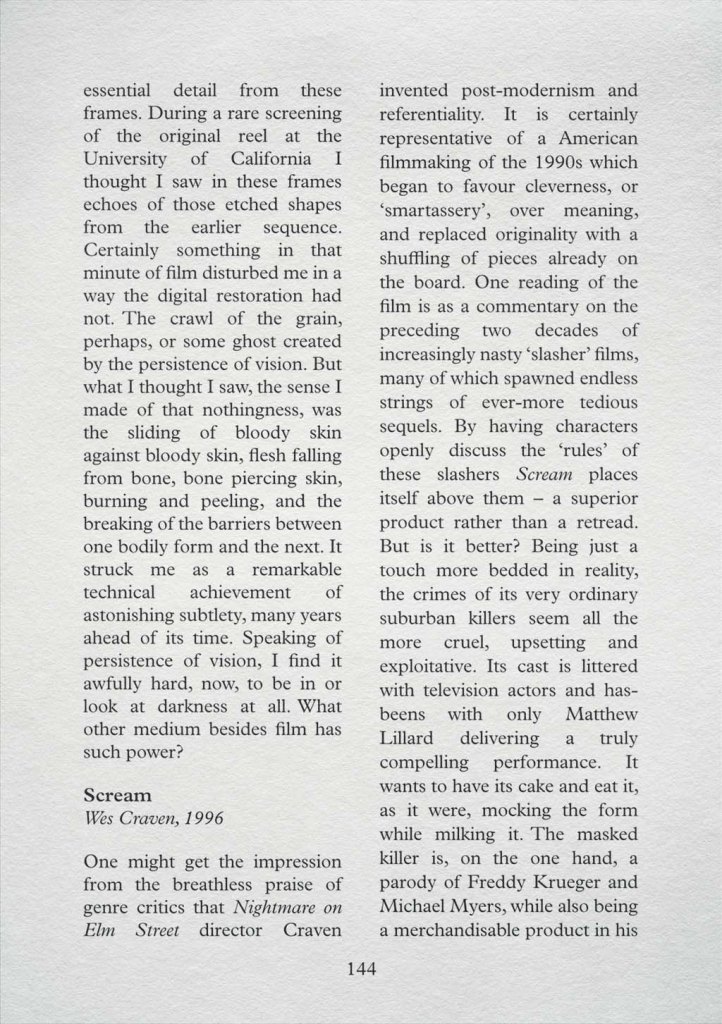
The following page from the same film guide: "...essential detail from these frames. During a rare screening of the original reel at the University of California I thought I saw in these frames echoes of those etched shapes from the earlier sequence. Certainly something in that minute of film disturbed me in a way the digital restoration had not. The crawl of the grain, perhaps, or some ghost created by the persistence of vision. But what I thought I saw, the sense I made of that nothingness, was the sliding of bloody skin against bloody skin, flesh falling from bone, bone piercing skin, burning and peeling, and the breaking of the barriers between one bodily form and the next. It struck me as a remarkable technical achievement of astonishing subtlety, many years ahead of its time. Speaking of persistence of vision, I find it awfully hard, now, to be in or look at darkness at all. What other medium besides film has such power? Scream, Wes Craven, 1996: One might get the impression from the breathless praise of genre..."
Categories
Fiction municipal gothic

FICTION: Winter Wonderland

When Dad turned up with tickets for Winter Wonderland, Tyler and I were truly astonished, for several reasons.

First, we hadn’t seen Dad since October, when he and Mum had one of their dramas. He stayed out all night and she waited for him. When we went to school, he still hadn’t turned up. He wasn’t there when we got home and she only laid three places for dinner. We knew better than to ask.

Secondly, it had already been agreed this was going to be a Little Christmas. In our family, this was an important concept. When Mum and Dad were flush, or had managed to patch things up with one or both sets of grandparents, we might get a Big Christmas. That meant proper presents, a proper Christmas dinner, and maybe even a proper tree. But most years were Little Christmases, where we each got a few things in a stocking and Christmas dinner was whatever Mum could conjure up from the freezer and the cupboards. One year, we had instant mash with Bisto and burgers.

Thirdly, even when there was a little bit of money around, Dad never bought us anything. It never occurred to him to treat or spoil us, or even to pretend to find fifty pence behind our ears. If he had coins in his pocket, he spent them on himself. Or very occasionally on Mum, if he was trying to heal a wound. Clothes, usually – skimpier and more gaudy than anything she would ever buy herself.

So, when he arrived on the doorstep, pink faced and cider breathed, chuckling and prancing like a clown, we simply didn’t believe him. He waved the envelope at us and pinched our cheeks.

‘Who’s the best Dad in the world, eh? My lovely girl and my lovely boy.’

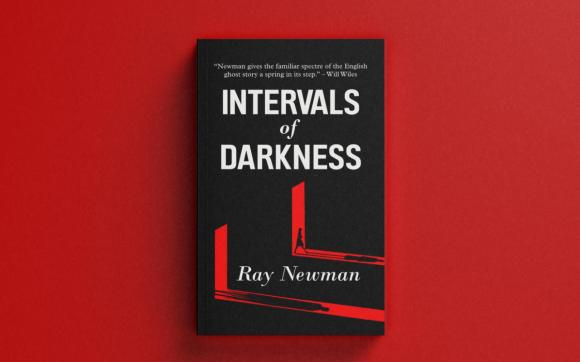
You can now read the rest of this story in my collection Intervals of Darkness available as an eBook and paperback from 7 September 2024.

The cover of Intervals of Darkness by Ray Newman. It is mostly black with an illustration showing two doorways bathed in red light. Someone is striding out of one doorway casting a long shadow. In the other doorway is just a shadow, implying an unseen figure.

Declaration on the use of generative AI

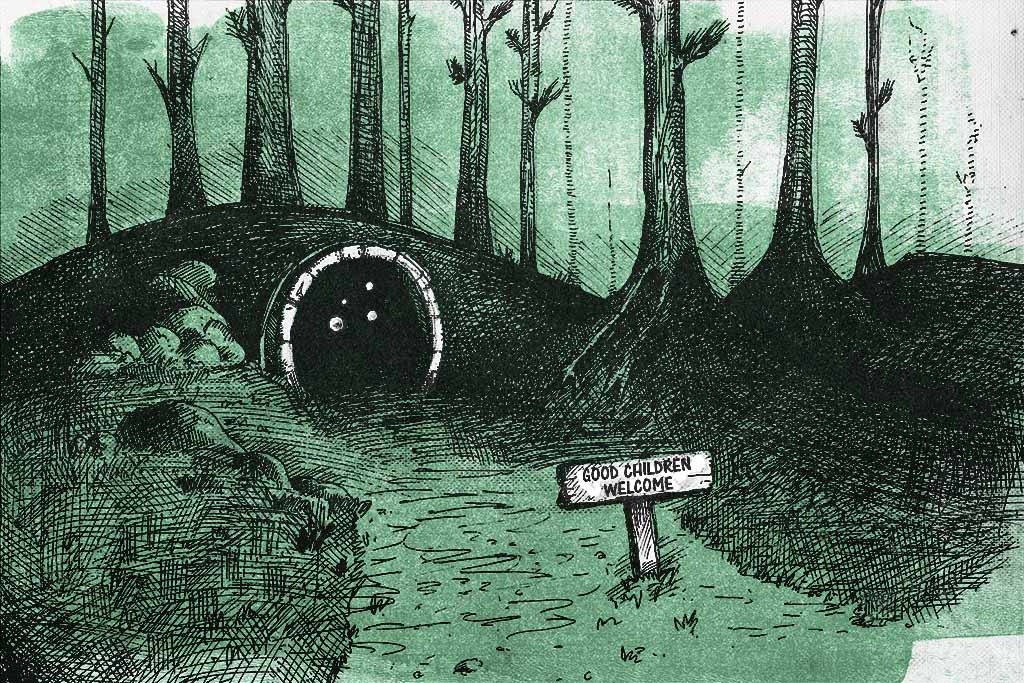
I didn’t use any AI tools, such as ChatGPT, to write the story. I drew the illustration myself with pen, on paper, and then edited it in Photoshop, which did include a small clean-up on the signpost using Adobe’s Generative Fill (Adobe Firefly).

Categories
Film & TV

Lure of the wasteland: love and death in the rubblescape

When they’ve built flats or superstores on the last of our wastelands, where will stories happen? Where will we go to play dangerous games?

Think of a 1970s British crime drama and you might well picture Jags and Ford Granadas chasing each other round nowhere spaces strewn with rubbish and ruins.

And any number of films stage their denouements on wasteland – because that’s where you end up when you’ve nowhere else to run.

It is a blank space, an urban version of the wild west, where confrontations between goodies and baddies can play out without civilians getting in the way.

Where did the wasteland come from?

It’s perhaps no surprise that the popularity of the word began to soar from the 1920s onward. 

Until then, the life of cities took place in their centres – factories, offices, housing, ports and public transport.

But in the 20th century, that began to change.

Wasteland is primarily a product of the decline of industry. In his 1969 book Derelict Britain John Barr explained the extent of the problem of wasteland in post-war Britain:

First of all, industrial wastelands are a visual affront. They offend the eye, they offend what is one of the world’s most civilised landscapes… To tolerate dereliction spattering that landscape, to expect people to live amidst dereliction, is not civilised… Derelict land, and the industrial junk left behind when industry has made its profit and fled, is dangerous to life.

There was also the clearance of ‘slums’ and the movement of the population out to suburbs and new towns.

And, of course, there was World War II. The Blitz created spectacular wastelands in the hearts of cities such as London and Bristol.

What wastelands mean

T.S. Eliot’s 1922 poem The Waste Land (significant ‘the’, wasteland as two words) addresses the collapse of western civilization brought about by the industrial revolution and the technological age.

For the 1979 album Setting Sons Paul Weller of The Jam wrote a song called ‘Wasteland’ which equates industrial dereliction with childhood freedom. It is only there “amongst the smouldering embers of yesterday” that the song’s working class narrator feels free to express feelings of love.

In the atomic age, wasteland also offered a taste of what might be – a vision of what our homes and streets could become with one well-placed missile.

On film, as well as being logistically convenient for location shooting, wasteland represented similar ideas.

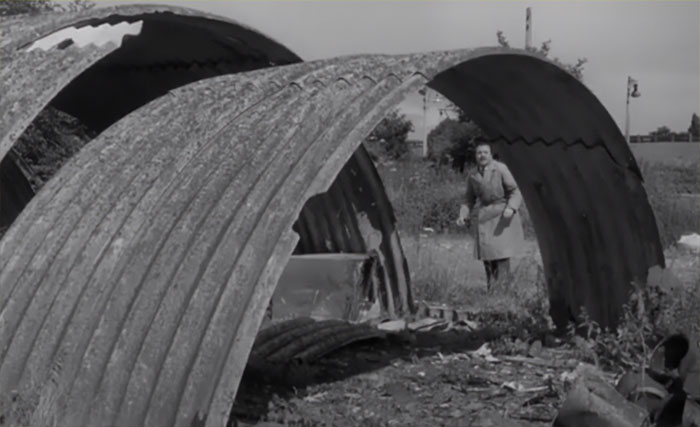
A man stares through the remains of Nissen huts surrounded by rubbish and weeds.
Richard Attenborough in Seance on a Wet Afternoon.

Wastelands on screen

In Seance on a Wet Afternoon (Bryan Forbes, 1964) wasteland is vital to the unhinged kidnap plot enacted by Billy and Myra (Richard Attenborough and Kim Stanley) as a promotional stunt for her work as a psychic.

Among tall grass, rusting Nissen huts and the remains of a half-demolished greyhound racing track, Billy prepares for the kidnap by dying his hair and hiding his motorbike.

Then, when he has the child in his custody, he returns to the same place to dump the stolen car and ditch his disguise.

The wasteland is a place between worlds, and between lives.

By passing through this wild space, he is able to leave civilization behind and transform himself from a timid suburban husband into a criminal capable of anything.

In The Small World of Sammy Lee (Ken Hughes, 1963) Anthony Newley plays a Soho nightclub compere who gets in debt with the wrong people.

His desperate attempts to raise money, against the clock, take him from one part of London to another.

Eventually, though, he runs out of road and winds up on a stretch of Thameside wasteland after dark.

There is nobody there to see or care as he is beaten half to death by his bookie’s enforcer.

In Bronco Bullfrog (Barney Platts-Mills, 1969) a young working class man called Del (Del Walker) tries to find somewhere to be alone with his girlfriend Irene (Anne Gooding).

They are frustrated at every turn, with interfering parents denying them privacy in both modernist flats and Victorian terraced houses.

Though it is far from ideal, like the protagonists of Paul Weller’s song, they resort to an inbetween space: a ruined building on wasteland in Stratford, East London. It is dirty, damp, overgrown and covered with graffiti, and this doesn’t work out either.

The Bashers is a remarkable documentary from 1963. Filmed by the BBC in Bristol it depicts the lives of youths in Barton Hill whose neighbourhood has great stretches of wasteland, awaiting the construction of new blocks of flats.

They don’t have much but they do have this remarkable resource and so entertain themselves by building giant bonfires, and battling gangs from rival neighbourhoods.

The authorities didn’t like this kind of thing, of course, and another place we see wasteland is in one of the most famous public information films. Lonely Water from 1973 shows children playing on the edge of a flooded quarry, among rusting cars and other fly-tipped rubbish.

Villains and tough cops

It’s in the gritty crime film that wasteland really comes into its own. Police corruption scandals and tabloid coverage of the Kray twins triggered a cycle of these in Britain from the late 1960s and through the 1970s.

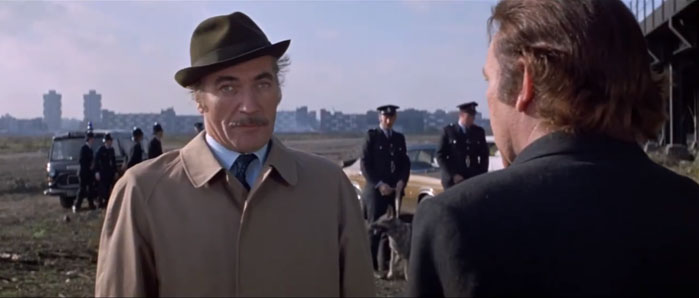
The final act of Villain (Michael Tuchner, 1971) sees Ronnie Kray-alike Vic Dakin (Richard Burton) on the run in the aftermath of a robbery.

He ends up on a vast area of wasteland at Nine Elms in Battersea, being chased through the ruins of a gas works and a British Rail goods depot.

Richard Burton confronts a Scotland Yard detective on wasteland with tower blocks in the distance.
Villain.

In Sitting Target (Douglas Hickox, 1972) the final scenes take place in a distinct type of wasteland location: a dusty, cluttered transport depot full of workmen’s sheds, parked buses and freight cars.

Here, Harry Lomart (Oliver Reed) is able to pursue his nemesis, using a red jeep to crash into their car time and again, spinning them around a space that already feels half like a graveyard.

Again, the idea seems to be that this is the end of the line. It’s where you end up when there’s nowhere else to go and where, if you’re lucky, you might just about be able to lose yourself.

This isn’t uniquely British. We see similar settings in American crime films from the same period, and in Italy especially. Italian films about tough cops, known as poliziotteschi, invariably include a car chase or shootout on wasteland on the outskirts of Rome, Milan, Turin, or some other città violenta.

When the villain and the tough cop made it to British TV, the wasteland went with them.

The very first shot of the very first regular episode of The Sweeney, broadcast in January 1975, is of a stretch of cracked concrete, where a van races towards a bright yellow Ford Capri. They’re tooling up for a blag, you see, and where else can you do that except on wasteland?

The same episode concludes with a brutal brawl on what looks like a bombsite. It’s like watching boys play cops and robbers and probably not the first time this particular bit of wasteland was used for that purpose.

Turning waste into money

In 1980, crime drama The Long Good Friday arguably signalled the end of the wasteland era. Harry Shand (Bob Hoskins) is an East End gangster looking to go straight by getting in early on the London docklands property development boom.

In the decades that followed, London would lose much of its wasteland as Canary Wharf rose from the rubble, and other cities have followed the same pattern.

That barren landscape beyond Tower Bridge would have one last starring role, though, with the remains of Beckton gas works doubling for Vietnam in Stanley Kubrick’s Full Metal Jacket.

Now they’re almost gone, some of us have started to feel nostalgic for those wastelands. They were dangerous, mysterious and wide open.

Those that remain, pending development, are invariably locked down tight, with heavy security and surveillance.

For our own protection, of course, so we don’t end up like the victim of a 1970s public information film, drowned or crushed.

And to make sure squatters can’t get in and make use of these otherwise barren spaces to park vans or caravans.

But where are we supposed to have our showdowns now?

Or hold hands amongst the punctured footballs and rusting bicycles?

Categories
buildings Fiction

FICTION: The Architects

‘I think I’d like to see Mountvale again,’ said Julian German from the tangle of his duvet.

Esther German, on her way to the airing cupboard with unnecessary haste, paused in the doorway of his room and peered at him. She smoothed a towel over her arm.

‘Did you say something, Jules?’

‘I said, woman, that I would like to see Mountvale one last time.’

Esther removed her glasses and let them hang around her neck on their beaded strap. She blinked and twitched.

‘Mountvale?’

‘Christ give me strength… Mountvale school. Bloody Mountvale. Again, meaning another time; once more.’

Esther came into the room with its smell of antiseptic cream and sweat. She lowered herself into the dusty steel-framed chair against the wall. Its feet scraped on the dull parquet. Julian winced.

‘The weather’s awful. Wouldn’t you rather spend the day in? I can find a film for you to watch.’

Julian put his hands behind his head.

‘No, I bloody wouldn’t. I want to see that school. One last time.’

‘I don’t see why. It’s a very ordinary building and–’

‘Russell Cavendish brought it up the other day. Said somebody from Historic England was talking about getting it listed. Unique example of post-war construction.’

‘But Russell–’

‘The first use of curtain walling in the whole county,’ Julian went on.

Esther looked towards the large window, speckled with rain and streaked with green moss at its corners.

Julian shook his head and growled.

‘Are you going to drive me or shall I drive myself?’

Julian had always been too tall to sit comfortably in cars. Even now, with a hump in his back and a couple of inches lost to the erosion of his spinal cartilage, he looked uncomfortable in the passenger seat of the Citroen.

Esther leaned forward against the steering wheel, thin wrists at ten to two. Her lips were pulled back from her teeth as she squinted past the windscreen wipers.

A passing van threw a fine mist from the road.

‘Left,’ snapped Julian, pointing with bunched arthritic fingers.

Esther ignored him.

He grabbed at the steering wheel.

‘Bloody left, woman! Left.’

She slapped his hand away and he winced.

‘Don’t panic, darling. I’m driving, not you, and I know the way.’

He stroked the translucent skin where she’d made contact, inspecting for a bruise, and pouted.

‘Do you? Know the way, I mean? I didn’t see you look at a map before we left.’

‘I don’t need a map.’

‘Typical woman. Why bloody plan anything?’

At a roundabout, she took the right exit. Julian leaned towards the window, scanning the road signs. He looked over his shoulder.

‘Where the bloody hell are we going now?’

‘It’s funny,’ said Esther, her voice unsteady. ‘The listing thing. Nothing we worked on was built to last, was it?’

‘Speak for your bloody self,’ said Julian, forgetting for a moment his anxiety over the route. ‘I always saw my work in context as part of the broader sweep of history.’

‘Our work,’ said Esther.

‘Oh, for God’s sake…  Yes, yes, technically, yes.’

‘And do try not to lecture. I’m not one of your students.’

He shrugged and folded his arms.

‘You were never a preservationist, anyway,’ she went on. ‘Knock it all down, you used to say.’

Julian didn’t reply.

Esther took her eyes off the road for a moment and saw that he’d fallen asleep, quite suddenly, as he often did in the car.

‘This isn’t the way to Mountvale,’ Julian bellowed.

‘I do wish you’d wear your hearing aid, darling. Then you’d know how loud you’re being.’

‘I don’t need it. My hearing is fine. And this is completely the wrong direction.’

They were on a country lane, now, passing through a village with a Norman church.

‘I thought we might go somewhere else instead of Mountvale,’ said Esther.

‘Where the hell are we?’

He saw and recognised the pub and so knew the village.

‘There’s a layby up ahead. You can turn there.’

‘Wouldn’t you like to stop for lunch? You could have a pint of beer.’

‘Don’t mother, me woman. For one thing, you’ve had no bloody practice. Just turn the car around and take me to Mountvale.’

Esther did as she was told, struggling with the gear stick as she conducted a five-point turn in ever-heavier rain.

‘I’m sorry,’ said Julian after a few moments, once he’d got his way. ‘About the mothering business. I forget sometimes.’

‘It’s alright, darling,’ said Esther. She sounded weary.

‘I’d have been a dreadful father, anyway.’

‘You certainly aren’t a terribly good husband.’

Julian laughed.

‘That’s my girl,’ he said, reaching across to pat her thigh. ‘As good as you get, eh?’

She brushed him away.

‘I’m driving.’

As they got nearer to Mountvale, in the early winter twilight, Julian became agitated again.

‘This is the estate, isn’t it? It’s changed a lot.’

‘Well, a lot of lives have been lived here,’ said Esther. ‘These buildings were always meant to be used.’

‘Plastic windows. Pebbledash. Pastel paint. Dreadful. Why did they cover the concrete?’ He raised his chin in lecturing mode. ‘It had such purity.’

‘But we didn’t have to look at it every day, did we? Or live in it, or work in it.’

‘Not that old argument!’ said Julian raising his voice and twisting in his seat.

She took advantage of his distraction to make a deliberate wrong turn.

‘Goldfinger lived in his tower, didn’t he?’

‘For a short while. But Le Corbusier lived in a fishing cottage. And Lubetkin lived in a Georgian townhouse.’

‘I’d have gladly lived on any of the estates where we worked. Our house, the house I designed for us–’

‘That we designed.’

‘Yes, yes, our house is true to the principles, isn’t it?’

Esther didn’t reply to that, not even to mention the draughts that blew through the open plan living area, or the water that gathered on the fatally flat roof all year round.

They were on a crescent, now, with a rippling concrete road and prefabricated homes. The house lights and streetlights had begun to come on.

‘This isn’t the way,’ said Julian. ‘I’m sure I remember…’ His mouth opened and closed as he tried to grip onto something. Spit gathered in the corners of his lips. He slammed a hand onto the dashboard.

‘Central square, community centre, health centre, shopping parade, schools complex opposite – primary, junior, secondary. These crescents are at the other end of the estate.’

‘You’re quite right, so they are,’ said Esther quietly.

‘What?’

She didn’t repeat herself, just flipped on the indicator and entered the final phase of the journey.

It couldn’t be avoided, now.

She parked the car half on the kerb and turned off the engine. The lights died with it.

They sat together in silence as rain sounded on the roof and windscreen.

Julian sighed.

‘Where’s my umbrella?’

Esther reached into the back seat and found it for him.

He undid his seatbelt and got out. After a struggle he got the umbrella up and lifted it. In his swollen hand, over his big head, it looked absurd, like something from Jacques Tati.

As he shuffled to the black cast-iron gate, Esther remembered when his stride was long and confident. She pulled the hood of her well-worn anorak over her head and joined him.

She looped her arm through his and they shivered together.

The gate and fence were still there but beyond was wasteland: concrete, wild grass, scattered bricks and litter.

‘The school’s gone,’ he said quietly.

‘Yes.’

 A large sheet of clear plastic trapped in brambles snapped and boomed.

‘But Russell said…’

‘Russell’s been gone a long time, too, darling.’

‘Gone?’

‘Three years.’

‘A highly significant building, he said, and now…’

‘Not significant enough. And with too much asbestos.’

Julian snatched his arm away.

‘A sound material, in its day. Hindsight is a bloody fine thing.’

‘Come on, Jules, let’s go home. Aren’t you hungry?’

Julian didn’t move except to raise a hand to the railings. He wrapped his fingers around the rusting metal and the wind filled his eyes with water.

The next morning, the sun made golden stripes on the far wall of the bedroom as it passed through the blinds.

‘Esther! Where the hell are you? 

Esther’s footsteps sounded along the parquet in the hall. She appeared in the doorway, small and exhausted.

‘I’ve had a thought.’

‘Yes?’

‘I’d like to see Mountvale one last time.’

Esther blinked and sighed.

‘Mountvale?’

Categories
books

Spooky stories to read in 2023

One of my resolutions for 2023 is to read at least one short story every day. Totally achievable, right?

Yes, definitely, especially if this replaces endlessly scrolling social media, hoping something might happen.

But I do like social media, especially when it’s helping me find good stuff to watch or read.

I asked for recommendations for spooky stories on Mastodon and Twitter – not just the names of authors, but which specific piece or pieces I should read first.

I’ve got piles of anthologies and volumes of collected stories. The challenge is knowing where to start.

This is the list I’ve ended up with.

The Same DogRobert Aickman
The TrainsRobert Aickman
The Fully Conducted TourRobert Aickman
The Coffin HouseRobert Aickman
The SwordsRobert Aickman
Ringing the ChangesRobert Aickman
The School FriendRobert Aickman
The DiverA.J. Alan
The Room in the TowerE.F. Benson
The OutcastE.F. Benson
The Moonlit RoadAmbrose Bierce
The WillowsAlgernon Blackwood
The WendigoAlgernon Blackwood
The Gospel According to MarkJorge Luis Borges
CurfewLucy M. Boston
The Bishop of HellMarjorie Bowen
The Crown Derby PlateMarjorie Bowen
The ScytheRay Bradbury
SmeeA.M. Burrage
The Day Father Brought Something HomeR. Chetwynd Hayes
Hell is the Absence of GodTed Chiang
SnareBora Chung
The Upper BerthF. Marion Crawford
The SmileF. Marion Crawford
A Slap in the FaceChris Culshaw
The Dark DivideChris Culshaw
The LandladyRoald Dahl
Out of the DeepWalter de la Mare
The HorlaGuy de Maupassant
The Signal-ManCharles Dickens
The Return of the NativeWilliam Croft Dickinson
The BreakthroughDaphne du Maurier
The Apple TreeDaphne du Maurier
The Blue LensesDaphne du Maurier
The EntranceGerald Durrell
A Rose for EmilyWilliam Faulkner
KwaidanLafcadio Hearn
Pop ArtJoe Hill
Black PhoneJoe Hill
The Brownie of the Black HaggsJames Hogg
Three Miles UpElizabeth Jane Howard
While the Nightjar SleepsAndrew Michael Hurley
The ToothShirley Jackson
The Monkey’s PawW.W. Jacobs
Under the CrustTerry Lamsley
The TowerMarghanita Laski
The Haunted SaucepanMargery Lawrence
Whoever Heard of A Haunted LiftAlan W. Lear
CargoE. Michael Lewis
In a Foreign Town in a Foreign LandThomas Ligotti
The White PeopleArthur Machen
The SundialR.H. Malden
The HouseKatherine Mansfield
An Encounter in the MistA.N.L Munby
Gabriel ErnestH.H. ‘Saki’ Munro
Man Size in MarbleEdith Nesbit
The ShadowEdith Nesbit
Secret Observations On the Goat GirlJoyce Carol Oates
Dolling HaltPamela Oldfield
The Beckoning Fair OneOliver Onions
RooumOliver Onions
The Running CompanionPhillipa Pearce
The Yellow WallpaperCharlotte Perkins Gilman
Tourist TrapBarbara Roden
Bosworth Summit PoundL.T.C. Rolt
This Creeping ThingRobert Shearman
If The Dead KnewMay Sinclair
The Portobello RoadMuriel Spark
On MirrorsBen Tufnell
The Pennine Tower RestaurantSimon K. Unsworth
The Island of RegretsElizabeth Walter
The Boys’ ToiletsRobert Westall
AfterwardEdith Wharton
The EyesEdith Wharton
Miss Mary PaskEdith Wharton
The Lady’s Maid’s BellEdith Wharton
Pomegranate SeedEdith Wharton
Diary of a MadmanLu Xun
Last updated 11/01/2023.

I’ve already read some of these, as you might expect, but will probably reread them this year.

You’ll also notice that there’s no M.R. James because I’ve read his ghost stories multiple times. He’s a given. The same goes for H.P. Lovecraft who, anyway, is generally more hysterical than spooky.

With that in mind, what’s missing? Comment below, or let me know via Mastodon or Twitter.

Categories
Film & TV

Of dogs and dreams: the strange case of Lindsey C. Vickers’ The Appointment, 1981

“Extract from police report number 727a, strictly confidential, unpublished and unavailable. Subject: Sandy Freemont. The last positive sighting was on her way home from a school orchestra rehearsal. This was on Tuesday May 14th at approximately 6:30 in the evening. At about this time her friend Janey Carr places her positively as entering the footpath through the area known as Cromley Woods, a then popular shortcut for several of the children living in Millard Heights…”

In the suburbs of a middle English town, a schoolgirl walking takes a shortcut through a wood. From the undergrowth, she hears the mischievous laughter of children and her name is called. She pauses and then, in a moment of sudden, startling violence, disappears.

These events, accompanied by amplified natural sounds, an off-kilter music box theme and, finally, shrieking strings after Bernard Herrmann, establish the tone of Lindsey C. Vickers’ 1981 British horror film The Appointment.

The rules do not apply here; anything might happen; brace yourself.

It’s possible you’ve never heard of The Appointment. I hadn’t myself until 2021, via a mention by Elric Kane on the Pure Cinema Podcast.

At that time, the only way to see it was via a VHS rip on YouTube. Once I’d got used to it, the video murk and constant hiss only added to the unsettling quality of the film.

Nor was it inappropriate: this film was only ever released on VHS, in the early days of the home video boom.

It was hard to find much information about Vickers online and, in fact, quite a few writers had assumed he was a woman. So I cobbled together my own potted biography from newspaper archives and scraps.

Vickers was born in 1940, brought up in Norwood Green, Southall, London, and educated at Dormers Wells Secondary School and Southall Technical College.

He left school without qualifications and got a job working as a messenger at London Airport (now Heathrow) before moving into film, starting as a cinema projectionist.

He went on to study film at the University of London and became a film assistant at the BBC where he directed a documentary short called ‘Impressions of Richmond’.

He became assistant director to Denis Mitchell before moving to the Government advertising office, COI, where he made a film a week for global distribution.

He worked as an assistant director on a slew of Hammer and Amicus films throughout the 1960s and 70s, including Taste the Blood of Dracula (Peter Sady, 1970) and The Vampire Lovers (Roy Ward Baker, 1970)

In 1978, he was given the chance to write, direct and edit a short film called The Lake which pre-empts the mood, themes and imagery of The Appointment. It’s beautifully shot and highly effective, despite limited resources, and was made available, fully restored, on the 2020 BFI collection Short Sharp Shocks.

The Appointment was Lindsey Vickers’ first and only full-length feature film as director, which perhaps explains why the astonishing opening doesn’t quite connect with the rest of the film.

My suspicion on first viewing was that the first five minutes were shot separately as a ‘sizzle reel’ to convince investors. I’ve since learned that it was the other way round: the intro was shot later to spice up the completed film.

In 1981, the British film industry was in trouble. According to a contemporary article in the BFI magazine Sight & Sound, only 27 features were produced in the UK that year. The Appointment was one of them.

It cost £650,000 to make and was funded in large part by the National Coal Board Pension Fund – resolutely unglamorous.

It was produced by Vickers’ own company, First Principle Film Productions, with hopes of breaking into the US market.

After that startling pre-credits sequence, the narrator disappears, never to return, and we find ourselves, unexpectedly, in a suburban family drama with engineer Ian (Edward Woodward) obliged to break the news to his daughter Joanne (Samantha Weysom) that he won’t be able to attend her school concert.

The opening sequences are calculatedly bland and the performances almost blank.

Edward Woodward, in V-neck and sensible spectacles, chats to his friend, a mechanic, and to his wife (Jane Merrow) with the same dry tone as Jack Torrance speaks to his new employer at the Overlook Hotel.

Woodward consistently defaults to a half-smile. Even so, just as in The Shining (Stanley Kubrick, 1980), everything feels just a touch off.

In an interview he gave in 2020, Vickers said, ‘I live in the supernatural world up here. The World of the uncanny. The world of ‘How can that be?’ We can see that in The Appointment.

Even before anything truly horrific happens, Joanne’s over-strong reaction to the news that her father is going away – only enhanced by Weysom’s eccentric delivery of the lines – puts us on edge.

Where is he going? To give evidence at the inquest following a fatal mining disaster in which his engineering firm was implicated, apparently no more to him than an inconvenience.

After he snaps at Joanne and sends her to bed he spends an uncomfortably long time staring at the door to her room, thinking about turning the handle. Does he often visit her room at night?

Things really get interesting when Ian tries to get some sleep before his early start the next day.

We’ve all been trained to understand that a prowling camera means we’re seeing through the eyes of someone or something; this someone or something is at Ian’s house, moving through the garden, through the door, along the hallways, in the midnight blue.

Time stops – a recurring theme – as Ian dreams that his wife, in a red dress, turns into his daughter, touching him with more than filial affection.

He is woken by a sudden image of a furious barking of a slavering Rottweiler. When he returns to sleep, he dreams again, this time of his forthcoming journey, and his own death.

The film’s long third act answers questions about that dream: was it a nightmare, or a premonition? From suburb to motorway to service station to remote country roads (filmed in Wales) he is stalked by those black dogs in a way that would amount to a decent gag in a less disturbing film.

There are startling images throughout, with distortions of time and gravity, accompanied by equally disconcerting sound design: wind, unexpected echoes, sudden silences, skittering and skipping.

Much weight is added by Trevor Jones’s romantic, melancholy music, interspersed with electronic droning.

When the end comes, it is shocking and surreal, starting with a biblically tempting apple that seems, somehow, to fall upwards and fly away into space.

In a more mainstream horror film, we’d get a Van Helsing, a priest or a policeman – perhaps that narrator from the opening sequence – to explain what’s going on and to conquer the evil.

Here, there’s no such bow-tying. We’re left bewildered and are expected to put the pieces together ourselves.

Is this a story about a poltergeist summoned by a rage-filled teenage girl? Is it about a demon or the devil? Are we trapped in Ian’s dream?

I have my ideas. You’ll no doubt have yours.

Sources

  • ‘British film production 1981’, Sight & Sound, Autumn 1982, pp.258-261.
  • ‘Making the grade in filmland’, County Times and Gazette, 15 July 1966.

This piece was originally written for the defunct British horror website Horrified. Since its publication in 2021, The Appointment has been released on Blu-ray by the BFI, with The Lake as a bonus feature. It also has a commentary by Lindsey C. Vickers along with other bonus features. To my delight, a quote from my piece featured in a press advert for this new release.

Categories
Fiction municipal gothic

FICTION: Last Christmas

Christmas Day, four in the afternoon, and the stale air in the front room feels like a weighted blanket.

Dad is asleep in his grubby chair, whistling through his drooping white moustache. Mum is fussing about, back and forth from the kitchen, groaning every time she puts weight on her hips. My sister is staring at her phone, scrolling, liking, scrolling, liking…

We’re not allowed to watch TV because our family tradition is to play board games and card games, except that doesn’t happen any more, not since Aunt Jenny died and Uncle Terry stopped coming. Now, we just vegetate and compost.

Two more nights to go. Just two more nights.

‘I’m going for a walk,’ I say, surprising myself. ‘Get some air and the last of the light.’

And I’m coat on, out the door, before anyone can stop me.

It doesn’t feel much fresher outside. Like most Christmases, it’s grey and almost muggy.

One foot in front of the other, walking nowhere in particular.

I’ve lived away up in the city for twenty years and my home town feels psychedelically weird, like one of my stress nightmares. Is this really where I grew up? Are these really the streets I used to play on?

The pylons that run the length of the main road on the estate crackle as the evening dew begins to settle. I feel the hairs on my neck spring.

Nobody told me the pub was gone. There’s just a bare space now, surrounded by a wire fence, and notices about planning permission.

On the corner, there’s a phone box. One of the glass and steel type, skeletal and unromantic. It was where I used to call my first girlfriend during university holidays. I stop for a moment and look at the dangling handset. I wonder if it still works.

Then it rings.

There’s no traffic on the roads, no sound at all from the nearby houses, and the electronic chirruping seems outrageously loud. I feel embarrassed, as if I’ve made it happen, and quickly walk on. The phone keeps sounding behind me, calling after me even, but eventually fades out of range.

I take the next left, towards Holy Trinity Church and a patch of grass we used to call, charitably, The Green. That’s where Deano Tremlett broke my ankle playing football, with the ‘NO BALL GAMES’ sign for one goalpost and a cricket stump for the other.

I pass a shuttered cornershop, a shuttered fishing tackle shop, and a house lit up like a Las Vegas casino. An inflatable peeping tom Santa is staring through the window of the bedroom.

As I near The Green, I remember something: next to the post box and the concrete planters full of cigarette ends, there’s another phone box. I’m not exactly braced this time but I am ready. When it rings, though, I still say ‘Bloody hell!’ out loud.

Oh, I see. I get it. Someone’s watching me and they’re calling it from a mobile. It’s a prank. I smile for the benefit of my hidden audience and reach for the handset.

‘Hello?’ I say.

I’d forgotten how bad they smell, phone box handsets: bad breath, mould, metal. The black plastic feels cold in my hand.

The line crackles slightly.

‘Who is it?’

Then I hear something. Drums. A thin echoing beat, like hold music.

Now this makes more sense. It’s a robocall. Spam. I breathe out, relieved, and slam the handset back into place.

Keep walking. Past the church, up a rough path by the side – Hog Alley we called it as kids – and through into Chamberlain Court. Follow that towards the secondary school, the primary school and the health centre.

Through windows and net curtains I see families on sofas or in armchairs, staring towards the TV, either slumped or wrestling with game controllers.

I notice the phone box on the corner of Franklin Road well in advance. Its glass is stained and fogged. There’s grass growing around its base. I think about avoiding it but don’t want to turn back the way I came.

And of course it rings.

‘Fuck off,’ I shout at it.

The ringing, somehow, gets louder, so I have to answer it before anyone else comes along.

This time, the music starts immediately, before I have time to speak. This time, I recognise it.

It’s the intro to ‘Last Christmas’ by Wham! with its chugging synthesisers and a wordless vocal. George Michael’s voice squeezes through the small speaker as he sings the first line: ‘Laaaast Christmas…’

Then the recording catches.

It’s not quite like a record skipping but, rather, an insistent hard-edged loop.

‘Last Christmas/ Last Christmas/ Last Christmas/ Last Christmas/ Last Christmas/ Last Christmas/ Last Christmas/ Last Christmas–’

It’s the same few seconds of music but seems more intense with each repetition.

I drop the handset and leave it swinging as I walk away.

I can still hear the music for a few steps, dissolving into pure treble, then disappearing altogether.

It’s getting cold now and I need to be home where it’s safe. I break into a jog.

Each phone box I pass rings for me, desperate to tell me something.

I run up the garden path and turn my Yale key, the one I’ve had since I was fourteen.

In the kitchen, Mum and Dad are hobbling about the dining table, bickering over the pickled onions and the cheese board.

‘What’s the matter?’ asks Mum.

Clammy and shaky, I force a smile.

‘Nothing,’ I say. ‘Just glad to be here.’

And I mean it.


If you enjoyed this story then check out my collection Municipal Gothic which has thirteen stories about ghosts on council estates, devil dogs in supermarket car parks and haunted tower blocks.