Categories
council

The Likes of Us

council_houses

‘University? Don’t go. It’s not for the likes of us.’

I sometimes wonder if I might have been the last person in Britain to be on the receiving end of that phrase.

When my grandmother spoke those words to me over a cup of tea at her council flat in the mid-1990s it was already an anachronism — a cliché, or joke. But she really meant it.

I only got to know this grandmother well after she was widowed. As long as there was a rum-soaked bully with Navy tattoos in the corner we children weren’t made to feel welcome beyond a tense and gloomy visit a week or so before Christmas each year. Once he’d gone the house seemed brighter and she became lighter on her feet. For the first time I heard stories about her father and grandfather, East End hard men and bastards to varying degrees, and realised that she smiled so much because, however hard her adult life had been at times, it was infinitely better than where she had come from.

She worked until the day she died, cleaning the house of a wealthy local family who I gather thought they were doing her a favour by letting her scrub their floors despite her bad heart and busted knees. She never complained about them and always called them Mr and Mrs even as I sat on the chintzy sofa steaming with indignation on her behalf.

When I told her I’d been offered a place at a good university I thought she’d be pleased. I was used to adults being impressed by my achievements. In fact, that sweet hit of approval was what drove me through school and exams. — I was addicted to being told I was a clever boy, like a laboratory hamster conditioned with a controlled feed of sugar water.

But Nan… Nan looked horrified, as if she’d had a vision of the disastrous fate that awaited me. She did, after all, read tea leaves and regarded herself as having The Gift. It was a reaction and perhaps the most emotional I ever saw her.

I was upset and angry, not so much at her as at whatever accident of programming had made her think that way. What did she think was going to happen? That I’d be laughed at or bullied? I brushed it off and I never got to find out exactly what she meant because she died not long after.

I’ve quite often thought about her advice over the years. At various times I’ve suspected she was broadly right — it wasn’t for the likes of me and I didn’t have a huge amount of fun. When the university kept phoning and writing asking for donations after I’d left, as if we’d been great pals, I told them to stop.

Now I wonder if the bit she got wrong was specifically, ‘Don’t go.’ We have to keep going, even as more obstacles are placed in the way, and even if it’s a difficult experience. Otherwise the breach in the wall will get sealed up and we’ll back where we started.

Categories
concrete council Somerset Uncategorized

Smiling Somerset

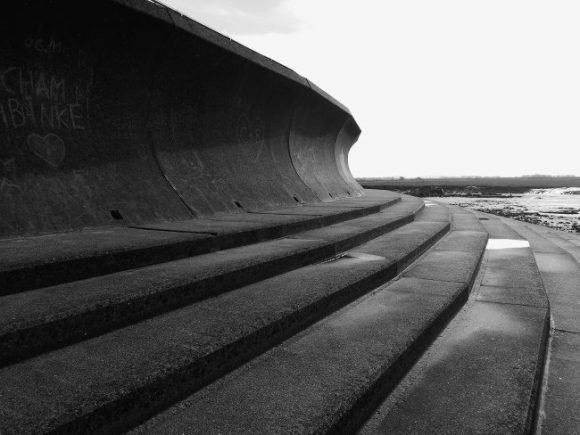
Grey concrete in black-and-white.
The sea wall at Burnham.

When I tell people I’m from Somerset they usually say, ‘Oh, lovely!’ recalling holidays they’ve had. But my home town, Bridgwater, isn’t lovely. I mean, I love it, but it’s a working town, with barely a touch of twee about it.

When I bumped into one of my former A level tutors in a pub in London years after leaving home he described Bridgwater as being ‘Like Barnsley or Bolton dropped into the middle of the rural West Country.’ Someone else once summed it up as ‘a small town with inner-city problems’. And a graffito left in the town centre, on display for many years, was pithier: ‘All this town cares about is fucking carnival.’

I should explain Carnival. It takes place every November and is the town’s pulse — an obsession for many and something of which the town is rightly proud. To understand the scale and drama of the event you can do worse than listen to this excellent episode of The Untold narrated by Grace Dent and produced by Polly Weston which goes behind the scenes of  a friendship rent asunder by competing carnival club loyalties.

One of my favourite things is to make habitually unimpressed sophisticates watch videos of Carnival on YouTube; imagining bumpkins prancing about on the back of flat-bed lorries, their jaws drop when they see the fully illuminated mechanically animated behemoths thundering along in clouds of noise and steam. It is amazing. Barmy, brash, camp, yes, but truly amazing.

Then there are the holiday resorts of Burnham and Weston where the sea is merely a concept, once popular with working class Brummies and northerners who would pass us on the motorway as we headed towards Fleetwood and Blackpool. Again, there was no twee in Burnham, just full-throated fun when there was sufficient booze and sun, or oppressive uniform greyness when there wasn’t.

Wintry scene with morning colours of pale purple and orange.
Frozen nettles on the Somerset levels.

When I started to take myself for long walks as a teenager, it was along the banks of drainage ditches, in the orbit of the sinister Royal Ordnance Factory. However far I walked, I could always hear the sore throat of the motorway and occasionally military aircraft would thunder low overhead. There were pillboxes everywhere, unremarked upon, brutalist cubes in the middle of otherwise pretty fields.

As a young man my council estate conditioning and a comprehensive school cringe made even the most ordinarily pleasant town or village feel intimidatingly posh so that for many years the prettier side of Somerset felt all but inaccessible. It didn’t matter, though, because I liked the flat, grim, gritty, gleefully tacky version that I understood. I never called it a ‘shithole’ like some of the other aloof university-bound kids. I never really wanted to leave.

More recently, fuelled by homesick reading, and with the chip on my shoulder finally beginning to disintegrate as I enter middle age, I’ve begun to explore — to appreciate the nature, architecture and deep history of a place I thought I knew. I’ve realised it’s not all institutional severity — there are orchards, forests, cliffsides, ancient churches and a thousand other delights. And I like that version of Somerset too, even if I still feel like a tourist there.

Categories
buildings history

It’s In Swindon

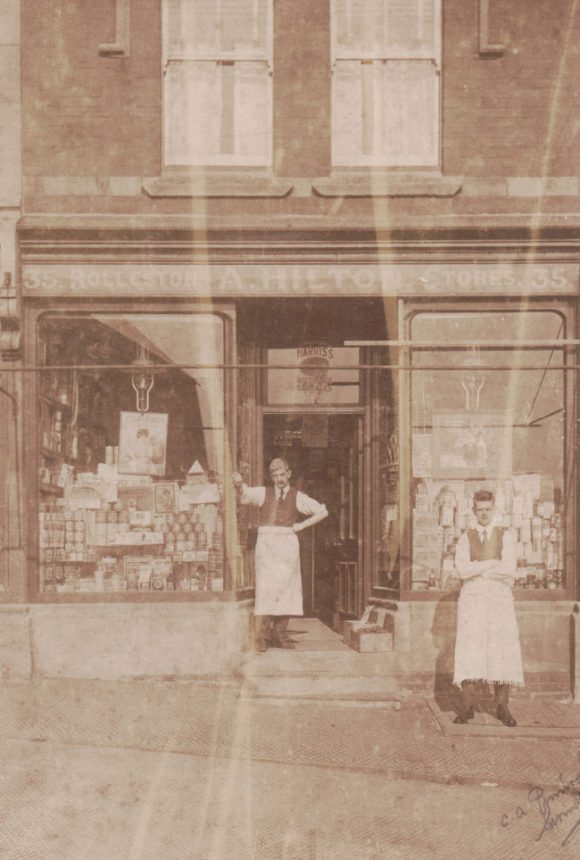
Edwardian photograph: a grocer's shop.

I have a skill that I have yet to work out a way to monetise: finding places on Google Street View based on a single photograph and limited data.

You know when some account or other Tweets a black-and-white photo with some variant on, ‘Any idea where this is, Twitter peeps?’ Once I’ve finished vomiting over the use of ‘Twitter peeps’, I’m the bloke that spends an hour switching between Street View, census records, online photo archives and about 60 other sources to work it out.

It reminds of a jigsaw puzzle based on an M.C. Escher drawing I once helped the other half with. All the pieces looked the same, it seemed utterly impossible, but slowly we learned to distinguish between mostly black, cross-hatched black, sideways hatched dark grey, stippled dark grey, and so on. With an old photo, the more you stare, the more details pop out — a church spire in the background, a number on a nearby shop, the name of a brand of horse food, a faded sign…

Only this morning I cracked a puzzle set by the ever-fascinating @ghostsigns by spotting a war memorial in the bottom right corner; searching the Imperial War Museum’s war memorial database for NEWCASTLE UNDER LYME OBELISK and then exploring the area around Chesterton Park (where I’ve never been in real life) on Street View.

It’s satisfying on several levels. First, it’s pleasing to help someone else. Secondly, as someone who often wants help from others solving pub-related mysteries, I hope it earns me some Karma or something. Then there’s the pleasure of the hunt — I didn’t know anything about Newcastle-under-Lyme when I got up this morning, but now I feel as if I’ve lived there. Finally, there’s the reason most people do puzzles: the sense of elation that comes with a deferred resolution. I may have punched the air discreetly over my porridge.

My greatest triumph came closer to home a couple of years ago. The photo at the top of this post is of my partner’s great grandfather. We knew he ran a grocer’s shop in East London between the wars on a particular street (Orford Road, Walthamstow) but couldn’t work out where it was exactly. I stared at that picture, at Street View, back at the picture, back at Street View, until hours later I declared, ‘It’s in Swindon. Here, look.’

See, Orford road doesn’t slope, I eventually remembered, which broke that hang up. Then, free to think beyond what I’d assumed was an established fact, I started to look more widely, starting by Googling ROLLESTON which, among other things, is a street in Swindon. That rang a bell — wasn’t that where the other half’s great-grandmother was born? I trolled up and down Rolleston Street for a bit but couldn’t find the shop. Then I zeroed in on this distinctive feature:

Window bracket

I’d seen this, here. But the window arrangement wasn’t quite right, and none of the other buildings nearby had the same arrangement. Then, the final move: I looked at the building from a different angle and found a shot from an older Street View survey: BINGO, THERE IT IS.

That’s clearly a converted shop premises, on a slope, with the right arrangement of windows and brackets. (I didn’t know then about the back-and-forward date slider in Street View, or maybe it hadn’t appeared at that point.)

I know, I know — this is incredibly bloody boring. That’s who I am. Deal with it. And if you get stuck with something like this, do drop me a line. I might be able to help and even if I can’t I’ll have fun trying.

Categories
food

Working Class Discernment and the Humble Avocado

An avacado viewed from above.

There’s a version of what being ‘working class’ means (usually championed by those who aren’t) that suggests a kind of pig-like, unquestioning gluttony — which implies that thinking about what you eat and drink, and expressing a preference, is bourgeois pretentiousness. Real first-against-the-wall stuff.

I’ve always found this weird because the working class family I grew up in talked about food and drink all the time. I’ve written about this before, albeit in a subscriber-only newsletter hardly anyone reads, so I’ll quote myself:

During meals, we invariably talked about what we were eating, how it could be improved, and how it compared to previous experiences of the same dish. Even if it was just egg and chips — ‘If you get a good heat on it, the bottom frills up and goes crispy, which is how it should be.’

It was partly because we were determined to squeeze as much pleasure out of life as funds would allow: wasting money on a bad dinner is annoying when you’re wealthy, but heartbreaking when you’re not.

We had a favourite chip shop, which changed frequently as we monitored the quality of the food with successive changes of management: their chips are over-cooked, the fish batter is greasy, they’re cooking it all in the same oil which isn’t at the right temperature for either. We turned our noses up at most bought-in pies but loved Holland’s Potato & Meat. (I still do — that buttery crust, the creamy quality of the potato… Oh, yes.) We debated who made the best roast potatoes — Mum, Nan or Aunty D? (It was, and still is, Aunty D — sorry, Mum.) Was a brand-name brown sauce worth the extra money over the supermarket’s own version? (Yes — less sugary.) We talked about cheese at Christmas when there was more than one to compare. When she had time, Mum made bread, and we all knew it was better than the supermarket stuff — crustier, more flavoursome, with a crumb that fought back.

I also remember Dad and his friends debating the quality of local ciders (Rich’s had the right balance of price and quality), beer (homebrew especially) and whisky.

And a bit more that’s just come to me: my late uncle, a former tank driver, latterly a mechanic, used to take account of particularly good meals he’d eaten to tell me about when he saw me. Sometimes, he’d keep back a slice of especially good bacon or a slice of particularly impressive boiled ham for me to try, serving it up with oil-blackened fingers. Food is love and all that.

I was thinking about this today because I’ve just eaten a particularly fantastic avocado. (95p from Lidl, avo fans — bigger, better, cheaper and more reliable than those from any other shop in town, for reasons unknown.) Stop, don’t hate me!

See, avocado defeated my family the first time we tried it in about 1984, when we were temporarily between homes (because, money) and living with Nan and Gramps. Mum had read about them in a magazine and, as we all liked to try new things, got one at the supermarket. The problem is, it was marketed as an ‘avocado pear’, which set up quite the wrong expectations. Then, on top of that, we had no idea what a ripe avocado felt like so this specimen had the texture of a cricket ball. I can still remember the sensation of eating it — the kind of tannic bitterness you feel on the skin of your teeth. We all tried a bite and grimaced before it went in the bin.

So for years I didn’t think I liked avocado until a holiday in Spain in my twenties where a woman running a market stall asked my partner and I if we wanted one ‘¿Para comer?’ That is, to eat now. She grabbed at them, prodding with her fingers until she found one that was just right — not in a twee lifestyle aspirations way but like a production line operator weeding out dented cans. The one she selected and hurled into a paper bag tasted like vegetable velvet and I felt (as I too often do) a surge of annoyance: why had I been letting middle class people keep good stuff like this to themselves? Good cheap stuff, too — denied to me through lack of experience rather than shortness of funds.

So, I like avocados now. Not because I’m a traitor to my people, or because I’m trying to impress anyone, but because they taste good.

Unless… Well.. You don’t think the act of writing this might betray a lingering anxiety, do you?

Categories
concrete council

Asbestos in the Memory Cupboard

Reading Katrina Navickas’s post about what she calls ‘Brutalgie’ I felt a momentary pang of guilt: am I being dreadfully superficial when I swoon at a photo of a tower block?

To some extent, yes, clearly. When all I have to go on is a picture and my only response is ‘Phwoar!’ then I’m reacting to it almost as a piece of graphic design — it’s the contrast, the geometry, the texture that’s titillating me.

But, at the same time, that strikes me as a political act in itself — a way of saying, ‘This is beautiful’, in defiance of people who are scared of public buildings and municipal housing, who can only see failure in it. Finding something to appreciate in the bus station, the tax office or a squat tower block is a way of flicking the Vs at those who insist the true England is only that of stately homes, Victorian townhouses and Cotswold villages.

deep_water_1998
The Ponds at Cranleigh Gardens, Bridgwater

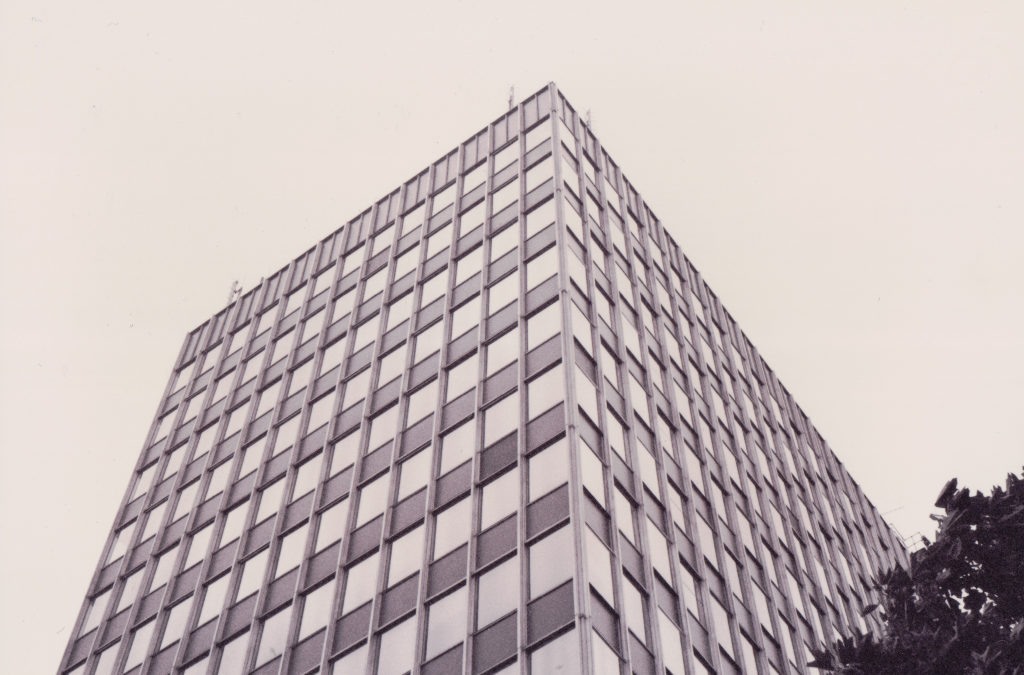
I spent the largest part of my childhood in a house made of slabs of precast reinforced concrete on a council estate in Somerset. I generally resist extreme or simplistic points of view which means, in practice, I irritate everybody by responding with some variation of, ‘Well, to some extent yes, but…’ In the case of life on a council estate, here’s the fence I sit on:

First, my experience was apparently less rosy than some people’s. We didn’t leave the doors unlocked and wander in and out of each other’s houses as I’ve seen some people I was at school with suggest through shared ‘Do you remember when…’ memes on Facebook. In fact, anything we left outside the house (or in the shed) after dark got stolen — clothes on the line, a garden bench, the bike I got for Christmas, Dad’s toolbox, and so on. Some neighbours were friendly, sure, but slightly too many were damaged, violent and scary. The back door would rattle ominously in the evening when Dad was working nights so that Mum ended up sitting with the riot club my Uncle brought back from Northern Ireland at her side. I can therefore understand why people tend towards a narrative of ‘escape’ when they talk about growing up Council — if you’re anything less than a raging hard-case, it’s a constant challenge.

But, at the same time, it’s not hell on earth. In my town there were two big estates and the residents of each thought the other was an Escape from New York style no-go wasteland, which I think illustrates the problem. If you don’t live on a particular council estate, or even occasionally walk through one, it’s easy to see photos of burned out cars and ‘hooded youths’, or hear grim stories of psychos and drugs, and think that’s all there is. You don’t see the old bloke tending to his gooseberries, the summer afternoon barbecues, or the quiet kids indoors drawing their own comic books. They can be tranquil places with lots of air and green space — pleasingly repetitive and well-ordered, with outbreaks of personality in the garden ornaments and decor. When my parents decided it was time to ‘escape’ when I was a teenager I went into a furious sulk — the estate was my home and I loved it. Or maybe I had some form of Stockholm syndrome. Who knows.

west_street_1998
New Cross, South London, I think

The photos that accompany this post weren’t snapped on a smartphone and then processed with some retrovision app or other. (Although I am guilty of that.) They were taken around 20 years ago using the second-hand East German SLR my parents got me for Christmas one year. (Not because they were hipsters — because it was cheap.) I didn’t really know how to use it and most of the pictures I took were under- or over-exposed but this handful make me realise just how long I’ve been looking at the supposedly grim and grey and seeing something else.

When I went to university, which was all wood-panelling and classicism, I took photos like this with me as a reminder of the landscape that made me. Fuel for the chip on my shoulder, I suppose.

The point is I can honestly say that when I stand in the cathedral-like space under the motorway bridge at Dunwear, the M5 blasting its white noise overhead, or walk through a ‘blighted’, ‘troubled’ estate in some strange part of the country, that the feeling of peace I feel might not be contextualised or politicised, but nor is it ironic or superficial. It’s emotional. For better or worse, that’s how I’ve been programmed. Concrete makes me calm. That’s my kink.

Categories
Uncategorized

What is this, 2008?

Sometimes there are things I want to say that I can’t fit in a Tweet or a Facebook post. This is where I’m going to put them. Then put the link in a Tweet or Facebook post. That’s what I reckon blogs are for.