
Editor and writer.


When Dad turned up with tickets for Winter Wonderland, Tyler and I were truly astonished, for several reasons.
First, we hadn’t seen Dad since October, when he and Mum had one of their dramas. He stayed out all night and she waited for him. When we went to school, he still hadn’t turned up. He wasn’t there when we got home and she only laid three places for dinner. We knew better than to ask.
Secondly, it had already been agreed this was going to be a Little Christmas. In our family, this was an important concept. When Mum and Dad were flush, or had managed to patch things up with one or both sets of grandparents, we might get a Big Christmas. That meant proper presents, a proper Christmas dinner, and maybe even a proper tree. But most years were Little Christmases, where we each got a few things in a stocking and Christmas dinner was whatever Mum could conjure up from the freezer and the cupboards. One year, we had instant mash with Bisto and burgers.
Thirdly, even when there was a little bit of money around, Dad never bought us anything. It never occurred to him to treat or spoil us, or even to pretend to find fifty pence behind our ears. If he had coins in his pocket, he spent them on himself. Or very occasionally on Mum, if he was trying to heal a wound. Clothes, usually – skimpier and more gaudy than anything she would ever buy herself.
So, when he arrived on the doorstep, pink faced and cider breathed, chuckling and prancing like a clown, we simply didn’t believe him. He waved the envelope at us and pinched our cheeks.
‘Who’s the best Dad in the world, eh? My lovely girl and my lovely boy.’
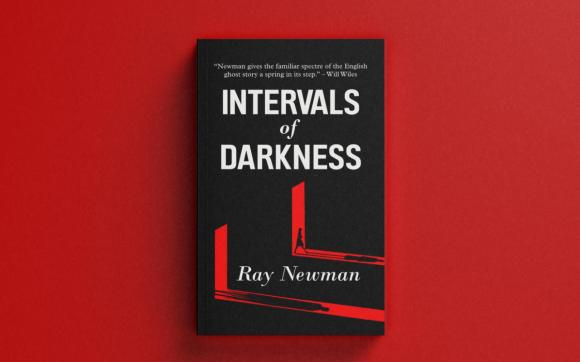
You can now read the rest of this story in my collection Intervals of Darkness available as an eBook and paperback from 7 September 2024.

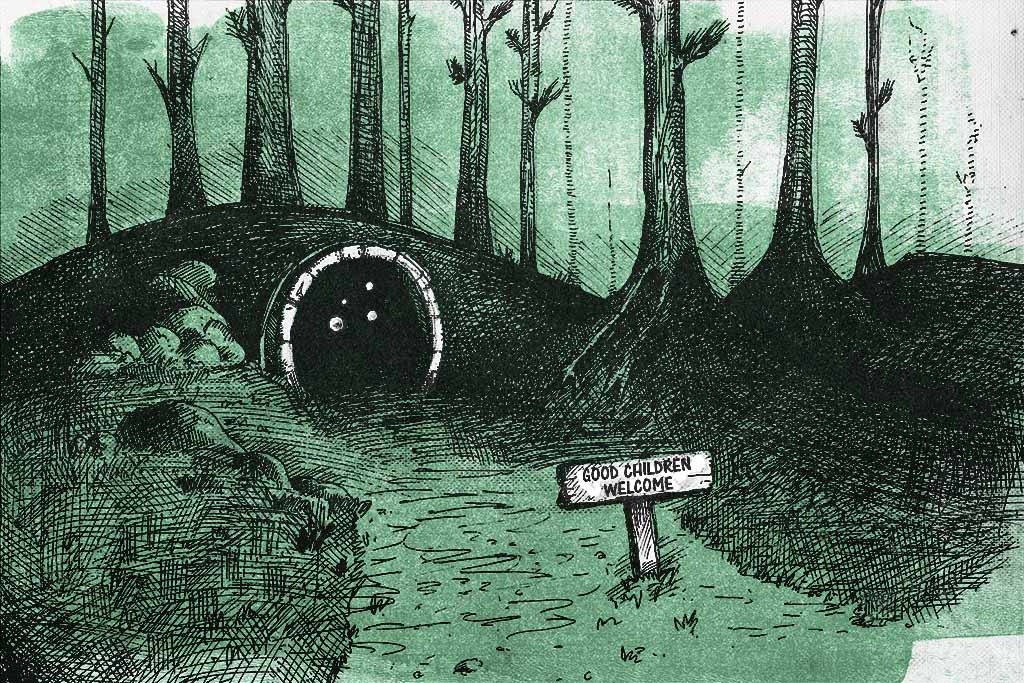
I didn’t use any AI tools, such as ChatGPT, to write the story. I drew the illustration myself with pen, on paper, and then edited it in Photoshop, which did include a small clean-up on the signpost using Adobe’s Generative Fill (Adobe Firefly).
When they’ve built flats or superstores on the last of our wastelands, where will stories happen? Where will we go to play dangerous games?
Think of a 1970s British crime drama and you might well picture Jags and Ford Granadas chasing each other round nowhere spaces strewn with rubbish and ruins.
And any number of films stage their denouements on wasteland – because that’s where you end up when you’ve nowhere else to run.
It is a blank space, an urban version of the wild west, where confrontations between goodies and baddies can play out without civilians getting in the way.
It’s perhaps no surprise that the popularity of the word began to soar from the 1920s onward.
Until then, the life of cities took place in their centres – factories, offices, housing, ports and public transport.
But in the 20th century, that began to change.
Wasteland is primarily a product of the decline of industry. In his 1969 book Derelict Britain John Barr explained the extent of the problem of wasteland in post-war Britain:
First of all, industrial wastelands are a visual affront. They offend the eye, they offend what is one of the world’s most civilised landscapes… To tolerate dereliction spattering that landscape, to expect people to live amidst dereliction, is not civilised… Derelict land, and the industrial junk left behind when industry has made its profit and fled, is dangerous to life.
There was also the clearance of ‘slums’ and the movement of the population out to suburbs and new towns.
And, of course, there was World War II. The Blitz created spectacular wastelands in the hearts of cities such as London and Bristol.
T.S. Eliot’s 1922 poem The Waste Land (significant ‘the’, wasteland as two words) addresses the collapse of western civilization brought about by the industrial revolution and the technological age.
For the 1979 album Setting Sons Paul Weller of The Jam wrote a song called ‘Wasteland’ which equates industrial dereliction with childhood freedom. It is only there “amongst the smouldering embers of yesterday” that the song’s working class narrator feels free to express feelings of love.
In the atomic age, wasteland also offered a taste of what might be – a vision of what our homes and streets could become with one well-placed missile.
On film, as well as being logistically convenient for location shooting, wasteland represented similar ideas.

In Seance on a Wet Afternoon (Bryan Forbes, 1964) wasteland is vital to the unhinged kidnap plot enacted by Billy and Myra (Richard Attenborough and Kim Stanley) as a promotional stunt for her work as a psychic.
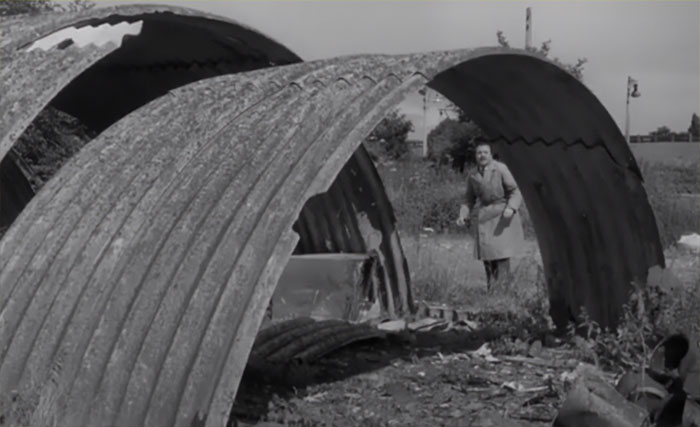
Among tall grass, rusting Nissen huts and the remains of a half-demolished greyhound racing track, Billy prepares for the kidnap by dying his hair and hiding his motorbike.
Then, when he has the child in his custody, he returns to the same place to dump the stolen car and ditch his disguise.
The wasteland is a place between worlds, and between lives.
By passing through this wild space, he is able to leave civilization behind and transform himself from a timid suburban husband into a criminal capable of anything.
In The Small World of Sammy Lee (Ken Hughes, 1963) Anthony Newley plays a Soho nightclub compere who gets in debt with the wrong people.
His desperate attempts to raise money, against the clock, take him from one part of London to another.
Eventually, though, he runs out of road and winds up on a stretch of Thameside wasteland after dark.
There is nobody there to see or care as he is beaten half to death by his bookie’s enforcer.
In Bronco Bullfrog (Barney Platts-Mills, 1969) a young working class man called Del (Del Walker) tries to find somewhere to be alone with his girlfriend Irene (Anne Gooding).
They are frustrated at every turn, with interfering parents denying them privacy in both modernist flats and Victorian terraced houses.
Though it is far from ideal, like the protagonists of Paul Weller’s song, they resort to an inbetween space: a ruined building on wasteland in Stratford, East London. It is dirty, damp, overgrown and covered with graffiti, and this doesn’t work out either.
The Bashers is a remarkable documentary from 1963. Filmed by the BBC in Bristol it depicts the lives of youths in Barton Hill whose neighbourhood has great stretches of wasteland, awaiting the construction of new blocks of flats.
They don’t have much but they do have this remarkable resource and so entertain themselves by building giant bonfires, and battling gangs from rival neighbourhoods.
The authorities didn’t like this kind of thing, of course, and another place we see wasteland is in one of the most famous public information films. Lonely Water from 1973 shows children playing on the edge of a flooded quarry, among rusting cars and other fly-tipped rubbish.
It’s in the gritty crime film that wasteland really comes into its own. Police corruption scandals and tabloid coverage of the Kray twins triggered a cycle of these in Britain from the late 1960s and through the 1970s.
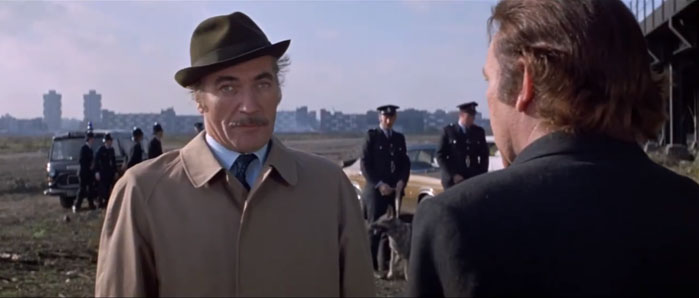
The final act of Villain (Michael Tuchner, 1971) sees Ronnie Kray-alike Vic Dakin (Richard Burton) on the run in the aftermath of a robbery.
He ends up on a vast area of wasteland at Nine Elms in Battersea, being chased through the ruins of a gas works and a British Rail goods depot.

In Sitting Target (Douglas Hickox, 1972) the final scenes take place in a distinct type of wasteland location: a dusty, cluttered transport depot full of workmen’s sheds, parked buses and freight cars.
Here, Harry Lomart (Oliver Reed) is able to pursue his nemesis, using a red jeep to crash into their car time and again, spinning them around a space that already feels half like a graveyard.
Again, the idea seems to be that this is the end of the line. It’s where you end up when there’s nowhere else to go and where, if you’re lucky, you might just about be able to lose yourself.
This isn’t uniquely British. We see similar settings in American crime films from the same period, and in Italy especially. Italian films about tough cops, known as poliziotteschi, invariably include a car chase or shootout on wasteland on the outskirts of Rome, Milan, Turin, or some other città violenta.
When the villain and the tough cop made it to British TV, the wasteland went with them.
The very first shot of the very first regular episode of The Sweeney, broadcast in January 1975, is of a stretch of cracked concrete, where a van races towards a bright yellow Ford Capri. They’re tooling up for a blag, you see, and where else can you do that except on wasteland?
The same episode concludes with a brutal brawl on what looks like a bombsite. It’s like watching boys play cops and robbers and probably not the first time this particular bit of wasteland was used for that purpose.
In 1980, crime drama The Long Good Friday arguably signalled the end of the wasteland era. Harry Shand (Bob Hoskins) is an East End gangster looking to go straight by getting in early on the London docklands property development boom.
In the decades that followed, London would lose much of its wasteland as Canary Wharf rose from the rubble, and other cities have followed the same pattern.
That barren landscape beyond Tower Bridge would have one last starring role, though, with the remains of Beckton gas works doubling for Vietnam in Stanley Kubrick’s Full Metal Jacket.
Now they’re almost gone, some of us have started to feel nostalgic for those wastelands. They were dangerous, mysterious and wide open.
Those that remain, pending development, are invariably locked down tight, with heavy security and surveillance.
For our own protection, of course, so we don’t end up like the victim of a 1970s public information film, drowned or crushed.
And to make sure squatters can’t get in and make use of these otherwise barren spaces to park vans or caravans.
But where are we supposed to have our showdowns now?
Or hold hands amongst the punctured footballs and rusting bicycles?
‘I think I’d like to see Mountvale again,’ said Julian German from the tangle of his duvet.
Esther German, on her way to the airing cupboard with unnecessary haste, paused in the doorway of his room and peered at him. She smoothed a towel over her arm.
‘Did you say something, Jules?’
‘I said, woman, that I would like to see Mountvale one last time.’
Esther removed her glasses and let them hang around her neck on their beaded strap. She blinked and twitched.
‘Mountvale?’
‘Christ give me strength… Mountvale school. Bloody Mountvale. Again, meaning another time; once more.’
Esther came into the room with its smell of antiseptic cream and sweat. She lowered herself into the dusty steel-framed chair against the wall. Its feet scraped on the dull parquet. Julian winced.
‘The weather’s awful. Wouldn’t you rather spend the day in? I can find a film for you to watch.’
Julian put his hands behind his head.
‘No, I bloody wouldn’t. I want to see that school. One last time.’
‘I don’t see why. It’s a very ordinary building and–’
‘Russell Cavendish brought it up the other day. Said somebody from Historic England was talking about getting it listed. Unique example of post-war construction.’
‘But Russell–’
‘The first use of curtain walling in the whole county,’ Julian went on.
Esther looked towards the large window, speckled with rain and streaked with green moss at its corners.
Julian shook his head and growled.
‘Are you going to drive me or shall I drive myself?’
Julian had always been too tall to sit comfortably in cars. Even now, with a hump in his back and a couple of inches lost to the erosion of his spinal cartilage, he looked uncomfortable in the passenger seat of the Citroen.
Esther leaned forward against the steering wheel, thin wrists at ten to two. Her lips were pulled back from her teeth as she squinted past the windscreen wipers.
A passing van threw a fine mist from the road.
‘Left,’ snapped Julian, pointing with bunched arthritic fingers.
Esther ignored him.
He grabbed at the steering wheel.
‘Bloody left, woman! Left.’
She slapped his hand away and he winced.
‘Don’t panic, darling. I’m driving, not you, and I know the way.’
He stroked the translucent skin where she’d made contact, inspecting for a bruise, and pouted.
‘Do you? Know the way, I mean? I didn’t see you look at a map before we left.’
‘I don’t need a map.’
‘Typical woman. Why bloody plan anything?’
At a roundabout, she took the right exit. Julian leaned towards the window, scanning the road signs. He looked over his shoulder.
‘Where the bloody hell are we going now?’
‘It’s funny,’ said Esther, her voice unsteady. ‘The listing thing. Nothing we worked on was built to last, was it?’
‘Speak for your bloody self,’ said Julian, forgetting for a moment his anxiety over the route. ‘I always saw my work in context as part of the broader sweep of history.’
‘Our work,’ said Esther.
‘Oh, for God’s sake… Yes, yes, technically, yes.’
‘And do try not to lecture. I’m not one of your students.’
He shrugged and folded his arms.
‘You were never a preservationist, anyway,’ she went on. ‘Knock it all down, you used to say.’
Julian didn’t reply.
Esther took her eyes off the road for a moment and saw that he’d fallen asleep, quite suddenly, as he often did in the car.
‘This isn’t the way to Mountvale,’ Julian bellowed.
‘I do wish you’d wear your hearing aid, darling. Then you’d know how loud you’re being.’
‘I don’t need it. My hearing is fine. And this is completely the wrong direction.’
They were on a country lane, now, passing through a village with a Norman church.
‘I thought we might go somewhere else instead of Mountvale,’ said Esther.
‘Where the hell are we?’
He saw and recognised the pub and so knew the village.
‘There’s a layby up ahead. You can turn there.’
‘Wouldn’t you like to stop for lunch? You could have a pint of beer.’
‘Don’t mother, me woman. For one thing, you’ve had no bloody practice. Just turn the car around and take me to Mountvale.’
Esther did as she was told, struggling with the gear stick as she conducted a five-point turn in ever-heavier rain.
‘I’m sorry,’ said Julian after a few moments, once he’d got his way. ‘About the mothering business. I forget sometimes.’
‘It’s alright, darling,’ said Esther. She sounded weary.
‘I’d have been a dreadful father, anyway.’
‘You certainly aren’t a terribly good husband.’
Julian laughed.
‘That’s my girl,’ he said, reaching across to pat her thigh. ‘As good as you get, eh?’
She brushed him away.
‘I’m driving.’
As they got nearer to Mountvale, in the early winter twilight, Julian became agitated again.
‘This is the estate, isn’t it? It’s changed a lot.’
‘Well, a lot of lives have been lived here,’ said Esther. ‘These buildings were always meant to be used.’
‘Plastic windows. Pebbledash. Pastel paint. Dreadful. Why did they cover the concrete?’ He raised his chin in lecturing mode. ‘It had such purity.’
‘But we didn’t have to look at it every day, did we? Or live in it, or work in it.’
‘Not that old argument!’ said Julian raising his voice and twisting in his seat.
She took advantage of his distraction to make a deliberate wrong turn.
‘Goldfinger lived in his tower, didn’t he?’
‘For a short while. But Le Corbusier lived in a fishing cottage. And Lubetkin lived in a Georgian townhouse.’
‘I’d have gladly lived on any of the estates where we worked. Our house, the house I designed for us–’
‘That we designed.’
‘Yes, yes, our house is true to the principles, isn’t it?’
Esther didn’t reply to that, not even to mention the draughts that blew through the open plan living area, or the water that gathered on the fatally flat roof all year round.
They were on a crescent, now, with a rippling concrete road and prefabricated homes. The house lights and streetlights had begun to come on.
‘This isn’t the way,’ said Julian. ‘I’m sure I remember…’ His mouth opened and closed as he tried to grip onto something. Spit gathered in the corners of his lips. He slammed a hand onto the dashboard.
‘Central square, community centre, health centre, shopping parade, schools complex opposite – primary, junior, secondary. These crescents are at the other end of the estate.’
‘You’re quite right, so they are,’ said Esther quietly.
‘What?’
She didn’t repeat herself, just flipped on the indicator and entered the final phase of the journey.
It couldn’t be avoided, now.
She parked the car half on the kerb and turned off the engine. The lights died with it.
They sat together in silence as rain sounded on the roof and windscreen.
Julian sighed.
‘Where’s my umbrella?’
Esther reached into the back seat and found it for him.
He undid his seatbelt and got out. After a struggle he got the umbrella up and lifted it. In his swollen hand, over his big head, it looked absurd, like something from Jacques Tati.
As he shuffled to the black cast-iron gate, Esther remembered when his stride was long and confident. She pulled the hood of her well-worn anorak over her head and joined him.
She looped her arm through his and they shivered together.
The gate and fence were still there but beyond was wasteland: concrete, wild grass, scattered bricks and litter.
‘The school’s gone,’ he said quietly.
‘Yes.’
A large sheet of clear plastic trapped in brambles snapped and boomed.
‘But Russell said…’
‘Russell’s been gone a long time, too, darling.’
‘Gone?’
‘Three years.’
‘A highly significant building, he said, and now…’
‘Not significant enough. And with too much asbestos.’
Julian snatched his arm away.
‘A sound material, in its day. Hindsight is a bloody fine thing.’
‘Come on, Jules, let’s go home. Aren’t you hungry?’
Julian didn’t move except to raise a hand to the railings. He wrapped his fingers around the rusting metal and the wind filled his eyes with water.
The next morning, the sun made golden stripes on the far wall of the bedroom as it passed through the blinds.
‘Esther! Where the hell are you?
Esther’s footsteps sounded along the parquet in the hall. She appeared in the doorway, small and exhausted.
‘I’ve had a thought.’
‘Yes?’
‘I’d like to see Mountvale one last time.’
Esther blinked and sighed.
‘Mountvale?’
One of my resolutions for 2023 is to read at least one short story every day. Totally achievable, right?
Yes, definitely, especially if this replaces endlessly scrolling social media, hoping something might happen.
But I do like social media, especially when it’s helping me find good stuff to watch or read.
I asked for recommendations for spooky stories on Mastodon and Twitter – not just the names of authors, but which specific piece or pieces I should read first.
I’ve got piles of anthologies and volumes of collected stories. The challenge is knowing where to start.
This is the list I’ve ended up with.
| The Same Dog | Robert Aickman |
| The Trains | Robert Aickman |
| The Fully Conducted Tour | Robert Aickman |
| The Coffin House | Robert Aickman |
| The Swords | Robert Aickman |
| Ringing the Changes | Robert Aickman |
| The School Friend | Robert Aickman |
| The Diver | A.J. Alan |
| The Room in the Tower | E.F. Benson |
| The Outcast | E.F. Benson |
| The Moonlit Road | Ambrose Bierce |
| The Willows | Algernon Blackwood |
| The Wendigo | Algernon Blackwood |
| The Gospel According to Mark | Jorge Luis Borges |
| Curfew | Lucy M. Boston |
| The Bishop of Hell | Marjorie Bowen |
| The Crown Derby Plate | Marjorie Bowen |
| The Scythe | Ray Bradbury |
| Smee | A.M. Burrage |
| The Day Father Brought Something Home | R. Chetwynd Hayes |
| Hell is the Absence of God | Ted Chiang |
| Snare | Bora Chung |
| The Upper Berth | F. Marion Crawford |
| The Smile | F. Marion Crawford |
| A Slap in the Face | Chris Culshaw |
| The Dark Divide | Chris Culshaw |
| The Landlady | Roald Dahl |
| Out of the Deep | Walter de la Mare |
| The Horla | Guy de Maupassant |
| The Signal-Man | Charles Dickens |
| The Return of the Native | William Croft Dickinson |
| The Breakthrough | Daphne du Maurier |
| The Apple Tree | Daphne du Maurier |
| The Blue Lenses | Daphne du Maurier |
| The Entrance | Gerald Durrell |
| A Rose for Emily | William Faulkner |
| Kwaidan | Lafcadio Hearn |
| Pop Art | Joe Hill |
| Black Phone | Joe Hill |
| The Brownie of the Black Haggs | James Hogg |
| Three Miles Up | Elizabeth Jane Howard |
| While the Nightjar Sleeps | Andrew Michael Hurley |
| The Tooth | Shirley Jackson |
| The Monkey’s Paw | W.W. Jacobs |
| Under the Crust | Terry Lamsley |
| The Tower | Marghanita Laski |
| The Haunted Saucepan | Margery Lawrence |
| Whoever Heard of A Haunted Lift | Alan W. Lear |
| Cargo | E. Michael Lewis |
| In a Foreign Town in a Foreign Land | Thomas Ligotti |
| The White People | Arthur Machen |
| The Sundial | R.H. Malden |
| The House | Katherine Mansfield |
| An Encounter in the Mist | A.N.L Munby |
| Gabriel Ernest | H.H. ‘Saki’ Munro |
| Man Size in Marble | Edith Nesbit |
| The Shadow | Edith Nesbit |
| Secret Observations On the Goat Girl | Joyce Carol Oates |
| Dolling Halt | Pamela Oldfield |
| The Beckoning Fair One | Oliver Onions |
| Rooum | Oliver Onions |
| The Running Companion | Phillipa Pearce |
| The Yellow Wallpaper | Charlotte Perkins Gilman |
| Tourist Trap | Barbara Roden |
| Bosworth Summit Pound | L.T.C. Rolt |
| This Creeping Thing | Robert Shearman |
| If The Dead Knew | May Sinclair |
| The Portobello Road | Muriel Spark |
| On Mirrors | Ben Tufnell |
| The Pennine Tower Restaurant | Simon K. Unsworth |
| The Island of Regrets | Elizabeth Walter |
| The Boys’ Toilets | Robert Westall |
| Afterward | Edith Wharton |
| The Eyes | Edith Wharton |
| Miss Mary Pask | Edith Wharton |
| The Lady’s Maid’s Bell | Edith Wharton |
| Pomegranate Seed | Edith Wharton |
| Diary of a Madman | Lu Xun |
I’ve already read some of these, as you might expect, but will probably reread them this year.
You’ll also notice that there’s no M.R. James because I’ve read his ghost stories multiple times. He’s a given. The same goes for H.P. Lovecraft who, anyway, is generally more hysterical than spooky.
With that in mind, what’s missing? Comment below, or let me know via Mastodon or Twitter.
“Extract from police report number 727a, strictly confidential, unpublished and unavailable. Subject: Sandy Freemont. The last positive sighting was on her way home from a school orchestra rehearsal. This was on Tuesday May 14th at approximately 6:30 in the evening. At about this time her friend Janey Carr places her positively as entering the footpath through the area known as Cromley Woods, a then popular shortcut for several of the children living in Millard Heights…”
In the suburbs of a middle English town, a schoolgirl walking takes a shortcut through a wood. From the undergrowth, she hears the mischievous laughter of children and her name is called. She pauses and then, in a moment of sudden, startling violence, disappears.
These events, accompanied by amplified natural sounds, an off-kilter music box theme and, finally, shrieking strings after Bernard Herrmann, establish the tone of Lindsey C. Vickers’ 1981 British horror film The Appointment.
The rules do not apply here; anything might happen; brace yourself.
It’s possible you’ve never heard of The Appointment. I hadn’t myself until 2021, via a mention by Elric Kane on the Pure Cinema Podcast.
At that time, the only way to see it was via a VHS rip on YouTube. Once I’d got used to it, the video murk and constant hiss only added to the unsettling quality of the film.
Nor was it inappropriate: this film was only ever released on VHS, in the early days of the home video boom.
It was hard to find much information about Vickers online and, in fact, quite a few writers had assumed he was a woman. So I cobbled together my own potted biography from newspaper archives and scraps.
Vickers was born in 1940, brought up in Norwood Green, Southall, London, and educated at Dormers Wells Secondary School and Southall Technical College.
He left school without qualifications and got a job working as a messenger at London Airport (now Heathrow) before moving into film, starting as a cinema projectionist.
He went on to study film at the University of London and became a film assistant at the BBC where he directed a documentary short called ‘Impressions of Richmond’.
He became assistant director to Denis Mitchell before moving to the Government advertising office, COI, where he made a film a week for global distribution.
He worked as an assistant director on a slew of Hammer and Amicus films throughout the 1960s and 70s, including Taste the Blood of Dracula (Peter Sady, 1970) and The Vampire Lovers (Roy Ward Baker, 1970)
In 1978, he was given the chance to write, direct and edit a short film called The Lake which pre-empts the mood, themes and imagery of The Appointment. It’s beautifully shot and highly effective, despite limited resources, and was made available, fully restored, on the 2020 BFI collection Short Sharp Shocks.
The Appointment was Lindsey Vickers’ first and only full-length feature film as director, which perhaps explains why the astonishing opening doesn’t quite connect with the rest of the film.
My suspicion on first viewing was that the first five minutes were shot separately as a ‘sizzle reel’ to convince investors. I’ve since learned that it was the other way round: the intro was shot later to spice up the completed film.
In 1981, the British film industry was in trouble. According to a contemporary article in the BFI magazine Sight & Sound, only 27 features were produced in the UK that year. The Appointment was one of them.
It cost £650,000 to make and was funded in large part by the National Coal Board Pension Fund – resolutely unglamorous.
It was produced by Vickers’ own company, First Principle Film Productions, with hopes of breaking into the US market.
After that startling pre-credits sequence, the narrator disappears, never to return, and we find ourselves, unexpectedly, in a suburban family drama with engineer Ian (Edward Woodward) obliged to break the news to his daughter Joanne (Samantha Weysom) that he won’t be able to attend her school concert.
The opening sequences are calculatedly bland and the performances almost blank.
Edward Woodward, in V-neck and sensible spectacles, chats to his friend, a mechanic, and to his wife (Jane Merrow) with the same dry tone as Jack Torrance speaks to his new employer at the Overlook Hotel.
Woodward consistently defaults to a half-smile. Even so, just as in The Shining (Stanley Kubrick, 1980), everything feels just a touch off.
In an interview he gave in 2020, Vickers said, ‘I live in the supernatural world up here. The World of the uncanny. The world of ‘How can that be?’ We can see that in The Appointment.
Even before anything truly horrific happens, Joanne’s over-strong reaction to the news that her father is going away – only enhanced by Weysom’s eccentric delivery of the lines – puts us on edge.
Where is he going? To give evidence at the inquest following a fatal mining disaster in which his engineering firm was implicated, apparently no more to him than an inconvenience.
After he snaps at Joanne and sends her to bed he spends an uncomfortably long time staring at the door to her room, thinking about turning the handle. Does he often visit her room at night?
Things really get interesting when Ian tries to get some sleep before his early start the next day.
We’ve all been trained to understand that a prowling camera means we’re seeing through the eyes of someone or something; this someone or something is at Ian’s house, moving through the garden, through the door, along the hallways, in the midnight blue.
Time stops – a recurring theme – as Ian dreams that his wife, in a red dress, turns into his daughter, touching him with more than filial affection.
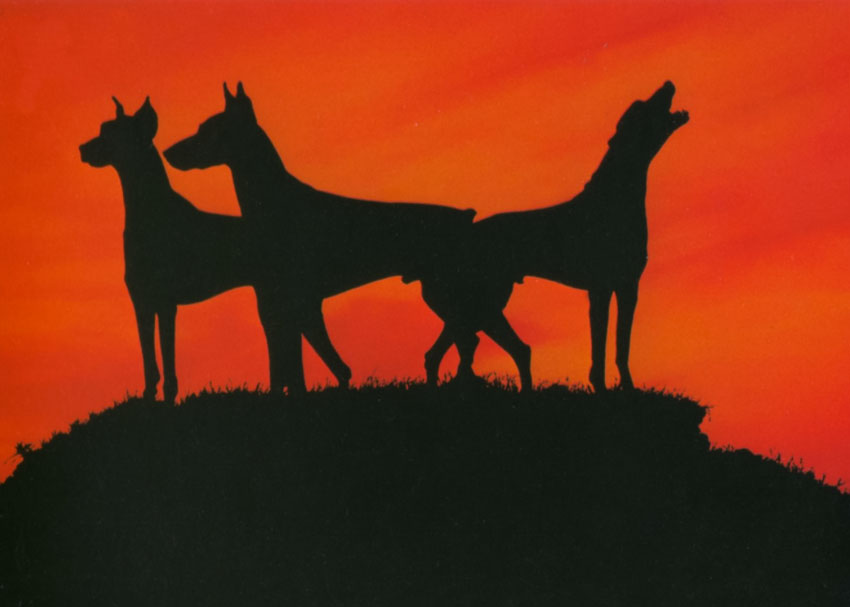
He is woken by a sudden image of a furious barking of a slavering Rottweiler. When he returns to sleep, he dreams again, this time of his forthcoming journey, and his own death.
The film’s long third act answers questions about that dream: was it a nightmare, or a premonition? From suburb to motorway to service station to remote country roads (filmed in Wales) he is stalked by those black dogs in a way that would amount to a decent gag in a less disturbing film.
There are startling images throughout, with distortions of time and gravity, accompanied by equally disconcerting sound design: wind, unexpected echoes, sudden silences, skittering and skipping.
Much weight is added by Trevor Jones’s romantic, melancholy music, interspersed with electronic droning.
When the end comes, it is shocking and surreal, starting with a biblically tempting apple that seems, somehow, to fall upwards and fly away into space.
In a more mainstream horror film, we’d get a Van Helsing, a priest or a policeman – perhaps that narrator from the opening sequence – to explain what’s going on and to conquer the evil.
Here, there’s no such bow-tying. We’re left bewildered and are expected to put the pieces together ourselves.
Is this a story about a poltergeist summoned by a rage-filled teenage girl? Is it about a demon or the devil? Are we trapped in Ian’s dream?
I have my ideas. You’ll no doubt have yours.
This piece was originally written for the defunct British horror website Horrified. Since its publication in 2021, The Appointment has been released on Blu-ray by the BFI, with The Lake as a bonus feature. It also has a commentary by Lindsey C. Vickers along with other bonus features. To my delight, a quote from my piece featured in a press advert for this new release.
Christmas Day, four in the afternoon, and the stale air in the front room feels like a weighted blanket.
Dad is asleep in his grubby chair, whistling through his drooping white moustache. Mum is fussing about, back and forth from the kitchen, groaning every time she puts weight on her hips. My sister is staring at her phone, scrolling, liking, scrolling, liking…
We’re not allowed to watch TV because our family tradition is to play board games and card games, except that doesn’t happen any more, not since Aunt Jenny died and Uncle Terry stopped coming. Now, we just vegetate and compost.
Two more nights to go. Just two more nights.
‘I’m going for a walk,’ I say, surprising myself. ‘Get some air and the last of the light.’
And I’m coat on, out the door, before anyone can stop me.
It doesn’t feel much fresher outside. Like most Christmases, it’s grey and almost muggy.
One foot in front of the other, walking nowhere in particular.
I’ve lived away up in the city for twenty years and my home town feels psychedelically weird, like one of my stress nightmares. Is this really where I grew up? Are these really the streets I used to play on?
The pylons that run the length of the main road on the estate crackle as the evening dew begins to settle. I feel the hairs on my neck spring.
Nobody told me the pub was gone. There’s just a bare space now, surrounded by a wire fence, and notices about planning permission.
On the corner, there’s a phone box. One of the glass and steel type, skeletal and unromantic. It was where I used to call my first girlfriend during university holidays. I stop for a moment and look at the dangling handset. I wonder if it still works.
Then it rings.
There’s no traffic on the roads, no sound at all from the nearby houses, and the electronic chirruping seems outrageously loud. I feel embarrassed, as if I’ve made it happen, and quickly walk on. The phone keeps sounding behind me, calling after me even, but eventually fades out of range.
I take the next left, towards Holy Trinity Church and a patch of grass we used to call, charitably, The Green. That’s where Deano Tremlett broke my ankle playing football, with the ‘NO BALL GAMES’ sign for one goalpost and a cricket stump for the other.
I pass a shuttered cornershop, a shuttered fishing tackle shop, and a house lit up like a Las Vegas casino. An inflatable peeping tom Santa is staring through the window of the bedroom.
As I near The Green, I remember something: next to the post box and the concrete planters full of cigarette ends, there’s another phone box. I’m not exactly braced this time but I am ready. When it rings, though, I still say ‘Bloody hell!’ out loud.
Oh, I see. I get it. Someone’s watching me and they’re calling it from a mobile. It’s a prank. I smile for the benefit of my hidden audience and reach for the handset.
‘Hello?’ I say.
I’d forgotten how bad they smell, phone box handsets: bad breath, mould, metal. The black plastic feels cold in my hand.
The line crackles slightly.
‘Who is it?’
Then I hear something. Drums. A thin echoing beat, like hold music.
Now this makes more sense. It’s a robocall. Spam. I breathe out, relieved, and slam the handset back into place.
Keep walking. Past the church, up a rough path by the side – Hog Alley we called it as kids – and through into Chamberlain Court. Follow that towards the secondary school, the primary school and the health centre.
Through windows and net curtains I see families on sofas or in armchairs, staring towards the TV, either slumped or wrestling with game controllers.
I notice the phone box on the corner of Franklin Road well in advance. Its glass is stained and fogged. There’s grass growing around its base. I think about avoiding it but don’t want to turn back the way I came.
And of course it rings.
‘Fuck off,’ I shout at it.
The ringing, somehow, gets louder, so I have to answer it before anyone else comes along.
This time, the music starts immediately, before I have time to speak. This time, I recognise it.
It’s the intro to ‘Last Christmas’ by Wham! with its chugging synthesisers and a wordless vocal. George Michael’s voice squeezes through the small speaker as he sings the first line: ‘Laaaast Christmas…’
Then the recording catches.
It’s not quite like a record skipping but, rather, an insistent hard-edged loop.
‘Last Christmas/ Last Christmas/ Last Christmas/ Last Christmas/ Last Christmas/ Last Christmas/ Last Christmas/ Last Christmas–’
It’s the same few seconds of music but seems more intense with each repetition.
I drop the handset and leave it swinging as I walk away.
I can still hear the music for a few steps, dissolving into pure treble, then disappearing altogether.
It’s getting cold now and I need to be home where it’s safe. I break into a jog.
Each phone box I pass rings for me, desperate to tell me something.
I run up the garden path and turn my Yale key, the one I’ve had since I was fourteen.
In the kitchen, Mum and Dad are hobbling about the dining table, bickering over the pickled onions and the cheese board.
‘What’s the matter?’ asks Mum.
Clammy and shaky, I force a smile.
‘Nothing,’ I say. ‘Just glad to be here.’
And I mean it.
If you enjoyed this story then check out my collection Municipal Gothic which has thirteen stories about ghosts on council estates, devil dogs in supermarket car parks and haunted tower blocks.
Sleeve notes for a Blu-ray box set that doesn’t exist.
In April 1969 the British film director Bryan Forbes became head of EMI Films in the UK. His statement of intent summed up a particular view of the state of the national film industry at the time:
We have gone too far with pornography and violence… There is simply no reason why filthy violence should be dragged into pictures. You do not have to lower your sights to entertain. We must see to it that entertainment does not become a dirty word.
Meanwhile newspapers were full of talk about “the permissive society”. More specifically, they were asking “Has it gone too far?” Here’s Rosemary Simon in an article in the Illustrated London News:
The saddest aspect of the whole situation is the needless waste. Healthy boys and girls who channel their energies into creating a disturbance instead of concentrating on sport, work, or helping in the community… Attractive girls with their whole future before them who, instead of enjoying their youth and eventually getting married, find themselves pregnant and are faced with the tragic alternative of seeking an abortion of of giving birth an illegitimate baby.
Tabloid newspaper The People reported that its readers had come out 4 to 1 against the permissive society based on the sentiment of correspondence received, like this letter:
A housewife has to try to make a happy home knowing her husband is queueing up to go to work beside a see-through, bra-less, mini-skirted girl… that he chats up a topless barmaid at his pub, while he spends the evening at his club watching strip-tease… If he can afford it, a sexy girl will even cut his hair. Unless he is made of stone he must get involved somewhere… A housewife feels hurt, inadequate, dreary and cannot compete. This is where the children begin to suffer. – Mother of four. Name and address supplied.
That’s terrible, said the public. Appalling. Tell me more. Like, what exactly are they getting up to, these dirty bastards?
In this context British films walked a difficult path. They knew people wanted to see films with sexual content, especially if it was transgressive. But couldn’t be seen to condone it.
So they made films which suggested sexual liberation had gone wrong, that perversion was rife, and that this was a serious Problem of Our Age… while also depicting it more or less frankly, with actors who were more-or-less lovely to look at.
Like American films of the 1930s and 40s who had to make gangsters pay for their crimes to justify the preceding hour of swagger and violence, British ones of the late 1960s had to make sure the swingers suffered for their pleasure.

There are a slew of films from 1968 to 1972 that aren’t formally related but which catch a similar mood and bounce off each other.
They sometimes share cast members, or at least types – ostensibly angelic blonde youths frequently feature, for example, as do sexually confident older women, and kinky establishment men.
Most of them are set in and around London and use the city to highlight the contrast between the old world (decaying, Victorian, Gothic) and the new: motorways, modernist towers, coffee bars, discotheques and pop art pads.
Their soundtracks steal from pop music of the period while always being a little too square, more Alan Hawkshaw than Mick Jagger, straight off the library shelf.
As for the tone, it’s about sickness. Yes, they’ll show you pretty young things with their kit off, to varying degrees, but they’ll also make you feel slightly queasy.
Brothers and sisters put hands and lips where they shouldn’t. People sweat and fret, suffering from physical and/or mental wounds. They mix sex and death at every opportunity. And adults frequently behave and even dress like children – which says what about their lovers?
Is it ever sexy? Fleetingly, sometimes, but more often it feels like the aversion therapy Alex undergoes in A Clockwork Orange.

The film that feels to me like the start of this run is Twisted Nerve (dir. Roy Boulting, 1968) starring Hywell Bennett as a baby-faced blonde psychopath called Martin.
Barry Foster plays a lecherous lodger employed in the film industry, who says at one point: “If you want me to sell your crummy films, I say you’ve gotta give it a good dose of S&V. That’s what the public wants. Sex and violence.”
What a disgusting attitude, we are invited to think, before gorging on our own helping of S&V.
At the time, the controversy around Twisted Nerve centred on its treatment of the subject of Down’s Syndrome and its tangling of chromosomal conditions with mental illness. That’s even less comfortable for viewers today.
But it exactly demonstrates the tendency of these films to balance turn-ons with turn-offs. Twisted Nerve starts with Martin engaged in an extended discussion with a doctor about his brother’s incontinence, likely early death and parental abandonment. It’s pointedly bleak.
Martin then adopts, or rather inhabits, an alternate personality – Georgie, a childlike character presumably based on Martin’s observations of his own brother. As Georgie, he stalks Hayley Mills and inveigles his way into her home. He then seduces her mother (Billie Whitelaw) who, remember, is up for it, despite believing that he has the mental capacity of an eight-year-old.
Martin is sick but so is almost everyone else, including his own respectable but uncaring parents.

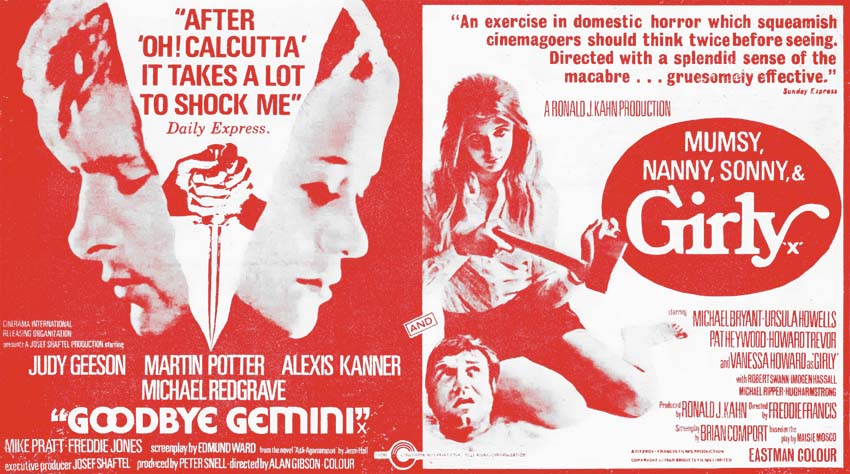
It’s astonishing that two of the key films in this cycle were released simultaneously and often shown together as a double bill. That is Goodbye Gemini (dir. Alan Gibson) and Mumsy, Nanny, Sonny & Girly (dir. Freddie Francis) both released in 1970.
Of the two, Mumsy, Nanny, Sonny & Girly is the better and more interesting film. It tells the story of a strange family – or is it a cult? – living together in a large country house.
The matriarch (Ursula Howells) and her servant (Pat Heywood) run the house while Girly (Vanessa Howard) and Sonny (Howard Trevor) run around in school uniform playing The Game.
To play The Game, you need playmates, so they occasionally go out into the world to seduce or bamboozle vulnerable men into joining them at the house. Those men are imprisoned and played with until they break the (impenetrable, unwritten) rules, at which point they are murdered.
When this film was released in the US it had a new title – Girly – and Vanessa Howard was the focus of the marketing. Dressed as a schoolgirl, the then 22-year-old actress sometimes plays the character as a seductress, and at other times as genuinely childlike. The audience is invited to fancy her, then to feel unclean for having done so.
It’s a grubby, disturbing, slimy film that makes my skin creep in the same way as Death Line, only without the gore. The other comparison might be The Texas Chain Saw Massacre, which also finds horror in twisting the traditional family structure.
Goodbye Gemini is more generic. It opens with rapidly cut shots of a coach arriving in London along the motorway, soundtracked by thumping Hammond-driven rock music. It’s meant to tell us we’re arriving in the big city, in the modern world, but of course it all looks a bit damp and tatty.
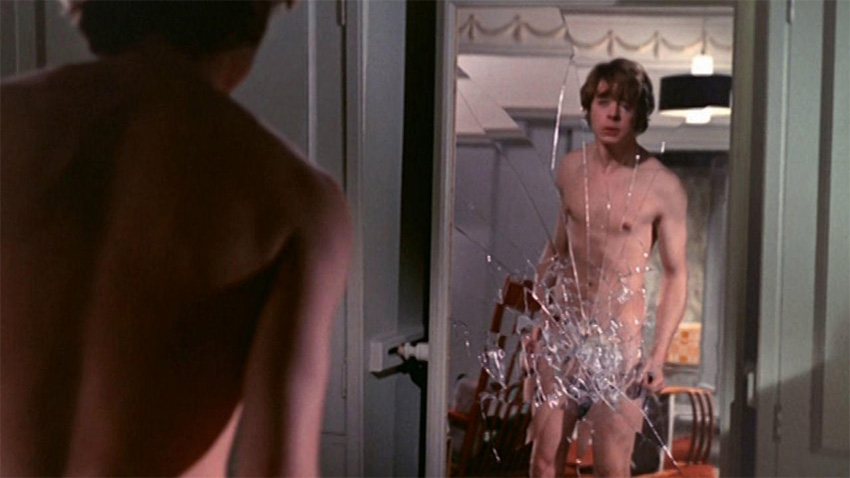
Judy Geeson and Martin Potter play cute blonde twins Jacki and Julian. They’re in their late teens or twenties but act younger, often deferring decisions to their teddy bear, Agamemnon. Decisions such as whether to throw the housekeeper who’s supposed to be looking after them down the stairs, for example, so they can enjoy London without restraint.
Julian loves Jacki a bit too much, in a way that’s not healthy. For a while, they share a boyfriend, hippy hipster Clive, who also wants to be Julian’s pimp. To seal that deal, he arranges for him to be raped by two men. So Julian and Jacki arrange for Clive to die. And so on into ever-descending spirals of blood and hysteria.
It’s a sweaty, feverish, unsettling film that tells us sex is a nightmare, love is a sickness, and that only death can set us free. It was also released under the name Twinsanity which is less tasteful but gives a clearer idea of its tone.

There are plenty of other films that fit alongside those mentioned above, many of them included in the excellent book Offbeat edited by Julian Upton, which presents an alternative canon of British film.
I’ve already mentioned Dracula AD 1972 which brings Dracula to modern-day swinging London. Here, the obligatory handsome blonde boy with a black heart is Johnny Alucard (Christopher Neame). His sickness takes the form of a master-slave relationship with Dracula himself. You could take Dracula out of the equation and retool this as a story about a delusional psychopath loose among the hipsters of Chelsea with relative ease. Like Goodbye Gemini it opens with shots of London – jet planes, flyovers, tower blocks – accompanied by pounding rock-funk. The following year’s The Satanic Rites of Dracula, also directed by Gibson, provided more of the same, with the addition of a satanic sex-power cult.
What Became of Jack and Jill (dir. Bill Bain, 1972) has Vanessa Howard, AKA Girly, as one half of a murderous young couple opposite Paul Nicholas. They shag on his granddad’s grave as they plot the murder of his grandmother. Their plan is to scare her to death by convincing her that the young are rioting in the streets and rounding up the elderly.
Unman, Wittering & Zigo (dir. John Mackenzie, 1971) isn’t set in London but transplants swinging London icon David Hemmings to a public school in the country. His pupils, arrogant little bastards, tell him they killed his predecessor and will kill him if he doesn’t submit to their will. As they engage in a battle of wills, the boys stalk and eventually attempt to rape his wife. Sonny from Mumsy, Nanny, Sonny & Girly would fit right in. He might even make a good pal for the unfortunately marginalised Wittering.
Jerzy Skolimowski’s Deep End from 1970 is beautifully made – definitely more art than exploitation. But it still gives us the beautiful blonde boy with a kink in his brain (John Moulder Brown), sexual relationships that cut uncomfortably across age barriers, and sex scenes that are more disturbing than arousing. He plays Mike, a 15-year-old boy who gets a job at a swimming pool in East London. On day one his colleague Susan (Jane Asher) initiates him into a job on the side pleasuring older women in the sauna rooms. He is driven mad by his infatuation with Susan and their complex relationship (she rejects him, then brings him close) leads to the inevitable mingling of sex and death.
The Ballad of Tam Lin (dir. Roddy McDowall, 1970) cuts across sub-genres. The first act takes place in that familiar, slightly square version of swinging London with beautiful young things in mod clothes speeding around in sports cars. The sequence in which they race out of town, past the modern office blocks of London Wall and up the M1, recalls the opening scenes of both Goodbye Gemini and Dracula AD 1972. They are the acolytes of a beautiful older woman (Ava Gardner) who seems to draw strength from their youth. There’s no room for dead weight in her commune-cult, though, and we see that she uses people up and discards them. The second half of the film fits more comfortably into the folk horror bracket, however.
These films are all quite different, I realise, in both intent and quality, but you could pick any two and run them together as an effective double bill.
When I asked people on Twitter about this they suggested a whole slew of other candidates. I’ve compiled those, along with the films listed above, into a watchlist on Letterboxd. Let me know what’s missing.
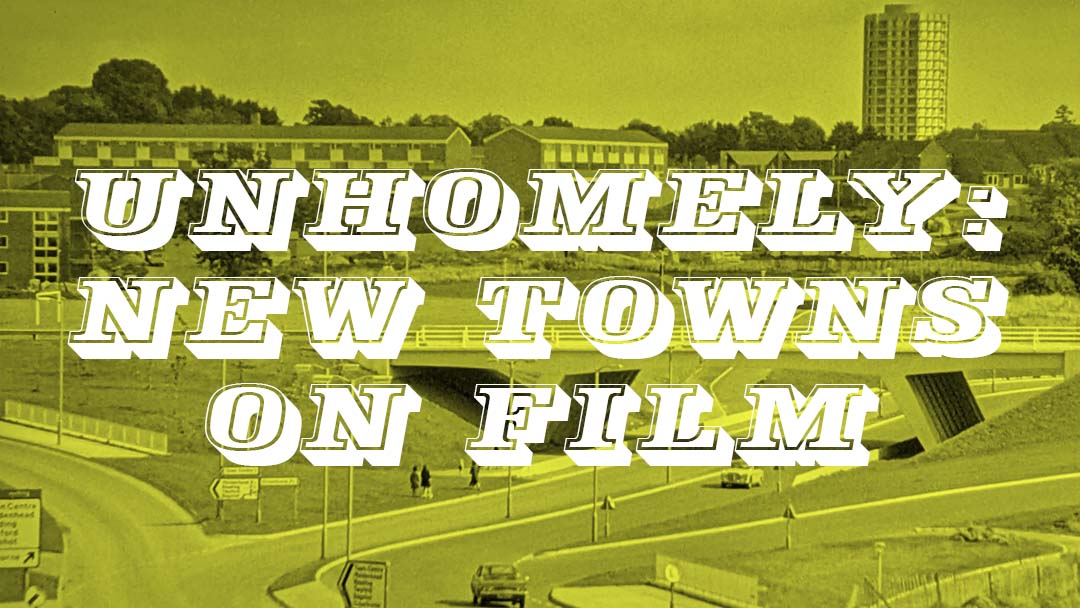
On film, the post-war British new town is an uncanny space – heaven, hell, or somewhere between, but certainly not quite real.
The idea of the new town was born out of hope and optimism. With population growth, cities half-demolished by the Blitz, and increasingly demanding expectations around quality of life, ordinary working people in Britain needed new and better homes.
The British government set about identifying sites across the UK where large residential towns could be built from scratch, or by drastically expanding existing smaller settlements.
This was revolutionary, contrary to the usual British wait-and-see gradualism, and not everybody was convinced by the idea. It’s certainly difficult to find wholly positive depictions of the new towns project on film outside government propaganda.

Right at the beginning, when the new towns only existed in plans and papers, Basil Dearden directed a film based on J.B. Priestley’s 1943 play They Came to a City. Released in 1944, it’s not explicitly about new towns but rather about the need to reorder British society along fairer lines after the war.
It just so happens, however, that Priestley’s metaphor for this new society is a city. A new one.
Priestley’s script acknowledges that not everyone wants to come on this journey – and those who choose to stay behind have their reasons. Nonetheless, the argument is clear: things need to change and someone needs to have the guts to explore the frontier.
Almost as if they couldn’t help themselves, however, Dearden and Priestley make the new town not only ambiguous but also unsettling, alien and even a little threatening. A supernatural, spiritual force rather than the product of pure bureaucracy.
Dearden’s previous film, Halfway House, had a similar structure – strangers gather to solve an existential mystery – only in that case, the twist is that they have all gone back in time to fix their mistakes. Here, they’ve gone forward, and are being given a chance to prepare for Things to Come.
We never get to see the town, only the giant portal and staircase that lead to it, and the alternately appalled or euphoric faces of the visitors as they return. That makes it all the more unnerving. What on earth can be at the end of that staircase? Surely something more exciting than, say, Harlow.
After the war, the New Towns Act of 1946 triggered the building process. Development of the first wave was focused on London and the South East.
From then on, the idea of the new town as a point of tension – new versus old, planned versus organic, urban versus rural – would be played out on film, consciously or otherwise, time and again.

Some filmmakers were drawn to new towns because, half-built in the 1950s, they offered plenty of unsettling atmosphere off the peg. They were strange spaces. Silent. Disconnected from the world. Alienating.
Literally so in the case of Nigel Kneale’s Quatermass II.
The original 1955 BBC television series features scenes set in a ‘prefab town’ built for workers at the sinister secret facility around which the plot revolves. By the time Hammer adapted it for film in 1957 (dir. Val Guest) the setting was very clearly a more permanent new town, filmed on location at Hemel Hempstead.
It is presented as bleak and windswept, like a colony on Mars. The houses, in rippling rows, are surrounded by moorland. From one angle, it is urban. From another, rural. Both, and neither.
This plays on a feeling that new towns simply should not be. Towns should grow over the course of decades, over centuries – not overnight.
In his 2016 book The Weird and the Eerie Mark Fisher wrote about a container port in Suffolk as “a weird phenomenon, an alien and incommensurable eruption in the ‘natural’ scene”. Its silence, when viewed from a distance, contributes to this sensation. New towns can have a similar effect.
There’s also cold war paranoia in Quatermass II, and a suspicion of anything resembling socialism. The people of the town are unwitting worker drones for alien invaders, their servitude bought with these bland, identical homes, and the promise of food on the table in return for no questions asked.
A later television production, Danger Man, took a more head-on approach to the same idea. In the 1964 episode ‘Colony Three’ John Drake (Patrick McGoohan) is kidnapped and taken to Hamden New Town. (Played by Hatfield.) It’s perfectly clean, perfectly civilised, but of course it’s not an English town at all – it’s an unnamed Eastern bloc country and is a training ground for spies.

This sense of the uncanny, of the new town as an unnatural invader, is even present in ostensibly comic films.
In The Big Job, a not-quite-Carry-On from 1965 directed by Gerald Thomas, Sid James (also in Quatermass 2) plays a gangster who buries the spoils of a robbery in a country field. Fifteen years later, when he is released from prison, he returns to find that a new town (Bracknell) has been built on those very fields – and a police station right on top of his treasure.
It’s a funny setup but it also underlines the pace of change in post-war Britain. Who would expect deep English countryside to become a settled English townscape in such a short span of time? Turn your back and the very fabric of the country will shift.
This leads us to another question: what does the new town bury or replace?

In the American film Poltergeist (dir. Tobe Hooper, 1982) a Spielburbian planned community (housing estate) is built on the site of an old burial ground that was never cleared, which is the source of its haunting.
But almost every inch of Britain is a burial ground or battlefield.
Requiem for a Village (dir. David Gladwell, 1975) is almost a ghost story, or perhaps an example of folk horror, built around the growth of a new town around a country village.
In the opening scenes we see an old man set off from a modern housing estate on the edge of the town, wobbling along on his bike. He negotiates roundabouts and a dual carriageway, eventually finding his way to a secluded village church. While tending the grounds, he has a vision of bodies rising from the graves, returning to the pews in the church. He follows them and so begins a trip through his own memory, and a collective memory of a lost rural life.
The new town here isn’t bad – the houses are large, clean and comfortable. And the past is murky, too, blighted by war, poverty and rape.
But, still, there’s a suggestion that the modern world has rolled concrete, closes and crescents over something richer and more complex. The bulldozer is an existential threat.

A less arty but perhaps no less heartfelt take on some of the same ideas can be found in, of all places, the second film based on the TV sitcom Till Death Us Do Part.
Released in 1972, The Alf Garnett Saga (dir. Bob Kellett) relocates Garnett from the East End of London to a tower block in a new town – Hemel Hempstead, once again. He not only dislikes it but cannot cope with it. It has the trappings of a community, such as a pub, but is configured in a way that leaves him bewildered, imprisoned and humiliated.
At one point, he takes LSD, imagines himself to be a chicken and nearly falls from the balcony: “Out the window, fly away… Open the window, open the cage…”
In an essay translated into English as ‘The Uncanny’ Sigmund Freud actually uses the German word unheimlich – ‘unhomely’. Are new towns homely?
A common criticism of new towns and overspill estates is that they lack soul or character. “Rows of houses that are all the same” are contrasted with the individuality of the buildings found in towns which developed organically over centuries. And because these houses are built in clean, straight-line modernist style, they seem to lack individual texture.
There’s another kind of place they call to mind, especially when seen in their pristine state in films from the 1960s and 70s: the ‘tin towns’ in which the British Army trains for urban warfare. Or, of course, standing sets on studio backlots, whose houses are usually hollow shells.

In both I Start Counting (dir. David Greene, 1969) and The Offence (dir. Sidney Lumet, 1973) the new town is dangerous in another way: as the hunting ground for a serial killer.
I Start Counting makes explicit an alienating quality in new town life. “The rain don’t even fall on us here,” says Granddad, looking forlornly from the window of the family’s tower block flat. The flat is actually a studio set and, painted beige and white throughout, evokes the alien simulation of a bland hotel room where Dave Bowman ends up at the end of Kubrick’s 2001: A Space Odyssey.
If the new town feels unreal, like a simulation, then what might that do to the mind of a psychopath already struggling to ascribe real feelings to, or empathise with, his victims? They’re just non-player characters in an open world game.
Then there’s the would-be utopian landscape of pedestrian underpasses, footbridges and green space. A dream in the promotional films made by new town corporations to market themselves to the young city dwellers they hoped to lure. But also appealing to parasites looking for opportunities to kidnap, maim or kill.

In I Start Counting it’s parkland at the end of the bus route – the new town’s weirdly hard edge – where young women are most vulnerable. In The Offence, it’s tunnels running beneath brand new roads where a child-killer strikes.
Built-up but sparse, populated but somehow empty, this new town (Bracknell, again) feels especially psychically dangerous. Look what it does to Detective Sergeant Johnson (Sean Connery): he loses his grip on reality and morality, brooding in his tower block flat and the new-build brutalist police station like a man in purgatory.
New towns are appealing to criminals of other varieties, too. As a composite of both Kray twins in Villain (dir. Michael Tuchner, 1971) Richard Burton plans the perfect payroll robbery to take place on the beautifully empty roads of (yet again) Bracknell.
For the East End villain, this is ideal: do your business out of town, on the wild, distant frontier, with only provincial policemen in your way.

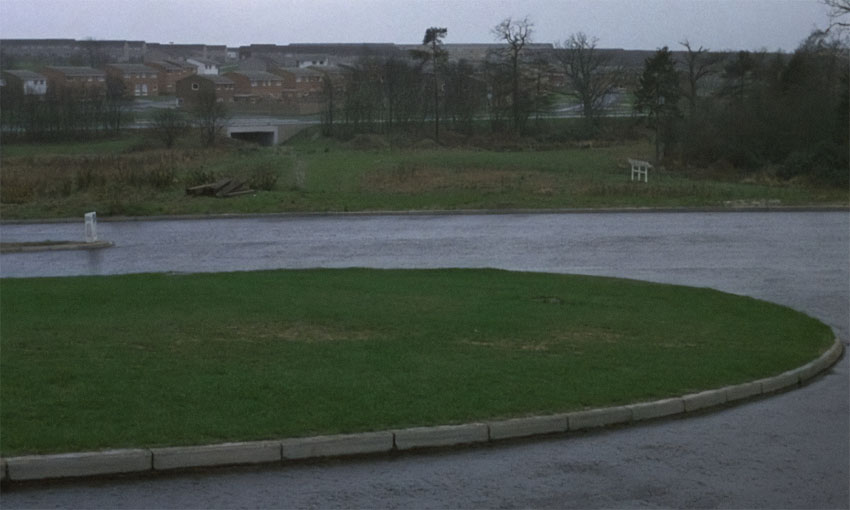
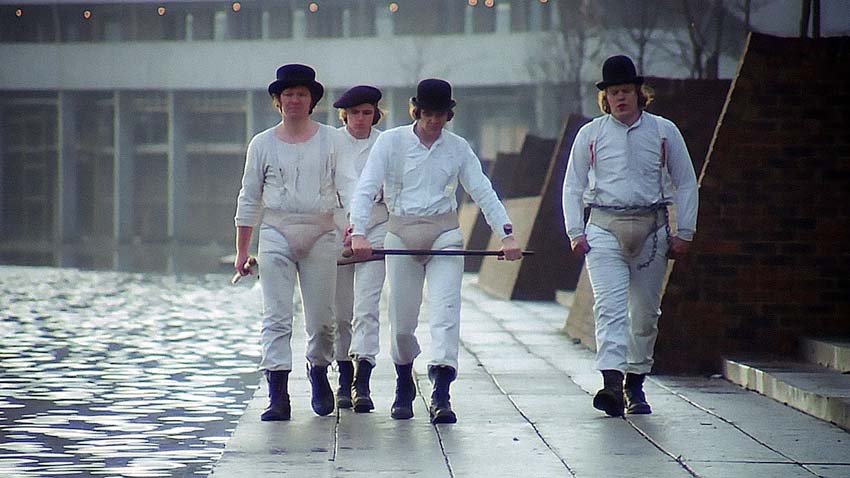
And then, of course, there’s Stanley Kubrick’s A Clockwork Orange (1971), which used Thamesmead, marketed as “London’s new town!”, to represent a dystopian future.
More than any other film, this cut through the PR and foresaw problems to come. When footbridges and underpasses cease to be cared for, when the gardens become overgrown, and the concrete sickens, the shine can go off a new town pretty fast.
Despite the recurring portrayal of the new town as uncanny, unsettling and alienating, it’s not all bad news. In two notable sex comedies, it’s not a training ground for aliens, spies or criminals but for randy teenagers. It’s a playground. A safe space to practice being an adult.

In fact, rewind: there’s even some of this in I Start Counting. It offers glimpses of a town centre where young people are given places of their own – record shops, cafes, nightclubs – and where there are plenty of precincts and arcades, squares and parks. They’re new and shiny, too, not yet haunted by Alex and his droogs.
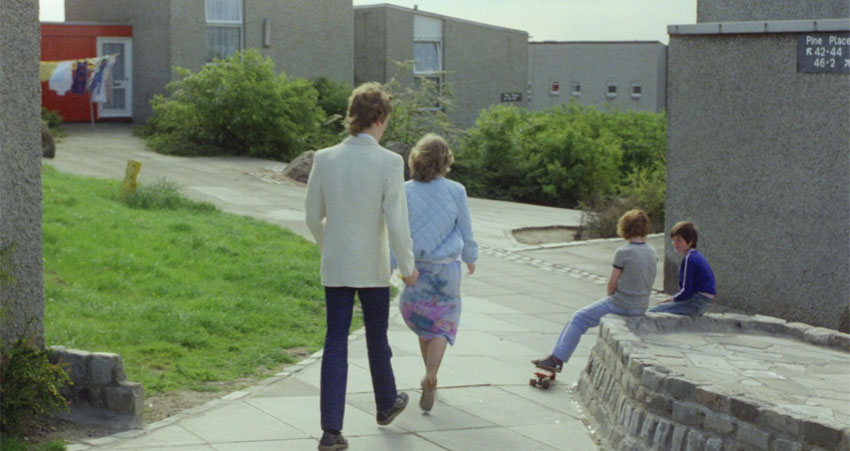
In Here We Go Round the Mulberry Bush (dir. Clive Donner, 1968) and Gregory’s Girl (dir. Bill Forsyth, 1980) the focus is entirely on the struggles of young men to understand young women.
The bland, clean safeness of their new town backdrops (Stevenage and Cumbernauld respectively) saves us from the heavy ‘issues’ that so often bog down British youth films. We don’t need to think about urban decay when there’s love in the air. In Forsyth’s film, Cumbernauld looks positively Californian, its concrete bathed in golden hour light. Shangri-La.
Christopher Ian Smith’s 2017 documentary New Town Utopia, about Basildon in Essex, gets the balance right. With time, it argues, memories have accrued and traditions have developed. If they aren’t paradise, these Pinocchio towns, have at least achieved their dream of becoming real places.
Everyone manages their mental health differently. For me, it’s about treading water to keep my head above the waves.
As a teenager and twenty-something I was a wreck: depressed, often thinking about suicide, prone to panic attacks and insomnia.
Now, in my mid-forties, I still have low days, still don’t sleep well, and sometimes catch myself saying “Ugh, it would be easier if I was dead.”
But it’s under control, generally speaking.
That’s thanks largely, I think, to a single course of counselling on the NHS. I know that doesn’t work for everyone, or isn’t enough, but it worked for me.
It helped me stop worrying about what I can’t control (sleep); to let myself step off the high-achiever treadmill; and to address the scars left by childhood poverty.
I’ve also learned to talk to my other half when things feel bad – which isn’t often. Sometimes just verbalising it makes it go away.
That’s especially true of what I call, coyly, “the old SI” (suicidal ideation). Mostly, it’s an escape valve thought, an extreme form of “Ah, fuck it all.”
Stability and routines help, too. A wise friend once told me there are two types of people in the world: those who want a rollercoaster ride and those who want a steady life.
I’m the latter.
I wake up at the same time, seven days a week.
I know my plans days and weeks in advance.
I run on a set schedule.
Oh, yes, that cliché: I hate running but I have to take my medicine. If I skip a run, my mood dips noticeably.
I can also be thrown out by working late or at weekends, which doesn’t happen often; by too many social occasions in a row; or by, oh, you know, global pandemics.
Things like that interrupt the rhythm of my little legs, churning away under the waves, causing my head to dip below the surface.
That need for stability has probably prevented me being successful as a writer, to a degree. I need a nine to five job to cling to and it’s hard to write when you’ve been working all day.
But I also know that I’ve been lucky to enjoy 15 plus years of relative calm.
I don’t take it for granted. After all, it might only take one bad day to drag me right back down.
This quick post is a risk in its own way. “Talk about your mental health!” we’re constantly told. It’s good. It’s healthy.
Well, not for me. It’s like picking at a scab. I’ll decide when to do it, thanks, and might never do it again.