Trident House is an aching place where nobody dwells by choice.
The Inquiry team was sent to Trident House ostensibly because it was the only office building in the Council’s property estate with space for enough desks and for the hundreds of boxes of historic paperwork.
That it is a distasteful business – that the Council is ashamed of and embarrassed by the Inquiry – also played a part. Trident House is out of sight, on the wrong side of the ring road, where nobody from the Council has to think about it between those uncomfortable hearings that take place in the main chamber every few months.
The Council was once proud of Trident House as a symbol of its arrival in the twentieth century. It was declared open by the Duke of Edinburgh in 1971 and there was a souvenir brochure. But fashions change and brand new buildings age. They darken. They weep black and green. Now, Trident House is one of the Council’s greatest problems, not quite abandoned, but with more empty floors and more unsafe, shuttered zones as the years pass.
The Inquiry occupies the first floor of the east wing. On one side, its curtain of windows looks over a courtyard with a dry fountain and cracked paving slabs. On the other, the view is of a car park that runs up to a trough along which flows a dirty, diverted stream.
Jade’s desk is on the car park side. Her job is to scan and catalogue printed documents, which means she’s one of a handful of people who actually need to be present in the office. She’s often the only person on site.
When her department at the Council was told to contribute three people to the Inquiry team, Jade was at the top of the list of staff her boss felt able to spare. In fact, she hopes Jade never comes back.
Jade is often told she looks like a wet weekend and even when she intends to smile, which doesn’t happen often, her mouth only becomes slightly less downturned. She always seems to be shivering slightly, as if in a permanent state of mild shock, and sometimes chooses to do nothing at all for minutes at a time. It’s not that she does something other than work – Jade has no interests or hobbies, and doesn’t use social media – but that she likes to stare out of the window, deliberately unfocusing her eyes, aiming to become as close to unconscious as possible.
Lately, though, one thing has begun to interest her: Trident House itself.
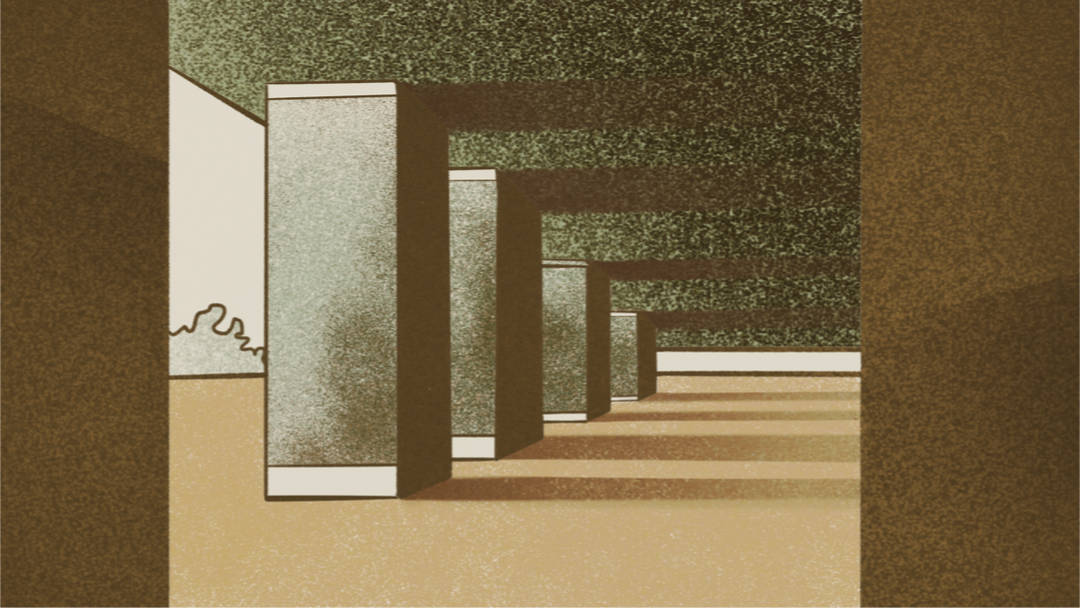
First, she noticed its textures. Sitting in the grim courtyard eating her thin, pale sandwiches, eyes fixed on nothing in particular, she gradually became aware of the presence of wood grain in the concrete pillars, or piloti, that suspend the office block in space like a hovering UFO, and form sheltered colonnades. She didn’t understand how this wood grain could be possible, being ignorant of the process by which concrete was poured into timber formworks to create the modular blocks from which Trident House was constructed. That first time, she placed her sandwich and its plastic wrapping on the bench, and stepped across to the pillar immediately in front of her to run her fingertips over the faint ripples on its surface. These were, in relief, the knots and wavering lines of a pine tree felled decades ago in some lonely Baltic forest.
Then, over the course of weeks, Jade became aware of other peculiar qualities of the piloti. The wood grain suggested trees and the arrangement of these concrete trees in turn suggested, at some primal, subconscious level, the feeling of a forest. They sliced the daylight, filtered it, and created long shadows. They emphasised distance and created perspective. They anchored Jade in space. This is no accident: the building’s designer, an emerging talent from the City Architect’s Department, had set out to evoke precisely this as part of ‘a playful engagement with ideas of artificiality and naturalness’, according to that souvenir brochure from 1971.
The work of the Inquiry is not urgent, whatever the Council’s press office might say, and Jade’s senior managers aren’t ambitious or diligent. As long as some documents get scanned, some reports are written, and a needle moves on the progress dashboard every day, they’re content for her to stare out of the window or, as happens increasingly often, to wander down to the courtyard for a cigarette break. Jade doesn’t smoke but her supervisors (working from home) haven’t noticed this. Instead, she weaves her way between the piloti, caressing them as she passes. Touch grass, they say – an evolution of the old idea of hugging trees. Jade’s vacant ritual is a version of this, a connection with nature several steps removed. Trident House has glamoured her and, in her glamour, she is unaware of what draws her there and stalks her through the concrete weald – the imprint of a vanished forest, a distorted memory, an inverted thing.
One Friday afternoon, after a meditative quarter of an hour among the piloti, she buzzes herself back into the building with the card that dangles on a lanyard around her neck. There is a plaque on the wall, half-concealed behind several mobile notice boards, blue rectangles on wheels, that have been abandoned in the reception area. If she paused to look and to read the text on the plaque, she’d learn about N.J. Gardiner, 1956-1977, who ‘died in the dedicated pursuit of his municipal duties’. But to Jade, the plaque is just part of the institutional scurf that marks most of the walls in the building: pinboards, posters, stopped clocks in Swiss style, fire alarms, fire extinguishers and acrylic signs pointing to facilities that no longer exist, like the library, the canteen and the bomb shelter on basement level two.
The main staircase is of the type found in almost every post-war library, secondary school and public building in the country, with floating steps, speckled grey linoleum, and varnished handrails. Jade’s steps echo through the foyer as she climbs towards the first floor. At the top of the steps is a double door with two panes of glass. As she approaches, slightly out of breath, fluorescent lights beyond the double door flutter into life. This has never happened before and Jade is surprised to discover that the lights in such an old building can be motion sensitive.
A sign on the door, printed on A4 and held in place with tape, reads: ‘No entrance without express permission, thank you in advance for your consideration in this matter, Estates and Maintenance’. She looks through the window on the door on the left and sees an enormous space, stripped of its partitions. There are several hundred swivel chairs and the same number of flatscreen computer monitors sitting on the floor, an ocean of matt black rectangles and tangled cables. More lights come on, their soft clicking and flickering rippling towards the back of the room. The far wall is covered with sheets of flipboard paper, yellowing and torn. They’re covered in marker scrawls and sticky notes, though most of the latter have fluttered to the mushroom-coloured carpet like leaves in shades of neon. She observes the room for a long time certain that something there is about to move and that if she looks away, she’ll miss it.
The weekend keeps her away from Trident House. It is filled with too many brothers, sisters-in-law, nephews and nieces. There are too many jokes at her expense.
On Monday when she takes her next smokeless cigarette break it is raining and finally almost autumnal, despite the summer heat that has persisted into October. Some actual smokers are lurking by the doorway, sheltering in the colonnade – staff from another Council team. They don’t acknowledge her. Jade puts piloti between her and them as quickly as possible until the sound of the downpour is louder than their murmuring and coughing.
This time, for the first time, she looks up. The concrete above, supported by the piloti, has a texture of its own. Its enormous flat panels are stained with frills of green moss. There are chips, cracks and even craters in which rusting steel reinforcing rods show as lines of orange. There are also pipes and cables threaded and pinned in place, running from one place to another, and disappearing into the concrete. Her eyes scan this desolate landscape, this blast zone, this pitted plain, and she forgets which way is up and which is down.
Then she hears a sound just loud enough to make itself known over the hammering of the rain: birdsong, perhaps, or the mewing of a cat, or the improvised tune of a small child at play. She snaps her head down, breaking free of the view above. She steps forward, back, to the left, further left. The sound becomes louder and becomes more distinct. It’s not human or animal but there is meaning in it. Circling one of the piloti, she finds the source: a rusting speaker, part of Trident House’s fire alarm and emergency evacuation system. It is emitting high pitched whistles and chattering noises and, Jade thinks, the occasional discernible word: ‘…leave immediately… belongings… danger…’ The sound dies away until Jade is staring at nothing but a hunk of decaying metal fixed in place with rusty bolts. The cable that ought to be supplying its power is not connected, terminating in tufts of insulation and copper wiring.
The smokers have gone when Jade returns to the office. She once again ignores N.J. Gardiner’s plaque and once again mounts the municipal modernist staircase. The lights in the space behind the double doors once again tick into life and Jade once again looks through the small pane of glass on the door on the left. She blinks and breathes a little faster. Were those bare concrete pillars there before? They follow the layout of the piloti beneath the building and seem to make sense, structurally, supporting that expanse of tiled ceiling. Jade knows, though, that they are new. The neon sticky notes have multiplied, clustering in piles around the bases of the pillars, which have punched their way through the floor. A draft passes through the space, via an open or broken window, perhaps, and the sticky notes whirl and settle.
From three o’clock onwards, the handful of people in the office start to leave. First the seven in the morning starters, then the eight o’clock starters, then, finally at five, Jade is free to go. She packs her bag, retrieves her lunchbox from the fridge in the small kitchen, uses the toilet, and heads towards the exit. The lights in the furniture storage area don’t activate but Jade pauses in front of the door anyway. She glances at the A4 paper sign for a moment and decides to ignore it. The door is stiff but not locked and swings inward when she applies her shoulder to it.
It’s gloomy but not dark and everything is as it was earlier in the afternoon. Standing in the space she is aware of the smell: dust, damp, rot, fresh earth. The heavy duty carpet squishes damply beneath her feet. Her usual constant shivering intensifies because she is certain there is something here. She wants to speak, to challenge it, but cannot make a sound pass her quivering lips. Drawing close to one of the piloti – yes, these pillars are identical to the ones outside, beneath the building – she walks her fingers over the wood grain texture in the raw concrete.
Whatever is with her in the room is an inverted impression of something natural. She knows this, even if she can’t articulate it. It’s alive and dead at the same time. It’s both malevolently intelligent and animalistically, reactively mindless. And it wants her. She presses her hand into the concrete pillar and keeps pressing. Its rough teeth bite into her flesh. Pain shoots up the tendons in her wrist and forearm. She embraces the pillar and pushes her face into the concrete, too. Why won’t it open? Why won’t it let her inside?
The spell is broken by the clattering of the double doors. Jade leaps away from the pillar and spins around.
‘You’re not supposed to be in here, love,’ says the security guard. He’s a former soldier in his fifties, paunchy and white haired, dressed in a polo shirt branded with the name of a private security firm.
‘Sorry,’ says Jade. ‘I thought I heard someone calling for help.’
As he steps across the floor the lights come on. He stops some distance away and swears under his breath.
‘What have you… Are you okay?’
He gestures at his own face as his eyes dart across hers.
She raises her fingers to her cheek. She gasps as she touches the tacky, bloody scratches and feels them sting. The inversion is inverted and her flesh has the texture of timber grain.
The security guard does not seem to notice the new pillars in the room, despite having patrolled there hundreds of times, including the morning of that very day. He guides her towards his small office on the ground floor where he keeps the first aid kit. When she leaves the now deserted building at quarter to six she has a large sticking plaster across her cheek and a mesh of smaller plasters across the palm of her hand.
Jade has never seen the courtyard after dark and it feels more like a forest than ever. Wind rushes through leaves, and timber creaks, but those things cannot be, and are not, happening.
She tries to work out which of the piloti is the root of the one that has broken through into the storage space, the one with which she could not merge.
Her footsteps echo tightly beneath the building, like drops falling into still water, until she finds what she’s certain is the right pillar. She recognises its grain and, tracing the lines on the concrete, finds the ghost of her own face marked out in rusty stains.
This time, she knows what Trident House wants her to do. She circles the pillar once, twice, three times, her footsteps ringing out. The disconnected speaker whines with pleasure or malice. On her fourth circuit she steps behind the pillar and her footsteps stop as if someone has lifted the needle from a recording.
If you enjoyed reading ‘Piloti’ then check out my collections of short stories available as eBooks or paperbacks through Amazon.


