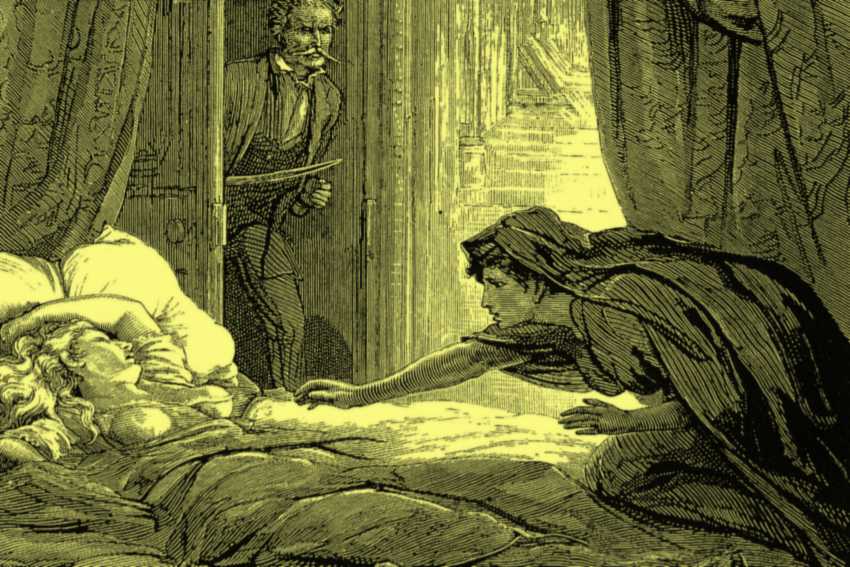
Sheridan Le Fanu’s Carmilla is a fascinating story. If nothing else it was published in 1872, long before Dracula, and was clearly a huge influence on Bram Stoker.
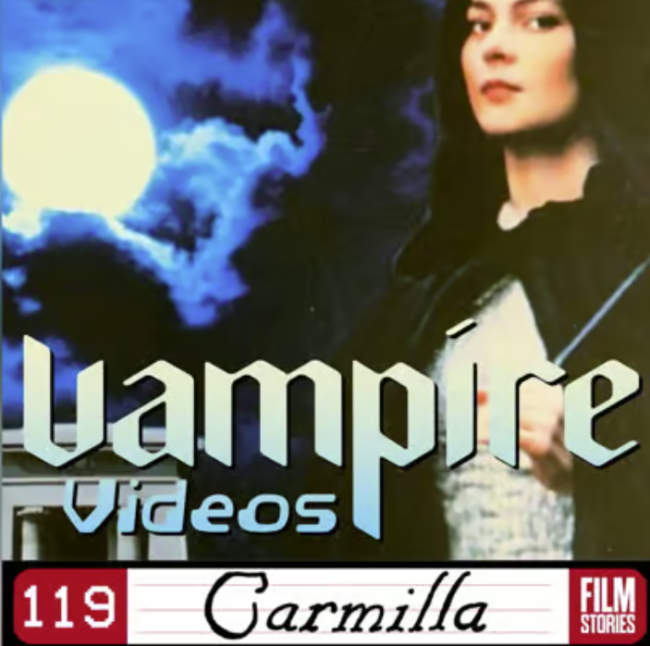
When the team at the Vampire Videos podcast invited me to join them as their guest on an episode my first challenge was to think of a vampire movie they hadn’t already covered.
Fortunately, I’ve developed a taste for the kinds of films you can only find in the depths of YouTube, which is where I found a 1989 episode of the US anthology series Nightmare Classics based on Carmilla.
It stars Jennifer Tilly as Carmilla and relocates the action from Styria in Eastern Europe to the American Deep South.
You can find out what I think of this adaptation by listening to the podcast.
Here, though, I wanted to say a few words about Le Fanu’s original story which I suspect many readers of vampire fiction have overlooked for various reasons.
I first read Carmilla as a teenager during the vampire craze of the early 1990s, when kids at my comprehensive school in Somerset – even those who wouldn’t normally be seen dead with a book – were carrying around film tie-in editions of Dracula and Interview With a Vampire.
I read both, and saw both films, and wanted more, so when I was given the chance to choose a book for a school prize, I selected The Penguin Book of Vampire Stories edited by Alan Ryan.
What a treasure trove that book was, and is. I still have the same copy, its pages yellowing, wrapped in ‘protective film’ that is slowly eating it, with a slip on the flyleaf which tells me I won the Phillips Award for Academic Achievement in 1994.
As well as John Polidori’s ‘The Vampyre’ and Stoker’s own ‘Dracula’s Guest’ it contains the complete text of Carmilla, a novella at 70 or so pages.
I sometimes describe myself as Britain’s Most Uptight Man and I was even worse as a teenager. Carmilla, at that time more than 120 years’ old, still had the power to thrill and shock (me, at least). I was astonished by how modern it seemed with an intense sexuality and, specifically, what seemed to me in 1994 to be a clear and unambiguous portrayal of a lesbian relationship:
In silence, slowly we walked down to the drawbridge, where the beautiful landscape opened before us.
“And so you were thinking of the night I came here?” she almost whispered.
“Are you glad I came?”
“Delighted, dear Carmilla,” I answered.
“And you asked for the picture you think like me, to hang in your room,” she murmured with a sigh, as she drew her arm closer about my waist, and let her pretty head sink upon my shoulder. “How romantic you are, Carmilla,” I said. “Whenever you tell me your story, it will be made up chiefly of some one great romance.”
She kissed me silently.
“I am sure, Carmilla, you have been in love; that there is, at this moment, an affair of the heart going on.”
“I have been in love with no one, and never shall,” she whispered, “unless it should be with you.”
I’d like to pretend I had a sensitive, sophisticated response to this at the age of 16 but what I probably thought was “I’m confused, help!” and/or “Cor, girls kissing!”
Carmilla, I later learned, was the source for all of Hammer’s “Cor! Girls with their tops off!” vampire movies of the 1970s, their use of the name ‘Karnstein’ being the most obvious giveaway.
The Vampire Lovers from 1972, with Ingrid Pitt as Carmilla, is a fairly close adaptation of Le Fanu’s novella with all the flaws and compromises you might expect for a film of the time.
I don’t want to spoil the podcast but it’s fair to say the 1989 adaptation, though less exploitative, also has its flaws.
It would be great to see an adaptation of this story as lavish and careful as Francis Ford Coppola’s Bram Stoker’s Dracula or Robert Eggers’s recent version of Nosferatu.
There are themes in Carmilla that still resonate in 2025, not least the negative power of loneliness.
Laura is utterly isolation in a castle in the middle of nowhere, surrounded by stuffy old men and servants.
It is her desperation for a friend, for any kind of companionship, that makes her so vulnerable to Carmilla’s serial predation. Or, to put it another way, that makes her so ready to be liberated. Which is it?
I see in this uncomfortable tension some interesting echoes of online exploitation and catfishing.
That such contemporary parallels can be drawn is perhaps a sign that Carmilla has depth and value beyond it’s part in the genesis of Dracula, and beyond its undoubted erotic charge.
You can listen to the podcast at vampirevideos.co.uk or wherever you usually get podcasts. The full text of Carmilla is available online at Project Gutenberg and in The Penguin Book of Vampire Stories which you can buy used for buttons.

 Precast Reinforced Concrete Heart