Categories
Film & TV

The mask as the cheapest unit of the uncanny

If horror film makers have nothing else they can always rely on a cheap mask to bring a sense of the uncanny, playing upon our deepest instinctive fear of The Other.

Watching the 1974 Spanish horror thriller Night of the Skull, directed by Jess Franco, I was struck by how it instantly seemed to step up a notch when a character in a mask appeared on screen.

The mask in question isn’t a lovingly crafted custom design. It’s not carved or sculpted. No, it’s a typically floppy, tacky rubber Halloween mask, as you can see in the picture above. But that doesn’t matter.

What matters is that, suddenly, there’s a human on screen whose true features we cannot see or read – who is utterly blank.

A few years later the same trick was used to even greater effect in Halloween, from 1978. John Carpenter’s film, which really kickstarted the ‘slasher’ craze, gave its enigmatic killer Michael Myers a mask which, as everyone knows, was adapted from a novelty product supposed to depict William Shatner as Captain Kirk.

In that case, the mask is more detailed and comes with the added oddness of feeling vaguely familiar. Should we recognise this face?

Demonstrating just how broadly we might define a mask in this context, the monster at the heart of the Friday the 13th series, Jason Voorhees, at first wore a simple sack over his head. Then, from the third film in the series, he gained his trademark hockey mask – a white ellipse with a few dark holes punched in it.
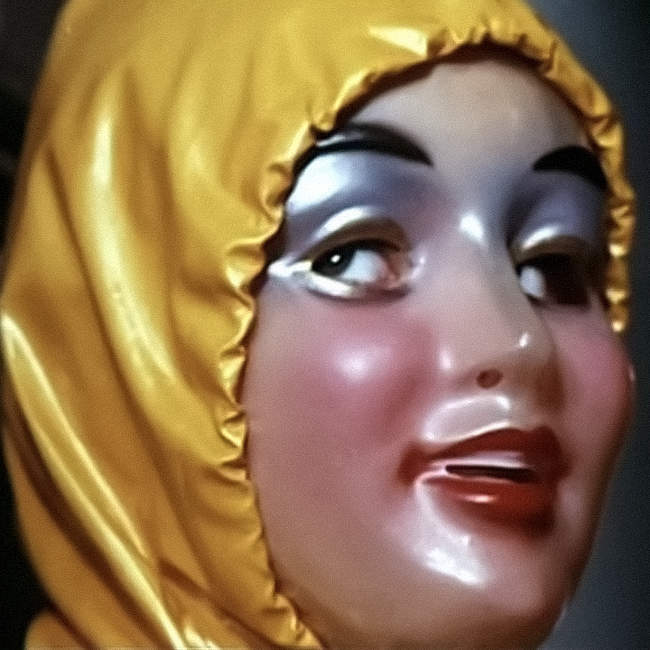
A person in a yellow anorak with a cheap plastic mask covering their face. It has shiny red cheeks and smiling red lips. The whole thing looks waxy and alien.
Alice, Sweet Alice.

In proto-slasher Alice, Sweet Alice (Alfred Sole, 1976) the mask is the cheapest, simplest plastic mask you can imagine – the kind I might have bought with my pocket money at the seaside, held on with a string of thin elastic. And it still works. The killer’s face becomes fixed, glossy and rigid, frozen in a smile that our animal brains read as uncanny.

There are examples of real life murderers wearing masks. The perpetrator of the 1946 Texarkana Moonlight Murders, for example, wore a white cloth mask.

And the Zodiac Killer who terrorised San Francisco and the surrounding area in the late 1960s wore a hood that concealed his face, turning him into a folkloric bogeyman.

For people like this, the mask is a way to become more than their pathetic selves, and to assert their dominance.

If you can’t see my face, but I can see you, then I’m in control.

Ed Gein, the inspiration for Norman Bates, The Texas Chain Saw Massacre, and many other fictional serial killers, made a mask from the peeled skin of his victims. His motive seems to have been to possess them from within – to steal their identities in a sense that predates online fraud.

A shot from a black and white film of two robbers wearing loose, leathery masks that make them look like monsters.
Kansas City Confidential.

Accessories to crime

The mask gives anonymity to criminals of all kinds, from lads riding eBikes too fast round the local park to hardened blaggers.

Criminals pull a pair of tights over their heads, or a balaclava, and in an instant their features are concealed or distorted.

In the heist movie, as much as the horror movie, masks create an instant visual hook. Think of the gang in Kansas City Confidential (Phil Karlson, 1952) with their unsettling felt masks, or the crew in Point Break (Kathryn Bigelow, 1991) who wear comical rubber masks representing various presidents of the USA.

In A Clockwork Orange (Stanley Kubrick, 1971) the juvenile delinquent Alex wears a particularly grotesque, phallic mask during an instance of home invasion and rape.
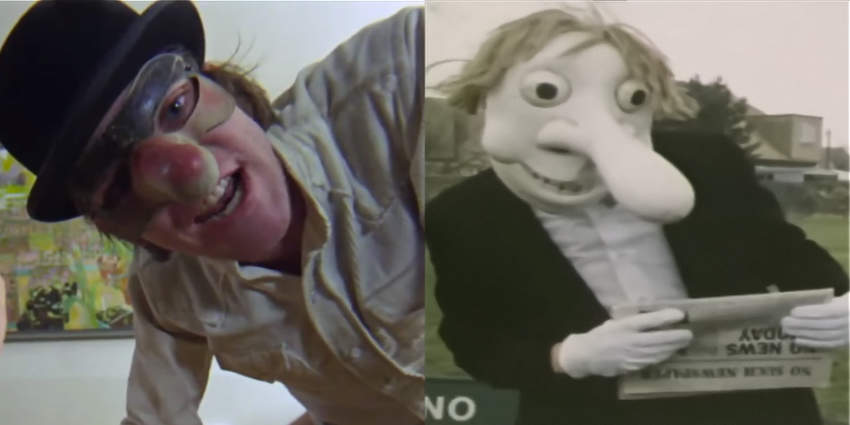
A comparison of Alex the Droog with his phallic nose and Mr Noseybonk with his perfectly innocent, but very similar, long proboscis.
Alex, left, and Noseybonk, right.

And when hauntologically minded British people over fifty talk about being ‘terrified’ of the 1970s children’s television character Noseybonk, consider the similarities between Alex’s mask and Noseybonk’s.

Much as they are empowering masks can also be dangerous.

The best section of a book I did not otherwise care for, Grady Hendrix’s 2023 novel How to Sell a Haunted House, is a side narrative which depicts the danger of masks. It tells the story of a troupe of avant garde puppeteers who fashion and don masks in the likeness of Pupkin, a sinister haunted puppet, and lose control of themselves:

It’s hard to describe what it feels like to wear a mask. You’re aware of what’s going on around you but it all feels far away. The longer you wear the mask, the more distant the world becomes through your eyeholes. Bits and pieces of time go black because the mask is active and you slip into a semi-somnolent state, but it feels good because you’re not in control. Nothing is your fault. You’re a puppet. Like Clark said, ‘A puppet is a possession that possesses the possessor.’ And a mask turns a person into a puppet.

In Kaneto Shindō’s 1964 film Onibaba, set in medieval Japan, the particularly sinister mask below equates to a curse. Yes, it confers power, but it also extracts a fee, binding itself to the wearer’s face, with removal only coming at too high a cost.

A Japanese mask fixed in a horrifying grimace.
Onibaba.

Creating horror from nothing

Masks are scary, among other reasons, because they deny us the cues we rely on to assess threats.

They turn our fellow humans into creatures that are humanlike but different enough to trigger deeply programmed fight-or-flight subroutines.

If you can afford to buy or make a mask, as simple and cheap as you like, you can generate horror.

And you will do so in the most efficient, powerful way possible – by short circuiting our rational minds.

Night of the Skull is available on Blu-Ray from Vinegar Syndrome, along with two other rare gialli, in the box set Spanish Blood Bath.

Categories
history science Somerset

Frankenstein in the Quantocks

POSTER: "Andrew Crosse -- the man who created life!"

A gentleman scientist fills a laboratory with primitive electrical equipment and, through experiments considered blasphemous by his peers, summons life.

This is the plot of one of the elemental gothic horrors, that’s true, but it is also something that really happened, not among the romantic mountain peaks of Mitteleuropa but on Somerset’s Quantock Hills. And the scientist was not a doomed young Byronic hero but a distinctly middle-aged Englishman called Andrew Crosse.

Crosse was born  in July 1784 at Fyne Court, a country house built by his family in 1620s on the edge of the Quantocks between Bridgwater and Taunton. Though now we now think of the Quantocks as a landscape dominated by conifers it was then covered with ancient woodland, its heathlands bright with yellow furze and purple heather, pockmarked here and there with sandstone and limestone quarries, and richly populated with deer and other game animals. A place of ‘free, wild solitude,’ in the words of Crosse’s biographer, his widow Cornelia.

Fyne Court before the fire of 1894, via the National Trust website.

Andrew’s father, Richard, was strict to the point of being intimidating and though his mother cooed over her ‘little Andrew’ his parents sent him away to board with a tutor in Dorchester at the age of six. There he learned Ancient Greek, oddly before he had learned to write English, before moving on to a school in Bristol at the age of eight.

In Bristol, on a grim diet of black potatoes and ‘hashed mutton’, he developed a fascination with fireworks and electricity. His father had known the famous electrical experimenter Benjamin Franklin and perhaps that laid the foundations of his interest, but the real spur to action was a lecture he heard about at a tavern where he had got into the habit of taking meals to avoid the dreadful school dinners.

A school friend, John Jenkyns, provided Cornelia with a note for inclusion in her biography which recalled what came after that formative experience:

I dare say he has mentioned to you our first joint attempt in the science of electricity, and the wonderment occasioned to a circle of school boys by giving them a shock with a Leyden phial… charged by a broken glass of a barometer…

Crosse and Jenkyns used this contraption to tease – or, let’s be honest, bully – younger boys who were marched up to a terrifyingly gothic witch-like figure sitting next to a box. (The witch was Crosse in costume.) Inside the box there was a depiction of hell with a devil dancing in front of it, pitchfork in hand. (A clever trick in itself: the figure was hanging from a single human hair.) The little lads were made to look at this macabre scene for a moment before the jar was discharged, giving them a physical jolt to match and intensify the psychological one. (At my school the bullies just gave you a dead arm in the corridor but this is presumably what you’re paying for with private education.)

Andrew Crosse. (This picture is all over the internet but I can’t find the original source.)

Crosse left Bristol for Oxford in 1802 taking with him an ‘electrical machine’ that he had acquired from a ‘philosophical instrument maker’, and a hunger to learn more. After university he returned to Somerset and made an abortive attempt to study law while, now orphaned, he also managed the family estate. His true fascination could not be resisted, however, and he soon had a new electrical apparatus to play with – a huge cylindrical electrostatic generator attached to a battery made up of 50 Leyden jars. This machine was made by his friend George Singer, another electrician, as such scientists were then known, though the word now refers to a specific, less glamorous trade. They would spend all day running electrical experiments together and then, in the evening, walk on the Quantocks engaged in intellectual debate.

A battery of Leyden jars.
Leyden jars as depicted in an 1894 medical textbook.

In around 1807 Crosse was inspired to begin a new line of investigation. He kept finding himself drawn to Holwell Cavern, a fissure in the limestone rock the roof of which was covered in star-like Aragonite crystal formations caused by the dripping of mineral laden water through the rock. A true man of the Romantic age, he of course wrote a poem about the cave, which begins:

Now pierce the hill’s steep side, where dark as night
Holwell’s rude cavern claims the torch’s light;
Where, breathless, dank, the fissure cleaves in twain
Th’ unchisell’d rock which threats to close again,
And swallow in its adamantine jaws
The bold explorer of creation’s laws.

Crosse later said: “I felt convinced at an early period that the formation and constant growth of the crystalline matter which lined the roof of this cave was caused by some peculiar upward attraction; and, reasoning more on the subject, I felt assured that it was electric attraction.”

He took water from the cave and, back in his lab at Fyne Court, connected it to a battery and ran a current through it. Nothing happened for days and he was about to give up when, after almost two weeks, he spotted sunlight glinting on crystals that had grown on one of the wires.

In the years that followed, he married, had children, and continued working on his ‘electrical poem’. He argued politics and philosophy with his brother Richard, and travelled to Plymouth where, from the deck of a hired boat, he caught a glimpse of Napoleon Bonaparte imprisoned aboard HMS Bellerophon.

A painting of ships.
Napoleon’s Bellerophon depicted in ‘Scene in Plymouth Sound’ by John James Chalon, 1815, via Royal Museums Greenwich.

He also continued his experiments, constructing an ‘atmospherical conductor’, a copper wire of about a mile in length which he used to attract lightning during thunderstorms and bad weather, creating ‘terrific… noise and brilliant light’. Crosse himself described how one experiment created “explosions… [and a] stream of fire too brilliant to look at”. Calmly harnessing the power of the atmosphere he used the electricity to boil liquids, fuse metals and cause fires. Locals would turn up at Fyne Court and ask to be zapped to cure their various ailments which, according to Crosse, sometimes worked. It is easy to see how this kind of experiment inspired the modern vision of the mad scientist.

As recounted in Brian Wright’s 2015 biography, it was Singer who convinced Crosse to talk at one of the regular lecture events hosted by the parachutist, balloonist and showman-scientist André-Jacques Garnerin at a London theatre. On the night of Crosse’s lecture on 28 December 1814 two more famous figures from history happened also to be present: Mary Shelley and her husband, the poet Percy Shelley.

We know from her diary that Mary took note of Crosse’s lecture, whether she paid attention to its details or not. A year and a half later, at the Villa Deodati on the shore of Lake Geneva, she would write her most famous book, Frankenstein. Did Crosse inspire Victor Frankenstein? Perhaps partly, or perhaps Frankenstein inspired Crosse, because back in the peace and quiet of Somerset he continued his experiments into batteries and crystallisation in relative obscurity for another 20 years, long after Mary Shelley’s book had become a bestseller.

Crosse was in his early fifties when an accidental discovery, and the equally accidental announcement of its results, brought him fame or, rather, infamy. In 1837 he carried out a month-long experiment attempting to grow crystals by electrifying a chunk of porous volcanic stone. On the 26th day he observed what looked like insects. Then, on the 28th day, to his astonishment, he saw them wiggle their legs. A few days later they wriggled free and began to move around the frame where the experiment was being conducted. They were, Crosse concluded, mites of the genus Acarus, and there were soon a hundred or more, some with six legs, others with eight. Where had they come from? And how on earth were they surviving in an acid solution?

Sketch of a bug.
Pierre Turpin’s drawing of Acarus Crossii made using a microscope, from The Annals of Electricity, Magnetism and Chemistry, May 1838, via Google Books.

Crosse mentioned this odd occurrence to some friends in what he thought was private conversation but one of the group was the editor of the Somerset Gazette and couldn’t resist running an account of the experiment. That article was picked up and reproduced or quoted in newspapers across the country, usually under the headline EXTRAORDINARY EXPERIMENT.

Outrage commenced almost at once. Who did Crosse think he was, claiming to have created life, and bragging everywhere about his amazing discovery which was obviously a complete con? Crosse was hurt by those accusations: he hadn’t made any such claims and certainly hadn’t sought to publicise his experiments. He was blamed for crop blight and received a letter calling him “a reviler of our holy religion” – in other words, he was accused of playing God.

For another decade he and other scientists attempted to replicate the results, often with success, but without reaching any convincing conclusion. Was the electricity reviving fossilised insect material in rocks or soil? Was the water contaminated, or the apparatus? Or had Crosse really discovered the secret to summoning life?

These days, the consensus is that the equipment probably was dirty — inevitable, almost, in those days of imperfect sanitising techniques. Hardly the stuff of legends, and Crosse certainly did not go on to ‘create’ any more substantial form of life such as, say, a murderous, misunderstood monster created from cadavers rifled from graveyards.

Even though Shelley wrote her novel twenty years before Crosse’s mite experiments, and though in reality the links are tenuous, in recent decades the connection has become indelible, and it is probably fair to say that the Thunder & Lightning man owes his lasting fame to Mary Shelley. Peter Haining, that master of the fun but unreliable horror-history hackjob, called his 1979 book about Crosse The Man Who Was Frankenstein which, clearly, he wasn’t. And, well, I’ve done it here, haven’t I?

There is something irresistible about the idea of so macabre a fiction having any basis in reality, especially when that reality occurred in the wooded hills and heathland of Somerset where the red deer roam.