Categories
books Intervals of Darkness

Story-by-story: Second Homes

I lived in Penzance in Cornwall for six years, including several stormy, boarded-up off-seasons. This story is about how that felt – and about the distinctly haunted landscape.

I used to observe the coming and going of people throughout the year, and the rhythms of the tourist industry. Repainting and repointing in the run up to Easter. And the general air of exhaustion in early autumn.

I was especially struck by how silent Mousehole seemed in the gaps between holidays, when the second homes and rental properties were empty.

(See also: Bait, dir. Mark Jenkin, 2019.)

On Scilly, in Marazion, and in various other places, I’d pick up interesting details about how things worked – like the chip shop owners who shut for the winter and disappeared to Florida.

Another influence, though not directly referenced, was the Solomon Browne disaster of 1981. When the Penlee lifeboat went out in a storm to save crew and passengers aboard the MV Union Star. Sixteen people died including eight lifeboatmen from Mousehole.

This tragedy suffused the village and the area. The old lifeboat house was a permanent memorial on the coast path and The Ship Inn has a plaque and photographs of the lifeboat crew. Children and relatives of crew members still live in the area.

This sadness offers a strange contrast to the Instagram-friendly lifestyles of people from ‘up country’ who only come down when there’s a reasonable chance the sun will be out.

I can’t claim to have totally sussed Cornwall in six years. I doubt you could do that in four centuries. But I learned enough to tell this small story.

A note on ‘granfer’

A couple of stories in this collection use the West Country word ‘granfer’ – that is, grandfather.

I’ve heard it used naturally and without affectation in both Cornwall and Bristol, hundreds of miles apart.

I like it because it adds a bit of regional texture without doing the impenetrable Jarge Balsh thing.

In another story, however, I have ‘gramps’. One reason for that is that, as a kid in Somerset, I heard it used quite frequently – but never ‘granfer’.

The other quite weird reason for ‘gramps’ over ‘granfer’ I’ll reveal in a later post in this series.

A quote from Verity Holloway: "Impressively eerie and packed with shocks... moments of powerful poignancy and startling strangeness. You'll want to linger over these stories." Next to it is the cover of Intervals of Darkness with a black background and red details. The illustration is of a person casting a long shadow. Nearby is another shadow suggesting a lurking but hidden figure.

Intervals of Darkness will be published on 7 September. You can pre-order the eBook now.

Categories
books Intervals of Darkness

Story-by-story: British Chemicals

The third story in Intervals of Darkness draws on research I did for an article published in Fortean Times a few years ago about a haunted factory.

My dad worked at the factory in question and we often talked about what might have made it feel spooky.

Point: the land was ancient, with old ghosts.

Counterpoint: everyone was exhausted and off their tits on chemical fumes.

This story, which Rowan Lee has suggested recalls the work of Nigel Kneale, is an attempt to explore that line between rational explanation and genuine supernatural experiences.

I also had in mind Danny Robins’s radio and TV series Uncanny which, especially in more recent episodes, has included ‘cases’ which seem less than convincing.

I asked myself in what context an account of a haunting might seem truly beyond doubt.

Perhaps being shared in private, behind closed doors, by someone who definitely isn’t seeking attention – and who has a strong commercial incentive not to have seen a ghost – might be convincing.

Working on this story on and off for the past couple of years I quizzed Dad to harvest convincing details.

Those were added to the stories I’ve been hearing for years about life working at British Cellophane, and other factories.

I also drew on my own teenage experiences of factory work, including the time I accidentally got high on solvents while cleaning a protective suit and floated across the shop floor giggling, unable to feel my legs.

Hints of worldbuilding?

The story takes place in a post-war new town called Newhamstead. That name also crops up 

in another quite different story in Intervals of Darkness, ‘The Night of the Fox’.

I’ve always loved the way H.P. Lovecraft and his literary circle casually reused the names of places, characters, forbidden tomes, and monstrous entities.

That there’s no particular coherence in the way they are applied (despite later attempts by nerds to tidy things up) only adds to the sense of intrigue.

See also: those throwaway references in Star Wars to the Kessel Run and the Clone Wars.

So, I don’t know if the Newhamstead in these stories is the same place, exactly, or if this will one day add up to a ‘cycle’, but I couldn’t resist the deliberate internal reference.

A quote from Rowan Lee: "Newman returns to haunted Britain with fourteen more wonderful stories... Fans of folk horror and weird fiction find a lot to love..." Next to it is the cover of Intervals of Darkness with a black background an illustration, in red, of a person casting a long shadow as they emerge from a doorway. Another shadow is nearby, implying the presence of a second, unseen person.

Intervals of Darkness will be published on 7 September. You can pre-order the eBook now.

Categories
books Intervals of Darkness

Story-by-story: Men Who Live in Caravans

The second story in Intervals of Darkness is unusual in that it’s not overtly supernatural – but it could have been, with a couple of tweaks, and is certainly, I think, weird.

It’s also one of the most personal, close-to-the-bone things I’ve ever written. In the sense that I sort of hoped my family wouldn’t read it.

It’s about a man who lives in a caravan on farmland, scraping a living with shift work.

This could describe more than one of my own late relatives, and several people my parents have known over the years, and several people I’ve encountered in pubs up and down the West Country.

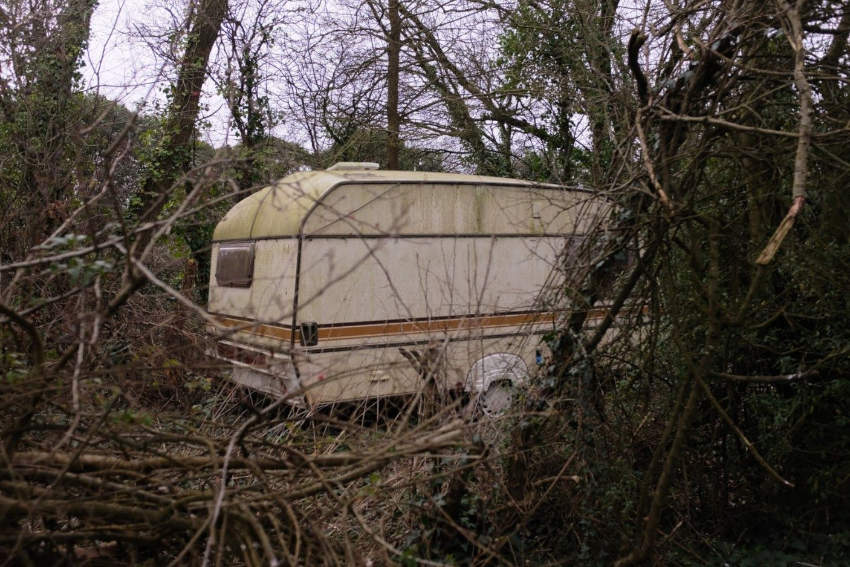
The specific trigger – the thing that put it on my to-write list – was a particular caravan in a particular field. It was overgrown, tangled among branches, and green with moss. And yet there were signs that someone was living in it.

(That’s it above.)

I stared at it for a long time, took a photograph or two. Then I thought about an uncle who died in a caravan in the corner of a field, and was discovered by my dad when he went round with his regular care package one weekend.

With a few wrong turns, that could have been Dad, too. Or me.

But, fretting about class, I tied myself in knots over this for a while.

Did I have the right to tell this story?

Was it inherently snobbish or sneering?

Eventually, I had a word with myself. Who else was going to write it if not me? And if I wrote it plainly, sincerely, honestly, I’d be using my small amount of privilege in a useful way.

Still, at first, I wanted to do what I usually do and hide behind the safety of a spooky story. An early draft ended, predictably, with more overtly supernatural events.

But, as with a story not in this collection, ‘The Architects’, I pulled back and let weirdness be a seasoning, rather than the sauce.

Writing it was an emotional experience. I had to stop several times, overcome with feeling, and even pushed to tears.

The feedback I’ve had since it was published at Minor Literatures suggests that people took the story as intended.

A drainage channel alongside a narrow country lane. There are reeds at its banks and algae on its surface. The landscape is flat.
The Mark Yeo at Rooksbridge in Somerset.

On ‘reens’

The word ‘reens’ crops up quite often in my stories. That’s because I grew up in Somerset which is sliced all across with reens, or rhynes.

They’re drainage ditches – a human intervention in the landscape.

One near my parents’ house, the Mark Yeo, was created in the 13th century.

I find them romantic and mysterious in a very specific, unromantic, un-mysterious way.

Sometimes, they look like shimmering, infinite mirrors running towards distant hills.

And at other times, they’re full of beer cans and algae.

A quote from John Grindrod: "Existing somewhere between Robert Aickman and J.G. Ballard, these blackly funny tales are sure to chill you, no matter how high you turn the central heating." Next to it is the cover of Intervals of Darkness with a black background and red details. The illustration is of a person casting a long shadow. Nearby is another shadow suggesting a lurking but hidden figure.

Intervals of Darkness will be published on 7 September. You can pre-order the eBook now.
Categories
books Intervals of Darkness

Story-by-story: Poor Ned’s Head

The story that opens Intervals of Darkness is an example of magically frictionless fiction.

I saw a call for submissions on the theme of ‘water’ and then, only a little while later, visited the wreck of the Mary Rose in Portsmouth.

Being me, I was drawn to the cabinets filled with skulls found aboard the wreck. What must it feel like to be killed in action, lie in the mud for several hundred years, and then be put on display?

The facial reconstructions added another layer of weirdness. In curatorial terms, this is good interpretation. It helps civilians like me understand the past more clearly, in human terms. But all those disclaimers, and the careful choice of language… Those reconstructions are just informed guesswork, really. And they always look a bit… wrong. Talk about the uncanny valley.

My other half says that she likes being with me when an idea for a story strikes me. She recalls it happening very obviously on this museum visit – “Must find notebook… Must write down… Haunted skull… Eye to eye with… Must find notebook…”

Then I did something at which I’m worryingly good: quickly absorbed a bunch of writing about ships, sailing, and archaeology, and synthesised it into some plausible bullshit. It wouldn’t fool anyone who knows a lot about those subjects (I suspect Steve Toase might fling the book into a fire) but it’s enough to sell the story to most readers, I think.

Having successfully begged for an extended submission deadline I hammered out a first draft of the story in a couple of hours. And not much changed in the rewrite.

Maybe that impassioned drafting gave it a boost. I don’t think it’s an exaggeration to say that Verity Holloway, editor of Cloister Fox magazine, snapped it up – and she’s told me again since what a great story she believes it to be.

This was also the story that signalled a slight change of direction from Municipal Gothic. Not every story I write has to be set in those working class environments where I feel most at home.

It’s also the first time I’ve written a story intended to evoke Nigel Kneale. I was thinking about his particular niche – that intersection of technology and the spirit world, as in The Stone Tape – and wondered if and how a computer-generated model might become possessed.

The first review, from Rowan Lee, mentioned Nigel Kneale, though not in connection with this story, so that thread obviously runs throughout the collection.

Blooper reel

  • In the original draft of the story I had my ship, Faerie, sailing from Falmouth to Portsmouth, but sinking in Mount’s Bay. Revising it for Intervals of Darkness I thought, hold on, that doesn’t make sense… So now, she was bound for Kinsale instead.
  • The first draft of the story had the eyes as being in the ‘stern’ of the skull but it got fixed in the edit. Look, I told you I was blagging this.
A quote from Verity Holloway: "Impressively eerie and packed with shocks... moments of powerful poignancy and startling strangeness. You'll want to linger over these stories." Next to it is the cover of Intervals of Darkness with a black background and red details. The illustration is of a person casting a long shadow. Nearby is another shadow suggesting a lurking but hidden figure.

Intervals of Darkness will be published on 7 September. You can pre-order the eBook now.