Categories
Film & TV

Another collection of vintage ghost stories for Christmas

If you’ve seen all of the BBC Ghost Stories for Christmas, and want more of the same, I’ve got good news for you.

Last year I put together a list of films, short films and TV episodes that seemed to me to capture something of the vibe of the Lawrence Gordon Clark era of BBC ghost stories for Christmas.

Since then, I’ve come across quite a few more examples.

I found them through:

  • my own nosing about on YouTube
  • social media posts and chats with people like Jamie Evans and Jon Dear
  • on blogs like A Year in the Country
  • mentioned in old film and TV guides actually printed in ink on yellowing paper
  • in the extra features on Blu-ray discs

Some of the qualities I’m drawn to are, in brief:

  • the textures of vintage media – film grain, video wobble
  • conciseness – under and hour is best
  • bleak, melancholy nostalgia
  • a vaguely literary sensibility

You can hear me talk more about this on the latest episode of Joe Tindall’s Cinéclub podcast, if you’re a podcast person.

Now, onto the list.

Shades of Darkness: Afterward, 1983

A misty, melancholy adaptation of an Edith Wharton story. The premise is fascinating – you won’t realise you’ve seen the ghost until long afterward, goes the legend – but unfortunately sets up a disappointing ending. Still, it is fascinating to watch a period ghost story with a female protagonist, from a story by a female author.

The Mind Beyond: Stones, 1976

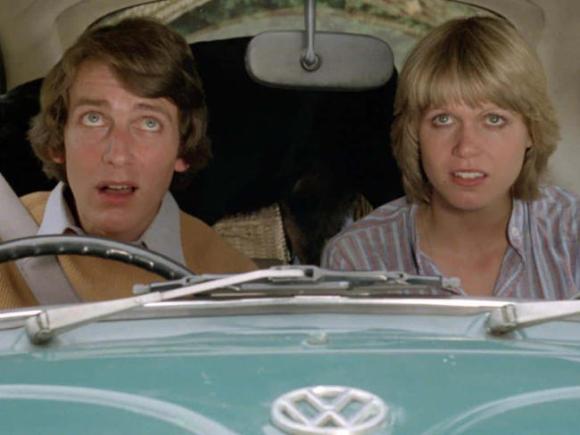
The Mind Beyond was a series of TV plays on supernatural themes produced by Irene Shubik for BBC 2’s Playhouse strand. They’re all interesting but this particular episode has stone circles, cursed tomes, and possessed children, putting it squarely in folk horror and hauntology territory. It has the usual pondering and bickering for the first 40 minutes or so and then accelerates towards a rather powerful ending.

A young man and a young man in turquoise Volkswagen are looking shocked at something.
The Lake

The Lake, 1978

The short film Lindsey C. Vickers made before The Appointment. It’s about a young couple who go out to the countryside to see a famous ‘murder house’ and then find themselves being stalked, or haunted, by a mysterious presence. It’s available on the first of the BFI’s Short Sharp Shocks collections (recommended) and also as an extra on their disc of The Appointment.

Andrina, 1981

This one’s a bit special: it’s a ‘lost’ Bill Forsyth film, made between Gregory’s Girl and Local Hero. It’s more melancholy and bittersweet than the BBC ghost stories but shares their stillness and reliance on rural landscapes to create a sense of lonely unease. It’s about a lonely old man in Orkney who is blessed to meet a young woman who takes charge of his life and cares for him. I’d never heard of it until ‘Afterglow’ posted about it turning up, surprisingly, on YouTube.

Night Terrors: The Hospice, 1987

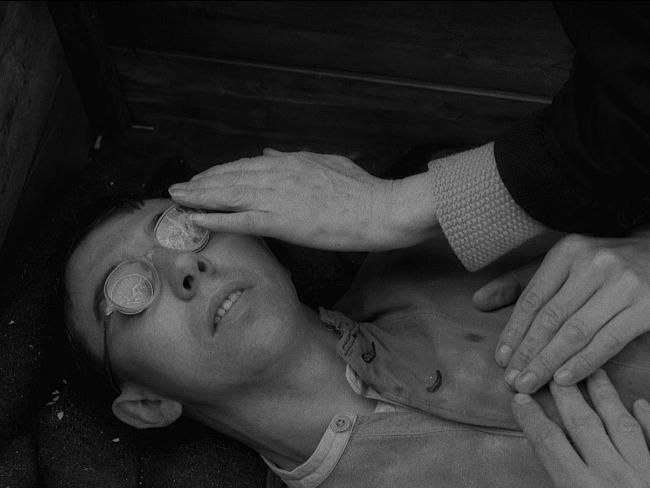
A 50-minute TV film that quite adequately interprets one of Robert Aickman’s best ‘strange stories’. It has to stretch the material a little, amping it up somewhat in the process, and the ending feels slightly less ambiguous than in the original text. But many of the key moments and images are there, and every bit as disturbing. Where the film benefits is in the performances by Jack Shepherd as Maybury, Alan Dobie as the sinister manager, and Jonathan Cecil as Maybury’s unsettling roommate Bannard. Cecil in particular seems to have been given the instruction I imagine actors love to hear: take it as far as you like, love; go as far over the top as you like. His chinless, rubbery British face, through a fish eye, looming too close to Maybury, and too close to us, is truly disturbing.

A young man with shattered spectacles lies on the ground while an old woman's hand reaches out for his face.
Loving Memory

Loving Memory, 1970

Tony Scott’s directorial debut. Country folk keep to themselves and follow their own laws. When Ambrose and his nameless sister kill a young cyclist they don’t only hit and run – they take the corpse with them and make it part of the family. All three performances are excellent although it’s David Pugh as a blankly staring cadaver, surrounded by buzzing flies, who perhaps has the greatest challenge. It’s available on a BFI disc along with his brother Ridley Scott’s first short film. You can also rent it online via the BFI.

Haunted: The Ferryman, 1974

A one-hour TV film based on a story by Kingsley Amis and starring Jeremy Brett. A writer (an avatar of Amis himself) achieves great success with a novel about a haunted pub. Then, resenting the attention that comes with success, he runs away for a weekend in the country with his wife. They’re not quite happy, perhaps because his ego takes up too much space in the relationship, and there’s tension around their lack of children. They end up in a pub that has almost the same name as the one in his book. The manager has almost the same name as his pub manager. The barman has almost the same name as his barman. Has he been here before, or is there a crack in reality? It’s got that pleasing mix of stillness and shock that marks so many supernatural British TV productions of this era and Brett is magnetic, if unsubtle, in the lead role.

A man hangs from a gibbet on a moor.
The Pledge

The Pledge, 1981

A macabre short by Digby Rumsey which marries shots of desolate moorland with close ups of maggots wriggling in the mouth of a corpse dangling from a gibbet. It’s not about the living dead but the dead dead – and what happens after death. It’s given an enormous lift by a propulsive theme tune by Michael Nyman. It’s an extra on the BFI disc of Schalcken the Painter and is also available on BFI Player.

I don’t know if I’ll have enough for another list next year but do feel free to make suggestions. I know about The Stone Tape and Schalcken the Painter, though.

Categories
Fiction

FICTION: The Short Stay

All they want to do is get out of their wet clothes but the key doesn’t work. As Hannah struggles, Joe stands behind her sniffing the warm, musty air of the corridor.

‘Stinks of mice.’

Hannah tries pulling the key out a little as she turns it. She tries pulling up on the door handle. She tries pushing the key harder into the door.

‘Let me try,’ says Joe.

He pushes her aside, reaches for the key, and turns it without the slightest trouble.

‘Easy, see?’

The flat is smaller than it looked in the photographs on the booking website. The laminate flooring is scuffed and there is a vegetal smell.

Joe lugs his bag into the bedroom leaving Hannah to carry her own.

‘Fucking rail replacement fucking buses,’ says Joe, more to himself than to her. ‘“Let’s spend Christmas somewhere different,” she says. Oh, yeah, nice one. I don’t know why we ever bother going anywhere with the state of the trains in this country.’

‘Never mind,’ says Hannah. ‘We’ll have an early night tonight and explore the city properly tomorrow.’

Joe hangs his sodden black trenchcoat over the back of a chair and pulls his wet shirt away from his bony torso. Looking around he puffs out, despairing and disbelieving.

‘Merry Christmas to us, and happy anniversary.’

‘This is just a base, though, isn’t it?’ says Hannah, her voice beginning to crack.

‘You’d better change,’ he replies. ‘You look like a drowned cat.’

Hannah pushes a snake of dyed black hair behind her ear, her bangles rattling, and slides her glasses up her nose.

Joe won’t look at her. As he heads to the bathroom with their shared toiletry bag he slides past without making contact.

Alone, Hannah listens to the room for a moment. It has no sound at all. It’s too small and too full of furniture to reverberate. She wonders how many flats they managed to squeeze into the former warehouse when they converted it. Too many, anyway.

She hears the sounds of Joe using the toilet, the flush, the shower. Bathroom smells, shit and lime-scented gel, fill the small flat.

She removes her dripping dress and stands in her underwear, shivering and goose-bumped, while she unpacks her bag. She puts on pyjama bottoms and an oversized t-shirt and heads to the combined sitting room and dining area.

There are two windows looking out over an office block. Only a few lights are on – a meeting room on the first floor, an office on the sixth – so the wall of glass forms a blank, black mirror. She moves and spots her own reflection, sees herself doubled, distorted, reflected, shadowed. The flat’s windows open a few inches, not enough to jump from, but enough to let in frosty air and sounds from the street below: a whisper, a shrieking laugh, and the crunch of broken glass.

Joe emerges from the bathroom wrapped in a towel. His fine white hair is plastered to his head and his body looks thinner and paler than ever.

‘All yours,’ he says and disappears into the bedroom.

Hannah goes into the bathroom and locks the door. She can’t use the toilet because it’s not private enough for her to relax, but she sits on the seat for a while. There’s no window, only an extractor fan that hums at an irritating frequency. After a while she gives up and gets up to wash. Before she picks up the soap, she removes her wedding ring. It’s a struggle to get it over the knuckle, over the swell of flesh it pushes before it, but sheer force does the job. She places the ring carefully on the glass shelf above the sink. The metal clicks into place as if magnetised. Hannah washes her hands, neck and face, then dries herself with the only other towel in the flat. She flosses, cleans her teeth, and ties her hair up with an elasticated band.

When she reaches for the wedding ring, it is gone.

Her fingers crab and scrape around. She inspects the full length of the glass shelf. She drops to her knees and looks beneath the sink, finding only a tangle of cobwebs and hair. She looks under the bath and behind the toilet. She checks the plughole. No, it couldn’t have fallen down there, the strainer would have caught it. She pats the pockets of her pyjama bottoms. Finally, she looks into the toilet bowl where perhaps, she thinks, it might have rolled, which would be just her luck. Nothing.

‘What are you doing in there? Come to bed so I can turn the light off.’

Hannah feels a flutter in her heart.

She opens the door and, hesitating, steps across the hall to the bedroom.

He is already curled up beneath the duvet, his head almost buried.

‘I’ve lost my wedding ring,’ she says in a weak voice.

Joe emerges and peers at her, blinking and small-eyed.

‘What? When?’

‘Just now. Freshening up.’

He groans.

‘It can’t have gone far. We’ll find it in the morning. I’ll find it.’

She climbs into bed and reaches out for Joe.

‘Christ, you’re cold,’ he says, when her hand brushes his back.

He turns off the bedside lamp.

Exhausted but awake, Hannah lies and listens. Apart from Joe’s soft snoring, there is something else in the silence – the non-sound of someone holding their breath and holding still.

The morning is bright and Joe’s mood has improved a little. He even makes the coffee, bringing two cups into the bedroom.

‘Four sachets they’ve given us, and four little pots of fake milk. Stingy bastards.’

Hannah draws her knees up beneath the duvet and hugs them with one curled arm, the other lifting the steaming coffee cup to her mouth at intervals. Joe stares at his phone which, perhaps subconsciously, he angles so that Hannah can’t see the screen.

‘Can you have a look for my ring?’ she asks.

‘What? Oh, yeah, sure. In a minute.’

After a second or two he looks up from his screen and turns to her.

‘Why do you take your wedding ring off at all?’

‘It’s more hygienic,’ she says. ‘I don’t want it to get dirty under there.’

‘Yeah, but if you leave it on you’re putting it in hot soapy water. So it gets cleaned. It’s probably more hygienic that way, if anything.’

He turns back to his phone, chews his thumbnail to tidy the edges.

‘It’s supposed to symbolise eternity, isn’t it?’ he mutters. ‘Commitment. I never take mine off.’

‘What I don’t understand is how I lost it. It definitely didn’t roll and there’s nowhere for it to go.’

Joe puts his phone on the bedside table and limps into the bathroom groaning. She watches as he inspects the shelf, the sink, the floor, the plughole.

‘Probably got taken by the house elves,’ he says as he comes back to the bedroom. ‘Try asking for it back.’

‘How does that work?’

Stretching a t-shirt over his head and angular arms Joe says, muffled: ‘Hey, house elves – may I please have my wedding ring back? Like that.’

Hannah mutters the request under her breath. It doesn’t work, at least not immediately.

Joe spends another ten minutes investigating the bathroom before they go out and emerges with a shrug.

‘Sometimes there are gaps around the pipework but everything is sealed tight in there. I don’t know how you do it, I really don’t.’

Over an expensive breakfast at a cafe with oatmeal coloured walls and smashed avocado on sourdough toast Hannah says:

‘Let’s just forget about the ring and try to have a nice Christmas anyway. Just the two of us, somewhere new. We need to decorate the flat a bit. Brighten it up. And get some treats in.’

‘Beer. Wine. Gin.’

They spend the morning of the day before Christmas Eve shopping, buying a tiny tree with twinkling fibre-optic lights, a plastic wreath, and a candle that’s supposed to smell of fir trees. Joe lugs two heavy bags back from the supermarket and opens his first can of beer at exactly midday as he flips through channels on the TV.

As she lays out slices of ham, cheese and salami on a plate, and cuts a supermarket baguette into small rounds, Hannah looks at her hands. They look different without the ring, obviously, but do they look better?

‘We should go to the pub or something,’ says Joe after lunch, two cans of beer down. ‘While there’s still, like, an hour of daylight.’

They wrap up in coats, scarves, and hats and head out into the city. There are Christmas lights up in the centre and a busker is playing ‘Jingle Bells’ on an accordion. Hannah leads them to the cathedral which they circle, but Joe doesn’t want to go inside. The light begins to die and the grey sky turns flat, first, then begins to shade to blue. They drift back to the shopping precinct and its bright lights.

‘That place looks cosy,’ says Joe, spotting a half-timbered pub called Ye Olde Bear. He heads through the door and Hannah follows. It’s crowded and hot with half the customers in novelty Christmas jumpers. Joe pushes his way to the bar and raises a hand to get the attention of the barman. His wedding ring, a thick, plain band, glints amid the fairy lights. He orders Hannah’s usual half of lager and a pint of cider for himself.

Because it’s Christmas, when the usual rules don’t apply, they both drink too much. Hannah’s usual limit is three pints but she ends up drinking five. Dinner is two cheese rolls and a packet of crisps. Joe is on eight pints when he decides to switch to single malt whisky, because it’s Christmas, and Hannah agrees to have one, too, because it’s Christmas, and suddenly, it’s nearly midnight and the pub is closing around them.

They go from giggling arm-in-arm to arguing in no time at all. They both need the toilet but Joe insists on pissing behind a wheelie bin, prolonging her discomfort. He wants to find a kebab shop. She begins to cry, for no particular reason, just everything, and he raises his voice without meaning to.

‘Go back to the flat, then! Take the key! I’ll see you there when I’ve had my chicken doner.’

‘You want me to walk back on my own, in the dark, in a strange city?’

‘Fuck sake… Come with me, then!’

‘I really need a wee.’

He shoves the keyring into her hands.

‘I’ll see you there in, like, fifteen minutes.’

Hannah watches him stagger away and wonders what it is she feels, other than heartburn from the whisky and a pressing pain in her bladder.

The next morning, Christmas Eve, she wakes with a head that feels like concrete and a papery mouth. Joe is not with her. She croaks his name then checks her phone. There are several missed calls and messages from Joe, each more desperate than the last. She must have fallen asleep, or passed out, leaving him stuck in the street outside all night. The last message reads:

‘Will sleep in park. Fuck you.’

Dressing hurriedly, wanting to vomit, she rushes out and downstairs, trying to work out which park he might have meant. She calls him and listens to his phone ring as she walks over frosty cobbles. He doesn’t answer.

The nearest park is by the riverside. She makes a complete circuit, checking each bench and shelter, looking at the single-person tents concealed in the hedgerows and copses. She shouts his name, screams it, constantly redialling his number.

‘What if he comes back to the flat and I’m not there?’ she thinks after a while. She returns to wait for him.

Wide awake now, shaking with cold and adrenalin, she sits down in the kitchen. She closes her eyes, breathes out, breathes in, breathes out, breathes in, but calm never comes.

Her eyes pop open when something slams into the tabletop.

There in front of her something is spinning and shining. She is mesmerised. It slows to a teeter and then falls flat on its side. Her wedding ring. 

She sees the second ring fall, seeming to appear from somewhere just above her head, before it hits the table with force. It is thicker and heavier and begins to roll. To stop it reaching the table’s edge she reaches out and slaps it flat.

It feels hot.

She looks at her palm.

A perfect red circle has been burned into the skin.


Image based on a photograph by Luwadlin Bosman at unsplash.com

Categories
Film & TV

The infinite supply of BBC ghost stories for Christmas

There are only eight episodes of the BBC Ghost Story for Christmas, produced between 1971 and 1978. That’s not enough. Here are some suggestions for where to go next.

First, let’s address a technicality: the 1968 adaptation of M.R. James’s ‘Oh, Whistle, and I’ll Come to You, My Lad’ directed by Jonathan Miller was a standalone film in the Omnibus strand.

It inspired A Ghost Story for Christmas and is often spoken about as part of that strand. In the unlikely event you haven’t seen it – start there!

Seven of the eight core episodes were directed by Lawrence Gordon Clark. He wrote the first two before handing over that duty to people like John Bowen and David Rudkin.

The final episode of that original run, ‘The Ice House’, from 1978, was written by Bowen and directed by Derek Lister.

The short films and television episodes listed below aren’t all ghost stories. And they weren’t all produced by the BBC.

Some are lighter, some are darker. Some are quite cinematic, others distinctly low-budget studio productions.

I’ve chosen them because they trigger in me something of the same feeling I get from, say, ‘Lost Hearts’, an M.R. James adaptation with a period setting, or from ‘Stigma’, which has an original story and a contemporary setting.

If I’ve omitted a film you like, it might be because I don’t know about it – do leave suggestions in the comments. But it’s probably more likely at this point that I do know about it but decided it didn’t fit.

‘The Beast’ from the 1982 West Country Tales series, for example, doesn’t feel to me like the same thing at all, enjoyable as it is.

1. Dead of Night: The Exorcism, 1972

Written and directed by Don Taylor this episode of the anthology series Dead of Night works as both (a) a terrifying ghost story and (b) a commentary on class. It has a group of well-to-do friends gathering for Christmas in an old working man’s cottage which one couple has bought and renovated. The title hints at a twist.

BFI DVD (out of print) | YouTube

2. Dead of Night: A Woman Sobbing, 1972

Another story from the same anthology series which combines social commentary with effective, shiver-inducing horror. John Bowen’s script is about unhappy marriages, the sidelining of middle-aged women, and menopausal depression. Anna Massey is a brilliant actress and there’s less scenery chewing than in some TV plays of the period. And the sobbing woman, symbolic as she may be, is as creepy as hell.

BFI DVD (out of print) | YouTube

3. Wessex Tales: The Withered Arm

Adapted from a Thomas Hardy story this has the perfect mix of bleak landscapes, horrifying moments, and stillness. It’s got a distinct folk horror feel, too.

BBC iPlayer

4. Beasts: Baby, 1976

The whole of this series written by Nigel Kneale is interesting, and very much worth watching. But this is the episode which feels, to me, closest in tone to the work of Lawrence Gordon Clark and his collaborators. It’s about a haunted house, essentially, with Jane Wymark as a pregnant woman and Simon MacCorkindale as her VERY SHOUTY husband. They find a mummified animal in the walls of their cottage and (probably) supernatural occurrences ensue.

Network DVD (out of print, eBay) | YouTube

5. Mr. Humphreys and his Inheritance, 1976

A 1970s M.R. James adaptation ought to hit all the right notes but this very short adaptation of a lesser-known James story is flawed and slight. It was made by Yorkshire Television as an educational piece to demonstrate the power of music in film which means it has intrusive music throughout. The pay-off is worth 15 minutes of anyone’s time, though – one of those psychedelic, nightmare images that works so well on grainy 16mm film.

YouTube

6. A Child’s Voice, 1978

This is often described online as a BBC production, presumably as a bit of search engine optimisation clickbaitery. Not only is it not a BBC production – it is not even British. It was produced by the Irish company B.A.C. Films and filmed, I believe, in Dublin, with an Irish director, Kieran Hickey, and Irish crew. The script is by a Brit, though – film critic David Thomson. It stars T.P. McKenna as a writer who has a cult following reading his own ghost stories on the radio late at night. Then a character from one of those stories begins to call him on the telephone…

YouTube

7. Tarry-Dan Tarry-Dan Scarey Old Spooky Man, 1978

A recent discovery for me, this BBC production was written by Peter McDougall and directed by John Reardon. It’s set and was shot in Cornwall and tells the story of a troubled young man who becomes obsessed with a local tramp, and has nightmares about the stained glass in a local church. It’s Penda’s Fen adjacent but with a grittier, tougher feel, as Kim Newman has written about on his blog

YouTube

8. Casting the Runes, 1979

This is a big one being an M.R. James adaptation directed by Lawrence Gordon Clark, but for ITV (Yorkshire Television) rather than the BBC. It updates the story to 1970s Leeds and makes great use of bleak, snowy locations. It also makes the protagonist a woman (Jan Francis) and has her working in TV journalism, instead of academia. It’s atmospheric and unsettling but, like the original story, also has an element of suspense and adventure.

Network DVD (out of print, eBay) | YouTube

9. Ghost in the Water, 1982

This was made for children and it shows, being more Grange Hill than Lawrence Gordon Clark. It’s about working class children investigating a haunting in the industrial landscape of the English Midlands – all canals, comprehensive schools and council estates. The lead actors are amateurs and their performances sit somewhere between monotonous and annoying. But, still, that arguably adds to the unusual feel of the piece. It was directed by Renny Rye and based on a story by Edward Chitham.

BBC DVD (Google it) | YouTube

10. Classic Ghost Stories: Wailing Well, 1986

This series of five 15-minute Jackanory-style readings of M.R. James stories by Robert Powell is more effective than you might expect. They’re all good but I’ve singled out this one as a story that hasn’t, as far as I know, been adapted elsewhere. They were offered as extras on my BFI DVD set of the BBC Christmas ghost stories and are also available as a standalone disc.

BFI DVD | YouTube

11. The Woman in Black, 1989

I hesitate to mention this as it’s so well known, and feature length. But the mood and feel is so close to the work of Lawrence Gordon Clark that I can’t exclude it from the list. It was also hard to see for a long time, until the defunct label Network released a Blu-ray in 2020. It was adapted for ITV by Nigel Kneale from Susan Hill’s 1983 novel and was filmed partly on location at Osea in Essex. It’s fantastically moody and also has one legendary jump scare that still works even when you know it’s coming.

Network Blu-ray (Google it) | Amazon Prime streaming

12. Ghosts: Three Miles Up, 1995

An adaptation of Elizabeth Jane Howard’s classic of weird fiction made for a short-lived BBC anthology series. It takes some liberties with the original story but catches some of the mood – and also borrows from Lawrence Gordon Clark that love of desolate but beautiful English landscapes. It’s about two brothers who try to fix their relationship by going on a canal boat holiday together. It’s already going badly when they pick up a strange girl and things get really strange.

YouTube

Categories
Fiction

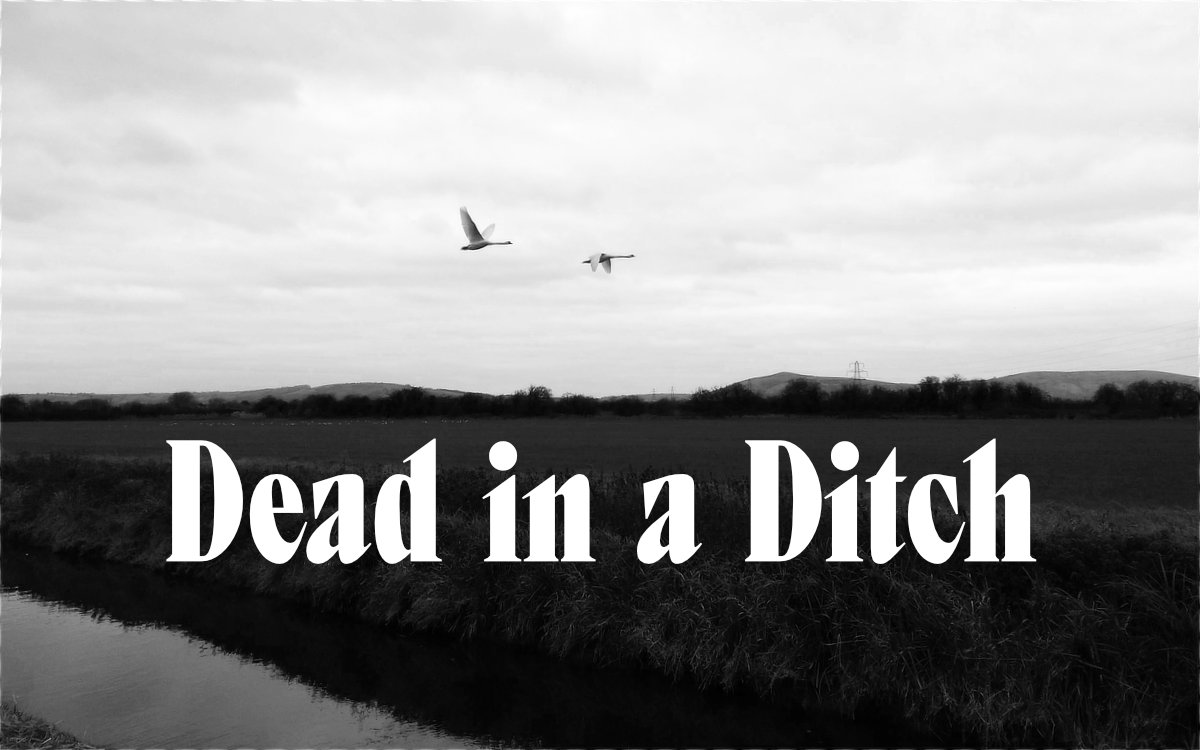
FICTION: Dead in a ditch

Where is the worst place you could end up haunting? I reckon my spots a contender. It was bad from day one, standing knee deep in the green water of a ditch, looking down on my own smashed body in the half-submerged hatchback.

Then it took them three months to find me, even right there by the main road between town and the village, because the reeds were high. I watched my body bloat and fart bog gas and liquify. I watched rats and insects help themselves to my flesh. I saw my bones emerge like the wreckage of a ship on the shoreline with the tide sliding out.

I tried not to look. I took an interest in the clouds in the big sky above the levels, and in the trees as they began to yellow at the edges and drop their leaves. I watched sunrises, sunsets, and stared at the stars – I could see them so clearly out there in total darkness. I counted cars, too, as they flew by. You’re going too fast, I thought, and remembered that people kept saying that to me, too.

Then, when the trees were bare with black branches, a car passed slowly enough that a child in the back seat saw the low sun catch the roof of the wreck. The car stopped at a layby a little way along the road into town. I could hear the burr of its engine and the tick of its hazard lights above the breath of the westerly wind. The police car came a little later and the road was closed. Then an ambulance. Then, just after dark, a forensics team with floodlights and tents. Finally, a pickup truck from a garage in town arrived and, by dawn, the car was gone, and it was just me and the dirty water around my jeans.

Mum and Dad came, parking at the roadside. Cars kept passing at twenty above the limit, one or two honking their horns in irritation at the blockage in the road. My parents couldn’t see or hear me as I murmured to them: ‘It’s alright, don’t miss me, don’t feel pain for me…’ Before they departed they left a stuffed monkey, a bunch of flowers in a heavy stone pot, and a card I couldn’t read. In the weeks that followed I watched the card blow away in the wash from an articulated lorry, the monkey turn ragged and grow green mould, and the flowers rot to black stalks. I didn’t see Mum and Dad again. I suppose they drove the long way round to town after that, so as not to have to think about me.

After a long while I got tuned into the other dead around and about. There was a pale smudge in the field opposite that I thought must once have been a woman. She seemed young and was always stooped, always weeping. The sound sometimes carried on the wind. She might have been there since the Civil War, or long before. One night in June I watched a Douglas C-47 with black and white invasion stripes on its tail pass silently overhead and fade out of existence somewhere over the old airfield. I learned that the famous Headless Horseman was real, too, though less glamorous than in the stories they told around town. He passed by, once a month or so, and was a nasty old thing. He had a dirty tunic streaked with brown blood and his head was in his lap, crushed and misshapen, but still screaming. He was always in a hurry to be somewhere. On summer evenings, if there wasn’t too much traffic, and the wind was right, I could hear the sounds of the battle of 1685 being replayed on the field outside the village. The teachers from the village school used to take us there to camp out, and tell us ghost stories as we toasted bread over a fire.

Years must have passed before I saw Dani again. I’d dropped her off in town before making that last journey and I suppose she had no reason to come to the village after I’d gone. Then one day, there she was, in the driver’s seat of her own hatchback, framed in the open window. She was a little older but no less beautiful. After the car had passed I realised there was also someone in the passenger seat. An hour later, she drove back and I saw her for another two seconds, a face in shadow, her hands on the wheel. I also saw that the man sitting next to her had a broad chest and tidy beard.

I’d always wondered how eternity would work. Wouldn’t you get bored? In life, I could hardly sit still, and was always after a distraction or a thrill. That’s probably why I drove so fast all the time, to feel not-boredom for a few minutes. But boredom, it turns out, is only a problem for the living. It comes out of being anxious the whole time about your status and how much you’ve achieved. It does us all right in the survival game. It keeps us moving and exploring. In death, though, you let time wash over you in an endless stream. I wasn’t waiting. I didn’t expect anything, or hope for anything. I just was, and just am.

If there was anything I longed for, and longing’s too strong a word, it was to see Dani again. When I died, the wires that connected me to the world were cut, but the cut wasn’t clean. An intermittent contact made me feel something, or remember how it felt to feel something, or something like that.

She passed along the road many times after that. Alone in the car; with the man; following a removal van; dressed for work in her supermarket uniform; dressed for a Christmas party in a sparkling silver dress, with the man in a shimmering suit; and in a wedding dress in a vintage car with ribbons tied to its radiator. Their car got bigger, the backseat gained a baby seat, then a baby, then two babies. They drove too fast, of course, because everyone did. The car hugged the bend, lifted a little one one side, always ready to tip.

Through cycles of sun and moon, summer and winter, flood and drought, I stood there with water boatmen skidding around my knees, and rats circling. The creatures knew I was there, somehow, in some simple way, because they never touched me, or went through me, or whatever would have happened.

There was no way for me to make any difference in the world, I knew that for sure. Still, I always wanted Dani’s car to break down as it passed me, so I thought hard about it, and one day, it did. I felt as if I’d made it happen. The engine cut out and she began to drift. She guided it into the verge and put on the hazard lights. Then she got out and walked along the road directly in front of me.

Her fine blonde hair had just begun to turn grey and there were new folds and grooves around her eyes. Speaking into her phone she said:

‘About halfway, yes, just past Crockford Farm.’

It was the first time I’d heard her voice in all these years and I experienced something like a memory of how it felt to yearn for someone. I remembered, for a sliver of a moment, how a sweet harvest apple tasted and what it meant to smell the sea.

While she waited for the mechanics to come, she leaned on a gate and, resting her chin on her arms, looked out over a field of yellow rapeseed.

Did she remember this was where it had happened? Did she ever know?

The recovery vehicle came, its orange lights throwing twists of fire on the surface of the filthy ditchwater. Within a few minutes the engine of her car was turning over. She put the radio on and I heard two bars of a song I didn’t know before she waved to the mechanic and sped off.

Over the years, Dani kept passing, back and forth, like an irregular pendulum, village to town, town to village. The car changed, and she changed, but I didn’t.

Her children got their own cars, which they drove much too fast, and I wondered if she ever used my story as a warning.

One day, after I suppose decades must have gone by, Dani appeared dressed in black in the back of a limousine, following a hearse.

A few years after that, the hearse passed again, and this time Dani’s children were in the black car that followed.

That night, the Headless Horseman passed, screaming mad, as usual. I screamed back.


The cover of Intervals of Darkness with quotes from John Grindrod and Rowan Lee.

If you enjoyed this story you’ll probably also enjoy my collections Intervals of Darkness (2024) and Municipal Gothic (2022).

Categories
Intervals of Darkness

Story-by-story: Competing Theories With Regard to the Origins of the Ghost of Totterdown Lock

I wrote the first words of this unusually structured story, about the ghost, or ghosts, haunting a canal lock, in about 2017. I finished it in 2023.

Those first lines weren’t written to be part of a story. They were the snippet of poetry which opens it and which were inspired by – that is, ripped off from – Wilfred Owen’s ‘Shadwell Stair’:

I am the ghost of Shadwell Stair.
       Along the wharves by the water-house,
       And through the cavernous slaughter-house,
I am the shadow that walks there.

I came back to the lines I’d written, about Bristol’s evocatively-named Floating Harbour and Underfall, when I became obsessed with Totterdown Lock.

I walk or run past Totterdown Lock almost every day but didn’t notice it until I read something about it being filled in during World War II. You can see it here on a historic map.

This got me thinking about how the landscape of St Philips Marsh has changed over the years with successive waves of industrialisation.

Entire communities, like St Silas, have come and gone. Everywhere there are traces of old structures, old waterways, old street patterns.

I also wanted to capture something of the garbled nature of local ghost stories. “What I heard was…” and “The story I was always told is…” I don’t use Facebook much but I am a member of a couple of local history groups where this kind of half-remembered tale is often told.

Really, this was a way for me to tell a lot of small ghost stories, overlapping and contradicting each other, in a range of voices. A little like ‘Ten Empty Rooms’ in my last collection, Municipal Gothic.

The story was originally published, if that’s not too grand a word, in a homemade ‘zine of which I printed precisely 20 copies.

I gave those away to anyone who was interested. Just because I wanted to make something complete and whole, purely for the sake of making it.

What’s your personal ghost story?

One of my favourite conversational games is to ask people: “Have you got a ghost story?” Almost everybody does, it turns out.

The closest I’ve got isn’t from Totterdown Lock or the Feeder Canal but from the road that runs parallel, one block over.

Walking along Silverthorne Lane one damp, blustery evening, alone and surrounded by derelict industrial buildings, I distinctly felt the firm prod of a finger in the small of my back.

I span around, ready to defend myself from a mugger or weirdo. But, of course, there was nobody there.

I’ve thought about this a lot since it happened. Of course the setting might have had something to do with it – the shadows, the ruins.

Perhaps what I felt was a piece of litter blown into me by the gale.

Or maybe it was just a muscle spasm.

So… what’s your personal ghost story?

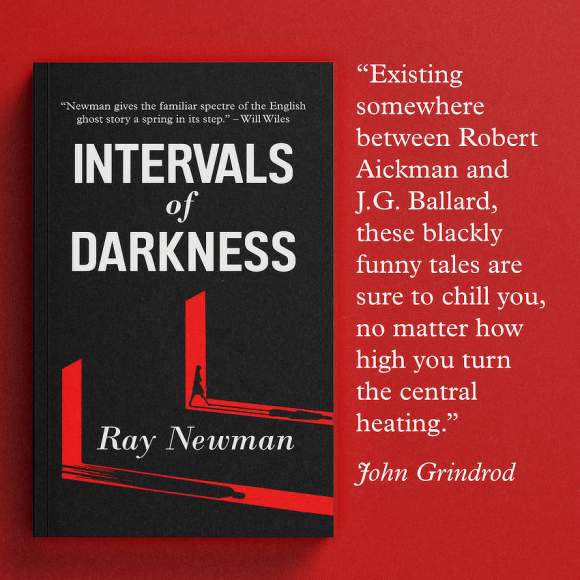
A quote from John Grindrod: "Existing somewhere between Robert Aickman and J.G. Ballard, these blackly funny tales are sure to chill you, no matter how high you turn the central heating." Next to it is the cover of Intervals of Darkness with an illustration of someone being stalked through a dark chamber pierced by shafts of light.

Intervals of Darkness will be published as a paperback and eBook on 7 September. You can pre-order the eBook now.

Categories
books Intervals of Darkness

Story-by-story: Second Homes

I lived in Penzance in Cornwall for six years, including several stormy, boarded-up off-seasons. This story is about how that felt – and about the distinctly haunted landscape.

I used to observe the coming and going of people throughout the year, and the rhythms of the tourist industry. Repainting and repointing in the run up to Easter. And the general air of exhaustion in early autumn.

I was especially struck by how silent Mousehole seemed in the gaps between holidays, when the second homes and rental properties were empty.

(See also: Bait, dir. Mark Jenkin, 2019.)

On Scilly, in Marazion, and in various other places, I’d pick up interesting details about how things worked – like the chip shop owners who shut for the winter and disappeared to Florida.

Another influence, though not directly referenced, was the Solomon Browne disaster of 1981. When the Penlee lifeboat went out in a storm to save crew and passengers aboard the MV Union Star. Sixteen people died including eight lifeboatmen from Mousehole.

This tragedy suffused the village and the area. The old lifeboat house was a permanent memorial on the coast path and The Ship Inn has a plaque and photographs of the lifeboat crew. Children and relatives of crew members still live in the area.

This sadness offers a strange contrast to the Instagram-friendly lifestyles of people from ‘up country’ who only come down when there’s a reasonable chance the sun will be out.

I can’t claim to have totally sussed Cornwall in six years. I doubt you could do that in four centuries. But I learned enough to tell this small story.

A note on ‘granfer’

A couple of stories in this collection use the West Country word ‘granfer’ – that is, grandfather.

I’ve heard it used naturally and without affectation in both Cornwall and Bristol, hundreds of miles apart.

I like it because it adds a bit of regional texture without doing the impenetrable Jarge Balsh thing.

In another story, however, I have ‘gramps’. One reason for that is that, as a kid in Somerset, I heard it used quite frequently – but never ‘granfer’.

The other quite weird reason for ‘gramps’ over ‘granfer’ I’ll reveal in a later post in this series.

A quote from Verity Holloway: "Impressively eerie and packed with shocks... moments of powerful poignancy and startling strangeness. You'll want to linger over these stories." Next to it is the cover of Intervals of Darkness with a black background and red details. The illustration is of a person casting a long shadow. Nearby is another shadow suggesting a lurking but hidden figure.

Intervals of Darkness will be published on 7 September. You can pre-order the eBook now.

Categories
books Intervals of Darkness

Story-by-story: British Chemicals

The third story in Intervals of Darkness draws on research I did for an article published in Fortean Times a few years ago about a haunted factory.

My dad worked at the factory in question and we often talked about what might have made it feel spooky.

Point: the land was ancient, with old ghosts.

Counterpoint: everyone was exhausted and off their tits on chemical fumes.

This story, which Rowan Lee has suggested recalls the work of Nigel Kneale, is an attempt to explore that line between rational explanation and genuine supernatural experiences.

I also had in mind Danny Robins’s radio and TV series Uncanny which, especially in more recent episodes, has included ‘cases’ which seem less than convincing.

I asked myself in what context an account of a haunting might seem truly beyond doubt.

Perhaps being shared in private, behind closed doors, by someone who definitely isn’t seeking attention – and who has a strong commercial incentive not to have seen a ghost – might be convincing.

Working on this story on and off for the past couple of years I quizzed Dad to harvest convincing details.

Those were added to the stories I’ve been hearing for years about life working at British Cellophane, and other factories.

I also drew on my own teenage experiences of factory work, including the time I accidentally got high on solvents while cleaning a protective suit and floated across the shop floor giggling, unable to feel my legs.

Hints of worldbuilding?

The story takes place in a post-war new town called Newhamstead. That name also crops up 

in another quite different story in Intervals of Darkness, ‘The Night of the Fox’.

I’ve always loved the way H.P. Lovecraft and his literary circle casually reused the names of places, characters, forbidden tomes, and monstrous entities.

That there’s no particular coherence in the way they are applied (despite later attempts by nerds to tidy things up) only adds to the sense of intrigue.

See also: those throwaway references in Star Wars to the Kessel Run and the Clone Wars.

So, I don’t know if the Newhamstead in these stories is the same place, exactly, or if this will one day add up to a ‘cycle’, but I couldn’t resist the deliberate internal reference.

A quote from Rowan Lee: "Newman returns to haunted Britain with fourteen more wonderful stories... Fans of folk horror and weird fiction find a lot to love..." Next to it is the cover of Intervals of Darkness with a black background an illustration, in red, of a person casting a long shadow as they emerge from a doorway. Another shadow is nearby, implying the presence of a second, unseen person.

Intervals of Darkness will be published on 7 September. You can pre-order the eBook now.

Categories
books Intervals of Darkness

Story-by-story: Poor Ned’s Head

The story that opens Intervals of Darkness is an example of magically frictionless fiction.

I saw a call for submissions on the theme of ‘water’ and then, only a little while later, visited the wreck of the Mary Rose in Portsmouth.

Being me, I was drawn to the cabinets filled with skulls found aboard the wreck. What must it feel like to be killed in action, lie in the mud for several hundred years, and then be put on display?

The facial reconstructions added another layer of weirdness. In curatorial terms, this is good interpretation. It helps civilians like me understand the past more clearly, in human terms. But all those disclaimers, and the careful choice of language… Those reconstructions are just informed guesswork, really. And they always look a bit… wrong. Talk about the uncanny valley.

My other half says that she likes being with me when an idea for a story strikes me. She recalls it happening very obviously on this museum visit – “Must find notebook… Must write down… Haunted skull… Eye to eye with… Must find notebook…”

Then I did something at which I’m worryingly good: quickly absorbed a bunch of writing about ships, sailing, and archaeology, and synthesised it into some plausible bullshit. It wouldn’t fool anyone who knows a lot about those subjects (I suspect Steve Toase might fling the book into a fire) but it’s enough to sell the story to most readers, I think.

Having successfully begged for an extended submission deadline I hammered out a first draft of the story in a couple of hours. And not much changed in the rewrite.

Maybe that impassioned drafting gave it a boost. I don’t think it’s an exaggeration to say that Verity Holloway, editor of Cloister Fox magazine, snapped it up – and she’s told me again since what a great story she believes it to be.

This was also the story that signalled a slight change of direction from Municipal Gothic. Not every story I write has to be set in those working class environments where I feel most at home.

It’s also the first time I’ve written a story intended to evoke Nigel Kneale. I was thinking about his particular niche – that intersection of technology and the spirit world, as in The Stone Tape – and wondered if and how a computer-generated model might become possessed.

The first review, from Rowan Lee, mentioned Nigel Kneale, though not in connection with this story, so that thread obviously runs throughout the collection.

Blooper reel

  • In the original draft of the story I had my ship, Faerie, sailing from Falmouth to Portsmouth, but sinking in Mount’s Bay. Revising it for Intervals of Darkness I thought, hold on, that doesn’t make sense… So now, she was bound for Kinsale instead.
  • The first draft of the story had the eyes as being in the ‘stern’ of the skull but it got fixed in the edit. Look, I told you I was blagging this.
A quote from Verity Holloway: "Impressively eerie and packed with shocks... moments of powerful poignancy and startling strangeness. You'll want to linger over these stories." Next to it is the cover of Intervals of Darkness with a black background and red details. The illustration is of a person casting a long shadow. Nearby is another shadow suggesting a lurking but hidden figure.

Intervals of Darkness will be published on 7 September. You can pre-order the eBook now.

Categories
books

Spooky stories to read in 2023

One of my resolutions for 2023 is to read at least one short story every day. Totally achievable, right?

Yes, definitely, especially if this replaces endlessly scrolling social media, hoping something might happen.

But I do like social media, especially when it’s helping me find good stuff to watch or read.

I asked for recommendations for spooky stories on Mastodon and Twitter – not just the names of authors, but which specific piece or pieces I should read first.

I’ve got piles of anthologies and volumes of collected stories. The challenge is knowing where to start.

This is the list I’ve ended up with.

The Same DogRobert Aickman
The TrainsRobert Aickman
The Fully Conducted TourRobert Aickman
The Coffin HouseRobert Aickman
The SwordsRobert Aickman
Ringing the ChangesRobert Aickman
The School FriendRobert Aickman
The DiverA.J. Alan
The Room in the TowerE.F. Benson
The OutcastE.F. Benson
The Moonlit RoadAmbrose Bierce
The WillowsAlgernon Blackwood
The WendigoAlgernon Blackwood
The Gospel According to MarkJorge Luis Borges
CurfewLucy M. Boston
The Bishop of HellMarjorie Bowen
The Crown Derby PlateMarjorie Bowen
The ScytheRay Bradbury
SmeeA.M. Burrage
The Day Father Brought Something HomeR. Chetwynd Hayes
Hell is the Absence of GodTed Chiang
SnareBora Chung
The Upper BerthF. Marion Crawford
The SmileF. Marion Crawford
A Slap in the FaceChris Culshaw
The Dark DivideChris Culshaw
The LandladyRoald Dahl
Out of the DeepWalter de la Mare
The HorlaGuy de Maupassant
The Signal-ManCharles Dickens
The Return of the NativeWilliam Croft Dickinson
The BreakthroughDaphne du Maurier
The Apple TreeDaphne du Maurier
The Blue LensesDaphne du Maurier
The EntranceGerald Durrell
A Rose for EmilyWilliam Faulkner
KwaidanLafcadio Hearn
Pop ArtJoe Hill
Black PhoneJoe Hill
The Brownie of the Black HaggsJames Hogg
Three Miles UpElizabeth Jane Howard
While the Nightjar SleepsAndrew Michael Hurley
The ToothShirley Jackson
The Monkey’s PawW.W. Jacobs
Under the CrustTerry Lamsley
The TowerMarghanita Laski
The Haunted SaucepanMargery Lawrence
Whoever Heard of A Haunted LiftAlan W. Lear
CargoE. Michael Lewis
In a Foreign Town in a Foreign LandThomas Ligotti
The White PeopleArthur Machen
The SundialR.H. Malden
The HouseKatherine Mansfield
An Encounter in the MistA.N.L Munby
Gabriel ErnestH.H. ‘Saki’ Munro
Man Size in MarbleEdith Nesbit
The ShadowEdith Nesbit
Secret Observations On the Goat GirlJoyce Carol Oates
Dolling HaltPamela Oldfield
The Beckoning Fair OneOliver Onions
RooumOliver Onions
The Running CompanionPhillipa Pearce
The Yellow WallpaperCharlotte Perkins Gilman
Tourist TrapBarbara Roden
Bosworth Summit PoundL.T.C. Rolt
This Creeping ThingRobert Shearman
If The Dead KnewMay Sinclair
The Portobello RoadMuriel Spark
On MirrorsBen Tufnell
The Pennine Tower RestaurantSimon K. Unsworth
The Island of RegretsElizabeth Walter
The Boys’ ToiletsRobert Westall
AfterwardEdith Wharton
The EyesEdith Wharton
Miss Mary PaskEdith Wharton
The Lady’s Maid’s BellEdith Wharton
Pomegranate SeedEdith Wharton
Diary of a MadmanLu Xun
Last updated 11/01/2023.

I’ve already read some of these, as you might expect, but will probably reread them this year.

You’ll also notice that there’s no M.R. James because I’ve read his ghost stories multiple times. He’s a given. The same goes for H.P. Lovecraft who, anyway, is generally more hysterical than spooky.

With that in mind, what’s missing? Comment below, or let me know via Mastodon or Twitter.

Categories
books Fiction municipal gothic

Municipal Gothic: 13 ghost stories

Council estates, motorway underpasses, bypass hotels, concrete cathedrals and run-down pubs. Places we all know, that we see where we live in suburbs and towns. Why shouldn’t they be haunted?

Municipal Gothic, my new collection of ghost stories, shows that they very much can be. It is now available as a paperback via Amazon, at £8.99 in the UK, $12 in the US and around the world at various prices.

In these thirteen stories you’ll meet a demonic black dog tasked with administering a lineal curse in the age of sperm donation; a witch’s familiar forced to live off fried chicken bones; an architect whose buildings can drive you mad; headless villains, and more.

It includes a revised version of ‘Modern Buildings in Wessex’, originally published as a zine or chapbook to some acclaim in 2020. It’s ghost story in the form of an architectural guide – M.R. James meets Ian Nairn.

David Southwell, of Hookland fame, is a fan of this particular piece which is how I got up the nerve to ask him to supply a foreword for the collection. He has plenty of interesting things to say about how ghost stories work, about working class fiction and, of course, about the power of plausible fake ephemera to conjure places that don’t exist.

In a similar vein, you’ll also find a new piece: ‘An Oral History of the Greater London Exorcism Authority’. Inspired by the kind of self-congratulatory in-house publications put out by public bodies in the 1970s and 80s, and by my love of institutional branding, it started life as a few mocked-up images on Twitter…

…but before long, I knew I’d have to write something more substantial to back up those ideas. It became an exercise in tone of voice – could I write first-hand testimony from multiple people? (Neville Hutchinson, the GLEA engineer who does not believe, and his colleague Ernest ‘Cabbage’ Lacomber are my favourites, I think.)

‘The Curse Follows the Seed’ is, as they say, ‘a very personal piece’ for reasons you might be able to work out when you’ve read it. It was the first story I wrote with the concept of municipal gothic in mind. Has anyone ever before set a key scene in a story in the area by the bins in a supermarket car park? I can’t help myself.

Other stories in the collection evolved from an abandoned novel. Why, when I try to write social realism, do ghosts, premonitions and black dogs keep turning up? See ‘Who Took Mary Cook’ for evidence of this.

Certain pieces emerged slowly, over the course of years, as I worked on them with my Wednesday night writers’ group. I must thank Andy Hamilton, Corinne Dobinson, Mike Manson and Piers Marter, and others who have come and gone, for their encouragement and advice. They saw scraps of ideas and helped me find the way, as with ‘Protected By Occupation’, which first landed with them in 2019 as a scrappy period piece inspired by the Lamb Inn haunting (PDF, bris.ac.uk).

Please do buy a copy of the book and let me know what you think. Or, more importantly, let Amazon and Goodreads know what you think – a quick rating and review is worth more than you can imagine.