
A key feature of popular music is the use of artificial echo and reverberation to make small ensembles sound big, to complexify simple arrangements, and to turn poky studio spaces into wide open landscapes.
Listen to ‘Isi’, the opening track of Neu! 75, by German band Neu, for example. It begins with a simple sequence played on a piano. But a reverberation (reverb) effect sends each of the three basic chords out into a big blue sky – one that exists only in a studio box of tricks.
Echo and reverb are such a part of the background to recorded music that most of us don’t notice they’re there. We would notice, however, if they weren’t.
When a piece of music is described as ‘epic’ it’s probably reverb, often paired with echo, that is creating that impression.
Echo, or ‘delay’, is a subtly different effect. It’s about the repetition of distinct sounds rather than their washing away into space.
Play a single note, add repetitions with delay, and play that into reverb and, in an instant, you have music. A sound that can make you feel things.
Please subscribe to get notified when I post something new here. It’s what I’m doing instead of setting up yet another Substack newsletter.
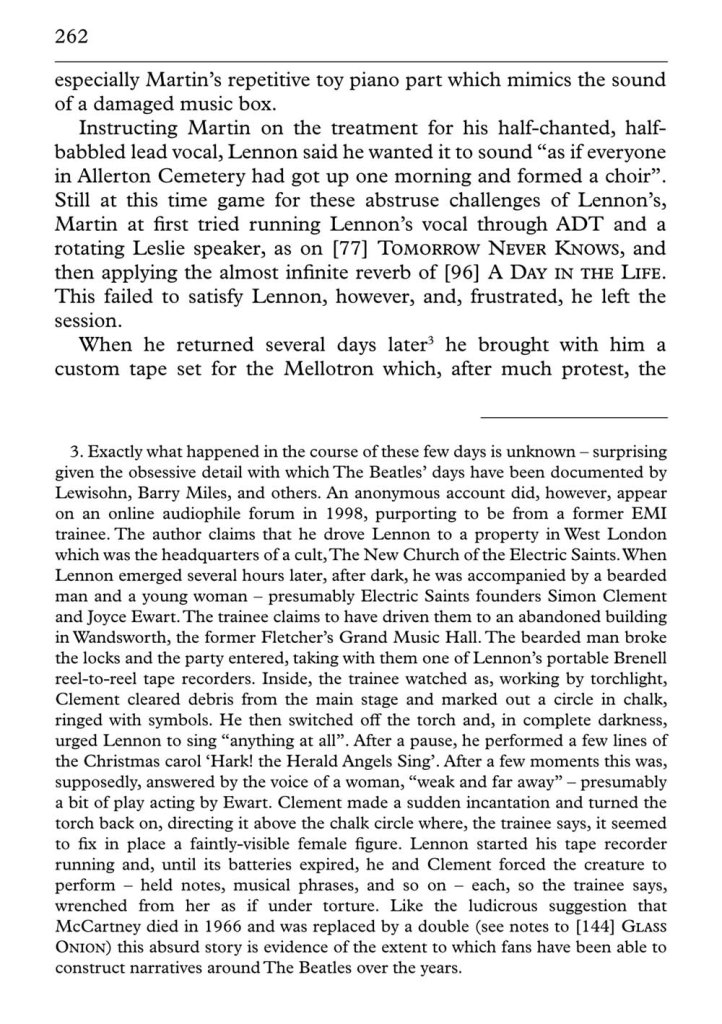
Psychedelic music was largely built on the use of reverb and echo. Think of Sgt. Pepper’s Lonely Hearts Club Band by The Beatles and its associated single, ‘Strawberry Fields Forever’, and how often John Lennon’s voice in particular is adrift in a swirl of its own tails, haunting itself.
To psychedelic and progressive musicians, reverb and echo perhaps seemed to mimic the opening up of their own minds through the use of psychedelic drugs, or their discovery of esoteric spirituality, or both.
These effects turn the performer into a god, their voice calling out across all the lands – or, alternatively, allow them to become as one with the universe. At any rate, they allow them to cease to be themselves:
“With ‘Tomorrow Never Knows’ I’d imagined in my head that in the background you would hear thousands of monks chanting.”
John Lennon quoted in The Beatles by Hunter Davies, 1968
What we rarely acknowledge is how strange it is to be able to create these auditory virtual realities from loops of magnetic tape, wobbly springs, sheets of metal suspended in boxes, electronic circuits or, most recently, lines of code.
Before reverb and echo devices, these effects were created by playing in real spaces such as halls, churches or water tanks. Then studio technicians worked out that they could pipe sound into those spaces, record the echo remotely, and blend it with the mix. But, still, you needed big, empty rooms to play with.
Spring reverb was an early breakthrough. It achieved the impression of space by channeling sound through a box full of springs and recording their vibrations. This is very much the sound of surf music. But where is the surf guitar player as we hear them twanging on recordings? In the hall created by the curl of a giant wave? In Monument Valley? In deep space?
Early echo/delay effects were created through similarly analogue means, using loops of tape to record a sound and play it back almost immediately, layered over the original. By adjusting settings engineers can create the impression of sounds bouncing into infinity, or slapping back as if from a nearby cliff face.
The EMT 140 plate reverb, first manufactured in 1957, was a significant breakthrough. That’s it travelling in space in the main image above. It was used extensively on recordings by The Beatles and Pink Floyd, among others, and is one of the defining sounds of psychedelia.
It conjures vastness from a bland looking wooden box of the type you might find collecting dust at the back of a school assembly hall.
Inside that box is a large plate of sheet metal suspended from springs. Your raw sound – John Lennon singing, for example – is played into the plate through (in non technical terms) a small speaker. That causes the plate to reverberate and that sound, in turn, is picked up and sent back out of the box to be mixed with the original sound.
Since the 1970s, it’s been possible to create reverb and echo using, first, analogue electronic circuits, and then digital signal processing. This has allowed those mindbendingly enormous spaces to be housed in ever-smaller packages – the voice of God in a matchbox.
In recent years, convolution reverb has emerged. It uses ‘impulse responses’ (IRs) to capture the qualities of real spaces. Or to steal their souls at gunpoint, you might say. Because that’s often how IRs are created – by firing a starter pistol into, say, a cave, or concert hall, and recording the violent boom.
Another modern trend is shimmer reverb which, rather than recreating real spaces in perfect fidelity, creates impossible ones, where sound behaves in illogical but magical ways. It uses digital processing to repeat each sound at a different pitch, as part of a wash of sound, creating twinkling harmonies. It’s a key feature of modern ambient music.
Ambient music. Musical ambience. Ambience as music. Listeners want to be taken away, enveloped, lifted ten feet off the ground.
Reverb and echo are how that happens.


 Precast Reinforced Concrete Heart