
Art doesn’t necessarily need to include people, and art that omits them isn’t necessarily inhumane – but we need to resist the allure of the soothing blank.
When I read the line “For its right wing adherents, the absence of humans is a feature, not a bug, of AI art” it felt like a contribution to a conversation I’ve been having in my head for years.
It comes from an essay by Gareth Watkins for New Socialist and resurfaced recently because the US Department of Homeland Security posted a painting called ‘Morning Pledge’ by American artist Thomas Kinkade (1958-2012).
It depicts two schoolboys walking along a street in an idealised small town in 1950s America. It’s kitsch, essentially – the stuff of ‘Who remembers…?’ accounts on Facebook.
Part of the supposed appeal of the image is the promise of space, peace and homogenous white culture. It presents the small town as the antidote to the Lovecraftian nightmare of the big city, with its crowded streets, small skies and complex mix of peoples.

In America, ‘manifest destiny’ was about heading west to open space, and to freedom. On film in particular, westerns continued to mythologise this expansion throughout the 20th century. That’s especially true of the films of John Ford who fetishises vast desert landscapes, and the brave men who exist in them, in contented isolation.
From manifest destiny it’s only a couple of steps to the idea of ‘Lebensraum’ (living space) which was a key concept justifying the Nazis’ annexation of European nations, and the push into the east.
In a 2023 article, nature writer Richard Smyth argued that the appeal of rewilding programmes sometimes reflects an urge to purge natural spaces of humans, and evidence of human activity:
A strong anti-people streak is evident not only in old-school get-orf-my-land types, but also among the carefully curated hills and vales of the rewilders – a queasy tension, in the latter case, between ‘look at these splendid landscapes!’ and ‘stay the hell away from these splendid landscapes!’
When right wingers complain that “Britain is full!” or overcrowded it only compounds the sense that the left-liberal position must be to embrace and revel in the presence of people, and to resist the allure of spaces without them.
Cropping people from the frame
As someone who is a habitual Camera Haver and Photograph Taker, I’ve been grappling for more than a decade with the question of whether photos should or should not include people.
Photos of the world around us, I mean. Street photography, in other words.
There’s an argument that photographs without people don’t qualify as street photography. Those are just photos of streets. No, street photography at its best captures human beings in motion, living their lives, in all their infinite variety, behaving in fascinating ways.
To capture real life, however, street photographers must be, to some extent, intrusive, voyeuristic, and sly. They snatch images of strangers who either don’t know they’re being photographed, or don’t get chance to object.
Some street photographers push this to the limit. Bruce Gilden is famous for his aggressive technique, thrusting his camera into the faces of strangers and snapping them with full flash. It gives his pictures enormous energy but can also feel like a form of abuse.
British photographer Martin Parr takes a gentler approach but has also been criticised for exploiting or mocking his often working class subjects, betraying snobbery in where he chooses to point his camera.
Where is the line between what street photographers do and the creepy behaviour of social media voyeurs filming young women on nights out?
All of this is why there’s now a view that the only truly ethical way to take photographs of strangers in the street is to ask permission, ideally before you point your camera at them; and to share publicly only images that come with explicit permission from the subject in the form of signed consent documents.
In that context, photos of spaces without people begin to feel like the less problematic (less fascistic) choice.
A convenient excuse for misanthropy
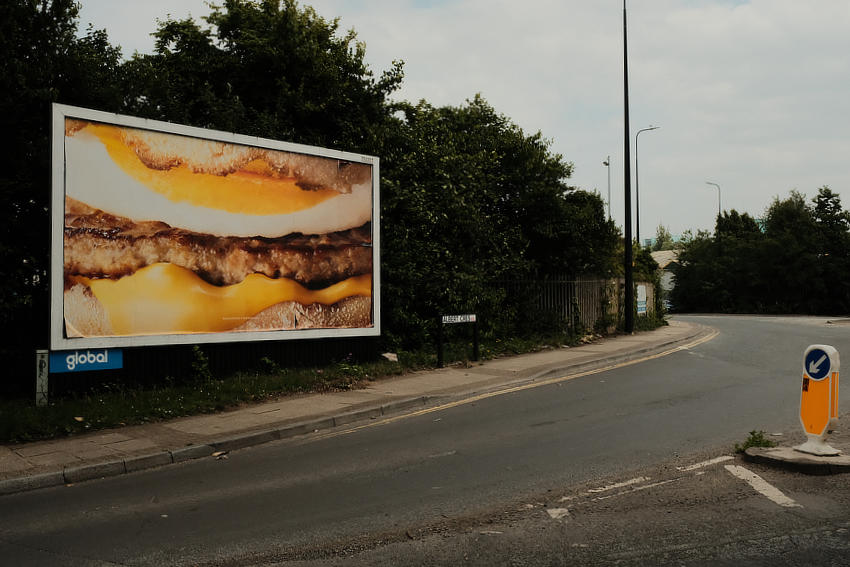
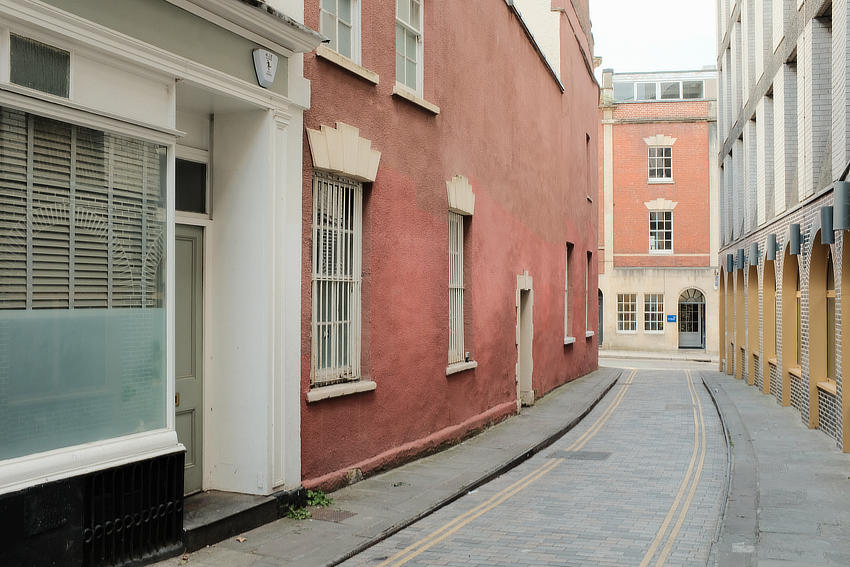
My own photographs tend to be of humanless spaces and blanks in the urban landscape. I often spend ages waiting for people to clear the frame, or grab my shot in split second gaps as people pass back and forth through the scene.
One of my more successful photo projects, Bristol Without Cars, relied on this approach for its effect.
I might tell myself this is an ethical choice but it’s also a personal preference.
With or without a camera, I spend hours every week walking through industrial estates near my house rather enjoying their dusty, desert-like emptiness.
Recently, I found myself alone in a Norman church in an apparently deserted village, listening to birdsong and the wind. And I was surprised to hear myself emit a long, contented sigh.
When I think about nerdy billionaires and their post-apocalyptic bunkers, I sometimes wonder if being the last men on earth is their true desire – peace at last! And, uncomfortably, I recognise that urge in myself.
During my Bristol Without Cars project, I thought I was creating rather peaceful, almost utopian images. But others found them unsettling and even post-apocalyptic.
Adding to my sense that the urge to depopulate my photographs is unhealthy is the fact that it’s part of the sales pitch for using AI in image editing: “It’s great for getting rid of people…”
In this world, people are viewed as clutter, or as a mess to be cleared away. Is it also, perhaps, part of what Tracy Durnell has called “the business borg aesthetic”, in which “Humans are perceived as sources of inefficiency”?
Remember me
I worry about the long-term value of the thousands of largely people-free photographs I take every year. When I choose to photograph bins (as my partner mockingly puts it) rather than humans, I’m not only magically erasing them from the landscape but also from (small H) history.
As time passes, the work of great street photographers gains additional value as documentation of history, and specifically aspects of social history that would otherwise be overlooked.
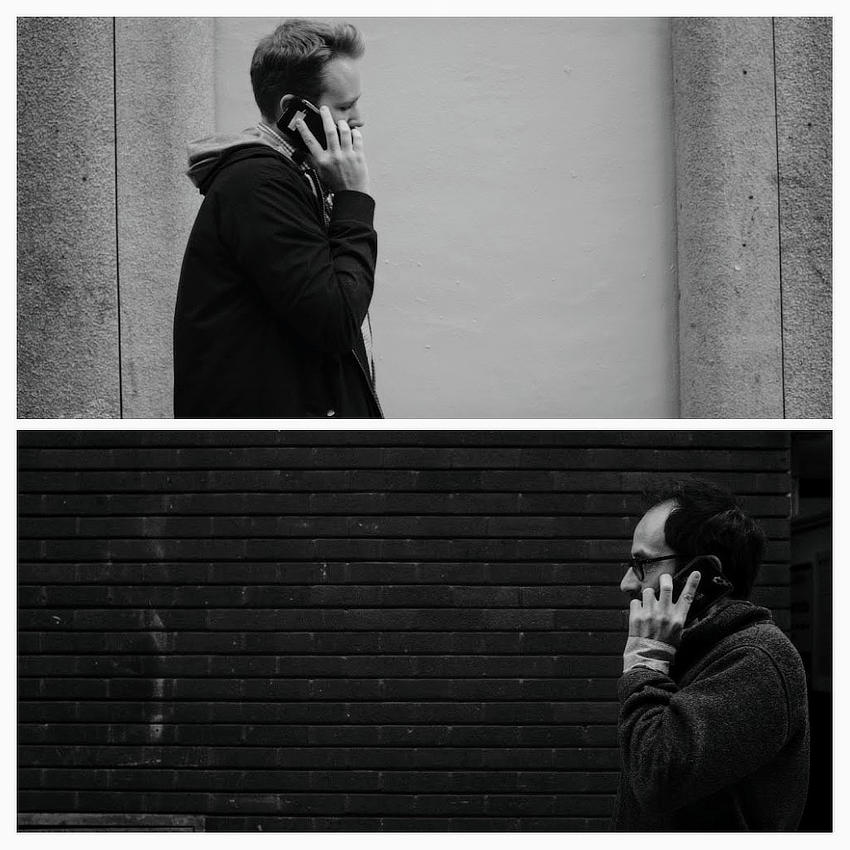
Tish Murtha’s work captures the bodies, the faces and the living spaces of working class English people in ways that now feel profound and vital. This is also true of, say, Chris Killip, or the many citizen photographers whose work is unearthed and published by Cafe Royal books.
This is why I have a guilty secret: I do, in fact, take photographs of strangers in their place in the urban landscape. It’s just that I don’t often share those images in public, or on social media.
No, those are for (small P) posterity. There for me to look at in 30 or 40 years time and remember that I was, in fact, surrounded by humanity in all its wonderful variety.







 Precast Reinforced Concrete Heart