Categories
music

They cannot stop you making music

They – that is, the bastards that would grind you down – cannot stop you making music.

They can stop you from making a living from it, though.

Think of all those bands who somehow never seemed to get paid despite multiple hit records. Steve Marriott of The Small Faces ended up collecting 7-Up bottles for the deposit, and stealing to feed his family.

Thirty years ago, the standard fee for a gig in a pub was around £200. In 2025, it continues to be around £200.

Spotify has automated and perfected the business of ripping off musicians, paying them very little for their work and sometimes nothing at all.

Still, you make music for the love it it, right? As long as you’ve got something to pluck, bash or blow into, you can still make a noise.

Until they take away your instruments, of course.

School music services in the UK, which used to supply many working class kids with their first instruments, have been eroding for decades. A 2019 survey found a 21% decrease in the provision of music lessons in state schools while, of course, with bloody inevitability, provision increased in independent schools.

Musical instruments are also among the first things to go when poorer families need extra cash. Go into any high street pawnbroker and you’ll see rows of guitars hanging on the wall, along with keyboards, string instruments, saxophones, drum machines…

At least pawn shops used to be an affordable place to acquire instruments, too, although the internet has changed that. We live in a world where there is no longer any such thing as a bargain, because every second-hand item is priced at its theoretical maximum market values, pegged against eBay.

Still, music software has done away with the need for real instruments, hasn’t it? Apple’s Garageband is a free app that comes with loops, virtual drummers, a library of instruments, and multitrack recording capabilities.

And I’ve just paid a few pounds for Koala Sampler which puts an incredibly powerful, easy-to-use sampler on my phone and in my pocket.

Back in the 2000s, grime musicians created backing tracks using Playstation games consoles and mobile phone ringtones.

And entire careers have been built on hacked and cracked music software – complete production studios running on bedroom PCs, for which not a penny was paid.

Unfortunately, they, the bastards, can also make sure you never have the time, energy or focus to practice or perform.

Work takes up the best part of your brain and leaves you hollowed out. I say that as a privileged desk worker with one steady, regular job. Imagine trying to fit music in around shift work, or multiple jobs?

That’s before we get into the multiplying distractions of modern life, with a thousand algorithms competing to break your flow and steal your attention.

I’m writing this partly because I’ve been thinking about my dad again. A year ago today was the last time I saw him, at a hospital in Weston-super-Mare. I wrote an obituary for him last year while still in the deepest pit of grief.

Now, still missing him but less painfully, I’m able to feel inspired by his passion for making music.

His real job, his real identity, wasn’t as a factory or warehouse worker. It wasn’t even being a dedicated father, sweet as it would be to be able to make the claim.

No, he was, with a capital M, a Musician.

That he found time to learn to play the bass guitar, to form bands, to rehearse with them, and to play so many gigs over the course of decades, is a miracle.

Like many men of his generation, he started out with skiffle – the ultimate expression of working class musical ingenuity, with tea chest basses and kitchen sink percussion.

Later in life, he bought cheap bass guitars with bent necks and bad actions and battled with them until they sang.

He prioritised practicing in draughty church halls over watching TV and rehearsed until his fingers had grown armour.

He overcame his natural introversion and social awkwardness to approach other similarly gruff working class men and say: “Will you be in my band?”

When I think of Dad in full bloom it’s on stage in a pub, wrists strapped with support bandages, with fingers scarred from years of turning pistons moving up and down the fret board just as they’ve been drilled to do.

He couldn’t make his living out of music but he lived music all the same. They couldn’t stop him.

Categories
music

Echo and reverb: the mechanical ghosts of wide open spaces

A key feature of popular music is the use of artificial echo and reverberation to make small ensembles sound big, to complexify simple arrangements, and to turn poky studio spaces into wide open landscapes.

Listen to ‘Isi’, the opening track of Neu! 75, by German band Neu, for example. It begins with a simple sequence played on a piano. But a reverberation (reverb) effect sends each of the three basic chords out into a big blue sky – one that exists only in a studio box of tricks.

Echo and reverb are such a part of the background to recorded music that most of us don’t notice they’re there. We would notice, however, if they weren’t.

The same piano chord ‘dry’ and then with reverb and echo.

When a piece of music is described as ‘epic’ it’s probably reverb, often paired with echo, that is creating that impression.

Echo, or ‘delay’, is a subtly different effect. It’s about the repetition of distinct sounds rather than their washing away into space.

Play a single note, add repetitions with delay, and play that into reverb and, in an instant, you have music. A sound that can make you feel things.

Please subscribe to get notified when I post something new here. It’s what I’m doing instead of setting up yet another Substack newsletter.

Psychedelic music was largely built on the use of reverb and echo. Think of Sgt. Pepper’s Lonely Hearts Club Band by The Beatles and its associated single, ‘Strawberry Fields Forever’, and how often John Lennon’s voice in particular is adrift in a swirl of its own tails, haunting itself.

To psychedelic and progressive musicians, reverb and echo perhaps seemed to mimic the opening up of their own minds through the use of psychedelic drugs, or their discovery of esoteric spirituality, or both.

These effects turn the performer into a god, their voice calling out across all the lands – or, alternatively, allow them to become as one with the universe. At any rate, they allow them to cease to be themselves:

“With ‘Tomorrow Never Knows’ I’d imagined in my head that in the background you would hear thousands of monks chanting.”

John Lennon quoted in The Beatles by Hunter Davies, 1968

What we rarely acknowledge is how strange it is to be able to create these auditory virtual realities from loops of magnetic tape, wobbly springs, sheets of metal suspended in boxes, electronic circuits or, most recently, lines of code.

Before reverb and echo devices, these effects were created by playing in real spaces such as halls, churches or water tanks. Then studio technicians worked out that they could pipe sound into those spaces, record the echo remotely, and blend it with the mix. But, still, you needed big, empty rooms to play with.

Spring reverb was an early breakthrough. It achieved the impression of space by channeling sound through a box full of springs and recording their vibrations. This is very much the sound of surf music. But where is the surf guitar player as we hear them twanging on recordings? In the hall created by the curl of a giant wave? In Monument Valley? In deep space?

Early echo/delay effects were created through similarly analogue means, using loops of tape to record a sound and play it back almost immediately, layered over the original. By adjusting settings engineers can create the impression of sounds bouncing into infinity, or slapping back as if from a nearby cliff face.

The EMT 140 plate reverb, first manufactured in 1957, was a significant breakthrough. That’s it travelling in space in the main image above. It was used extensively on recordings by The Beatles and Pink Floyd, among others, and is one of the defining sounds of psychedelia.

It conjures vastness from a bland looking wooden box of the type you might find collecting dust at the back of a school assembly hall.

Inside that box is a large plate of sheet metal suspended from springs. Your raw sound – John Lennon singing, for example – is played into the plate through (in non technical terms) a small speaker. That causes the plate to reverberate and that sound, in turn, is picked up and sent back out of the box to be mixed with the original sound.

Since the 1970s, it’s been possible to create reverb and echo using, first, analogue electronic circuits, and then digital signal processing. This has allowed those mindbendingly enormous spaces to be housed in ever-smaller packages – the voice of God in a matchbox.

In recent years, convolution reverb has emerged. It uses ‘impulse responses’ (IRs) to capture the qualities of real spaces. Or to steal their souls at gunpoint, you might say. Because that’s often how IRs are created – by firing a starter pistol into, say, a cave, or concert hall, and recording the violent boom.

Another modern trend is shimmer reverb which, rather than recreating real spaces in perfect fidelity, creates impossible ones, where sound behaves in illogical but magical ways. It uses digital processing to repeat each sound at a different pitch, as part of a wash of sound, creating twinkling harmonies. It’s a key feature of modern ambient music.

Ambient music. Musical ambience. Ambience as music. Listeners want to be taken away, enveloped, lifted ten feet off the ground.

Reverb and echo are how that happens.

Categories
music therapy

Lost albums, lost boys

I was 17 when Tom from college turned up at my parents’ house with an urgent need to talk about Brian Wilson.

At that point, I knew very little about the Beach Boys, and even less about Tom – an intense boy who had to bow to pass through doorways, who dressed in indie beige and stoner moss, and communicated mostly through Chris Morris quotes. We barely spoke in classes and certainly didn’t hang out after hours.

Who were his friends? The double-barrelled weed kids, I suppose, because they wore the same non-uniform uniform and the same carefully unstyled, uncut haircuts. They slouched around together, forming and disbanding songless bands every five minutes, dopey and aloof at the same time.

As Tom barged through the front door and made his way towards my room, distant and half-smiling, I thought, oh no, this is part of some elaborate mockery that will end up with my social status sinking lower than it already is.

He inspected my very small record collection, mostly stolen from Mum and Dad or bought at Woolworths: best-ofs and B-side compilations of the Kinks, the odd 99p Britpop single, some albums by the Jam on tape, and an embarrassing number of Hancock’s Half Hour tapes.

No comment, and then, eyes locked on, “Do you know about Smile?”

Smile? What was that? A band, maybe? I was too startled to reply.

“Brian Wilson. The Beach Boys. Smile.”

The Beach Boys, as in ‘Surfin’ USA’? As in the scratched LPs my uncle kept alongside the Ventures and Chris Rea in his Hi-Fi cabinet? My Dad, cooler than me then and always, had no time for the Beach Boys at all.

“No,” I said, and off Tom went, delivering the kind of passionate monologue that would end up on YouTube these days but back then had to be directed at people from college you barely knew, face to face, on gloomy Wednesday afternoons.

Brian Wilson, Tom said, was a genius but driven mad by LSD while producing what was to be his masterpiece, the album Smile, scheduled for release in 1967. It was a symphony, impossibly complex, like Pet Sounds but ten times more ambitious. And then Wilson, so Tom told it, scrapped the album, retired to his bedroom, and was never seen again. But, he went on, the tapes had leaked, and it was possible, if you were connected, to hear snippets – glimpses of something magical out of reach, of pop music on another level.

I don’t remember that I said anything – I was warily awaiting the punchline, and so gave the odd noncommittal uh-huh and mmmm.

After a while, Tom left, and we continued at college as if this moment had never occurred.

But Smile lingered.

It became my ‘thing’, in fact, for many years. I woke up to ‘Prayer’ every morning and listened to hour after hour of ‘Heroes & Villains’ sessions, trading tapes with oddball Americans and eccentric Scandinavians.

When Brian Wilson performed a finished version of Smile in London in 2004, I was there, laughing and sighing with delight.

Smile was found, but Tom got lost.

What I’d taken to be ironic detachment turned out to be clinical. I heard stories of his decline – that he’d dropped out and become a ghost, stalking our home town, back and forth from bedroom to record shop, shaggy and strange.

A Brian Wilson of our own, I suppose, without the cushion of songwriting royalties or the warmth of the sun.

Categories
music

The Quality of Beatlesness

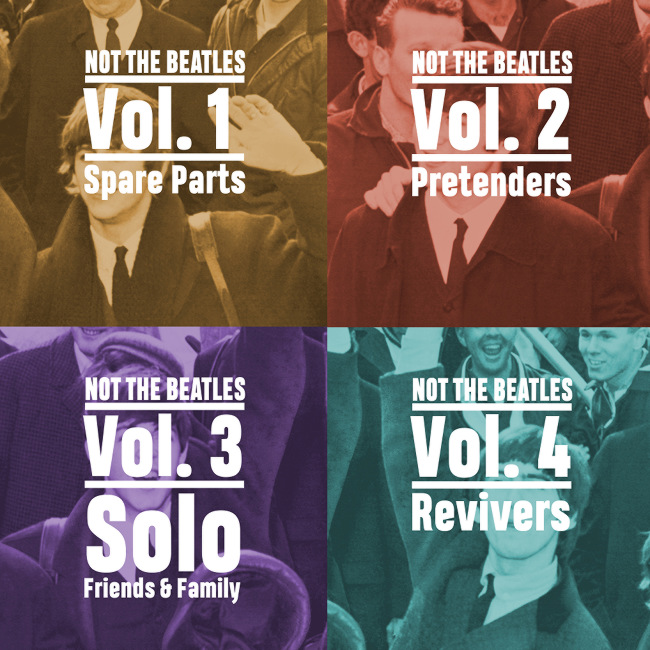
Not the Beatles -- playlist cover montage.

Many musicians have tried to sound like the Beatles and most have failed because what makes the Beatles great and enduring is an essential, alchemical quality of Beatlesness.

Before I get into this, here’s my history with the Beatles. I grew up in a family where the Beatles weren’t especially important. My Dad liked them and had most of their records, but he much preferred the Rolling Stones and the Kinks; Mum hated the Beatles, having pledged her allegiance to the Small Faces in 1965; and the other influential baby boomer in my life, Uncle Norman, was all about the Beach Boys and the Ventures. I think I decided for myself, as a teenage swot trying to work out what music was all about, that the Beatles were essentially crap – excessively revered, too sentimental, too self-indulgent. I mean, brass bands?  No thanks.

Then, during my first year at university, I got religion – a sudden conversion, listening to ‘Strawberry Fields’ over and over again during a thunderstorm, in the circle of light from an Anglepoise. By the time I was 24, my obsession had led me to write 30,000 words on the subject of Revolver that got near to being published as a book before the publisher got taken over, and in e-book form elicited kind comments from various quarters including Rolling Stone. That got it out of my system, or at least the bootleg-seeking, mono-is-best part of the madness.


Get my ‘Not the Beatles’ Spotify Playlists


Every now and then, though, I come back to the Beatles and listen to them obsessively for a week or two. Or, as in the most recent resurgence of interest, their imitators.

Pastiche has always intrigued me. You can learn a lot about H.P. Lovecraft or Sherlock Holmes by reading attempts to imitate them which never quite reach the mark but, in failing, tell us something about the original. Exposing yourself to work that makes you say, “Oh, no – Conan Doyle would never do that,” is a particularly effective way of discerning the outlines of what Conan Doyle did.

The Beatles are an especially productive seed for pastiche and ‘Beatlesque’ is a word that can be applied, and has been applied, to almost every artist from ABBA to the Chemical Brothers at one point or another.

That’s partly because in their psychedelic pomp the Beatles were so much about easily borrowed surface decoration. Use a Mellotron, a piccolo trumpet, a megaphone, some backwards loops, or a sitar, and you immediately have a sprinkle of Beatle dust over your song. Reprise the opening track at the end of your album and provide the bare bones of a concept, perhaps a few spoken words to segue from one song to another, and you’re a step closer. So why does a track such as, say, ‘King Midas in Reverse’ by the Hollies, though it ticks the boxes, not sound like the Beatles? The voices, for starters.

John Lennon’s adenoidal Scouse growl and Paul McCartney’s pretty-boy, pouting purr, apart or combined into a super-weapon, don’t sound like anything or anyone else. Though just occasionally, someone else will give it a shot. One of my favourite Beatles pastiches, which I discovered 20 years ago on a compilation called Circus Days, isn’t on Spotify and so I couldn’t include it on the playlist above (Vol. 2: Pretenders) but is on YouTube. Listen to the vocal on this first verse:

For a moment, for a few seconds, that sounds so like McCartney it’s unnerving. Then they had to ruin it by doing something stupid like hiring a child chorus. In general, the most effective Beatles pasticheurs are either those blessed with a soundalike, or shameless enough simply to do an impression which, even when it sounds daft, still triggers a response in the pleasure centres. Neil Innes’s John Lennon impression is broad but basically accurate, which is a good part of why it’s possible to use Rutles songs, “do a poo poo” and all, as a kind of methadone for Beatles addiction.

The other problem for would-be imitators is that the Beatles weren’t formulaic, or at least the formula mutated so quickly from one record to the next that its shape is hard to discern. Anybody can pick a Beatles song and copy it but they’ll just have that one song, not the key to the entire sound. There are, though, certain techniques and tricks that immediately summon the spirit of the Beatles, such as what Andy Partridge of XTC has called ‘banana fingers piano’ – that insistent, rudimentary thumping that McCartney used time and again. The ‘Tomorrow Never Knows’ drum beat is almost the basis of its own sub-genre; and the same might be said for the ‘Taxman’ bassline, and bubbling McCartney notice-me bass more generally.

Production, the sonic texture of the recordings, is important too. Even in an age when you can buy sample libraries of every keyboard at Abbey Road and play them through painstaking digital recreations of the original mixing desk and compressors, the sound seems somehow out of reach. Some attempts end up sounding too clean or too cold, while others lean too far the other way and end up lacking sizzle and crispness. The Beatles weren’t muddy, even when they were dense. Again, the word alchemy springs to mind: those people, those instruments, that space, in that moment, created something greater than the sum of the parts.

Finally, there’s something about energy levels. No pop song ever sounds quite as frantically exciting as ‘Twist and Shout’ or ‘It Won’t Be Long’, or as perfectly mellow and distant as ‘A Day in the Life’. Some of that I suspect came from the Beatles’ confidence, later shading into arrogance, and perhaps it’s hard to broadcast confidence when you’re imitating somebody else, because you don’t really believe who you are is good enough.

Of the bands seeking to imitate the early Beatles (see volumes 2 and 4 above) the most successful are those which manage to capture a little of the amphetamine frenzy, the bite of the guitars, and those voices. ‘Jealousy’ by the Poppees is a notably convincing attempt that I reckon would fool 80 per cent of non-obsessives. Wannabe Sgt Peppers get closest when they are able to wriggle into that tiny gap between shoddy (a cheap organ parps into a cheap reverb unit in lieu of a brass section; a synthesiser that sounds more like a B&Q doorbell than a Lowrey) and cheesy (Mantovani strings where they should be Bernard Herrmann; excessively harmonious harmonies).

But Beatlesness is so ethereal that it doesn’t look the same to any two people. The message boards and comment threads I read researching my playlists were full of people saying that this band or that sounds exactly like the Beatles when, frankly, they don’t. I cannot hear the Beatles in Crowded House, for example, but the chances are you won’t hear the Beatles in some of my choices, either. Sometimes it’s only there fleetingly or partially anyway.

Your thoughts on Beatlesness are very welcome. In the meantime, I hope you enjoy the playlists.

If you want to listen to all the tracks from the four playlists embedded above on shuffle there’s also a master list, ‘Not the Beatles Vol. X: Everything’. I got a lot of ideas from this website in particular — do have a look.