
The neighbourhood. Quiet, curving streets where children play in the road, making way now and then for a wood-panelled station wagon or Chevy pick-up. The houses are probably painted white, with white wooden fences, and perfectly green lawns. There might be a paperboy slinging rolled copies of the local daily. TVs are always on and always showing black-and-white movies or Looney Tunes cartoons. Kids have Star Wars posters on their bedroom walls and play games on Atari consoles. Teenagers listen to pop music on chunky Sony Walkmans. There will certainly be tall, tanned dads watering lawns and washing cars and faintly glamorous moms cradling brown bags overflowing with shopping. For dinner, it’s Wendy’s or McDonald’s, accompanied by cans of Coke or Tab for the kids and Budweiser for Dad. And it is always Independence Day, or Halloween, or Christmas – golden hour glow, warm autumn leaves, perfect snow. America is on top, life is good, adventure is just round the corner.
I spent my early years on a concrete council estate in a small town in Somerset but, like Rick Deckard in Blade Runner finding succour in his implanted memories, the images that spring to mind when I think of childhood are often American in flavour. That’s because, like many people my age, I grew up largely in front of a rented Rumbelow’s TV, absorbing the sunny glow of Spielburbia.
Spielburbia is a name for the American suburb as envisioned by Steven Spielberg. It manifests in films he directed such as E.T. the Extra-Terrestrial (1982), those he produced such as Back to the Future (dir. Robert Zemeckis, 1985) and others which simply imitated his style in pursuit of a share of his incredible commercial success. As far as I can tell, the term Spielburbia was first used by Tony Williams, disparagingly, in his 1996 book Hearths of Darkness, with reference to Poltergeist, a pop horror film that Spielberg produced and was long thought to have shadow-directed over Tobe Hooper’s shoulder. Williams sees Spielburbia as a reflection of an ‘infantile mindset’. To those living through less than perfect childhoods and, worse, the crushing weight of adventureless adulthood, that is precisely its appeal.
My gateway to Spielburbia was a branch of Ritz Video on the Sydenham Estate shopping arcade in Bridgwater. That’s where my parents rented, in big yellow boxes, also-ran kids adventure films like D.A.R.Y.L., The Boy Who Could Fly, The Explorers and Flight of the Navigator, all of which I saw long before E.T. or Close Encounters. When I talked about this with my brother, he recalled the colour-coding system that dictated the rental price: E.T. was expensive, D.A.R.Y.L. was cheap. So we watched D.A.R.Y.L. and loved it. Television was also important, five- or six-year-old big-budget American movies being the key events in what continuity announcers called ‘a very special Christmas here on BBC1’, or bank holiday matinees.
To a child in Britain in the 1980s, Spielburbia was both familiar and alien. We had kids on bikes. We had fences. We had plastic action figures and even American footballs, for which there was a brief craze in the UK at the tail-end of the decade. But it lacked the scale or glamour. The bikes were rusty non-brands from Halfords. The fences were steel mesh, also rusting. There was no mountain behind our estate – no pine forest or field of corn.
The cinematic Spielburbia came into being, I think, with Spielberg’s first big hit, Jaws, released in 1975. Though set on a tourist island, not in the suburbs, the feel is there in the scenes of Chief Brody’s domestic life and the arrival of tourists on Fourth of July weekend. Spielberg has a delicate touch when it comes to portraying the barely-blessed lives of ordinary Americans – adults and children bickering and laughing together over unmade beds, coffee machines and bowls of sugary cereal. In Jaws, Martin Brody awakes reluctantly and stumbles stiff-legged across the bedroom to check on the kids in the yard. “In Amity, you say yaaahd,” says Ellen Brodie, teasing. “They’re in the yaaahd, not too faaaah from the caaaah. How’s that?” replies Martin. “Like you’re from New York,” says Ellen. While Brodie fields a garbled call about a missing swimmer, his son Michael swaggers into the kitchen and proudly shows off a wound – the result of playing on poorly-maintained back-garden swings against his father’s instructions.
Swings! A minor detail but, oddly, a recurring one in the run of Spielberg’s movies from Jaws to Poltergeist. I’d bet any money his own childhood home had a set. And that mention of New York is important too: this is not New York City, or Los Angeles or Chicago – the default urban settings that define many cult films of the 1970s. The appeal of Spielburbia is that, at least until killer sharks, aliens or sinister government agents arrive on the scene, it is not ‘gritty’ or dangerous. It is – I can’t avoid the word any longer – ‘sleepy’.
Spielberg’s next film, Close Encounters from 1977, develops the idea. Centreing on a family man, Roy Neary, played by Richard Dreyfuss, it grounds the fantastical alien visitation plot with a portrait of a down-to-earth lower-middle-class suburb in Muncie, Indiana. Muncie – the very word sounds like an adjective, something from The Meaning of Liff, perhaps meaning dull or bland. The neighbourhood provides a pointedly sane backdrop against which Neary’s UFO-induced madness plays out. Spielberg delights in the background details: backyard swings, again; dads in shorts washing cars and boats on sloping driveways; children practicing their baseball swings, or riding bikes.
Though set in Indiana, in the American Midwest, it was actually filmed in Mobile, Alabama, in the southeastern US. That Spielberg could make this substitution tells us something: American suburbs are American suburbs, utterly interchangeable. Or, if you prefer, universal. The house that played the part of the Neary home is in a post-World-War-II housing development called Colonial Heights – an arrangement of near-identical single-storey houses along meandering streets designed to go nowhere in particular. It is a classic example of ‘tract housing’.
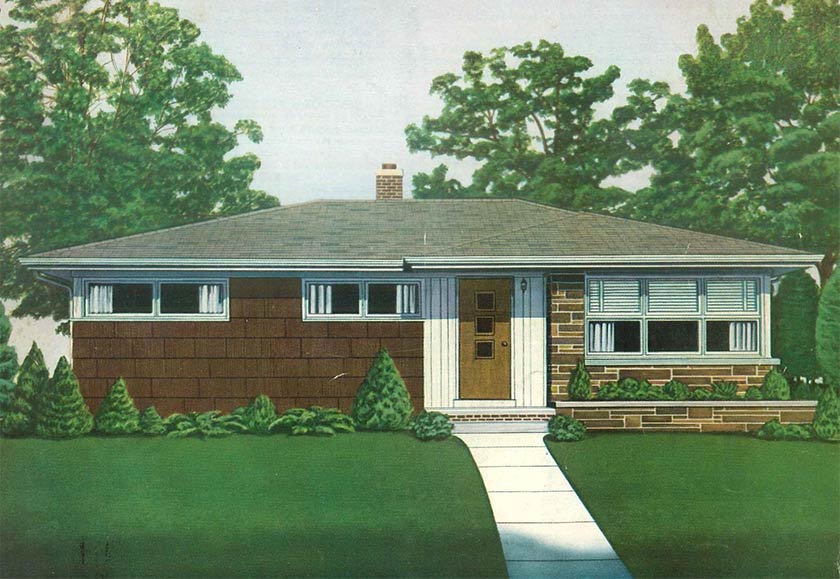
Tract housing, sometimes known as ‘cookie-cutter housing’, was primarily a post-World-War-II phenomenon. As the US population grew, increasing by 50 per cent between 1940 and 1970, millions of Americans moved from rural settlements into urban and suburban settings. By 1970, there were around 75 million Americans living in the suburbs – more than the entire population of the UK.
This suburbanisation was brought about by the advent of techniques for mass-producing appealing homes, and of heavy-duty construction vehicles which made it possible to clear great areas of agricultural land, wilderness or even desert plains. Hills could be flattened, terracing imposed, and landscapes composed – new spaces into which thousands of individual homes could be dropped with maximum efficiency.
The most famous examples might be the Levittowns built by Abraham Levitt & Sons in New York, Pennsylvania, New Jersey, Puerto Rico and Maryland between 1947 and 1970. The houses were built on production lines and could be erected in a single day.
While many applauded the democratisation of home-ownership this brought, the uniformity of this new suburban architecture – it’s sheer bloody munciness – unnerved some. What had happened to American individualism? A 1950 catalogue for the tellingly named Standard Homes Company entitled Homes for Your Street or Mine boasts that the designs within were ‘standardized to avoid waste… America’s best planned small homes’. The utopian illustrations depicting ‘The Lorain’, ‘The Lexington’, ‘The Wayne’ immediately bring to mind Spielburbia.
These suburbs also came in for criticism from those who saw in them the potential for ever-greater alienation and detachment from society – where were the neighbourhood bars or diners? Where were people supposed to congregate when not at work? Ray Oldenburg, author of The Great Good Place, published in 1989, saw the loss of this vital ‘third place’ from American culture after World War II as the root of many societal ills:
What opportunity is there for two men who both enjoy shooting, fishing or flying to get together and gab if their families are not compatible? Where do people entertain and enjoy one another if, for whatever reason, they are not comfortable in one another’s homes? Where do people have a chance to get to know one another casually and without commitment before deciding whether to involve other family members in their relationship? Tract housing offers no such places.
Ira Levin’s 1972 novel The Stepford Wives, made into a film in 1975, takes the uniformity of suburbia to its logical conclusion – if all the houses are the same, why not all the people? His sour, satirical take has housewives killed and replaced by compliant robots.
Spielberg isn’t unaware of suburbia’s downsides. As Roy Neary has his breakdown in Close Encounters, for example, the neighbours gather to watch, gawping from their driveways or leaning out of bedroom windows. When he speaks to them – ‘Good morning!’ – they ignore him. These people are crammed together and yet miles apart. But, overall, his take on suburbia is fond.
Spielberg himself grew up in just such a post-war neighbourhood, in Phoenix, Arizona. Joseph McBride made the pilgrimage while researching his 1997 biography of the director:
When a visitor enters Steven’s old neighborhood in Phoenix today, with its 1950s-era ranch houses still lining a broad, tranquil street crisscrossed by friendly kids riding bicycles, the feeling is inescapable: You’re not only going back in time, you’re entering a Spielberg movie.
Nowadays, anyone can visit Spielberg’s childhood home at 3443 North 49th Street thanks to Google Street View and to do so is startling – McBride is absolutely right, and it’s easy to imagine Spielberg location hunting, always seeking somewhere that felt just like home. Whereas others of his generation rejected suburban upbringings and wrote songs or novels mocking square life, Spielberg apparently yearned for it.
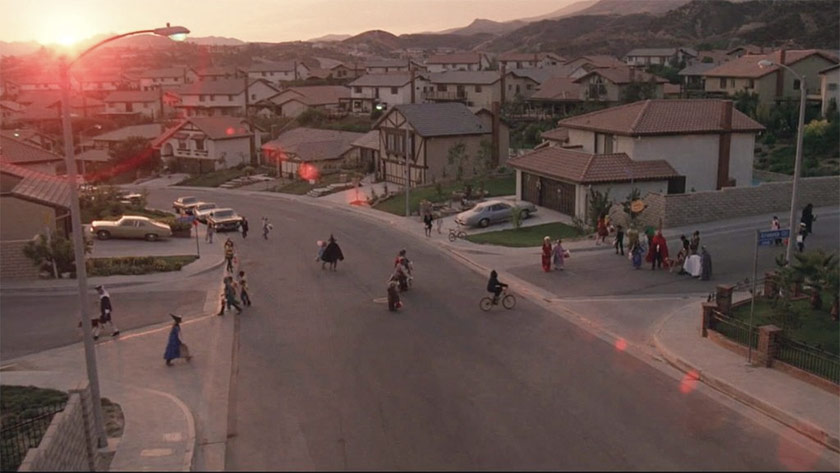
The two films in which Spielburbia really comes into focus are both from 1982: E.T. the Extra Terrestrial, directed by Spielberg, and Poltergeist, which he wrote and produced.
E.T. takes the growing list of tropes – or tics, perhaps – from Jaws and Close Encounters and amplifies them. For example, Spielburbia is defined by an abundance of mass-produced toys. In Close Encounters, Roy Neary tinkers with a model train set while a music-box in the shape of Pinnochio plays ‘When You Wish Upon a Star’. By the time we get to E.T., however, with the action playing out primarily in an eleven-year-old’s bedroom, there are moments when it feels like a commercial. ‘This is Greedo,’ says Elliot, showing his friend from outer space his Star Wars figures, ‘and then this is Hammerhead. See, this is Walrus Man. And this is Snaggletooth. And this is Lando Calrissian.’ A Texas Instruments Speak’n’Spell machine is even part of the contraption E.T. builds to ‘phone home’.
In E.T. we’re treated to sweeping crane shots of the suburb, filmed and set in the San Fernando Valley outside Los Angeles, and the majority of the action takes place there. Children on BMX bikes use their knowledge of the topography – its back alleys, broken fences and empty lots – to evade capture. Near the end of the film, a glimpse of a half-finished development on a new tract of land, into which the children escape, threatens to turn this into a film about the suburbs. Poltergeist, released in the same month of the same year, completes that journey.
The family man at the centre of Poltergeist, Steve Freeling (Craig T. Nelson), doesn’t just live in a suburb – he’s a salesman for the development company that built the bland but pleasant Cuesta Verde estate. Early in the film, director Tobe Hooper plays a sly trick, fading from a shot of the cluttered Freeling family kitchen to what looks like the same room stripped bare. Then Steve walks in with a couple who are considering buying what turns out to be a different house. ‘l can’t tell one house from the other,’ says the potential buyer.
At first, Cuesta Verde seems almost perfect, with all the Spielburbian signifiers. Then its flaws become apparent – the houses are crammed so close together that the Nearys and their neighbours keep switching the channels on each other’s TVs. As the haunting begins we learn that the truth is grimmer yet: the land on which the houses were built was a former cemetery and though the headstones were moved, the corpses were left in place beneath backyards and porches.
Perhaps this is the moment where Spielberg soured on Spielburbia, or at least moved on. He would not himself direct or write any more films with this setting, leaving his disciples to carry the baton.
If 1982 had the ‘Summer of Spielberg’, 1985 was the summer of Spielburbia, seeing the release of four notable films in the sub-genre.
Back to the Future was written by Robert Zemeckis and Bob Gale and directed by Zemeckis, with Spielberg in the producer’s seat. Like Poltergeist, it offers a critical portrayal of the suburbs, taking advantage of the time travel plot to show a post-war Californian development, Lyon Estates, in both its well-worn 1980s incarnation and as a mere aspiration in 1955. ‘Live in the home of tomorrow…. Today!’ reads an advertising hoarding outside gates which open onto a tract of dusty land that is naked but ready.
The Goonies, directed by Richard Donner and based on a story by Spielberg, who also hovered around the set. It takes elements of E.T. – the child’s-eye view, the pursuit by sinister adults – and fuses it with the skeletons, subterranean tunnels and treasures of the Indiana Jones movies.
Neither Explorers, directed by Spielberg protege Joe Dante, or D.A.R.Y.L, had any involvement from the man himself, but both took components of Close Encounters and E.T., shook them up and glued them back together.
Even after 1985, the films kept coming – Flight of the Navigator and The Boy Who Could Fly from 1986, for example – but Spielburbia began to feel like a cliche and the movies like ever-weaker echoes.
Then, in 1989, Joe Dante directed The ‘Burbs, which might be said to put a neat full stop on this first phase. Dante’s films always walk a fine line between sincerity and satire and The ‘Burbs, which features Tom Hanks in an early outing for his ‘America’s Dad’ persona, tackles the strangeness of the suburbs head on while also celebrating them. Unlike Spielberg’s own suburban-set fantasies, which used real streets in real towns, The ‘Burbs was filmed on the backlot at Universal Studios. It used a set known as ‘Colonial Street’ which you will have seen in hundreds of TV shows and films – The Munsters lived there, as did the Desperate Housewives.
For twenty years or so after The ‘Burbs, Spielburbia was more or less neglected on film, even if a generation of us homesick for it, and for the comfort of childhood, drifted back there when the opportunity arose. Then in 2011 one of those children, director J.J. Abrams, revived Spielburbia in his own film, Super 8. Set in Ohio in 1979, it takes the masterlist of tropes and ticks them off one by one as a band of plucky kids on bikes take on both aliens and the military-industrial complex. It kicked off a run of similarly self-conscious homages including, most notably, the Duffer Brothers’ Netflix-produced Stranger Things, now approaching its fourth season, as well as a distinctly Spielburbian take on Stephen King’s scary clown story IT spread across two films.
What are people yearning for when they watch these films and TV shows? For some of us, it’s straightforward nostalgia for the pop culture we consumed as kids. For others – those who grew up in Ronald Reagan’s America – it must be a fond memory of a time when things felt less complicated.
And, dare I say it, Spielburbia is terribly, unashamedly white. Not only are there no black neighbours but scarcely anyone not presented as Anglo-Saxon or Irish. The first Levittowns were explicitly racist, with contracts stipulating that only members of ‘the caucasian race’ were allowed to buy or let. Spielberg, who often describes himself as having been the only Jew in his neighbourhood as a child, even turned Jewish actor Richard Dreyfuss into Roy Neary, apparently an Irish-American. It’s a dream of the 1980s as the 1960s or 1950s – a continuation of the American Graffiti tendency of Spielberg’s friend and frequent collaborator George Lucas.
More than anything, though, Spielburbia is a mood. Whatever outlandish events might be occurring, thanks to Industrial Light & Magic or the devil or visitors from space, as viewers, we’re invited to remember the best moments of being eleven years old. We’re reminded of sharing meals with our imperfect parents, around cluttered tables, knowing that there were toys to be played with upstairs and outside, in the golden light of the evening, streets to roam. Whether it’s Muncie, Indiana, or Bridgwater, Somerset, or a muddling of the two in memory, the feeling is real.
This piece originally appeared in the ‘zine The Happy Place published by the Bristol Writers’ Group in June 2020. You can still get paper copies. Our next ‘zine, Stepping Out, is due imminently and we’ll be performing new pieces as part of the Bristol Festival of Literature on 21 October. Get a ticket here.
 Precast Reinforced Concrete Heart