Leipzig to Berlin to Klaipeda to Karlshamn to Stockholm to London.
Elleman spends six weeks in a safehouse in Ladbroke Grove, learning English from the Daily Mirror and Sexton Blake magazines.
At first, he thinks his insomnia is a stress response. London sounds different to Leipzig, smells different; he misses church bells and Bach on Sunday mornings.
The interrogators keep strange hours, too – a man and a woman, he with a moustache and pipe, she limping and fine-boned. They ask him questions at dawn, at midnight, on rainy afternoons. He draws organisation charts, picks faces from catalogues of mugshots and surveillance photographs – Henschke, Tiepelt, Brosig, all of them. He reproduces schematics from memory.
The first time a full twenty-four hours passes without a minute of sleep, he doesn’t notice. He moves from bare bedroom to bare bathroom to bare sitting room as the grey day comes and goes. When night falls, he shaves, startled at his own red-flooded eyes in the mirror. He puts on a clean, new English shirt and a new English tie in moss green. Then he goes to the window and watches the street.
Red buses, black cabs, Ford cars with impotent fins. In the orange circle of the street lamp he sees pretty girls in short skirts, men in pinstripes, then, after midnight, only vagrants and slow policemen in black overcoats. Dawn comes, with drizzle.
‘You didn’t sleep last night,’ says the woman. She offers him a French cigarette. Elleman notices her smell: garlic and mothballs. ‘Not at all.’
‘Didn’t I?’
She pushes a photograph across the kitchen table.
He blinks, eyelids scraping over eyeballs like fine sandpaper.
‘You’re watching me.’
‘Why can’t you sleep?’
Elleman looks at the photograph and feels his soul slide sideways. He doesn’t remember standing there in the bay window like that with his mouth open in a scream.
She shows him another picture, then another.
‘Ten o’clock, two o’clock, four o’clock…’ says the woman.
‘Pills, perhaps?’ says Elleman.
The pills don’t work. They make him drowsy and upset his stomach, forcing him to sit for hours in the claustrophobic toilet with its stained copies of the Picture Post. But still no rest.
This time, he catches himself screaming and realises there is no sound, or at least not one his ears can detect. He wonders if the dogs can hear him, or the foxes under the brambles in the railway cutting.
The street light flickers, triggering a feather-edged memory of what he knows, somehow, to be the Soviet military hospital at Wünsdorf.
‘But that’s strange,’ he says to himself. ‘I’ve never been there.’
‘Let me make you some coffee,’ says the woman. She grinds a fig with the beans and presents it in a dainty cup she has brought in her handbag.
‘It’s how they do it in Vienna,’ she says.
‘When can I leave the apartment?’ asks Elleman. ‘Some air might help.’
‘I’ll need to discuss this with my colleague.’
After three nights and days without sleep, the memory of Wünsdorf gains substance – or perhaps the hallucination becomes more vivid: he is on his back under swinging lights, squeaking wheels beneath, amid the stink of pickled cabbage and vodka sweat. Someone says, in Ukrainian-accented Russian, ‘We’ll crack him open like a boiled egg.’
‘Dr Elleman,’ says the woman as she presents him with another Viennese coffee, ‘I should be delighted to take you for a turn on Wormwood Scrubs.’
‘Not Hyde Park?’
‘The Scrubs will be safer.’
The streets on the way are dirty and the terraces have aggressively blank, haunted gaps where strange weeds grow. As the breeze touches his face, bringing with it a little of her sweet bedsit perfume, Elleman imagines he hears a voice speaking imperfect German: ‘We must aim for maximum effect.’
‘When do you think I might start work?’ he asks as they cross a wide, quiet road. ‘I miss the laboratory. And work will help me sleep.’
‘There’s no chance, I’m afraid,’ she says. A sympathetic smile, a pat on the arm. ‘You’ve failed clearance.’
Elleman feels the scream rising. He opens his mouth to let it out and vomits, then collapses. A car pulls up and before he knows what has happened, two men in overcoats and small brown hats have thrown him onto the back seat.
‘Queen Alex, I think,’ the woman says to the driver.
At the hospital, they make him sleep. Not pills but injections – the nuclear option. His brain and body shut down.
When he wakes up it feels as if a century has passed. He knows at once he is outside, lying on the ground. He sees soft grey sky and hears gulls crying. He sighs with pleasure at the cool air flowing over his skin and stretches, shudders, smiles. There is grass beneath him, and sand.
‘I’m afraid we couldn’t get it out,’ says the woman. He rolls his head from one side to the other trying to locate her. She is sitting on steps leading up to the passenger door of a twin-rotor helicopter. She is smoking.
‘Hmm?’ says Elleman.
‘The thing the Russians put in your head. We couldn’t get it out. It sent the Geiger counter crazy. You’re a dangerous man to be around.’
She flicks away her cigarette end and waves a hand. The rotors begin to turn.
‘You didn’t know?’ she shouts, holding her hair back to stop it blowing into her eyes.
He blinks.
‘I’m sorry,’ she says.
She retreats into the helicopter and closes the door. It judders and lifts, kicking up grit, then howls away. For a moment, there is silence – no gulls, no people, just distant waves.
Elleman sits up and looks down at his hospital gown. His head does ache. It does feel heavy. He notices a sign in red – LIVE FIRE KEEP CLEAR – and realises they have placed him at the centre of a great painted target.
Then he detects, far away, the sound of an Avro Vulcan beginning its bombing run.
Grandpa’s hand feels like soft, rumpled leather. His nails are thick, curved and brown. His black Harrington jacket smells of tobacco and sweat. When he smiles, only one side of his mouth turns up. He’s been dead since 1990 but I can remember him in 3D, HD, stereo surround.
I remember more things, in finer detail, than many other people, or so I gather. As a writer, that’s handy. I can summon places, people and textures from storage and describe them.
As a human being, it’s sometimes a problem. Once or twice a day I’ll wince with embarrassment or sigh with sadness at something that happened more than thirty-five years ago.
“It’s weird that you remember literally every moment of your childhood,” someone said recently, which prompted a conversation with members of my family about how their memories work.
My Mum swears that her earliest memory is of Grandpa, her dad, leaning over a balcony in a checked dressing gown. When she asked her late mum about this she all but spat out her tea: this moment, she thought, could only have occurred when Mum was a nine-month-old baby in her pram, looking up at the house from the garden.
My brother, on the other hand, got quite emotional admitting to us that he didn’t really remember Grandpa at all. He died when my brother was nine, not even that young, but my brother doesn’t have deep memory banks. He lives in the present and doesn’t do nostalgia. It’s interesting, too, that he’s the mathematician-scientist in the family and proclaims himself totally uninterested in the visual arts.
Outside the family, there’s my friend Jack and his photographic memory. We only discovered this when, years ago, he recalled some minor historical detail.
“How do you remember stuff like that?” someone asked.
“Same as anyone else,” he said, shrugging. “I just picture the front page of the newspaper for that day and then, you know, read the headlines and then zoom in on the story for the details.”
My partner’s sister is similarly gifted and seems able to remember useful things like what everyone in the family ate at her twelfth birthday meal and who got what for Christmas in 1987. She’s also got a knack for recalling sporting statistics and who won what at which Olympics back to 1984.
I sometimes doubt my own memory, though. Am I a good writer because I have a good memory, or does my memory seem good because I’m imaginative?
In the last few years I’ve been working on novels set in the 1950s and seem to be able to draw on memory to fill in their details, too. Not my memories but secondhand memories from my parents, grandparents and other relatives, filled in with details I’ve plucked from family photos, film, television, novels and goodness knows where else.
I remember holding Grandpa’s hand, the curve of his fingernails, the smell of his jacket… Or I have a few sketched lines, a single fuzzy frame, and, like one of those machine learning demonstrations that lights up the internet every other week, my brain fills in the gaps with guesswork and borrowed textures.
The neighbourhood. Quiet, curving streets where children play in the road, making way now and then for a wood-panelled station wagon or Chevy pick-up. The houses are probably painted white, with white wooden fences, and perfectly green lawns. There might be a paperboy slinging rolled copies of the local daily. TVs are always on and always showing black-and-white movies or Looney Tunes cartoons. Kids have Star Wars posters on their bedroom walls and play games on Atari consoles. Teenagers listen to pop music on chunky Sony Walkmans. There will certainly be tall, tanned dads watering lawns and washing cars and faintly glamorous moms cradling brown bags overflowing with shopping. For dinner, it’s Wendy’s or McDonald’s, accompanied by cans of Coke or Tab for the kids and Budweiser for Dad. And it is always Independence Day, or Halloween, or Christmas – golden hour glow, warm autumn leaves, perfect snow. America is on top, life is good, adventure is just round the corner.
I spent my early years on a concrete council estate in a small town in Somerset but, like Rick Deckard in Blade Runner finding succour in his implanted memories, the images that spring to mind when I think of childhood are often American in flavour. That’s because, like many people my age, I grew up largely in front of a rented Rumbelow’s TV, absorbing the sunny glow of Spielburbia.
Spielburbia is a name for the American suburb as envisioned by Steven Spielberg. It manifests in films he directed such as E.T. the Extra-Terrestrial (1982), those he produced such as Back to the Future (dir. Robert Zemeckis, 1985) and others which simply imitated his style in pursuit of a share of his incredible commercial success. As far as I can tell, the term Spielburbia was first used by Tony Williams, disparagingly, in his 1996 book Hearths of Darkness, with reference to Poltergeist, a pop horror film that Spielberg produced and was long thought to have shadow-directed over Tobe Hooper’s shoulder. Williams sees Spielburbia as a reflection of an ‘infantile mindset’. To those living through less than perfect childhoods and, worse, the crushing weight of adventureless adulthood, that is precisely its appeal.
My gateway to Spielburbia was a branch of Ritz Video on the Sydenham Estate shopping arcade in Bridgwater. That’s where my parents rented, in big yellow boxes, also-ran kids adventure films like D.A.R.Y.L., The Boy Who Could Fly, The Explorers and Flight of the Navigator, all of which I saw long before E.T. or Close Encounters. When I talked about this with my brother, he recalled the colour-coding system that dictated the rental price: E.T. was expensive, D.A.R.Y.L. was cheap. So we watched D.A.R.Y.L. and loved it. Television was also important, five- or six-year-old big-budget American movies being the key events in what continuity announcers called ‘a very special Christmas here on BBC1’, or bank holiday matinees.
To a child in Britain in the 1980s, Spielburbia was both familiar and alien. We had kids on bikes. We had fences. We had plastic action figures and even American footballs, for which there was a brief craze in the UK at the tail-end of the decade. But it lacked the scale or glamour. The bikes were rusty non-brands from Halfords. The fences were steel mesh, also rusting. There was no mountain behind our estate – no pine forest or field of corn.
The cinematic Spielburbia came into being, I think, with Spielberg’s first big hit, Jaws, released in 1975. Though set on a tourist island, not in the suburbs, the feel is there in the scenes of Chief Brody’s domestic life and the arrival of tourists on Fourth of July weekend. Spielberg has a delicate touch when it comes to portraying the barely-blessed lives of ordinary Americans – adults and children bickering and laughing together over unmade beds, coffee machines and bowls of sugary cereal. In Jaws, Martin Brody awakes reluctantly and stumbles stiff-legged across the bedroom to check on the kids in the yard. “In Amity, you say yaaahd,” says Ellen Brodie, teasing. “They’re in the yaaahd, not too faaaah from the caaaah. How’s that?” replies Martin. “Like you’re from New York,” says Ellen. While Brodie fields a garbled call about a missing swimmer, his son Michael swaggers into the kitchen and proudly shows off a wound – the result of playing on poorly-maintained back-garden swings against his father’s instructions.
Swings! A minor detail but, oddly, a recurring one in the run of Spielberg’s movies from Jaws to Poltergeist. I’d bet any money his own childhood home had a set. And that mention of New York is important too: this is not New York City, or Los Angeles or Chicago – the default urban settings that define many cult films of the 1970s. The appeal of Spielburbia is that, at least until killer sharks, aliens or sinister government agents arrive on the scene, it is not ‘gritty’ or dangerous. It is – I can’t avoid the word any longer – ‘sleepy’.
Spielberg’s next film, Close Encounters from 1977, develops the idea. Centreing on a family man, Roy Neary, played by Richard Dreyfuss, it grounds the fantastical alien visitation plot with a portrait of a down-to-earth lower-middle-class suburb in Muncie, Indiana. Muncie – the very word sounds like an adjective, something from The Meaning of Liff, perhaps meaning dull or bland. The neighbourhood provides a pointedly sane backdrop against which Neary’s UFO-induced madness plays out. Spielberg delights in the background details: backyard swings, again; dads in shorts washing cars and boats on sloping driveways; children practicing their baseball swings, or riding bikes.
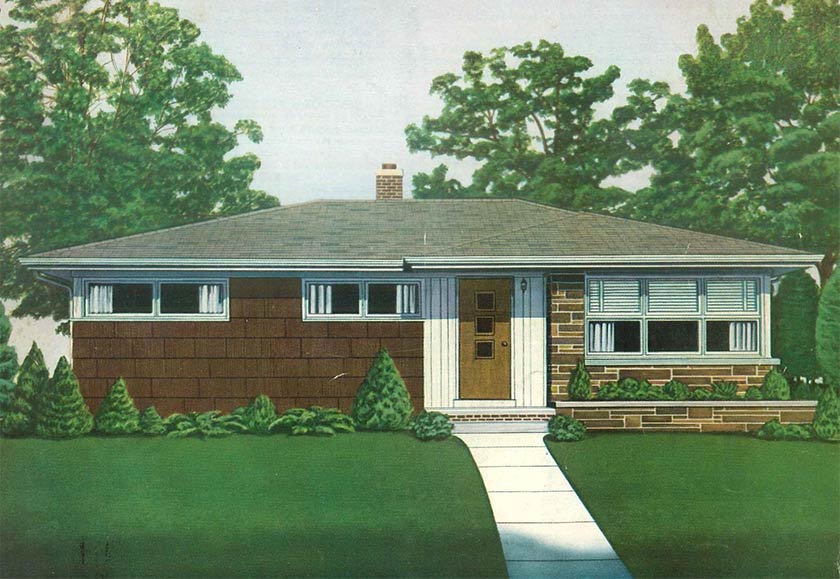
Though set in Indiana, in the American Midwest, it was actually filmed in Mobile, Alabama, in the southeastern US. That Spielberg could make this substitution tells us something: American suburbs are American suburbs, utterly interchangeable. Or, if you prefer, universal. The house that played the part of the Neary home is in a post-World-War-II housing development called Colonial Heights – an arrangement of near-identical single-storey houses along meandering streets designed to go nowhere in particular. It is a classic example of ‘tract housing’.
From ‘Homes for Your Street and Mine’, 1950, via Archive.org.
Tract housing, sometimes known as ‘cookie-cutter housing’, was primarily a post-World-War-II phenomenon. As the US population grew, increasing by 50 per cent between 1940 and 1970, millions of Americans moved from rural settlements into urban and suburban settings. By 1970, there were around 75 million Americans living in the suburbs – more than the entire population of the UK.
This suburbanisation was brought about by the advent of techniques for mass-producing appealing homes, and of heavy-duty construction vehicles which made it possible to clear great areas of agricultural land, wilderness or even desert plains. Hills could be flattened, terracing imposed, and landscapes composed – new spaces into which thousands of individual homes could be dropped with maximum efficiency.
The most famous examples might be the Levittowns built by Abraham Levitt & Sons in New York, Pennsylvania, New Jersey, Puerto Rico and Maryland between 1947 and 1970. The houses were built on production lines and could be erected in a single day.
While many applauded the democratisation of home-ownership this brought, the uniformity of this new suburban architecture – it’s sheer bloody munciness – unnerved some. What had happened to American individualism? A 1950 catalogue for the tellingly named Standard Homes Company entitled Homes for Your Street or Mine boasts that the designs within were ‘standardized to avoid waste… America’s best planned small homes’. The utopian illustrations depicting ‘The Lorain’, ‘The Lexington’, ‘The Wayne’ immediately bring to mind Spielburbia.
These suburbs also came in for criticism from those who saw in them the potential for ever-greater alienation and detachment from society – where were the neighbourhood bars or diners? Where were people supposed to congregate when not at work? Ray Oldenburg, author of The Great Good Place, published in 1989, saw the loss of this vital ‘third place’ from American culture after World War II as the root of many societal ills:
What opportunity is there for two men who both enjoy shooting, fishing or flying to get together and gab if their families are not compatible? Where do people entertain and enjoy one another if, for whatever reason, they are not comfortable in one another’s homes? Where do people have a chance to get to know one another casually and without commitment before deciding whether to involve other family members in their relationship? Tract housing offers no such places.
Ira Levin’s 1972 novel The Stepford Wives, made into a film in 1975, takes the uniformity of suburbia to its logical conclusion – if all the houses are the same, why not all the people? His sour, satirical take has housewives killed and replaced by compliant robots.
Spielberg isn’t unaware of suburbia’s downsides. As Roy Neary has his breakdown in Close Encounters, for example, the neighbours gather to watch, gawping from their driveways or leaning out of bedroom windows. When he speaks to them – ‘Good morning!’ – they ignore him. These people are crammed together and yet miles apart. But, overall, his take on suburbia is fond.
Spielberg himself grew up in just such a post-war neighbourhood, in Phoenix, Arizona. Joseph McBride made the pilgrimage while researching his 1997 biography of the director:
When a visitor enters Steven’s old neighborhood in Phoenix today, with its 1950s-era ranch houses still lining a broad, tranquil street crisscrossed by friendly kids riding bicycles, the feeling is inescapable: You’re not only going back in time, you’re entering a Spielberg movie.
Nowadays, anyone can visit Spielberg’s childhood home at 3443 North 49th Street thanks to Google Street View and to do so is startling – McBride is absolutely right, and it’s easy to imagine Spielberg location hunting, always seeking somewhere that felt just like home. Whereas others of his generation rejected suburban upbringings and wrote songs or novels mocking square life, Spielberg apparently yearned for it.
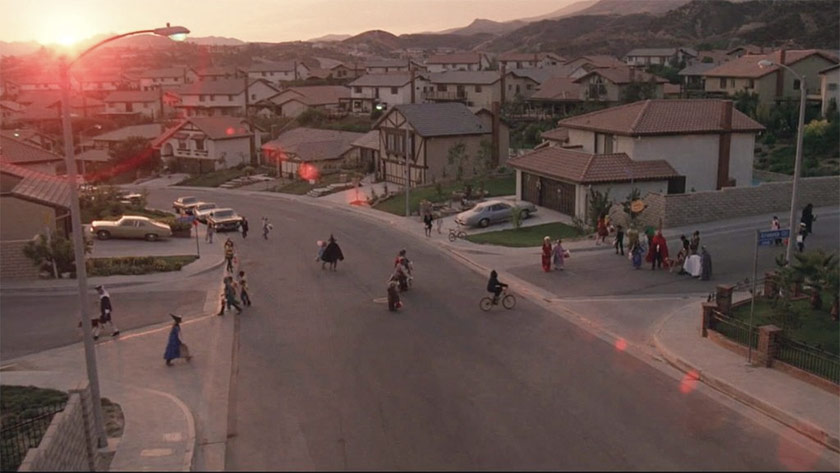
A scene from E.T. the Extra Terrestrial
The two films in which Spielburbia really comes into focus are both from 1982: E.T. the Extra Terrestrial, directed by Spielberg, and Poltergeist, which he wrote and produced.
E.T. takes the growing list of tropes – or tics, perhaps – from Jaws and Close Encounters and amplifies them. For example, Spielburbia is defined by an abundance of mass-produced toys. In Close Encounters, Roy Neary tinkers with a model train set while a music-box in the shape of Pinnochio plays ‘When You Wish Upon a Star’. By the time we get to E.T., however, with the action playing out primarily in an eleven-year-old’s bedroom, there are moments when it feels like a commercial. ‘This is Greedo,’ says Elliot, showing his friend from outer space his Star Wars figures, ‘and then this is Hammerhead. See, this is Walrus Man. And this is Snaggletooth. And this is Lando Calrissian.’ A Texas Instruments Speak’n’Spell machine is even part of the contraption E.T. builds to ‘phone home’.
In E.T. we’re treated to sweeping crane shots of the suburb, filmed and set in the San Fernando Valley outside Los Angeles, and the majority of the action takes place there. Children on BMX bikes use their knowledge of the topography – its back alleys, broken fences and empty lots – to evade capture. Near the end of the film, a glimpse of a half-finished development on a new tract of land, into which the children escape, threatens to turn this into a film about the suburbs. Poltergeist, released in the same month of the same year, completes that journey.
The family man at the centre of Poltergeist, Steve Freeling (Craig T. Nelson), doesn’t just live in a suburb – he’s a salesman for the development company that built the bland but pleasant Cuesta Verde estate. Early in the film, director Tobe Hooper plays a sly trick, fading from a shot of the cluttered Freeling family kitchen to what looks like the same room stripped bare. Then Steve walks in with a couple who are considering buying what turns out to be a different house. ‘l can’t tell one house from the other,’ says the potential buyer.
At first, Cuesta Verde seems almost perfect, with all the Spielburbian signifiers. Then its flaws become apparent – the houses are crammed so close together that the Nearys and their neighbours keep switching the channels on each other’s TVs. As the haunting begins we learn that the truth is grimmer yet: the land on which the houses were built was a former cemetery and though the headstones were moved, the corpses were left in place beneath backyards and porches.
Perhaps this is the moment where Spielberg soured on Spielburbia, or at least moved on. He would not himself direct or write any more films with this setting, leaving his disciples to carry the baton.
If 1982 had the ‘Summer of Spielberg’, 1985 was the summer of Spielburbia, seeing the release of four notable films in the sub-genre.
Back to the Future was written by Robert Zemeckis and Bob Gale and directed by Zemeckis, with Spielberg in the producer’s seat. Like Poltergeist, it offers a critical portrayal of the suburbs, taking advantage of the time travel plot to show a post-war Californian development, Lyon Estates, in both its well-worn 1980s incarnation and as a mere aspiration in 1955. ‘Live in the home of tomorrow…. Today!’ reads an advertising hoarding outside gates which open onto a tract of dusty land that is naked but ready.
The Goonies, directed by Richard Donner and based on a story by Spielberg, who also hovered around the set. It takes elements of E.T. – the child’s-eye view, the pursuit by sinister adults – and fuses it with the skeletons, subterranean tunnels and treasures of the Indiana Jones movies.
Neither Explorers, directed by Spielberg protege Joe Dante, or D.A.R.Y.L, had any involvement from the man himself, but both took components of Close Encounters and E.T., shook them up and glued them back together.
Even after 1985, the films kept coming – Flight of the Navigator and The Boy Who Could Fly from 1986, for example – but Spielburbia began to feel like a cliche and the movies like ever-weaker echoes.
Then, in 1989, Joe Dante directed The ‘Burbs, which might be said to put a neat full stop on this first phase. Dante’s films always walk a fine line between sincerity and satire and The ‘Burbs, which features Tom Hanks in an early outing for his ‘America’s Dad’ persona, tackles the strangeness of the suburbs head on while also celebrating them. Unlike Spielberg’s own suburban-set fantasies, which used real streets in real towns, The ‘Burbs was filmed on the backlot at Universal Studios. It used a set known as ‘Colonial Street’ which you will have seen in hundreds of TV shows and films – The Munsters lived there, as did the Desperate Housewives.
For twenty years or so after The ‘Burbs, Spielburbia was more or less neglected on film, even if a generation of us homesick for it, and for the comfort of childhood, drifted back there when the opportunity arose. Then in 2011 one of those children, director J.J. Abrams, revived Spielburbia in his own film, Super 8. Set in Ohio in 1979, it takes the masterlist of tropes and ticks them off one by one as a band of plucky kids on bikes take on both aliens and the military-industrial complex. It kicked off a run of similarly self-conscious homages including, most notably, the Duffer Brothers’ Netflix-produced Stranger Things, now approaching its fourth season, as well as a distinctly Spielburbian take on Stephen King’s scary clown story IT spread across two films.
What are people yearning for when they watch these films and TV shows? For some of us, it’s straightforward nostalgia for the pop culture we consumed as kids. For others – those who grew up in Ronald Reagan’s America – it must be a fond memory of a time when things felt less complicated.
And, dare I say it, Spielburbia is terribly, unashamedly white. Not only are there no black neighbours but scarcely anyone not presented as Anglo-Saxon or Irish. The first Levittowns were explicitly racist, with contracts stipulating that only members of ‘the caucasian race’ were allowed to buy or let. Spielberg, who often describes himself as having been the only Jew in his neighbourhood as a child, even turned Jewish actor Richard Dreyfuss into Roy Neary, apparently an Irish-American. It’s a dream of the 1980s as the 1960s or 1950s – a continuation of the American Graffiti tendency of Spielberg’s friend and frequent collaborator George Lucas.
More than anything, though, Spielburbia is a mood. Whatever outlandish events might be occurring, thanks to Industrial Light & Magic or the devil or visitors from space, as viewers, we’re invited to remember the best moments of being eleven years old. We’re reminded of sharing meals with our imperfect parents, around cluttered tables, knowing that there were toys to be played with upstairs and outside, in the golden light of the evening, streets to roam. Whether it’s Muncie, Indiana, or Bridgwater, Somerset, or a muddling of the two in memory, the feeling is real.
This piece originally appeared in the ‘zine The Happy Place published by the Bristol Writers’ Group in June 2020. You can still get paper copies. Our next ‘zine, Stepping Out, is due imminently and we’ll be performing new pieces as part of the Bristol Festival of Literature on 21 October. Get a ticket here.
A few people have asked if there’s another novel on the way, and there is.
As if today, 29 June 2020, I’m 47,500 words done on another crime novel, which will be 80-90,000 words when complete.
This one is set in Bristol in the 1950s and features a character I hope will fuel an entire series of books – a detective, of course.
I like him a lot. He’s not boring. He doesn’t listen to opera or drive a vintage car. He does things I don’t expect him to do – always pleasing.
I’ve been sharing chunks of it with my writers’ group for a while and so far, the reactions have been largely positive. And it can be a fairly brutal forum, so this is encouraging.
I’ll be honest, writing during the height of the coronavirus crisis wasn’t easy.
It didn’t seem important, for one thing – at least not as important as refreshing Twitter every five minutes for a fresh shot of condensed doom.
At the same time, when I did sit down to wrote, constant background anxiety made every word harder to extract.
I’m in the flow, now, though, thank God.
One job I’m not looking forward to is rewriting the whole thing in the present tense. Having devoured a few currently popular crime novels, I decided to give it a go and it was an obvious, immediate improvement.
Books set in the past always bear the risk of feeling distant; this small tweak transports the reader and makes the action feel way more vivid.
But 40,000+ words now need fixing.
I guess it’s one way to force a close edit of my own text.
At my current pace, it should be done by the end of September. Then I need to put it aside for a while, rewrite, edit, edit, edit, edit and…
Send it away with great hope and low expectations in January 2021, perhaps?
Here’s the story: I like rummaging through boxes of ephemera in bookshops and antiques markets, which is how I came across my original copy of the 1968 booklet Modern Buildings in Wessex by the architectural critic Stewart Brayne.
I bought it for 50p because of my interest in post-war buildings but soon discovered that there’s a lot more to it than that.
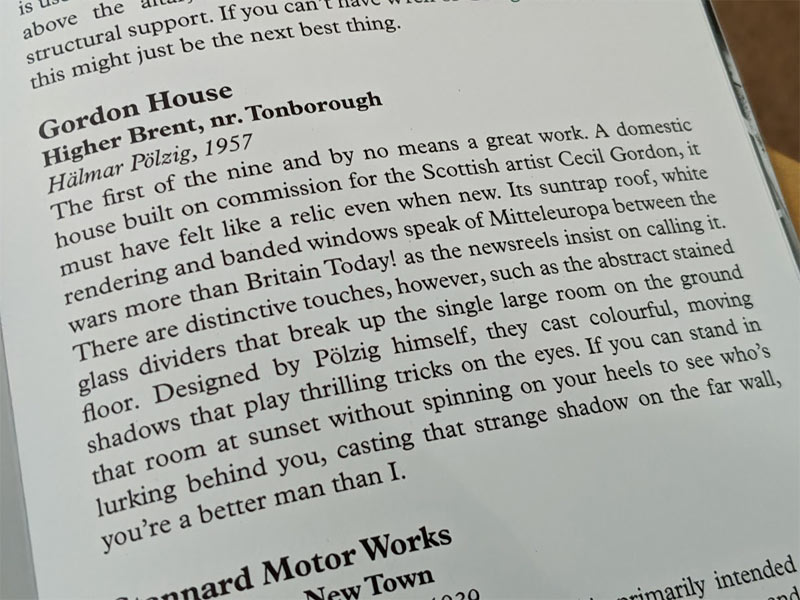
Among notes on schools and civic centres, there are entries concerning the work of émigré architect Hälmar Pölzig who built extensively in Wessex:
And that’s just the start…
* * *
I really do like ephemera.
And I really do like post-war buildings, especially as described by Ian Nairn.
Nairn’s London from 1966 is one of my very favourite books, especially this entry:
I also love the stories of H.P. Lovecraft and M.R. James, Universal horror films, folk horror and all that eerie Scarred for Life TV from the 1970s and 80s.
I first wrote a version of this story 15 or more years ago, with a character inspired by Nikolaus Pevsner exploring the buildings of a backwater Somerset town. It was a rewrite of ‘Shadows over Innsmouth’, essentially, and didn’t quite click.
Somehow, though, it must have been locked away in the back of my brain, evolving and ripening, until a few weeks ago, I suddenly thought, oh, yeah, that’s how to do it.
It’s not just a short story – it’s an object, a work of pastiche.
I’m really happy with how it’s turned out, from the typography (like Nairn’s London, the body copy is set in Plantin) to the photos to the cover design.
I’ve only had 50 copies printed because, honestly, when you draw a Venn diagram of people who like Ian Nairn and those who like creeping horror, I don’t think the overlap is huge.
If you want a copy, get in touch. It’s got 20 pages and costs £5 delivered. Email me (raymondnewman@gmail.com) or DM via Twitter (@MrRayNewman) to sort out payment and postage.
The final book for this year’s reading project is a suitably dense full stop of a novel that forced me to attempt a revival of long-dormant skills of critical interpretation.
Günter Grass’s magic-realist historical epic was published in German in 1959 and in English in 1961. Grass, born in 1927, served in the Waffen-SS as a conscripted child soldier at the end of World War II. He won the Nobel Prize for Literature in 1999.
A very brief summary: Oskar Matzerath is born in Danzig, a city both German and Polish, in 1921; at the age of three, he decides to stop growing, and so remains a child throughout the rise of Nazism; he expresses himself through compulsive drumming and, every now and then, by smashing glass with his scream. Oskar’s family evolves, dissolves and reconstitutes as he falls into the orbit of one character after another, from Bebra the Nazi propaganda dwarf to the bedridden jazz musician Klepp. The war ends, Danzig becomes Gdansk, Oskar decides to give up his drum and grow, at last, before washing up in Düsseldorf and, finally, a madhouse.
You could, I suppose, take it at face value as a macabre fantasy story about a man-child with supernatural powers. As a Stephen King novel with extra eels, however, it’s a failure, being episodic, rambling and bewildering for long stretches.
No, it’s obviously about Germany and the madness of the 20th century. The reader’s job is to unpick more specific meaning from the rock-slide of imagery and symbolism.
Let’s start with the easy stuff, then: Oskar, who cannot say for sure whether his father is the German Matzerath or the Pole Bronski, represents Danzig-Gdansk, or Prussia more generally. Both he and the city exist in a state of permanent, unsustainable tension.
What about the horse’s skull crawling with eels the sight of which makes Oskar’s mother vomit before driving her to commit slow suicide by gorging on fish? This feels like a pivotal moment and suggests war, holocaust and the destabilisation of Europe through its infestation by nationalism. But it’s also about the human body – we all rot, we’re all meat and slime and bone.
The erotics of disgust are a constant theme throughout the book. Bullying children make Oskar eat a ‘stew’ of bodily fluids; the smell beneath his grandmother’s skirts reminds him of mushrooms; his first lover eats a particularly stomach-churning mixture of Oskar’s spit and sweet ‘fizz powder’; he fondles the beautiful scars that cover the back of a pugnacious acquaintance; another lover wallows, unwashed, in a filthy bed; Oskar pickles the severed finger of an almost-lover retrieved by a rented dog from a field of tall grass; and so on.
Oskar, the deformed, malevolent pervert, stands for Germany, a deformed, perverted nation.
It’s hard not to see Oskar’s reluctant decision to abandon his drum and start the agonising business of accelerated growth after the war as a reference to West Germany’s apparent overnight conversion into a modern, prosperous nation. Oskar almost seems to become respectable, self-sufficient and productive but the veneer is thin: at night, he’s still capable of crawling naked into a hallway and writhing on the coconut matting in a kind of sexual fit.
I’m going to be thinking about this book for a long time, I suspect, and dipping back in to enjoy, if that’s the right word, specific episodes.
The account of a post-war Düsseldorf nightclub where people peel overpriced onions and join in bouts of collective crying, for example, or Oskar’s tour of the concrete fortresses along the Normandy coast as part of a wartime cabaret troupe, both work as unsettling short stories.
What does it tell us about 1959? Nothing new, perhaps, but it underlines the dominance at this precise moment of the twin topics of sex and war. If processing the war was difficult for American and British writers, it was altogether more intense for Germans, forced to contend with guilt, the redrawing of borders and the snapping from existence of entire cities.
A version of this piece appeared in The Modernist magazine for spring 2019 which had the theme of ‘Infrastructure’. You can buy a copy here.
Throughout the 20th century, Bristol’s civic leaders bet everything on roads.
First, they ran a dual carriageway through Georgian Queen Square in the 1930s, bending it around an equine statue of William III.
Then in the 1960s, “it was decided to provide for UNLIMITED CAR ACCESS to the City Centre”, as Dorothy Brown explains in her 1975 booklet Bristol and How it Grew. “Planning was dominated by road engineers who were allowed to create out-of-scale 6-lane throughways, enormous roundabouts and motorway-standard curves, right in the middle of the city.”
In 1967 they installed a flyover near Temple Meads, simultaneously dominating and pathetic, resembling a rollercoaster as much as a road.
Plans for a grand Outer Ring Road, with a projected completion date of 1975, were abandoned, but parts did appear – stuttering into existence at the Cumberland Basin and Hotwells, and at Lawrence Hill roundabout.
Everywhere pedestrians were shoved into underpasses, herded along streets in the sky, or forced to wait at at anxiety-inducing crossing points.
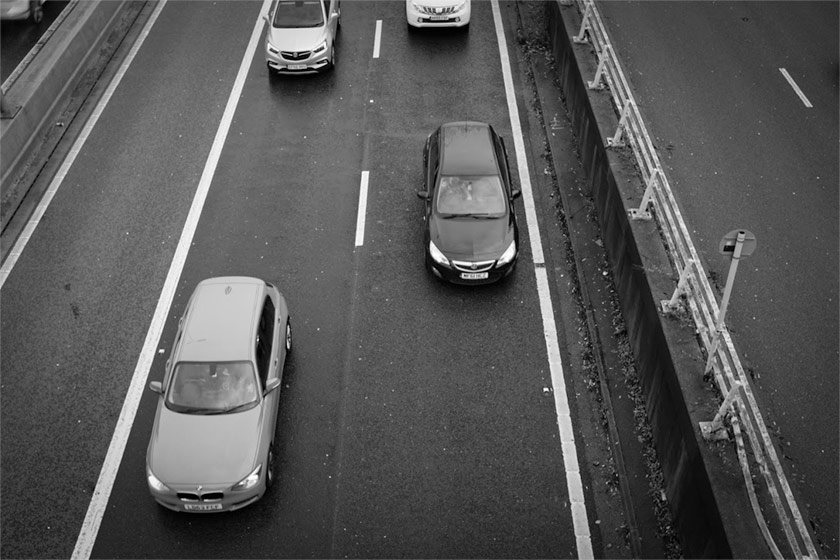
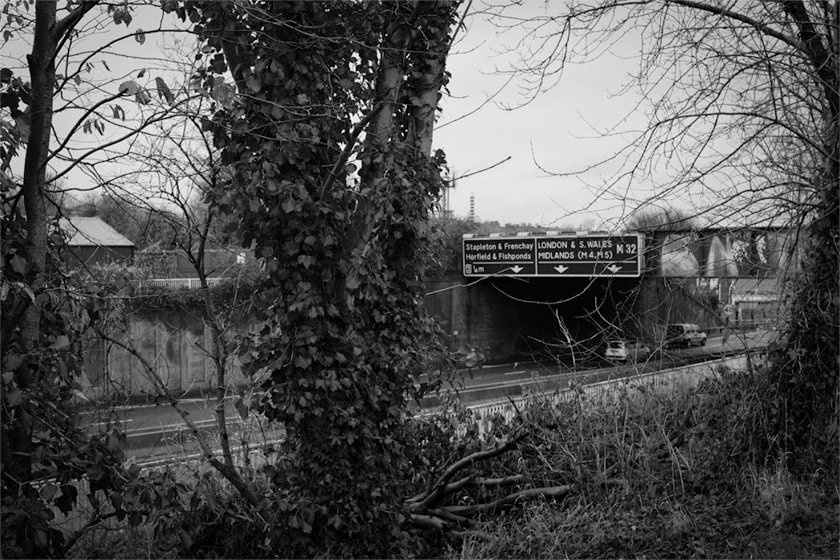
The M32 was part of this unfettered road-building strategy and one of few parts that was completed, and that remains in place. The first stretch of motorway opened in 1966, then a second in 1970, and the final length in 1975. It is generally spoken of as a scar, an eyesore, or even a ‘dagger into the heart of Bristol’, reflecting the trauma of its birth.
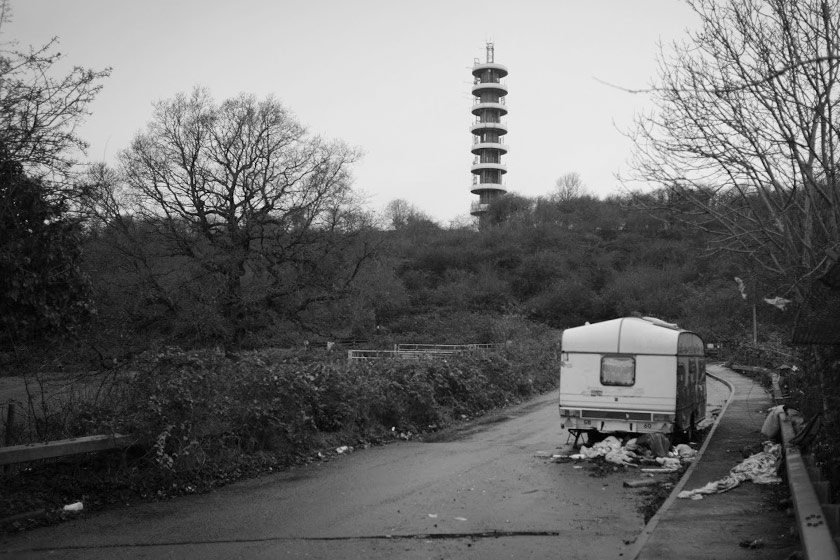
To enable its construction, families were forcibly relocated to new estates, houses were demolished, streets cut in two, and communities broken apart. The new borderlands, bristling with brambles and dead ends, attracted graffiti, fly-tipping, muggers and caravan shanties. In 2018, the outrage might have died down, but resentment lingers.
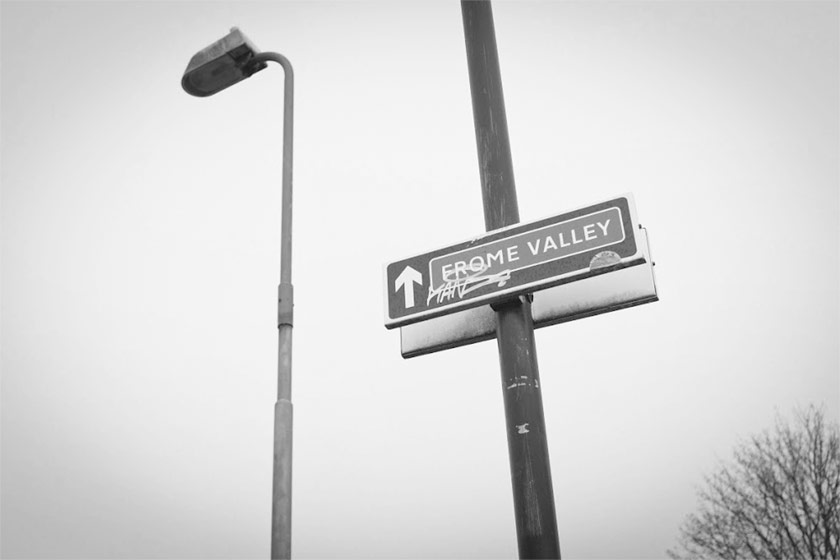
Infrastructure is usually intended to be invisible, or hidden, or at least ignored. Accordingly, pedestrians are held at arm’s length from the M32 for much of its four-and-a-half miles, as it cuts through Bristol, up the Frome Valley, and out into the Gloucestershire countryside.
It grows out of a dual carriageway in the city centre, like a river taking on tributaries, finally bursting into full being at Junction 3, in a frothing tumble of looping slip-roads and subways.
This is where the fences and walls go up, grey blocks and corrugated metal, protecting walkers from the roaring road, and the road from the strange behaviour of pedestrians. LET BRISTOL BREATHE reads repeated graffiti; LAND OF HOPE & GLORY says a banner on the bow of a concrete bridge, promoting a YouTube channel.
Between St Werburghs and Easton, the motorway is pushed down into a deep cutting, and the path is pulled away from the road’s edge. Through black branches in buffering parkland there can be seen the odd glimpse of grey, the blue shimmer of overhead signs, the roofs of lorries whipping by. But the sound – the waterfall rush of rubber on asphalt – is swallowed.
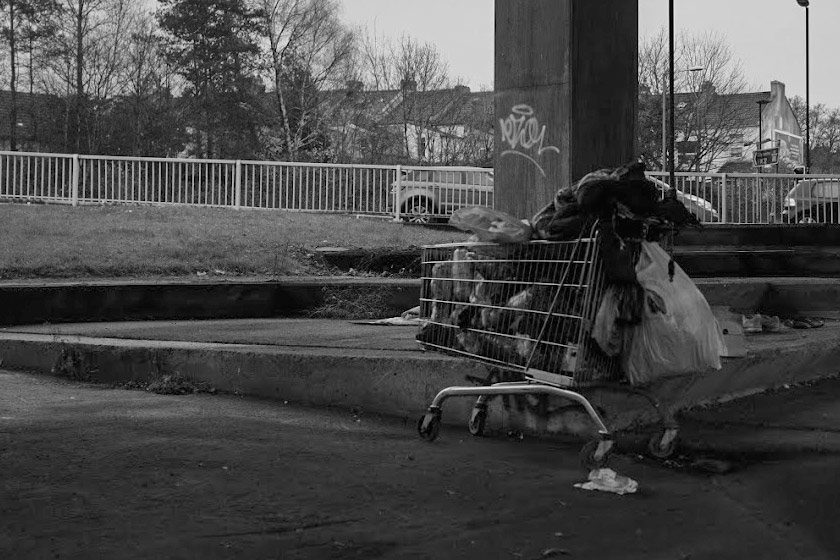
Then it rises again, shooting above the rooftops, launching traffic into the sky, and pedestrians are allowed back, this time into the void left beneath the road. The space is extraordinary, a world of monumental columns and holy reverberation. People live here, in permanently parked caravans or converted vans, or curled up next to shopping trolleys full of possessions.
Thin men in broken trainers conduct urgent, secret business in underpasses. In the deepest shadows, children, teenagers, young adults, and adult adults, send skateboards scraping and clattering, up and down graffiti-covered ramps.
And then a symbol just too on the nose: the River Frome emerges from its man-made tunnel, following the course of the motorway for a few hundred metres, fenced in and covered.
At Eastville roundabout it reaches a crescendo of on-ramps, off-ramps, levels and layers. Pedestrians are directed to hostile above-ground crossings, or channeled into subways where leaves and litter drift. One one side is the landscaped anti-wilderness of Eastville Park. On the other, soot-soiled suburban houses, and Pur Down, with the ever-watchful telecommunications tower like something from a Simon Stålenhag painting.
As Eastville becomes Stapleton, the motorway curves off across Bridge Farm, where trespassers are not welcome. It doesn’t appear again until the bridge at Heath House Lane where parked vans advertise breakdown services and fly-tippers ignore ‘No Fly Tipping’ signs.
Scrambling up to wind-battered Stoke Park reveals the stroke of the motorway laid out almost in its entirety, headlights like tracer fire connecting the city with its target.
Even if the Queen Square carriageway has gone, even with the Temple Meads flyover demolished, the 20th century at least left its signature here – careless, but with a certain elegance, and distinct vigour.
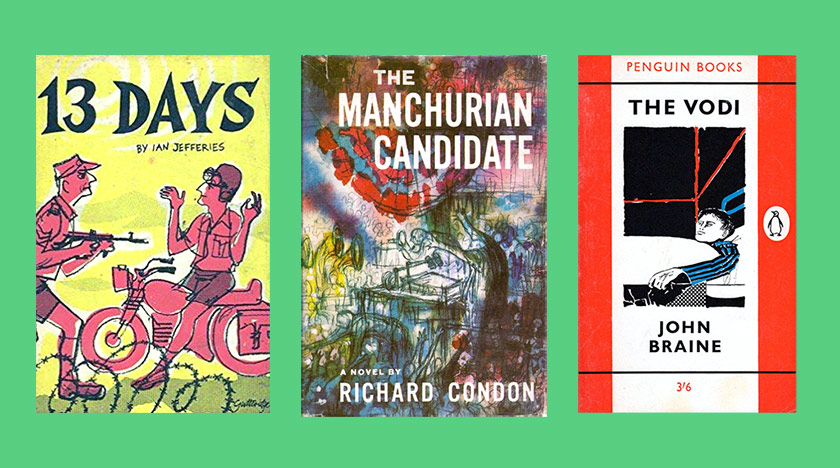
The three most recent books in my #reading1959 project were Thirteen Days by Ian Jefferies,The Manchurian Candidate by Richard Condon, and The Vodi by John Braine. They fit together oddly well.
One common theme emerging in many of the books from 1959 I’ve read this year is the legacy of war – PTSD, institutionalisation, lives arrested or derailed, and a sense of the world recovering from a nervous breakdown.
The Manchurian Candidate takes the Korean War as its starting point, telling a wonderfully compelling story of paranoia and brainwashing. The 1962 film is better known than the book and perhaps rightly so: the book was essentially written as a movie pitch and is far less subtle or convincing. In fact, it’s positively baroque.
Sergeant Raymond Shaw is an unlikable man, unpopular with his platoon. He is identified by a Chinese-Soviet brainwashing project as the perfect candidate to be programmed as an assassin, not least because of his privileged upbringing as the stepson of a rapidly rising American politician.
The early chapters, set in Korea and depicting the brainwashing in progress, are the best. Shaw’s cold-blooded murder of his comrades, under hypnosis and in front of an audience of Communist dignitaries, is chilling.
There’s also something grimly fascinating in Shaw’s uneasy friendship with his former commanding officer, Ben Marco, each having been forced to like the other through hypnotism. There’s material enough there for an entire extra novel.
Shaw’s mother is the other standout character – a controlling, social climbing psychopath who nailed a puppy’s feet to the floor as a child and maintains her perky attitude with shots of heroin between embassy balls. She both uses her son for political gain – the Chinese fix it so that he is awarded the Congressional Medal of Honor, making him a valuable PR tool – and (just when you think it can’t ramp any higher) seduces him while he’s hypnotised.
What makes the book difficult to enjoy in 2019 is exactly that hysterical, over-the-top tone, which carries through into the writing style. It’s part wannabe beat prose, part Mickey Spillane, all pure ham:
There is an immutable phrase at large in the languages of the world that places fabulous ransom on every word in it: The love of a good woman. It means what it says and no matter what the perspective of or stains of the person who speaks it, the phrase defies devaluing. The bitter and the kind can chase each other around it, this mulberry bush of truth and consequence, and the kind may convert the bitter and the biter may emasculate the kind but neither can change its meaning because the love of a good woman does not give way to arbitrage.
The typically pulpy attitude to women doesn’t help, either. We’re supposed to like Marco and root for him, for example, but he uses women and even occasionally hits them if they won’t do what he wants, the latter being presented as evidence of his impressive virility. No thanks. Otherwise, women are mad bitches (see above), sexy angels (Marco’s fiance) or plot devices to move forward the stories of Important and Vigorous Men.
***
Thirteen Days (or 13 Days in some printings) is also about foreign wars and the madness they encourage in otherwise ordinary men.
Set in Palestine in 1948, it presents another Sergeant, Sergeant Craig of the Royal Engineers, who has embraced the chaos and corruption of the Middle East and lives a maverick life of arms smuggling and artful skiving.
A characteristic moment is his admission that, building a vital water storage tank for a far-flung British Army base, he made up for a lack of concrete by using boulders in the foundations, only because of a lack of boulders he actually used dead donkeys: “What with the heat and everything they must have swelled. But anyway, the foundations cracked…”
Something about him brings to mind Len Deighton’s unnamed insubordinate spy, christened Harry Palmer on film, but Craig also has something in common with the protagonist of Absolute Beginners– a young man who’s not quite as hard or impervious as he likes to think.
When idealism surfaces, unexpectedly, he becomes allied to the Jewish cause, falls in love with a beautiful young woman who works as a driver for a paramilitary group and ultimately has his heart broken when all this proves to be more than a game.
The details of Army life and of the landscape are well drawn, clearly based on the author’s own first-hand experience (Ian Jefferies is a pseudonym), as is the sense of detachment and unreality triggered by being forced to live so far from home, with so little purpose.
Thirteen Days is an interesting book but hard to latch onto: is it supposed to satire, or a straight-up thriller? (Check out the cover, above, which suggests Doctor in the House.) It succeeds best when it settles on the latter and gives us a stretch of suspenseful action into the finale.
***
John Braine’s The Vodi is a peculiar and rather brilliant book, up to a point.
Dick Corvey is recovering from tuberculosis in a sanitarium in the north of England from where he reflects on his life and misfortunes, battling the onset of bitterness as much as TB.
What gives the book its interest is the bleakness of tone – the north here is all shadows, decay and drizzle – and, of course, the Vodi. The Vodi is an organised crime gang made up of goblin-like minions under the control of the monstrously fat Nelly. The Vodi controls the district, torturing and ruining the lives of its victims, primarily out of spite. There’s a hint of Arthur Machen in it but also of Cruella De Vil.
Dick and his best friend Tom invent the Vodi as boys but Dick persists in clinging to the idea as a luckless adult. A key moment in the book, the point at which Dick and Tom diverge, is when Tom disavows the existence of the Vodi immediately after his first sexual experience with a girl. Tom goes on to take control of his own destiny, embrace risk, and eventually finds success; Dick bounces from Army to clerical job to sanitarium to sanitarium job, passive and pathetic.
And that’s Braine’s argument, in the end: that you have to fight, strive and desire. Only when Dick falls in love with a nurse, Evelyn, do things change for him. Evelyn loves him but becomes engaged to another man because she can’t bring herself to shackle herself to a sad case like Dick. Tempted as he is to blame the Vodi and surrender, his passion for her prompts him to discover the inner resources he needs to overcome the disease and make the bold decisions necessary to become a full personality.
***
War, the maddening power of institutions, sinister controlling forces, the struggle to work out what being a man really means… As the final stretch of #reading1959 begins, a thesis is certainly beginning to form.
And though this wasn’t the plan when I started out, it’s all proving very handy for my current writing project, a crime novel based on a true story and set in the late 1950s. Surface detail is easy but I feel as if I’ve really got into the psychology of the time.
Why is my novel called The Grave Digger’s Boy? Well, finding out is part of the fun, but here’s something I’ve kept a bit quiet until now: I’m a grave digger’s boy.
For a year or so when I was at junior school, my dad had a job as a grave digger for the council.
At the time, I thought this was pretty cool. I enjoyed telling other kids who would either recoil or want to know more.
There certainly were macabre stories – days spent opening up old graves so the newly-dead could join their spouses or siblings, boots through the rotten lids of coffins, slips and falls among the mud and bones…
But it was also utterly mundane. Rotas and requisition orders, job sheets and sheds. Cheese and pickle sandwiches in the back of the van, sheltering from the rain.
Part of being a writer is throwing different ideas into your brain and letting them bounce around until they stick together in interesting ways.
So if The Grave Digger’s Boy is ingredient one, here’s number two, freshly added: John Braine’s The Vodi, which I came across as part of my #reading1959 project, has been described as ‘kitchen sink gothic’ – bleak social realism with an added flavour of the sinister supernatural.
Suddenly, I realise that lots of things I’ve written or have been working on that I’d thought were separate and distinct, aren’t.
For example, there’s my big work in progress – the epic novel I expect to finish in a decade or so that I jokingly refer to as War and Peace but set on a council estate. When I launched into writing last year, something happened that I hadn’t planned or expected: incidents of the uncanny began to manifest in what was supposed to be raw realism.
Here’s an example, from the opening, set in 1957, as two central characters arrive at a half-built council estate after dark, late at night:
John Patrick slammed the brakes on and the little car jerked to a dead stop. He turned off the headlights and they sat in the dark as the engine ticked.
‘Will you bloody give over? We’re nearly there.’
Another sigh, softer, came from between her dark lips.
‘You’re gorgeous, you are,’ he said after a moment. ‘Like a film star.’
She tutted. ‘Well? Go on, you daft sod.’
He looked at her for a moment longer and then pushed a lick of his brown Bryclreemed hair back into place behind a big ear.
‘It’ll all look better in daylight.’
He switched the lights back on and they both started.
Staring back at them from the road was a big cat, as big as a man, with oily black fur and eyes reflecting back as yellow stars.
Irene shrank back in her seat.
The engine purred.
The cat licked its lips, yawned, and bolted away.
After a few seconds, Irene cut into the silence.
‘What the bloody hell was that?’
With a shaking hand, John took the cigarette from between his lips, snuffed it, and tucked it behind his ear.
‘A large female yaws,’ he said.
‘Yaws? What’s a yaws?’
‘A-Mild and a-bitter with a whisky chaser, a-thank you kindly.’
Elsewhere in the story, there’s the ghost of a dead sibling and an echo of Bella in the Wych Elm – “Who Took Mary Cook?” The UFO my dad swears blind he saw might turn up, too.
Another novel, abandoned for now, tentatively titled The Red Lodge, combines the case of the Lamb Inn haunting with the modern trend for buildings ‘protected by occupation’:
“Charlie boy!”
A hand on my arm, those fat digits digging into my bones.
“I’ve missed seeing you.”
“Hello, Uncle Bernard.”
His hand dropped away and he looked me up and down.
“You look like shit,” he said, rummaging in his pocket for a bunch of keys.
I said nothing.
He slapped flatfootedly towards the temporary steel gate with its warning signs and chains and opened the padlocks one by one.
Together, we dragged the gate across rough concrete, scratching a white semi-circle.
Bernard drew on his vape stick and exhaled a blueberry flavoured cloud around his unruly head as he considered the overgrown driveway.
“Got decent boots on? Let’s walk.”
I looked down at my well-worn, thin-soled Adidas trainers, but didn’t protest.
“It’s a lot of land,” I said, partly to break the uncomfortable rhythm of our synchronised steps.
Amid the brambles were the remains of concrete and brick structures, pieces of pipe cut off a few inches above ground, and chunks of rusting machinery. Here and there were burst bags of rubbish, hurled over the fence and left for rats and gulls to tear apart. A lone shoe grew moss.
“Lovely, isn’t it?”
He wasn’t being sarcastic – to Bernard, it really did look beautiful, a virgin plain beyond the frontier.
“They built parts for planes here before the War, until they moved production under Salisbury Plain.”
The house was getting nearer, flooding the horizon with a wall of red.
“There were Italian prisoners of war here until 1947, working on the farms.”
Beneath our feet, concrete gave way to smooth asphalt and Bernard began fingering his keys again.
We stopped at the doorway with its clamshell hood and four white stone steps as Bernard muttered to himself, irritated: “Fucking thing… Checked it before I left the office… Should have… Fuck sake…”
I could hear the motorway in the distance – a constant exhalation – and the wind shaking the brambles, but there was also something else – a high, secret sound.
In more concrete terms (no pun intended) is there perhaps something about the way the houses were constructed? In the Sunderland case journalist Ken Culley slept in the haunted bedroom but, despite apparently making every effort to spook himself, saw no evidence of anything supernatural. What he did observe was that the construction of the house made it simultaneously cold and stuffy, and that opening the window caused a localised breeze to swirl around the foot of the bed, numbing his feet. Light and airy may have been the intention but large rooms with high ceilings, sparsely furnished, offer great potential for echoes, reflections and strange circulations.
Focusing on the connections between all of this, more items from the memory banks presented themselves – a body of family stories, from the morbid Lancastrian side, that must have settled in my subconscious.
Greaty Aunt Ann, for example, who tried to kill herself by walking into the sea but came back to shore to get an umbrella when it started raining.
The great-great-uncle who tramped around the country during the depression of the 1930s sleeping in graveyards: “They’re safer than anywhere else; it’s the wick ‘uns outside you’ve to worry about.”
A vague tale of a relative, or family friend – urban legend, more likely – who worked as night-watchman at a funeral parlour and ran screaming from the premises when at two in the morning, through the action of tightening muscles and trapped air, a corpse sat up and groaned at him.
My grandmother’s story of a childhood acquaintance from Crawshawbooth who awoke to find a rat that had eaten its way into her bedroom from the attic chewing at the tip of her nose and cheeks.
My current project, which I’m unsubtly trailing on Twitter, sits in the same territory – the darkness of recent past, the modern world weighed down by the old, blood on the lino.
‘Kitchen-sink gothic’ is good – and there’s an anthology that uses that title. I gather ‘gothic realism’ is also a term that sometimes pops up. But I prefer ‘municipal gothic’, perhaps because it suggests a Venn diagram of two of my favourite projects, Hookland and Municipal Dreams.
I’ve been writing municipal gothic by accident until now but I reckon it’ll be deliberate from here on.
In search of obscurities from 1959, I decided to look through book review columns from that year in the newspaper archives.
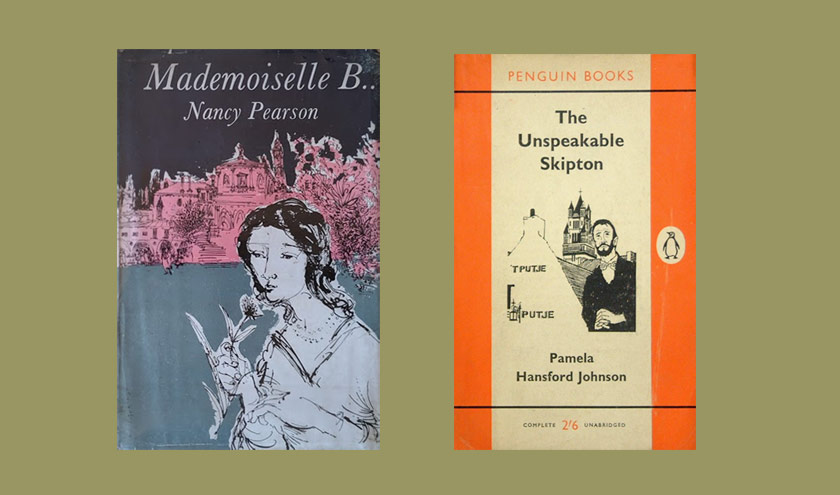
It was The Times that threw up The Unspeakable Skipton by Pamela Hansford Johnson and Mademoiselle B… by Nancy Pearson.
The former has gone into my top ten discoveries from this year. Pitched as a satire, it’s actually dreadfully sad, telling the story of a lonely, poverty-stricken English writer living in Bruges, pushing away anyone who might care for him.
A pompous, pretentious snob, Daniel Skipton regards himself as a Great Writer, having had limited success with a literary novel a decade or so earlier. He writes around 240 words a day of his new novel, filling the rest of his time with scrounging, petty con artistry and a little pimping.
The atmosphere is close to Highsmith’s Ripley novels or perhaps Simenon – oily canals, brown cafes, drab brothels and decaying aristocratic houses.
Though not a crime novel, it might be considered a story of suspense.
The book covers a few weeks during which a party of English tourists is in town. They’re drawn together because he hopes to exploit them, taking them to live sex shows and restaurants, while they find him amusing. Meanwhile, a wild card is in play – an Italian count who might or might not be what he seems.
I spent the last 50 pages fretting over whether Skipton’s rather pathetic Big Score would come together – as his guts growl and health fails, will he be able to afford to eat, or be sent back to scavenging in bins?
He’s not likeable, that’s the point, except that, as the book wears on, a grudging respect forms: he really is committed to being an artist and his constant hustling is in service of that ideal.
And the stream of spite is preemptive and defensive – he hates himself more than anyone else could possibly hate him.
And it turns out it’s still in print, so not obscure at all – I’m just ignorant.
What does it tell us about 1959? In some ways, it feels as if it could have been written in the 1930s, except that objects, attitudes and acts which might have been kept off stage two decades earlier are proudly out on display.
* * *
Mademoiselle B… is less brilliant but still deserves to be better known. Or at least known at all – Goodreads doesn’t even list it, as far as I can see.
It’s a short book, barely a novel, that seems to have been sold as a titillating tale of forbidden lesbian love.
In fact, it’s a gentle, melancholy story of a schoolgirl’s fascination with a young teacher who is either mad, or haunted, or a little of both.
The setting, a boarding school in France, is depicted in perfect detail, from the rotten stink of the canteen to the sinister presence of ever watchful, elderly surveillants. There is always discordant, hesitant piano music somewhere in the far distance.
Boredom and seclusion breed tension and send everyone slightly insane, turning petty disagreements into soap opera and crushes into great passions. When the narrator leaves the school to convalesce on the coast, and has the company of other young people in less Gothic surroundings, she all but forgets Mademoiselle B.
What I didn’t expect, but enjoyed enormously, was the supernatural element which gave a flavour of the Tanzschule from Argento’s Suspiria or one of those ‘women running away from a mansion at night’ paperbacks.
The girls all believe the school is haunted by its past residents, whose portraits hang on the walls, and Mademoiselle B seems especially sensitive to this idea. She feels their hands holding hers in the dark, they whisper her name, and one particular attentive ghost comes to her room at night.
At the great end-of-term ball with which the book climaxes, it’s strongly hinted that she might be right, as mysterious, uncanny masked figures mingle with pupils in fancy dress