Categories
Fiction

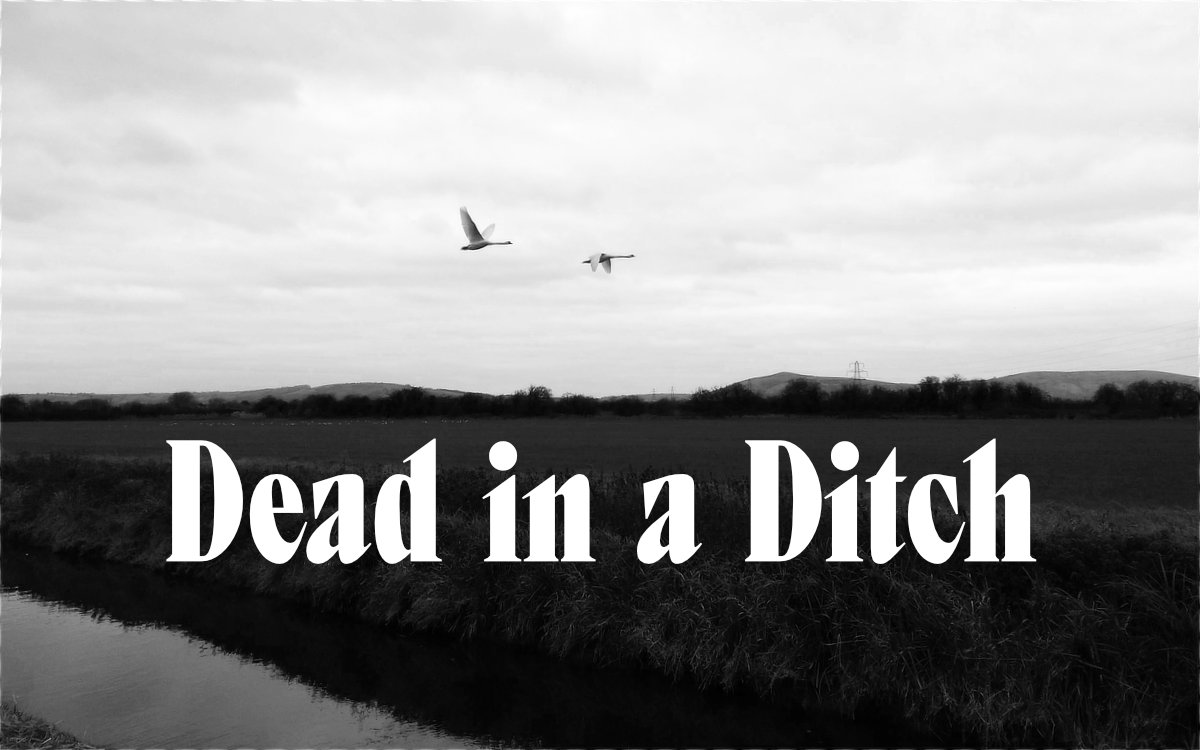
FICTION: Dead in a ditch

Where is the worst place you could end up haunting? I reckon my spots a contender. It was bad from day one, standing knee deep in the green water of a ditch, looking down on my own smashed body in the half-submerged hatchback.

Then it took them three months to find me, even right there by the main road between town and the village, because the reeds were high. I watched my body bloat and fart bog gas and liquify. I watched rats and insects help themselves to my flesh. I saw my bones emerge like the wreckage of a ship on the shoreline with the tide sliding out.

I tried not to look. I took an interest in the clouds in the big sky above the levels, and in the trees as they began to yellow at the edges and drop their leaves. I watched sunrises, sunsets, and stared at the stars – I could see them so clearly out there in total darkness. I counted cars, too, as they flew by. You’re going too fast, I thought, and remembered that people kept saying that to me, too.

Then, when the trees were bare with black branches, a car passed slowly enough that a child in the back seat saw the low sun catch the roof of the wreck. The car stopped at a layby a little way along the road into town. I could hear the burr of its engine and the tick of its hazard lights above the breath of the westerly wind. The police car came a little later and the road was closed. Then an ambulance. Then, just after dark, a forensics team with floodlights and tents. Finally, a pickup truck from a garage in town arrived and, by dawn, the car was gone, and it was just me and the dirty water around my jeans.

Mum and Dad came, parking at the roadside. Cars kept passing at twenty above the limit, one or two honking their horns in irritation at the blockage in the road. My parents couldn’t see or hear me as I murmured to them: ‘It’s alright, don’t miss me, don’t feel pain for me…’ Before they departed they left a stuffed monkey, a bunch of flowers in a heavy stone pot, and a card I couldn’t read. In the weeks that followed I watched the card blow away in the wash from an articulated lorry, the monkey turn ragged and grow green mould, and the flowers rot to black stalks. I didn’t see Mum and Dad again. I suppose they drove the long way round to town after that, so as not to have to think about me.

After a long while I got tuned into the other dead around and about. There was a pale smudge in the field opposite that I thought must once have been a woman. She seemed young and was always stooped, always weeping. The sound sometimes carried on the wind. She might have been there since the Civil War, or long before. One night in June I watched a Douglas C-47 with black and white invasion stripes on its tail pass silently overhead and fade out of existence somewhere over the old airfield. I learned that the famous Headless Horseman was real, too, though less glamorous than in the stories they told around town. He passed by, once a month or so, and was a nasty old thing. He had a dirty tunic streaked with brown blood and his head was in his lap, crushed and misshapen, but still screaming. He was always in a hurry to be somewhere. On summer evenings, if there wasn’t too much traffic, and the wind was right, I could hear the sounds of the battle of 1685 being replayed on the field outside the village. The teachers from the village school used to take us there to camp out, and tell us ghost stories as we toasted bread over a fire.

Years must have passed before I saw Dani again. I’d dropped her off in town before making that last journey and I suppose she had no reason to come to the village after I’d gone. Then one day, there she was, in the driver’s seat of her own hatchback, framed in the open window. She was a little older but no less beautiful. After the car had passed I realised there was also someone in the passenger seat. An hour later, she drove back and I saw her for another two seconds, a face in shadow, her hands on the wheel. I also saw that the man sitting next to her had a broad chest and tidy beard.

I’d always wondered how eternity would work. Wouldn’t you get bored? In life, I could hardly sit still, and was always after a distraction or a thrill. That’s probably why I drove so fast all the time, to feel not-boredom for a few minutes. But boredom, it turns out, is only a problem for the living. It comes out of being anxious the whole time about your status and how much you’ve achieved. It does us all right in the survival game. It keeps us moving and exploring. In death, though, you let time wash over you in an endless stream. I wasn’t waiting. I didn’t expect anything, or hope for anything. I just was, and just am.

If there was anything I longed for, and longing’s too strong a word, it was to see Dani again. When I died, the wires that connected me to the world were cut, but the cut wasn’t clean. An intermittent contact made me feel something, or remember how it felt to feel something, or something like that.

She passed along the road many times after that. Alone in the car; with the man; following a removal van; dressed for work in her supermarket uniform; dressed for a Christmas party in a sparkling silver dress, with the man in a shimmering suit; and in a wedding dress in a vintage car with ribbons tied to its radiator. Their car got bigger, the backseat gained a baby seat, then a baby, then two babies. They drove too fast, of course, because everyone did. The car hugged the bend, lifted a little one one side, always ready to tip.

Through cycles of sun and moon, summer and winter, flood and drought, I stood there with water boatmen skidding around my knees, and rats circling. The creatures knew I was there, somehow, in some simple way, because they never touched me, or went through me, or whatever would have happened.

There was no way for me to make any difference in the world, I knew that for sure. Still, I always wanted Dani’s car to break down as it passed me, so I thought hard about it, and one day, it did. I felt as if I’d made it happen. The engine cut out and she began to drift. She guided it into the verge and put on the hazard lights. Then she got out and walked along the road directly in front of me.

Her fine blonde hair had just begun to turn grey and there were new folds and grooves around her eyes. Speaking into her phone she said:

‘About halfway, yes, just past Crockford Farm.’

It was the first time I’d heard her voice in all these years and I experienced something like a memory of how it felt to yearn for someone. I remembered, for a sliver of a moment, how a sweet harvest apple tasted and what it meant to smell the sea.

While she waited for the mechanics to come, she leaned on a gate and, resting her chin on her arms, looked out over a field of yellow rapeseed.

Did she remember this was where it had happened? Did she ever know?

The recovery vehicle came, its orange lights throwing twists of fire on the surface of the filthy ditchwater. Within a few minutes the engine of her car was turning over. She put the radio on and I heard two bars of a song I didn’t know before she waved to the mechanic and sped off.

Over the years, Dani kept passing, back and forth, like an irregular pendulum, village to town, town to village. The car changed, and she changed, but I didn’t.

Her children got their own cars, which they drove much too fast, and I wondered if she ever used my story as a warning.

One day, after I suppose decades must have gone by, Dani appeared dressed in black in the back of a limousine, following a hearse.

A few years after that, the hearse passed again, and this time Dani’s children were in the black car that followed.

That night, the Headless Horseman passed, screaming mad, as usual. I screamed back.


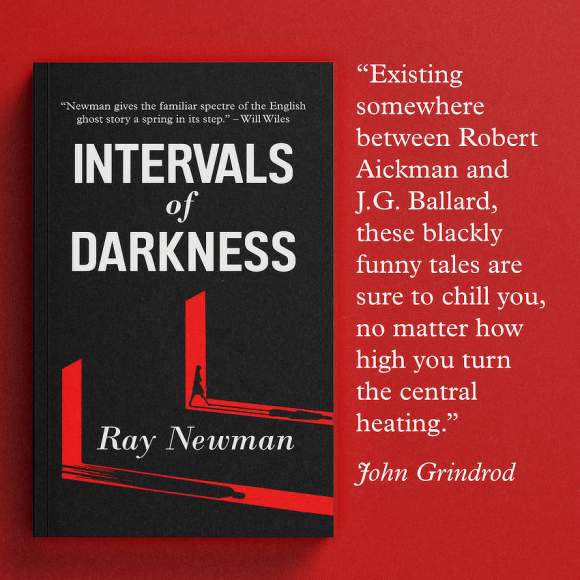
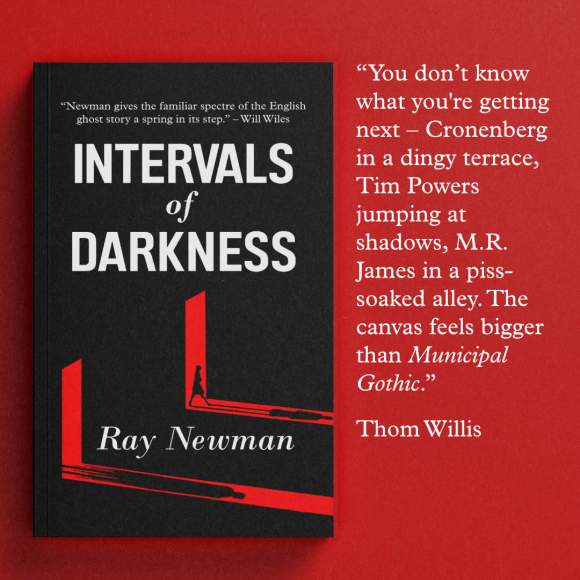
The cover of Intervals of Darkness with quotes from John Grindrod and Rowan Lee.

If you enjoyed this story you’ll probably also enjoy my collections Intervals of Darkness (2024) and Municipal Gothic (2022).

Categories
Intervals of Darkness

Introducing Intervals of Darkness

My new book, Intervals of Darkness, with 14 weird stories, is now out.

You can buy it as a paperback or eBook more-or-less anywhere in the world, including

From the ghosts of marching soldiers haunting marshland to delivery drivers lost in nightmarish tower blocks, and from reanimated skulls to psychogeographers encountering ancient spirits on council recreation grounds, it’s a wide-ranging collection direct from my subconscious to you.

I hope you enjoy it.

Praise for Intervals of Darkness

“Newman returns to haunted Britain with fourteen more wonderful stories… Fans of folk horror and weird fiction will find a lot to love in this collection.” – Rowan Lee in her review at The Harvest Maid’s Revenge

“Impressively eerie and packed with shocks, Intervals of Darkness ushers the reader through 1970s grime and Gothic opulence, with moments of powerful poignancy and startling strangeness. You’ll want to linger over these stories.” – Verity Holloway, editor of Cloister Fox and author of Pseudotooth and The Others of Edenwell

“Housing estates, factories, tower blocks and caravans, nowhere is safe from Ray Newman’s dark imagination. Existing somewhere between Robert Aickman and JG Ballard, these blackly funny tales are sure to chill you, no matter how high you turn the central heating. It’s every bit the equal of Municipal Gothic, and if anything it’s darker and stranger.” – John Grindrod, author of Concretopia, Iconicon and Outskirts

“You don’t know what you’re getting next – Cronenberg in a dingy terrace, Tim Powers jumping at shadows, M.R. James in a piss-soaked alley. The canvas feels bigger than Municipal Gothic.” Thom Willis, editor of Microwrites

“Witty, creepy, moving, and brilliantly written weird fiction…” – Jamie Evans

“Chilling, atmospheric and darkly witty.” – Stephen Graves, director of The Dead of Winter

How I wrote these stories

I’ve written a ‘behind the scenes’ breakdown of each story in the collection without, I hope, any spoilers. A friend has been reading each story, then reading my notes, and that’s probably a good approach.

Categories
Intervals of Darkness

Story-by-story: Industrial Byproducts

This is, I suppose, an example of working class, social realist body horror – a story about what tough work does to human flesh.

It started life as a passage in a novel I was working on which I used to describe, only half joking, as War & Peace on a council estate. Why should only aristocratic families get the dynastic epic treatment?

That book featured characters not based on members of my family, but certainly borrowing details of their biographies, and mannerisms, mixed up until they were no longer quite recognisable.

The specific incident that prompted this story, though, did involve my late father.

For a long stretch he worked nights as a lathe operator at a piston factory. He’d come home in the morning with curls of metal embedded in his fingers – like splinters, but worse. He or my mum would remove them before he could go to bed.

That also got me thinking about how my mum and aunties, and various women I worked with in factories, would eventually resign themselves to cropping their hair and trimming back their nails, to make factory work easier

‘Industrial Byproducts’ takes that process to its logical conclusion, perhaps also inspired by this amazing, or awful, advert from the 1980s which burned itself into my brain when I was a child:

I could tie myself in knots worrying about whether I’ve got all these details right, or whether they reveal some internalised snobbery, or whatever.

But if part of the point of writing is catharsis, and if we value honesty, I need to crush that urge to self censor. I need to let it, whatever it is, stream out.

The last lines of this story were painful to write. They’re even more painful to read back from the other side of the loss of my dad.

Catharsis. Honesty. Confronting the things that scare us most.

A quote from Verity Holloway: "Impressively eerie and packed with shocks... moments of powerful poignancy and startling strangeness. You'll want to linger over these stories." Next to it is the cover of Intervals of Darkness with a black background and red details. The illustration is of a person casting a long shadow. Nearby is another shadow suggesting a lurking but hidden figure.

Intervals of Darkness, a collection of 14 weird stories, is out today as an eBook and paperback:

Categories
Intervals of Darkness

Story-by-story: The Unbidden Guest

Funny story: I stole the title of this period horror story set in 19th century Milan from P.G. Wodehouse, who gave us ‘Jeeves and the Unbidden Guest’ in 1916.

For me, writing weird stories, or ghost stories, is often about an initial flare of inspiration, like the striking of a match.

When I saw the title of the Wodehouse story I thought: “Wow, that sounds like something from M.R. James or H.P. Lovecraft.”

I amused myself for a while by imagining how Jeeves might handle a haunting – “Perhaps you might invite one of your fellow members of the Drones Club, Mr Carnacki, to join us at Totleigh Towers, sir…”

Then, on holiday in Milan, the title popped up again and collided in my brain with a vague memory of The Aspern Papers by Henry James which I last read about 30 years ago, and the fantastic BBC film Schalcken the Painter, based on a story by Le Fanu.

Although most of my recent stories have had contemporary or post-war settings I’ve always enjoyed writing pastiche, and used to produce lots of faux-Edwardiana. So this was a slight departure, but not a major detour.

To get started, I found and devoured a slew of 19th century travel memoirs by British poets and writers, partly to train my brain on the prose style, and partly to, frankly, steal some of their descriptions of the historic city.

Having a narrator who is himself a stranger in town adds a degree of separation. If I get anything wrong, there’s his stupidity to blame.

Having ploughed through Byron at university, stanza after stanza, canto after canto, and Shelley as a teenager, I also enjoyed the challenge of writing some suitably bad poetry for my hero, James Lemuel Madin.

Again, it didn’t need to be good because he’s more Thomas Thorne from Ghosts than John Keats. Bumptious. Bigheaded. Convinced of his own brilliance.

Someone in my writing group read an early version of this story and said: “I don’t like him very much.” To which I’d say, correct. I don’t like him very much either.

That Madin’s best-known poem is an epic called Scholomance is (a) another point of connection between two of my stories and (b) adds another layer of Gothic spookiness, Scholomance being the mythical school of black magic mentioned in Bram Stoker’s Dracula.

Here’s the other story I’ve written that mentions Scholomance. There might be more to come.

A quote from Rowan Lee: "Newman returns to haunted Britain with fourteen more wonderful stories... Fans of folk horror and weird fiction will find a lot to love."

Intervals of Darkness will be published tomorrow, Saturday 7 September. You can pre-order the eBook now.

Categories
Intervals of Darkness

Story-by-story: Winter Wonderland

I published this story here on the blog last December as part of my own emerging tradition of sharing a ghost story for Christmas.

It’s not really a ghost story, though, so much as a tale of horror, in a few ways.

First, it has more nasty physicality than I usually go for – more bone and blood.

And there’s actually a moment in the story that appalled me as I wrote it. Bloody hell, where did that come from?

The answer is, my subconscious, which I tried really hard to set free as I wrote all of these stories, but especially this one.

This story also came out of conversations with my friend Jamie Evans who is a fan of Rod Serling and often talks about the concept of ‘cosmic justice’.

His own excellent stories often follow this pattern: introduce us to someone truly awful, make clear that they deserve whatever they’re getting, then give the reader the satisfaction of watching them get it.

Then there’s the pleasure of subverting, or perverting, the idea Christmas. Many writers of weird fiction, and makers of horror movies, have explored this over the years, perhaps starting with Dickens.

Christmas is supposed to be a happy time of family gatherings, peace on earth, and goodwill to all men. When you lace it with alienation, violence, and monstrous creatures, the juxtaposition can be delightful.

Check out the early slasher movie Black Christmas or the 2010 film Rare Exports for more of that.

Another strain of real world horror is, of course, financial and social.

The narrator of this story knows more about their parents’ money problems than any child should, and is weary before their age. 

“It me”, as people used to say. I grew up poor and, as a child, was constantly aware of what we could and could not afford, and could tell when money was particularly tight.

So I used to do things like tearing up letters about school trips and throwing them away on the way home to avoid stressing my parents out.

I now realise, though, that I had one great privilege: parents who cared for and loved me, and upon whom I could rely. But there were plenty of children at school and on the estate who didn’t have that.

And there are plenty of kids in the city where I live who are dealing with neglectful, selfish or chaotic parents right now.

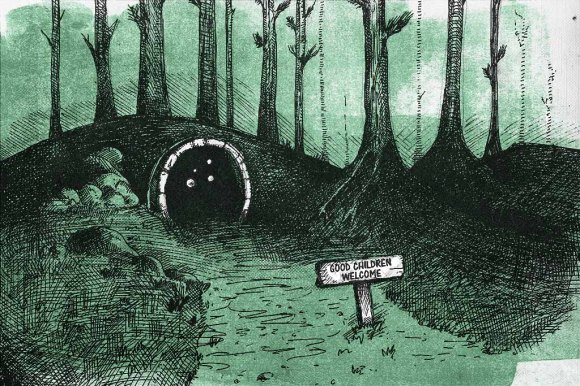
A pen and ink drawing of a grotto in a mound in a dark wood. There is a sign that reads "Good children welcome".
My original illustration for ‘Winter Wonderland’.

The lost illustration

One thing I’m a little sad not to have carried over to Intervals of Darkness is the illustration I drew to accompany this story when I first published it.

It’s quite cool, I think. I should probably get it framed and add it to my gallery of spooky art.

A quote from Verity Holloway: "Impressively eerie and packed with shocks... moments of powerful poignancy and startling strangeness. You'll want to linger over these stories." Next to it is the cover of Intervals of Darkness with a black background and red details. The illustration is of a person casting a long shadow. Nearby is another shadow suggesting a lurking but hidden figure.

Intervals of Darkness will be published on Saturday 7 September. You can pre-order the eBook now.

Categories
Intervals of Darkness

Story-by-story: The Pallbearers

This is the shortest story in the collection and was inspired by a paragraph in The Valley, Elizabeth Clarke’s 1969 memoir of Welsh country life.

She describes the care with which the men of the village carry a coffin from a remote farmhouse to the chapel on the day of a funeral.

It’s poignant rather than horrifying but I read her book over a couple of bleak, misty days in an out-of-season coastal town where we’d gone to scatter some ashes.

On the train home, under heavy cloud, her brief account filtered through my subconscious and emerged as a first draft typed in some discomfort on a fold-down railway table.

As with other stories in this collection, its location shifted from the source to the West Country, and I had the landscape of the Mendip Hills in mind in particular.

The characters have names of people from school, from my estate, from war memorials, and from cemeteries.

I collect the names of the dead in a notebook for later use – a macabre habit in its own right. I also share them on BlueSky with the hashtag #CemeteryNames.

Like many of my nightmares (I’m a terrible one for nightmares) it’s about struggling to complete a task, or a journey, as the very ground beneath your feet slows you down, or trips you up.

It’s a very short story, so this is a very short blog post.

A quote from Rowan Lee: "Newman returns to haunted Britain with fourteen more wonderful stories... Fans of folk horror and weird fiction will find a lot to love."

Intervals of Darkness will be published on Saturday 7 September. You can pre-order the eBook now.

Categories
Intervals of Darkness

Story-by-story: The Horns in the Earth

Lots of my weird stories are also supposed to be at least a little bit funny. The self-regarding literary psychogeographer who narrates ‘The Horns in the Earth’ gave me lots of opportunities for humour.

For example, I had great fun coming up with titles for his books – Avenues and Alleyways: an exploration of the back passages of Britain is a particularly puerile example.

But this character is also a reflection of me. His constant stream-of-consciousness search for ways to jam disparate ideas together into a coherent story is a bit like how I write fiction:

I found shards of crockery, chunks of blue glass and an ink bottle, and several pieces of terracotta with fractured text: ‘Ginger beer’. A century’s-worth of crap that had tumbled down the slope from the houses on the ridge above… Hold on, I thought – is this a metaphor for something? These post-war dormitory estates as human landfill. Dumping grounds on the edge for people towns and cities don’t want. A nation divided. Yes, this was good, definitely worth tugging at.

This is another story set largely on council estates.

I had in mind, as I often do, Southmead and Lockleaze in Bristol; the Sydenham estate in Bridgwater where I grew up; and the Treneere estate in Penzance, where I spent hours wandering when I lived in Cornwall.

I took an alleyway from one, a recreation ground from another, an arcade of shops from a third, the wind-swept square of a fourth…

I’m so familiar with the textures and feel of places like this that writing it comes naturally. In fact, my dreams are often set on council estates – usually a distorted version of Sydenham – as if that’s the default game map for my subconscious.

An overgrown wooded bank on an industrial estate with the corner of a former council building and a rusting shipping container.
The site of the ancient Chapel of St. Anne.

Another important influence on this story is an ancient religious site near where I live, near the CO-OP, round the back of an industrial estate.

In St. Anne’s Woods there’s a wooded valley with a holy well.

It’s surrounded by iron railings and the tree above it is covered with tattered rags – the remains of face masks hung there as a sort of offering during the pandemic.

There’s often a burned out moped nearby.

The well was associated with the Chapel of St. Anne which stood about 350 metres away. It was destroyed by Henry VIII. In 1486, his father Henry VII made a pilgrimage to the chapel and the well.

So, I’m gently mocking psychogeographers, while also indulging in a little psychogeography myself.

Cake and eat it, me.

‘The Horns in the Earth’ is also the closest I’ve got to indulging in a trope I dislike: the scary youth in a hoodie.

Without wanting to self censor, I challenged myself when I noticed the story drifting that way, and I hope I’ve done something slightly more interesting than simply say: aren’t working class kids terrifying?

That the narrator finds them so perhaps tell us something important about him.

A quote from Verity Holloway: "Impressively eerie and packed with shocks... moments of powerful poignancy and startling strangeness. You'll want to linger over these stories." Next to it is the cover of Intervals of Darkness with a black background and red details. The illustration is of a person casting a long shadow. Nearby is another shadow suggesting a lurking but hidden figure.

Intervals of Darkness will be published on 7 September. You can pre-order the eBook now.

Categories
Intervals of Darkness

Story-by-story: Father Paul

What if the bearded hippy vicar who used to guest star at my school assemblies had to deal with the events of The Exorcist? That simple question was the seed for this story.

The vicar who came to my school wasn’t called Paul but he did have a beard and an acoustic guitar. He was a Cambridge graduate and softly well spoken.

And his church on the estate was a post-war modernist building, with concrete columns and parquet floors, at which I attended harvest festivals, christenings and weddings.

But I can’t say that my character of Father Paul is ‘based’ on this real vicar because when I knew him, I was a child – and not one who regularly went to church.

In other words, Father Paul is a creation inspired by memories of vague impressions.

The main thing I took from the real vicar is the title ‘Father Paul’. Because our vicar was always called ‘Father…’ even though he was Church of England.

When I shared drafts of this story with various critical friends, a couple picked me up on this detail, thinking they’d found a mistake. But (a) that’s how it was and (b) it turns out lots of CoFE vicars get called ‘Father’ informally; some dislike it, most don’t.

Also in the mix was (and I might almost say ‘as ever’) the Enfield poltergeist, the classic working class English haunting. Chris Coates has written a pleasingly snarky debunking of the Enfield case.

Personally, I don’t believe for one moment that anything supernatural happened in that particular house.

For this story, I asked myself, how would an unequivocally real poltergeist case look and feel? What would need to happen for somebody level-headed to really believe in what they were seeing?

And how might a cunning demon or devil go about denying an exorcist documentary evidence of the facts as part of its mischief?

Finally, as I’m sure many people will notice, there’s a touch of a famous British folk horror film here, too, which I won’t name because it would probably constitute a spoiler to do so.

When you’ve read the story, let me know if you’ve worked out which film I mean.

More generally, the landscape of Bristol, and of my hometown, both of which were urbanised rapidly after World War II, continues to inspire me.

Concrete laid over old orchards. Council houses on hills and in valleys with who knows what beneath the mud.

Place names borrowed by local government officials from those of farms, fields, lost manor houses, and other landmarks otherwise wiped from the map.

How many exorcisms do we need?

I’m very conscious that poltergeists and exorcisms might be played out, or at least hard to find new approaches towards.

In this case, I hope that the setting (an English council estate), the quirk of a non-Catholic exorcist, and the streak of folk horror, might make it feel fresh.

Having said that, for more in a similar vein, I recommend The Borderlands, a somewhat successful 2013 film about Catholic priests sent to exorcise a church in Devon.

A quote from Thom Willis: "You don't know what you're getting next – Cronenberg in a dingy terrace, Tim Powers jumping at shadows, M.R. James in a piss-soaked alley. The canvas feels bigger than Municipal Gothic."

Intervals of Darkness will be published on 7 September. You can pre-order the eBook now.

Categories
Intervals of Darkness

Story–by-story: Tales from the Levels: Remembrance

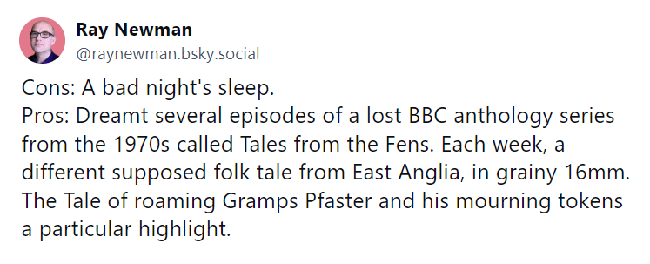
This lost episode of a 1970s children’s television series came to me in a dream. Usually dream stories are nonsense but this one, to my astonishment, worked.

Here’s the dream:

Cons: A bad night's sleep.
Pros: Dreamt several episodes of a lost BBC anthology series from the 1970s called Tales from the Fens. A post from BlueSky: "Each week, a different supposed folk tale from East Anglia, in grainy 16mm. The Tale of roaming Gramps Pfaster and his mourning tokens a particular highlight."

You’ll note that, in the dream, it was Tales from the Fens, but I don’t know East Anglia well enough (yet) to write that.

So I brought it closer to home, to Somerset.

The dream gave me a premise and some details but, of course, I had to do a lot to turn it into a coherent piece of fiction.

I also found myself thinking about Jeremy Deller’s nationwide art installation to mark the centenary of the start of World War I, ‘We’re Here Because We’re Here’, from 2014.

There is also, of course, that story from Sapphire & Steel with the ghost of a soldier from World War I haunting a railway station. (Which I think Jeremy Deller must also have had in mind.)

Having dreamt of a TV show, I had to make it a TV show, which also happens to tie into my interest in grainy old BBC ghost stories for Christmas, and Tales of the Unexpected, and similar.

Let’s be honest, this is pure nostalgic, hauntological fan service.

The final component was the idea that Bernard Miles might be the narrator of the story. Miles is perhaps best known for his performance as Joe Gargery in David Lean’s 1946 film of Great Expectations. He was also famous for his stage and screen performances in rural dialects.

Though he specialised in the accents of counties surrounding London, I reckon he could easily have stretched to a Somerset accent with a little time to prep. And I think he’s exactly the kind of person an ITV subsidiary might have approached for a job like this in 1970.

I dithered a little about how much storytelling business to include. In the end, I went heavy on it at the start, and at the end, but let it fade out in the middle. Because I suspect that, as with attempts to write in regional accents, it would get pretty annoying after a while.

Somerset place names

People who know Somerset will notice that I’ve rendered a couple of place names as they’re spoken rather than as they’re spelled.

In reality, Chidgey is Chedzoy and Muchney is Muchelney.

My thinking was, though, that surely Mr Miles would be given them as spoken in his script, right?

But also, I just take a certain homesick pleasure in these little details.

A quote from Thom Willis: "You don't know what you're getting next – Cronenberg in a dingy terrace, Tim Powers jumping at shadows, M.R. James in a piss-soaked alley. The canvas feels bigger than Municipal Gothic."

Intervals of Darkness will be published on 7 September. You can pre-order the eBook now.

Categories
Intervals of Darkness

Story-by-story: While You Were Out

The inspirations for this story about a delivery driver feel blindingly obvious to me – I wonder if anyone will see the connection?

First, there’s the nightmare logic of the films of Lucio Fulci and, in particular, The Beyond from 1981.

I find it hard to argue that The Beyond is a great film.

It has all the usual problems of Italian exploitation horror – bad dubbing, odd pacing, nonsense plot – plus the particularly dense layer of dinge and sleaze that seems to ooze from Fulci’s pores and over everything he makes.

So I’m not necessarily saying you should watch it.

But don’t be mistaken: I love it. At least, I keep rewatching it, and thinking about it.

Because, for all its flaws, it is full of breathtaking images, and its disjointedness begins to feel like a feature rather than a bug.

The ending, in particular, I find astonishing.

Our heroine and hero escape from pursuers by running into the basement of one building, only to find themselves in the basement of another, right across town.

This makes no sense.

What makes even less sense is that they then find themselves walking across an infinite plain strewn with corpses.

“And you will face the sea of darkness, and all therein that may be explored,” says the voiceover, gravely.

A still from The Beyond which shows two people on a plain surrounded by scattered, vaguely human forms.

The other inspiration, very obvious, I think, is Robert Aickman’s wonderful 1967 story ‘The Cicerones’, in which a tourist explores a cathedral on the Continent and meets a series of unnerving tour guides as space and time distort around him:

Then something horrible seemed to happen; or rather two things, one after the other. Trant thought first that the stone panel he was staring at so hard seemed somehow to move; and then that a hand had appeared round one upper corner of it. It seemed to Trant a curiously small hand… the stone opened further, and from within emerged a small, fair-haired child… ‘Hullo,’ said the child, looking at Trant across the black marble barrier and smiling.

So, when writing ‘While You Were Out’, I kept challenging myself to make it not make sense in the same pleasing way.

To achieve this you really need to tap into the feeling of dreams or nightmares – the strange segues, the instability of objects or people, the sense of wading through glue.

The setting, a group of tower blocks on the edge of an English city, is not based on any one place but it does borrow from Barton Hill and Redcliffe in Bristol, where I live.

There’s also something of Gleadless Valley near Sheffield which I visited on a bleak November day a few years ago.

And the elevators, stairwells and corridors are straight out of various tower blocks I have known, including one in East London where my partner’s father lived for a while.

The chink of departing coin

When I wrote this post about being a working class writer last week it prompted writer Joel Morris to talk about characters who feel “the chink of departing coin”.

Bogdan, the delivery driver who is the main character in this story, is under pressure to meet unrealistic targets. And stress is part of what makes him vulnerable to strange experiences.

Throughout Intervals of Darkness there are characters who make bad decisions because they need the money. As well as feeling true to life – or, at least, true to my own experiences – this also brings a new energy source to the stories.

One of the characters in ‘British Chemicals’, for example, takes speed and works through his break periods because he’s just become a father and needs all the overtime he can get.

A quote from Verity Holloway: "Impressively eerie and packed with shocks... moments of powerful poignancy and startling strangeness. You'll want to linger over these stories." Next to it is the cover of Intervals of Darkness with a black background and red details. The illustration is of a person casting a long shadow. Nearby is another shadow suggesting a lurking but hidden figure.

Intervals of Darkness will be published on 7 September. You can pre-order the eBook now.