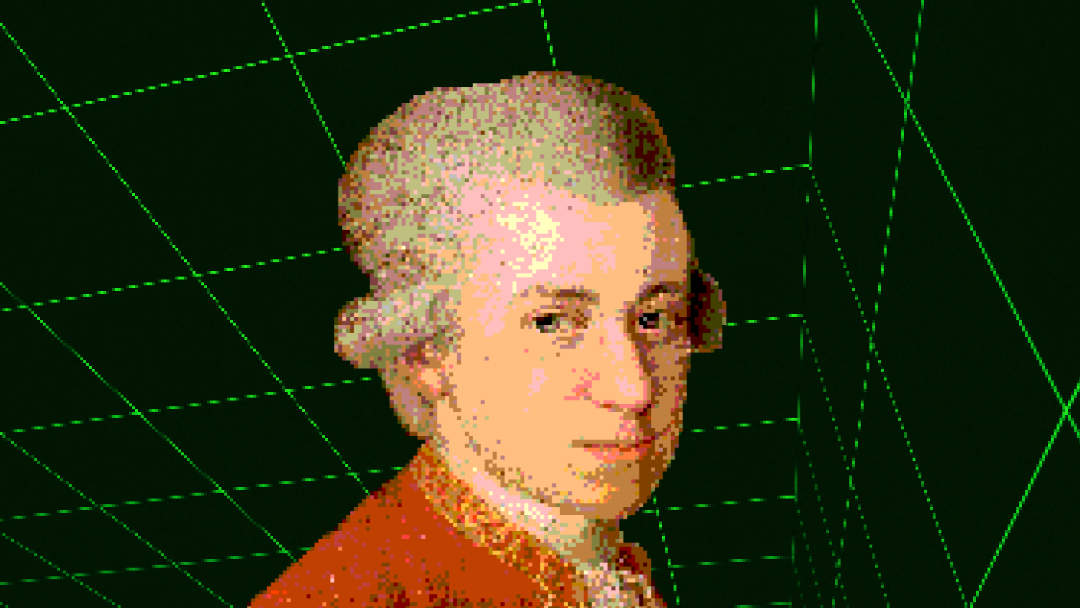
What was going on in the 1970s and 80s that Bach and Mozart became tangled up with technology and science fiction? I’ve got a theory.
A key text in all of this is the 1985 cyberpunk story ‘Mozart in Mirrorshades’ by Bruce Sterling and Lewis Shiner, available in the genre-defining anthology Mirrorshades from 1986. Originally published in Omni magazine, it depicts a world in which time travel is used to mine resources from the past, while at the same time polluting the culture of the past. So, of course, a teenage Wolfgang Amadeus Mozart has become a rock star in an alternate Salzburg of 1775.
In his introduction to the story Sterling writes:
The figure of Wolfgang Amadeus Mozart seems to have a special resonance for this decade, appearing in films, Broadway plays, and rock videos, as well as in SF. It’s an interesting case of cultural synchronicity. Something is loose in the 1980s. And we are all in it together.
When he mentions rock videos Sterling must have been thinking of another product of 1985, ‘Rock me Amadeus’ by the Austrian musician Falco.
It features Falco as a punked up Mozart in a biker bar, garish video graphics, and various synthesisers and drum machines. It is, in itself, a cyberpunk artefact.
Falco was inspired in turn by the 1984 film Amadeus, directed by Miloš Forman from a screenplay by Peter Shaffer from the Broadway play mentioned by Sterling in his list of 1980s Mozartiana. It isn’t a science fiction story but it achieves its effect by asking: what if Mozart behaved like an American guy from 1984?
In 1983 a version of Mozart the child genius appeared in an advertisement making music on the Commodore 64 home computer.
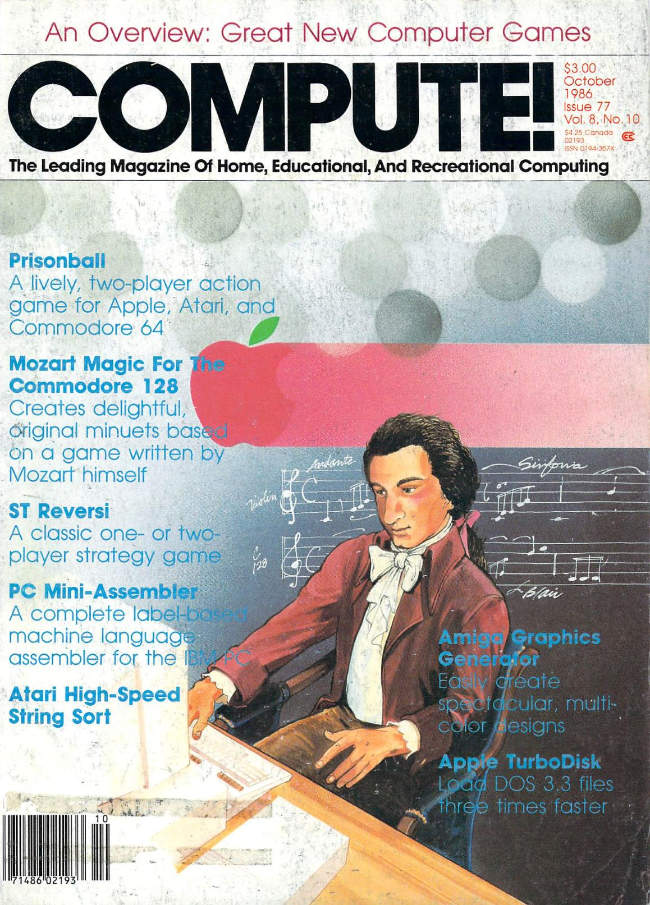
And by 1986, you could program your Commodore 128 to compose “minuets in the style of Mozart himself”:
This Commodore 128 program is a translation of a game by Wolfgang Amadeus Mozart. It composes a complete, original minuet at random. Mozart delighted in games of chance, so it was only natural that he should combine his two interests and produce an activity known as Musikalisches Wuerfelspiel, or musical craps. The idea was not original with Mozart, but his effort was the most successful.
As far back as 1968 Philip K. Dick’s ur-cyberpunk novel Do Androids Dream of Electric Sheep? contained this reference to Mozart:
[Rick Deckard] wondered if Mozart had had any intuition that the future did not exist, that he had already used up his little time. Maybe I have, too, Rick thought as he watched the rehearsal move along. This rehearsal will end, the performance will end, the singers will die, eventually the last score of the music will be destroyed in one way or another; finally the name ‘Mozart’ will vanish, the dust will have won.
Switched on Bach
J.S. Bach seems to have had a similar status, even if he lacked the punk-before-his-time cool of the imagined Mozart of the 1980s. His music, baroque rather than classical, more precise and algorithmic again, was repeatedly repurposed in futuristic contexts.
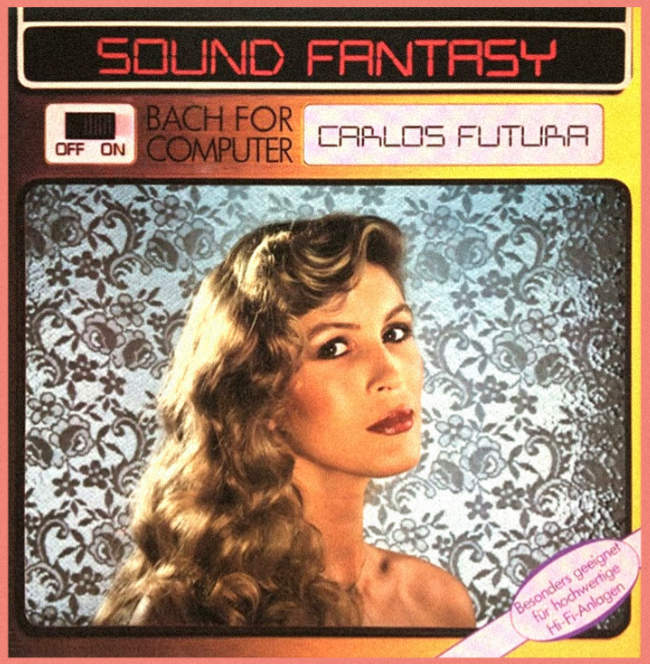
First, from the same year there’s Wendy Carlos’s 1968 album Switched on Bach which featured several pieces by Bach performed on the then brand new Moog synthesiser. The cover image sets the tone for the two decades to follow: an actor dressed in silk frock coat and powdered wig stands in front of an enormous Moog modular synth holding a set of headphones. He’s been brought up to date! Or yoinked out of his grave, dragged forward through time, to marvel at and approve of the technological future.
Wait, though – was it first? Or should we credit Procul Harum’s ‘A Whiter Shade of Pale’ from the preceding year? It lacked the obviously futuristic sound of the synthesizer but was certainly Bach dug up, electrified and revived.
Out of the spotlight, in academia, as early as 1971, Hugh Longuet-Williams and Mark Steedman were using Bach as a training ground for early experiments in artificial intelligence. Their paper ‘On interpreting Bach’ (PDF) explained how they’d created algorithms that could determine the meter and melodies of fugues passages from pieces in The Well-Tempered Clavier.
And music by Bach – not played on synthesizers – was sent into space in the form of the Voyager Golden Record dispatched with Voyager 1 and 2 in 1977.
The not-very-cyberpunk prog rock band Sky had a chart hit in 1980 with Toccata, featuring Francis Monkman on synthesisers that dominate the track.
In 1984 we find this remarkable example of computer-baroque in the film Electric Dreams. Edgar, a super home computer voiced by Bud Cort, attempts to seduce the cellist upstairs (Virginia Madsen) by duetting with her on a piece of music inspired by a minuet once attributed to Bach but now known to be by Christian Petzold.
Fiddling while chrome burns
I’m not sure how to classify projects like Gian Piero Reverberi’s Rondo Veneziano whose biggest hit, ‘La Serenissima’, evokes Vivaldi despite being an original composition in baroque style. But is there any clearer statement of the perceived connection between the music of the 18th century and the cyberpunk 1980s than this video?
My theory is that Mozart and Bach represent a supposed peak of human artistic achievement – civilised, orderly, precise – which both contrasted with the pre-apocalyptic chaos of the 20th century and found an echo in its technological achievements.
The steady, speedy, almost mechanical flow of baroque and early classical music reflected how people tended to imagine the internal operations of computers; and fingers on a harpsichord or organ didn’t seem so different to fingers on computer keyboards.
It’s also a typical manifestation of post-modernism – the same jumbling of styles, movements and eras that gave us a 1950s revival every few years from the 1970s onward, and which saw Beethoven’s fifth arranged as a disco tune.

 Precast Reinforced Concrete Heart