
London, like New York, is often too busy, and too much in flux, to play itself on film. So, time after time, filmmakers rebuild it on backlots – with varying degrees of accuracy.
Each of these other Londons represents a particular vision of the city, and conveys the creators’ preconceptions, prejudices and perspectives.
Even the best of them never quite look real. On high definition video, more than ever, we can see that ‘bricks’ are lines etched into plaster, and that their streets merge with painted ‘flats’ or matte paintings.
They’re fantasies. But are they any worse than, say, Dublin, or Riga, or Budapest, with every stone and brick the wrong colour, putting on their best cockney accents?
I’ll take the artistry and illusion of a backlot set over Prague scattered with red buses and phone boxes any day. (Even if that backlot is, itself, in Prague.)
Stand-in Londons in Hollywood
Old Hollywood loved to build Londons.
Cedric Gibbons created one at MGM for David Copperfield, directed by George Cukor in 1935. On screen, the backlot construction was supplemented with matte paintings.
Parts of that set, later known as ‘Copperfield Court’ or ‘Copperfield Courtyard’, were used in other productions, including on TV, for years to come.

At Universal, before Frankenstein, James Whale directed a version of Waterloo Bridge, released in 1931. For that production, a misty wartime London was created by Charles Hall, including a replica of the bridge itself that used forced perspective to suggest scale.
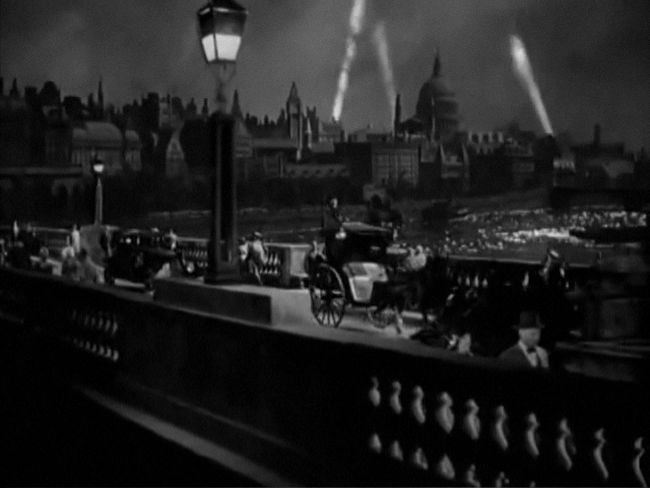
Hall and Whale were both British and perhaps this added to the relative realism of the production.
In his 1976 book Caligari’s Cabinet and Other Grand Illusions production designer Léon Barsacq shares a promotional image from the 1933 production of Noël Coward’s Cavalcade by Frank Lloyd for Fox. Barsacq also quotes the text that came with the photograph:
“Why! This is a section of the Strand!” exclaimed Miriam Jordan, whose home is in London, when taken to the London ‘set’ for ‘Cavalcade’ on the Fox Films lot. In the background is a typical London building and at the left is an exact replica of a small London park. Natives of the British Empire and world travelers are amazed at the fidelity with which William Darling, art director of Fox Films studios, reproduced London street scenes. Even the lamp posts are authentic.
Even after the war, when many Americans had seen Britain for themselves, Hollywood continued to film London under the Californian sun.
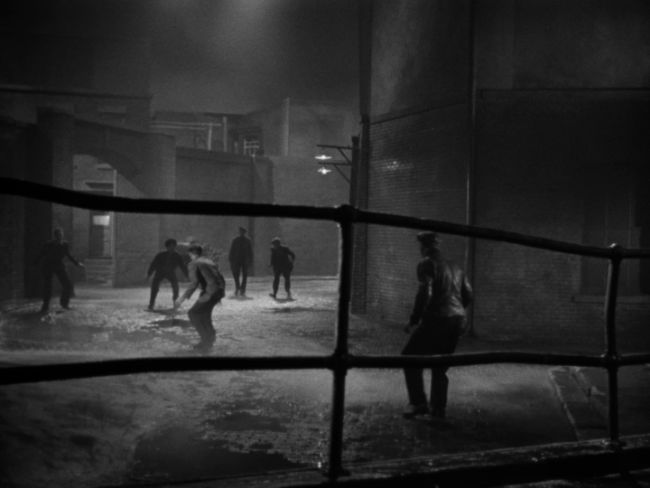
Burt Lancaster starred in and produced the British-set Kiss the Blood off My Hands – one of the all-time great film noir titles – in 1948. It was shot at Universal on an extensive recreation of the East End of London, and Wapping in particular, that supposedly represented 30 blocks of houses, warehouses and wharves.
At the other end of the scale, there was the brightly coloured, sugar-icing version of London seen in Mary Poppins, shot at the Disney studios in Burbank. Along with many matte paintings there was also a large physical set for Cherry Tree Lane, with more forced perspective, including on the cherry trees.
Backup Londons near London
Why recreate London when you’re on the outskirts of the real thing? Why not film on the actual streets? For convenience. Because London changes too fast for historical drama. And, perhaps, because an air of fantasy might be desirable.
In 1961, Cliff Richard, ‘the British Elvis’, was a huge star. The Young Ones was to be his first serious star vehicle, directed by Sidney J. Furie, and the budget justified the construction of a “quite extensive backlot town” of “relatively anonymous West London streets”, as described by Jonathan Bignell.

Bignell’s particular interest is that this set lingered on and was used and reused, dressed and redressed, to represent not only London but also locations around the world in British TV shows such as The Saint, The Champions and Randall and Hopkirk (Deceased).

A little later, at Shepperton, a 1964 French production, The Counterfeit Constable, called for the construction of another London in miniature.
These streets also hung about and, with tweaks, represented everything from the 18th century city in Moll Flanders to post-apocalyptic future London in one of the Doctor Who films.
The never-never London of Sherlock Holmes
The backup London at Shepperton described above was also used, with adjustments, in the 1965 Hammer film A Study in Terror, starring John Neville as Sherlock Holmes.
Over the years, however, Holmes has prompted the construction of several elaborate Londons in his own right.

In 1969, Alexander Trauner built a long stretch of Baker Street at Pinewood for Billy Wilder’s The Private Life of Sherlock Holmes. (He’d previously constructed a very convincing Paris for Wilder’s Irma la Douce in Los Angeles.)
This set would also linger on, decaying, and appear in distinctly less prestigious British productions such as Carry on at Your Convenience.

A decade or so later, Granada in Manchester set about bringing Sherlock Holmes to TV with Jeremy Brett in the lead role. For this expensive production it constructed its own Baker Street – just around the corner from its recreation of a red-brick Manchester terrace for the long-running soap opera Coronation Street.
This set is particularly interesting because it’s one many British children visited over the years as part of the Granada Studios Tour. I went myself, as a dorky teenage Holmesian, and felt as if I’d gone to heaven. (Years later, I worked on the real Baker Street for about six months, and there was no romance about that at all.)
When Guy Ritchie filmed his Sherlock Holmes with Robert Downey Jr., released in 2009, he also had a large scale Baker Street set to play with – albeit one built for a Harry Potter film and refitted. Rather than forced perspective, as employed by Trauner 40 years earlier, this set was extended with green screen and CGI. It was not an improvement, in artistic terms.
Recreating the East End
London’s East End is another common target for cinematic recreators – not least because the real East End was so extensively changed by, first, the Blitz, and then post-war remodelling.
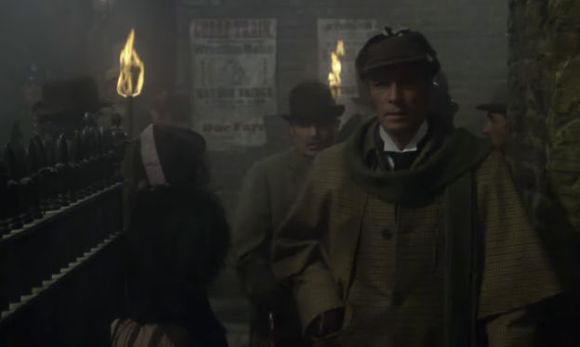
In Murder by Decree, a 1979 Sherlock Holmes film directed by Bob Clark and starring Christopher Plummer, Baker Street is played by Barton Street, a well-preserved thoroughfare in Westminster. But the East End, where Jack the Ripper stalks, was constructed at Elstree (Whitechapel streets) and Shepperton (docks and wharves). It’s very convincing, even sharing the screen with real locations in Bermondsey.
Twenty or so years later a film with a very similar plot, From Hell, directed by the Hughes Brothers, was shot on a set outside Prague designed by Martin Childs. Released in 2001, it fell between the cracks as the internet came into being, and the set is unfortunately not well documented. In ‘production notes’ of uncertain provenance at cinema.com Childs is quoted as saying:
“We couldn’t find anyplace here that resembled Whitechapel from all angles, so we ended up building it in the middle of a field. It became the unexpected highlight of this entire enterprise… We were very lucky that Prague was undergoing a major restoration and digging up many of its streets… because we were able to borrow cobblestones from the city…”
This set included versions of The Ten Bells pub and Nicholas Hawksmoor’s Christ Church, Spitalfields. The film might not be a masterpiece but the set might have been.
Another perhaps surprisingly careful reconstruction of the East End appears in Till Death Us Do Part, the 1969 feature film adaptation of the TV sitcom starring Warren Mitchell as Alf Garnett.

Several streets and corners are recreated in loving detail, with the brick convincingly soot blackened, and a railway arch to terminate the street. This neat capsule set allows director Norman Cohen to take us from the 1930s to the 1960s by changing details such as the brewery branding on the very realistic pub.
What it’s very like, in fact, is the Coronation Street set mentioned above or, jumping forward to the mid-1980s, the set constructed at BBC Elstree for another long-running soap, Eastenders.
Albert Square, which has been on TV every week since 1985, was supposedly based largely on Fassett Square in Dalston, and offers a snapshot of pre-gentrification East London. The set was carefully weathered and distressed to resemble real East London streets and I suspect fooled many people into thinking it was filmed on location.
Over the years, the set expanded, gaining new offshoot streets and details. In recent years, rebuilt and refined for the high-definition age, it’s even, finally, gained some modern flats and new-build townhouses.
The bland Bulgarian London
One of my favourite recreations of London – as in, one with which I am grimly fascinated – is at Nu Boyana Studios outside Sofia, Bulgaria.
Its standing London street set was built, I believe, for the 2016 action thriller London Has Fallen, and includes a version of the forecourt and entrance to St Paul’s Cathedral. More importantly, it also has several streets that reflect what too much of London really feels like today.
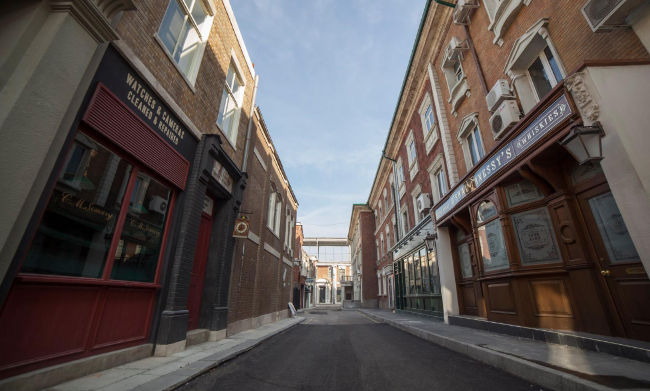
There are bland modern flats, like those which have filled in every available gap in East London. There are bland modern shop fronts painted in shades of grey. There are rows of bland Mayfair houses, too neat and too tidy, where it’s clear nobody actually lives. There’s a bland Irish theme pub that looks like no fun at all. There’s even a Patisserie Valerie.
This set crops up in cheap Christmas movies and cheap action movies – the type that go straight to streaming, and maybe feature an older actor just long enough to feature his face prominently on the poster.
I’m pretty sure I see it in adverts, too, providing a shiny, simple version of London without any of the grime or graffiti.
I could go on…
There are so many other Londons.
The streets of Poplar constructed for Call the Midwife in the grounds of stately home in Surrey, for example; the fantastical Fleet Street built at Pinewood for Tim Burton’s Sweeney Todd; the Soho built for Julien Temple’s Absolute Beginners; the other Soho constructed on an airfield for Amazon’s Good Omens; or the 1930s suburban street slowly bombed to bits in John Boorman’s blitz memoir Hope & Glory; or…
Well, like I say, I could go on.
Together, these many peculiar, partial Londons add up to a complete imaginary city that helps us see and appreciate the real one in all its infinite depth.

 Precast Reinforced Concrete Heart
5 replies on “These other Londons: the imagined city of the backlots”
[…] an online exhibit from the Royal Drawing School / the capital on film, sets and backlots at These other Londons: the imagined city of the backlots / a history of South London’s Dawson’s Heights Estate at Hidden Archiecture / the tallest […]
LikeLike
It looks to my untrained eye like “Copperfield Court” is the window of “Filby’s” in The Time Machine?
LikeLike
[…] Other Londons […]
LikeLike
[…] London, like New York, is often too busy, and too much in flux, to play itself on film. So, time after time, filmmakers rebuild it on backlots – with varying degrees of accuracy. Precast Reinforced […]
LikeLike
[…] you might know, one of my particular obsessions is the way cities are recreated on studio backlots, like London in Los Angeles. One of the features accompanying the new Criterion Collection release of Eyes Wide Shut is a […]
LikeLike