Categories
Film & TV

We need our flinches: on the cosiness of horror

It’s cowardice, isn’t it? That instinct that draws horror fans to old movies; camp, arch, silly films; and contemporary films set in the comforting warmth of the hand-knitted past.

The word ‘cosy’ has become an irritating background note in conversations around horror fiction.

It’s usually spoken about as a specific subset of work in the genre that offers “that happy ending, or low stakes”, as explained by Agatha Andrews on the podcast Books in the Freezer on 30 May 2023. It’s perhaps about friendship and love more than it is about cruelty.

But beyond that explicit cosiness, there’s an implicit cosiness baked into much of the genre.

Few consumers or fans of horror like to think of themselves as craving cosiness. Horror is edgy, grim, and dark. It’s for kids who don’t fit it and, like, see the world differently, man.

Horror critics speak approvingly of horror films as ‘disturbing’, ‘harrowing’ and ‘unflinching’ – ordeals through which we put ourselves, tests of our mettle, proof of our resilience in the face of fucked up shit.

In practice, however, we don’t want to be disturbed or harrowed. We want to be able to flinch. So, we protect ourselves with a range of distancing factors:

1. Time. Stories set or written in the past are less threatening than those which are strictly contemporary.

2. Geography. If the setting is physically distant from us – Texas, Italy, deep space – we feel safer.

3. Realism, or its absence. Freddy Krueger might be mean, and the Nightmare on Elm Street films might be gory, but they’re also close to being fairy tales.

4. Personal experience. We all know what will feel like salt in our own psychological wounds and can choose to avoid it.

5. Topicality. Difficult topics become less difficult when they’re no longer live; nuclear war was less scary in 2003 than in 1984.

Don’t look away

The 2020 film His House (dir. Remi Weekes) is about as far from cosy as I can imagine. It’s about a couple, refugees from South Sudan, who are dumped in a council house on an estate in England. The house turns out to be haunted by those they left behind on the gruelling journey.

It is set now. It is set in the UK, in a landscape I recognise. Remove the ghosts and it is an example of brutal social realism.

With its narrative about war, the danger of small boat crossings on the English Channel, and the vicious heartlessness of the UK asylum system, it could not feel more topical.

And, though I had it easy compared to these characters, the setting and sense of poverty reminded me uncomfortably of my own childhood – of scraping by with bugger all, constantly on edge.

I admired it, and am glad to have seen it, but cannot say I enjoyed watching it. At various points I actually felt the beginnings of a true panic response.

That’s what horror writers often believe they want to achieve, or to evoke. In reality, however, for the consumer of horror, the effect desired is more often a shiver, a pleasant thrill, or perhaps even a giggle.

I have a colleague (a woman, very politically aware) who talks about 1980s slasher movies as ‘comfort viewing’.

These are films in which one person after another is brutally murdered, often in graphic, gory detail; these people are often young, often female; and the feel of the films is often distinctly grimy.

But they are generally so over the top, so ridiculous, and so clearly set in another time (the 1980s) and place (Everytown USA) that, for British viewers, they’re a reassuring arm’s-length away from real fear. They make us jump and gasp but they rarely stay with us, or haunt our dreams.

That distance only increases when modern filmmakers or writers recycle slasher tropes and evoke the idealised Spielburbian settings of our collective childhoods. In Stranger Things or Fear Street Part One: 1994, both on Netflix, there’s an added layer of retro kitsch, or ironic detachment.

‘Trauma dumping’

A lot of contemporary horror fiction, or weird fiction, is inspired by the authors’ personal, physical or mental trauma.

Modern short stories are often ‘about’ some raw, real personal issue, such as child abuse, depression, racism, chronic illness, or gender transition. Or big, pressing existential problems like climate change.

They force us to confront complex, difficult subjects to the extent that reading for pleasure can feel like watching the news through a fictionalising filter, or listening to a deep, painful confession.

By turning them into fantastic stories, the authors are giving us a comfort blanket – a tiny degree of cosiness. But is it enough? For many readers, the answer is, no. It still feels too much like homework.

Or, to put that another way, they are often more enjoyable for the writer to write than for the reader to read.

(And I say this as someone who cannot stop writing stories attempting to process my own experiences of childhood poverty, often without intending to do so at all.)

Tweed, jerkins and knitwear

When I think of ‘cosy horror’ my mind leaps to M.R. James. His stories often have historic settings – they are set decades before they were written – and their revenants are older still. Now, in addition, we have more than a century of additional distancing. The tweediness of Edwardian prose tells us that we’re perfectly safe.

You might argue that James’s stories present eternal, subconscious fears: loneliness, unresolved sexuality, child murder… This is true. ‘Lost Hearts’, for example, certainly gave me shivers, as did its 1970s BBC TV adaptation.

At the same time, the way these stories are framed as fireside yarns in the original texts, or as ‘ghost stories for Christmas’ on TV, offers us a protective shield.

Similarly, I prompted some disagreement on Bluesky when I argued that folk horror is an essentially cosy sub-genre. As the filmmaker Paul Duane observed in response, folk horror often deals with “harsh” themes.

Equally, however, most of the best known examples are now viewed through a fog of 1970s film grain with half the cast in literally cosy vintage knitwear (dark Hygge) or 17th century jerkins and buckled boots (heritage horror).

Because that patina is part of the texture of folk horror, modern takes on this sub-genre are often also set in the past, as is the case with Starve Acre or Robert Eggers’s The Witch.

We get people in wigs discussing old news, with perhaps the odd talking goat or immortal rabbit to remind us that, by the way, none of this is real.

Even better, or more cosy, are Hammer films, and those from similar British studios such as Amicus. Does anybody watch these expecting to feel scared?

We might feel a little unnerved, perhaps, by the occasional striking image, or be made uneasy by the sexual politics. But more often, our reaction is to laugh at the big performances, at the Home Counties playing dress-up as Transylvania, and at blood as red as primary school poster paint.

The zombie apocalypse is another strong example of a cosying mechanism. These are really visions of our world post-plague, post-apocalypse, which give us a safe space in which to ask: could I shoot my neighbour in the head if they came for my resources, or threatened my tribe?

Anyway, enough of all that. I’m off to escape the horrors of the modern world in the warm embrace of a silly, colourful film in which a pair of binoculars fire spikes into someone’s eyes.

You know, in a cosy way.

This piece first appeared in issue two of the General Witchfinders zine. Issue three is out shortly and features a new short story by me called ‘We Have Always Battled Monsters in this Castle’.
Categories
Film & TV

Of dogs and dreams: the strange case of Lindsey C. Vickers’ The Appointment, 1981

“Extract from police report number 727a, strictly confidential, unpublished and unavailable. Subject: Sandy Freemont. The last positive sighting was on her way home from a school orchestra rehearsal. This was on Tuesday May 14th at approximately 6:30 in the evening. At about this time her friend Janey Carr places her positively as entering the footpath through the area known as Cromley Woods, a then popular shortcut for several of the children living in Millard Heights…”

In the suburbs of a middle English town, a schoolgirl walking takes a shortcut through a wood. From the undergrowth, she hears the mischievous laughter of children and her name is called. She pauses and then, in a moment of sudden, startling violence, disappears.

These events, accompanied by amplified natural sounds, an off-kilter music box theme and, finally, shrieking strings after Bernard Herrmann, establish the tone of Lindsey C. Vickers’ 1981 British horror film The Appointment.

The rules do not apply here; anything might happen; brace yourself.

It’s possible you’ve never heard of The Appointment. I hadn’t myself until 2021, via a mention by Elric Kane on the Pure Cinema Podcast.

At that time, the only way to see it was via a VHS rip on YouTube. Once I’d got used to it, the video murk and constant hiss only added to the unsettling quality of the film.

Nor was it inappropriate: this film was only ever released on VHS, in the early days of the home video boom.

It was hard to find much information about Vickers online and, in fact, quite a few writers had assumed he was a woman. So I cobbled together my own potted biography from newspaper archives and scraps.

Vickers was born in 1940, brought up in Norwood Green, Southall, London, and educated at Dormers Wells Secondary School and Southall Technical College.

He left school without qualifications and got a job working as a messenger at London Airport (now Heathrow) before moving into film, starting as a cinema projectionist.

He went on to study film at the University of London and became a film assistant at the BBC where he directed a documentary short called ‘Impressions of Richmond’.

He became assistant director to Denis Mitchell before moving to the Government advertising office, COI, where he made a film a week for global distribution.

He worked as an assistant director on a slew of Hammer and Amicus films throughout the 1960s and 70s, including Taste the Blood of Dracula (Peter Sady, 1970) and The Vampire Lovers (Roy Ward Baker, 1970)

In 1978, he was given the chance to write, direct and edit a short film called The Lake which pre-empts the mood, themes and imagery of The Appointment. It’s beautifully shot and highly effective, despite limited resources, and was made available, fully restored, on the 2020 BFI collection Short Sharp Shocks.

The Appointment was Lindsey Vickers’ first and only full-length feature film as director, which perhaps explains why the astonishing opening doesn’t quite connect with the rest of the film.

My suspicion on first viewing was that the first five minutes were shot separately as a ‘sizzle reel’ to convince investors. I’ve since learned that it was the other way round: the intro was shot later to spice up the completed film.

In 1981, the British film industry was in trouble. According to a contemporary article in the BFI magazine Sight & Sound, only 27 features were produced in the UK that year. The Appointment was one of them.

It cost £650,000 to make and was funded in large part by the National Coal Board Pension Fund – resolutely unglamorous.

It was produced by Vickers’ own company, First Principle Film Productions, with hopes of breaking into the US market.

After that startling pre-credits sequence, the narrator disappears, never to return, and we find ourselves, unexpectedly, in a suburban family drama with engineer Ian (Edward Woodward) obliged to break the news to his daughter Joanne (Samantha Weysom) that he won’t be able to attend her school concert.

The opening sequences are calculatedly bland and the performances almost blank.

Edward Woodward, in V-neck and sensible spectacles, chats to his friend, a mechanic, and to his wife (Jane Merrow) with the same dry tone as Jack Torrance speaks to his new employer at the Overlook Hotel.

Woodward consistently defaults to a half-smile. Even so, just as in The Shining (Stanley Kubrick, 1980), everything feels just a touch off.

In an interview he gave in 2020, Vickers said, ‘I live in the supernatural world up here. The World of the uncanny. The world of ‘How can that be?’ We can see that in The Appointment.

Even before anything truly horrific happens, Joanne’s over-strong reaction to the news that her father is going away – only enhanced by Weysom’s eccentric delivery of the lines – puts us on edge.

Where is he going? To give evidence at the inquest following a fatal mining disaster in which his engineering firm was implicated, apparently no more to him than an inconvenience.

After he snaps at Joanne and sends her to bed he spends an uncomfortably long time staring at the door to her room, thinking about turning the handle. Does he often visit her room at night?

Things really get interesting when Ian tries to get some sleep before his early start the next day.

We’ve all been trained to understand that a prowling camera means we’re seeing through the eyes of someone or something; this someone or something is at Ian’s house, moving through the garden, through the door, along the hallways, in the midnight blue.

Time stops – a recurring theme – as Ian dreams that his wife, in a red dress, turns into his daughter, touching him with more than filial affection.

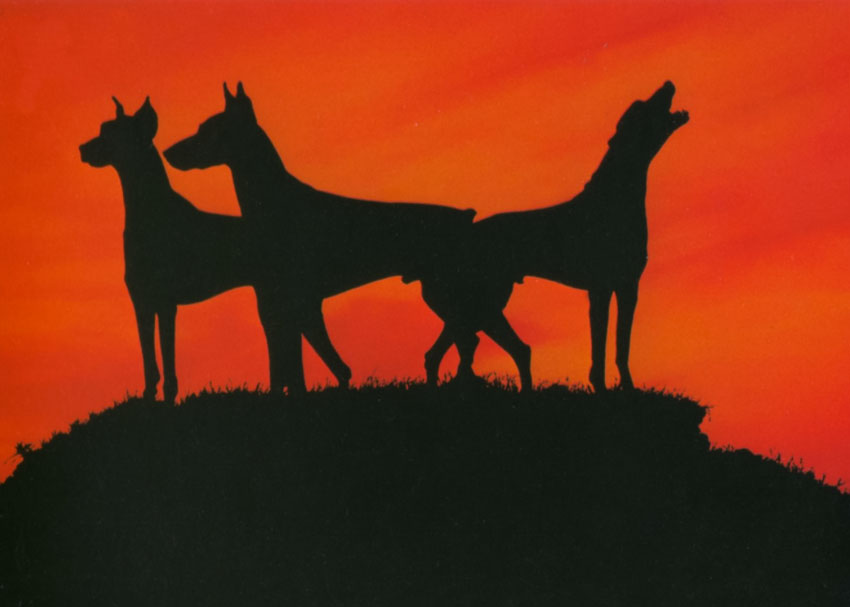
He is woken by a sudden image of a furious barking of a slavering Rottweiler. When he returns to sleep, he dreams again, this time of his forthcoming journey, and his own death.

The film’s long third act answers questions about that dream: was it a nightmare, or a premonition? From suburb to motorway to service station to remote country roads (filmed in Wales) he is stalked by those black dogs in a way that would amount to a decent gag in a less disturbing film.

There are startling images throughout, with distortions of time and gravity, accompanied by equally disconcerting sound design: wind, unexpected echoes, sudden silences, skittering and skipping.

Much weight is added by Trevor Jones’s romantic, melancholy music, interspersed with electronic droning.

When the end comes, it is shocking and surreal, starting with a biblically tempting apple that seems, somehow, to fall upwards and fly away into space.

In a more mainstream horror film, we’d get a Van Helsing, a priest or a policeman – perhaps that narrator from the opening sequence – to explain what’s going on and to conquer the evil.

Here, there’s no such bow-tying. We’re left bewildered and are expected to put the pieces together ourselves.

Is this a story about a poltergeist summoned by a rage-filled teenage girl? Is it about a demon or the devil? Are we trapped in Ian’s dream?

I have my ideas. You’ll no doubt have yours.

Sources

  • ‘British film production 1981’, Sight & Sound, Autumn 1982, pp.258-261.
  • ‘Making the grade in filmland’, County Times and Gazette, 15 July 1966.

This piece was originally written for the defunct British horror website Horrified. Since its publication in 2021, The Appointment has been released on Blu-ray by the BFI, with The Lake as a bonus feature. It also has a commentary by Lindsey C. Vickers along with other bonus features. To my delight, a quote from my piece featured in a press advert for this new release.