I’ve found the Blu-ray box set Shadows in the Fog to be a great introduction to the West German Krimi genre despite, on paper, being a collection of also-rans.
‘Krimi’ is a description applied to a run of films made in Germany between the 1950s and the 1970s, based on or inspired by the works of British crime writer Edgar Wallace.
The six films in this set were made by CCC Filmkunst as an attempt to cash in on the better-known Rialto Film series.
Rialto’s films were adapted directly from the novels of Edgar Wallace but CCC cannily enlisted Wallace’s son, Bryan Edgar Wallace, as the mascot for their knockoff series.
CCC’s films were all supposed to be based at least on ideas by Wallace the younger, although really the important thing was to get his name on the posters and in the opening credits.
Much has been made of the influence of Krimi on the Italian giallo genre. Often, the suggestion is that the giallo realises fully what the Krimi only half grasped. It’s true that gialli are generally bolder, more erotic, and more colourful.
Being British, it’s easy to scoff at the version of England presented in these films, recreated on Berlin studio backlots, on suburban streets, or in the grounds of historic buildings.
If you’re even remotely sensitive to architecture and design, you’ll notice the absence of London brick and the jarring presence of baroque stonework. And wven with the careful placement of extras in British police helmets and strategically parked Jaguars, you can’t turn smart Berlin apartment blocks on a neat grid into Soho or Whitechapel.
It’s only fair, though, isn’t it? At the same time the UK’s Hammer Films expected us to buy a country park as the wild mountain forests of Mitteleuropa, and its own backlot dollhouses as ‘Carlsbrück’ or ‘Karlsbad’.
The Mad Executioners, AKA Der Henker von London.
It doesn’t really matter that the London of the Krimi film is unconvincing because in this context it is merely a mythic playground for archetypes. (See also the landscape of the western, as various critics have observed.)
It has more in common with the foggy Universal backlot London of the Basil Rathbone Sherlock Holmes films of the 1940s than with the real thing.
In fact, Sherlock Holmes is clearly an unspoken reference point for the Krimi.
For example, the plot of The Phantom of Soho (Franz Josef Gottlieb, 1964) concerns a group of wealthy conspirators being hunted down one by one as revenge for a crime committed overseas – a plot structure Conan Doyle used multiple times.
As in the Holmes stories, we often get lords and wards and family secrets, with stately homes as key locations.
The films perhaps have more in common with the money-grubbing post-war Holmes pastiches of Adrian Conan Doyle, or with August Derleth’s Solar Pons stories, both of which tend to the macabre and the melodramatic.
One of the films in this set, The Curse of the Yellow Snake (Franz Josef Gottlieb, 1963) suggests a contemporary of Holmes, Sax Rohmer’s Fu Manchu, with all the racism that entails. It also feels like a precursor to Indiana Jones and the Temple of Doom and, going full circle, Young Sherlock Holmes.
Unlike Sherlock Holmes stories, Krimi credits the dogged men of Scotland Yard with a certain amount of genius.
The chief protagonist is usually a police inspector, like Jeff Mitchell (Harry Riebauer) in The Strangler of Blackmoor Castle (Harald Reinl, 1963) or John Hillier (Hansjörg Felmy) in The Mad Executioners (Edwin Zbonek, 1963).
They’re often the sharpest men on screen, both in terms of brainpower and fashion sense.
There’s never anything supernatural afoot but the films often hint that there might be. The killer in The Phantom of Soho wears a skeleton mask while in The Mad Executioners a gang of vigilantes rides about the Home Counties in a horsedrawn Gothic hearse straight out of Dracula.
The more Krimi I watch, the more I want to watch.
They’re reassuringly formulaic but also constantly surprising. The music is groovy, jazzy, and often surprisingly electronic. The faces are fascinating – household names in Germany but mostly unknown elsewhere, unless they cropped up in war films playing Nazi officers.
And this fantasyland of nightclubs, secret tunnels, laboratories, ruins, wild moors, and foggy Spreeside-Thameside streets is such a wonderful place to escape the here and now.
When they’ve built flats or superstores on the last of our wastelands, where will stories happen? Where will we go to play dangerous games?
Think of a 1970s British crime drama and you might well picture Jags and Ford Granadas chasing each other round nowhere spaces strewn with rubbish and ruins.
And any number of films stage their denouements on wasteland – because that’s where you end up when you’ve nowhere else to run.
It is a blank space, an urban version of the wild west, where confrontations between goodies and baddies can play out without civilians getting in the way.
Where did the wasteland come from?
It’s perhaps no surprise that the popularity of the word began to soar from the 1920s onward.
Until then, the life of cities took place in their centres – factories, offices, housing, ports and public transport.
But in the 20th century, that began to change.
Wasteland is primarily a product of the decline of industry. In his 1969 book Derelict Britain John Barr explained the extent of the problem of wasteland in post-war Britain:
First of all, industrial wastelands are a visual affront. They offend the eye, they offend what is one of the world’s most civilised landscapes… To tolerate dereliction spattering that landscape, to expect people to live amidst dereliction, is not civilised… Derelict land, and the industrial junk left behind when industry has made its profit and fled, is dangerous to life.
There was also the clearance of ‘slums’ and the movement of the population out to suburbs and new towns.
And, of course, there was World War II. The Blitz created spectacular wastelands in the hearts of cities such as London and Bristol.
What wastelands mean
T.S. Eliot’s 1922 poem The Waste Land (significant ‘the’, wasteland as two words) addresses the collapse of western civilization brought about by the industrial revolution and the technological age.
For the 1979 album Setting Sons Paul Weller of The Jam wrote a song called ‘Wasteland’ which equates industrial dereliction with childhood freedom. It is only there “amongst the smouldering embers of yesterday” that the song’s working class narrator feels free to express feelings of love.
In the atomic age, wasteland also offered a taste of what might be – a vision of what our homes and streets could become with one well-placed missile.
On film, as well as being logistically convenient for location shooting, wasteland represented similar ideas.
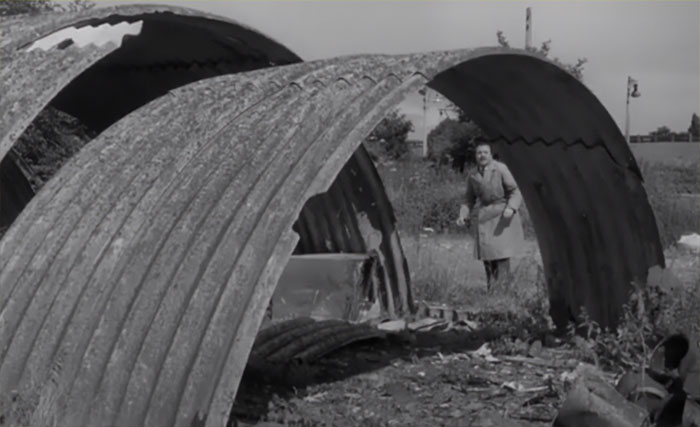
Richard Attenborough in Seance on a Wet Afternoon.
Wastelands on screen
In Seance on a Wet Afternoon (Bryan Forbes, 1964) wasteland is vital to the unhinged kidnap plot enacted by Billy and Myra (Richard Attenborough and Kim Stanley) as a promotional stunt for her work as a psychic.
Among tall grass, rusting Nissen huts and the remains of a half-demolished greyhound racing track, Billy prepares for the kidnap by dying his hair and hiding his motorbike.
Then, when he has the child in his custody, he returns to the same place to dump the stolen car and ditch his disguise.
The wasteland is a place between worlds, and between lives.
By passing through this wild space, he is able to leave civilization behind and transform himself from a timid suburban husband into a criminal capable of anything.
In The Small World of Sammy Lee (Ken Hughes, 1963) Anthony Newley plays a Soho nightclub compere who gets in debt with the wrong people.
His desperate attempts to raise money, against the clock, take him from one part of London to another.
Eventually, though, he runs out of road and winds up on a stretch of Thameside wasteland after dark.
There is nobody there to see or care as he is beaten half to death by his bookie’s enforcer.
In Bronco Bullfrog (Barney Platts-Mills, 1969) a young working class man called Del (Del Walker) tries to find somewhere to be alone with his girlfriend Irene (Anne Gooding).
They are frustrated at every turn, with interfering parents denying them privacy in both modernist flats and Victorian terraced houses.
Though it is far from ideal, like the protagonists of Paul Weller’s song, they resort to an inbetween space: a ruined building on wasteland in Stratford, East London. It is dirty, damp, overgrown and covered with graffiti, and this doesn’t work out either.
The Bashers is a remarkable documentary from 1963. Filmed by the BBC in Bristol it depicts the lives of youths in Barton Hill whose neighbourhood has great stretches of wasteland, awaiting the construction of new blocks of flats.
They don’t have much but they do have this remarkable resource and so entertain themselves by building giant bonfires, and battling gangs from rival neighbourhoods.
The authorities didn’t like this kind of thing, of course, and another place we see wasteland is in one of the most famous public information films. Lonely Water from 1973 shows children playing on the edge of a flooded quarry, among rusting cars and other fly-tipped rubbish.
Villains and tough cops
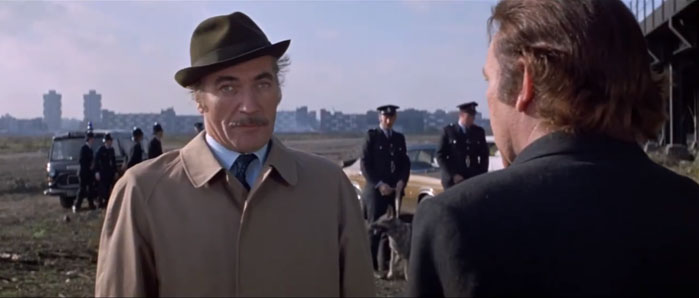
It’s in the gritty crime film that wasteland really comes into its own. Police corruption scandals and tabloid coverage of the Kray twins triggered a cycle of these in Britain from the late 1960s and through the 1970s.
The final act of Villain (Michael Tuchner, 1971) sees Ronnie Kray-alike Vic Dakin (Richard Burton) on the run in the aftermath of a robbery.
He ends up on a vast area of wasteland at Nine Elms in Battersea, being chased through the ruins of a gas works and a British Rail goods depot.
Villain.
In Sitting Target (Douglas Hickox, 1972) the final scenes take place in a distinct type of wasteland location: a dusty, cluttered transport depot full of workmen’s sheds, parked buses and freight cars.
Here, Harry Lomart (Oliver Reed) is able to pursue his nemesis, using a red jeep to crash into their car time and again, spinning them around a space that already feels half like a graveyard.
Again, the idea seems to be that this is the end of the line. It’s where you end up when there’s nowhere else to go and where, if you’re lucky, you might just about be able to lose yourself.
This isn’t uniquely British. We see similar settings in American crime films from the same period, and in Italy especially. Italian films about tough cops, known as poliziotteschi, invariably include a car chase or shootout on wasteland on the outskirts of Rome, Milan, Turin, or some other città violenta.
When the villain and the tough cop made it to British TV, the wasteland went with them.
The very first shot of the very first regular episode of The Sweeney, broadcast in January 1975, is of a stretch of cracked concrete, where a van races towards a bright yellow Ford Capri. They’re tooling up for a blag, you see, and where else can you do that except on wasteland?
The same episode concludes with a brutal brawl on what looks like a bombsite. It’s like watching boys play cops and robbers and probably not the first time this particular bit of wasteland was used for that purpose.
Turning waste into money
In 1980, crime drama The Long Good Friday arguably signalled the end of the wasteland era. Harry Shand (Bob Hoskins) is an East End gangster looking to go straight by getting in early on the London docklands property development boom.
In the decades that followed, London would lose much of its wasteland as Canary Wharf rose from the rubble, and other cities have followed the same pattern.
That barren landscape beyond Tower Bridge would have one last starring role, though, with the remains of Beckton gas works doubling for Vietnam in Stanley Kubrick’s Full Metal Jacket.
Now they’re almost gone, some of us have started to feel nostalgic for those wastelands. They were dangerous, mysterious and wide open.
Those that remain, pending development, are invariably locked down tight, with heavy security and surveillance.
For our own protection, of course, so we don’t end up like the victim of a 1970s public information film, drowned or crushed.
And to make sure squatters can’t get in and make use of these otherwise barren spaces to park vans or caravans.
But where are we supposed to have our showdowns now?
Or hold hands amongst the punctured footballs and rusting bicycles?
Sleeve notes for a Blu-ray box set that doesn’t exist.
In April 1969 the British film director Bryan Forbes became head of EMI Films in the UK. His statement of intent summed up a particular view of the state of the national film industry at the time:
We have gone too far with pornography and violence… There is simply no reason why filthy violence should be dragged into pictures. You do not have to lower your sights to entertain. We must see to it that entertainment does not become a dirty word.
Meanwhile newspapers were full of talk about “the permissive society”. More specifically, they were asking “Has it gone too far?” Here’s Rosemary Simon in an article in the Illustrated London News:
The saddest aspect of the whole situation is the needless waste. Healthy boys and girls who channel their energies into creating a disturbance instead of concentrating on sport, work, or helping in the community… Attractive girls with their whole future before them who, instead of enjoying their youth and eventually getting married, find themselves pregnant and are faced with the tragic alternative of seeking an abortion of of giving birth an illegitimate baby.
Tabloid newspaper The People reported that its readers had come out 4 to 1 against the permissive society based on the sentiment of correspondence received, like this letter:
A housewife has to try to make a happy home knowing her husband is queueing up to go to work beside a see-through, bra-less, mini-skirted girl… that he chats up a topless barmaid at his pub, while he spends the evening at his club watching strip-tease… If he can afford it, a sexy girl will even cut his hair. Unless he is made of stone he must get involved somewhere… A housewife feels hurt, inadequate, dreary and cannot compete. This is where the children begin to suffer. – Mother of four. Name and address supplied.
That’s terrible, said the public. Appalling. Tell me more. Like, what exactly are they getting up to, these dirty bastards?
In this context British films walked a difficult path. They knew people wanted to see films with sexual content, especially if it was transgressive. But couldn’t be seen to condone it.
So they made films which suggested sexual liberation had gone wrong, that perversion was rife, and that this was a serious Problem of Our Age… while also depicting it more or less frankly, with actors who were more-or-less lovely to look at.
Like American films of the 1930s and 40s who had to make gangsters pay for their crimes to justify the preceding hour of swagger and violence, British ones of the late 1960s had to make sure the swingers suffered for their pleasure.
London Wall as seen in The Ballad of Tam Lin, 1970
A cinematic uniperverse
There are a slew of films from 1968 to 1972 that aren’t formally related but which catch a similar mood and bounce off each other.
They sometimes share cast members, or at least types – ostensibly angelic blonde youths frequently feature, for example, as do sexually confident older women, and kinky establishment men.
Most of them are set in and around London and use the city to highlight the contrast between the old world (decaying, Victorian, Gothic) and the new: motorways, modernist towers, coffee bars, discotheques and pop art pads.
Their soundtracks steal from pop music of the period while always being a little too square, more Alan Hawkshaw than Mick Jagger, straight off the library shelf.
As for the tone, it’s about sickness. Yes, they’ll show you pretty young things with their kit off, to varying degrees, but they’ll also make you feel slightly queasy.
Brothers and sisters put hands and lips where they shouldn’t. People sweat and fret, suffering from physical and/or mental wounds. They mix sex and death at every opportunity. And adults frequently behave and even dress like children – which says what about their lovers?
Is it ever sexy? Fleetingly, sometimes, but more often it feels like the aversion therapy Alex undergoes in A Clockwork Orange.
Twisted Nerve
Georgie likes ducks
The film that feels to me like the start of this run is Twisted Nerve (dir. Roy Boulting, 1968) starring Hywell Bennett as a baby-faced blonde psychopath called Martin.
Barry Foster plays a lecherous lodger employed in the film industry, who says at one point: “If you want me to sell your crummy films, I say you’ve gotta give it a good dose of S&V. That’s what the public wants. Sex and violence.”
What a disgusting attitude, we are invited to think, before gorging on our own helping of S&V.
At the time, the controversy around Twisted Nerve centred on its treatment of the subject of Down’s Syndrome and its tangling of chromosomal conditions with mental illness. That’s even less comfortable for viewers today.
But it exactly demonstrates the tendency of these films to balance turn-ons with turn-offs. Twisted Nerve starts with Martin engaged in an extended discussion with a doctor about his brother’s incontinence, likely early death and parental abandonment. It’s pointedly bleak.
Martin then adopts, or rather inhabits, an alternate personality – Georgie, a childlike character presumably based on Martin’s observations of his own brother. As Georgie, he stalks Hayley Mills and inveigles his way into her home. He then seduces her mother (Billie Whitelaw) who, remember, is up for it, despite believing that he has the mental capacity of an eight-year-old.
Martin is sick but so is almost everyone else, including his own respectable but uncaring parents.
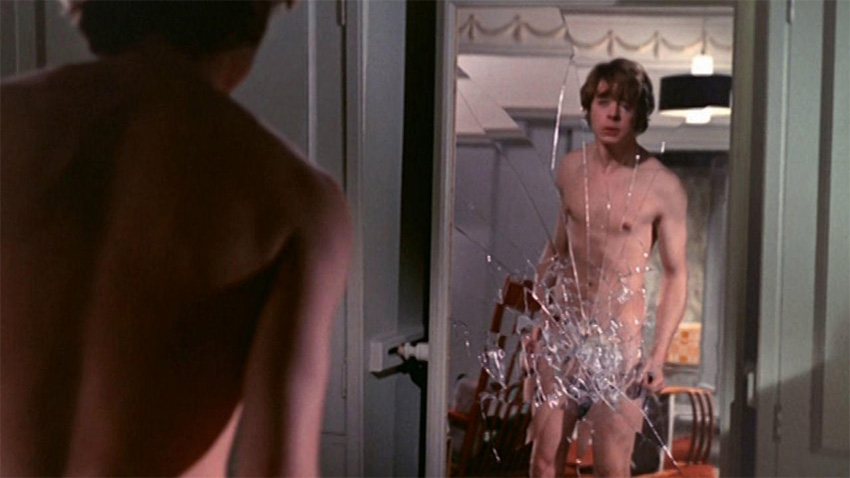
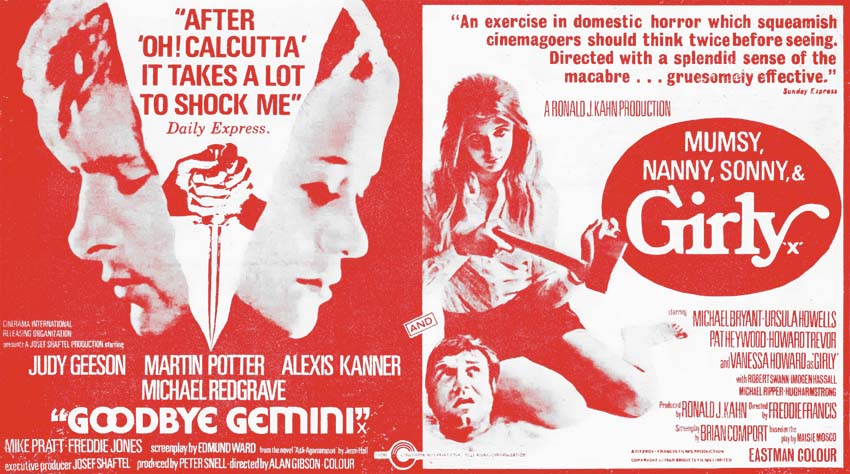
Goodbye Gemini/Mumsy, Nanny, Sonny & Girly
An infamous double bill
It’s astonishing that two of the key films in this cycle were released simultaneously and often shown together as a double bill. That is Goodbye Gemini (dir. Alan Gibson) and Mumsy, Nanny, Sonny & Girly (dir. Freddie Francis) both released in 1970.
Of the two, Mumsy, Nanny, Sonny & Girly is the better and more interesting film. It tells the story of a strange family – or is it a cult? – living together in a large country house.
The matriarch (Ursula Howells) and her servant (Pat Heywood) run the house while Girly (Vanessa Howard) and Sonny (Howard Trevor) run around in school uniform playing The Game.
To play The Game, you need playmates, so they occasionally go out into the world to seduce or bamboozle vulnerable men into joining them at the house. Those men are imprisoned and played with until they break the (impenetrable, unwritten) rules, at which point they are murdered.
When this film was released in the US it had a new title – Girly – and Vanessa Howard was the focus of the marketing. Dressed as a schoolgirl, the then 22-year-old actress sometimes plays the character as a seductress, and at other times as genuinely childlike. The audience is invited to fancy her, then to feel unclean for having done so.
It’s a grubby, disturbing, slimy film that makes my skin creep in the same way as Death Line, only without the gore. The other comparison might be The Texas Chain Saw Massacre, which also finds horror in twisting the traditional family structure.
Goodbye Gemini is more generic. It opens with rapidly cut shots of a coach arriving in London along the motorway, soundtracked by thumping Hammond-driven rock music. It’s meant to tell us we’re arriving in the big city, in the modern world, but of course it all looks a bit damp and tatty.
Judy Geeson and Martin Potter play cute blonde twins Jacki and Julian. They’re in their late teens or twenties but act younger, often deferring decisions to their teddy bear, Agamemnon. Decisions such as whether to throw the housekeeper who’s supposed to be looking after them down the stairs, for example, so they can enjoy London without restraint.
Julian loves Jacki a bit too much, in a way that’s not healthy. For a while, they share a boyfriend, hippy hipster Clive, who also wants to be Julian’s pimp. To seal that deal, he arranges for him to be raped by two men. So Julian and Jacki arrange for Clive to die. And so on into ever-descending spirals of blood and hysteria.
It’s a sweaty, feverish, unsettling film that tells us sex is a nightmare, love is a sickness, and that only death can set us free. It was also released under the name Twinsanity which is less tasteful but gives a clearer idea of its tone.
Vanessa Howard in What Became of Jack and Jill, 1972
I’ve already mentioned Dracula AD 1972which brings Dracula to modern-day swinging London. Here, the obligatory handsome blonde boy with a black heart is Johnny Alucard (Christopher Neame). His sickness takes the form of a master-slave relationship with Dracula himself. You could take Dracula out of the equation and retool this as a story about a delusional psychopath loose among the hipsters of Chelsea with relative ease. Like Goodbye Gemini it opens with shots of London – jet planes, flyovers, tower blocks – accompanied by pounding rock-funk. The following year’s The Satanic Rites of Dracula, also directed by Gibson, provided more of the same, with the addition of a satanic sex-power cult.
What Became of Jack and Jill (dir. Bill Bain, 1972) has Vanessa Howard, AKA Girly, as one half of a murderous young couple opposite Paul Nicholas. They shag on his granddad’s grave as they plot the murder of his grandmother. Their plan is to scare her to death by convincing her that the young are rioting in the streets and rounding up the elderly.
Unman, Wittering & Zigo (dir. John Mackenzie, 1971) isn’t set in London but transplants swinging London icon David Hemmings to a public school in the country. His pupils, arrogant little bastards, tell him they killed his predecessor and will kill him if he doesn’t submit to their will. As they engage in a battle of wills, the boys stalk and eventually attempt to rape his wife. Sonny from Mumsy, Nanny, Sonny & Girly would fit right in. He might even make a good pal for the unfortunately marginalised Wittering.
Jerzy Skolimowski’s Deep End from 1970 is beautifully made – definitely more art than exploitation. But it still gives us the beautiful blonde boy with a kink in his brain (John Moulder Brown), sexual relationships that cut uncomfortably across age barriers, and sex scenes that are more disturbing than arousing. He plays Mike, a 15-year-old boy who gets a job at a swimming pool in East London. On day one his colleague Susan (Jane Asher) initiates him into a job on the side pleasuring older women in the sauna rooms. He is driven mad by his infatuation with Susan and their complex relationship (she rejects him, then brings him close) leads to the inevitable mingling of sex and death.
The Ballad of Tam Lin (dir. Roddy McDowall, 1970) cuts across sub-genres. The first act takes place in that familiar, slightly square version of swinging London with beautiful young things in mod clothes speeding around in sports cars. The sequence in which they race out of town, past the modern office blocks of London Wall and up the M1, recalls the opening scenes of both Goodbye Gemini and Dracula AD 1972. They are the acolytes of a beautiful older woman (Ava Gardner) who seems to draw strength from their youth. There’s no room for dead weight in her commune-cult, though, and we see that she uses people up and discards them. The second half of the film fits more comfortably into the folk horror bracket, however.
These films are all quite different, I realise, in both intent and quality, but you could pick any two and run them together as an effective double bill.
When I asked people on Twitter about this they suggested a whole slew of other candidates. I’ve compiled those, along with the films listed above, into a watchlist on Letterboxd. Let me know what’s missing.
In 2021, I taught myself to sit down and watch films like I used to as a kid.
Not just easy films, or comfortingly familiar ones, either – films I’d never heard of; often old, sometimes slow, frequently strange.
Through work weariness and pandemic funk I’d drifted into some bad habits: evenings spent watching two or three episodes of some American police procedural or other that I didn’t even like or enjoy. Mentally chewing gum as I waited for bedtime.
Then I moved house and, for the first time in years, my collection of DVDs was where I could get to it. I found discs I’d forgotten I had and which I’d never got around to watching, or not seen in 20 years.
And, as it happened, the winter-spring lockdown was the perfect time to explore.
It wasn’t a resolution, as such. I’m not good with resolutions. But I did find myself thinking, come on, now, Ray – if you’ve got time to watch sodding Bones, which is terrible, you’ve got time to watch The Fifth Cord. How bad can it be? (It was great.)
I also got better at resisting the urge to dither: just pick a film; it doesn’t matter all that much.
Before long, watching films had become a new habit. Or, at least, a revived one, because I used to do this when I was a teenager, too.
Back then, I’d tape films from the TV with the VHS recorder I inherited from my grandmother when she upgraded. I had stacks of tapes, each with two or three films on, carefully labelled.
I’d stay up past midnight watching oddities on BBC2 or Channel 4, and spend Saturday and Sunday afternoons with canonical classics such as Casablanca or The Third Man.
At sixth-form college, I ran the film society, choosing films and writing programme notes for the other five or six attendees to snigger at. (I was a pretentious little berk.)
This year was about scrambling to catch up on a lost decade or two.
To some degree, I’ve trusted the curatorial instinct of labels such as Arrow Films, Indicator, Masters of Cinema and the Criterion Collection. If they’ve bothered to release a film on a pristine Blu-ray disc, you can be sure it will be worth a couple of hours of your time, in one way or another.
They also led me to books such as Danny Peary’s Guide For the Film Fanatic from 1986, which provided yet more items for my watchlist.
The watchlist isn’t just a scrap of paper, either: it’s on Letterboxd. Using that platform properly for the first time has really worked for me. Making myself log, rate and review each film I watch has kept me focused on my target of watching 150 films this year.
Not every film I’ve seen this year has been a joy – others may love Alice, Sweet Alice but I did not. But learning to sit through the duds, and think about them in context, is all part of the fun.
If you only get time to watch one, I’d say I Start Counting was the standout – an unsettling coming of age drama with a serial killer on the side, all set in a post-war English new town.
And if you’ve got recommendations for 2022, I’d be delighted to hear them.






 Precast Reinforced Concrete Heart