
Categories
crime Film & TV

The Todd Killings, Smooth Talk, and the allure of the creep

Everything about the American serial killer Charles Schmid sounds pathetic – so how was he able to command the loyalty of his teenage followers?

That’s a question grappled with by two films based on Schmid’s story, 1971’s The Todd Killings, directed by Barry Shear, and 1985’s Smooth Talk, directed by Joyce Chopra.

Both films ultimately share the same original source: a 1966 Life magazine article by Don Moser called ‘The Pied Piper of Tucson’.

That article is a masterpiece of true crime writing, available online, and also collected in a 2008 Library of America anthology. Moser painted a picture of a loser and weirdo who, in his early 20s, was still hanging around with school kids in Tucson, Arizona:

At the time of his arrest last November, Charles Schmid was 23 years old. He wore face make-up and dyed his hair. He habitually stuffed three or four inches of old rags and tin cans into the bottoms of his high-topped boots to make himself taller than his five-foot-three and stumbled about so awkwardly while walking that some people thought he had wooden feet. He pursed his lips and let his eyelids droop in order to emulate his idol, Elvis Presley. He bragged to girls that he knew 100 ways to make love, that he ran dope, that he was a Hell’s Angel.

But Schmid was somehow appealing to teenagers who saw not a creep but a local own-brand version of Elvis Presley:

He had a nice car. He had plenty of money from his parents, who ran a nursing home, and he was always glad to spend it on anyone who’d listen to him. He had a pad of his own where he threw parties and he had impeccable manners… He knew where the action was, and if he wore make-up—well, at least he was different… [To] the youngsters – to the bored and the lonely, to the dropout and the delinquent, to the young girls with beehive hairdos and tight pants they didn’t quite fill out, and to the boys with acne and no jobs – to these people, Smitty was a kind of folk hero. Nutty maybe, but at least more dramatic, more theatrical, more interesting than anyone else in their lives: a semi-ludicrous, sexy-eyed pied piper who, stumbling along in his rag-stuffed boots, led them up and down Speedway.

Schmid was more than “nutty”. He tortured at least one cat, for starters. Then, in May 1964 he convinced two young friends to accompany him as he kidnapped, raped and murdered 16-year-old Aileen Rowe. They helped him bury the body in the desert – and kept his secret.

A little later, in the summer of 1964, he met 16-year-old Gretchen Fritz at a swimming pool. He seduced her and they had a rocky year-long relationship. It culminated in the death of both Gretchen and her younger sister, Wendy, in August 1965. When he showed a friend called Richard Bruns where the bodies were buried in the desert, Bruns turned Schmid into the law.

Schmid was convicted of murder in August 1966 and sentenced to death. By June 1967 a film based on the story was in production.
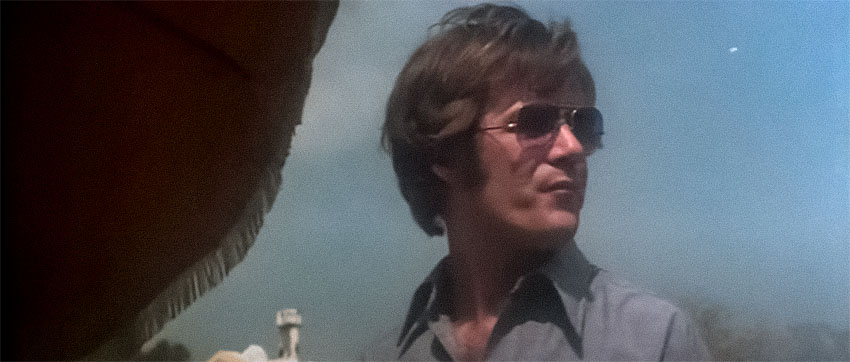
A screengrab from The Todd Killings showing Skipper Todd with bushy long hair, shades, and a wide collared shirt.
Robert F. Lyons as Skipper Todd in The Todd Killings.

The Todd Killings: torn from today’s headlines!

The Todd Killings had a range of working titles like ‘Pied Piper of Tucson’, ‘The Pied Piper’ and ‘What Are We Going to Do Without Skipper?’

It was eventually released in 1971 with the action relocated from Tucson to the fictional town of Darlington, California.

Schmid became ‘Skipper Todd’ played by Robert F. Lyons, with his look and lingo brought up to date. Skipper has shaggy Mick Jagger hair, tight bell bottoms, and a green dune buggy. He also plays folk rock songs on an acoustic guitar, almost like a spare member of The Monkees, or Charles Manson.

Lyons really is good looking, though, and brings to the part a commanding arrogance. The children follow him because he has the qualities of a leader. In odd, intercut scenes he is shown lying to a US Army recruiter to wriggle out of fighting in Vietnam where, actually, he might have thrived as another William Calley.

Updates and poetic licence aside, the film is an otherwise relatively faithful recounting of the facts of the case.

It has a particularly strong opening: Skipper is burying a body in the desert, helped by a devoted young girlfriend and a panicky boy.

This is not a whodunnit, or a did-he-do-it, like Psycho. That this young man is bad is established from shot number one.

From the off, we also empathise with the bored kids who are groomed by Skipper Todd, even as we want to shake them by the shoulders and urge them to break free.

We even begin to understand why they would reward his madness and violence with devotion. They are weak, and their parents are weak, too. He is good at spotting weakness and filling the gaps in people’s live. He has everyone, both boys and girls, under an erotic spell.

Did Charles Schmid ever see The Todd Killings? He died in prison in 1975 so it’s just about possible. If so, he would probably have found it flattering.
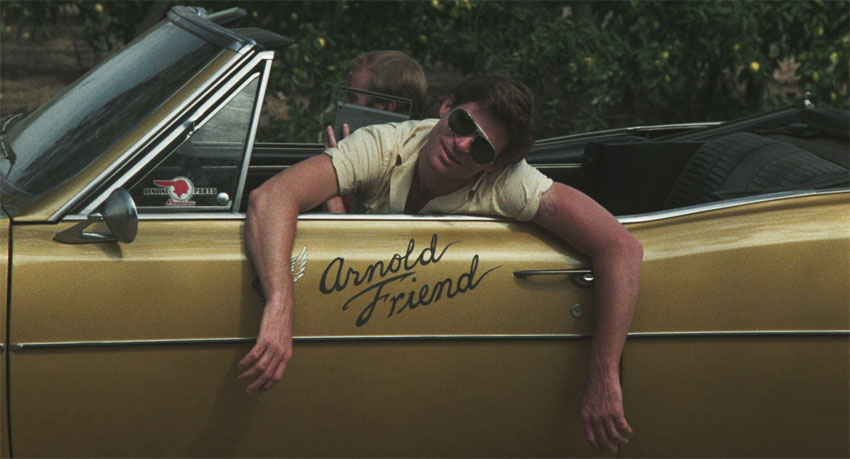
A man with muscular arms and sunglasses leans over the door of a gold convertible. His head is tipped to one side. The name Arnold Friend is painted in script letters on the side of the car.
Treat Williams as Arnold Friend in Smooth Talk.

Smooth Talk: back to the future

More than a decade later a second film tackled the story more obliquely, and more artfully. Joyce Chopra’s Smooth Talk from 1985 was not based on Moser’s article but on a short story by Joyce Carol Oates, ‘Where Are You Going, Where Have You Been?’ first published in 1966.

In Oates’s version of the Schmid affair, which was distilled from Moser, the monstrous fake teenager is called Arnold Friend. He stalks, seduces and seizes a teenager called Connie while her well-to-do parents are out at a barbecue. It crams a lot into a few thousand words and presents small town America as a menacing, sickly place.

Smooth Talk expands on the short story significantly, using Oates’s original material to form only the final act of the film.

It also does something really clever with the period. Connie (Laura Dern) is a quintessential 1980s teenager straight out of a John Hughes movie, while Arnold Friend (Treat Williams) is a relic of the 1950s. He is a cheap knockoff of James Dean (Connie has posters of Dean on her bedroom wall) and therefore closer to the real Charles Schmid than Skipper Todd.

In this, there’s an echo of another film: Terence Malick’s Badlands from 1973, in which Martin Sheen based his performance as spree-killer Kit Carruthers on James Dean. Kit wasn’t based on Charles Schmid, however, but his near namesake, Charles Starkweather – another rural weirdo with a taste for teenage girls.

In some ways, Arnold Friend is a less complex character than Skipper Todd, or the real Charles Schmid. He’s a sinister stranger, not a ‘pied piper’ who everyone knows and admires. He’s clearly a much older man (Williams was 34 when he played the part), dressed anachronistically, and almost supernaturally sinister in his manner, like an avatar of the Devil after Connie’s living soul.

In this version of the story Arnold Friend doesn’t kill anybody – as far as we know. He stalks Connie and, eventually, convinces her to go for a ride. This is roughly where Oates’s story ends and in that version we’re left to speculate on her fate. But if you know it’s inspired by Schmid your speculation is likely to favour murder.

In the film, Connie returns. She is changed – an adult, now, and no longer innocent. But she is, at least, not dead and buried in the desert.

In almost every way Smooth Talk is the better film. Not least because it makes Friend/Schmid an exterior menace and puts in the turbulent mind of one of his victims.

The Schmids, they’re multiplying

There is something particularly dark and rich about this story which must be why filmmakers keep coming back to it.

There’s Dead Beat from 1994, which seems almost impossible to see; Lost from 2005, adapted from a novel by horror writer Jack Ketchum; and Dawn from 2014, which focuses on the sister of one of Schmid’s victims.

Schmid is not the only killer to have inspired multiple movies, though. In fact, it’s unusual for a notable serial killer not to have inspired multiple movies.

Leopold and Loeb are practically a sub-genre (Rope, Compulsion, Swoon). So is Ed Gein – the original model for six decades of psycho-slashers, from Norman Bates to Leatherface. And Badlands is by no means the only take on the Charles Starkweather and Caril Ann Fugate story.

As a writer of fiction I find it almost maddening that real life generates stories that are so much more out there than anything I could invent. If I’d created Charles Schmid as a character it wouldn’t have occurred to me to give him white foundation make-up, a fake mole, and shoes full of crushed tin cans. Real criminals are often both dumber and more interesting than their fictional counterparts.

More importantly, I don’t know if I’d have been able to look at Schmid through the eyes of a teenager and have them think, “That guy is cool, I love him, I’ll do whatever he says.”

Main image: A digital sketch based on several different photos of Charles Schmid composited, traced, and treated with textures and filters.
Categories
Film & TV

Goodbye Aquarius: how sickness, sex and death got tangled up in British films 1968-72

Sleeve notes for a Blu-ray box set that doesn’t exist.

In April 1969 the British film director Bryan Forbes became head of EMI Films in the UK. His statement of intent summed up a particular view of the state of the national film industry at the time:

We have gone too far with pornography and violence… There is simply no reason why filthy violence should be dragged into pictures. You do not have to lower your sights to entertain. We must see to it that entertainment does not become a dirty word.

Meanwhile newspapers were full of talk about “the permissive society”. More specifically, they were asking “Has it gone too far?” Here’s Rosemary Simon in an article in the Illustrated London News:

The saddest aspect of the whole situation is the needless waste. Healthy boys and girls who channel their energies into creating a disturbance instead of concentrating on sport, work, or helping in the community… Attractive girls with their whole future before them who, instead of enjoying their youth and eventually getting married, find themselves pregnant and are faced with the tragic alternative of seeking an abortion of of giving birth an illegitimate baby.

Tabloid newspaper The People reported that its readers had come out 4 to 1 against the permissive society based on the sentiment of correspondence received, like this letter:

A housewife has to try to make a happy home knowing her husband is queueing up to go to work beside a see-through, bra-less, mini-skirted girl… that he chats up a topless barmaid at his pub, while he spends the evening at his club watching strip-tease… If he can afford it, a sexy girl will even cut his hair. Unless he is made of stone he must get involved somewhere… A housewife feels hurt, inadequate, dreary and cannot compete. This is where the children begin to suffer. – Mother of four. Name and address supplied.

That’s terrible, said the public. Appalling. Tell me more. Like, what exactly are they getting up to, these dirty bastards?

In this context British films walked a difficult path. They knew people wanted to see films with sexual content, especially if it was transgressive. But couldn’t be seen to condone it.

So they made films which suggested sexual liberation had gone wrong, that perversion was rife, and that this was a serious Problem of Our Age… while also depicting it more or less frankly, with actors who were more-or-less lovely to look at.

Like American films of the 1930s and 40s who had to make gangsters pay for their crimes to justify the preceding hour of swagger and violence, British ones of the late 1960s had to make sure the swingers suffered for their pleasure.

London Wall as seen in The Ballad of Tam Lin, 1970

A cinematic uniperverse

There are a slew of films from 1968 to 1972 that aren’t formally related but which catch a similar mood and bounce off each other.

They sometimes share cast members, or at least types – ostensibly angelic blonde youths frequently feature, for example, as do sexually confident older women, and kinky establishment men.

Most of them are set in and around London and use the city to highlight the contrast between the old world (decaying, Victorian, Gothic) and the new: motorways, modernist towers, coffee bars, discotheques and pop art pads.

Their soundtracks steal from pop music of the period while always being a little too square, more Alan Hawkshaw than Mick Jagger, straight off the library shelf.

As for the tone, it’s about sickness. Yes, they’ll show you pretty young things with their kit off, to varying degrees, but they’ll also make you feel slightly queasy.

Brothers and sisters put hands and lips where they shouldn’t. People sweat and fret, suffering from physical and/or mental wounds. They mix sex and death at every opportunity. And adults frequently behave and even dress like children – which says what about their lovers?

Is it ever sexy? Fleetingly, sometimes, but more often it feels like the aversion therapy Alex undergoes in A Clockwork Orange.

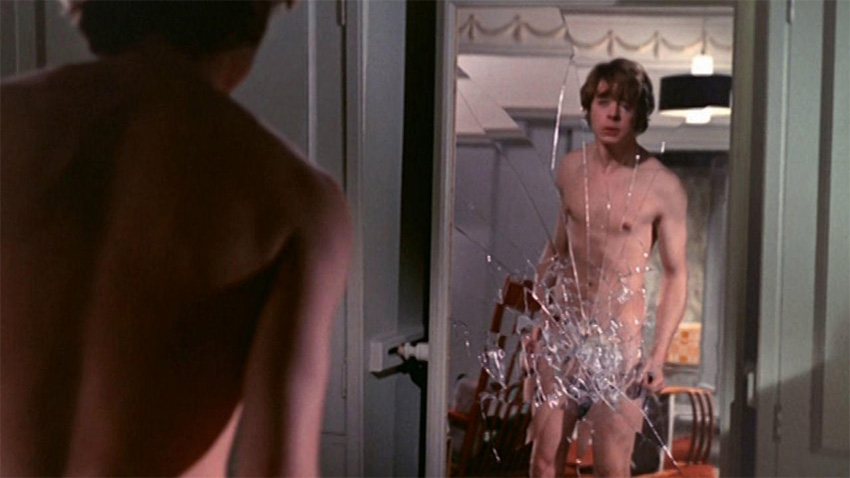
Hywell Bennet naked in front of a shattered mirrror.
Twisted Nerve

Georgie likes ducks

The film that feels to me like the start of this run is Twisted Nerve (dir. Roy Boulting, 1968) starring Hywell Bennett as a baby-faced blonde psychopath called Martin.

Barry Foster plays a lecherous lodger employed in the film industry, who says at one point: “If you want me to sell your crummy films, I say you’ve gotta give it a good dose of S&V. That’s what the public wants. Sex and violence.”

What a disgusting attitude, we are invited to think, before gorging on our own helping of S&V.

At the time, the controversy around Twisted Nerve centred on its treatment of the subject of Down’s Syndrome and its tangling of chromosomal conditions with mental illness. That’s even less comfortable for viewers today.

But it exactly demonstrates the tendency of these films to balance turn-ons with turn-offs. Twisted Nerve starts with Martin engaged in an extended discussion with a doctor about his brother’s incontinence, likely early death and parental abandonment. It’s pointedly bleak.

Martin then adopts, or rather inhabits, an alternate personality – Georgie, a childlike character presumably based on Martin’s observations of his own brother. As Georgie, he stalks Hayley Mills and inveigles his way into her home. He then seduces her mother (Billie Whitelaw) who, remember, is up for it, despite believing that he has the mental capacity of an eight-year-old.

Martin is sick but so is almost everyone else, including his own respectable but uncaring parents.

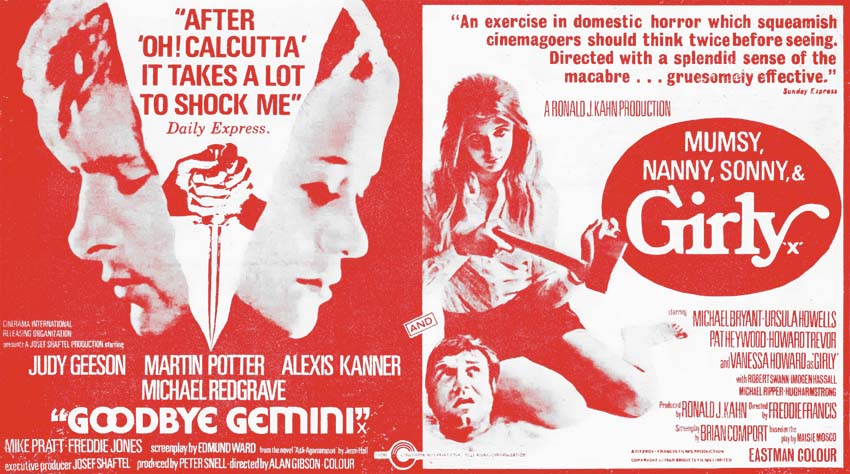
An ad for the double bill from 1970.
Goodbye Gemini/Mumsy, Nanny, Sonny & Girly

An infamous double bill

It’s astonishing that two of the key films in this cycle were released simultaneously and often shown together as a double bill. That is Goodbye Gemini (dir. Alan Gibson) and Mumsy, Nanny, Sonny & Girly (dir. Freddie Francis) both released in 1970.

Of the two, Mumsy, Nanny, Sonny & Girly is the better and more interesting film. It tells the story of a strange family – or is it a cult? – living together in a large country house.

The matriarch (Ursula Howells) and her servant (Pat Heywood) run the house while Girly (Vanessa Howard) and Sonny (Howard Trevor) run around in school uniform playing The Game. 

To play The Game, you need playmates, so they occasionally go out into the world to seduce or bamboozle vulnerable men into joining them at the house. Those men are imprisoned and played with until they break the (impenetrable, unwritten) rules, at which point they are murdered.

When this film was released in the US it had a new title – Girly – and Vanessa Howard was the focus of the marketing. Dressed as a schoolgirl, the then 22-year-old actress sometimes plays the character as a seductress, and at other times as genuinely childlike. The audience is invited to fancy her, then to feel unclean for having done so.

It’s a grubby, disturbing, slimy film that makes my skin creep in the same way as Death Line, only without the gore. The other comparison might be The Texas Chain Saw Massacre, which also finds horror in twisting the traditional family structure.

Goodbye Gemini is more generic. It opens with rapidly cut shots of a coach arriving in London along the motorway, soundtracked by thumping Hammond-driven rock music. It’s meant to tell us we’re arriving in the big city, in the modern world, but of course it all looks a bit damp and tatty.

Judy Geeson and Martin Potter play cute blonde twins Jacki and Julian. They’re in their late teens or twenties but act younger, often deferring decisions to their teddy bear, Agamemnon. Decisions such as whether to throw the housekeeper who’s supposed to be looking after them down the stairs, for example, so they can enjoy London without restraint.

Julian loves Jacki a bit too much, in a way that’s not healthy. For a while, they share a boyfriend, hippy hipster Clive, who also wants to be Julian’s pimp. To seal that deal, he arranges for him to be raped by two men. So Julian and Jacki arrange for Clive to die. And so on into ever-descending spirals of blood and hysteria.

It’s a sweaty, feverish, unsettling film that tells us sex is a nightmare, love is a sickness, and that only death can set us free. It was also released under the name Twinsanity which is less tasteful but gives a clearer idea of its tone.

Vanessa Howard in What Became of Jack and Jill, 1972

Sickness is in, baby!

There are plenty of other films that fit alongside those mentioned above, many of them included in the excellent book Offbeat edited by Julian Upton, which presents an alternative canon of British film.

I’ve already mentioned Dracula AD 1972 which brings Dracula to modern-day swinging London. Here, the obligatory handsome blonde boy with a black heart is Johnny Alucard (Christopher Neame). His sickness takes the form of a master-slave relationship with Dracula himself. You could take Dracula out of the equation and retool this as a story about a delusional psychopath loose among the hipsters of Chelsea with relative ease. Like Goodbye Gemini it opens with shots of London – jet planes, flyovers, tower blocks – accompanied by pounding rock-funk. The following year’s The Satanic Rites of Dracula, also directed by Gibson, provided more of the same, with the addition of a satanic sex-power cult.

What Became of Jack and Jill (dir. Bill Bain, 1972) has Vanessa Howard, AKA Girly, as one half of a murderous young couple opposite Paul Nicholas. They shag on his granddad’s grave as they plot the murder of his grandmother. Their plan is to scare her to death by convincing her that the young are rioting in the streets and rounding up the elderly.

Unman, Wittering & Zigo (dir. John Mackenzie, 1971) isn’t set in London but transplants swinging London icon David Hemmings to a public school in the country. His pupils, arrogant little bastards, tell him they killed his predecessor and will kill him if he doesn’t submit to their will. As they engage in a battle of wills, the boys stalk and eventually attempt to rape his wife. Sonny from Mumsy, Nanny, Sonny & Girly would fit right in. He might even make a good pal for the unfortunately marginalised Wittering.

Jerzy Skolimowski’s Deep End from 1970 is beautifully made – definitely more art than exploitation. But it still gives us the beautiful blonde boy with a kink in his brain (John Moulder Brown), sexual relationships that cut uncomfortably across age barriers, and sex scenes that are more disturbing than arousing. He plays Mike, a 15-year-old boy who gets a job at a swimming pool in East London. On day one his colleague Susan (Jane Asher) initiates him into a job on the side pleasuring older women in the sauna rooms. He is driven mad by his infatuation with Susan and their complex relationship (she rejects him, then brings him close) leads to the inevitable mingling of sex and death.

The Ballad of Tam Lin (dir. Roddy McDowall, 1970) cuts across sub-genres. The first act takes place in that familiar, slightly square version of swinging London with beautiful young things in mod clothes speeding around in sports cars. The sequence in which they race out of town, past the modern office blocks of London Wall and up the M1, recalls the opening scenes of both Goodbye Gemini and Dracula AD 1972. They are the acolytes of a beautiful older woman (Ava Gardner) who seems to draw strength from their youth. There’s no room for dead weight in her commune-cult, though, and we see that she uses people up and discards them. The second half of the film fits more comfortably into the folk horror bracket, however.

These films are all quite different, I realise, in both intent and quality, but you could pick any two and run them together as an effective double bill.

When I asked people on Twitter about this they suggested a whole slew of other candidates. I’ve compiled those, along with the films listed above, into a watchlist on Letterboxd. Let me know what’s missing.

Categories
buildings concrete Film & TV

Unhomely: new towns on film

On film, the post-war British new town is an uncanny space – heaven, hell, or somewhere between, but certainly not quite real.

The idea of the new town was born out of hope and optimism. With population growth, cities half-demolished by the Blitz, and increasingly demanding expectations around quality of life, ordinary working people in Britain needed new and better homes.

The British government set about identifying sites across the UK where large residential towns could be built from scratch, or by drastically expanding existing smaller settlements.

This was revolutionary, contrary to the usual British wait-and-see gradualism, and not everybody was convinced by the idea. It’s certainly difficult to find wholly positive depictions of the new towns project on film outside government propaganda.

Contemplating life in the post-war Britain to come in They Came to a City, 1944.

Right at the beginning, when the new towns only existed in plans and papers, Basil Dearden directed a film based on J.B. Priestley’s 1943 play They Came to a City. Released in 1944, it’s not explicitly about new towns but rather about the need to reorder British society along fairer lines after the war.

It just so happens, however, that Priestley’s metaphor for this new society is a city. A new one.

Priestley’s script acknowledges that not everyone wants to come on this journey – and those who choose to stay behind have their reasons. Nonetheless, the argument is clear: things need to change and someone needs to have the guts to explore the frontier.

Almost as if they couldn’t help themselves, however, Dearden and Priestley make the new town not only ambiguous but also unsettling, alien and even a little threatening. A supernatural, spiritual force rather than the product of pure bureaucracy.

Dearden’s previous film, Halfway House, had a similar structure – strangers gather to solve an existential mystery – only in that case, the twist is that they have all gone back in time to fix their mistakes. Here, they’ve gone forward, and are being given a chance to prepare for Things to Come.

We never get to see the town, only the giant portal and staircase that lead to it, and the alternately appalled or euphoric faces of the visitors as they return. That makes it all the more unnerving. What on earth can be at the end of that staircase? Surely something more exciting than, say, Harlow.

After the war, the New Towns Act of 1946 triggered the building process. Development of the first wave was focused on London and the South East.

From then on, the idea of the new town as a point of tension – new versus old, planned versus organic, urban versus rural – would be played out on film, consciously or otherwise, time and again.

An alien colony or a home counties new town? (Quatermass II.)

Some filmmakers were drawn to new towns because, half-built in the 1950s, they offered plenty of unsettling atmosphere off the peg. They were strange spaces. Silent. Disconnected from the world. Alienating.

Literally so in the case of Nigel Kneale’s Quatermass II.

The original 1955 BBC television series features scenes set in a ‘prefab town’ built for workers at the sinister secret facility around which the plot revolves. By the time Hammer adapted it for film in 1957 (dir. Val Guest) the setting was very clearly a more permanent new town, filmed on location at Hemel Hempstead.

It is presented as bleak and windswept, like a colony on Mars. The houses, in rippling rows, are surrounded by moorland. From one angle, it is urban. From another, rural. Both, and neither.

This plays on a feeling that new towns simply should not be. Towns should grow over the course of decades, over centuries – not overnight.

In his 2016 book The Weird and the Eerie Mark Fisher wrote about a container port in Suffolk as “a weird phenomenon, an alien and incommensurable eruption in the ‘natural’ scene”. Its silence, when viewed from a distance, contributes to this sensation. New towns can have a similar effect.

There’s also cold war paranoia in Quatermass II, and a suspicion of anything resembling socialism. The people of the town are unwitting worker drones for alien invaders, their servitude bought with these bland, identical homes, and the promise of food on the table in return for no questions asked.

A later television production, Danger Man, took a more head-on approach to the same idea. In the 1964 episode ‘Colony Three’ John Drake (Patrick McGoohan) is kidnapped and taken to Hamden New Town. (Played by Hatfield.) It’s perfectly clean, perfectly civilised, but of course it’s not an English town at all – it’s an unnamed Eastern bloc country and is a training ground for spies.

X marks the spot. (The Big Job.)

This sense of the uncanny, of the new town as an unnatural invader, is even present in ostensibly comic films.

In The Big Job, a not-quite-Carry-On from 1965 directed by Gerald Thomas, Sid James (also in Quatermass 2) plays a gangster who buries the spoils of a robbery in a country field. Fifteen years later, when he is released from prison, he returns to find that a new town (Bracknell) has been built on those very fields – and a police station right on top of his treasure.

It’s a funny setup but it also underlines the pace of change in post-war Britain. Who would expect deep English countryside to become a settled English townscape in such a short span of time? Turn your back and the very fabric of the country will shift.

This leads us to another question: what does the new town bury or replace?

All this used to be fields. (Requiem for a Village.)

In the American film Poltergeist (dir. Tobe Hooper, 1982) a Spielburbian planned community (housing estate) is built on the site of an old burial ground that was never cleared, which is the source of its haunting.

But almost every inch of Britain is a burial ground or battlefield.

Requiem for a Village (dir. David Gladwell, 1975) is almost a ghost story, or perhaps an example of folk horror, built around the growth of a new town around a country village.

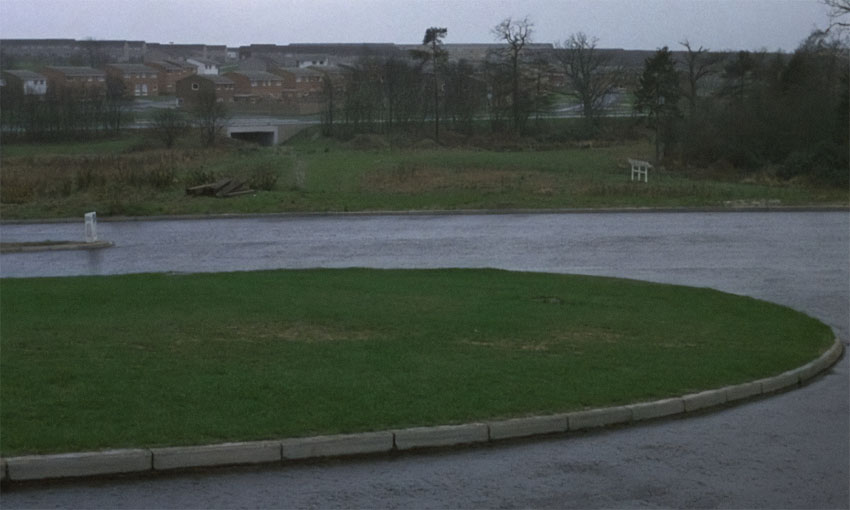
In the opening scenes we see an old man set off from a modern housing estate on the edge of the town, wobbling along on his bike. He negotiates roundabouts and a dual carriageway, eventually finding his way to a secluded village church. While tending the grounds, he has a vision of bodies rising from the graves, returning to the pews in the church. He follows them and so begins a trip through his own memory, and a collective memory of a lost rural life.

The new town here isn’t bad – the houses are large, clean and comfortable. And the past is murky, too, blighted by war, poverty and rape.

But, still, there’s a suggestion that the modern world has rolled concrete, closes and crescents over something richer and more complex. The bulldozer is an existential threat.

New town madness in The Alf Garnett Saga, 1972.

A less arty but perhaps no less heartfelt take on some of the same ideas can be found in, of all places, the second film based on the TV sitcom Till Death Us Do Part.

Released in 1972, The Alf Garnett Saga (dir. Bob Kellett) relocates Garnett from the East End of London to a tower block in a new town – Hemel Hempstead, once again. He not only dislikes it but cannot cope with it. It has the trappings of a community, such as a pub, but is configured in a way that leaves him bewildered, imprisoned and humiliated.

At one point, he takes LSD, imagines himself to be a chicken and nearly falls from the balcony: “Out the window, fly away… Open the window, open the cage…”

In an essay translated into English as ‘The Uncanny’ Sigmund Freud actually uses the German word unheimlich – ‘unhomely’. Are new towns homely?

A common criticism of new towns and overspill estates is that they lack soul or character. “Rows of houses that are all the same” are contrasted with the individuality of the buildings found in towns which developed organically over centuries. And because these houses are built in clean, straight-line modernist style, they seem to lack individual texture.

There’s another kind of place they call to mind, especially when seen in their pristine state in films from the 1960s and 70s: the ‘tin towns’ in which the British Army trains for urban warfare. Or, of course, standing sets on studio backlots, whose houses are usually hollow shells.

Beige, white, oatmeal and ‘elephant’s breath’: the bland perfection of a new town flat in I Start Counting.

In both I Start Counting (dir. David Greene, 1969) and The Offence (dir. Sidney Lumet, 1973) the new town is dangerous in another way: as the hunting ground for a serial killer.

I Start Counting makes explicit an alienating quality in new town life. “The rain don’t even fall on us here,” says Granddad, looking forlornly from the window of the family’s tower block flat. The flat is actually a studio set and, painted beige and white throughout, evokes the alien simulation of a bland hotel room where Dave Bowman ends up at the end of Kubrick’s 2001: A Space Odyssey.

If the new town feels unreal, like a simulation, then what might that do to the mind of a psychopath already struggling to ascribe real feelings to, or empathise with, his victims? They’re just non-player characters in an open world game.

Then there’s the would-be utopian landscape of pedestrian underpasses, footbridges and green space. A dream in the promotional films made by new town corporations to market themselves to the young city dwellers they hoped to lure. But also appealing to parasites looking for opportunities to kidnap, maim or kill.

Something something liminal spaces something something. (The Offence.)

In I Start Counting it’s parkland at the end of the bus route – the new town’s weirdly hard edge – where young women are most vulnerable. In The Offence, it’s tunnels running beneath brand new roads where a child-killer strikes.

Built-up but sparse, populated but somehow empty, this new town (Bracknell, again) feels especially psychically dangerous. Look what it does to Detective Sergeant Johnson (Sean Connery): he loses his grip on reality and morality, brooding in his tower block flat and the new-build brutalist police station like a man in purgatory.

New towns are appealing to criminals of other varieties, too. As a composite of both Kray twins in Villain (dir. Michael Tuchner, 1971) Richard Burton plans the perfect payroll robbery to take place on the beautifully empty roads of (yet again) Bracknell.

For the East End villain, this is ideal: do your business out of town, on the wild, distant frontier, with only provincial policemen in your way.

Bloody kids. (A Clockwork Orange.)

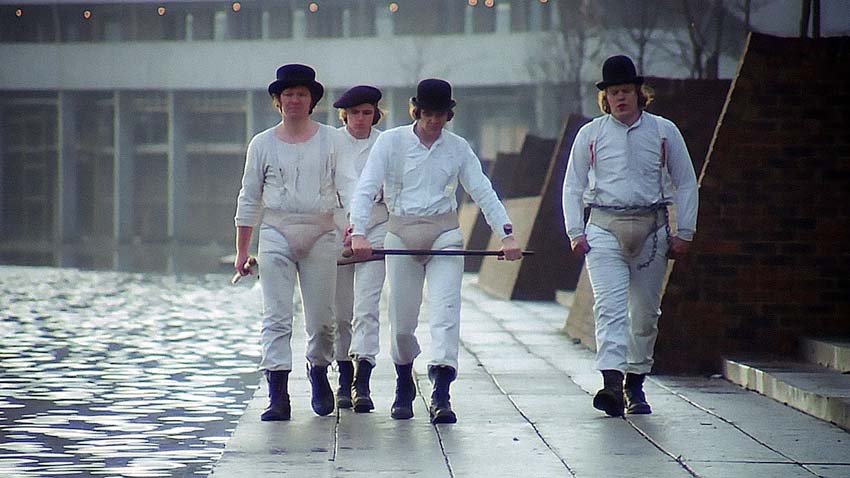
And then, of course, there’s Stanley Kubrick’s A Clockwork Orange (1971), which used Thamesmead, marketed as “London’s new town!”, to represent a dystopian future.

More than any other film, this cut through the PR and foresaw problems to come. When footbridges and underpasses cease to be cared for, when the gardens become overgrown, and the concrete sickens, the shine can go off a new town pretty fast.

Despite the recurring portrayal of the new town as uncanny, unsettling and alienating, it’s not all bad news. In two notable sex comedies, it’s not a training ground for aliens, spies or criminals but for randy teenagers. It’s a playground. A safe space to practice being an adult.

A backdrop to young love in Gregory’s Girl.

In fact, rewind: there’s even some of this in I Start Counting. It offers glimpses of a town centre where young people are given places of their own – record shops, cafes, nightclubs – and where there are plenty of precincts and arcades, squares and parks. They’re new and shiny, too, not yet haunted by Alex and his droogs.

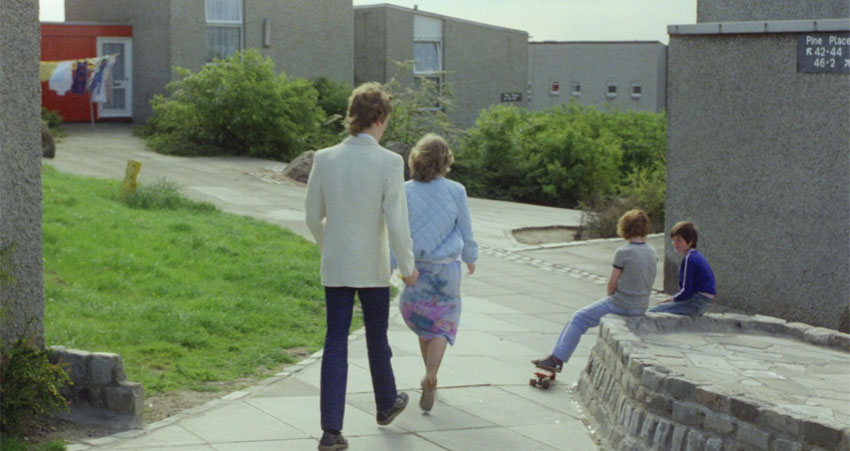
In Here We Go Round the Mulberry Bush (dir. Clive Donner, 1968) and Gregory’s Girl (dir. Bill Forsyth, 1980) the focus is entirely on the struggles of young men to understand young women.

The bland, clean safeness of their new town backdrops (Stevenage and Cumbernauld respectively) saves us from the heavy ‘issues’ that so often bog down British youth films. We don’t need to think about urban decay when there’s love in the air. In Forsyth’s film, Cumbernauld looks positively Californian, its concrete bathed in golden hour light. Shangri-La.

Christopher Ian Smith’s 2017 documentary New Town Utopia, about Basildon in Essex, gets the balance right. With time, it argues, memories have accrued and traditions have developed. If they aren’t paradise, these Pinocchio towns, have at least achieved their dream of becoming real places.

Sources and further reading

Categories
Film & TV

FILM: Journey to Spielburbia

The neighbourhood. Quiet, curving streets where children play in the road, making way now and then for a wood-panelled station wagon or Chevy pick-up. The houses are probably painted white, with white wooden fences, and perfectly green lawns. There might be a paperboy slinging rolled copies of the local daily. TVs are always on and always showing black-and-white movies or Looney Tunes cartoons. Kids have Star Wars posters on their bedroom walls and play games on Atari consoles. Teenagers listen to pop music on chunky Sony Walkmans. There will certainly be tall, tanned dads watering lawns and washing cars and faintly glamorous moms cradling brown bags overflowing with shopping. For dinner, it’s Wendy’s or McDonald’s, accompanied by cans of Coke or Tab for the kids and Budweiser for Dad. And it is always Independence Day, or Halloween, or Christmas – golden hour glow, warm autumn leaves, perfect snow. America is on top, life is good, adventure is just round the corner.

I spent my early years on a concrete council estate in a small town in Somerset but, like Rick Deckard in Blade Runner finding succour in his implanted memories, the images that spring to mind when I think of childhood are often American in flavour. That’s because, like many people my age, I grew up largely in front of a rented Rumbelow’s TV, absorbing the sunny glow of Spielburbia.

Spielburbia is a name for the American suburb as envisioned by Steven Spielberg. It manifests in films he directed such as E.T. the Extra-Terrestrial (1982), those he produced such as Back to the Future (dir. Robert Zemeckis, 1985) and others which simply imitated his style in pursuit of a share of his incredible commercial success. As far as I can tell, the term Spielburbia was first used by Tony Williams, disparagingly, in his 1996 book Hearths of Darkness, with reference to Poltergeist, a pop horror film that Spielberg produced and was long thought to have shadow-directed over Tobe Hooper’s shoulder. Williams sees Spielburbia as a reflection of an ‘infantile mindset’. To those living through less than perfect childhoods and, worse, the crushing weight of adventureless adulthood, that is precisely its appeal.

My gateway to Spielburbia was a branch of Ritz Video on the Sydenham Estate shopping arcade in Bridgwater. That’s where my parents rented, in big yellow boxes, also-ran kids adventure films like D.A.R.Y.L., The Boy Who Could Fly, The Explorers and Flight of the Navigator, all of which I saw long before E.T. or Close Encounters. When I talked about this with my brother, he recalled the colour-coding system that dictated the rental price: E.T. was expensive, D.A.R.Y.L. was cheap. So we watched D.A.R.Y.L. and loved it. Television was also important, five- or six-year-old big-budget American movies being the key events in what continuity announcers called ‘a very special Christmas here on BBC1’, or bank holiday matinees.

To a child in Britain in the 1980s, Spielburbia was both familiar and alien. We had kids on bikes. We had fences. We had plastic action figures and even American footballs, for which there was a brief craze in the UK at the tail-end of the decade. But it lacked the scale or glamour. The bikes were rusty non-brands from Halfords. The fences were steel mesh, also rusting. There was no mountain behind our estate – no pine forest or field of corn.

The cinematic Spielburbia came into being, I think, with Spielberg’s first big hit, Jaws, released in 1975. Though set on a tourist island, not in the suburbs, the feel is there in the scenes of Chief Brody’s domestic life and the arrival of tourists on Fourth of July weekend. Spielberg has a delicate touch when it comes to portraying the barely-blessed lives of ordinary Americans – adults and children bickering and laughing together over unmade beds, coffee machines and bowls of sugary cereal. In Jaws, Martin Brody awakes reluctantly and stumbles stiff-legged across the bedroom to check on the kids in the yard. “In Amity, you say yaaahd,” says Ellen Brodie, teasing. “They’re in the yaaahd, not too faaaah from the caaaah. How’s that?” replies Martin. “Like you’re from New York,” says Ellen. While Brodie fields a garbled call about a missing swimmer, his son Michael swaggers into the kitchen and proudly shows off a wound – the result of playing on poorly-maintained back-garden swings against his father’s instructions.

Swings! A minor detail but, oddly, a recurring one in the run of Spielberg’s movies from Jaws to Poltergeist. I’d bet any money his own childhood home had a set. And that mention of New York is important too: this is not New York City, or Los Angeles or Chicago – the default urban settings that define many cult films of the 1970s. The appeal of Spielburbia is that, at least until killer sharks, aliens or sinister government agents arrive on the scene, it is not ‘gritty’ or dangerous. It is – I can’t avoid the word any longer – ‘sleepy’.

Spielberg’s next film, Close Encounters from 1977, develops the idea. Centreing on a family man, Roy Neary, played by Richard Dreyfuss, it grounds the fantastical alien visitation plot with a portrait of a down-to-earth lower-middle-class suburb in Muncie, Indiana. Muncie – the very word sounds like an adjective, something from The Meaning of Liff, perhaps meaning dull or bland. The neighbourhood provides a pointedly sane backdrop against which Neary’s UFO-induced madness plays out. Spielberg delights in the background details: backyard swings, again; dads in shorts washing cars and boats on sloping driveways; children practicing their baseball swings, or riding bikes.

Though set in Indiana, in the American Midwest, it was actually filmed in Mobile, Alabama, in the southeastern US. That Spielberg could make this substitution tells us something: American suburbs are American suburbs, utterly interchangeable. Or, if you prefer, universal. The house that played the part of the Neary home is in a post-World-War-II housing development called Colonial Heights – an arrangement of near-identical single-storey houses along meandering streets designed to go nowhere in particular. It is a classic example of ‘tract housing’.

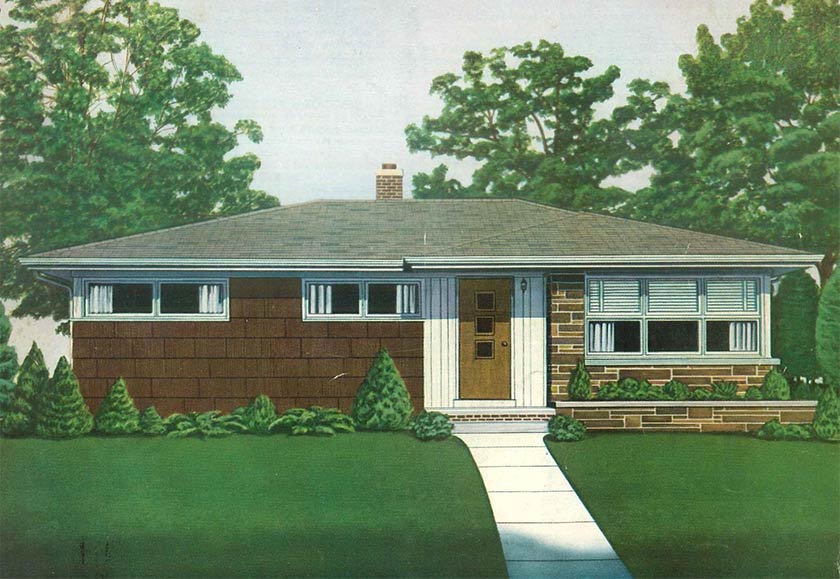
A cookie cutter home.
From ‘Homes for Your Street and Mine’, 1950, via Archive.org.

Tract housing, sometimes known as ‘cookie-cutter housing’, was primarily a post-World-War-II phenomenon. As the US population grew, increasing by 50 per cent between 1940 and 1970, millions of Americans moved from rural settlements into urban and suburban settings. By 1970, there were around 75 million Americans living in the suburbs – more than the entire population of the UK.

This suburbanisation was brought about by the advent of techniques for mass-producing appealing homes, and of heavy-duty construction vehicles which made it possible to clear great areas of agricultural land, wilderness or even desert plains. Hills could be flattened, terracing imposed, and landscapes composed – new spaces into which thousands of individual homes could be dropped with maximum efficiency.

The most famous examples might be the Levittowns built by Abraham Levitt & Sons in New York, Pennsylvania, New Jersey, Puerto Rico and Maryland between 1947 and 1970. The houses were built on production lines and could be erected in a single day.

While many applauded the democratisation of home-ownership this brought, the uniformity of this new suburban architecture – it’s sheer bloody munciness – unnerved some. What had happened to American individualism? A 1950 catalogue for the tellingly named Standard Homes Company entitled Homes for Your Street or Mine boasts that the designs within were ‘standardized to avoid waste… America’s best planned small homes’. The utopian illustrations depicting ‘The Lorain’, ‘The Lexington’, ‘The Wayne’ immediately bring to mind Spielburbia.

These suburbs also came in for criticism from those who saw in them the potential for ever-greater alienation and detachment from society – where were the neighbourhood bars or diners? Where were people supposed to congregate when not at work? Ray Oldenburg, author of The Great Good Place, published in 1989, saw the loss of this vital ‘third place’ from American culture after World War II as the root of many societal ills:

What opportunity is there for two men who both enjoy shooting, fishing or flying to get together and gab if their families are not compatible? Where do people entertain and enjoy one another if, for whatever reason, they are not comfortable in one another’s homes? Where do people have a chance to get to know one another casually and without commitment before deciding whether to involve other family members in their relationship? Tract housing offers no such places.

Ira Levin’s 1972 novel The Stepford Wives, made into a film in 1975, takes the uniformity of suburbia to its logical conclusion – if all the houses are the same, why not all the people? His sour, satirical take has housewives killed and replaced by compliant robots.

Spielberg isn’t unaware of suburbia’s downsides. As Roy Neary has his breakdown in Close Encounters, for example, the neighbours gather to watch, gawping from their driveways or leaning out of bedroom windows. When he speaks to them – ‘Good morning!’ – they ignore him. These people are crammed together and yet miles apart. But, overall, his take on suburbia is fond.

Spielberg himself grew up in just such a post-war neighbourhood, in Phoenix, Arizona. Joseph McBride made the pilgrimage while researching his 1997 biography of the director:

When a visitor enters Steven’s old neighborhood in Phoenix today, with its 1950s-era ranch houses still lining a broad, tranquil street crisscrossed by friendly kids riding bicycles, the feeling is inescapable: You’re not only going back in time, you’re entering a Spielberg movie.

Nowadays, anyone can visit Spielberg’s childhood home at 3443 North 49th Street thanks to Google Street View and to do so is startling – McBride is absolutely right, and it’s easy to imagine Spielberg location hunting, always seeking somewhere that felt just like home. Whereas others of his generation rejected suburban upbringings and wrote songs or novels mocking square life, Spielberg apparently yearned for it.

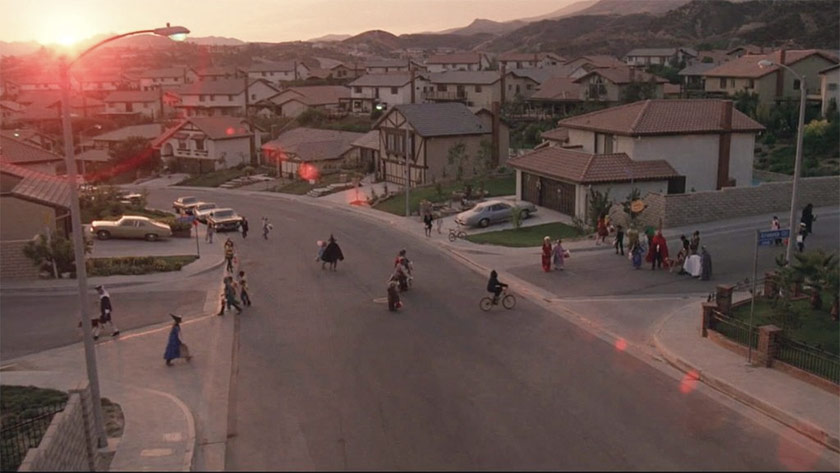
A screengrab from E.T.
A scene from E.T. the Extra Terrestrial

The two films in which Spielburbia really comes into focus are both from 1982: E.T. the Extra Terrestrial, directed by Spielberg, and Poltergeist, which he wrote and produced.

E.T. takes the growing list of tropes – or tics, perhaps – from Jaws and Close Encounters and amplifies them. For example, Spielburbia is defined by an abundance of mass-produced toys. In Close Encounters, Roy Neary tinkers with a model train set while a music-box in the shape of Pinnochio plays ‘When You Wish Upon a Star’. By the time we get to E.T., however, with the action playing out primarily in an eleven-year-old’s bedroom, there are moments when it feels like a commercial. ‘This is Greedo,’ says Elliot, showing his friend from outer space his Star Wars figures, ‘and then this is Hammerhead. See, this is Walrus Man. And this is Snaggletooth. And this is Lando Calrissian.’ A Texas Instruments Speak’n’Spell machine is even part of the contraption E.T. builds to ‘phone home’.

In E.T. we’re treated to sweeping crane shots of the suburb, filmed and set in the San Fernando Valley outside Los Angeles, and the majority of the action takes place there. Children on BMX bikes use their knowledge of the topography – its back alleys, broken fences and empty lots – to evade capture. Near the end of the film, a glimpse of a half-finished development on a new tract of land, into which the children escape, threatens to turn this into a film about the suburbs. Poltergeist, released in the same month of the same year, completes that journey.

The family man at the centre of Poltergeist, Steve Freeling (Craig T. Nelson), doesn’t just live in a suburb – he’s a salesman for the development company that built the bland but pleasant Cuesta Verde estate. Early in the film, director Tobe Hooper plays a sly trick, fading from a shot of the cluttered Freeling family kitchen to what looks like the same room stripped bare. Then Steve walks in with a couple who are considering buying what turns out to be a different house. ‘l can’t tell one house from the other,’ says the potential buyer.

At first, Cuesta Verde seems almost perfect, with all the Spielburbian signifiers. Then its flaws become apparent – the houses are crammed so close together that the Nearys and their neighbours keep switching the channels on each other’s TVs. As the haunting begins we learn that the truth is grimmer yet: the land on which the houses were built was a former cemetery and though the headstones were moved, the corpses were left in place beneath backyards and porches.

Perhaps this is the moment where Spielberg soured on Spielburbia, or at least moved on. He would not himself direct or write any more films with this setting, leaving his disciples to carry the baton.

If 1982 had the ‘Summer of Spielberg’, 1985 was the summer of Spielburbia, seeing the release of four notable films in the sub-genre.

Back to the Future was written by Robert Zemeckis and Bob Gale and directed by Zemeckis, with Spielberg in the producer’s seat. Like Poltergeist, it offers a critical portrayal of the suburbs, taking advantage of the time travel plot to show a post-war Californian development, Lyon Estates, in both its well-worn 1980s incarnation and as a mere aspiration in 1955. ‘Live in the home of tomorrow…. Today!’ reads an advertising hoarding outside gates which open onto a tract of dusty land that is naked but ready.

The Goonies, directed by Richard Donner and based on a story by Spielberg, who also hovered around the set. It takes elements of E.T. – the child’s-eye view, the pursuit by sinister adults – and fuses it with the skeletons, subterranean tunnels and treasures of the Indiana Jones movies.

Neither Explorers, directed by Spielberg protege Joe Dante, or D.A.R.Y.L, had any involvement from the man himself, but both took components of Close Encounters and E.T., shook them up and glued them back together.

Even after 1985, the films kept coming – Flight of the Navigator and The Boy Who Could Fly from 1986, for example – but Spielburbia began to feel like a cliche and the movies like ever-weaker echoes.

Then, in 1989, Joe Dante directed The ‘Burbs, which might be said to put a neat full stop on this first phase. Dante’s films always walk a fine line between sincerity and satire and The ‘Burbs, which features Tom Hanks in an early outing for his ‘America’s Dad’ persona, tackles the strangeness of the suburbs head on while also celebrating them. Unlike Spielberg’s own suburban-set fantasies, which used real streets in real towns, The ‘Burbs was filmed on the backlot at Universal Studios. It used a set known as ‘Colonial Street’ which you will have seen in hundreds of TV shows and films – The Munsters lived there, as did the Desperate Housewives.

For twenty years or so after The ‘Burbs, Spielburbia was more or less neglected on film, even if a generation of us homesick for it, and for the comfort of childhood, drifted back there when the opportunity arose. Then in 2011 one of those children, director J.J. Abrams, revived Spielburbia in his own film, Super 8. Set in Ohio in 1979, it takes the masterlist of tropes and ticks them off one by one as a band of plucky kids on bikes take on both aliens and the military-industrial complex. It kicked off a run of similarly self-conscious homages including, most notably, the Duffer Brothers’ Netflix-produced Stranger Things, now approaching its fourth season, as well as a distinctly Spielburbian take on Stephen King’s scary clown story IT spread across two films.

What are people yearning for when they watch these films and TV shows? For some of us, it’s straightforward nostalgia for the pop culture we consumed as kids. For others – those who grew up in Ronald Reagan’s America – it must be a fond memory of a time when things felt less complicated.

And, dare I say it, Spielburbia is terribly, unashamedly white. Not only are there no black neighbours but scarcely anyone not presented as Anglo-Saxon or Irish. The first Levittowns were explicitly racist, with contracts stipulating that only members of ‘the caucasian race’ were allowed to buy or let. Spielberg, who often describes himself as having been the only Jew in his neighbourhood as a child, even turned Jewish actor Richard Dreyfuss into Roy Neary, apparently an Irish-American. It’s a dream of the 1980s as the 1960s or 1950s – a continuation of the American Graffiti tendency of Spielberg’s friend and frequent collaborator George Lucas.

More than anything, though, Spielburbia is a mood. Whatever outlandish events might be occurring, thanks to Industrial Light & Magic or the devil or visitors from space, as viewers, we’re invited to remember the best moments of being eleven years old. We’re reminded of sharing meals with our imperfect parents, around cluttered tables, knowing that there were toys to be played with upstairs and outside, in the golden light of the evening, streets to roam. Whether it’s Muncie, Indiana, or Bridgwater, Somerset, or a muddling of the two in memory, the feeling is real.

This piece originally appeared in the ‘zine The Happy Place published by the Bristol Writers’ Group in June 2020. You can still get paper copies. Our next ‘zine, Stepping Out, is due imminently and we’ll be performing new pieces as part of the Bristol Festival of Literature on 21 October. Get a ticket here.